1. The buying problem: a nice sample can still hide bulk risk
A canvas tote bag sample often looks simple: two panels, two handles, a logo, and a carton. In production, the risk is not the basic shape. The risk is that the sample and the bulk order are not made under the same conditions. A sample may use stock fabric from the sample room, careful sewing by the best operator, hand-cut logo placement, or a slower print curing process. Bulk production must repeat those details at speed, across hundreds or thousands of pieces.
For procurement teams, the sample review should not be a visual approval only. It should convert the bag into measurable purchase order data. If the approval says only “sample approved,” the buyer has little protection when the bulk shipment arrives with thinner canvas, shorter handles, a slightly smaller body, or a print that cracks after folding. A good sample review creates a shared standard for fabric, construction, printing, packing, and inspection.
- Do not approve a sample until the supplier confirms which details are identical to bulk production.
- Separate design approval from production approval; a beautiful logo layout does not prove bulk sewing quality.
- Record measurable standards in the PO, not only in email comments.
- Keep one sealed approved sample with the buyer and one sealed approved sample with the factory.
2. Start with the real use case before choosing canvas weight
Canvas tote bag cost and performance are strongly affected by fabric weight. Many RFQs say “canvas tote bag” without specifying oz or GSM, so suppliers quote different materials and appear to have very different pricing. One factory may quote 8 oz cotton canvas for a light event giveaway, while another quotes 12 oz canvas for a retail tote. Both may be honest quotes, but they are not comparable.
For most wholesale canvas tote bags, buyers should specify fabric by oz and GSM. As a practical reference, 8 oz canvas is often used for lighter promotional totes, 10 oz gives a better hand-feel for branded retail or bookstore bags, and 12 oz is more suitable when the bag must feel sturdy and hold heavier contents. Exact GSM varies by mill and weave, so treat oz as a market shorthand and GSM as the measurable control point.
- Light promotion: 8 oz canvas, roughly around 270 GSM, for low load and cost-sensitive campaigns.
- Standard branded tote: 10 oz canvas, roughly around 340 GSM, balancing cost, durability, and print surface.
- Heavy retail tote: 12 oz canvas, roughly around 407 GSM, better structure but higher fabric and freight cost.
- Premium structured bag: 14 oz or heavier, usually requiring stronger needles, slower sewing, and higher MOQ planning.
3. Review the sample like an inspector, not like a catalog buyer
A proper sample review starts with measurement. Lay the tote flat, smooth it without stretching, and measure finished width, finished height, gusset depth if any, and handle drop. Finished size is what the end user sees. Cut size is only useful for factory costing. If the buyer approves a cut size drawing but does not control the finished size, seam allowance and pressing can create surprises.
Then check construction in the same order a final inspector would: fabric face, seams, handles, reinforcement, print, finishing, and packing. Do not rely only on photos. Canvas texture, ink thickness, thread tension, and handle stiffness are difficult to judge from images. For importers approving remotely, ask the factory for a short inspection video showing measurement with ruler, close-ups of stitching, and a simple load test.
- Measure body width at top and bottom; a tote can be wider at one end if cutting is not square.
- Measure handle drop from the top edge of the bag to the inside top of the handle curve.
- Check whether the side seams are straight and whether the two handles sit at the same height.
- Look inside the bag for raw edges, loose threads, and uneven seam finishing.
- Fold the printed area lightly to see whether ink cracks or lifts from the canvas texture.
4. Fabric details that should be written into the RFQ
Canvas fabric is not only about weight. The buyer should also define fiber composition, color, weave, shrinkage expectation, and surface condition. Natural cotton canvas may show cotton seed flecks and slubs, which can be acceptable for an eco-style tote but not for a clean luxury retail bag. Bleached or dyed canvas gives a cleaner background but can increase cost, lead time, and shade control requirements.
If the tote will be printed, the fabric surface matters. A loose weave may absorb ink unevenly and make logo edges look soft. A very heavy weave may give a rugged look but reduce detail clarity. If the logo uses fine text, thin lines, or a QR code, ask for a print strike-off on the actual canvas. Do not approve artwork on paper and assume it will behave the same on fabric.
- State cotton canvas, recycled cotton canvas, organic cotton canvas, or blended canvas if material claim matters.
- Specify natural, bleached, dyed, or custom Pantone fabric color where required.
- Request GSM tolerance, for example plus or minus 5 percent, subject to factory confirmation.
- Define whether visible cotton seed flecks, slubs, or shade variation are acceptable.
- Ask whether fabric is pre-shrunk if the tote may be washed by the end user.
5. Print method decisions: screen print, transfer, embroidery, or label
For wholesale canvas tote bags, screen printing is usually the most economical and stable choice for simple logos, solid color artwork, and medium to large order quantities. It gives good coverage on cotton canvas when the screen mesh, ink type, and curing are controlled. The buyer should confirm whether the quote includes one color on one side, two sides, or multiple colors, because each screen and print position affects setup and production time.
Heat transfer can handle gradients, small details, or full-color artwork, but buyers should review hand-feel, edge visibility, and wash or rub resistance. Embroidery gives a premium texture but can pucker lighter canvas and is slower for large designs. Woven labels or side labels are useful when the brand wants a subtle identity instead of a large front print. The sample review should confirm not only how the logo looks on day one, but how it handles folding, packing, rubbing, and normal use.
- Screen print: best for solid logos, slogans, simple graphics, and cost control.
- Heat transfer: useful for gradients, many colors, or small detail, but test cracking and peeling.
- Embroidery: premium look for small logos, but check puckering and backside finishing.
- Woven or cotton label: good for minimalist branding, side seam identity, or private label programs.
- Digital direct print: possible for complex artwork, but confirm color fastness and cost at bulk quantity.
6. MOQ logic: why the lowest MOQ is not always the safest quote
MOQ for canvas tote bags is not one single number. It is affected by fabric sourcing, dyeing, printing setup, cutting efficiency, sewing line setup, and packing. A factory may accept a low MOQ if the buyer uses stock natural canvas and a one-color screen print. The same factory may require a higher MOQ for custom-dyed fabric, custom webbing, multiple artwork versions, or retail barcode packing.
When comparing quotes, ask the supplier to break MOQ down by fabric color, print design, and packing style. This helps a distributor plan mixed designs without accidentally triggering multiple setup charges. If you need 1,000 bags total across five designs, the real production question is whether the factory can print five designs on the same fabric batch efficiently, or whether each design carries its own minimum and setup waste.
- Stock natural canvas usually supports lower MOQ and faster sampling.
- Custom dyed canvas may require fabric mill MOQ and lab dip approval.
- Multiple print designs increase screen setup, artwork checking, and production changeover.
- Individual retail packing can slow packing speed and raise carton volume.
- Very low MOQ may use available fabric rolls, which can create shade variation between repeat orders.
7. How to compare supplier quotes without choosing the wrong bag
A low unit price can be useful only if the quoted specification is the same. When a buyer receives three quotes for wholesale canvas tote bags, the first check should be fabric weight, finished size, handle material, print method, included colors, and packing. If these are not aligned, the comparison is not price competition; it is specification confusion.
Ask each factory to quote in a structured way. The unit price should state the exact fabric, bag size, handle size, logo method, logo position, MOQ, sample cost if any, sample lead time, bulk lead time, packing, carton details, and trade term. For freight planning, carton dimensions and gross weight are not optional. Canvas is bulky, and a small change in folding or carton quantity can change storage and shipping cost.
- Fabric cost: canvas GSM, fabric width utilization, dyeing or bleaching, and wastage.
- Cutting and sewing cost: bag size, gusset, handle reinforcement, stitch density, and operator speed.
- Logo cost: screen charges, print colors, print positions, ink type, curing, or transfer material.
- Packing cost: polybag, hangtag, barcode, carton grade, carton mark, and pallet requirement if applicable.
- Export cost: documentation, inland handling, inspection support, and trade term responsibilities.
8. Packing and carton details that affect landed cost
Packing is often treated as an afterthought, but for canvas tote bags it affects appearance, moisture risk, warehouse handling, and freight cost. A heavy canvas tote folded too tightly may arrive with deep creases across the logo. A light natural canvas tote packed without protection in a weak carton may pick up dust or humidity marks. On the other hand, unnecessary individual polybags can increase cost, labor, plastic use, and carton volume.
For distributors and retail buyers, packing should match the next handling step. If the bags go directly to an event, bulk packing with clear carton marks may be enough. If they go to ecommerce fulfillment, barcode labels and consistent folding may be required. If they are sold at retail, hangtags, belly bands, or individual bags may be needed. Every extra packing component should be shown in the sample or packing approval photos before bulk shipment.
- Confirm pieces per inner bundle and pieces per export carton.
- Request carton size, gross weight, and net weight before order confirmation.
- Specify whether bags are folded with print inside or outside.
- Use moisture protection where shipping route or season creates humidity risk.
- Check whether retail labels are applied straight, scannable, and in the required location.
9. Lead time planning from artwork to approved pre-production sample
Lead time begins after the factory has usable artwork, confirmed specification, deposit or order authorization, and any required sample approval. Buyers often lose time because the RFQ is incomplete: the logo file is low resolution, the fabric weight is not fixed, or the packing is undecided. The factory can estimate, but it cannot lock the production schedule until the main variables are closed.
A realistic sourcing workflow includes sample development, sample review, corrections if needed, pre-production sample approval, material purchasing, cutting, printing, sewing, finishing, inspection, packing, and shipment booking. If the order has a tight event deadline, the buyer should identify which steps can run in parallel and which cannot. For example, fabric purchasing may start after fabric approval, but logo printing should not start until print strike-off approval if color accuracy matters.
- Artwork check: confirm vector file, print size, Pantone references, and logo placement.
- Blank sample: review fabric weight, bag size, handle drop, and sewing before logo production.
- Print strike-off: approve ink color, edge sharpness, curing, and hand-feel on actual canvas.
- Pre-production sample: approve final construction, logo, labels, and packing before bulk.
- Final inspection: schedule before shipment, with enough time for rework if defects are found.
10. Acceptance criteria to prevent disputes after shipment
Acceptance criteria should be written before production, not after defects appear. Canvas tote bags are handmade textile products, so small measurement variation and natural fabric characteristics can be normal. The buyer and factory should agree which variation is acceptable and which defect is major. This avoids arguments such as whether a small cotton slub is a defect or a natural feature of unbleached canvas.
For most branded orders, major defects include wrong fabric weight, wrong body size beyond tolerance, weak handle stitching, misplaced logo, wrong logo color, print cracking, stains, holes, broken seams, missing labels, incorrect packing, and unreadable barcodes. Minor defects may include very small loose threads or slight natural shade variation, depending on the brand standard. The approved sample is the physical reference, but the PO should still include numerical tolerances.
- Suggested finished size tolerance should be agreed by product size and fabric type, not assumed.
- Logo placement tolerance should define distance from top edge or bag centerline.
- Handle drop tolerance should be controlled because user comfort depends on it.
- Print defects should be classified by visibility, size, and location.
- Carton and packing defects should be included because they affect receiving and resale.
Specification comparison for buyers
| Spec decision | Recommended option | When it fits | Buyer risk to check |
|---|---|---|---|
| Fabric weight | 10 oz to 12 oz cotton canvas, usually around 340-407 GSM depending on weave | Retail giveaway, bookstore tote, event merchandise, reusable shopping bag with moderate load | Supplier may quote lower GSM or loose weave to reduce cost; request actual GSM tolerance and fabric swatch |
| Bag structure | Flat tote with boxed bottom or side gusset if volume is required | Flat tote for documents and apparel; gusseted tote for groceries, kits, and retail bundles | Gusset depth changes carton volume and freight cost; confirm finished size after sewing, not only cut size |
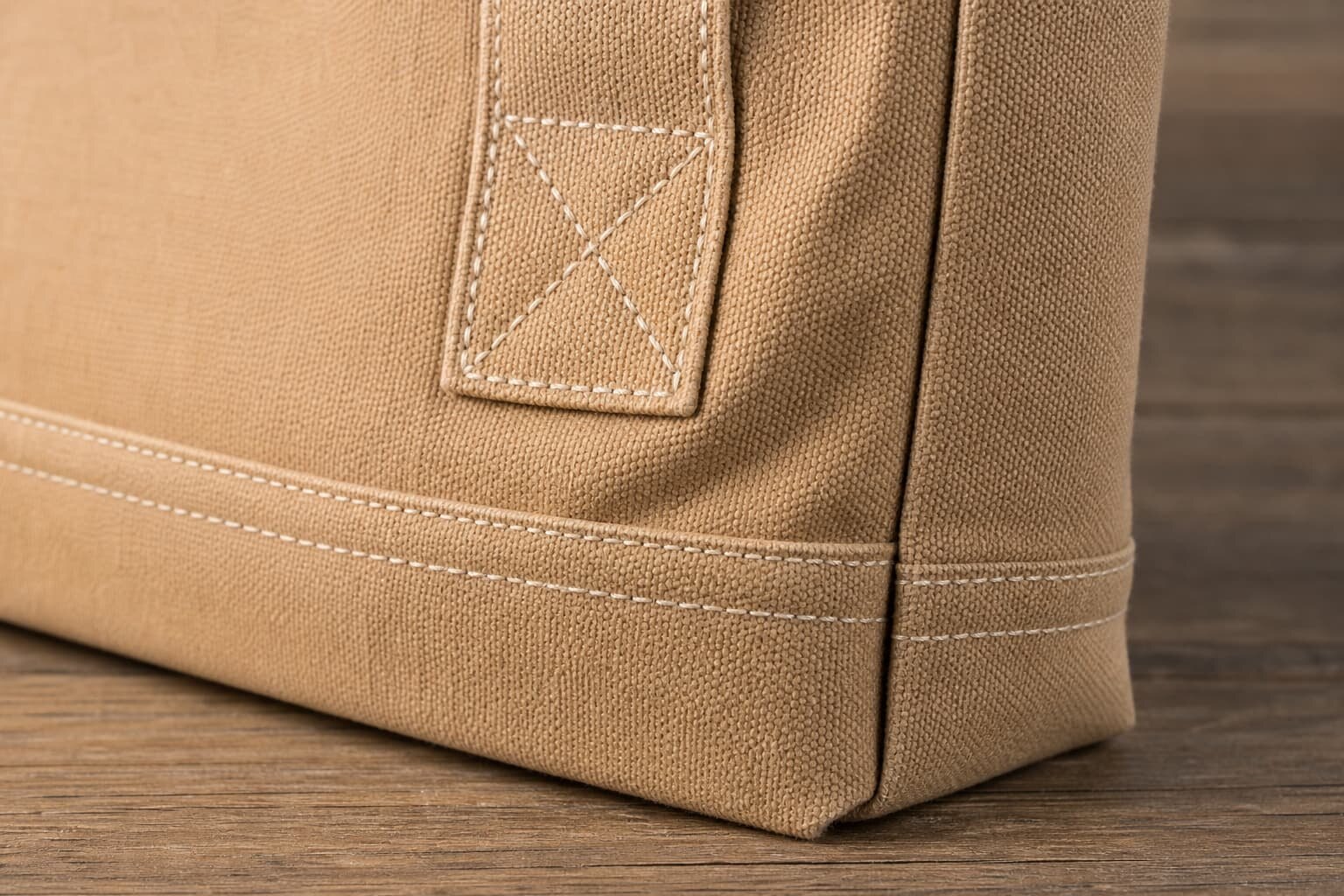
| Handle construction | Self-fabric canvas handles with cross-stitch reinforcement | Standard branded tote where strength and consistent appearance matter | Handle drop may shrink after sewing; check drop length, reinforcement pattern, and load test |
| Printing method | Screen print for 1-3 solid colors; heat transfer for gradients or small photographic details | Screen print for most logos; transfer when artwork has fine tones or many colors | Ink hand-feel, cracking, and color shift on natural canvas; approve print strike-off before bulk |
| MOQ setup | Start from fabric availability, print setup, and packing method instead of asking for one fixed MOQ | Importers comparing several designs, colorways, or retail pack options | Low MOQ can carry higher unit cost, substitute fabric, or batch color variation |
| Packing plan | Bulk pack in export carton with inner polybag only if needed for dust or retail handling | Distributor stock, online fulfillment preparation, or event delivery | Over-packing increases cost and waste; under-packing causes creases, moisture risk, and carton damage |
Buyer checklist before sampling
- Confirm the sample is made with the same fabric weight, weave, color, and shrinkage treatment intended for bulk production.
- Measure finished width, height, gusset, and handle drop on the sewn sample, not on a flat pattern drawing.
- Check handle reinforcement: box stitch or cross stitch should be centered, balanced, and free from skipped stitches.
- Review seam allowance, inside edge finishing, and thread color under good light before approving the counter sample.
- Rub the printed logo by hand and with a clean white cloth to check ink curing, crocking, and surface feel.
- Compare logo size, placement, and color against approved artwork and Pantone or physical print standard.
- Load the sample with a realistic weight for the intended use and inspect handle stress points after carrying.
- Ask the factory whether the sample was sewn by the bulk production line or by a sample technician only.
- Approve packing with actual fold method, carton quantity, carton size, gross weight, and any barcode or label position.
- Record all approved details in the purchase order: GSM tolerance, finished size tolerance, print tolerance, packing, and inspection level.
Factory quote questions to send
- What is the quoted fabric specification in oz and GSM, and what tolerance will apply in bulk production?
- Is the canvas greige, bleached, dyed, or pre-shrunk, and what shrinkage should we expect after washing or steaming?
- Are you quoting cut size or finished size, and what finished measurement tolerance do you recommend for this tote?
- Which print method is included in the price, how many colors are included, and what artwork file format do you need?
- Will you provide a fabric swatch, blank sample, printed strike-off, and pre-production sample before bulk production?
- What MOQ applies per fabric color, per print design, and per packing method?
- What is the sample lead time and the bulk lead time after deposit and final artwork approval?
- What stitch density, reinforcement pattern, and thread type are included in the quotation?
- What packing is included: individual polybag, bulk polybag, carton only, hangtag, barcode, or retail sleeve?
- Can you quote carton dimensions, quantity per carton, estimated gross weight, and loading quantity before order confirmation?
Quality-control points to confirm
- Fabric GSM should be checked by cutting and weighing fabric from the same batch used for production, not only by touching the finished bag.
- Finished dimensions should be measured after sewing and pressing, with separate tolerances for width, height, gusset, and handle drop.
- Stitching should be checked for skipped stitches, broken thread, uneven tension, loose backstitching, and seam puckering.
- Handle strength should be tested at both attachment points because failures usually occur at the reinforcement box, not the handle center.
- Print quality should be inspected for color accuracy, registration, edge sharpness, pinholes, ink bleeding, cracking, and poor curing.
- Natural canvas should be reviewed for acceptable slubs and shade variation so the buyer does not reject normal cotton characteristics later.
- Packing inspection should verify fold method, carton quantity, carton strength, humidity control, carton markings, and retail label placement.
- The approved sample should be sealed, signed, dated, and referenced in the purchase order as the comparison standard for bulk inspection.