1. Start With the Real Procurement Question, Not the Lowest Unit Price
Canvas tote bags look simple, which is why quote comparison can be misleading. A buyer may receive five prices for a “40 x 35 cm natural canvas tote with logo,” then assume the cheapest supplier is the most competitive. In practice, each factory may have quoted a different product: 8 oz instead of 10 oz canvas, shorter handles, one-side printing instead of two-side printing, bulk carton packing instead of retail packing, or a lead time that starts only after all approvals are complete.
For a B2B buyer, the goal is not to force every supplier into the same low number. The goal is to identify which quotation actually matches the selling channel, quality promise, delivery window, and landed-cost target. A promotional giveaway bag may justify a lighter fabric and simpler packing. A retail merchandise tote for a bookstore, grocery chain, apparel brand, or corporate program usually needs better fabric control, cleaner sewing, predictable printing, and clearer QC acceptance criteria.
The most useful quote comparison therefore turns every important assumption into a measurable line item. If a supplier cannot confirm fabric weight, seam type, print area, packing data, or inspection standard, the price is not yet comparable. It is only an estimate based on the supplier’s preferred assumptions.
- Do not compare quotes until fabric weight, size, handle, print, packing, MOQ, and lead-time start point are defined.
- Treat missing details as commercial risk, not as minor paperwork gaps.
- Compare FOB or EXW unit price together with packing volume, inspection requirements, and likely change costs.
- Use one controlled RFQ version for all shortlisted suppliers so the comparison is fair.
2. Normalize the Bag Specification Before You Send the RFQ
A strong RFQ does more than name the product. It describes the finished tote in enough detail that each supplier is pricing the same construction. Instead of writing “standard canvas tote bag,” define the finished width, height, gusset, handle drop, fabric weight, color, print method, seam construction, label requirement, packing style, and intended use. This reduces the chance that one factory quotes an economy promotional version while another quotes a retail-grade version.
Finished size is especially important because canvas bags are cut, sewn, folded, and sometimes washed or pressed. A small difference in dimensions can change fabric consumption and carton volume. Handle length also changes both comfort and fabric usage. A short hand-carry handle may be cheaper than a shoulder-length handle, but it may not meet the buyer’s use case. If the tote must carry books, bottles, groceries, event kits, or apparel, write that into the RFQ so the supplier can select a practical seam and reinforcement method.
The same rule applies to labels and accessories. A woven side label, care label, hangtag, barcode sticker, insert card, snap button, zipper, inside pocket, or bottom gusset may look minor in a product photo, but each item changes sourcing, sewing time, inspection, and packing work.
- Size example: 38 cm W x 42 cm H, no gusset, finished tolerance plus or minus 1 cm.
- Gusset example: 10 cm bottom gusset for grocery or book use, boxed and aligned at side seams.
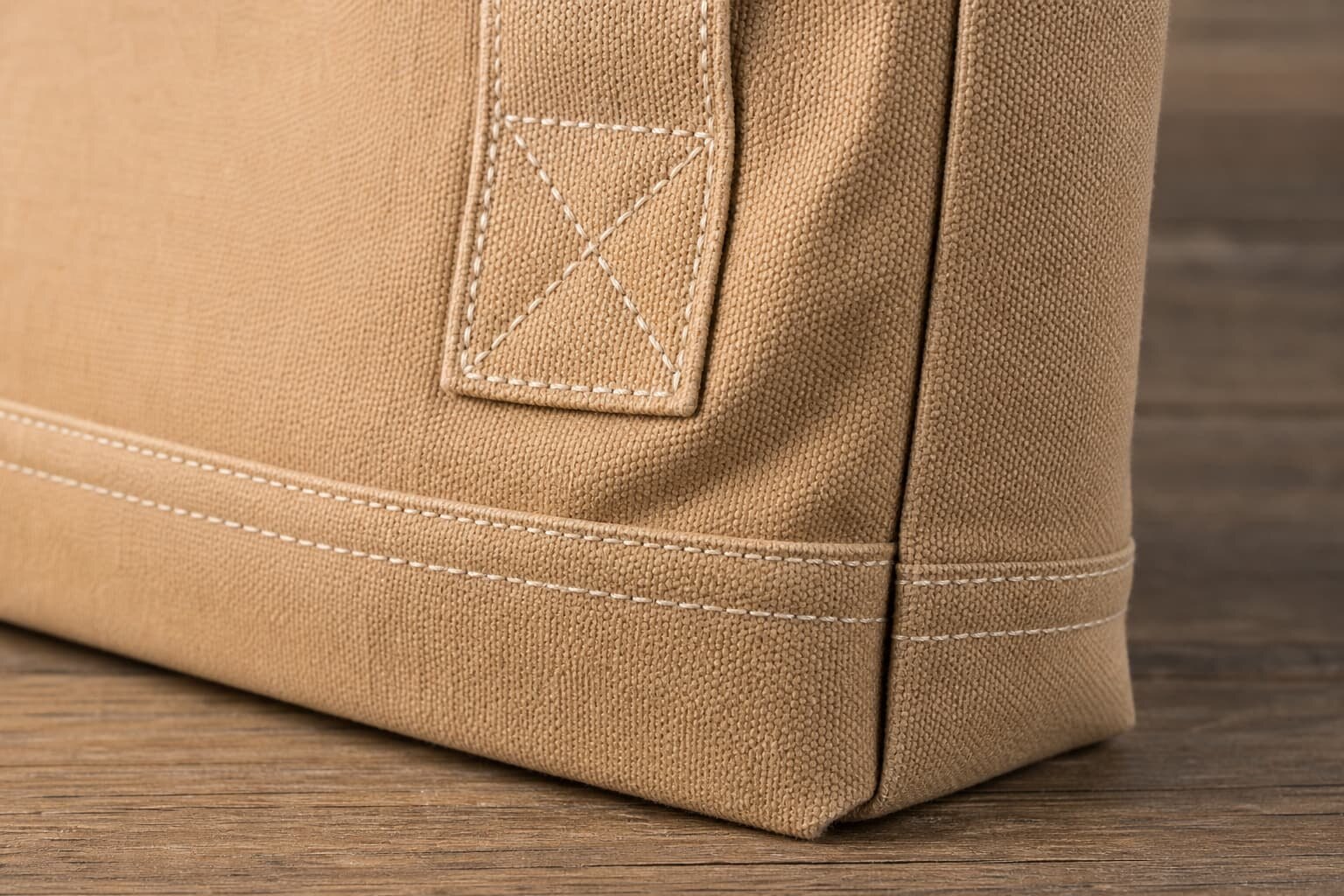
- Handle example: self-fabric handles, 2.5 cm finished width, 60 cm total length, reinforced with cross-stitch and back-tack.
- Construction example: inside overlock seam for economy or bound seam for premium retail appearance.
- Use example: reusable retail tote for books and apparel, not single-day event handout.
3. Fabric Weight: The Biggest Source of Hidden Price Gaps
Fabric is usually the largest cost driver in wholesale canvas tote bags. A quote for 8 oz canvas should not be treated as equivalent to a quote for 10 oz or 12 oz canvas, even if the bag size and logo are identical. Heavier canvas uses more cotton, can require slower sewing, increases carton weight, and may increase freight cost. It also affects hand feel, perceived value, durability, and how the bag folds in packing.
Buyers should ask for both oz and GSM, but they should also understand that conversions are approximate and supplier-dependent. Mills may refer to greige fabric weight before finishing, finished fabric weight after processing, or dyed/washed fabric weight after shrinkage and finishing. This is why two suppliers can both say “10 oz” while delivering fabrics with different weight, thickness, and hand feel. If the fabric weight is important for retail claims or customer experience, require a swatch, mill specification, or approved sample before bulk production.
A practical way to compare quotes is to create fabric scenarios. For an event giveaway, 6-8 oz canvas may be enough if the bag only needs to hold brochures or light merchandise. For a standard reusable shopping tote, 10 oz is often a more balanced choice. For premium retail, lifestyle merchandise, or heavier carry use, 12-16 oz may be appropriate. These ranges are common working references, not universal standards, so the final decision should be based on the supplier’s actual fabric, sample, and test results.
- Ask whether the fabric is 100% cotton canvas, recycled cotton blend, organic cotton, or cotton-poly blend.
- Confirm whether the quoted color is natural, bleached, dyed, washed, stonewashed, brushed, or otherwise finished.
- Set a fabric weight tolerance, such as plus or minus 5%, if fabric weight affects the product claim or sales channel.
- For dyed canvas, approve a lab dip before bulk dyeing and check whether each color has a separate MOQ.
- Do not compare an 8 oz bulk-packed promotional quote with a 12 oz retail-packed quote without adjusting for quality and landed cost.
4. Printing: Compare Setup, Print Area, Color Count, and Risk
Logo printing can make two similar tote quotes very different. A one-color screen print on one side is usually much simpler than a large two-side design, a multi-color registration print, a dark-fabric print requiring an underbase, or a full-color heat transfer. Print area changes ink consumption, screen size, drying time, handling, and rejection risk. If the RFQ says only “logo print,” the factory may quote the lowest reasonable assumption rather than the artwork you actually need.
Screen printing is often practical for solid logos, slogans, and repeat wholesale orders. It can be cost-efficient when color count is limited and artwork is stable. Heat transfer or digital printing may fit full-color graphics, gradients, photos, or smaller programs, but buyers should evaluate hand feel, edge marks, folding behavior, and rub resistance. On natural canvas, fabric texture may reduce sharpness compared with smooth fabric. On dyed canvas, ink opacity and color matching can be harder, especially with light ink on dark fabric.
Procurement teams should separate print cost into setup cost, running cost, and approval risk. A supplier with a slightly higher unit price but a clear print strike-off process may be safer than a supplier that includes “printing” without describing ink type, maximum print area, or color tolerance.
- State print size in centimeters, for example 22 cm W x 18 cm H, instead of sending only an artwork file.
- Define print position, such as centered and 10 cm below top edge, with an agreed tolerance such as plus or minus 0.5-1 cm.
- Provide Pantone references when color matching matters, and specify whether close commercial matching is acceptable.
- Ask whether screens, films, artwork handling, strike-off samples, and extra print rejects are included or separate.
- For two-side printing, confirm whether the quoted price includes both sides and whether the second side uses the same or different artwork.
5. Sewing Construction and Handles Determine Durability
Sewing details are easy to overlook because many canvas totes look similar in photos. In bulk production, however, seam type, thread, stitch density, reinforcement, trimming, and pressing all affect labor cost and durability. A simple overlocked inside seam is faster and cheaper than a bound seam. A flat tote is simpler than a boxed gusset tote. A tote with lining, zipper, pocket, label, or snap closure requires more operations and more inspection points.
Handle construction deserves special attention. Handles are the highest-stress part of most tote bags. A low quote may use narrower handles, shorter handle length, fewer stitches, weaker back-tack, or smaller reinforcement patches. For light promotional use, this may be acceptable. For grocery, bookstore, corporate gift, or retail merchandise use, handle reinforcement should be visible, symmetrical, and tested.
A measurable sewing specification helps prevent disputes. Instead of saying “strong stitching,” state the seam type, stitch density range, seam allowance, reinforcement pattern, and load-test requirement. The factory can then quote the actual labor and machine setup needed.
- Economy construction: overlock inside seams, flat body, no lining, self-fabric handles, simple reinforcement.
- Standard reusable construction: overlock or folded seam, cross-stitch handle reinforcement, consistent stitch density, trimmed threads.
- Premium construction: bound seams, boxed gusset, heavier canvas, inside pocket, woven label, hangtag, and cleaner pressing.
- Practical stitch density target: about 7-10 stitches per inch for many canvas tote constructions, adjusted by fabric weight and thread.
- Confirm whether label sewing, care tag, hangtag stringing, snap button, zipper, or pocket work is included in the quoted unit price.
6. MOQ and Price Breaks: Compare the Real Minimums
MOQ is rarely just one number. Canvas tote bag minimums may depend on fabric color, fabric weight, dyeing batch, print design, print method, bag size, label, and packing style. A factory may accept 1,000 pieces for natural canvas with one artwork but require 1,000 pieces per dyed color. If a buyer orders five colors at 400 pieces each, the total quantity may look acceptable, but the production setup may not be efficient for the factory or the dyeing mill.
Price breaks should match real buying scenarios. Asking for 1,000, 3,000, 5,000, and 10,000 pieces per design is more useful than asking for a single best price. At lower quantities, setup charges, sample work, fabric cutting loss, print preparation, and packing setup are spread over fewer units. At higher quantities, the unit price may improve, but carton volume, inspection workload, and inventory exposure also increase.
For repeat programs, ask whether the factory can hold screens, patterns, approved samples, or surplus fabric. This can reduce restart time, but it should be documented. Fabric held for too long may change shade, collect moisture, or become unavailable for exact replenishment if the mill changes batches.
- Ask MOQ per fabric color, not only total order quantity.
- Ask MOQ per artwork, print color count, and print method.
- Ask whether mixed sizes can share a fabric MOQ if the fabric and color are the same.
- Request price breaks at quantities that match your buying plan and warehouse capacity.
- Confirm whether repeat-order pricing assumes unchanged artwork, unchanged fabric, and the same packing method.
7. Packing Data Can Change the Landed Cost More Than Expected
Packing is one of the most common reasons a low unit price becomes less attractive after freight calculation. Bulk flat packing is efficient for distributors that repack locally. Retail or fulfillment orders may require individual polybags, recycled polybags, paper bands, insert cards, barcode labels, hangtags, carton labels, carton marks, and maximum carton weight limits. These requirements add material, labor, inspection, and sometimes more carton volume.
Canvas tote bags are not fragile, but they can be bulky, especially when made from 12 oz or heavier canvas, with gussets, structured handles, or individual packing. A quote for 5,000 pieces may look cheaper by a few cents per unit, but if the carton CBM is materially higher, the landed cost may be worse. This is why procurement teams should compare carton dimensions, pieces per carton, gross weight, net weight, and total CBM together with FOB or EXW pricing.
Bulk versus individual packing is a practical example. Bulk packing may reduce factory cost and freight volume, but it may create repacking work, barcode application, and extra handling at destination. Individual packing may cost more at origin, but it may reduce downstream labor if the bags go directly into retail or e-commerce fulfillment. The better option depends on the full supply chain, not the factory price alone.
- Request pieces per carton, carton size, net weight, gross weight, and estimated total CBM for each quote scenario.
- Define folding method if crease location affects retail presentation or print appearance.
- Confirm whether individual polybags, recycled polybags, paper bands, insert cards, hangtags, and barcode labels are included.
- Check carton mark format, carton label placement, export carton quality, and maximum carton weight for warehouse handling.
- For long ocean shipments or humid routes, discuss inner liner, desiccant, storage conditions, and moisture inspection before shipment.
8. Sampling Should Close Specification Gaps Before Bulk Cutting
Sampling is not just a design preview. It is the stage where the supplier proves that the quote can become a controlled bulk product. A proper pre-production sample should confirm fabric weight, fabric color, sewing construction, handle length, print color, print position, label placement, folding method, and packing. If a sample is made from available stock fabric but bulk production will use newly dyed fabric, that difference must be recorded so the buyer does not approve the wrong reference.
Quote comparison should include sample charges, sample lead time, courier cost, and whether the charge is refundable after bulk order. More important, buyers should define what sample approval means. If the sample approval only covers the general look, the factory may still treat dimensions, fabric weight, print tolerance, or packing as flexible. For a retail or distributor order, the approved sample should be a control sample used by both buyer and factory QC.
A sample comment sheet is useful because it converts subjective feedback into action. For example, “make handle stronger” is weak. “Increase handle width to 2.5 cm finished, keep 60 cm total length, use cross-stitch reinforcement 3 cm x 3 cm, and back-tack at top seam” is much clearer and easier to inspect.
- Approve lab dip before dyed bulk fabric, unless the approved sample is already made from the actual bulk dye lot.
- Keep one signed or clearly identified approved sample with the factory and one with the buyer if possible.
- Close all sample comments before bulk cutting, especially fabric, print size, handle drop, and packing.
- Approve a print strike-off when artwork color, edge sharpness, or registration matters.
- Do not treat a photo-only approval as equal to a physical sample approval for high-value retail orders.
9. Lead Time Must Be Compared by Approval Gate
A quoted lead time such as 25 days or 35 days is only useful when the buyer knows when the clock starts. Some factories count from deposit receipt. Others count from artwork confirmation, sample approval, lab dip approval, fabric arrival, or final packing confirmation. If the quote does not define the start point, it may be optimistic rather than operational.
Lead time also depends on the specification. A natural canvas tote with one-color screen print and bulk packing may move quickly because fabric is easier to source and printing is simple. A dyed 12 oz tote with two-side print, individual packing, barcode labels, and retail carton marks requires more approval steps. Lab dips, print strike-offs, pre-production samples, buyer comments, internal approval meetings, and courier transit can add days or weeks before bulk production even begins.
Importers should build the schedule backward from the required warehouse arrival date. Include supplier production, final inspection, corrective action time if needed, export documentation, vessel or air booking, customs clearance, domestic transport, and receiving time. If delivery is tied to a campaign, store launch, conference, or retailer appointment, the quote comparison should score schedule reliability as heavily as unit price.
- Ask for separate timing for fabric sourcing or dyeing, cutting, printing, sewing, QC, packing, and export handover.
- Clarify whether lead time starts after deposit, artwork approval, lab dip approval, sample approval, or material arrival.
- Add buffer for courier sample transit and buyer internal approval, especially when several departments must sign off.
- For peak season, ask whether sewing and printing capacity is reserved after deposit or only after sample approval.
- For repeat orders, confirm whether screens, cutting patterns, carton marks, and control samples are retained.
10. Use a Decision Framework to Shortlist Suppliers
The final supplier shortlist should be based on comparable value, not simply the lowest unit price. A strong quote is complete, measurable, and connected to the buyer’s channel. It identifies fabric, dimensions, print, sewing, packing, MOQ, lead time, sample process, and QC criteria. It also separates included and excluded charges so procurement can calculate landed cost and avoid late-stage changes.
A useful decision framework has three layers. First, reject quotes that do not match mandatory requirements, such as fabric weight, delivery date, print method, or retailer packing rules. Second, normalize the remaining quotes by adding missing charges and freight-impact data. Third, score supplier risk: responsiveness, technical clarity, sample quality, QC cooperation, packing accuracy, and willingness to provide production evidence.
If two suppliers are close in cost, choose the one that reduces uncertainty. The supplier that can explain why 12 oz canvas changes carton CBM, why individual packing changes labor, or why a print underbase is needed on dark canvas is often easier to manage than the supplier that only repeats a low price. For B2B procurement, the best canvas tote bag quote is the one your team can approve, inspect, ship, and sell without hidden assumptions.
- Create comparison columns for fabric oz/GSM, composition, color process, dimensions, tolerances, handle details, seam type, print method, packing, MOQ, and lead-time start point.
- Add separate cost columns for unit price, setup, sample, lab dip, packing, barcode, carton, inspection, inland freight, and estimated freight impact from CBM.
- Mark each missing detail as a risk item before negotiation, not after sample approval.
- Shortlist suppliers that provide complete technical answers, realistic lead times, and measurable QC cooperation.
- Award the order only after the specification, sample process, inspection criteria, packing data, and payment/shipment milestones are documented.
Specification comparison for buyers
| Quote scenario | What changes in the quote | Typical cost impact to evaluate | Buyer check before approval |
|---|---|---|---|
| 8 oz natural canvas, one-side one-color screen print, bulk carton packing | Economy fabric, simple artwork, minimal packing labor, lower carton volume | Lower unit price and lower freight volume, but less structure and lower perceived retail value | Confirm this is acceptable for event giveaway or light daily use; do not compare directly with 10 oz or 12 oz retail totes |
| 10 oz natural canvas, one-side screen print, reinforced handles, bulk flat packing | Standard reusable tote specification with better hand feel and stronger carry points | Moderate unit price; usually a practical balance for bookstore, grocery, corporate, and distributor orders | Confirm finished fabric weight, handle drop, cross-stitch size, stitch density, and carton CBM |
| 12 oz dyed canvas, two-side screen print, individual polybag | Heavier fabric, dyeing process, more print handling, added packing material and labor | Higher fabric cost, higher reject risk, higher carton weight, and more CBM for freight planning | Compare landed cost, not only FOB price; require lab dip, print strike-off, and pre-production sample |
| 14-16 oz premium canvas with gusset, bound seams, hangtag, barcode, retail carton marks | Premium construction and retail-ready packing with more sewing time and inspection points | Highest unit cost among common tote options; may reduce repacking work at destination | Confirm seam finish, needle/thread strength, label placement, carton label format, and retailer compliance needs |
| Low MOQ mixed-color order | Multiple fabric colors or artwork versions split across a small total quantity | Setup, dyeing, printing, and line-change costs are spread over fewer pieces | Ask MOQ per color, per artwork, per print method, and per packing style before accepting the price break |
| Bulk packing versus individual packing | Same bag, different folding, polybag/paper band, barcode, insert card, and carton arrangement | Individual packing can increase labor, material, inspection time, carton volume, and fulfillment readiness | Request pieces/carton, carton size, gross weight, total CBM, barcode cost, and packing sample photo |
Buyer checklist before sampling
- Define finished bag width, height, gusset depth, handle drop, and size tolerance instead of using only a rough capacity description.
- Specify canvas weight in both oz and approximate GSM, and state that values may vary by mill standard; require the supplier to say whether weight is greige, finished, dyed, or washed fabric weight.
- Identify composition clearly: conventional cotton, recycled cotton blend, organic cotton, cotton-poly blend, or another fabric blend.
- Confirm fabric color standard: natural, bleached, dyed Pantone reference, lab dip, or approved sample; include acceptable shade tolerance if retail consistency matters.
- List handle material, finished handle width, total handle length or drop, reinforcement method, and expected loading use.
- Define print method, print size, number of colors, print location, ink type, artwork file format, Pantone references, and one-side or two-side printing.
- Separate product unit price from screen/tooling charges, sample charges, lab dip charges, packing charges, barcode charges, inspection charges, inland freight, and export document costs if applicable.
- Ask for MOQ by fabric color, bag size, print design, print method, and packing style, not only total order quantity.
- Require a pre-production sample approved for fabric, sewing, dimensions, print color, print placement, handle length, label position, and packing before bulk cutting.
- Compare carton dimensions, pieces per carton, gross weight, net weight, estimated CBM, and pallet/loading assumptions to calculate landed cost.
Factory quote questions to send
- Is the quoted canvas weight based on greige fabric, finished fabric, dyed fabric, or washed fabric, and what is the approximate GSM equivalent?
- What is the exact fabric composition, yarn count or weave description if available, and finishing process for the quoted canvas?
- What weight tolerance can you control for bulk fabric, for example plus or minus 5%, and how will it be verified?
- What MOQ applies per fabric color, per print design, per bag size, per print method, and per packing method?
- Which print method is included in the unit price, what is the maximum quoted print area, and are one side or two sides included?
- Are screen charges, film charges, sample charges, lab dip charges, cutting mold charges, artwork handling charges, barcode charges, and carton mark charges included or separate?
- What seam construction is included: overlock, bound seam, French seam, boxed gusset, bottom reinforcement, lining, pocket, zipper, or label sewing?
- What handle reinforcement is included, what stitch pattern is used, and what loading test can the factory perform before shipment?
- What are the packing details: bulk flat pack, individual polybag, recycled polybag, paper band, insert card, master carton quantity, carton size, carton mark, and gross weight?
- What AQL inspection level do you normally accept for tote bags, and can you follow a buyer-specific checklist?
Quality-control points to confirm
- Use a written inspection plan, commonly AQL General Inspection Level II with critical defects 0, major defects 2.5, and minor defects 4.0 unless the buyer sets another standard.
- Check finished width, height, gusset, handle drop, handle width, and print position against the approved tolerance sheet; common tote tolerances are about plus or minus 1 cm for bag dimensions and plus or minus 0.5 cm for handle width/drop, but tighter retail tolerances should be agreed before production.
- Verify fabric weight by cutting and weighing a measured fabric area or by using an agreed mill test report; set an acceptable bulk tolerance such as plus or minus 5% when fabric weight is part of the commercial claim.
- Inspect canvas shade under consistent lighting and compare bulk fabric with approved lab dip or production sample; record shade lot differences before cutting mixed-color orders.
- Check stitch density, seam allowance, skipped stitches, loose threads, back-tack quality, and handle reinforcement symmetry; a practical target for many canvas totes is about 7-10 stitches per inch, adjusted for fabric weight, thread, and machine setup.
- Perform a load test based on intended use, such as hanging the bag with 10 kg for 30 minutes for standard retail totes or a buyer-specified higher load for grocery/book use; check handle tearing, seam slippage, and fabric distortion after the test.
- Test handle attachment with a pull check or static load check on sampled pieces, especially when the quote uses long shoulder handles or heavy canvas.
- Check print adhesion and appearance using dry and wet rub tests on sampled prints, such as 10 back-and-forth rub cycles with white cotton cloth, then review staining, ink lift, cracking, and edge loss against the approved sample.
- For washable or repeat-use claims, agree on a simple wash or soak method before ordering; for example, one gentle wash cycle or hand-wash simulation followed by inspection for print cracking, color bleeding, and shrinkage.
- Confirm packing count per carton, barcode placement, carton mark, moisture protection, polybag or paper band quality, carton strength, and carton sealing before shipment release.