Start with the commercial problem, not the tote photo
Wholesale canvas tote bag quotes often look comparable on the first page of a supplier email. The line may say natural canvas tote, logo print, bulk pack, FOB price. In production terms, that description can hide major differences: 8 oz versus 10 oz fabric, no gusset versus bottom gusset, small logo versus large front print, basic handle stitching versus reinforced handles, bulk packing versus individual retail packing, and EXW price versus FOB export price.
Procurement teams get better outcomes when they treat the RFQ as a normalization exercise. The purpose is not simply to find the lowest unit price. The purpose is to make each supplier price the same product, under the same commercial terms, with the same approval path and the same shipment responsibilities. Once the quotes are aligned, a higher price may be justified by stronger material, better print testing, lower rework risk, shorter lead time, or more complete packing data. Without that alignment, the lowest quote may only be the least complete quote.
A good comparison file should show what is included, what is excluded, and what must be confirmed before deposit. This is especially important for canvas totes because buyers often use them for brand campaigns, retail resale, corporate gifts, trade shows, bookstore merchandise, subscription kits, or distributor stock. A tote is simple in shape, but the brand risk is visible: weak handles, dirty fabric, crooked print, wrong shade, and crushed cartons are easy for end users to notice.
- Normalize the technical spec before negotiating price.
- Separate unit price from setup charges, sample costs, packing costs, inland freight, and export charges.
- Ask every supplier to quote the same Incoterm, currency, quantity break, and lead-time start point.
- Treat missing carton data, print data, or sample basis as a quote gap, not a small detail.
- Use approved physical references when fabric hand-feel, color, and print finish matter.
Build one specification sheet suppliers cannot interpret three ways
The strongest RFQ begins with a specification sheet that describes the finished tote in measurable terms. A photo is useful for style direction, but it is not enough for procurement. The factory needs finished width, height, gusset, handle size, seam construction, fabric weight, print method, print location, packing, and tolerance expectations. If these details are missing, each supplier fills the blanks with its own default method, and the quotes stop being comparable.
For size, write width x height x gusset and define whether measurements are taken flat, after ironing, or after washing if washing is part of the process. For handles, list full handle length, handle drop, width, material, and whether the bag must fit comfortably over the shoulder. For construction, say whether the buyer expects self-fabric handles, cotton webbing handles, cross-stitch reinforcement, bar tack, bound seams, overlock seams, inner pocket, magnetic snap, zipper, lining, or label. Each additional feature changes fabric consumption, labor time, and inspection complexity.
The spec should also include buyer priorities. If the tote is for a one-day event, cost and speed may be more important than a premium seam finish. If it is sold in a museum shop or retail chain, fabric hand-feel, print clarity, inside finishing, packaging, and carton labeling become more important. Telling the supplier the use case helps them recommend practical alternatives instead of guessing.
- Finished dimensions: width, height, gusset, and tolerance.
- Fabric: composition, weave, weight range, color, finish, and certification needs if any.
- Handles: length, drop, width, material, attachment, and reinforcement.
- Sewing: seam type, stitch density if required, thread color, trimming, and inside finish.
- Branding: artwork file, Pantone references, print size, location, method, and number of positions.
- Packing: folding, polybag, hangtag, barcode, carton count, carton mark, and carton weight limit.
Fabric weight, finish, and color drive more cost than buyers expect
Canvas tote fabric is commonly described by ounces or GSM, but buyers should treat those numbers as planning references until the supplier confirms the actual fabric. As a general sourcing example, 6 oz to 8 oz canvas may suit lightweight event giveaways, 10 oz canvas often works for standard branded reusable totes, and 12 oz canvas is common for heavier, more premium programs. The exact GSM equivalent varies by mill, weave, yarn, finishing, and measurement basis, so the quote should state the supplier's actual range instead of relying only on a familiar market name.
The finish matters as much as the number. Natural unbleached canvas usually supports more flexible MOQ and shorter preparation time than custom dyed fabric. Bleached canvas can give a cleaner base for bright prints but may cost more and require better stain control. Dyed canvas adds shade approval, dye-lot minimums, potential crocking concerns, and sometimes longer lead time. Washed canvas changes hand-feel and shrinkage behavior. Organic or recycled claims may require documentation, and procurement should confirm whether certification applies to fiber, fabric, factory process, transaction certificate, or only a supplier statement.
When comparing quotes, ask for a swatch before approving price assumptions. A buyer may discover that one supplier's 10 oz feels stiff and dense while another feels softer or looser. Neither is automatically wrong, but the difference affects perceived quality, print coverage, and how the bag folds into cartons. If the tote will carry books, bottles, or retail goods, do not select the lightest option without checking handle strength and seam performance.
- Budget event tote: often 6-8 oz canvas, subject to supplier confirmation and sample approval.
- Standard branded tote: often around 10 oz or roughly 280-300 GSM as a planning range.
- Premium daily-use tote: often around 12 oz or roughly 340-360 GSM as a planning range.
- Natural canvas is usually easier for MOQ than custom dyed canvas.
- Custom dyeing needs lab dip approval, shade tolerance, and dye-lot minimum confirmation.
- Ask whether fabric weight is quoted before finishing, after finishing, or as a market description.
Construction details reveal why two similar bags are not the same quote
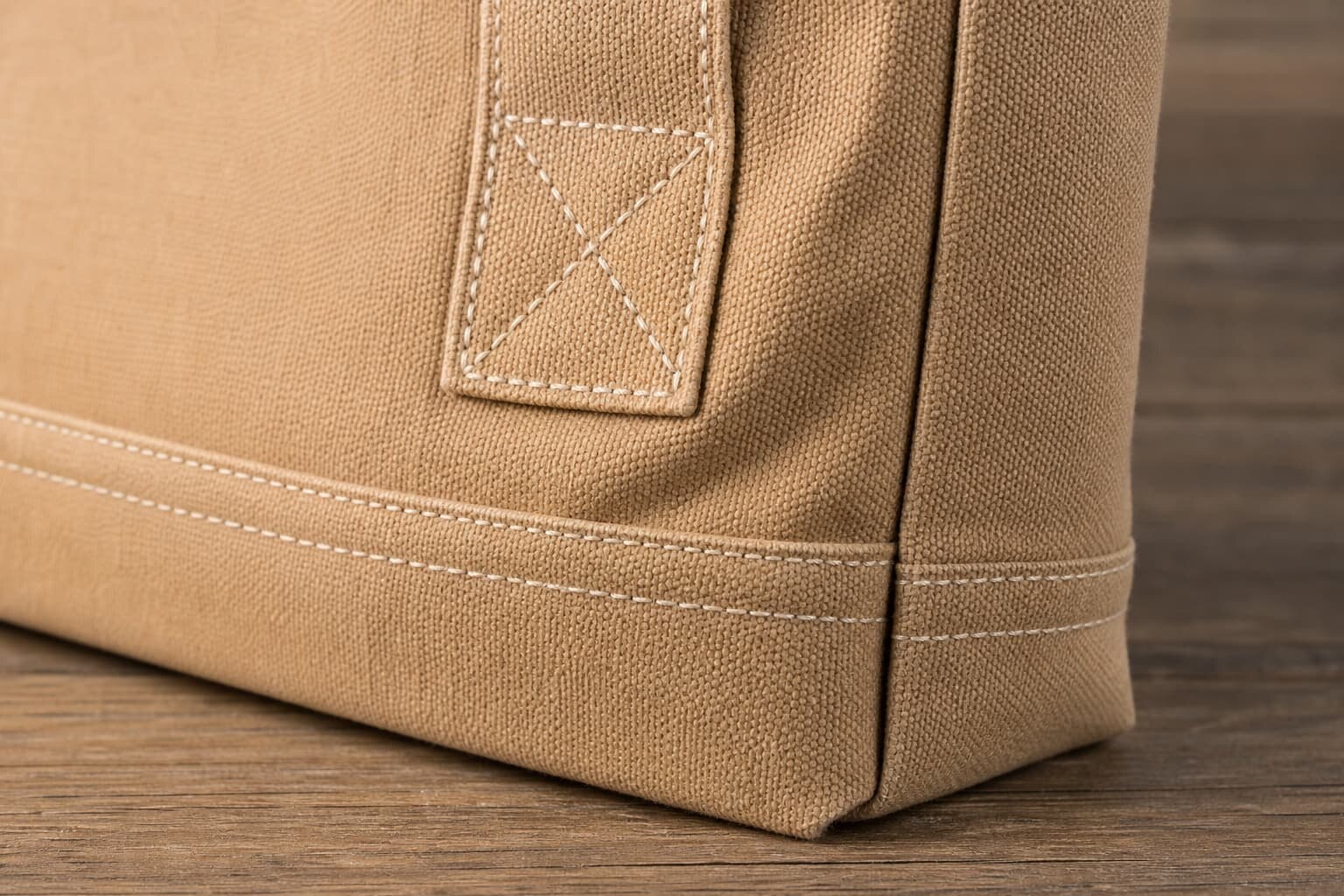
Front-view photos hide a lot of cost. A tote with narrow handles, fewer stitches, and basic overlock seams may look close to a better-made tote in a small product image. In use, the difference is clear. Handles twist, seams fray, corners pull, and the bag loses shape. For B2B buyers, these failures create customer complaints, retail returns, or wasted campaign stock. Construction details deserve the same attention as fabric weight.
Handle design is one of the largest variables. Self-fabric handles use the same canvas as the bag body and can look cohesive, but they require cutting, folding, stitching, and reinforcement. Cotton webbing handles may be efficient and strong, but they change the look and sourcing basis. Wider handles feel more comfortable and premium but use more material. Longer shoulder handles increase consumption and carton bulk. Reinforcement can be cross-stitch, box stitch, bar tack, or another factory method; the buyer should see photos and approve the sample, not rely on the word reinforced.
Inside finishing also affects the quote. Overlock seams are common for cost-sensitive bulk totes and can be perfectly acceptable when done cleanly. Bound seams look neater and can reduce fraying, but they add labor and material. A gusset creates more capacity but uses more fabric and changes sewing steps. Inner pockets, zippers, snaps, labels, and hangtags add value but should be quoted line by line so procurement can decide what is necessary.
- Ask for photos of inside seams, not only front-panel product images.
- Define handle drop if shoulder carry is required, because full handle length alone can be misleading.
- Specify reinforcement pattern and acceptable workmanship for handle attachment.
- Separate optional features such as pocket, zipper, snap, lining, label, and hangtag in the quote.
- Check whether thread color should match fabric, match print, or contrast intentionally.
Choose the print method before comparing the price
Logo printing can change the unit cost as much as fabric. Screen printing is often suitable for one to three solid colors, strong logo blocks, simple slogans, and repeat programs. The quote should state print size, number of colors, number of locations, screen charges, setup fees, ink type if relevant, and whether a strike-off is included. A one-color 12 cm logo on one side cannot be compared with a two-color 28 cm front print and back print.
More detailed artwork may require heat transfer, DTF, DTG, embroidery, woven labels, or a combination. These methods can be useful, but each has risk. Transfers may feel heavier or plastic-like if the film is poor or pressing is not controlled. Fine artwork may lose detail on coarse canvas. Embroidery can look premium but may pucker lighter fabric and is usually priced by stitch count or design complexity. Digital methods may need fabric pretreatment and closer testing. The buyer should request a print strike-off on the actual fabric, not only a digital proof on screen.
Print position also needs measurable approval. Define distance from top seam, horizontal centering, print width and height, and tolerance. For retail programs, buyers may also specify rub resistance, wash expectation if applicable, and color tolerance. Pantone references help, but ink appearance can shift on natural, bleached, dyed, or textured canvas. The approved strike-off becomes the real reference.
- Screen print: strong option for solid logos and efficient repeat production.
- Heat transfer or DTF: useful for gradients or many colors, but test adhesion and hand-feel.
- Embroidery: premium appearance, but check puckering, stitch count, and backing.
- Woven label: consistent branding for repeat programs and subtle retail details.
- Always define print size, location, colors, setup charges, and strike-off approval.
- Approve print on the final fabric color, not only on white paper or a digital mockup.
MOQ logic should be negotiated by cost driver
MOQ is often treated as a fixed number, but it is usually a bundle of manufacturing constraints. A factory may set MOQ because fabric is bought by roll, dyeing has a minimum vat size, screens require setup, cutting tables are planned by batch, sewing lines need efficiency, or packing materials must be ordered in minimum quantities. Natural canvas with a standard size and one print location may support a lower MOQ than a custom dyed tote with gusset, two-sided print, and individual barcode packing.
Instead of asking only for the lowest MOQ, procurement should ask which part of the specification creates the minimum. If fabric color is the issue, the buyer may choose natural canvas or stock color. If print setup is the issue, the buyer may pay a separate setup charge or reduce the number of colors. If cutting efficiency is the issue, a standard size may help. If packing is the issue, bulk pack may reduce the minimum. This conversation turns MOQ from a yes-or-no barrier into a cost decision.
Low MOQ can be useful for pilots, events, and new retail concepts, but it should not hide cost. A supplier may quote a low minimum with higher unit price, fabric surcharge, shared dye-lot risk, or separate sample and setup fees. That can be acceptable if the buyer is testing demand, but it should be visible in the comparison sheet. For repeat programs, ask about price breaks at 500, 1,000, 3,000, 5,000, and 10,000 pieces, and confirm whether screens, patterns, or labels can be reused.
- Ask for MOQ by fabric, dyeing, printing, sewing, and packing where relevant.
- Request quantity breaks so the buyer can see where the cost curve improves.
- Ask what changes if order quantity drops below MOQ: surcharge, fabric substitution, longer lead time, or setup fee.
- Use standard fabric, standard size, and fewer print positions when MOQ is the main constraint.
- For repeat orders, confirm whether previous screens, approved swatches, labels, and cartons can be reused.
Sample approval must match the bulk-production assumption
Samples are often where quote discipline breaks down. A factory may send an existing tote to show workmanship, a mockup with substitute fabric, or a digitally printed sample when bulk will be screen printed. Those samples can be useful at early development stages, but they should not be treated as final approval unless they match the production basis. The pre-production sample should use the intended fabric, color, construction, handle method, print method, trims, labels, and packing approach as closely as possible.
Procurement should define the sample path in the RFQ. A practical sequence is fabric swatch or lab dip, artwork review, print strike-off, pre-production sample, buyer approval, then bulk cutting. For simple natural canvas totes, the process may be shorter. For custom dyed canvas, special print methods, retail packaging, or strict brand color control, the process needs more gates. The quote should say which sample costs are included, which are refundable, how many revisions are allowed, and who pays courier charges.
Sample approval should include measurement and documentation. Measure the bag flat, record dimensions, compare fabric hand-feel, inspect inside seams, check handle comfort, rub the print, fold the bag as packed, and photograph details. Keep one sealed approved sample with the buyer and one with the factory. If a third-party inspection is planned, the inspector should receive the final spec sheet and approved sample references.
- Approve swatch or lab dip before bulk fabric purchase when color matters.
- Request print strike-off before approving full production for large logos or special print methods.
- Use a pre-production sample made with final fabric and final print method whenever possible.
- Record approved tolerances for size, print position, color, and workmanship.
- Seal and label approved samples with date, item code, version, and buyer sign-off.
- Do not let bulk cutting start until sample exceptions are written and accepted.
Packing, cartons, and freight data belong in the quote
Packing is not a back-office detail; it affects product condition, freight cost, warehouse handling, and customer presentation. Bulk pack is usually economical for promotional distribution, events, and distributor stock. Individual polybagging may be necessary for retail, e-commerce, clean storage, or barcode control, but it adds material, labor, carton volume, and sometimes destination compliance requirements. Buyers trying to reduce plastic should state that requirement early so the factory can suggest paper bands, belly bands, recycled polybags, or bulk alternatives if appropriate.
Carton data should be requested before purchase order approval. Ask for pieces per carton, carton dimensions, gross weight, net weight, total CBM, carton mark, inner packing, and folding method. For planning purposes, suppliers may use common carton quantities such as 50 to 100 pieces depending on tote size, fabric weight, and packing method, but procurement should treat those as examples until the supplier confirms the actual carton plan. Heavy 12 oz bags, gussets, stiff handles, individual bags, and hangtags all affect carton size and weight.
Folding is especially important when the logo covers a large front area. A hard fold through the print may create a crease, pressure mark, or cracking risk depending on the ink or transfer method. Ask the factory to show packed-sample photos and confirm whether the logo will be folded inward or outward. If cartons will go to a retail distribution center, label placement, barcode format, master carton limits, and carton strength should be specified before the quote is final.
- Bulk pack reduces cost and material use for many B2B programs.
- Individual polybagging improves cleanliness and scan control, but increases cost and volume.
- Ask for total CBM so freight and landed cost can be estimated.
- Set maximum carton weight if the buyer warehouse or carrier has handling limits.
- Define carton marks, barcode labels, hangtags, inner pack, and pallet requirements early.
- Confirm folding method before approving large front prints or heat transfers.
Quality control should be written before production starts
Canvas tote QC is strongest when the buyer and factory agree on inspection criteria before the deposit or at least before bulk production. The inspection should cover dimensions, fabric, color, print, sewing, handles, cleanliness, packing, carton count, and documents. For larger orders or stricter retail programs, buyers may reference an AQL-based sampling plan and define the inspection level, acceptable quality limits, and defect categories. The point is not to make the order complicated; it is to remove argument at shipment release.
Defect categories make inspection more practical. Critical defects may include unsafe contamination, wrong product, sharp metal, severe mildew, or banned materials if relevant to the market. Major defects may include broken handle, open seam, wrong fabric color, wrong print, severe stain, incorrect barcode, missing required label, or carton shortage. Minor defects may include small loose threads, slight shade variation within tolerance, or small removable marks. The categories should reflect the buyer's sales channel and risk level.
Tolerance also needs written approval. Finished size may have an agreed tolerance such as plus or minus 1 cm if the program allows it. Print placement may have a smaller tolerance depending on artwork size and bag shape. Fabric weight should be a range, not an impossible exact number. Color should be checked against an approved swatch or lab dip under consistent lighting. If the buyer requires needle detection, metal contamination control, restricted-substance testing, or specific packaging warnings, those requirements must be in the RFQ and quote.
- Agree inspection timing: inline, pre-final, final random inspection, or shipment release check.
- Reference AQL and inspection level when the buyer requires a formal sampling standard.
- Define critical, major, and minor defects before production.
- Set tolerances for dimensions, print placement, fabric weight, and color.
- Check handles, seams, print adhesion, stains, odor, carton marks, and count accuracy.
- Confirm rework, reinspection, delay, and cost responsibility before deposit.
Use landed cost, not factory unit price, for the final decision
The cheapest factory unit price is not always the cheapest delivered tote. Landed cost includes product cost, setup charges, sample costs when allocated, inland transport, export handling, ocean or air freight, duty, tax, customs brokerage, insurance, destination delivery, inspection, storage, and sometimes repacking. Even when a buyer does not know every final number at RFQ stage, the quote should include enough data to estimate the difference between suppliers.
Incoterms are a common source of false savings. EXW can look cheaper because the buyer pays from the factory door, including inland pickup and export process. FOB includes delivery to the named port and export clearance under the agreed term. CIF, DAP, DDP, and other terms move different responsibilities to the supplier, but the buyer still needs to understand what is included, what is estimated, and who carries risk at each step. Procurement should compare all suppliers on one internal basis, such as estimated landed cost per piece at the buyer warehouse.
Payment terms also affect supplier selection. A low price with 100 percent advance payment may be less attractive than a slightly higher price with deposit and balance after inspection. Quote validity matters when raw material or freight costs are unstable. A supplier that provides carton CBM, realistic lead time, sample basis, and clear QC terms may be easier to manage than a supplier with a vague but low unit price. The final decision should score cost, capability, communication, documentation, risk, and fit for the order, not price alone.
- Normalize all suppliers to the same Incoterm, port, currency, and delivery destination.
- Add setup, screen, sample, testing, label, packing, and inland charges to the comparison.
- Use carton CBM and gross weight to estimate freight impact.
- Record payment terms and inspection rights, not only deposit percentage.
- Check quote validity and whether price is subject to fabric, currency, or freight changes.
- Score supplier risk based on completeness, sample quality, QC openness, lead time realism, and communication.
Specification comparison for buyers
| Quote field | Supplier A | Supplier B | Supplier C | How procurement should normalize it |
|---|---|---|---|---|
| Incoterm and port | FOB Shanghai | EXW factory | DDP warehouse | Convert to one landed-cost basis before comparing unit price. EXW needs inland transport, export handling, and forwarding added; DDP needs duty, tax, and delivery assumptions checked. |
| Currency and validity | USD, valid 15 days | USD, valid 30 days | EUR, valid 20 days | Use one currency and record exchange-rate date. Short validity matters when cotton, dyeing, freight, or labor costs are moving. |
| Quantity and MOQ | 1,000 pcs quoted, MOQ 500 | 1,000 pcs quoted, MOQ 1,000 | 1,000 pcs quoted, MOQ 300 with surcharge | Separate true production MOQ from price-break quantity. Ask what cost changes below MOQ: fabric, print setup, cutting loss, or packing materials. |
| Fabric basis | 10 oz natural cotton canvas | 280 GSM natural cotton canvas | 10 oz canvas, dyed black | Confirm whether weight is before or after finishing, and compare actual swatches. Dyed or washed fabric can change cost, shrinkage, hand-feel, and lead time. |
| Bag size and gusset | 38 x 42 cm, no gusset | 38 x 42 x 10 cm gusset | 15 x 16 in, no gusset | Normalize dimensions in the same unit and include finished-size tolerance. A gusset increases fabric use, sewing steps, carton volume, and sometimes MOQ. |
| Handle construction | Self-fabric, 2.5 x 60 cm, cross-stitch | Cotton webbing, 2.5 x 55 cm | Self-fabric, 2 x 50 cm, bar tack | Compare handle width, drop, attachment method, stitch density, and shoulder-carry fit. Handle shortcuts are a common reason for cheaper quotes. |
| Print specification | 1-color screen print, front only, 28 x 24 cm | 1-color screen print, front, size not stated | DTF full color, front and back | Require print method, color count, print size, location, setup fees, strike-off cost, and curing or adhesion expectations. A smaller logo is not the same quote. |
| Sample basis | Pre-production sample included after deposit | Existing sample only | Custom sample paid separately | Record whether the sample uses production fabric, production print method, and final construction. Existing samples are useful for workmanship, not final approval. |
| Packing and carton data | 50 pcs/carton, 48 x 40 x 35 cm, 16 kg GW | 100 pcs/carton, carton size TBD | Individual polybag, 50 pcs/carton, 22 kg GW | Request pieces per carton, carton dimensions, gross weight, net weight, total CBM, folding method, carton marks, barcode rules, and any master-carton limits. |
Buyer checklist before sampling
- Define finished bag size as width x height x gusset, with measurement method and tolerance.
- Specify fabric composition, weave, target weight, color, finish, and whether sustainability documentation is required.
- State whether fabric weight is expected as a finished-product range, not only a market name such as 10 oz canvas.
- Confirm handle length, handle drop, handle width, material, attachment method, and shoulder-carry requirement.
- Attach vector artwork and list Pantone references, print size, print location, number of colors, and number of print positions.
- Ask whether print setup, screen charges, film charges, strike-off, artwork adjustment, and extra print locations are included.
- Define seam construction, reinforcement type, thread color, stitch density if needed, and inside finishing standard.
- State packing requirements: bulk pack, individual polybag, hangtag, barcode, carton marks, folding method, and carton weight limits.
- Request pieces per carton, carton dimensions, gross weight, net weight, total CBM, and palletization information if applicable.
- Separate fabric, sewing, printing, packing, testing, sample, inland freight, export, and document charges where possible.
Factory quote questions to send
- What exact fabric composition, weave, color, finish, and weight range are included in this quote?
- Is the quoted fabric weight measured before finishing, after finishing, or provided as a market reference?
- Is the canvas natural, bleached, dyed, washed, organic, recycled, conventional cotton, or blended material?
- What MOQ applies to this price, and which specific cost item changes if the order quantity is lower?
- Are fabric surcharges, dyeing minimums, screen fees, setup charges, sample fees, labels, testing, and inland freight included or separate?
- Which print method do you recommend for our artwork, and what are the expected opacity, hand-feel, curing, and durability considerations?
- Can you provide a fabric swatch, print strike-off, and pre-production sample before bulk cutting?
- Will the pre-production sample use the same fabric, print method, handle construction, thread, seam finish, and packing as bulk production?
- What seam type, thread type, stitch density, handle reinforcement, and inside finishing are included?
- What are the estimated pieces per carton, carton dimensions, gross weight, net weight, and total CBM for our order quantity?
Quality-control points to confirm
- Measure finished bag width, height, gusset, handle length, handle drop, and print position against the approved specification sheet.
- Check finished fabric weight or approved swatch match, and record whether weight is evaluated by GSM, ounce reference, or buyer-approved hand-feel.
- Inspect fabric for holes, weaving defects, oil marks, stains, mildew odor, shade variation, excessive slubs, color streaks, and loose fiber.
- Verify fabric color against approved swatch or lab dip under consistent lighting; define tolerance before production when exact color matters.
- Confirm print method, print size, color, opacity, edge sharpness, registration, placement, curing, and surface cleanliness.
- Rub-test printed areas and check for ink transfer, cracking, peeling, poor adhesion, tackiness, or visible scorch marks from heat application.
- Check handle attachment with visual pull stress, correct reinforcement pattern, no skipped stitches, and no weak corners.
- Inspect inside seams for open seams, broken thread, uneven overlock, raw edges, loose ends, seam slippage, and poor trimming.
- Use documented defect categories such as critical, major, and minor so shipment release is not based on personal opinion.
- For larger or higher-risk orders, reference an AQL inspection plan and agree the inspection level and acceptable quality limits before production.