1. The buying problem: quotes look equal, but QC risk is not equal
A wholesale canvas tote bag looks simple on a quote sheet: size, fabric, handle, print, quantity, and price. In production, those few lines can create very different goods. One supplier may quote 12 oz canvas with tight sewing and controlled printing. Another may quote a lighter fabric called 12 oz by habit, use thinner thread, reduce reinforcement, and pack the bags too tightly. The unit price difference may look attractive until the buyer receives bags with weak handles, print cracks, uneven dimensions, or cartons that fail during inland transport.
A useful quality control plan does not need to be complicated, but it must be written before the factory starts bulk production. Procurement teams should treat QC as part of the RFQ, not as an afterthought before shipment. The goal is to make each quote comparable and to define what the factory must check at fabric receiving, cutting, printing, sewing, finishing, and packing. This article focuses on one clear buying problem: how to write and use a practical QC plan for wholesale canvas tote bags so the final product matches the approved sample and commercial expectation.
- Do not accept a quote that says only 12 oz canvas tote bag without GSM and construction details.
- Do not approve bulk production based only on a digital artwork proof.
- Do not leave packing method to the factory if your goods will pass through distributor warehouses or retail DCs.
2. Start QC with fabric weight, weave, and shrinkage control
Fabric is the largest cost driver and the most common reason for quote confusion. Canvas may be described by ounces, GSM, yarn count, or local mill naming. A buyer asking for 12 oz canvas may receive different fabrics from different factories unless the RFQ also gives approximate GSM and intended use. For many promotional and retail tote bags, 10 oz to 12 oz cotton canvas, roughly 270 to 340 GSM depending on weave and finishing, is a practical range. For premium reusable bags or heavier daily carry, 14 oz to 16 oz canvas, around 380 to 450 GSM, may be justified.
Natural canvas, bleached canvas, dyed canvas, and washed canvas behave differently. Natural fabric may show cotton seed flecks and shade variation. Bleached fabric gives a cleaner print base but may cost more and show dirt easily. Dyed canvas needs color approval and may have higher MOQ because fabric dyeing is done by batch. Washed canvas can improve hand feel but changes shrinkage and dimensions. The QC plan should require fabric checking before cutting, because once defective panels are sewn, the cost of correction increases and the shipment schedule becomes harder to protect.
- Ask the factory to state fabric as: 100% cotton canvas, plain weave, 12 oz, approx. 320 GSM, natural, unwashed, for example.
- Set an agreed GSM tolerance, such as plus or minus 5%, only if the factory confirms it is realistic for the selected fabric mill.
- For dyed canvas, require a lab dip or fabric swatch approval before bulk dyeing.
- For repeat orders, ask whether the same fabric mill and construction will be used.
3. Define finished size, gusset, and handle measurements the way inspectors will measure them
Many tote bag disputes come from unclear measurement language. A buyer may write 38 x 42 cm and assume this means finished bag size after sewing. A factory may interpret it as cut panel size or measure before ironing. If the tote has a bottom gusset or side gusset, the usable volume and finished width must be defined separately. A bag with the same front panel size can feel much smaller if the gusset is narrow, badly folded, or not sewn evenly.
Handle length also needs clear wording. Total handle length and handle drop are not the same. Handle drop is the vertical distance from the top edge of the bag to the top inside curve of the handle when lifted. Retail buyers often care about whether the bag fits comfortably over the shoulder. Distributors may care more about carton efficiency and cost. The QC plan should state how many pieces will be measured during inspection and what tolerance is acceptable. For normal sewn cotton canvas goods, a tolerance of about plus or minus 1 cm may be practical for major dimensions, but the buyer and factory should confirm this based on bag style and washing process.
- Specify finished width, finished height, gusset depth, handle total length, handle drop, and handle width.
- State whether measurements are taken with the bag laid flat, after trimming, after ironing, or after washing.
- For boxed-bottom totes, include bottom panel width and fold alignment requirements.
- Add a simple measurement sketch to the RFQ instead of relying only on text.
4. Match print method to artwork, fabric surface, and order quantity
Printing is where many otherwise acceptable canvas tote bag orders fail. Screen printing is usually the best choice for solid brand logos, simple artwork, and medium to large wholesale quantities. It gives good opacity and cost control, especially on natural or dyed canvas. Heat transfer can work for full-color artwork or smaller runs, but the hand feel, edge durability, and wash resistance must be checked. Digital direct printing may be suitable for detailed graphics, but rough canvas texture can reduce sharpness compared with paper or polyester.
A print approval should not be based only on a PDF proof. The buyer needs a physical strike-off or pre-production sample using the correct fabric and ink. Natural canvas absorbs ink differently from bleached or dyed canvas, and Pantone colors will not appear exactly like coated paper references. The QC plan should include print position tolerance, curing requirement, adhesion check, and appearance standard. If panels are printed before sewing, inspection must happen before assembly, because a crooked print on a sewn bag is much harder to replace without losing production time.
- Use screen print for one to three solid colors when artwork has clean edges and repeat volume.
- Use heat transfer carefully for full-color logos, and test edge lifting and cracking.
- Avoid very fine lines on coarse canvas unless the factory confirms print capability with a strike-off.
- Define print position from bag top edge and side seam, not only center placement.
- Check ink smell and curing, especially for retail goods packed soon after printing.
5. Handle strength and sewing quality are the real functional tests
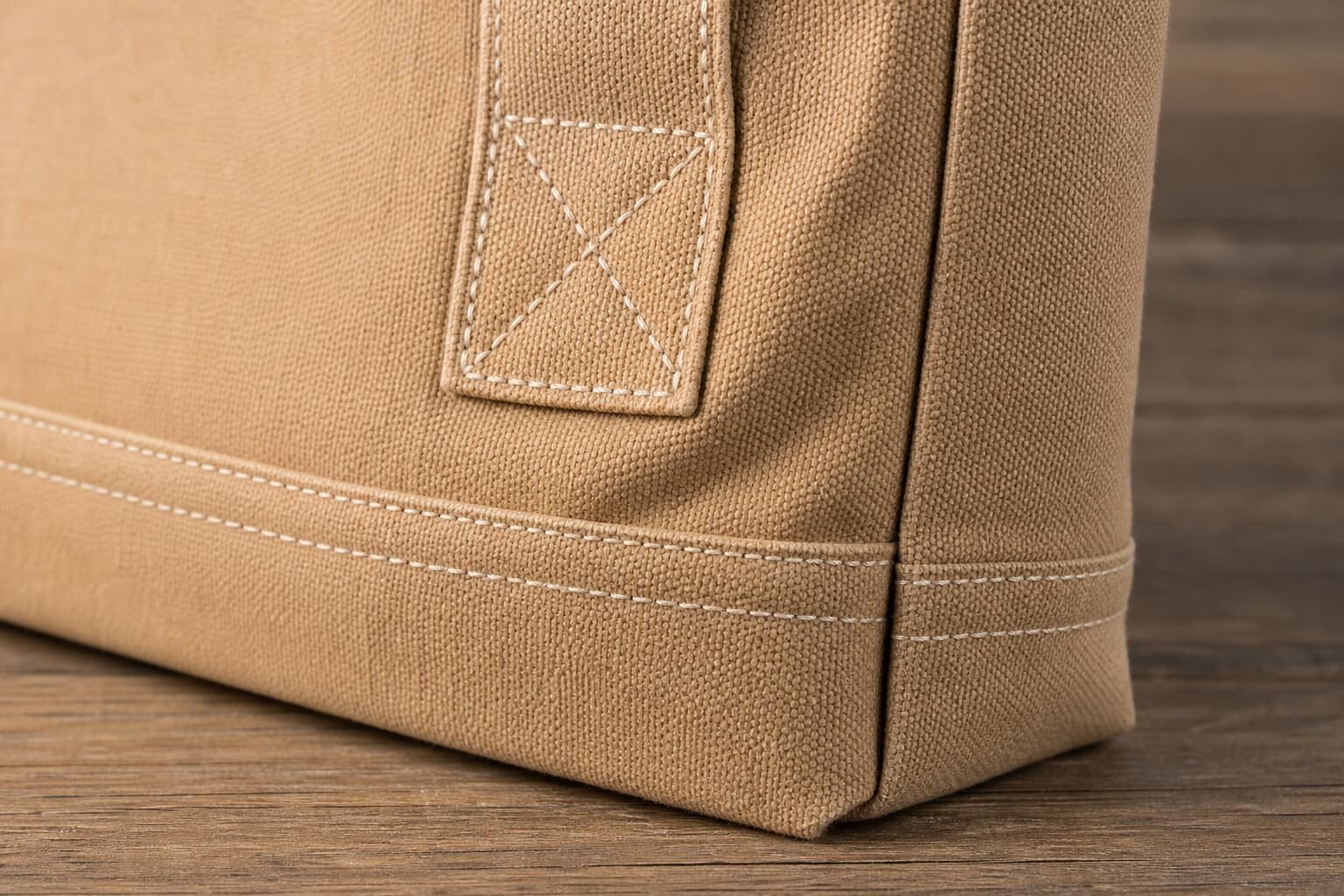
Canvas fabric may be strong, but the bag fails if the handle attachment is weak. For reusable shopping bags, books, bottles, or event merchandise, handle reinforcement is not optional. Common methods include box-X stitching, multiple rows of straight stitching, bar tacks, or reinforced cotton webbing sewn into the top hem. The best option depends on fabric weight, handle type, desired appearance, and target load. A premium-looking tote with poor handle reinforcement creates a higher complaint risk than a basic tote with honest construction.
Sewing QC should happen in line, not only at final inspection. Inspectors should check stitch density, skipped stitches, loose threads, needle damage, uneven seams, and twisted handles while the production team can still correct the process. Thread color should be approved, especially on dyed or black canvas where contrast stitching may be visible. For heavier 14 oz to 16 oz canvas, needle selection and machine setting matter because thick folded seams can create broken stitches or bulky corners. Buyers should ask the factory what load test they use internally and whether the test is pull, hanging weight, or practical carry simulation.
- For normal retail totes, request visible handle reinforcement such as box-X stitching or bar tack at stress points.
- Set stitch density expectations, for example 7 to 9 stitches per inch where suitable for the fabric and machine.
- Check that both handles are equal length and not twisted after top hemming.
- Inspect corners and gusset seams for skipped stitches on thick fabric layers.
- Keep photos of approved reinforcement for future repeat orders.
6. Use samples as production tools, not showroom pieces
A sample is useful only if it represents the future bulk order. Many buyers receive a beautiful sample made from available fabric, then place an order using a different fabric lot, different ink, or different handle tape. That creates arguments later because both sides approved something that was not actually the production standard. A proper sampling process should move from reference sample to revised sample to pre-production sample. The pre-production sample should use the same materials, process, logo size, and packing method planned for bulk.
The buyer should review the sample like an inspector, not like a catalog photo. Measure it, weigh it, check fabric hand feel, fold it, carry weight in it, look at the inside seams, and compare logo color under consistent light. If the sample is approved with comments, those comments must be written into the purchase order or QC file. Verbal sample comments are often lost when production moves from merchandiser to production manager. One approved sample should remain with the buyer, and one sealed sample should remain at the factory for line comparison.
- Record actual sample weight per piece; it helps identify fabric or size changes later.
- Photograph print position with a ruler for reference.
- Check whether the sample has the same inner label, hangtag, barcode, or packing as required for bulk.
- Reject samples that use substitute fabric unless they are clearly marked as construction-only samples.
- Do not start bulk production until the pre-production sample is approved in writing.
7. MOQ and lead time should be tied to material reality
MOQ is not just a sales number. It is linked to fabric sourcing, dyeing minimums, print setup, cutting efficiency, and sewing line arrangement. A simple natural canvas tote with one-color screen print may be possible at a lower MOQ because stock fabric is easier to source. A custom dyed canvas bag, special handle tape, custom woven label, or multi-color print usually requires higher MOQ or extra setup charges. Procurement teams should ask what part of the MOQ is driven by fabric, printing, or labor so they can make a commercial decision.
Lead time also needs to be broken into stages. A factory quote saying 30 days production may not include sample revision, artwork confirmation, fabric dyeing, print screen preparation, buyer delay, final inspection, or export booking. For time-sensitive retail launches, the buyer should request a schedule with milestones: sample days, material booking, fabric arrival, cutting, printing, sewing, packing, inspection, and goods ready date. This does not guarantee there will be no delay, but it makes the risk visible early enough to adjust quantity, shipping method, or approval timing.
- Ask for MOQ based on stock natural canvas and MOQ based on custom dyed canvas.
- Separate sample lead time from bulk production lead time.
- Confirm whether production days start after deposit, artwork approval, sample approval, or material arrival.
- Ask how many sewing lines and daily output are planned for your order.
- For repeat programs, discuss blanket orders or staged shipments instead of forcing one oversized first order.
8. Quote comparison: what should be visible in the factory price
A useful quote for wholesale canvas tote bags should show more than unit price. Buyers need enough data to understand what is included and what may become a later extra charge. At minimum, the quote should state fabric specification, finished size, handle material, print method, number of print colors and positions, label or tag details, packing method, carton quantity, estimated carton size, sample cost, setup charges, payment terms, lead time, and validity. Without these details, the lowest quote may simply be the least defined quote.
Cost breakdown does not mean the factory must reveal every internal margin, but the buyer should understand the main cost drivers. Fabric weight, fabric color, print coverage, handle type, sewing complexity, packing, and order quantity all affect price. If two quotes differ sharply, compare GSM, carton quantity, included accessories, and whether print screen charges are included. Also check trade terms. FOB, EXW, CIF, and DDP quotes cannot be compared as if they are the same commercial basis.
- Request unit price by quantity tier, such as 500, 1000, 3000, and 5000 pcs, if you are planning future reorders.
- Ask whether print screen, sample, courier, barcode labeling, hangtag, and inner polybag are included or separate.
- Confirm carton packing count because freight cost per piece can change the landed cost significantly.
- Check if the quote is based on current fabric stock or new fabric purchase.
- Require quote validity, especially when cotton fabric cost or exchange rate is unstable.
9. Packing QC prevents clean bags from becoming damaged goods
Packing is often treated as a low-value detail, but poor packing can damage finished canvas tote bags before the buyer sees them. Over-compressed cartons create permanent creases, especially on printed areas. Loose packing allows bags to shift and corners to deform. Moisture exposure can cause odor, mildew, carton softening, or staining. Natural cotton canvas also absorbs smells from storage environments, so goods should be packed clean and dry, not immediately after wet processes or in dusty areas.
The packing plan should match the sales channel. A distributor may want bulk flat packing with 25 or 50 pieces per bundle. A retail buyer may need individual polybags, hangtags, barcode labels, or carton labels by SKU. A sustainability-focused brand may prefer no individual polybag but still need moisture protection inside the master carton. The QC plan should include a packing audit: correct quantity per bundle, correct carton count, shipping marks, label accuracy, carton strength, gross weight, and whether the print surface is protected from rubbing.
- Define flat pack, folded pack, or roll pack before quoting because labor and carton volume differ.
- Keep carton gross weight practical for warehouse handling, often below buyer-specific maximums.
- Use inner liner or master polybag if moisture risk is high, even when individual polybags are avoided.
- Do not place dark printed surfaces face-to-face without checking rubbing or offset risk.
- Ask for carton drop or handling suitability if goods will move through multiple warehouses.
10. A practical inspection flow for canvas tote bag orders
For most wholesale canvas tote bag orders, inspection should be staged. First, inspect incoming fabric before cutting. Second, inspect cut panels and print strike-offs. Third, perform in-line sewing checks when 20% to 40% of production is complete. Fourth, do final random inspection when goods are fully packed or at least mostly packed. This flow catches material, print, and sewing problems before they become full-shipment problems. It also gives the factory time to repair or replace affected goods.
Buyers can use AQL inspection, but the defect list should be product-specific. Critical defects may include mold, sharp metal contamination, wrong logo, wrong material, or unsafe staining. Major defects may include broken seams, handle failure, large stains, severe print misplacement, incorrect size outside tolerance, or wrong packing. Minor defects may include small loose threads, slight shade variation within approved range, or small washable marks. The approved sample, purchase order, artwork file, packing instruction, and inspection checklist should all match. If they conflict, the inspector may not know which standard to enforce.
- Before cutting: check GSM, shade, stains, holes, and fabric width.
- Before sewing: check printed panels for color, position, curing, and artwork completeness.
- During sewing: check handle attachment, seam allowance, stitch density, and trimming.
- Before shipment: check finished size, appearance, quantity, carton marks, packing, and retained sample match.
- After shipment: keep inspection report and production photos for repeat order improvement.
Specification comparison for buyers
| Spec decision | Recommended option | When it fits | Buyer risk to check |
|---|---|---|---|
| Fabric weight | 10 oz to 12 oz cotton canvas, approx. 270-340 GSM depending on weave | Retail gift bags, bookstore totes, event merchandise, light grocery use | Do not compare only by oz; confirm actual GSM, yarn count, and whether the fabric is washed or unwashed |
| Heavy-duty fabric | 14 oz to 16 oz canvas, approx. 380-450 GSM | Premium retail totes, heavier daily carry, brand merchandise with higher perceived value | Higher GSM increases sewing difficulty, freight weight, and carton volume; check handle attachment strength |
| Handle construction | Self-fabric handles with box-X reinforcement or cotton webbing handles with bar tacks | Reusable shopping bags and promotional totes expected to carry books or bottles | Ask for handle pull test target and inspect stitch density; weak reinforcement is a frequent return issue |
| Printing method | Screen print for solid logos; heat transfer for full-color small runs; embroidery only for premium thick canvas | Brand logos, event artwork, retail packaging programs | Pantone matching on natural canvas is not identical to printing on white coated paper; approve a printed strike-off |
| MOQ planning | 500-1000 pcs for simple natural canvas with one-color print; higher MOQ for dyed fabric or custom weave | First purchase orders, campaign launches, distributor stock programs | Low MOQ may use available fabric lots; color and shrinkage can vary between repeat orders |
| Packing | Flat packed 25-50 pcs per inner bundle, moisture protection, export carton with clear shipping marks | Wholesale cartons for distributors, retail DC receiving, Amazon-style prep after separate approval | Over-compressed cartons can crease prints and deform bags; confirm carton size and max gross weight |
Buyer checklist before sampling
- Define bag size with finished tolerance, not only nominal size; include width, height, gusset, handle length, and handle drop.
- Confirm fabric by GSM, oz, composition, weave type, color, shrinkage expectation, and whether fabric is bleached, dyed, washed, or natural.
- Request a pre-production sample made with bulk fabric, bulk handle material, final print process, and intended packing method.
- Approve artwork with Pantone references, print size, print position tolerance, ink type, and whether one-side or two-side printing is required.
- Set seam and handle reinforcement requirements, including stitch type, stitch density, thread color, and load test expectation.
- Ask for an inspection plan covering fabric check, cutting check, in-line sewing check, print inspection, final random inspection, and packing audit.
- Confirm carton packing count, carton dimensions, gross weight, moisture control, barcode or shipping mark needs, and palletization if required.
- Compare quotes using the same specification sheet; reject vague quotes that only say cotton bag, canvas bag, or standard quality.
- Lock the approval chain: proto sample, revised sample if needed, pre-production sample, bulk production start approval, and final inspection approval.
- Keep one approved sample at the buyer side and one sealed sample at the factory for comparison during inspection.
Factory quote questions to send
- What exact canvas fabric will you quote: oz, GSM, composition, weave, color process, and available fabric width?
- Is the quoted fabric greige, natural, bleached, dyed, or washed after sewing? How will shrinkage affect finished size?
- What is the MOQ for this bag if using stock fabric, and what is the MOQ if fabric must be dyed to our Pantone target?
- Which print method do you recommend for our artwork, and what are the limits for fine lines, ink coverage, and print position tolerance?
- Will the sample use the same fabric, thread, handle tape, print ink, and packing as bulk production?
- What sewing reinforcement will be used at handle joints, and what load test can you support as an internal control?
- How many days are needed for sample, material preparation, printing, sewing, final QC, and packing after deposit and artwork approval?
- What carton quantity, carton size, gross weight, and moisture protection are included in the quote?
- Which items are excluded from the unit price: sample cost, mold or screen charge, inner polybag, barcode label, hangtag, pallet, or courier fee?
- What inspection standard and AQL level do you normally use for canvas tote bags, and can you support buyer third-party inspection?
Quality-control points to confirm
- Fabric GSM checked against approved specification before cutting, with tolerance agreed in the purchase order.
- Fabric defects such as slubs, oil marks, holes, shade bands, weaving lines, and stains separated before cutting.
- Cut panels measured against approved pattern, including allowance for seam folding and gusset construction.
- Print color, position, size, curing, adhesion, and cracking resistance checked before sewing when panels are printed flat.
- Handle length, handle drop, handle width, and reinforcement stitches checked during in-line sewing.
- Seam strength, stitch density, loose threads, skipped stitches, and needle holes inspected before final trimming.
- Finished bag dimensions checked after sewing and any washing process, not only at cutting stage.
- Final appearance checked for stains, uneven panels, twisted handles, misaligned side seams, and visible creases.
- Packing audited for carton count, inner bundle count, shipping marks, barcode labels, moisture protection, and carton strength.
- Retained production sample and inspection photos kept for repeat-order comparison.