1. MOQ is not one number; it is the result of the whole specification
Many buyers ask for the MOQ of wholesale canvas tote bags as if every factory has one fixed answer. In reality, MOQ changes when the buyer changes fabric weight, fabric color, bag dimensions, gusset style, handle material, logo method, label, packing, delivery split, or approval schedule. A 1,000 piece order of natural 10 oz canvas with a one-color front screen print is a very different production job from 1,000 pieces split across five dyed colors, three logos, two sizes, and individual retail barcode packing.
Procurement teams get better results when they ask what creates the MOQ rather than only asking the supplier to reduce it. If the factory has suitable natural canvas in stock, the minimum may be controlled by cutting efficiency and print setup. If the buyer wants a custom dyed cotton canvas, the fabric mill dye lot may be the true minimum. If the bag needs custom woven labels, special webbing, zipper, metal hardware, or retail cartons, an accessory supplier may become the limiting factor.
A practical wholesale canvas tote bags MOQ guide should therefore connect quantity to production drivers. This makes negotiation more precise. Instead of saying, "Can you do 300 pcs?" the buyer can ask, "What changes would make 300 pcs possible: stock fabric, one print color, standard handle, bulk packing, or a higher unit price?" That conversation is more useful for both cost control and production stability.
- Ask whether MOQ is per order, per SKU, per fabric color, per print design, per packing format, or per delivery batch.
- Do not compare two MOQ answers unless fabric, print, packing, quality level, lead time, and trade term are the same.
- For a first order, reduce custom variables before reducing quantity too aggressively.
- If the supplier quotes a low MOQ, ask which materials are already available and which costs are excluded.
2. Start the RFQ with the tote use case, not only the logo
A canvas tote for a conference giveaway, a bookstore, a grocery program, a subscription box, and a premium retail brand can look similar in a mockup, but they should not be quoted the same way. The use case determines the fabric weight, handle strength, seam finishing, print durability, packing format, and inspection standard. When buyers send only a logo file and ask for the lowest MOQ, suppliers must guess the performance level, and the quote often becomes too cheap, too vague, or impossible to compare.
Write one clear use-case sentence at the top of the RFQ. For example: "Retail tote for paid resale, natural canvas, must carry books and apparel, front logo, individual barcode sticker, clean folding required." This tells the supplier that finish, handle strength, carton presentation, and barcode accuracy matter. For an event giveaway, the buyer might write: "Promotional tote for conference handout, light documents only, bulk packed, simple one-color logo, cost-sensitive." The same supplier may recommend a different fabric and MOQ strategy for each use case.
Use case clarity also protects internal alignment. Marketing may focus on artwork, finance may focus on unit cost, and logistics may focus on carton volume. A short use-case statement gives all teams the same product purpose before the RFQ is issued.
- Retail resale usually needs cleaner stitching, better folding, consistent shade, barcode accuracy, and stronger defect limits.
- Event giveaways can often use lighter canvas and bulk packing if the brand accepts a practical promotional finish.
- Grocery and heavy-use totes need reinforced handles, stronger seams, gusset control, and carton weight planning.
- Product packaging totes may require smaller sizing, clean folding, low odor, and careful print transfer control.
- Employee merchandise should balance durability, comfort, and repeat reorder availability.
3. Fabric weight, GSM, and finishing have the biggest effect on quote accuracy
Canvas tote buyers often specify fabric in ounces, while fabric mills and factories may also use GSM. Both are useful, but neither should be treated as exact without a sample because yarn, weave, washing, dyeing, and finishing can change the final hand feel and measured weight. As an approximate reference, 6 oz canvas is often used for lighter promotional bags, 8 oz gives more body while staying economical, 10 oz to 12 oz is a common range for many retail totes, and 14 oz to 16 oz is used for heavier premium shoppers.
MOQ and price often rise with heavier fabric because each bag consumes more material value, cutting is bulkier, sewing speed may be slower, and the packed cartons become heavier. Heavier canvas can also reduce the number of pieces per carton, which increases total CBM and affects freight. A supplier that quotes only unit price, without carton dimensions and gross weight, is not giving enough information for a landed-cost decision.
Buyers should also distinguish natural, bleached, dyed, and washed canvas. Natural canvas usually shows cotton seed flecks and shade variation. Bleached canvas may look cleaner but can highlight stains or printing issues. Dyed canvas requires shade approval and dye-lot planning. Washed canvas may offer a softer hand feel, but it changes shrinkage, dimensions, and sometimes fabric weight. The approved pre-production sample should become the control standard.
- 6 oz to 8 oz: suitable for light documents, campaigns, and short-term promotional use where low cost matters.
- 10 oz to 12 oz: a balanced choice for many branded wholesale canvas tote bags and retail programs.
- 14 oz to 16 oz: stronger hand feel and premium appearance, but higher unit cost, sewing complexity, and freight impact.
- Natural canvas may contain visible cotton seed flecks; confirm whether this appearance is acceptable for the brand.
- When GSM is critical, ask whether the measurement is based on grey fabric, finished fabric, or the approved bulk sample.
4. Standard colors lower MOQ; dyed canvas needs a different sourcing plan
Natural, off-white, black, and some supplier-stock colors may be easier to source because fabric suppliers often keep them available. These colors usually support more flexible MOQs, faster sampling, and easier reorders. Custom dyed canvas is different. The dyeing mill may require a minimum lot, and the factory may need to purchase more fabric than the order actually consumes. That extra fabric cost may appear as a higher unit price, a higher MOQ, or a separate material surcharge.
If brand color is important, the RFQ should include a Pantone reference and, ideally, a physical standard. Cotton canvas absorbs dye differently from coated synthetic materials, so an exact visual match may not be realistic without lab dip review. Buyers should define the acceptable tolerance before production, not after goods are packed. For repeat programs, ask whether the factory will retain a production swatch and how future dye lots will be checked.
Color assortment planning is another MOQ trap. A 3,000 piece order sounds attractive until it becomes six colors of 500 pieces each with separate cutting, shade control, labeling, carton marks, and warehouse SKUs. Suppliers may quote a total MOQ but later clarify that color minimums apply. Procurement should confirm color-level MOQ before presenting assortment plans internally.
- Natural canvas usually gives the most flexible MOQ for simple tote programs.
- Custom dyed canvas may require lab dip approval before bulk fabric production.
- Ask whether the MOQ applies to each fabric color or the combined order quantity.
- For repeat orders, retain an approved production swatch, not only a Pantone code.
- Small custom-color reorders can be difficult if the mill dye lot is higher than the reorder quantity.
5. Print method can make a low MOQ easy, expensive, or risky
Screen printing remains a practical choice for many canvas totes because it works well for solid logos, slogans, and clean vector artwork. It is usually economical when the quantity is high enough to spread screen setup cost. However, MOQ or unit cost can rise when the artwork uses many colors, large ink coverage, tight registration, or printing on both sides. Natural canvas texture can also affect print edge sharpness and opacity.
For small runs or full-color artwork, digital print, DTF, or heat transfer may reduce setup barriers. These methods can be useful for seasonal drops, complex graphics, or market tests, but they have their own risks: heavier hand feel, edge marks, cracking, different rub resistance, or color shift on textured fabric. Embroidery, woven patches, and woven labels can create a premium appearance, but they add accessory MOQ, sampling time, and additional inspection points.
Buyers should make print decisions from actual artwork, not from method preference alone. A one-color black logo on natural canvas should not be treated like a full-bleed photo print. Conversely, a complex illustration may become expensive and inconsistent if forced into multiple screen colors. Ask the supplier to recommend the method, but require them to explain the MOQ, setup cost, sample risk, and quality-control plan for that method.
- Use screen print for solid logos, clean typography, limited colors, and repeat wholesale orders.
- Use digital, DTF, or transfer printing for gradients, photo-style graphics, or low-quantity artwork after sample testing.
- Use embroidery only after checking backing, needle holes, thread color, puckering, and effect on fabric hand feel.
- Large dark ink areas can feel stiff or show cracking if ink and curing are not suitable for the fabric.
- Confirm print size in centimeters or inches, and define distance from top edge, side edge, and center line.
6. Construction details change both MOQ and defect risk
A flat open tote is usually easier to quote and produce than a bottom-gusset shopper, boxed-bottom tote, zipper tote, lined canvas bag, or tote with internal pockets. Every construction detail changes cutting patterns, sewing operations, inspection time, and sometimes machine settings. Buyers who want the lowest practical MOQ should keep the first order close to an existing factory style and customize only the details that matter most: fabric weight, logo, handle length, and packing.
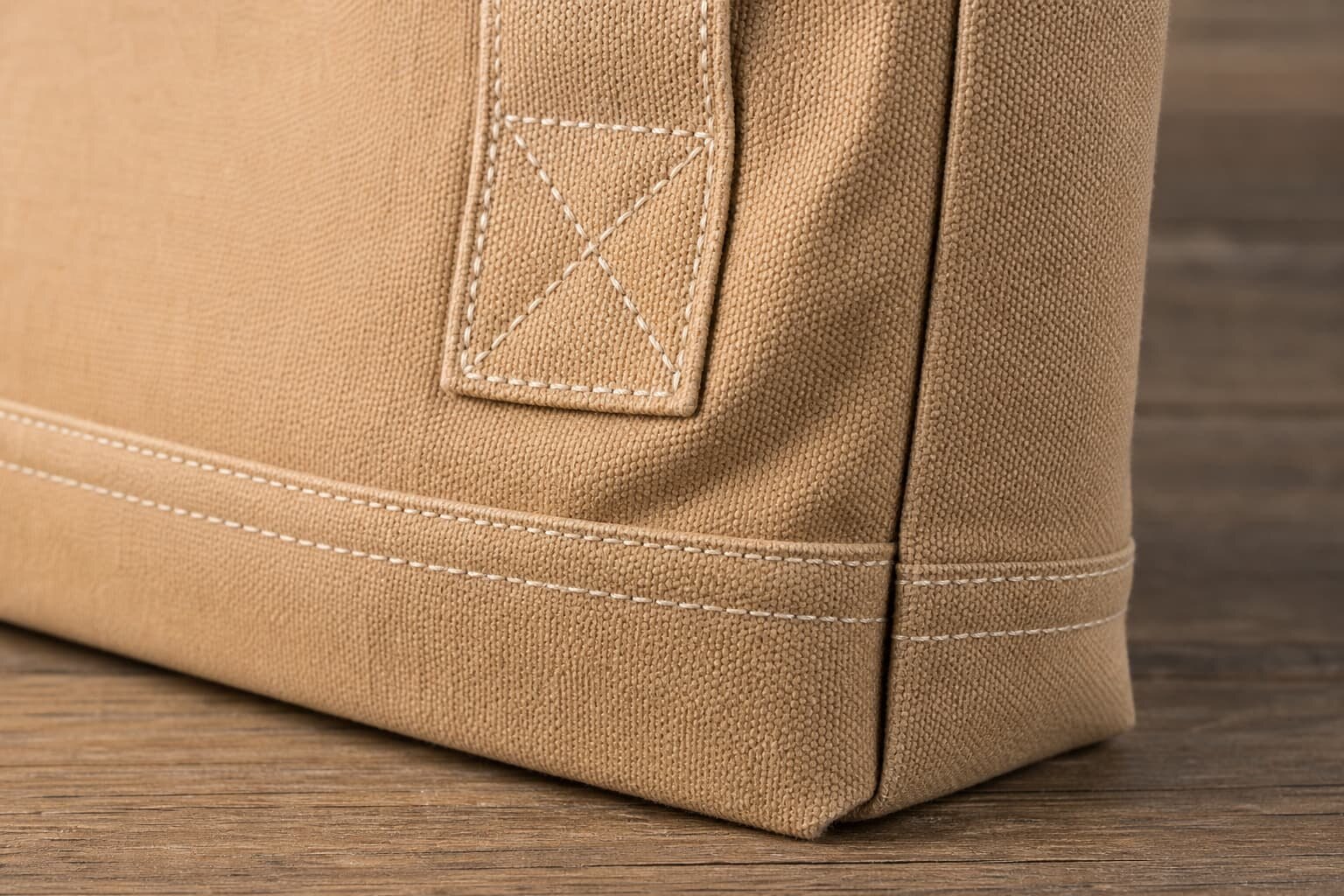
Handle design is one of the most common RFQ gaps. A 60 cm shoulder handle is different from a 35 cm hand-carry handle. Self-fabric handles, cotton webbing, rope handles, contrast handles, and custom jacquard webbing all have different sourcing and sewing requirements. If the bag will carry books, groceries, bottles, or other heavy items, the handle join should be reinforced and the load test should be defined.
Seam construction also affects perceived quality. A simple inside overlock may be sufficient for a promotional tote, while a retail bag may need cleaner binding or more controlled seam allowance. For heavier canvas, bulky seams can cause needle damage, uneven stitching, or visible puckering. These details should be checked during sample approval, not discovered in final inspection.
- State finished size as width x height x gusset, with handle drop listed separately.
- Clarify whether the bag has no gusset, bottom gusset, side gusset, boxed bottom, zipper, lining, pocket, or snap closure.
- Specify seam type when appearance matters: overlocked, bound, French seam, lockstitch, or buyer-approved factory standard.
- For heavier-use bags, request reinforced handle stitching and define a practical load test based on intended use.
- If adding zipper, lining, pocket, metal hardware, or custom webbing, expect longer sampling and possible accessory MOQ.
7. MOQ negotiation works best when it protects the factory process
Procurement teams often push MOQ down while keeping every custom requirement. Sometimes that is possible, but often it simply moves cost into another area: higher unit price, limited fabric choice, longer lead time, reduced price-break value, or more production risk. A stronger negotiation is to ask the supplier which specification changes would reduce MOQ without damaging the purpose of the bag.
Useful compromises include switching from custom dyed canvas to natural canvas, reducing print colors from four to two, using a factory-standard handle length, selecting a stock fabric weight, reducing artwork versions, or accepting bulk packing instead of individual polybags. These changes reduce setup loss and sourcing complexity. For a market test, a simpler first order is often better than forcing a custom retail program into an unrealistically small quantity.
Price breaks should be requested at realistic tiers with the specification held constant. If one quote is for 500 pieces bulk packed and another is for 3,000 pieces individually packed, the comparison will not explain the actual scale benefit. Ask for the same bag at 500, 1,000, 3,000, 5,000, and 10,000 pieces when those levels are relevant to your demand plan. The supplier can then show where setup, fabric buying, cutting efficiency, and packing labor improve.
- Lower MOQ by using stock canvas colors, standard fabric weights, and factory-standard bag bodies.
- Avoid splitting one small MOQ across too many artwork versions, fabric colors, or packing formats.
- Use the same bag body for several designs only if the factory confirms print setup and scheduling costs.
- Combine delivery dates only if storage, cash flow, and demand forecast allow it.
- Ask which cost changes if the order moves from 500 to 1,000 to 3,000 to 5,000 pieces.
8. Sample approval should test every decision that drives MOQ
A sample is not just a sales presentation piece. It is the control item for fabric, color, print, construction, handle comfort, labels, folding, and packing. If MOQ is based on a specific fabric weight, the sample should use that fabric weight. If the buyer approves custom dyed fabric, the sample should use the approved lab dip or production fabric when available. If the order includes individual retail packing, the sample should show the folding method, label position, barcode, warning label, and polybag size.
Photo approval can help with quick visual confirmation, but it cannot replace a physical sample for fabric hand feel, odor, stiffness, print texture, handle comfort, or carrying strength. For new suppliers, new fabric weights, new print methods, dyed canvas, retail programs, or higher-value orders, a pre-production sample is the practical safeguard. The cost and time of one correct sample are usually far lower than the cost of fixing thousands of bags with wrong logo placement, weak handles, unacceptable shade, or incorrect packing.
Sample approval should end with a written sign-off, not only an email saying the sample looks good. Attach tolerance notes for dimensions, logo position, shade, print quality, stitching, and packing. Keep one approved sample at the supplier and one with the buyer or inspection team when possible. That sample becomes the reference for production and final inspection.
- Check fabric weight, color, hand feel, odor, shrinkage risk, and visible fabric defects.
- Measure finished bag dimensions after sewing, not only cut panel dimensions.
- Check logo size and position from top edge, side edge, and center line.
- Review print opacity, edge sharpness, registration, curing, dry rub, and wet rub performance where suitable.
- Test handle attachment and carrying comfort with a realistic load based on intended use.
- Place the sample in intended carton packing to check folding marks, barcode visibility, and carton capacity.
- Approve any label, hangtag, barcode sticker, warning text, and country-of-origin mark before bulk packing.
9. Landed cost, trade terms, and logistics can change the better quote
Two suppliers can quote the same unit price while producing very different landed costs. Canvas totes are bulky, especially when made from 12 oz or heavier fabric. Individual polybags, tissue wrapping, hangtags, header cards, inserts, and retail folding can increase labor and carton volume. Bulk packing saves cost and space, but it may create wrinkles or require more labor at the destination if the warehouse needs individual handling.
Before choosing a supplier, ask for pieces per carton, carton dimensions, gross weight, net weight, and estimated CBM for the quoted quantity. This data lets the buyer estimate sea freight, air freight, warehouse receiving, storage, and carton handling. Heavy cartons may be inconvenient or unacceptable for some receiving operations, while oversized cartons can increase storage cost and damage risk. If cartons are mixed by SKU, confirm the exact carton marking and packing list format.
Trade terms must also be compared. EXW may look cheap because the buyer controls pickup and export arrangements, but it excludes many logistics steps. FOB usually includes delivery to the port and export clearance responsibilities defined by the agreement. CIF includes ocean freight and insurance to the destination port, but not necessarily import customs, duty, or final delivery. DDP may be convenient because it includes delivery to the buyer’s named location, but the buyer should confirm what duties, taxes, and documentation are included. The lowest product price is not always the lowest delivered cost.
- Request carton quantity, carton dimensions, gross weight, net weight, and total CBM with every serious quote.
- Ask whether the quote is EXW, FOB, CIF, DAP, DDP, or another agreed trade term.
- Confirm who handles export clearance, import clearance, duties, taxes, insurance, and final delivery.
- Check whether cartons need buyer-specific marks, palletization, barcode labels, or SKU-level separation.
- Review warehouse receiving requirements before approving mixed cartons, heavy cartons, or retail-packed goods.
- For air shipments, heavier canvas and individual packing can make freight cost a major part of landed cost.
10. Turn the specification into a supplier-comparable RFQ package
A low quote is not useful if it hides missing cost items or different assumptions. For canvas tote procurement, the RFQ should include the product drawing, fabric requirement, color target, print artwork, print size, logo position, handle details, label needs, packing instructions, target quantity, requested price breaks, inspection expectations, carton data request, and trade term. If one supplier includes screen charges and individual packing while another excludes them, the unit price comparison is misleading.
The best workflow is to build one controlled RFQ file and send the same package to each shortlisted supplier. Ask suppliers to quote in the same format: MOQ basis, unit price by quantity tier, sample cost, setup charge, print cost, label cost, packing cost, lead time, carton data, payment term, and trade term. Require suppliers to list assumptions where information is missing. This prevents repeated re-quoting and gives procurement, merchandising, quality, finance, and logistics teams the same facts.
After receiving quotes, compare them in stages. First check whether the technical specification is actually the same. Then compare MOQ basis and price breaks. Then compare sample lead time, bulk lead time, carton data, and trade terms. Finally, review QC capability and communication quality. A supplier that asks clear technical questions early may be more reliable than one that sends a fast one-line price without understanding the order.
- Create one approved specification sheet and use it for RFQ, sample approval, purchase order, inspection, and reorders.
- Request price breaks by quantity while keeping fabric, print, packing, and trade term unchanged.
- Ask suppliers to separate product cost, print cost, setup cost, label cost, packing cost, sample fee, and logistics assumptions.
- Confirm whether lead time starts after deposit, artwork approval, sample approval, material approval, or all of these milestones.
- Use a quote comparison table that includes unit price, MOQ driver, carton CBM, gross weight, trade term, and excluded charges.
- Do not release bulk production until sample approval, purchase order, artwork file, packing requirement, and QC tolerance sheet are aligned.
Specification comparison for buyers
| Spec decision | Recommended option | When it fits | MOQ or price-break driver | Buyer risk to check |
|---|---|---|---|---|
| Fabric weight for general retail tote | 10 oz to 12 oz cotton canvas, approximately 280 to 340 GSM depending on weave and finish | Bookstores, museum shops, lifestyle brands, employee merchandise, medium-load resale totes | Usually works well at moderate MOQs because fabric is commonly sourced; price breaks often improve once cutting waste and print setup are spread across 1,000+ pcs | Confirm finished GSM and hand feel from the approved sample; some suppliers quote grey fabric weight before washing, dyeing, or finishing |
| Fabric weight for low-cost event bag | 6 oz to 8 oz cotton canvas, approximately 170 to 240 GSM depending on construction | Conferences, campaigns, light document bags, giveaways, short-term promotional use | Lower fabric cost and faster sewing can support lower opening quantities, but very small runs may still carry print setup charges | Thin fabric can wrinkle, reveal contents, and show ink strike-through; approve a physical sample before bulk production |
| Fabric weight for premium shopper | 14 oz to 16 oz canvas, approximately 400 to 540 GSM depending on weave, yarn, and finishing | Paid retail merchandise, reusable shopping programs, heavier product carrying, premium brand presentation | Higher fabric consumption, slower sewing, heavier cartons, and lower pcs per carton can increase MOQ or reduce price-break gains | Check handle reinforcement, needle marks, seam bulk, carton gross weight, and freight impact before choosing heavier canvas |
| Fabric color strategy | Natural, off-white, black, or supplier-stock colors where acceptable | Market tests, repeat replenishment, distributor programs, branded giveaways with simple artwork | Stock colors generally reduce dyeing-lot pressure and may allow smaller MOQs or faster sampling | Confirm shade, cotton seed flecks, and whether the same stock shade can be repeated later |
| Custom dyed canvas | Lab dip approved dyed cotton canvas with Pantone or physical swatch target | Brand color programs, retail assortments, private-label collections | MOQ is often driven by fabric mill dye lot rather than bag sewing; leftover fabric cost may appear in unit price | Set shade tolerance, approve lab dip, retain production swatch, and ask how future reorders will be matched |
| Print method for simple logo | Screen print, 1 to 3 solid colors | Most wholesale canvas tote bags with flat vector artwork and clear brand colors | Screen cost and setup are spread better at higher quantities; price breaks usually become more meaningful above the first production tier | Ask for ink type, curing method, print size, color tolerance, and print opacity on textured canvas |
| Print method for full-color artwork | Digital print, DTF, or heat transfer after sample testing | Small seasonal drops, gradients, photo-style graphics, multi-color artwork that is expensive to screen print | Can lower screen setup barriers, but unit print cost may stay higher and artwork position control must be checked | Test hand feel, wash or rub resistance, edge marks, cracking, and color shift on the actual fabric |
| MOQ strategy for first order | Standard fabric, standard bag body, one print position, limited artwork versions | New supplier qualification, market test, initial retail program, budget-controlled promotion | Simplifying the spec lowers accessory, dyeing, and setup constraints, making the MOQ easier to negotiate | Too many custom details can push MOQ up through fabric dyeing, labels, handle webbing, and packing labor |
| Packing choice | Bulk pack 50 to 100 pcs per export carton unless retail packing is required | B2B distribution, warehouse replenishment, corporate giveaways, internal programs | Bulk packing reduces labor and material cost; individual packing increases time, carton volume, and sometimes MOQ for labels or bags | Check wrinkles, carton strength, SKU separation, barcode needs, and warehouse receiving requirements |
Buyer checklist before sampling
- Define the bag use case before MOQ discussion: giveaway, retail resale, grocery, product packaging, subscription box, employee merchandise, or distributor replenishment.
- State finished bag size in width x height x gusset, and list handle drop separately; do not rely on an approximate capacity description.
- Specify fabric weight by oz and approximate GSM where possible, and clarify whether the bag is natural, bleached, dyed, washed, or printed on colored canvas.
- Confirm whether the MOQ is driven by fabric roll, dyeing lot, printing setup, label production, handle webbing, hardware, carton packing, or production scheduling.
- Send vector artwork with Pantone references, print size, print position, and number of print colors; do not send only a low-resolution JPG logo copied from a website.
- Ask whether the quoted MOQ is per design, per fabric color, per print colorway, per size, per packing format, or total purchase order quantity.
- Require a physical pre-production sample when changing fabric weight, dyed color, print method, handle length, gusset construction, label, or packing format.
- Check estimated carton size, pieces per carton, gross weight, net weight, and total CBM before comparing supplier unit prices.
- Decide acceptable tolerance for size, fabric weight, logo position, color, shade, stitching, print defects, and packing count before mass production.
- Request a quote table that separates bag cost, print cost, label cost, packing cost, sample fee, screen or setup charge, inland delivery, and freight term.
Factory quote questions to send
- What is the MOQ for this exact bag size, fabric weight, fabric color, print method, label, handle, and packing method?
- Is your MOQ calculated per artwork, per fabric color, per size, per delivery batch, or per purchase order total?
- Which standard canvas weights do you keep available for faster production: 6 oz, 8 oz, 10 oz, 12 oz, 14 oz, or 16 oz?
- Are the quoted oz and GSM values based on grey fabric, finished fabric, washed fabric, or the approved bulk production sample?
- If we choose dyed canvas, what is the minimum dye lot, lab dip process, expected color tolerance, and reorder shade-control method?
- Which print method do you recommend for our artwork and why: screen print, digital print, heat transfer, DTF, embroidery, woven patch, or woven label?
- Can you make a pre-production sample using actual fabric, actual handle length, actual print size, final label, and actual packing?
- What are the sample lead time, bulk production lead time, and time needed after sample approval, deposit, material approval, and artwork confirmation?
- How many pieces per carton, what carton dimensions, gross weight, net weight, and estimated CBM for each quoted quantity?
- What quality checks are performed for handle strength, seam strength, print adhesion, fabric defects, shade variation, barcode accuracy, and carton packing?
Quality-control points to confirm
- Measure finished bag width, height, gusset, and handle drop against the approved sample and tolerance sheet.
- Check fabric weight by cutting and weighing sample panels when GSM accuracy is important, and confirm whether results match the approved bulk standard.
- Inspect fabric defects including slubs, stains, weaving lines, shade variation, oil marks, needle damage, and excessive wrinkles.
- Test handle attachment with a practical load test based on intended use, especially for 12 oz and heavier shoppers or grocery-style totes.
- Confirm logo size, position, color, print opacity, edge sharpness, registration, and curing before bulk packing begins.
- Perform dry and wet rub checks on printed areas where bags may contact clothing, books, retail packaging, or light-colored products.
- Check seam allowance, stitching density, skipped stitches, loose threads, broken needles, reinforcement points, and inside seam finishing.
- Confirm all labels, hangtags, barcodes, warnings, country-of-origin marks, and carton marks match the purchase order and retail requirements.
- Verify packing count per polybag and carton, carton weight, carton strength, mixed SKU separation, and barcode scannability.
- Review final random inspection photos or a third-party inspection report before shipment release, especially for new suppliers or retail orders.