Start With a Factory-Ready Spec
For wholesale canvas tote bags, many purchasing failures begin before the factory cuts fabric. A buyer sends a product photo and asks for the best price. One factory quotes 8 oz cotton, another quotes 12 oz canvas, one includes reinforced handles, and another assumes a simple promotional seam. The price gap looks like supplier competitiveness, but the real issue is that the product has not been defined tightly enough for procurement comparison.
A useful factory audit checks whether the supplier can turn your request into a repeatable production file. That file should include fabric, construction, print, trim, labels, packing, inspection criteria, and lead-time milestones. If the supplier cannot return a complete spec sheet during quotation, the same weak discipline may appear later as sample revisions, unclear production records, or disputes during final inspection.
For B2B buyers, the goal is not to overcomplicate a simple tote bag. The goal is to remove assumptions that change price, durability, appearance, freight cost, and customer acceptance. A canvas tote is often a low-cost item, but it may carry a brand logo in public for months. Small quality decisions become visible after distribution.
- Do not compare prices until bag size, fabric weight, handle style, print size, print location, and packing are fixed.
- Ask the supplier to return a completed spec sheet, not only a unit price and a product photo.
- Treat vague phrases such as heavy canvas, standard handle, eco ink, premium stitching, or export packing as open risk items.
- Use the audit to check process discipline: quote accuracy, sample control, material records, inspection method, and production traceability.
Define Fabric Weight and Composition
Canvas tote bag cost changes quickly when fabric weight changes. A bag quoted as 10 oz canvas should not be compared with an 8 oz plain cotton tote, even if both look similar online. Procurement teams should ask whether the supplier uses oz per square yard, GSM, or a mill code, and whether the weight is measured before or after bleaching, dyeing, washing, or other finishing.
For many retail and promotional canvas totes, 10 oz to 12 oz cotton canvas, approximately 280 to 340 GSM depending on construction and finishing, gives a useful balance of structure and cost. Lighter 6 oz to 8 oz fabric can work for short-term giveaways, conference inserts, or low-load use, but the bag may feel soft and the print may show more texture. Heavier 14 oz to 16 oz canvas can feel premium, but it increases sewing difficulty, needle wear, carton weight, and freight cost.
The PO should define an acceptable variance rather than leaving GSM as a marketing description. A practical buyer-controlled range might be an agreed target with a tolerance such as +/-5 percent, or a narrower range if the program requires strict repeat consistency. The right tolerance depends on fabric construction, testing method, and commercial expectation, so it should be agreed with the supplier before bulk purchase of fabric.
- Request both oz and GSM on the quote sheet, and ask how the factory verifies incoming fabric weight.
- Confirm whether the fabric is natural, bleached, dyed, pigment dyed, washed, organic cotton, recycled cotton, or a blended material.
- Ask for fabric swatches from the same batch type expected for bulk production, not only a generic showroom swatch.
- If organic or recycled content is important, request the certification or transaction documentation your compliance team requires before using the claim.
- Record shade, hand feel, weave character, seed flecks, and shrinkage expectations in the approved sample file.
Set Measurable Construction Tolerances
A tote bag can look acceptable in a front-view photo while still being weak in actual use. The common failure points are handle attachment, side seam, bottom seam, top hem, and gusset corners. For buyers selling to bookstores, supermarkets, museums, apparel brands, or corporate events, these details affect complaint risk more than a small saving on fabric.
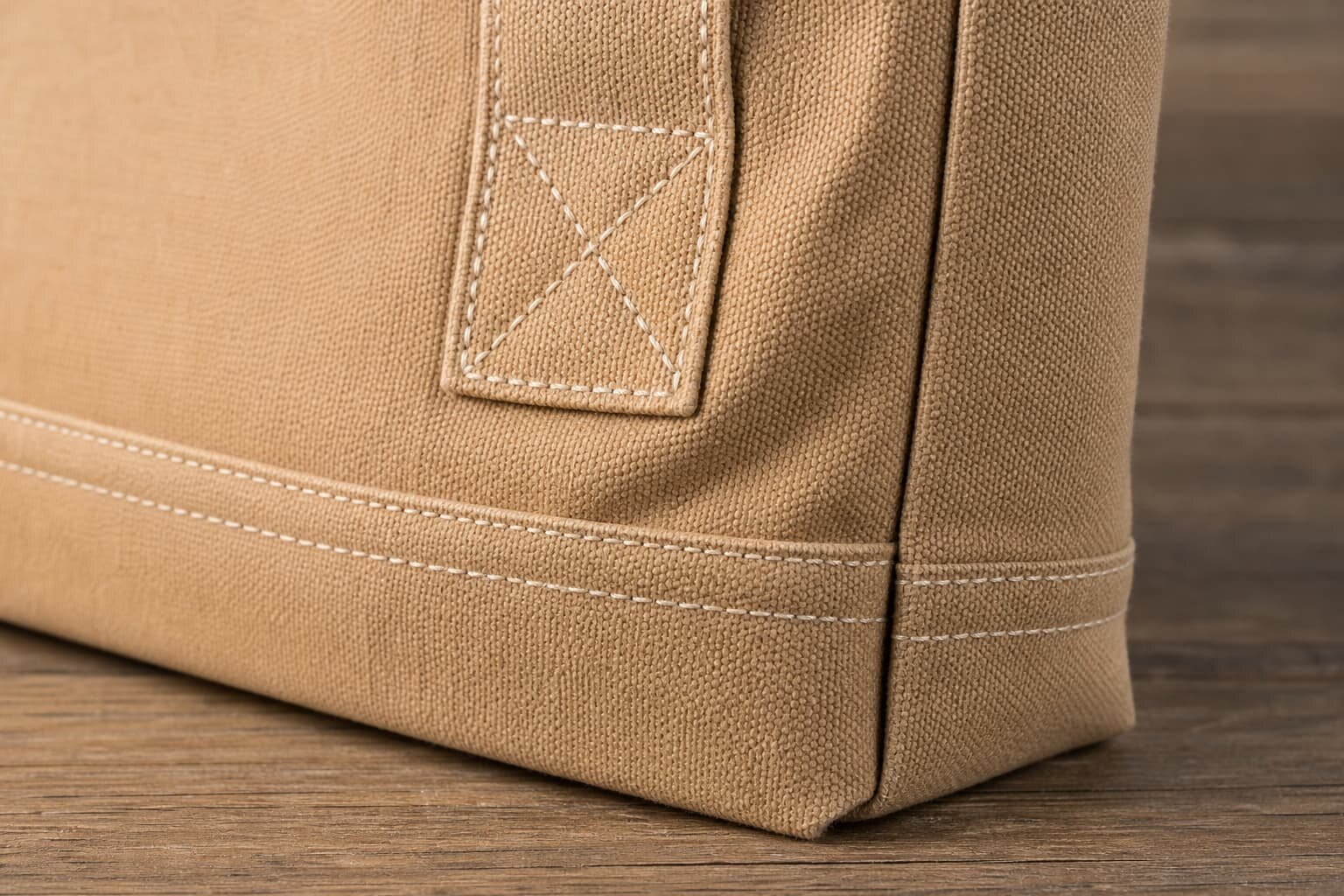
Factories may offer different sewing methods depending on the target price. A basic promotional tote may use simple lockstitch seams and a folded top opening. A stronger retail tote may need box-stitch handles, bartacks, wider seam allowance, heavier thread, inside binding, or a reinforced bottom. The audit should confirm which construction is included in the price and whether the bulk line can produce it consistently.
Tolerances should be practical and written. Many buyers use finished body tolerance around +/-1.0 cm for width and height, handle length tolerance around +/-1.5 cm, and print placement tolerance around +/-0.5 cm to +/-1.0 cm depending on logo size and panel construction. These are not universal standards, but they are concrete starting points for supplier discussion. If the bag is washed after sewing, the tolerance may need to account for shrinkage and distortion.
- Define finished width, height, gusset depth, handle width, handle length, handle drop, top hem height, and seam type.
- Ask for seam allowance, stitch density, thread color, reinforcement style, and acceptable variation from the approved sample.
- For shoulder carry, confirm handle drop on a worn sample, not only handle length measured flat.
- For heavy-load use, agree on a load test method, test weight, hang time, and pass/fail criteria before production.
- Check that sample reinforcement is not upgraded for approval and then reduced in bulk to save time or cost.
Match Print Method to Canvas Texture
Canvas has a visible weave, so print results differ from smooth polyester, coated paper, or nonwoven fabric. Fine lines may break across the fabric texture. Large solid areas may need heavier ink coverage. A light logo on natural or dark canvas may require an underbase. Artwork with small text, gradients, metallic effects, or tight registration should be reviewed before the factory commits to price and lead time.
Screen printing is often the practical choice for volume canvas tote orders with one to four solid colors. It controls cost well and can be durable when the ink is compatible with the fabric and properly cured. Heat transfer can suit detailed artwork or smaller runs, but buyers should check edge feel, film visibility, cracking after folding, and adhesion after rubbing. Embroidery, woven labels, and sewn patches can create a more premium product, but they add setup time and require accurate placement on a flexible panel.
Print quality should be inspected against measurable criteria. The quote and sample approval should state print size, print position from top and side seams, Pantone or approved color reference, acceptable color tolerance, whether underbase is used, and whether slight weave show-through is acceptable. For placement, many buyers specify a tolerance such as +/-0.5 cm from the approved artwork position for standard logos, adjusted if the artwork is unusually large or the panel is distorted by gussets.
- Provide vector artwork, Pantone references, print dimensions, print location, and artwork scale in the RFQ.
- Ask whether the price includes screen setup, film, color matching, sample printing, and underbase if required.
- Approve the print on the actual fabric color and texture, not only on a smooth lab strike-off.
- Rub the printed sample dry and lightly damp, then fold it through the logo area to check cracking, tackiness, or peeling.
- Confirm curing time before stacking so fresh prints do not transfer onto the next bag in the pile.
Break MOQ Into Cost Drivers
A low MOQ can be useful, but it does not always mean the best sourcing result. Canvas tote bag MOQ depends on fabric availability, dyeing quantity, cutting efficiency, print setup, sewing line planning, trim purchase, and packing material. A supplier may accept 300 pieces using stock natural canvas and one-color print, but require a much higher quantity for custom dyed fabric, multiple logo versions, or a non-standard bag size.
Procurement teams should ask what drives MOQ instead of accepting one headline number. Fabric color MOQ is different from logo MOQ. Screen print MOQ is different from sewing MOQ. Label MOQ, hangtag MOQ, barcode label MOQ, and carton mark requirements may also affect the final order. Once these drivers are separated, buyers can decide whether to consolidate designs, reduce colorways, use stock fabric, or accept a higher unit price for a smaller run.
The audit should also check whether the supplier's low MOQ depends on leftover fabric. Stock fabric can be a smart way to reduce lead time, but it must be verified. Ask how many meters are available, whether the full order can be cut from the same batch, and whether reorders can match the same shade and GSM. For repeat programs, continuity matters as much as first-order convenience.
- Ask for MOQ by fabric color, bag size, logo design, print color count, label, hangtag, and packing style.
- Check whether mixed colors, mixed prints, or split shipments are allowed under one total order quantity.
- Ask whether reorder MOQ changes after screens, labels, and sample approvals already exist.
- Request confirmation of stock fabric quantity before approving a low-MOQ order.
- Compare the cost impact of reducing SKUs versus paying setup charges for many small variations.
Make Samples Prove Bulk Production
A showroom sample is not enough for a factory audit. It shows what the supplier has made before, not necessarily what your order will be. The sample you approve should use the intended fabric weight, print process, thread color, label, handle reinforcement, fold method, and packing style. If the factory uses a substitute during early sampling, it should state the difference clearly and provide a bulk-equivalent pre-production sample before cutting mass fabric.
Canvas tote sample review should include measurement, hand feel, print, sewing, smell, packing, and folding recovery. Natural canvas may have cotton seed flecks, and that can be acceptable if the range is agreed. Oil marks, mold, holes, dirty fold lines, severe slubs, uneven panels, distorted handles, or strong chemical odor should not be treated as normal fabric character.
Approval control matters. Keep one signed or sealed approved sample at the factory and one with the buyer or inspection company. The approved sample should be linked to a date, version number, fabric reference, artwork version, and packing instruction. Without that control, a final inspection can become an argument over which sample was actually approved.
- Measure sample width, height, gusset, handle width, handle length, handle drop, and print position.
- Compare sample GSM, color, fabric texture, and hand feel against the quote sheet and swatch card.
- Check inside seams, top hem, handle reinforcement, bottom corners, stitch density, and thread trimming.
- Approve packing by sample, including fold method, label placement, polybag or no-polybag decision, carton quantity, and carton mark layout.
- Record any accepted deviations in writing so they do not become open quality disputes later.
Request Quote Data for Landed Cost
A factory quote that only shows unit price is incomplete for wholesale buyers. Canvas tote bags are bulky relative to their unit value, so freight cost can change the real landed cost. Packing quantity, carton size, compression, fold method, polybag use, and pallet plan all affect CBM. A cheaper unit price can disappear if the goods are packed inefficiently or require warehouse rework.
Ask suppliers to provide quote data in a format procurement, logistics, and finance teams can use. The quote should separate product cost, print setup, sample charges, label or hangtag cost, packing cost, testing cost if any, inland freight if included, and export carton details. This also makes repeat-order comparison easier because one-time setup charges can be separated from ongoing unit cost.
Commercial terms should be stated with the same discipline as product specs. Confirm currency, incoterm, loading port, payment schedule, sample fee treatment, tooling ownership if any, validity period, and whether the price assumes a certain fabric market level. For larger programs, ask the factory what changes would trigger requotation: fabric price movement, artwork revision, order split, carton change, or delayed approval.
- Request pieces per carton, carton dimensions, gross weight, net weight, total carton count, and estimated total CBM.
- Ask whether bags are flat packed, folded once, bundled, individually polybagged, retail packed, or compressed.
- Separate one-time setup charges from repeat-order unit costs.
- Confirm the incoterm, loading port, cargo-ready date, and any inland transport cost included in the quote.
- Ask the supplier to identify any assumptions that would change price after sample approval.
Control Packing Without Overpacking
Canvas tote bags can pick up dust, moisture, odor, and creases during production and shipment. Good packing does not mean excessive packing. For many wholesale orders, flat packing in clean export cartons is practical. Individual polybags may be required for retail distribution, barcode scanning, or marketplace fulfillment, but they add labor, material cost, and sustainability concerns. If the buyer wants plastic-free packing, the factory still needs a method to keep goods clean through carton handling and transport.
Packing should be checked before mass production is finished. Fresh screen prints can transfer if stacked too soon. Dark prints can mark light natural fabric under pressure. Folded handles can leave impressions across the front panel. Cartons that are too large allow movement and creasing; cartons that are too tight can deform the bags. The packing plan should balance product appearance, freight efficiency, and warehouse requirements.
For procurement buyers, carton data is not a back-office detail. It affects freight quote accuracy, pallet planning, warehouse receiving, and customer delivery. A purchase order should state carton quantity tolerance, pieces per carton, carton mark format, barcode needs, inner protection, polybag warnings where applicable, and whether mixed designs are allowed in the same carton.
- Define fold method so the logo is not creased through the center unless the buyer approves it.
- Use carton liners, inner bundles, or moisture protection when long storage, dusty handling, or humid routes are expected.
- Confirm barcode, hangtag, care label, warning label, suffocation warning, carton mark, and SKU segregation requirements before packing.
- Ask for packed-carton photos before final inspection, especially when the order has retail labeling or strict warehouse routing.
- Check that carton count, gross weight, net weight, and dimensions match the booking and shipping documents.
Use Practical AQL Inspection
Quality control for canvas tote bags should not rely on a general instruction such as inspect before shipment. The buyer should define inspection timing, inspection basis, defect classification, AQL level, and who can release goods. A common approach for consumer textile accessories is to use a recognized random-sampling plan such as ANSI/ASQ Z1.4 or ISO 2859-1, with general inspection level II unless the buyer's risk profile requires a different level. The exact AQL limits should be agreed by buyer and supplier before production.
AQL does not mean defects are approved automatically. It is a sampling method for deciding whether a lot is acceptable based on classified defects. Critical defects often have a zero-acceptance expectation. Major defects may include broken seams, missing logo, wrong size outside tolerance, print peeling, heavy stains, wrong fabric, handle failure, wrong packing, or missing required label. Minor defects may include small loose threads, slight shade variation within the approved range, or minor natural cotton flecks if accepted in the signed sample.
Inspection timing also matters. For higher-risk orders, consider an inline inspection when part of production is sewn and printed, especially if the order has a new factory, custom dyeing, tight print placement, or many SKUs. Final random inspection should happen when goods are 100 percent produced and at least 80 percent packed, or according to the inspection company's booking rule, so the inspector can check both product and carton execution.
- Define critical, major, and minor defects in the PO before production starts.
- Use approved sample, artwork file, spec sheet, packing instruction, and carton mark layout as inspection references.
- Set size, handle, print placement, GSM, shade, and packing tolerances in writing.
- Require measurement records, defect photos, carton selection list, and clear pass/fail conclusion in the inspection report.
- State whether failed inspection leads to sorting, rework, reinspection, discount negotiation, or shipment hold.
Build Lead Time From Real Steps
Lead time for wholesale canvas tote bags should not be quoted as one loose number. A reliable supplier should break it into artwork review, lab dip if required, material sourcing, sample making, sample approval, fabric preparation, cutting, printing, curing, sewing, trimming, inspection, packing, and export handover. This breakdown helps buyers see where delays may occur before the shipment date is already at risk.
Natural canvas with one-color screen print can usually move faster than custom dyed canvas with multi-color artwork, woven labels, and retail packing. Reorders may be faster if the same fabric, screens, labels, and packing materials are available. New programs need more buffer because artwork, sampling, and material approval create decision points. Buyers should connect approval deadlines to production milestones, so the factory cannot treat late artwork comments and late material purchase as invisible schedule risks.
The purchase order should state when lead time begins. Some factories count from deposit date, while others count from artwork approval, sample approval, receipt of labels, or fabric arrival. That difference can add meaningful time. For seasonal promotions, event merchandise, or retail launches, the schedule should include final inspection date, cargo-ready date, document cut-off, vessel or courier plan, and the latest acceptable delivery date.
- Ask when the lead-time clock starts: deposit, artwork approval, sample approval, fabric confirmation, or receipt of trims.
- Separate lab dip, sample, bulk production, inspection booking, packing, and export handover in the schedule.
- Confirm whether public holidays, dyeing queue, print capacity, sewing line load, or carton supply affect the plan.
- Put final inspection date, reinspection buffer, cargo-ready date, and shipping document deadline into the PO.
- For repeat orders, confirm whether fabric, screens, labels, and approved packing materials are still available before promising a shorter schedule.
Specification comparison for buyers
| Spec decision | Recommended option | When it fits | Buyer risk to check |
|---|---|---|---|
| Fabric weight | 10 oz or 12 oz cotton canvas, approximately 280-340 GSM, with agreed GSM tolerance | Retail totes, bookstore bags, merchandise bags, promotional bags that need a firm hand feel | Supplier quoting lighter plain cotton as canvas; verify GSM from fabric test report or swatch, and agree acceptable variance before PO |
| Finished size | Example starting spec: 38 x 42 cm body, optional 8-10 cm gusset, 2.5 x 60 cm handles | General retail, trade shows, bookshops, apparel stores, and supermarkets | Quotes are not comparable if body size, handle drop, gusset, seam allowance, and shrinkage tolerance are not fixed |
| Construction | Lockstitch seams with reinforced cross-stitch, box-stitch, or bartack handles | Reusable shopping bags and branded bags expected to carry real weight | Weak handle attachment, narrow seam allowance, skipped stitches, or inconsistent reinforcement between sample and bulk |
| Print method | Screen print for 1-4 solid colors; heat transfer for detailed artwork or small runs; embroidery or patch for premium trim | Logo projects where color consistency, durability, and cost control matter | Ink coverage on coarse canvas, Pantone tolerance, curing, rub resistance, cracking after folding, and print placement drift |
| MOQ logic | Separate MOQ by fabric color, custom dyeing, logo design, print color count, sewing line setup, and packing material | Buyers comparing factories or building assortments across colors and designs | Low headline MOQ may hide stock fabric limits, higher unit cost, setup charges, or shade inconsistency on repeat orders |
| Inspection basis | Approved sample plus written spec sheet, artwork file, packing instruction, and AQL plan | Any B2B order where rejection, rework, or warehouse chargebacks would be costly | Inspection fails if the buyer has no measurable tolerance for size, GSM, placement, defects, carton count, or labeling |
| Packing | Flat packed 50 or 100 pcs per export carton, with inner protection or individual polybag only when required | Wholesale orders moving by sea, courier, distributor warehouse, or retail fulfillment center | Overpacking raises CBM and waste; underpacking creates dirt, moisture, creasing, odor, and print transfer risk |
| Lead time | Milestone plan from artwork and sample approval through fabric, printing, sewing, inspection, packing, and cargo handover | New projects, custom colors, multi-color logos, and retail packing programs | A single lead-time number hides bottlenecks; confirm when the clock starts and which approvals can stop production |
Buyer checklist before sampling
- Lock finished bag width, height, gusset, handle width, handle length, handle drop, seam type, and tolerance before requesting prices.
- Ask the factory to state fabric composition, canvas weight in oz and GSM, construction type, color method, shrinkage control, and whether the weight is measured before or after finishing.
- Set practical tolerances in the PO, such as finished body size within +/-1.0 cm, handle length within +/-1.5 cm, print placement within +/-0.5 cm, and GSM within the agreed range or test standard.
- Confirm whether the quoted fabric is greige, natural, bleached, dyed, washed, recycled cotton, organic cotton, or blended material, and ask what documentation supports that claim.
- Specify print size, print position, Pantone or approved color standard, artwork file format, number of colors, underbase needs, curing requirements, and acceptable print defects.
- Request a pre-production sample made with actual bulk fabric, actual print method, actual thread color, actual handle reinforcement, and actual packing method.
- Check handle strength, seam alignment, print adhesion, print opacity, fabric stains, odor, loose threads, inside seam finish, carton marking, and packed-carton condition on samples.
- Compare MOQ by fabric color, print design, bag size, packing style, and trims, not only by total order quantity.
- Ask for carton dimensions, gross weight, net weight, pieces per carton, total carton count, and estimated CBM before calculating landed cost.
- Include AQL level, defect classification, sample size logic, approval sample control, inspection timing, rework rules, and final shipment document checks in the purchase order.
Factory quote questions to send
- What exact canvas weight are you quoting in oz and GSM, and is the weight measured before dyeing, after finishing, or on the finished bag panel?
- What GSM tolerance do you apply in bulk, and can you provide a fabric test report or internal incoming-material inspection record?
- Is the fabric in stock, made to order, dyed to order, washed after sewing, or purchased from a nominated mill?
- What is the minimum order quantity by fabric color, bag size, logo artwork, print color count, trim, and packing style?
- Which print method are you using for this artwork, and what evidence shows it is suitable for this canvas texture and color?
- Can you separate unit price, screen charges, sample charges, lab dip charges, label or hangtag charges, packing charges, testing charges, and inland freight?
- What tolerances do you apply for finished bag size, handle length, handle drop, fabric weight, print position, print color, and carton quantity?
- How many days are needed for artwork review, lab dip, counter sample, pre-production sample, bulk fabric, cutting, printing, curing, sewing, trimming, inspection, packing, and export handover?
- What tests can you perform or support for colorfastness, print adhesion, dry and wet rubbing, load capacity, seam strength, shrinkage, odor, and carton strength?
- Will bulk production use the same fabric roll type, ink system, thread color, stitch density, handle reinforcement, label position, and fold method as the approved sample?
Quality-control points to confirm
- Incoming fabric GSM, composition, weave character, shade, width, odor, and hand feel match the approved swatch, quote sheet, and purchase order.
- Finished bag dimensions remain within agreed tolerance after sewing, pressing, washing if applicable, and packing recovery.
- Handle attachment passes the agreed pull or load test without seam tearing, thread breakage, bartack failure, or visible distortion beyond the approved sample.
- Print color, position, edge sharpness, opacity, registration, curing, hand feel, rub resistance, and fold resistance match approved artwork and sample.
- No unacceptable stains, oil marks, mold, holes, broken yarns, heavy slubs outside approved fabric character, sharp contamination, strong odor, or visible dirt.
- Inside seams are clean, threads are trimmed, stitch density is consistent, top hems are even, and stress points are reinforced consistently across inspected cartons.
- Critical, major, and minor defects are classified before inspection, with AQL level and sample size selected according to order quantity and buyer risk tolerance.
- Packing quantity, fold method, carton markings, barcode labels, hangtags, care labels, warning labels, and polybag requirements match the buyer's packing instruction.
- Carton strength, liner use, moisture protection, sealing method, and pallet condition are suitable for the shipment route, warehouse handling, and storage time.
- Inspection report includes defect photos, measurement data, print placement checks, carton count, production lot traceability, and clear pass/fail conclusions before shipment release.