Start With the Bag's Job
A canvas messenger bag can play several roles for a wellness business. It might be a retail item at reception, an instructor kit, a retreat welcome bag, a spa merchandise piece, a corporate wellness giveaway, or a membership gift. Logo placement should change with that role. A large centered logo helps with event visibility and sponsor recognition. A small corner mark, woven label, or patch feels quieter and more wearable for yoga studios, pilates studios, spas, meditation centers, and natural wellness retailers.
Procurement teams get cleaner quotes when they define the commercial purpose first. A bag sold in a studio boutique needs better finishing and more careful packing than a one-day event giveaway. A retreat gift may need a richer canvas hand feel and sturdier hardware because guests continue using it after the program ends. A multi-location studio chain may need branch-level artwork control, which affects printing, inspection, packing, and carton labels.
The weakest RFQ says only custom logo on front. A stronger one describes the finished bag, the visible brand goal, logo dimensions, measurement reference points, branding method, and allowed tolerance. That extra detail prevents two common problems: suppliers quoting different products under the same description, and teams approving a digital mockup that cannot be repeated accurately in bulk production.
- Retail merchandise: prioritize clean flap shape, balanced logo size, stable canvas, and protected packing.
- Retreat welcome kit: specify expected contents and confirm the flap still closes cleanly when lightly filled.
- Instructor or staff bag: prioritize strap comfort, reinforced anchors, durable closures, and visible but not oversized branding.
- Corporate wellness event: simplify artwork, use standard canvas, and keep the print area easy to repeat at volume.
- Premium spa or boutique use: consider lower-corner print, side label, cotton label, or patch instead of a large front mark.
Lock the Construction Before the Logo
Logo placement cannot be finalized until the bag construction is fixed. The same artwork will sit differently on a 260 mm flap drop, a 300 mm flap drop, and a curved flap. Gusset depth also changes how the bag hangs when filled. If the bag will carry a towel, bottle, journal, skincare set, training booklet, or mixed welcome-kit contents, review placement with the bag empty and lightly loaded.
The specification sheet should separate finished dimensions from flat pattern dimensions. Finished width, finished height, gusset depth, flap width, flap drop, strap width, strap length range, pocket dimensions, closure location, and hardware positions should be shown in millimeters. Put the logo on the same technical drawing as the snap, buckle, hook-and-loop patch, topstitching, flap fold line, side seams, strap anchors, and curved corners.
For wellness brands, the front flap is usually the most valuable branding surface. Keep it calm. If the flap carries a large logo, oversized closure, decorative seam, patch, and visible reinforcement all at once, the bag can look busy and production becomes harder to inspect. For a cleaner spa or boutique result, move functional complexity to the interior or back panel when possible.
- Specify finished dimensions, not only sketch proportions or flat panel size.
- Show logo, flap fold line, closure, topstitching, gusset, strap anchors, and pockets on one diagram.
- Confirm whether the bag is designed for documents, apparel, towels, bottles, retail kits, or mixed daily use.
- Review logo visibility when the bag is closed, open, lightly filled, worn crossbody, and displayed on a shelf.
- Avoid placing artwork where it bends sharply, sits under a strap, touches hardware, or crosses a topstitch line.
Choose Canvas Weight Deliberately
Canvas weight affects cost, sewing efficiency, perceived quality, print stability, carton weight, and freight. A 10-12 oz cotton canvas, approximately 340-410 GSM, can work for lightweight event campaigns, but it may wrinkle more on a large flap and may feel too thin for retail sale. A 14-16 oz canvas, approximately 475-545 GSM, is a practical range for many wholesale canvas messenger bags for wellness studios because it gives the bag more body while staying sewable and packable. Heavier 18 oz canvas can look premium, but it raises needle stress, labor difficulty, carton weight, and landed cost.
Ask for both oz and GSM. Fabric descriptions vary by supplier and market, so a quote that says heavy cotton canvas is not enough. Also request the finished bag weight in grams per piece. Lining, pockets, metal sliders, snaps, rivets, reinforcement panels, and strap webbing can change freight costs even when the body canvas is the same.
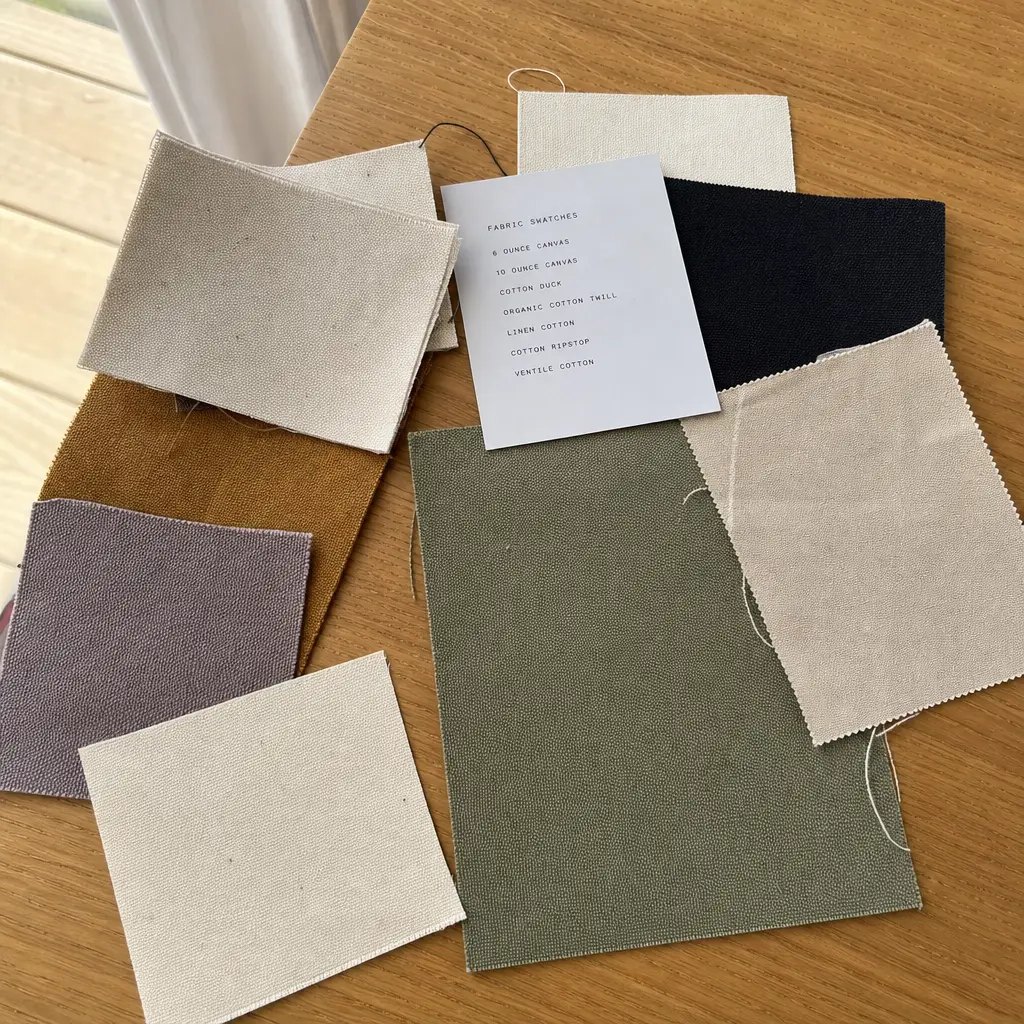
Finish matters as much as weight. Natural unbleached canvas suits an organic wellness look, but it often includes seed flecks, slubs, and lot-to-lot shade variation. Bleached canvas gives a cleaner background for printing, though it may feel less earthy. Dyed canvas can match brand colors, but it adds material lead time and color tolerance risk. If the logo uses sage, clay, cream, soft gray, beige, or other low-contrast tones, test the print on production-equivalent fabric.
- Budget event use: 10-12 oz canvas, simple construction, one-position print, and limited hardware.
- Studio retail: 14-16 oz canvas, reinforced stress points, clean flap surface, and controlled print finish.
- Premium retreat gift: 16 oz canvas, upgraded hardware, optional lining, and tighter packing control.
- Heavy commuter positioning: 18 oz canvas only if higher unit cost, sewing complexity, and freight weight are acceptable.
- Natural canvas standard: approve acceptable shade range, slubs, seed flecks, and surface character before production.
Measure Placement From Finished Points
The most common logo-placement mistake is measuring from the cut panel instead of the finished flap. Once the panel is sewn, turned, pressed, topstitched, fitted with a closure, and shaped at the corners, the visible safe area becomes smaller. Thick canvas and curved corners reduce it further. A logo that looked centered on a flat pattern can look low, tight, or tilted after sewing.
A production-ready instruction should use finished, repeatable measurement points. For example: logo centered horizontally on finished flap; artwork width 220 mm; artwork height 65 mm; bottom of artwork 75 mm above finished lower flap edge; minimum 35 mm from finished side seam; no print within 25 mm of magnetic snap center; placement tolerance +/-5 mm. The exact numbers must match the final bag, but this format gives the factory and inspector something measurable.
Quiet wellness branding often looks better in the lower right corner than across the full flap. It feels more like a retail accessory and less like event signage. Small marks, however, need simpler artwork. Fine taglines, delicate icons, thin lotus line art, and small reversed text can lose definition on textured canvas, especially with water-based ink. Confirm the minimum line width and approve a physical strike-off before bulk production.
- Measure from finished flap edge, finished side seams, visible fold line, snap center, and topstitch line.
- Keep 25-35 mm clearance from seams, curved corners, closure pressure points, and the lower flap edge where construction allows.
- State placement tolerance in millimeters, with +/-5 mm as a common practical target for simple flap printing.
- Photograph the approved sample with a ruler and use it as a shared factory, buyer, and inspection reference.
- Reject generic mockups that show a floating logo without finished dimensions or construction details.
Match Branding Method to Artwork
Screen printing is usually the best cost-to-quality choice when the artwork uses one to three solid colors. It works well on cotton canvas, keeps the flap relatively flexible, and suits repeat wholesale orders. Water-based ink can deliver the softer hand feel many wellness brands prefer. Pigment or more opaque systems may be needed for dyed or darker canvas. The RFQ should name the ink type and curing approach instead of saying screen print only.
Heat transfer has a place. It can handle gradients, photographic artwork, full-color graphics, and very small quantities. Still, it needs careful testing on a messenger flap because the flap bends, rubs, and may touch hardware during packing. A transfer that looks fine on a flat swatch may show edge shine, cracking, lifting, or stiffness after repeated opening and closing. For wellness products, hand feel matters; a glossy plastic patch can fight against the natural canvas story.
Embroidery, woven labels, cotton labels, and patches can also work when they fit the brand and budget. Embroidery is strongest for small marks, not large dense logos that may pucker a flat flap. Woven labels are reliable for subtle retail branding and can sit in a side seam, flap edge, inner pocket, or strap end. A patch can look premium, but it adds material approval, color control, stitching alignment, and more QC decisions.
- Screen print: best for solid marks, clean typography, volume orders, and controlled unit cost.
- Water-based print: good for soft hand feel and natural canvas, but opacity must be checked on the actual fabric shade.
- Heat transfer: useful for complex artwork, but requires adhesion, flex, rub, gloss, and edge-lift checks.
- Embroidery: suitable for small premium marks, risky for large dense designs on a flat flap.
- Woven or cotton label: subtle, retail-friendly, and reliable for quiet wellness branding.
- Patch: visually strong, but adds material sourcing, attachment alignment, and defect classification.
Build a Quote You Can Compare
Messenger bag prices can vary for reasons that are not obvious in a short email quote. Compared with a flat tote, a messenger bag may include a shaped flap, gusset, adjustable strap, slider, snap, rivets, lining, pockets, reinforcement patches, print, labels, hangtags, and individual packing. If one supplier quotes a 12 oz unlined bag and another quotes a 16 oz reinforced bag with metal hardware, the cheaper price is not a saving. It is a different product.
A comparable RFQ should separate the base bag, branding, accessories, sampling, packing, and export data. Ask each supplier to show what is included and what is charged separately: screen setup, strike-off, sample fee, label tooling, patch cost, hardware upgrade, barcode labels, branch carton labels, inner packing, and carton marks. This makes cost differences visible before the purchase order is placed.
Production flow also changes placement risk. Printing on cut panels gives a flatter print surface and cleaner pressure, but artwork must be approved before cutting, and misprints can create panel scrap. Printing on finished bags may reduce panel scrap, but it can restrict print area, increase handling difficulty, and make tight placement harder. Ask the factory which process it recommends and what tolerance it can hold.
- Base bag: finished dimensions, canvas GSM, lining, gusset, flap shape, strap, pocket, reinforcement, and stitching.
- Branding: artwork dimensions, color count, ink type, placement, tolerance, label size, and method-specific setup costs.
- Hardware: snap, slider, buckle, rivet, zipper, ring, metal finish, rust-control expectation, and attachment method.
- Packing: fold method, individual packing, carton quantity, carton size, carton marks, barcode labels, and branch allocation.
- Commercial terms: MOQ, sample cost, lead time, payment terms, incoterm, quote validity, carton CBM, net weight, and gross weight.
Control MOQ and Logo Versions
MOQ is usually driven by the most restrictive custom component, not simply by the number of finished bags. Stock natural canvas, standard cotton webbing, available hardware, and one-color screen print may support lower wholesale quantities such as 300-500 pieces when material stock and production capacity allow. Dyed canvas, custom strap color, custom lining, custom woven labels, custom patches, branded metal hardware, or multiple print colors can push MOQ higher because mills, webbing suppliers, label makers, and hardware suppliers have their own minimums.
Wellness groups often need more than one logo version in the same order. A chain may need branch logos. A retreat may need date-specific artwork. A corporate wellness buyer may need sponsor versions. This is manageable if the body construction stays the same and only artwork changes. The RFQ should list quantity by version and state whether cartons must be packed by logo, destination, branch, or event date.
Treat version control like SKU management, not a side note. Each artwork file should have a clear filename, revision date, logo size, placement diagram, color reference, production quantity, and carton-label rule. Avoid instructions buried in chat threads, such as use the green logo for Studio A. The purchase order should list every version as a line item so printing, inspection, and packing teams follow the same record.
- Lowest complexity: stock natural canvas, standard strap, standard hardware, one-position one-color screen print.
- Medium complexity: adjusted strap length, added pocket, upgraded snap, custom label, hangtag, or barcode sticker.
- Higher complexity: dyed fabric, custom webbing, custom lining, branded hardware, patches, or multiple logo colors.
- Version control: assign each artwork a SKU, quantity, file name, revision date, placement diagram, and carton label.
- MOQ warning: very low MOQ may mean stock fabric only, digital print, limited color choices, simplified packing, or available hardware only.
Approve Samples in Clear Gates
Do not approve a messenger bag sample only because it looks generally good. Approval should cover final fabric, fabric weight, logo size, logo color, logo position, print feel, flap shape, strap construction, closure alignment, hardware finish, pocket dimensions, seam quality, reinforcement, odor, cleanliness, and packing. If the sample uses a temporary substitute, such as non-final hardware or available canvas, record exactly what will change before bulk production.
A staged sample process reduces bulk risk. A fabric swatch confirms color, hand feel, GSM, and natural canvas character. A print strike-off confirms ink coverage, color, edge sharpness, line width, opacity, and hand feel on production-equivalent canvas. A construction sample confirms dimensions, function, and sewing. A pre-production sample confirms the full product with final materials, final logo placement, final hardware, final strap, final pocket layout, and final packing.
The approved pre-production sample should become the production standard. Photograph it with a ruler on the flap, record the approval date, and keep a sealed reference sample when possible. Marketing should approve the visible brand result. Procurement should approve cost, construction, packing, delivery, and inspection requirements. That split prevents one team from approving a digital proof while another assumes the physical bag has already been cleared.
- Measure logo width, height, distance from bottom flap edge, distance from side seams, and distance from snap or closure.
- Check flap symmetry and logo balance with the bag empty, lightly filled, closed, open, and worn crossbody.
- Review print color under neutral light against the approved strike-off or Pantone target.
- Flex the flap repeatedly to check cracking, stiffness, transfer lifting, ink dusting, or rubbing against hardware.
- Confirm strap length range, slider function, webbing comfort, and whether the strap covers the logo in display photos.
- Verify packing does not fold through the logo, press hardware into ink, or soil light natural canvas.
Set Inspection Criteria Early
Quality control should focus on the details buyers and end users notice first: the front flap, logo, stitching, strap, closure, cleanliness, and packing. Natural canvas may include small slubs, seed flecks, and shade variation. It should not include oil stains, mildew odor, dirty fingerprints, large broken yarns in visible areas, obvious panel mismatch, or carton transfer marks. Define acceptable natural character before production, not after cartons are ready to ship.
In-line inspection is useful for both logo placement and construction. If the first printed panels are off-position, production can stop before hundreds of bags are sewn. If strap joins are weak or snap placement is misaligned, correction is easier before final packing. Final inspection should then confirm measurement, print appearance, seam integrity, strap attachment, hardware function, cleanliness, odor, packing, and carton labeling.
For larger wholesale orders, buyers may use AQL inspection, but a generic bag checklist is not enough. The inspection document should name product-specific defects: logo more than the agreed tolerance from finished reference points, poor opacity on natural canvas, transfer edge lifting, snap pressure mark visible through the flap, loose strap anchor, flap not closing square, or mixed logo versions in one carton. Tie inspection to the approved sample and technical sheet.
- Critical defects: unsafe sharp hardware, mildew odor, severe contamination, wrong logo, wrong SKU, or non-functional closure.
- Major defects: logo outside tolerance, visible stains, open seams, weak strap anchors, misaligned flap, poor print adhesion, or mixed-version cartons.
- Minor defects: small loose threads, slight natural slub within approved range, or minor stitch waviness away from the visible front area.
- Functional checks: open and close snaps, slide adjusters, inspect strap anchors, and lightly load the bag for expected use.
- Measurement checks: verify finished dimensions, flap drop, logo position, pocket size, strap range, and carton quantity against the spec.
Protect the Flap in Packing
Packing affects both presentation and landed cost. A well-made canvas messenger bag can arrive looking cheap if the front flap is crushed, folded sharply, rubbed by a buckle, or marked by dirty cartons. Natural canvas shows dirt and abrasion more easily than dark synthetic fabric. If bags go directly to studios, retreat venues, fulfillment centers, or retail shelves, packing should be treated as part of the product specification.
Carton planning needs a balance between protection and freight efficiency. Many export cartons hold 25-50 pieces depending on finished size, canvas weight, strap folding, and individual packing. Too many pieces per carton can create compression marks, hard flap creases, and heavy handling weight. Too few pieces can increase CBM and landed cost. Request carton dimensions, net weight, gross weight, and CBM with the quote so procurement can compare total cost, not only unit price.
For multi-location wellness orders, carton labeling is a sourcing requirement. Each carton should identify purchase order number, SKU, logo version, color, quantity, destination, carton number, gross weight, and carton dimensions when needed. If bags must be pre-sorted by studio branch, retreat date, or retail door, provide that instruction before packing begins. Factory allocation is usually cleaner and cheaper than sorting after import.
- Protect the printed flap from buckles, snaps, rivets, dirty carton walls, sharp folds, and moisture.
- Use consistent strap folding so bags do not arrive tangled, twisted, or pressing into the logo.
- Specify individual polybag, recycled polybag, paper band, tissue, or no individual packing based on retail needs and sustainability policy.
- Request carton labels with PO number, SKU, logo version, quantity, destination, carton number, gross weight, and carton size.
- Pre-sort cartons by branch, retreat, event, or retail door when domestic repacking would be costly.
- Inspect final packing for flap compression, hardware pressure marks, carton dirt transfer, odor, and incorrect carton count.
Specification comparison for buyers
| Spec decision | B2B recommendation | Useful numeric target | Buyer risk to control |
|---|---|---|---|
| Primary front-flap logo | Approve placement on the finished flap, not only on a flat artwork mockup. Use finished seams, fold line, topstitching, and closure position as reference points. | Typical adult messenger bag: 180-240 mm logo width, with 25-35 mm clear margin from seams, snap, curved corners, and lower flap edge where construction allows. | If the supplier measures from the cut panel, the logo can shift after seam allowance, turning, pressing, snap installation, or curved-corner shaping. |
| Quiet wellness branding | Use a small one-color print, woven side label, cotton label, or sewn patch on the lower right flap, side seam, inner pocket, or strap end. | Small flap mark often 45-90 mm wide; woven labels commonly 25-50 mm wide depending on artwork and fold style. | Fine taglines, thin serif fonts, delicate mandalas, and icons under 0.4-0.5 mm line width may fill in or disappear on coarse canvas. |
| Canvas body fabric | Specify 14-16 oz cotton canvas, approximately 475-545 GSM, for most retail, retreat, and daily studio-use programs. Reinforce flap corners, gusset corners, and strap joins. | Request finished bag weight in grams per piece, plus carton quantity, net weight, gross weight, and CBM for freight comparison. | A cheaper quote may use lighter canvas, thinner webbing, or fewer reinforcements. Compare GSM, oz, finished weight, sample stiffness, and yarn feel. |
| Budget canvas option | Use 10-12 oz cotton canvas, approximately 340-410 GSM, only for lightweight event campaigns, welcome kits with low carry weight, or short-term promotions. | Best when contents are light, artwork is simple, and low carton weight matters more than a structured retail feel. | Large flaps can wrinkle, collapse, or distort the print when the bag is packed unevenly or worn crossbody. |
| Print method | Choose water-based or pigment screen print for 1-3 solid colors. Use transfer only when the artwork requires gradients, full color, or small-run flexibility. | Confirm ink type, color reference, curing method, hand-feel target, and rub/flex expectations before sampling. | Transfers can feel plasticky, show edge shine, crack on flap folds, or lift if not tested on the final canvas and closure construction. |
| Placement tolerance | Write measurable logo tolerance into the purchase order, tech pack, approved sample record, and inspection checklist. | Common practical target: +/-5 mm for a simple one-position flap print. Tighter tolerance may raise rejection risk on shaped or soft flaps. | Without a written tolerance, the factory, inspector, and buyer may disagree on whether an off-center logo is acceptable. |
| Strap construction | Use 38-50 mm cotton webbing with an adjustable metal slider and reinforced anchors for daily-use messenger bags. | Ask for strap length range, webbing GSM or thickness, slider material, and reinforcement method such as box stitch or bartack. | Thin webbing, weak bartacks, plastic sliders, or uneven anchor placement create fit complaints and durability risk. |
| Closure selection | Use a magnetic snap for a clean retail look. Consider covered hook-and-loop or buckle detail when event kits need stronger closure security. | Map closure center, stitched attachment area, and pressure points on the same drawing as the logo. | Closure hardware can mark the front flap, distort the logo, reduce safe print area, or create pressure marks during packing. |
| Interior organization | Specify one flat slip pocket for phone, card, or journal. Add zipper pockets only when the target retail price supports extra labor and inspection. | Define pocket width, height, opening direction, seam position, stitch type, and tolerance. | Unclear pocket dimensions cause sample revisions. Extra pockets add sewing defects, bulk, and inspection points. |
Buyer checklist before sampling
- Define the finished bag width, height, gusset depth, flap drop, flap width, strap width, strap length range, pocket layout, closure type, and expected carry load before asking for logo placement advice.
- Specify canvas weight in both oz and GSM. Also require finished bag weight per piece, carton quantity, carton dimensions, net weight, gross weight, and CBM for landed-cost comparison.
- Send editable vector artwork with final logo width and height, Pantone or approved color target, minimum line width, clear background instruction, and separate files for each studio branch or event version.
- Measure logo placement from finished reference points: finished flap edge, finished side seam, visible fold line, snap center, topstitch line, lower flap edge, and curved corner clearance.
- Decide how the logo must read: on a retail shelf, in e-commerce photos, when worn crossbody, when stacked in a welcome kit, or when used daily outside the studio.
- Confirm the branding method and included cost: screen print, heat transfer, embroidery, woven label, cotton label, patch, debossed label, or combined branding.
- Require a print strike-off on production-equivalent canvas when artwork uses muted wellness colors, small lettering, low-contrast ink, tight registration, reversed text, or line work below 0.5 mm.
- Approve a pre-production sample using final fabric, final print process, final closure, final hardware finish, final strap, final pocket layout, final reinforcement, and final packing method.
- Compare quotes using the same MOQ, SKU split, logo size, print color count, canvas GSM, strap specification, hardware type, packing method, carton quantity, incoterm, and sample requirement.
- Set written acceptance criteria for logo position tolerance, print color deviation, print adhesion, dry/wet rub, seam strength, strap pull, hardware alignment, closure function, cleanliness, odor, packing, and carton marks.
Factory quote questions to send
- What are the exact oz and GSM values for the body canvas, flap canvas, gusset, lining if any, pocket fabric, reinforcement fabric, and strap webbing?
- What are the finished bag width, height, gusset depth, flap width, flap drop, strap width, adjustable strap length range, and finished weight per piece?
- What reinforcements are included at strap anchors, flap corners, gusset corners, pocket openings, closure points, and other stress areas? Are bartacks, box stitches, rivets, or extra fabric patches used?
- Which logo methods are included in the quoted unit price, and which costs are separate: screen setup, print charge, transfer charge, embroidery digitizing, woven label mold, patch tooling, hangtag, or barcode label?
- What is the maximum safe printable area on the finished flap after allowing for seam allowance, topstitching, snap position, fold line, curved corners, and packing fold?
- Will the logo be printed on cut panels before sewing or on finished bags after sewing? What placement tolerance can you hold for each process?
- What MOQ applies separately to stock natural canvas, dyed canvas, custom webbing, custom lining, woven labels, patches, custom metal hardware, and retail packing?
- Can you provide a fabric swatch, print strike-off on bulk-equivalent canvas, construction sample, and pre-production sample before full production? What is the approval sequence?
- What are the sample lead time, strike-off lead time, material lead time, bulk production lead time, packing lead time, and extra time for dyed fabric or custom hardware?
- What inspection checks are performed in-line and final for print adhesion, dry/wet rub, color matching, seam quality, stitch density, strap pull, hardware function, needle damage, stains, odor, and carton condition?
Quality-control points to confirm
- Logo placement tolerance should be written into the purchase order and inspection sheet. A practical target is often +/-5 mm for a simple one-position flap print measured from finished reference points, while shaped flaps or complex construction may need a wider realistic tolerance.
- Print color should be checked under neutral light against the approved strike-off, Pantone target, or sealed sample. Do not approve bulk color from a phone photo or monitor proof alone.
- Screen print edges should be sharp and even, with no pinholes, ink bleeding, ghost image, registration shift, poor opacity, contaminated ink spots, or heavy buildup near flap folds.
- Heat transfers should be checked for edge lifting, cracking, scorch marks, gloss difference, stiff hand feel, adhesive bleed, and adhesion after repeated flap flexing.
- Artwork should meet the factory's minimum printable line width. For textured canvas, request confirmation before approving fine taglines, small reversed text, thin icons, or detailed mandalas.
- Main seams, flap seams, pocket seams, gusset corners, strap anchors, and topstitching should show consistent stitch density with no skipped stitches, broken threads, open seams, loose threads, or seam puckering.
- Strap attachment should be checked against the expected carry load. Require reinforced stitching such as bartack or box stitch, then inspect both visual alignment and practical pull resistance.
- Magnetic snaps, sliders, buckles, rivets, zippers, and rings should be aligned, smooth, rust-free, securely attached, and protected so they do not mark the printed flap during packing.
- Natural canvas shade should be controlled by fabric lot. Bulk panels should be compared with the approved sample, and obvious front-panel mismatch, oil marks, mildew odor, dark handling marks, or large broken yarns should be rejected.
- Cartons should protect the front flap from moisture, abrasion, hard folds, excessive compression, and direct contact between metal hardware and printed surfaces. Carton marks should match the packing list and purchase order allocation.