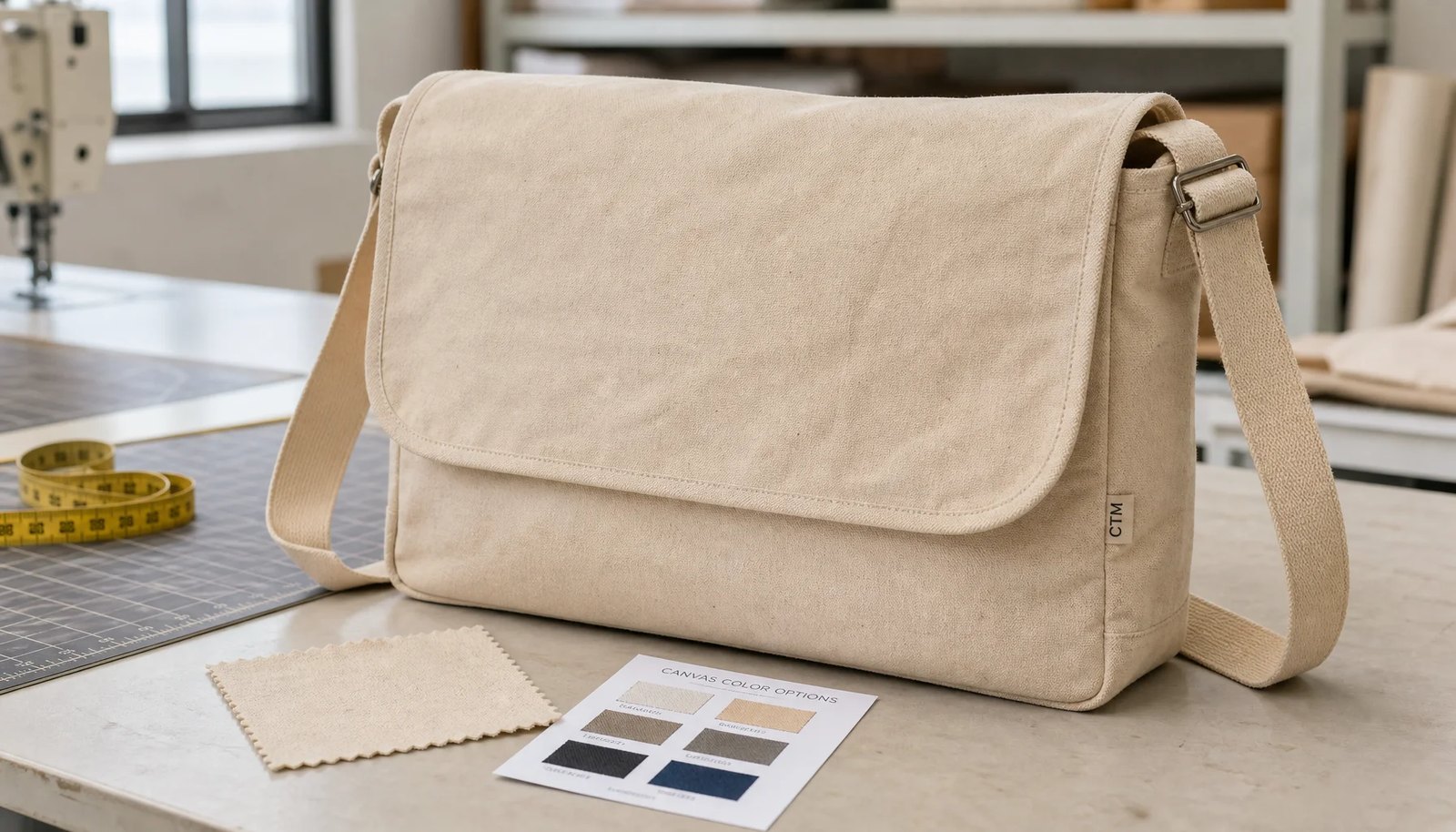
Why MOQ negotiation is different for university bookstore messenger bags
Wholesale canvas messenger bags for university bookstores are not the same as generic promotional bags. A bookstore order usually has retail display requirements, licensed logo controls, semester timing, and inventory risk. The buyer may need only a few hundred pieces for a pilot program, while the factory is thinking in fabric rolls, cutting efficiency, print setup, and packing labor. MOQ negotiation works best when both sides can see which part of the order is creating the minimum.
The common mistake is to send a simple message such as, "Please quote 300 pieces with logo." That forces the supplier to guess the canvas weight, color, print method, pocket structure, and packing. A responsible factory may quote high because the unknowns look risky. A weak supplier may quote low, then change the fabric, delay sampling, or add charges later. The better RFQ shows where the buyer can accept standardization and where the bookstore cannot compromise.
- Good MOQ negotiation starts with a controlled specification, not only a target quantity.
- The factory MOQ may come from fabric, dyeing, printing, labels, hardware, or packing rather than sewing.
- A lower first order quantity is easier to support when the buyer uses standard canvas colors and standard hardware.
- University bookstore programs should protect timing for semester opening, alumni events, orientation, and holiday retail.
Build the RFQ around the carrying use, not only the appearance
A messenger bag sold in a campus bookstore may carry notebooks, a water bottle, small electronics, or a light laptop. If the buyer specifies only a photo reference, two suppliers can quote very different bags. One may use 8 oz canvas with a narrow strap and light seams. Another may quote 12 oz canvas with reinforced tabs and a lined flap. Both may call the item a canvas messenger bag, but the retail performance and cost are not comparable.
Start the RFQ with the intended use and target retail price band. For example, a low-price spirit item can use a simple flap, one main compartment, and a screen-printed logo. A higher-end bookstore item may need a padded sleeve, zipper closure under the flap, antique brass hardware, and a woven campus label. These choices change MOQ because they change material sourcing and labor routing.
- State finished dimensions such as 38 x 28 x 10 cm, plus acceptable tolerance.
- Define strap width, for example 3.8 cm or 5 cm cotton webbing, and whether it is adjustable.
- List compartments: main body, inner slip pocket, front pocket, zipper pocket, or laptop sleeve.
- Specify closure: flap only, magnetic snap, Velcro, zipper under flap, or buckle detail.
- Describe the expected load, such as 3-5 kg for daily campus use, so reinforcement is not underbuilt.
Fabric weight and canvas source are the first MOQ drivers
Canvas weight is one of the biggest differences between a trial MOQ and a normal production MOQ. Natural cotton canvas in common weights is often easier for a factory to source in smaller quantities. Custom-dyed canvas, unusual recycled blends, or uncommon weights may require the factory to buy a full fabric lot. That fabric lot can be larger than the buyer's first bookstore order.
For university bookstore messenger bags, 10 oz to 12 oz cotton canvas is a practical starting point. In metric terms, that is often around 280-340 GSM, depending on weave and finishing. Lighter canvas can work for giveaway-style bags but may not hold the flap shape well. Heavier 14 oz to 16 oz canvas can feel premium but increases sewing difficulty, freight weight, and cost. If the bookstore wants a soft washed look, include shrinkage and color variation expectations in the spec.
- Natural canvas is usually the easiest path for lower MOQ and faster sampling.
- Black and navy may be standard stock for some factories, but shade can vary between mills.
- Custom school-color dyeing should include lab dip approval and may raise MOQ significantly.
- Pre-shrunk or enzyme-washed canvas can reduce post-production distortion but adds process time.
- A quote should state both oz and GSM because regional suppliers use different measurement habits.
How print method affects MOQ, setup cost, and rejection risk
Most bookstore messenger bags use screen printing because it is efficient for solid logos, school marks, and simple graphics on the flap or front panel. Screen printing has setup cost per color and requires curing control. On coarse canvas, very fine text, thin outlines, and small trademark details can fill in or appear uneven. If the design is licensed, the artwork should be approved at actual print size before the supplier burns screens.
Embroidery, woven labels, and patches can improve perceived value but may create their own MOQ. A woven label supplier may require a minimum label quantity that exceeds the bag order. Embroidery digitizing is not expensive compared with bulk production, but dense embroidery on a flap can pucker if the fabric is not stabilized. Heat transfer can handle gradients, but it may not match the handfeel expected on a natural canvas retail item.
- Use screen print for bold one-color or two-color bookstore graphics.
- Use embroidery for small premium marks, not large dense areas across the flap.
- Use woven labels when the buyer wants repeat branding across multiple bag styles.
- Avoid tiny legal text on rough canvas unless a printed label or hangtag can carry it instead.
- Request a print strike-off or pre-production sample using the final canvas color.
A practical MOQ negotiation model that factories can actually use
The most effective MOQ conversation gives the factory options. Instead of demanding one low quantity, request a tiered quote. For example, ask for 300, 500, 1,000, and 2,000 pieces with the same specification, then ask the factory to show which charges change at each level. This separates true production efficiency from simple margin padding. It also gives the bookstore buyer a clear view of whether a small trial order is commercially sensible.
When the preferred quantity is below the supplier's normal MOQ, offer controlled compromises. Keep the same body fabric as a stock item. Use one standard color. Reduce the number of print colors. Accept a standard carton pack. Move custom hangtags to a second order. These changes are more useful than asking the supplier to "support the first order" without changing any production burden.
- Negotiate MOQ per color and per design, not only total pieces.
- Ask whether 300 natural canvas pieces can be produced while 300 custom-dyed pieces cannot.
- Keep hardware standard unless it is central to the retail positioning.
- Use a shared woven label program across totes, pouches, and messenger bags to spread label MOQ.
- If the factory charges a low-quantity surcharge, request it as a separate line so later reorders are cleaner.
Compare quotes by cost structure, not only unit price
A low unit price can hide weak fabric, missing packing, or excluded setup charges. For a university bookstore order, the quote should show enough data for landed-cost comparison. The buyer needs unit price, sample cost, screen charges, label charges, packing method, carton dimensions, gross weight, and estimated CBM. Without these details, the purchasing team cannot compare sea freight, air freight, or warehouse receiving costs accurately.
Factories also quote under different Incoterms. An EXW price may look attractive but leaves inland transport, export handling, and document coordination to the buyer. FOB is usually easier for importers comparing factories in the same country. DDP can be convenient for small trial orders, but the buyer should understand what duty code, tax treatment, and delivery address are assumed. For a bookstore distributor, carton labeling and delivery appointment requirements can matter as much as the bag cost.
- Request unit cost at each quantity tier with the same specification.
- Separate one-time charges from repeat-order unit cost.
- Collect carton quantity, dimensions, gross weight, net weight, and CBM.
- State the target Incoterm: EXW, FOB, CIF, DAP, or DDP.
- Check whether barcode labeling, inner packing, and carton marks are included.
Sample approval should prove production, not just appearance
A messenger bag sample can look acceptable in a photo and still fail when produced in bulk. For MOQ negotiation, the sample is also a technical agreement. It confirms fabric weight, handfeel, print sharpness, hardware color, strap length, sewing reinforcement, label placement, and packing. If the factory makes the sample from substitute fabric because production fabric is not available, the buyer should treat it as a construction sample only.
The pre-production sample should be made after final artwork, final fabric, and final hardware are selected. For licensed university artwork, this sample may need approval from the licensing office or brand manager before bulk cutting. Do not allow bulk fabric cutting before logo placement, print color, and construction are signed off. The cost of correcting a wrong flap print after cutting is much higher than the cost of a few extra sample days.
- Measure the sample against the approved spec sheet and record actual dimensions.
- Test strap length adjustment and hardware movement by hand, not only visually.
- Rub the print after curing and check for cracking, smearing, or poor opacity.
- Load the bag with realistic weight and inspect strap tabs for seam stress.
- Approve one physical sample as the factory reference and keep one buyer reference if possible.
Packing decisions influence bookstore receiving and freight cost
Packing is often treated as an afterthought, but it can affect both cost and sell-through. Individual polybags keep canvas clean during freight and warehouse handling, but some universities prefer reduced plastic. A paper belly band or recyclable paper bag may be better for sustainability positioning, although it may not protect natural canvas from dust as well. The RFQ should state the preferred retail packing clearly so the supplier does not quote the cheapest default.
Carton packing should protect the shape of the flap and avoid excessive compression. Messenger bags with stiff bottom panels, buckles, or metal sliders should be arranged so hardware does not press into printed areas. For retail buyers, carton marks, SKU labels, and barcode accuracy are critical. A factory that ships mixed colors or designs without clear carton identification can create receiving delays at the bookstore warehouse.
- Use individual bags or paper wraps when natural canvas must remain clean for retail display.
- Limit carton weight to a level campus receiving staff can handle safely.
- Confirm pieces per carton by actual sample packing, not only by calculation.
- Place hardware away from printed logo surfaces to prevent pressure marks.
- Require carton marks to show PO number, SKU, color, quantity, carton number, and destination.
Lead time risk is tied to MOQ decisions
A lower MOQ does not always mean faster delivery. If the order uses custom-dyed fabric, a special woven label, or late artwork approval, the lead time may be longer than a larger standard-color order. University bookstores often work backward from a fixed retail date. Orientation, homecoming, graduation, and semester opening do not move because production is late. The RFQ should include the required ship date and the last acceptable arrival date.
A realistic schedule includes artwork approval, sample making, sample transit, sample review, fabric preparation, cutting, printing or embroidery, sewing, trimming, QC, packing, and export booking. During peak bag seasons, printing and sewing lines may be full. If the buyer is negotiating a small MOQ, the order may not receive the same production priority as a larger program unless the timing is agreed in writing.
- Reserve 7-12 days for a serious pre-production sample after complete artwork.
- Allow 25-45 days for standard bulk production after deposit and sample approval.
- Add time for lab dips if custom school colors are required.
- Do not count sample transit and buyer approval days as factory production days.
- For urgent bookstore launches, standard fabric and one-color print are the safest combination.
Set acceptance criteria before the purchase order is issued
MOQ negotiation should not weaken quality requirements. A small trial order still needs clear acceptance criteria because it may be sold directly to students, alumni, and campus visitors. Define tolerances that match sewn canvas production. Overly tight tolerances raise cost and disputes; vague tolerances create inconsistent goods. A practical spec sheet includes measurement points, print placement, shade tolerance, stitch quality, packing, and barcode rules.
Final inspection should sample across cartons, colors, and production batches. For bookstore goods, appearance defects are especially visible because products may be displayed face-out. Natural canvas can have slubs and minor weave variation, but oil stains, large dark marks, print smears, loose threads, broken stitching, and wrong labels should not pass. The buyer should decide whether inspection is done by the factory QC team, a third-party inspector, or the importer's own office.
- Finished size tolerance: commonly plus or minus 1 cm on main dimensions unless otherwise agreed.
- Print placement tolerance: define distance from flap edge, seam, or pocket line.
- Shade tolerance: approve fabric swatch or lab dip and keep it with the sealed sample.
- Stitching: no skipped stitches, broken seams, open bartacks, or loose strap tabs.
- Packing: correct SKU, correct carton count, clean bags, and no crushed retail-facing panels.
Specification comparison for buyers
| Spec decision | Recommended option | When it fits | Buyer risk to check |
|---|---|---|---|
| Canvas body fabric | 10 oz to 12 oz cotton canvas, about 280-340 GSM, pre-shrunk if printed after washing is expected | General university bookstore retail where the bag needs structure but must remain affordable | Some suppliers quote 8 oz canvas to win price; it may collapse, show print bleed, or feel too light for textbook use |
| Order color strategy | Start with natural, black, navy, or one dyed school color only | Best route when the buyer wants to negotiate MOQ below a normal dyed-fabric production run | Custom Pantone-dyed canvas can force higher fabric MOQ and longer lab dip approval |
| Logo decoration | Screen print for 1-3 solid colors; woven label or embroidery for premium bookstore programs | Screen print works for bold school marks and bookstore graphics on flap or front pocket | Fine halftones, small legal text, or large ink coverage can increase rejection risk on coarse canvas |
| Bag construction | Flap messenger with inner slip pocket, reinforced strap tabs, and boxed bottom | Suitable for campus retail because it balances function, price, and display appearance | Thin strap attachment stitching is a common failure point when students carry laptops or books |
| MOQ negotiation lever | Negotiate by standardizing fabric, hardware, lining, and carton packing before pushing quantity down | Useful when bookstore demand is uncertain or the season is a trial launch | A low MOQ with many custom details often moves cost into setup charges, sample fees, or poor margin |
| Packing format | Individual polybag or paper belly band, then 25-50 pieces per export carton depending on size | Works for bookstore receiving, shelf replenishment, and cleaner retail handling | Overpacked cartons can crush flaps and bend bottom panels; underpacked cartons raise freight cost |
| Sample approval | Pre-production sample using production fabric, actual print, real hardware, and final packing method | Needed before bulk cutting when the order includes school logo, custom color, or retail barcode label | A sales sample made from substitute canvas does not prove shrinkage, print adhesion, or final handfeel |
| Lead time planning | Allow 7-12 days for sampling after artwork and 25-45 days for bulk after deposit and sample approval | Realistic for standard canvas, standard colors, and normal screen printing during non-peak periods | Peak season, dyed fabric, embroidery, or late artwork approval can push shipment past semester opening |
Buyer checklist before sampling
- Define the exact messenger bag size, flap style, pocket layout, strap width, and intended carrying weight before requesting MOQ.
- Choose a target canvas weight in oz and GSM, not just the word canvas.
- Separate standard-color MOQ from custom-dyed-color MOQ in the RFQ.
- Send artwork with print size, Pantone references, placement, and whether the logo must match licensed university standards.
- State whether the bag needs an internal label, hangtag, barcode sticker, retail polybag, or carton shipping mark.
- Require the supplier to quote sample cost, mold or screen charge, bulk unit cost, packing cost, and freight-ready carton data separately.
- Set acceptance criteria for print position tolerance, stitching strength, shade variation, and carton condition before production.
- Request a pre-production sample made with production fabric and actual print method, not only a digital mockup.
- Confirm whether MOQ is per style, per color, per print design, or per shipment.
- Calculate landed cost using carton dimensions, gross weight, duty code assumptions, and destination receiving limits.
Factory quote questions to send
- What is your MOQ for this messenger bag per style, per fabric color, and per logo design?
- Is the quoted MOQ based on greige fabric stock, standard dyed canvas, or custom Pantone-dyed fabric?
- What canvas weight will you use in oz and GSM, and is it cotton canvas, poly-cotton canvas, or recycled cotton blend?
- What is the minimum fabric consumption required for this size, and can the pattern be nested with another buyer's fabric run?
- Which print method do you recommend for our artwork, and what is the maximum printable area on the flap or front pocket?
- Are screen setup charges, embroidery digitizing charges, woven label MOQ, or packing label charges included in the unit price?
- Can you provide one quotation at the normal MOQ and one quotation at our preferred trial quantity with all surcharge lines shown?
- What are the sample lead time, bulk lead time, and last artwork approval date needed for our ship window?
- What are the export carton dimensions, pieces per carton, gross weight, net weight, and estimated CBM for the quoted order?
- What stitching reinforcement is included at strap tabs, flap corners, bottom corners, and pocket openings?
Quality-control points to confirm
- Canvas weight tolerance should be agreed before production, for example quoted GSM plus or minus 5-8 percent depending on fabric source.
- Finished size tolerance should be practical for sewn canvas bags, commonly plus or minus 1 cm on main dimensions unless a tighter retail spec is justified.
- Logo placement tolerance should be defined in millimeters from seam or flap edge, not judged only by visual alignment.
- Screen print adhesion should pass a tape test and light rub test after full curing, especially on dark dyed canvas.
- Strap attachment should use box stitch, bartack, or dense reinforced stitching appropriate to the intended load.
- Metal hardware should be checked for sharp edges, plating consistency, and slider movement before packing.
- Flap, pocket, and bottom panel seams should be inspected for skipped stitches, loose threads, and seam slippage.
- Retail labels, barcodes, hangtags, and carton marks should match the purchase order exactly before shipment release.
- Cartons should be drop-tested or at least checked for compression resistance if the bags ship by sea and move through campus receiving.
- Final AQL inspection should include workmanship, measurement, print, packing, and carton count, not only visual appearance.