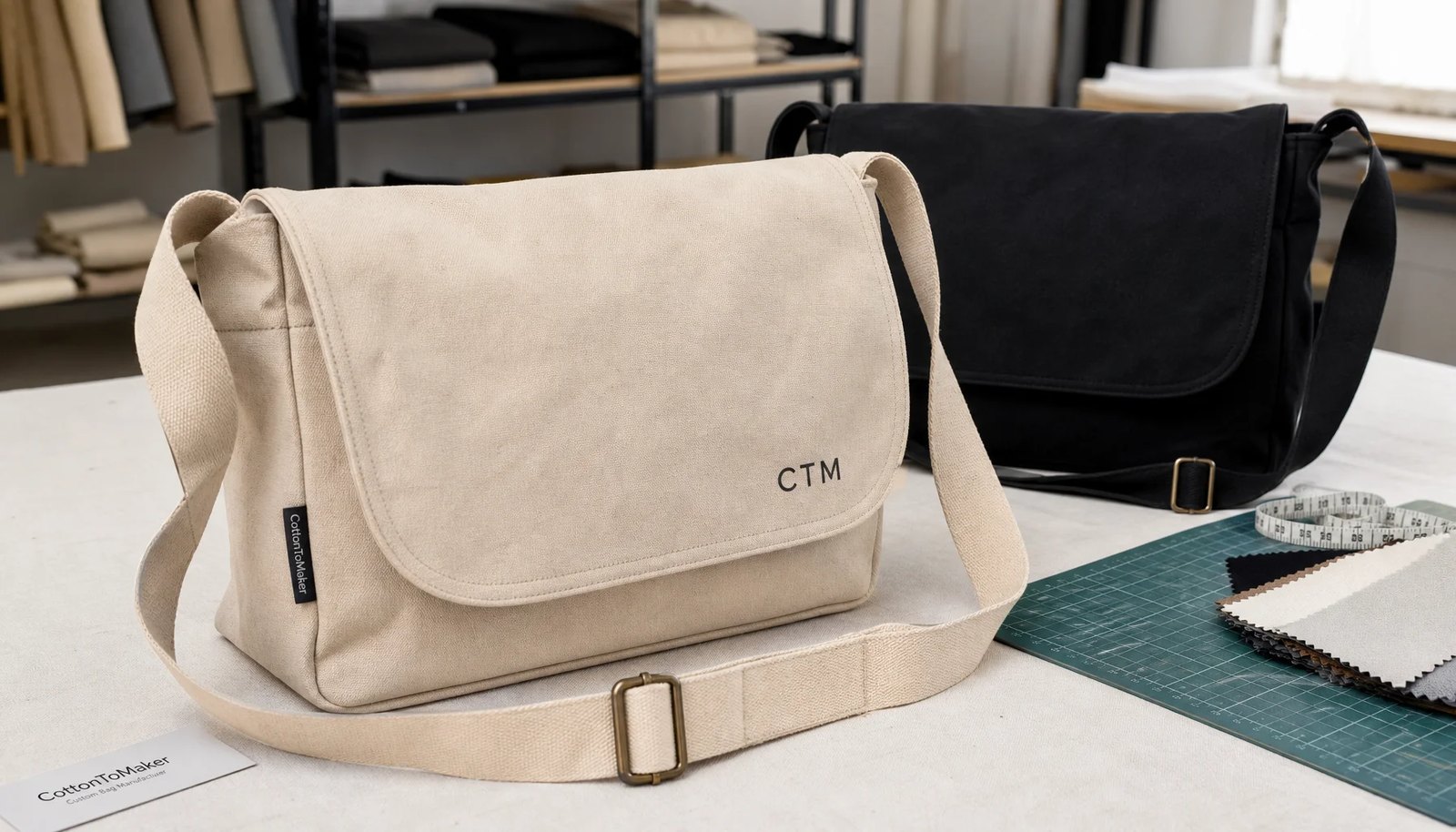
Start With the Event Constraint, Not the Unit Price
MOQ negotiation for wholesale canvas messenger bags for trade show exhibitors should start with the event requirement, not the factory's preferred batch size. The same bag can serve as a brochure carrier, a dealer meeting kit, a sponsor gift, a conference registration item, or a staff utility bag. Those uses do not require the same construction, and they do not carry the same schedule risk. If a buyer treats them as identical, the quote often becomes either too expensive or too vague to use.
For trade show programs, the real deadline is not the purchase order date. It is the latest day the cartons can land at the receiving warehouse and still be useful for the event. That changes the way MOQ should be framed. A bag that arrives after booth setup is a lost asset, even if the fabric, stitching, and print are all correct. Procurement should therefore tie the order discussion to ship date, warehouse location, receiving window, and the amount of risk the team can tolerate.
The quantity itself needs context. A 300-piece order should usually stay close to the factory's existing bag pattern, stock canvas, and standard packing. A 1,000-piece regional program may support a few controlled changes without forcing a full redesign. A recurring annual event or sponsor campaign may justify higher initial commitment if the supplier can split deliveries by show date or warehouse. Buyers get more leverage when they can show whether the order is a one-off event purchase or a repeatable program.
- Use the event deadline as the primary commercial constraint.
- Define whether the bag is for giveaways, staff use, sponsor kits, or resale.
- Match the quantity to the amount of customization you actually need.
- Ask whether the order can be split across two or more event dates.
- Treat late delivery as a sourcing risk, not only a logistics issue.
Turn the Use Case Into a Measurable Spec
Factories quote more accurately when they know what the bag must carry. A messenger bag for brochures can be lighter and shallower than one built for sample packs, a tablet, and a water bottle. A staff bag used all day at a booth should be treated differently from a one-time attendee giveaway. In practice, that means the RFQ should describe the contents, not just the style. The load dictates the structure, and the structure affects MOQ.
The core specification should include finished size, gusset depth, flap depth, strap width, strap length range, closure type, pocket layout, print position, and packing format. A common exhibitor size might sit around 35 x 28 x 8 cm, but that is only a starting point. If the bag needs to hold A4 brochures, letter-size inserts, a tablet sleeve, or boxed samples, those internal dimensions should be written out. If it must fit inside an event kit carton, that carton dimension should also be shared before sampling begins.
Do not rely on a visual mockup as the only reference. Mockups help the brand team approve the look, but they do not tell the factory how much print area is available after seam allowances and panel curvature are counted. Buyers should specify logo width and height, placement from the flap edge, and the exact color reference. When those numbers are missing, suppliers fill in the gaps with assumptions, and then the quotes stop being comparable.
- Define the expected load: documents, catalogs, tablet, samples, or a mixed kit.
- Write measurements as width x height x gusset, and list flap depth separately.
- State strap width and adjustable length range if the bag will be worn for long periods.
- Specify the closure as open flap, hook-and-loop, snap, buckle, magnetic button, or zipper under flap.
- Separate mandatory features from optional upgrades before you ask for price.
Choose Canvas Weight and Composition With Intent
Canvas is not a single material category. Procurement should ask for fabric weight in ounces and GSM, plus fiber composition. For many trade show messenger bag programs, 10 oz to 12 oz canvas is the practical starting range. It gives more body than a light promotional tote, but it stays within a cost and freight profile that makes sense for event distribution. If the bag only carries paper materials, 8 oz may be enough. If the sponsor expects a more premium, reusable item, 14 oz to 16 oz starts to make sense, but the unit cost and shipping weight rise with it.
Weight terminology needs careful handling. One supplier may quote greige weight before dyeing or finishing, while another uses finished fabric weight. Some sales teams use commercial shorthand that does not align cleanly with GSM. A buyer comparing offers should ask each supplier to state the measurement basis and provide a swatch. That swatch is not a courtesy sample; it is the reference standard for bulk approval.
Composition also changes the sourcing decision. 100 percent cotton canvas has the familiar look many brands want, but it can show slubs, flecks, and shade variation. Recycled cotton blends may suit sustainability goals, but the buyer should verify consistency and any testing claims rather than accepting broad wording. Poly-cotton canvas can improve dimensional stability or reduce cost in some cases, but it also changes hand feel and print behavior. The right answer depends on event positioning, artwork complexity, and the weight of the items inside the bag.
- 8 oz canvas: suitable for light document programs and cost-sensitive giveaways.
- 10 oz canvas: common starting point for exhibitor messenger bags that need decent body.
- 12 oz canvas: a stronger option for sponsor kits or repeated event use.
- 14 oz to 16 oz canvas: a premium, heavier choice with higher material and freight cost.
- Ask whether the quote is based on cotton, recycled cotton blend, poly-cotton, or another composition.
Use Construction Choices as Negotiation Levers
MOQ is easier to negotiate when the bag uses a pattern the factory already understands. A standard canvas messenger bag usually includes a flap, one main compartment, an adjustable shoulder strap, and sometimes a slip pocket. That is a useful format for trade shows because it gives visible branding, enough capacity for event materials, and a manageable sewing process. The more the buyer departs from an existing pattern, the more likely the factory is to ask for a higher minimum or a larger sample charge.
Each added feature should be treated as a separate sourcing decision. A zipper under the flap increases security, but it adds material, sewing time, and inspection points. A lining improves presentation, but it adds another layer of construction and may require extra color matching. Foam padding helps if the bag will carry electronics, but it is unnecessary for many brochure programs. Contrast binding, rivets, woven labels, custom pullers, extra pockets, and top-stitch details can all be useful, but they should not enter the base quote by accident.
Strap attachment deserves particular attention because it is where failures happen first. Exhibitors often overload these bags with catalogs and samples, so the load-bearing points need reinforcement. Procurement should specify bar tack, box stitch, or box-X stitch where the strap meets the body. If metal hardware is used, the factory should confirm the plating finish, edge smoothness, and slider function. If plastic hardware is used, the buyer should confirm that it carries the intended load without making the bag look too flimsy for the brand.
- Keep the silhouette close to an existing factory pattern when MOQ flexibility matters.
- Set gusset depth based on the actual contents, not on a guess.
- Specify reinforcement at all load-bearing strap points before sample approval.
- Add lining, zipper, or padding only when the event use truly requires it.
- Ask whether labels, patches, or hangtags have separate component minimums.
Match the Logo Method to the Fabric and Deadline
For most wholesale canvas messenger bags used by trade show exhibitors, screen printing is the most practical branding method. It supports one to three solid colors, gives strong flap visibility, and is usually easier to repeat across event seasons than more complex decoration. The catch is that canvas is textured. Small type, thin strokes, and reversed details can lose sharpness if the artwork is not prepared for the fabric. Buyers should review the mark at actual size and ask for a print strike-off on the real material whenever the logo includes fine detail.
Dark canvas deserves separate treatment. A white or bright logo on black or navy fabric may need an underbase to reach the required opacity. That can add cost, extend lead time, and slightly change the hand feel of the print. Natural canvas is more forgiving, but it still varies in texture, and large ink blocks can crack or feel stiff if the wrong ink system is used. The buyer should ask how the factory cures the ink and what rub or adhesion checks are appropriate for the chosen setup.
Screen print is not the only option. Heat transfer can work for full-color sponsor artwork or graphics with gradients, but it should be sampled for edge adhesion and surface feel. Digital print may help with detailed artwork, although it still needs real-fabric validation. Embroidery can look premium for smaller marks, yet dense stitching on a flap can pucker the cloth and increase cost. Woven labels or patches are useful when multiple sponsors share the same bag body or when artwork changes between events. The decision should follow the print requirement and the order size, not the mockup trend.
- Screen print: best for solid logos, limited colors, and repeat trade show programs.
- Heat transfer: useful for full-color graphics, but test edge adhesion and feel.
- Digital print: useful for detail and gradients, but sample on the actual canvas.
- Embroidery: best for smaller premium marks; avoid oversized dense artwork without testing.
- Woven label or patch: useful when the bag body stays the same but branding changes.
Separate Hard MOQ Drivers From Flexible Ones
MOQ is rarely a single number created by the sales rep. It is usually a combination of fabric purchasing, cutting efficiency, sewing-line planning, accessory availability, print setup, packing materials, and schedule allocation. A supplier may be comfortable sewing 500 bags if the fabric is already in stock, but not if the order requires custom dyed canvas or custom webbing. A buyer gets much better results by asking which specific component creates the minimum and which parts are negotiable.
There is a useful distinction between hard MOQ and flexible MOQ. Hard MOQ usually comes from custom dyed fabric, custom webbing, plated hardware, woven labels, retail packaging, or special accessories. Flexible MOQ often comes from screen setup, cutting table organization, sewing-line assignment, or carton packing. Once the buyer understands the difference, the negotiation becomes practical. Instead of asking for a vague discount, the buyer can offer to use stock canvas, standard strap color, existing hardware, or bulk packing in exchange for a lower minimum.
Clarify whether the MOQ is per order, per color, per logo, per print color, or per shipment. That matters especially for trade show teams working with regional versions or multiple sponsors. An order of 1,000 total bags can look strong until it becomes five logo versions of 200 pieces each. A factory may accept the total quantity but still charge separate screen fees, setup work, or separation labor. The quote should show those differences before the order is awarded.
- Ask the supplier to name the component that creates the MOQ.
- Use stock fabric and standard webbing when lowering MOQ is the priority.
- Keep the same bag body across logo versions whenever possible.
- Expect separate setup costs for separate logos or print colors.
- Avoid retail packaging unless the channel requires it.
Build a Comparable RFQ Before You Compare Prices
A low quote means very little unless each supplier is pricing the same bag. In canvas messenger bag sourcing, price differences often hide in the details: lighter fabric, smaller dimensions, narrower straps, cheaper hardware, no inner pocket, smaller print area, simplified packing, or looser inspection. Procurement should use a controlled RFQ sheet so those substitutions are visible before the prices are compared.
The RFQ should ask for finished size, fabric weight, composition, color, strap width, hardware type, closure type, pocket layout, logo method, print area, print colors, packing method, sample cost, lead time, Incoterm, carton data, and payment terms. It should also ask for tolerance and inspection support. That level of detail may feel strict for a promotional item, but it is the only way to compare offers fairly. It also reduces the chance of later disputes because the offer is tied to measurable specifications.
The buyer should also compare the landed-cost picture. Canvas messenger bags are bulkier than many promotional items, so carton size, gross weight, and CBM can influence freight cost and warehouse handling. A 12 oz bag may cost more than a 10 oz version and ship with a heavier profile, but it may still be the better choice if the event is sponsor-facing or long-life. The real comparison is not unit price alone; it is delivered value against the event requirement.
- Request two controlled versions, such as 10 oz and 12 oz, with all other details held constant.
- Separate unit price, logo setup, sample fee, packing upgrade, and freight estimate when possible.
- Collect carton quantity, carton dimensions, gross weight, net weight, and total CBM before freight comparison.
- Require the Incoterm and named destination so quotes are not mixed across trade terms.
- Ask suppliers to state assumptions directly when they cannot match the requested spec.
Use Sampling to Prove Production, Not Only Appearance
Sampling should prove that the supplier can make the actual trade show bag, not just a good-looking photo. A proper pre-production sample lets the buyer check fabric body, finished size, logo placement, strap comfort, hardware function, pocket layout, and packing approach before bulk production starts. For an event order, sampling is also a schedule control because it surfaces mistakes while there is still time to revise artwork or simplify construction.
Different sample types should be named clearly. An existing sample shows general workmanship and approximate style. A custom development sample proves the pattern and construction. A print strike-off shows color and ink behavior on the chosen canvas. A true pre-production sample should match the final fabric, final construction, final logo, and final packing as closely as possible. If time is tight, a buyer may approve a combination of existing body sample plus printed strike-off, but the approval limits should still be written down.
The sample should be tested the way the event team will actually use the bag. Load it with brochures, catalogs, sample packs, or a tablet. Wear it on the shoulder and adjust the strap. Check whether the flap sits flat, whether the print distorts near seams, whether the bag tips forward when full, and whether the strap attachment feels strong. Measure the bag flat against the spec sheet. That sounds basic, but it prevents one of the most common sourcing failures: approving a bag that looks right in photos and behaves badly on the show floor.
- Request photos of the sample front, back, inside, strap attachment, hardware, logo close-up, and packing.
- Measure width, height, gusset, flap depth, strap width, and strap adjustment range before approval.
- Check logo placement with a ruler from agreed reference points, not by eye alone.
- Rub the print after curing to check weak adhesion, cracking, smearing, or poor opacity.
- Load the sample with real event materials and inspect stress points after handling.
Set QC Tolerances and Defect Classes Before Bulk Production
Quality control needs to be defined before production starts. Canvas messenger bags are sewn products, so some variation is normal, but uncontrolled variation is not acceptable. A practical tolerance for finished size may be plus or minus 5 mm to 10 mm depending on the panel and construction. Print placement on a sewn flap is commonly controlled around plus or minus 5 mm from agreed reference points. Those numbers should be confirmed with the supplier and adjusted for the actual design, but they should never be left undefined.
Defect classification helps both sides keep inspection objective. Major defects may include wrong logo color, incorrect artwork, missing strap, broken seam, non-functioning hardware, severe stain, wrong fabric color, wrong size outside tolerance, or incorrect carton marking. Minor defects may include small loose threads, slight slub variation, minor shade difference within the approved range, or a small trimming issue that does not affect use. Critical defects depend on buyer policy and can include sharp hardware edges or contaminated goods.
Inspection should match the risk of the order. A reorder using the same approved sample may need lighter inspection than a first production run with custom color and multiple logos. Higher-risk orders can justify inline checks, final random inspection, or third-party inspection before shipment. Even when a third party is not used, the supplier should provide production photos and packed carton photos. The key point is to define the standard before the bags are finished, not after problems are discovered.
- Check fabric shade, stains, slubs, cuts, and hand feel against approved sample standards.
- Measure finished dimensions and logo placement on a defined sample quantity.
- Inspect strap attachment, seam strength, stitch density, skipped stitches, and bottom corner reinforcement.
- Test hardware movement, buckle grip, zipper operation, closure alignment, and sharp edges.
- Review print opacity, registration, curing, cracking, adhesion, and small text legibility.
Control Packing, Cartons, and Event Logistics
Packing is part of the product for trade show orders. A canvas messenger bag can be sewn correctly and still cause trouble if cartons are mixed, labels are unclear, printed areas are pressed before the ink has fully cured, or folded panels arrive heavily wrinkled. Flat bulk packing is usually efficient for booth giveaways, but the fold should protect the visible flap. If the bag is going into a dealer kit or a retail-style channel, individual polybags, paper bands, hangtags, barcode labels, or inner carton separation may be needed.
Carton data should be collected during quotation, not after production. Procurement needs carton quantity, carton dimensions, gross weight, net weight, and total CBM to compare freight and plan receiving. Heavy canvas loads need cartons strong enough to avoid crushing, especially for ocean freight or multi-step distribution. Underfilled cartons can deform, while overpacked cartons can wrinkle bags and press the logo. A supplier should confirm the final packing quantity after sampling because the real folded size can differ from the estimate.
Trade show logistics add another layer. Advance warehouse delivery often requires event name, booth number, PO number, destination contact, and receiving window. Distributor warehouses may require item codes, carton sequence numbers, or pallet rules. If multiple logo versions exist, they should be packed and marked separately so the booth team does not waste time sorting cartons during setup. These details do not make the bag more attractive, but they protect the event outcome.
- Use bulk flat packing for simple giveaways when presentation requirements are modest.
- Use polybags, paper bands, or hangtags only when the channel requires them.
- Mark cartons by SKU, logo version, fabric color, quantity, PO number, and event reference.
- Confirm carton dimensions, gross weight, net weight, and CBM before freight comparison.
- Ask whether printed flaps need interleaving, extra drying time, or special folding to avoid marks.
Specification comparison for buyers
| Procurement decision | Typical B2B specification | MOQ impact | Quote or QC detail to confirm |
|---|---|---|---|
| Canvas weight | 10 oz to 12 oz cotton canvas, roughly 340 to 410 GSM depending on fabric construction and finish | Usually easier than premium 14 oz to 16 oz canvas and stronger than light giveaway fabric | Ask whether weight is greige fabric weight, finished dyed fabric weight, or supplier shorthand; approve against a physical swatch |
| Finished size | Common event size around 35 x 28 x 8 cm, adjusted to brochure or tablet dimensions | Using an existing pattern can reduce sample cost and MOQ pressure | Confirm width, height, gusset, flap depth, and whether measurements are taken empty and laid flat |
| Logo method | One to three color screen print on the flap for most exhibitor programs | Lower setup burden than full-color or multi-position branding | Confirm maximum print area, ink opacity on canvas color, placement tolerance, and curing requirements |
| Fabric color | Natural, black, navy, grey, or other stock canvas where available | Stock fabric is one of the strongest MOQ reduction levers | Request real fabric photos, stock availability date, and shade variation standard before approving |
| Strap construction | 3.2 cm to 3.8 cm cotton webbing or poly-cotton webbing with adjustable slider | Standard webbing usually avoids component MOQ; custom dyed webbing may not | Check strap length range, webbing width tolerance, slider material, and reinforcement method |
| Hardware | Plastic slider for budget programs; metal slider or buckle for premium sponsor kits | Metal hardware can raise cost, weight, inspection steps, and component minimums | Confirm plating color, rust resistance expectation, sharp edge control, and whether hardware is stock |
| Internal features | One main compartment plus optional slip pocket | Extra pockets, lining, zipper closures, and padding increase labor and may raise MOQ | Quote each added feature separately so marketing upgrades do not hide in the base unit price |
| Packing | Flat bulk pack, commonly 25 to 50 pieces per export carton depending on size and weight | Bulk packing is easiest for MOQ; retail packing may create packaging minimums | Collect carton quantity, dimensions, gross weight, net weight, total CBM, carton marks, and barcode needs |
| Inspection limits | AQL-based or buyer-defined final inspection with written defect classes | Clear standards reduce rework disputes on short event deadlines | Define major and minor defects, size tolerance, logo tolerance, shade approval, and carton count rules |
Buyer checklist before sampling
- Define the trade show date, required arrival date, receiving warehouse, and latest safe ship date before opening MOQ negotiation.
- State whether the bag is a booth giveaway, dealer kit, sponsor pack, staff bag, conference registration item, or resale product.
- Confirm expected contents: brochures only, catalogs, samples, tablet, water bottle, apparel insert, or mixed sponsor materials.
- Choose a target fabric weight in oz and GSM; for most exhibitor messenger bags, compare 10 oz and 12 oz versions first.
- Ask whether canvas is 100% cotton, recycled cotton blend, poly-cotton, or another blend, and whether the quote changes by composition.
- Keep the first RFQ to one body size, one fabric color, one logo position, and one strap option if MOQ reduction is important.
- Send vector artwork such as AI, EPS, or PDF and specify Pantone or brand color references where applicable.
- Specify logo print size in centimeters or inches, not only as a mockup percentage.
- Set print placement tolerance from fixed reference points, commonly plus or minus 5 mm on sewn flap panels.
- Set finished size tolerance, commonly plus or minus 5 mm to 10 mm depending on bag construction and measurement method.
Factory quote questions to send
- What is your MOQ for this exact canvas messenger bag specification, and is it per order, per SKU, per fabric color, per logo, or per print setup?
- Which part of the specification creates the MOQ: canvas fabric, cutting efficiency, webbing, hardware, printing, label, packing, or production scheduling?
- Can the MOQ be reduced if we use your stock canvas color, existing messenger bag pattern, standard webbing, and one-color screen print?
- What fabric composition, fabric weight in oz and GSM, and finishing are included in the quoted price?
- Can you quote 10 oz and 12 oz versions separately using the same size, strap, print method, and packing?
- Is the canvas weight measured before dyeing, after dyeing, or based on the supplier's commercial fabric name?
- What finished size is quoted, including width, height, gusset depth, flap depth, strap width, and adjustable strap length range?
- What reinforcement is used at strap attachment points: bar tack, box stitch, X stitch, rivet, or another method?
- What print method is included, what is the maximum print area, and what artwork limitations apply on textured canvas?
- For dark canvas, is an underbase required for logo opacity, and is that included in the price and lead time?
Quality-control points to confirm
- Verify fabric composition and canvas weight against the approved swatch or pre-production sample, with agreed tolerance before cutting.
- Compare canvas shade under consistent light against the approved swatch, lab dip, or signed production sample.
- Measure finished bag width, height, gusset depth, flap depth, strap width, and adjustable strap length range on a defined sample set.
- Check strap attachment strength at each load-bearing point, especially bar tacks, box stitches, and bottom corner stress areas.
- Inspect seam allowance, stitch density, skipped stitches, broken threads, seam puckering, and alignment of flap and side panels.
- Check print color, opacity, registration, edge sharpness, adhesion, curing, cracking, and rub resistance against the approved proof.
- Measure logo placement from fixed bag edges or seam reference points, not by visual center alone.
- Confirm that small text, reversed lines, and sponsor marks remain legible on textured canvas at the approved print size.
- Test hardware function for slider movement, buckle grip, closure security, plating consistency, rust marks, and sharp edges.
- Check zipper function if included, including opening smoothness, end stops, puller strength, and seam integration.