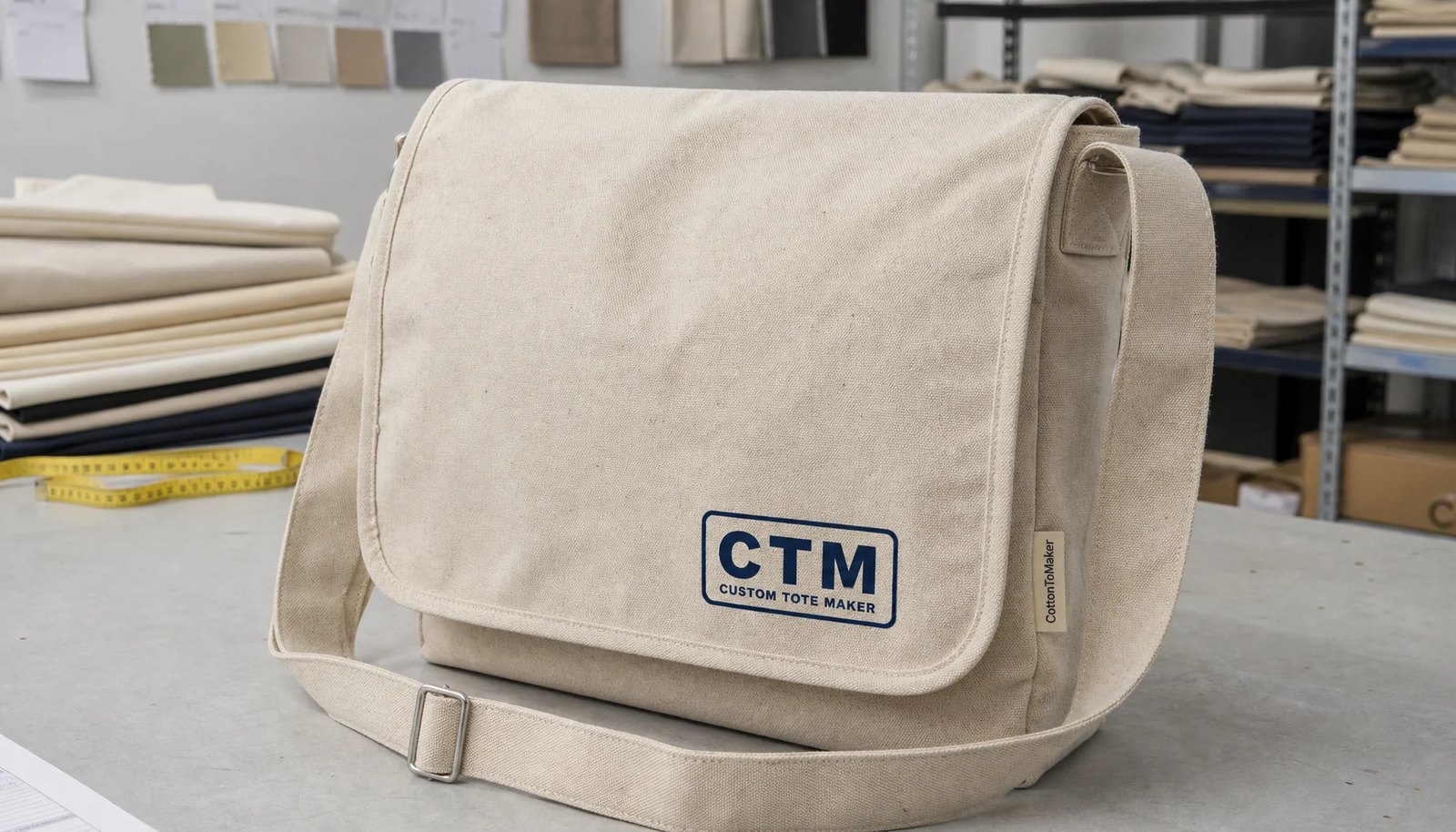
Start With The Real Exhibitor Load
A trade show messenger bag is asked to do more than hold a brochure. It is filled at registration, worn through crowded aisles, dropped under booth tables, carried on public transport, and often reused after the event. That is why a procurement brief should start with the load case, not with a loose request for a canvas shoulder bag with logo. The contents determine the canvas weight, strap width, stitch pattern, hardware grade, bottom structure, print placement, carton size, and inspection plan.
For most exhibitor programs, a practical working load is 3 kg to 5 kg. That usually covers catalogues, a notebook, tablet, charger, badge holder, water bottle, pens, and light samples. If the bag is intended for distributor kits, sales meetings, premium sponsor packs, or resale-style giveaways, specify 6 kg or more and build the stress points around that figure. Write the load into the RFQ and purchase order. A supplier cannot price durability accurately when the only use case is described as event use.
Working load is different from destructive breaking load. In sourcing terms, it means the finished bag should carry the stated weight repeatedly without visible seam failure, strap slippage, closure failure, or unacceptable shape distortion. A clear line in the specification could read: finished bag must carry a 5 kg working load for exhibitor use; strap anchors and side seams must show no stitch popping or tearing after sample load and swing review. That single sentence gives the factory a target and gives inspection teams something measurable.
- Brochure-only handout: 10-12 oz canvas may work if the bag is compact and strap anchors are reinforced.
- General exhibitor bag: 12 oz canvas with 38 mm webbing is a practical default for mixed booth contents.
- Premium or sales-kit bag: 14 oz canvas, reinforced bottom, and stronger anchor stitching improve structure and perceived value.
- Heavy sample load: reduce bag width, add a base panel, and reinforce anchors rather than relying only on heavier fabric.
- RFQ detail: state load in kg, example contents, expected carrying duration, reuse expectation, and venue delivery deadline.
Specify Canvas Weight Without Guesswork
Canvas weight is one of the biggest cost and performance levers in wholesale canvas messenger bags for trade show exhibitors. A 10 oz, 12 oz, and 14 oz quote may all be described as canvas, but they will not behave the same in the aisle or in the carton. A 10 oz canvas, often around 300-340 GSM depending on yarn and finishing, can suit light giveaways. A 12 oz canvas, often around 380-420 GSM, is a stronger default for reusable event bags. A 14 oz canvas, often around 450-500 GSM, feels more substantial but brings higher unit cost, higher freight weight, more needle wear, and more sewing difficulty.
Use both oz and GSM in the specification. Ounces are common in promotional bag discussions, while mills and quality teams often work in GSM. Add the tolerance, commonly expressed as a percentage such as +/-5%, because fabric weight can move by lot, finish, moisture, and measurement method. A purchase order that says heavy canvas or 12 oz style leaves room for substitution. If a quote falls outside the target range, ask whether the number is measured before finishing, after washing, or from an old stock lot.
Finish changes performance too. Natural canvas is often easier to source and may support a lower MOQ. Dyed canvas needs shade approval, dye-lot control, and colorfastness review. Washed canvas can look premium, but if it is not controlled before cutting, it may shrink, twist, or soften more than expected. Organic cotton and recycled cotton blends can work well for the right program, but buyers should confirm certification scope, fiber blend, lot availability, handfeel, and print performance before treating them as direct substitutes.
- Write fabric as 12 oz cotton canvas, approximately 380-420 GSM, tolerance +/-5%, or use the exact range agreed with the supplier.
- Separate natural, bleached, dyed, washed, organic, and recycled-blend options because MOQ, lead time, and QC requirements differ.
- Ask whether shrinkage is controlled by pre-shrinking, washing, sanforizing, steaming, or mill finishing before cutting.
- Approve a swatch from the intended bulk lot or confirmed stock lot, not only a photograph or old reference sample.
- Reject unapproved substitution unless GSM, shade, shrinkage, handfeel, and print adhesion are confirmed in writing.
Build Strength Into Strap Anchors
The strap anchor is the point most likely to turn a good-looking sample into a complaint. Users rarely carry event bags carefully. The bag swings from the shoulder, catches on chairs, gets lifted by one strap, and is sometimes overloaded before lunch. Strong body canvas will not save a weak anchor. The RFQ should state strap material, strap width, hardware width, reinforcement method, stitch pattern, and whether bartacks are included.
A 38 mm webbing strap is a practical default for general exhibitor use because it balances comfort, availability, and hardware compatibility. Cotton webbing has a natural look, though it may stretch more than polyester blends. Polyester or polyester-cotton webbing can improve dimensional stability and slider grip, but it may look less natural beside undyed cotton canvas. Self-fabric straps can match the body neatly, but they need proper folding, edge stitching, and reinforcement to prevent twisting, fraying, and stretch.
Stress zones do not stop at the strap. Top corners, bottom gussets, flap corners, magnetic snap areas, zipper ends, pocket openings, and internal dividers all need construction decisions. Pocket openings should have bartacks or secure backstitching because users pull phones, badges, and chargers from the same spots all day. Bottom corners need enough seam allowance, clean turning, and sometimes a base layer if the bag will carry dense samples. Price these details during quotation, not after a failed sample.
- Minimum anchor: box stitch at both strap ends for any bag expected to carry more than paper inserts.
- Stronger anchor: box stitch plus bartack or reinforcement patch for reusable exhibitor bags and sales kits.
- Hardware fit: slider and buckle inside width must match webbing width to prevent twisting and edge abrasion.
- Pocket control: bartack pocket openings, zipper ends, and divider stress points where users pull repeatedly.
- Inspection method: load the bag before checking strap anchors, because a flat-table review can hide skew and slippage.
Control Size, Capacity, And Pattern Accuracy
Messenger bag dimensions affect comfort, durability, packing, and cost. A wide bag may look generous in a mockup, but it puts more leverage on strap anchors and side seams. A deep gusset increases capacity yet can pull the flap out of alignment if the overlap is shallow. A narrow flap may look clean when empty and then expose contents once catalogues are inside. Lock the finished width, height, gusset, flap depth, strap width, adjustable strap range, pocket dimensions, seam allowance, and logo placement in centimeters.
Finished size tolerances should be realistic for sewn canvas. A practical B2B starting point is +/-0.5 cm for body width and height, +/-0.3 cm for gusset, and +/-1.0 cm for strap length unless the bag is oversized or intentionally soft. Tighter limits may be possible, but they can raise labor time and rejection rates. The tolerance should apply to finished goods after sewing and pressing, not only to cut panels. For private-label or retail-style programs, include pocket size, flap alignment, label placement, and carton packing dimensions in the same measurement plan.
Capacity should be checked with real event contents, not guessed from flat measurements. A bag that technically fits A4 documents may still feel awkward if the flap opening is tight, the gusset collapses, or an internal pocket steals space. Fill the sample with the intended catalogue stack, tablet, charger, and water bottle. Then close the flap and wear the bag. Look at how the flap sits, whether the closure lines up, whether the strap length feels comfortable, and whether the logo remains visible.
- Measure finished width, height, gusset, flap depth, handle drop if any, strap width, and maximum and minimum strap length.
- Confirm whether dimensions are measured empty, filled, laid flat, or standing, because soft canvas changes shape.
- Set logo placement by distance from seams, flap edge, closure hardware, and fold line rather than by visual estimate.
- Check flap overlap with a filled bag so contents remain covered and the closure still engages cleanly.
- Keep a measurement table in the tech pack and use the same points during sample approval and final inspection.
Choose Logo Methods For Real Wear
The logo on a trade show messenger bag takes abuse from hands, badges, booth counters, cartons, stacked bags, and repeated flap movement. Screen printing is usually the best cost-performance choice for one to three solid colors on cotton canvas, as long as the ink suits the fabric and is properly cured. For detailed artwork, gradients, sponsor grids, or full-color graphics, heat transfer may be appropriate, but it needs adhesion and cracking checks on the actual canvas texture. Woven labels, patches, embroidery, and leather-look badges can lift perceived value, though they add cost, MOQ, and sampling time.
Print placement is a durability decision as much as a branding decision. A large ink area across the flap bend line may crack sooner because the flap opens and closes repeatedly. A print placed too close to a magnetic snap can distort during snap attachment or daily use. Light ink on dark dyed canvas may require an underbase, which increases cost and makes the print feel thicker. Thick ink can look bold in a photo, then become stiff and vulnerable at folds. Ask the supplier to mark the fold line, snap position, seam allowance, and print-safe area before artwork is approved.
A print strike-off should be made on the intended fabric, ideally from the bulk lot. Review color against the Pantone or approved standard, edge sharpness, ink coverage over canvas texture, handfeel, curing, rub resistance, and alignment after folding. If the artwork includes several sponsor logos, confirm minimum readable line width and spacing before screens are made. A clean digital proof does not prove that small type will print clearly on coarse canvas.
- Artwork file: supply vector artwork, Pantone references, print size in cm, placement distances, and any sponsor readability requirements.
- Screen print: best for solid logos, simple slogans, event marks, and one to three color promotional branding.
- Heat transfer: useful for detailed or full-color graphics but must pass adhesion, edge lifting, and fold-crack checks.
- Patch or label: stronger option for premium positioning when a smaller branded area is acceptable.
- Approval check: review logo after packing and unpacking, because creases, blocking, and surface scuffing may not show on a loose sample.
Use A Practical Durability Test Checklist
A useful durability testing checklist should focus on the places wholesale canvas messenger bags for trade show exhibitors actually fail: strap pullout, side seam tearing, bottom sagging, weak closure, print abrasion, flap misalignment, hardware damage, inner seam fraying, and carton compression. The process does not need to feel like a full laboratory program for every promotional order. It does need enough detail that the factory, buyer, or third-party inspector can apply it the same way twice.
Start with the pre-production sample. Fill it to the stated working load, such as 5 kg, using compact weights or real event contents. Hang the bag for a defined period, then inspect strap anchors, side seams, gusset seams, bottom corners, and hardware. Add a carry or swing review to expose webbing slippage and anchor distortion. Open and close the flap repeatedly, especially if the print crosses the fold or the closure is magnetic. Rub the printed surface with dry white cotton fabric and inspect for color transfer, peeling, tackiness, or cracking.
Bulk inspection should be efficient, not random. Not every unit needs a destructive check. Inspectors can use a smaller sample set for load checks and a wider sample set for measurements, stitching, print, hardware function, shade, packing, and appearance. Define defect classes before cartons are sealed. Detached straps, broken closures, wrong fabric weight, unsafe sharp hardware, and severely misprinted logos should be treated as critical or major issues. Loose thread ends, minor approved shade variation, or removable dirt may be minor depending on the buyer standard.
- Load test: fill to the stated working load, hang, then inspect anchors, side seams, bottom corners, and shape distortion.
- Swing test: carry or swing the loaded bag to reveal webbing slippage, stitch popping, and hardware movement.
- Print rub test: rub with dry white cotton fabric and check for transfer, peeling, tackiness, or ink breakdown.
- Fold abrasion: open and close the flap repeatedly and inspect print, fold line, snap area, and edge stitching.
- Hardware test: operate snaps, buckles, sliders, rivets, and zippers after sewing and after packing pressure.
- Carton review: check carton strength, tape closure, fold marks, print blocking, moisture exposure, and gross weight.
Approve Samples In The Right Order
Sampling should move from idea to production evidence. A prototype is useful for checking dimensions, flap shape, pocket layout, strap position, and general style. It should not be the final bulk approval if it uses substitute canvas, available hardware, or a temporary logo. For printed trade show bags, approve a pre-production sample made with bulk canvas, final webbing, final hardware, final thread, final label, final print method, and intended packing.
Review the sample like a production unit, not like a mood board. Measure width, height, gusset, flap depth, strap width, strap length range, pocket size, label placement, and logo position. Fill it with real event contents and check whether the flap closes, the strap adjusts smoothly, the bag hangs comfortably, and the logo remains visible. If the bag must stand upright for booth display or sponsor photos, test that before production. Bottom construction and canvas weight decide the shape more than a retouched product image does.
Keep a sealed approval sample with both parties. The buyer, factory, and inspector should refer to the same standard for shade, handfeel, construction, stitching, hardware, logo, labels, and packing. Photo approval can help move quickly, but it hides important details such as fabric weight, print handfeel, hardware thickness, shade variation, and inner seam finishing. For urgent orders, video review can support speed, yet final material confirmation still matters when durability is part of the brief.
- Prototype: approve size, pocket layout, flap shape, strap position, closure type, and general construction.
- Material swatch: approve canvas color, GSM, handfeel, shrinkage control, strap color, thread, and hardware finish.
- Print strike-off: approve ink color, edge sharpness, handfeel, curing, rub resistance, and fold behavior on actual fabric.
- Pre-production sample: approve final materials, final stitching, final logo, final label, and final packing.
- Sealed standard: keep one approved sample with the buyer and one with the factory for inspection comparison.
Compare Quotes By Construction, Not Name
MOQ is shaped by material booking, dyeing lot size, print setup, hardware purchasing, cutting efficiency, line changeover, and packing requirements. Natural canvas in standard weights may support lower MOQ because it is easier to source. Custom-dyed canvas, special webbing colors, branded metal hardware, unusual linings, certified materials, and private-label packaging usually push MOQ higher. Buyers can often reduce MOQ pressure by choosing stock canvas and standard hardware while keeping the logo custom.
Unit price only makes sense beside the specification. A lower quote may exclude inner labels, print setup, reinforced stitching, carton marks, stronger export cartons, inspection repacking, or packing inserts. One supplier may quote 38 mm adjustable webbing with bartacks, while another quotes a narrower fixed strap with basic stitching. Both can call the item a canvas messenger bag, but the durability and landed cost are not the same. A quote recap should list fabric, GSM tolerance, dimensions, strap, reinforcement, print, labels, packing, carton data, sample fee, setup fee, lead time, payment terms, and exclusions.
Separate mandatory durability requirements from optional upgrades so suppliers can offer real alternatives without weakening the product. Mandatory items might include 12 oz canvas, reinforced strap anchors, screen print rub checks, finished size tolerance, and cartons suitable for event handling. Optional upgrades might include 14 oz canvas, an extra internal pocket, zipper closure, retail hangtag, barcode label, individual polybag, custom zipper pull, or certified organic cotton.
- Fabric cost drivers: GSM, yarn quality, dyeing, washing, certification, shrinkage control, usable width, and cutting waste.
- Labor cost drivers: pockets, binding, bartacks, curved flaps, lining, adjustable straps, zipper installation, and tight tolerances.
- Print cost drivers: number of colors, print size, underbase, screen setup, curing time, and number of print locations.
- Packing cost drivers: individual polybags, paper inserts, tissue, barcode labels, hangtags, stronger cartons, and pallets.
- Commercial checks: confirm sample fee, setup fee, quote validity, payment terms, rework responsibility, and inspection support.
Pack For Freight And Booth Distribution
Packing affects how the bag looks when it reaches the booth. Over-compressed cartons can create deep flap creases, bent corners, distorted straps, and print blocking where ink sticks to another surface under pressure. Flat packing gives the cleanest presentation, but it increases carton volume. A single controlled fold may be acceptable if the fold line is planned and does not cross the main logo. Random folding by packers is risky for printed messenger bags.
Trade show shipments often move through export warehouses, freight forwarders, couriers, hotel receiving docks, exhibition service teams, and booth staff. Cartons may be stacked, dropped, relabeled, opened, resealed, or split for partial distribution. Specify pieces per carton, carton board strength, gross weight limit, carton marks, pallet requirements, and whether each bag needs an individual polybag. If sustainability targets discourage polybags, consider tissue interleaving, paper inserts, master bundle bags, or controlled flat packing to reduce scuffing and print transfer.
Request carton data before confirming the purchase order. Freight cost for canvas bags can be driven by volume as much as weight, especially when bags are flat packed. Heavier canvas may improve durability but increase gross weight. Bulkier cartons may protect presentation but increase airfreight cost. Weak cartons may save very little and still damage the goods before the event. Ask for carton length, width, height, gross weight, net weight, pieces per carton, and pallet loading so the forwarder can compare options early.
- Presentation priority: use flat packing, paper inserts, or one controlled fold when the flap must look clean at distribution.
- Print protection: separate printed surfaces if heat, pressure, or long storage could cause blocking or scuffing.
- Handling limit: keep carton gross weight practical for warehouse teams, hotel receiving docks, and booth staff.
- Carton marks: include PO number, style, color, quantity, destination, carton count, event name, and booth reference if needed.
- Freight planning: request carton dimensions, gross weight, and pallet loading early enough for forwarder comparison.
Protect Lead Time From Small Delays
Canvas messenger bag lead time is usually controlled by material readiness and approval speed, not only by sewing capacity. The timeline starts after the factory has the deposit, artwork, material specification, sample route, and approval responsibilities. If the buyer changes canvas color, webbing color, pocket layout, logo size, print location, closure, or packing after sample approval, the production clock may restart. Trade show dates do not move, so build the schedule backwards from the date bags must be physically available at the booth.
A realistic schedule separates material sourcing, lab dip or swatch approval, sample making, print strike-off, cutting, sewing, inline QC, final inspection, packing, export handover, customs clearance, domestic delivery, and venue receiving. Natural canvas with a one-color screen print is simpler than custom-dyed heavy canvas with multiple pockets, special hardware, and retail labels. Air freight can shorten transit time, but it cannot recover time lost to late artwork, wet ink curing, missing carton marks, or slow sample approval.
Event logistics after arrival deserve their own line on the timeline. Delivery to an exhibition venue may require appointment booking, warehouse labels, advance receiving forms, material handling rules, or specific delivery windows. A shipment can arrive in the destination country on time and still miss booth distribution if local receiving requirements are incomplete. Add buffer for inspection, rework, repacking, customs, and venue handling instead of treating the flight or vessel arrival date as the finish line.
- Reserve extra time for custom dyeing, lab dips, washed canvas, special hardware, multi-color printing, or private-label packing.
- Approve print strike-offs before bulk printing; do not wait until finished bags are sewn to judge logo color.
- Schedule inline checks before all panels are assembled if the design has complex pockets, straps, or print placement.
- Plan final inspection before carton sealing when measurement, stitching, print, and packing details must be checked carefully.
- Add buffer for customs clearance, event warehouse appointments, local trucking, receiving labels, and booth delivery rules.
Specification comparison for buyers
| Spec decision | Recommended option | When it fits | Buyer risk to check |
|---|---|---|---|
| Body canvas weight | 12 oz cotton canvas, typically about 380-420 GSM before finishing, with stated GSM tolerance | General trade show exhibitor bags carrying catalogues, tablet, notebook, charger, badge, water bottle, and small samples | A quote based on 10 oz fabric may look cheaper but can sag, wrinkle, show bottom-corner wear, and fail load expectations sooner |
| Heavy-duty upgrade | 14 oz canvas, typically about 450-500 GSM, with reinforced bottom panel or double-layer stress zones | Distributor kits, sales meetings, premium sponsor bags, retail resale, or heavier sample packs | Higher GSM increases unit price, freight weight, needle wear, and sewing difficulty; confirm stitch quality and seam pucker limits |
| Economy construction | 10 oz canvas, typically about 300-340 GSM, with reinforced strap anchors and controlled bag size | Light brochure distribution, short event giveaways, or low-load conference handouts | Not suitable for dense samples, oversized catalogues, or repeated reuse unless load limits are written into the specification |
| Finished size tolerance | Body width and height within +/-0.5 cm; gusset within +/-0.3 cm; strap length within +/-1.0 cm unless otherwise agreed | Orders requiring consistent packing, logo placement, carton count, and booth distribution appearance | Loose tolerances can shift print placement, reduce usable capacity, and create uneven flap alignment across bulk production |
| Strap construction | 38 mm cotton or polyester-cotton webbing, adjustable slider, box stitch plus bartack or reinforcement patch at both anchors | Reusable exhibitor bags expected to carry 3-6 kg during a full exhibition day | Narrow webbing, self-fabric straps, or single-line stitching can tear, twist, slip, or become uncomfortable under swing load |
| Closure method | Flap with magnetic snap, press button, zipper, or buckle tested after sewing and packing | Exhibitors carrying documents, electronics, badges, and giveaway items in crowded halls | Weak magnets, misaligned snaps, sharp hardware edges, or plating scratches create complaints even if fabric weight is acceptable |
| Printing method | Screen print for one to three solid colors; heat transfer, woven patch, or embroidery for detailed or premium branding | Corporate logos, sponsor marks, booth themes, event slogans, and resale-style branding | Print must pass dry rub, adhesion, and fold-abrasion checks; thick ink can crack where the flap bends repeatedly |
| Interior finish | Bound seams or clean overlock with 8-10 stitches per inch on heavy canvas seams | Buyers balancing durability, appearance, and wholesale cost | Raw cotton edges can fray into the main compartment, especially around pockets, gussets, and high-rub corners |
| Sample approval route | Pre-production sample using bulk fabric, final webbing, final hardware, final print, final label, and final packing | Custom logo, custom size, private label, hardware color, event carton marks, or strict delivery requirements | Approving a proto sample with substitute materials hides shrinkage, shade, print adhesion, hardware, and packing differences |
Buyer checklist before sampling
- Define the expected working load in kg and list real contents exhibitors will carry: catalogues, tablet, charger, power bank, water bottle, notebook, badge holder, pens, and samples.
- Specify canvas weight in both oz and GSM, including tolerance, color, finish, shrinkage target, and whether the fabric is natural, bleached, dyed, washed, organic cotton, recycled blend, or stock material.
- Lock the finished dimensions: width, height, gusset, flap depth, strap width, adjustable strap range, pocket dimensions, seam allowance, flap overlap, and usable print area.
- State dimensional tolerances, commonly +/-0.5 cm for body width and height, +/-0.3 cm for gusset, and +/-1.0 cm for strap length unless the design requires looser limits.
- Require strap anchor reinforcement with box stitch, bartack, reinforcement patch, double-layer side panel, or a stated combination, and define the exact position of the reinforcement.
- Choose the logo method based on artwork detail, canvas color, print size, fold position, expected abrasion, ink handfeel, and whether the artwork crosses the flap bend line.
- Approve a pre-production sample made from bulk canvas, final webbing, final hardware, final thread color, final label, final print method, and final packing method.
- Set measurable acceptance criteria for seam strength, strap pull, stitch density, print rub, fold abrasion, hardware function, flap alignment, inner seam finishing, carton strength, and shade variance.
- Request carton size, gross weight, net weight, pieces per carton, carton marks, pallet loading, moisture protection, and estimated freight cube before confirming the purchase order.
- Build the schedule around material booking, lab dip or stock color approval, print strike-off, sample approval, cutting, sewing, inline QC, final inspection, packing, export cutoff, and venue delivery.
Factory quote questions to send
- What exact canvas weight are you quoting in oz and GSM, and what tolerance applies before and after dyeing, washing, printing, or finishing?
- Is the quoted fabric greige, natural, bleached, dyed, washed, organic cotton, recycled cotton blend, or stock color, and what MOQ and lead time apply to that material?
- What fabric inspection is performed before cutting, and can you report GSM, shade, width, visible defects, and shrinkage results for the approved lot?
- What shrinkage control is applied before cutting, and what dimensional change should we expect after steam, washing, pressing, or normal handling?
- What reinforcement is included at the strap anchor points: box stitch, bartack, extra patch, rivet, double-layer side panel, or only standard seam stitching?
- What strap material, width, thickness, adjustable length range, and hardware finish are included, and does the slider hold position under the stated working load?
- Which thread type and stitch density are quoted for main seams, flap edges, strap anchors, pockets, and bottom gusset seams?
- Which print method is included in the unit price, and what is the maximum stable print area on the flap, front body, back body, strap, or pocket?
- Can the print strike-off be made on bulk canvas, and how will you check ink curing, dry rub, adhesion, edge sharpness, and fold cracking?
- Can the pre-production sample use bulk fabric, final hardware, final thread, final logo method, final label, and final packing, and how many days are needed after artwork approval?
Quality-control points to confirm
- Canvas GSM should be checked with a fabric cutter and scale before cutting, not only by supplier declaration, old sample handfeel, or material name.
- Fabric shade should be checked under consistent lighting, especially for dyed canvas, natural canvas lots, contrast straps, multi-location deliveries, and reorders.
- Fabric defects should be marked before cutting, including slubs, oil stains, holes, weaving bars, heavy shade streaks, and dirt that would remain visible on natural canvas.
- Finished size tolerance should normally be controlled within +/-0.5 cm for body panels, +/-0.3 cm for gusset, and +/-1.0 cm for strap length unless the approved design states otherwise.
- Strap anchor points should withstand repeated pull testing at the buyer's stated working load without seam tearing, webbing slippage, stitch popping, rivet loosening, or fabric distortion.
- Stitch density should be even, usually 8-10 stitches per inch for heavy canvas seams, with no skipped stitches at corners, strap joints, pocket openings, flap curves, or gusset joins.
- Bartacks and box stitches should be centered, complete, and locked, with thread tension tight enough to hold but not so tight that it cuts the canvas yarns.
- Print should pass dry rub testing and moderate fold abrasion without visible peeling, heavy ink cracking, unacceptable color transfer, tackiness, or blocking after packed pressure.
- Magnetic snaps, press buttons, sliders, buckles, zippers, and rivets should function after sewing and packing, with no sharp edges, loose backs, weak closure, rust, or plating scratches.
- Internal seams should be overlocked, bound, or otherwise protected so cotton yarns do not fray into the main compartment, pockets, or closure area.