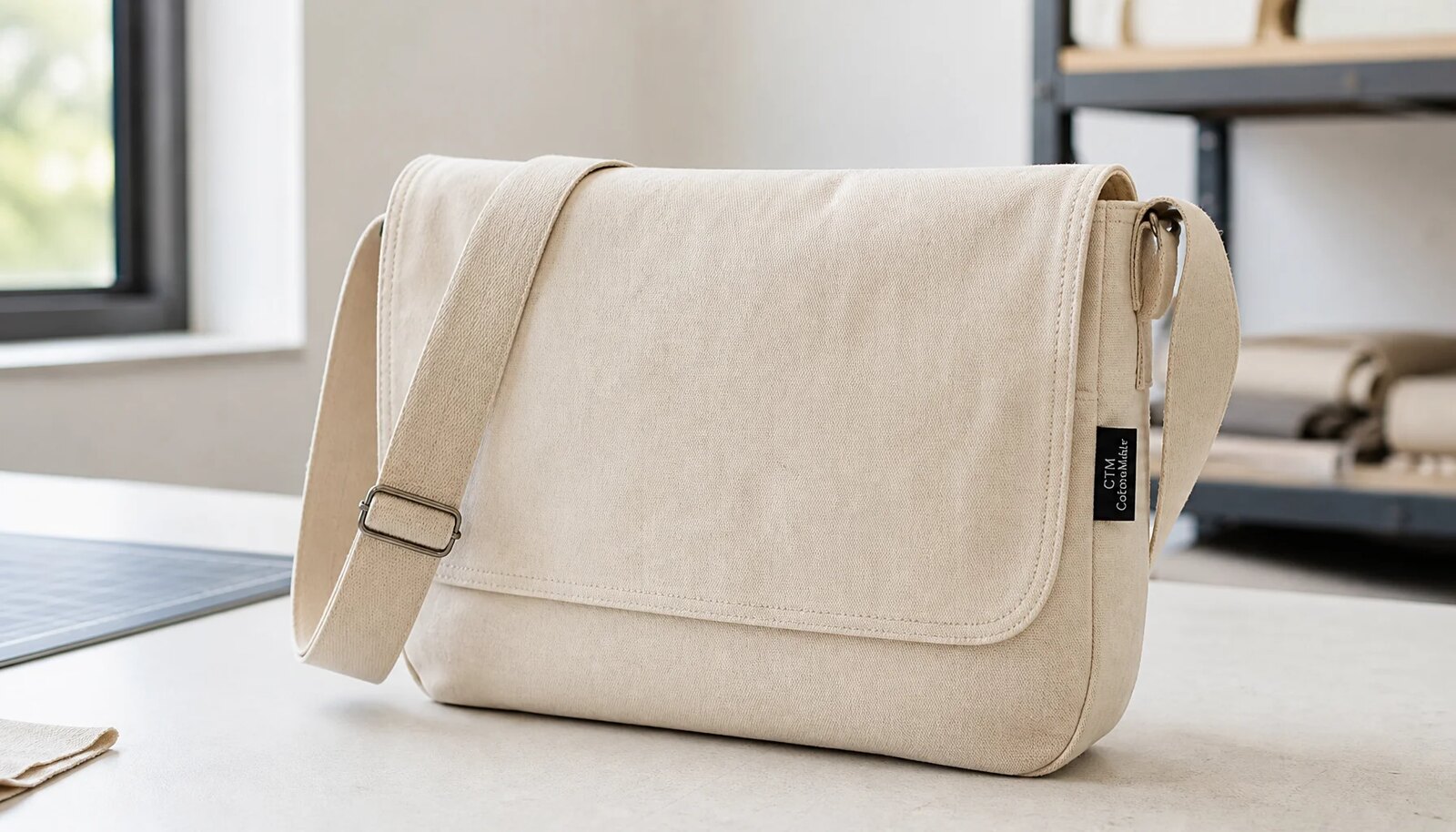
Start with carton planning, not after production
Canvas messenger bags are not flat goods once they are sewn, decorated, and packed. A flap, strap, slider, buckle, zipper pull, label, pocket, and reinforced seam all change how the bag sits in a carton. If the packing method is chosen after sewing is finished, the supplier may preserve factory convenience while creating higher freight cost, more creasing, or a worse unboxing experience for your wholesale customer.
For procurement teams buying wholesale canvas messenger bags for eco apparel brands, carton planning belongs in the RFQ. The carton is not just the last logistics step. It affects unit economics, warehouse handling, moisture exposure, and whether the bag arrives with a crisp retail shape or with pressure marks from over-packed cartons.
- Ask for the fold method, strap placement, inner protection, pieces per carton, carton dimensions, and gross weight in the quote.
- Request photos of one folded unit, a stacked bundle, a loaded carton, a sealed carton, and the carton marks.
- Treat carton count as incomplete unless it is paired with carton size and gross weight.
- Freeze the approved pack method in the purchase order, not only in email or chat.
Write an RFQ that prevents quote drift
A useful RFQ reads like a production brief. It tells the factory what the bag must be, what is optional, what is excluded, and what success looks like on receiving day. If those points are not written down, each supplier will fill the gaps differently. One quote may include a heavier canvas, a lined interior, and carton-only packing. Another may use lighter cloth, simpler stitching, and less protective packaging. The lower number is not automatically the better value.
Use centimeters for all finished dimensions and describe the measurement method. For sewn canvas goods, a practical body-dimension tolerance is often around plus or minus 0.5 cm to plus or minus 1.0 cm, while long straps may need a wider band. Ask the supplier to state the tolerance it can actually hold before sample approval, then repeat that tolerance in the PO and inspection sheet.
- State width, height, gusset, flap depth, pocket opening, strap width, strap drop, and adjustable strap range.
- List every controlled component: fabric lot, webbing, lining, zipper, snap, slider, label, thread color, artwork, packaging, and carton board.
- Ask suppliers to identify exclusions and assumptions so hidden scope does not appear later as a change order.
- Break lead time into sampling, strike-off, material sourcing, bulk sewing, inspection, rework buffer, and packing.
Separate fabric weight from fabric claims
Canvas weight is a frequent source of quote confusion. A 10 oz canvas is roughly 340 GSM, and a 12 oz canvas is roughly 407 GSM, but the printed number does not prove the fabric you receive. Some factories quote greige weight before dyeing or washing. Others quote finished fabric. Processing can change shrinkage, handfeel, shade, and folded bulk, which means the carton plan can shift even if the quote headline stays the same.
For many messenger bag programs, 10 oz to 12 oz finished canvas is a practical working range. Lighter cloth can lower material cost and pack flatter, but it may feel soft or crease under freight pressure. Heavier canvas improves structure and reduces the chance of collapse in the carton, but it can make sewing slower, increase gross weight, and push the shipment into a higher freight band. The right choice depends on retail positioning, decoration, and the receiving route.
- Ask for finished weight in both oz/yd2 and GSM.
- Confirm whether the canvas is raw, dyed, washed, enzyme-washed, pre-shrunk, or coated.
- Approve a physical swatch and shade range, especially for natural cotton canvas.
- Request documentation before making a sustainability claim such as organic cotton, recycled cotton, GOTS, GRS, or OEKO-TEX.
- Check whether darker dyes or coatings trigger extra colorfastness or restricted-substance review.
Compare construction options before you compare price alone
Two messenger bags can look similar from a distance and still have very different cost structures. Unlined bags are typically lighter and flatter, especially when the inside seams are neatly bound. A lined bag, often using 210D polyester or recycled polyester with PU coating, feels more finished and can support pockets or cleaner internal presentation, but it adds labor, material, and thickness. Interlining may help the bag hold shape, yet it also makes carton planning less forgiving.
Reinforcement should be written at the load points, not described with vague language. Strap joins, flap attachment, zipper ends, pocket corners, and side seams need explicit stitch treatment and seam allowance. Box-X stitching and bartacks are common, but the final inspection has to verify that the bulk run matches the approved sample. A factory can quote the right-looking bag and still change internal reinforcement if the spec is not precise.
- Specify whether interior seams are raw, overlocked, bound, or fully lined.
- Define pocket size, pocket position, pocket reinforcement, and whether pocket openings need bartacks.
- State strap webbing width, fiber content, thickness, hardware, and adjustment range.
- Ask for close-up photos of strap joints, pocket corners, and flap attachment during sample review.
- Confirm whether lining or interlining reduces pieces per carton before approving the unit price.
Choose decoration with freight and folding in mind
Decoration affects more than logo appearance. Screen print, embroidery, woven patch, heat transfer, and label application each create different cost, lead time, thickness, and packing behavior. Screen print works well for bold artwork and repeat wholesale runs, but coarse canvas can soften the edges and a large print can crack if it sits across a hard fold. Embroidery can look more premium, yet it adds thickness, may distort the panel, and can leave pressure marks when cartons are packed tightly.
The decoration specification should be measurable. State the method, size in centimeters, number of colors, artwork file format, placement from fixed seams, strike-off requirement, and approval sequence. If the design includes a raised patch or dense embroidery, decide whether the bag should be interleaved, tissue-wrapped, or packed with lower compression so the decoration does not imprint into the panel during transit.
- Keep large prints away from hard fold lines when possible.
- Approve decoration on actual bulk canvas rather than only on a digital mockup.
- Measure placement from the top seam, side seam, flap edge, or another fixed reference point.
- Check print opacity separately on natural, black, and dark-dyed canvas.
- Ask whether screens, setup, patches, labels, and strike-offs are included in unit price.
Use carton math before you approve the quote
A meaningful carton plan needs pieces per carton, carton dimensions, gross weight, and CBM. Those numbers should be calculated, not guessed. For example, if an unlined 12 oz messenger bag is packed 80 pieces per master carton and the carton measures 60 cm x 40 cm x 45 cm, the carton volume is 0.108 CBM. If gross weight is 19 kg, then 1,000 pieces require 12.5 cartons, which rounds to 13 cartons, or about 1.404 CBM before any pallet allowance. That calculation can be the difference between a workable landed cost and a shipment that quietly becomes too expensive to move.
Dimensional weight also matters, especially for air and courier programs. Using a common divisor of 5,000 in centimeters, the same carton rates at 21.6 kg dimensional weight. If actual gross weight is 19 kg, freight may be charged on the higher dimensional figure. If you add lining and the pack drops from 80 pieces to 60 pieces per carton while the carton height increases to 50 cm, the cube rises to 0.120 CBM and 1,000 pieces need 17 cartons, or about 2.04 CBM. A lower unit price can disappear fast if the carton math is not part of sourcing.
- Calculate CBM as length x width x height in meters.
- Compare actual gross weight with dimensional weight for air, courier, and some domestic moves.
- Ask whether carton quantity is rounded up by SKU, color, or mixed-carton rule.
- Set a practical maximum gross weight, often around 18 kg to 22 kg when manual handling is expected.
- Recalculate carton cube whenever lining, wider straps, hardware, hangtags, or individual polybags are added.
Match the pack method to the route and the receiving team
Packing is where product quality and logistics meet. A clean unit can still arrive damaged if the pack method is wrong. Canvas can take on moisture, hardware can mark the front panel, and a pressed logo can pick up a carton impression if the stack is too tight. The goal is not to use the least packaging at any cost. The goal is to use just enough packaging to protect the bag, keep receiving efficient, and avoid unnecessary freight cube.
Eco-positioned brands often want less plastic, but removing polybags only works if the route and receiving process support it. Carton-only packing can be acceptable for a controlled warehouse or a short inland route. It can fail on long sea freight, humid storage, or when bags are stacked with hard hardware facing the front panel. If the packaging carries environmental language, collect support before using that language in sales or compliance documents.
- Choose carton-only packing, paper bands, tissue, recycled polybags, or individual polybags based on route and receiving needs.
- Confirm barcode size, placement, scan test, hangtag position, and whether labels damage paper packaging.
- Define mixed-carton rules by SKU, color, and quantity.
- Ask for documentation for recycled content, FSC paper, GRS materials, or other packaging claims.
- Verify whether packaging changes alter carton count, gross weight, or carton dimensions.
Approve the sample as a production method, not a showroom piece
Sample approval should prove the actual method, not just the front view. Review the bag flat, lightly filled, worn by the strap, folded for packing, and compared with the written spec. A messenger bag that looks right on a table can still be wrong at the strap drop, flap length, interior seam finish, or carton profile. If the sample cannot pass those checks, bulk production will only repeat the problem at scale.
The golden sample should be signed, photographed, and tied to the purchase order. If a deviation is accepted, record it clearly so no one has to interpret email history later. Do not release bulk cutting or decoration until the fabric swatch, trim card, artwork strike-off, full sample, measurement tolerance, and carton method are all approved. That order matters because late changes to decoration or lining can alter the pack and freight model even when the exterior bag seems unchanged.
- Measure the sample and record actual dimensions against the tolerance table.
- Photograph reinforcement, inside seams, hardware, decoration close-up, folded unit, and loaded carton.
- Check whether the bag recovers shape after the proposed carton compression.
- Approve barcode label, carton mark, hangtag, and packaging layout before bulk packing.
- Keep one reference sample with the buyer and one with the factory for repeat orders.
Inspect shipment readiness, not just finished goods
Pre-shipment inspection should cover both product and carton. Product inspection includes measurement, appearance, construction, decoration, hardware, labeling, and function. Carton inspection includes count, SKU, color, carton marks, dimensions, gross weight, sealing, board condition, and damage. A well-made bag packed incorrectly can still arrive creased, mislabeled, damp, or delayed at receiving. The QC plan needs to catch those failures before the shipment leaves the factory.
Use an agreed AQL plan or another written inspection standard before production starts. Critical defects may include wrong product, wrong logo, unsafe sharp hardware, mold, severe contamination, or structural failure. Major defects may include broken stress-point stitching, zipper failure, off-tolerance decoration, incorrect carton count, or visible staining. Receiving teams should be able to cross-check the physical cartons against the PO without having to interpret factory shorthand.
- Open random cartons to verify physical count, fold method, SKU, color, and barcode scan.
- Spot-check carton dimensions and gross weight against the approved range.
- Inspect for moisture, odor, mold, crushed corners, pressure marks, and hardware impressions.
- Tie photos to carton number, SKU, production lot, and defect type for claims.
- Feed receiving results back into the next RFQ so the carton plan improves on repeat orders.
Turn the supplier quote into a buyer comparison sheet
A good supplier comparison sheet makes hidden assumptions visible. If one factory is quoting a 12 oz finished canvas bag with recycled polyester lining, a screen print, paper-band packing, and export cartons while another is quoting a lighter unlined bag with individual polybags, the unit price is not directly comparable. The same is true when one supplier includes strike-offs and carton marks and another excludes them. Without a comparison sheet, procurement teams end up comparing a complete offer against a partial one.
The practical approach is to normalize every quote against the same set of variables: fabric weight, finished dimensions, lining or no lining, decoration method, pack method, carton size, gross weight, incoterm, and inspection scope. That makes it easier to see whether the difference is real manufacturing efficiency or just a different scope. It also helps sourcing teams explain the final choice internally, because the reasoning is tied to measurable details rather than general impressions.
- Build a one-page compare sheet with identical columns for every supplier.
- Separate one-time charges, such as setup or strike-off costs, from recurring unit cost.
- Flag any quote that omits packaging, carton marks, or inspection support.
- Use the same incoterm and same packaging assumption for every offer.
- Record the approved carton plan alongside the final commercial price.
Specification comparison for buyers
| Decision area | Options to compare | Commercial impact | QC focus |
|---|---|---|---|
| Fabric weight | 10 oz finished canvas, 12 oz finished canvas, heavier washed canvas | Changes handfeel, carton cube, freight weight, crease resistance, and sewing difficulty | Confirm finished GSM or oz/yd2, shrinkage, shade, and whether the weight is finished fabric or greige fabric |
| Structure and lining | Unlined, bound seams, 210D polyester lining, recycled polyester lining, interlining | Adds or removes bulk, labor, perceived value, and pieces per carton | Inspect seam finish, lining attachment, pocket alignment, odor, and whether the chosen build still folds flat |
| Strap and hardware | Cotton webbing, polyester webbing, wider strap, metal slider, plastic slider, magnetic snap, zipper closure | Alters cost, received weight, strap comfort, and the risk of carton pressure marks | Check strap reinforcement, hardware finish, sharp edges, corrosion risk, slider action, and load-point stitching |
| Decoration method | Screen print, embroidery, woven patch, heat transfer, label application | Affects setup cost, lead time, thickness, and the way the bag packs after finishing | Review placement, registration, cracking, puckering, backing show-through, and color match on actual canvas |
| Pack method | Flat fold, tissue wrap, carton-only, paper band, individual polybag, inner bundle | Changes protection, presentation, warehouse receiving speed, and carton count | Verify fold shape, strap placement, barcode visibility, moisture control, abrasion risk, and packaging claims |
| Carton and pallet strategy | Standard master carton, heavier export carton, palletized cartons, mixed-SKU carton plan | Controls freight cost, manual handling risk, damage rate, and receiving efficiency | Check carton dimensions, gross weight, board grade, sealing method, pallet pattern, and visible carton marks |
Buyer checklist before sampling
- Define finished width, height, gusset, flap depth, pocket layout, strap width, strap drop, strap length range, closure type, and reinforcement before asking for price.
- State the fabric requirement as a finished spec, not a loose description: oz/yd2, approximate GSM, fiber content, weave, wash or dye process, shrinkage expectation, and approved handfeel.
- Use measurable tolerances for body dimensions, logo placement, strap length, carton dimensions, and gross weight so the factory knows what it must hold in bulk.
- Separate the build from the decoration: unlined, bound, lined, or interlined; screen print, embroidery, patch, or label; and what is included in the unit price.
- Ask for the full packing method: fold direction, strap position, inner wrap, bundle size, pieces per carton, carton board grade, sealing method, and any palletization requirement.
- Specify hardware and load points clearly: webbing width, slider type, buckle or snap, stitch pattern, bartack count, and minimum seam allowance at stress points.
- Request decorated strike-offs, seam close-ups, folded-pack photos, and one loaded carton image before bulk production is released.
- Require a carton calculation from the supplier that includes pieces per carton, carton dimensions, gross weight, and CBM rather than carton count alone.
- Collect documents for any sustainability claim before you use it in sales copy: organic, recycled, FSC, GRS, OEKO-TEX, or packaging compliance evidence where relevant.
- Normalize the quote by fabric weight, construction, decoration area, pack method, carton cube, incoterm, and QC scope so you are comparing like with like.
Factory quote questions to send
- What finished canvas weight are you quoting in oz/yd2 and GSM, and is that weight based on finished fabric after wash or dye, not greige cloth before processing?
- What fiber content is included in the canvas, and what documentation can you provide for any sustainability or recycled-content claim that appears in our market?
- What are the finished dimensions and tolerance bands for width, height, gusset, flap depth, pocket size, strap length, and strap drop?
- Is the bag unlined, bound inside, or lined; if lined, what lining material, denier, coating, and seam finish are included in the quoted build?
- What strap webbing width, thickness, slider type, and reinforcement stitch pattern are included, and what seam allowance is built into the unit price?
- What closure is quoted, and does the price include the exact zipper type, magnetic snap size, buckle finish, or other hardware specification?
- Which decoration method is quoted, what is the size in centimeters, how many colors are included, and where is the placement measured from?
- Can you supply a decorated pre-production sample or strike-off on actual bulk canvas before mass production starts?
- What carton plan are you quoting for our wholesale canvas messenger bags for eco apparel brands: fold method, strap placement, inner protection, pieces per carton, carton dimensions, gross weight, and CBM?
- Which costs are included or excluded: sample charge, artwork setup, screen or plate charge, labels, hangtags, barcode stickers, carton marks, inspection support, and export documents?
Quality-control points to confirm
- Check finished fabric weight against the approved specification, and make sure the reference is finished canvas rather than a fabric weight taken before processing.
- Compare shade against the approved swatch under consistent light, especially for natural, black, navy, washed, or garment-dyed canvas where lot variation is visible.
- Measure the finished bag flat using the agreed method for width, height, gusset, flap depth, pocket opening, and strap drop, and record the results on the inspection sheet.
- Inspect logo placement from fixed seams or edges; small marks usually need tighter control than large graphics, especially on coarse canvas where the eye reads misalignment quickly.
- Review screen prints for opacity, registration, pinholes, smearing, edge sharpness, and cracking after fold testing or flexing.
- Review embroidery, woven patches, and labels for puckering, loose threads, crooked placement, backing irritation, and frayed edges after handling.
- Check strap joints for bartacks or box-X stitching, enough seam allowance, no skipped stitches, no broken thread, and no weak load point at the top of the bag.
- Inspect hardware for sharp edges, rough zipper action, corrosion, weak magnet pull, uneven plating, and marks left on light canvas during packing.
- Look at seams for stitch density, raw edges, uneven binding, broken stitch lines, and loose thread trimming on the inside and outside of the bag.
- Verify carton count, SKU, color, barcode scan, carton dimensions, gross weight, sealing method, and pallet pattern against the purchase order before the shipment leaves the factory.