1. The buying problem: approving a messenger bag sample too quickly
A canvas messenger bag looks simple in photos, but it has more failure points than a flat tote bag. The flap must sit square, the shoulder strap must carry real weight, the closure must work through multiple fabric layers, and the print must survive bending near the front panel. Many procurement teams approve a sample because the fabric looks thick and the logo looks correct, then find bulk problems when cartons arrive: twisted flaps, slipping sliders, weak strap tabs, cracked print, or a bag that cannot hold shape on a retail shelf.
The purpose of a sample review is not only to decide whether the sample looks good. It is to convert a nice-looking sample into production rules. Your RFQ should tell the factory exactly what fabric weight, construction, print method, hardware, packing, and inspection standard must be quoted. If these items are not locked before pricing, you may receive low quotes that are not comparable.
- Review the sample as a product, not as a photo reference.
- Write down measurable acceptance criteria before bulk approval.
- Do not compare supplier prices until fabric, strap, hardware, print, and packing are aligned.
2. Fabric weight: why 12oz, 14oz, and 16oz canvas quote differently
Canvas messenger bags are usually quoted by ounce weight or GSM. For cotton canvas, 12oz is often around 400 GSM, 14oz around 475 GSM, and 16oz around 540 GSM, but the exact number depends on weave, finishing, and whether the weight is measured before or after dyeing or washing. A 16oz natural canvas bag can feel firm and premium, while a 16oz washed canvas may feel softer and slightly less structured.
For wholesale programs, the safest starting point is usually 14oz to 16oz canvas for the outer shell. A lighter 10oz or 12oz canvas may be acceptable for a giveaway messenger bag, but it will fold more easily and may not support metal hardware or a heavy strap well. If the bag will carry books, catalogs, samples, or a small laptop sleeve, ask the supplier to quote both 14oz and 16oz so you can compare unit cost, carton weight, and shape retention.
- Ask whether the quoted GSM is greige fabric, dyed fabric, finished fabric, or washed fabric.
- Request a fabric swatch from the same lot or same specification used for the sample.
- For retail bags, check surface defects such as slubs, thick yarn lines, stains, and shade variation.
- For dyed canvas, confirm colorfastness expectations because dark canvas can rub onto light clothing.
3. Structure and dimensions: check the bag as a carrying tool
A messenger bag is judged by how it carries, not only by its flat size. The RFQ should include finished width, height, bottom depth, side gusset depth, flap length, strap width, strap minimum and maximum length, pocket size, and closure position. If your design needs to hold A4 documents, catalogs, or a 13-inch laptop sleeve, test the real item in the sample instead of relying on nominal dimensions.
Dimension tolerance also matters. Canvas can shrink during washing, pressing, and sewing. A reasonable tolerance may be plus or minus 0.5 cm for small panels and plus or minus 1 cm for larger finished dimensions, but you should agree this with the factory before production. If the flap is only slightly too short, the bag may look unfinished. If it is too long, it may cover the logo or make the bag difficult to open.
- Measure top width and bottom width separately; they may not be the same after sewing.
- Check whether the front flap covers the opening evenly from left to right.
- Confirm if the bottom is a flat gusset, boxed bottom, or simple folded construction.
- Load the sample with realistic contents and check whether the side seams pull outward.
4. Strap and hardware: the main stress area buyers should not ignore
The shoulder strap is often the most important quality point on a canvas messenger bag. A good sample should use cotton webbing or strong polyester webbing with enough width for the expected load. For light promotional use, 38 mm webbing may be enough. For retail, student, travel, or work bags, 50 mm webbing gives better comfort and looks more balanced on a heavier canvas body.
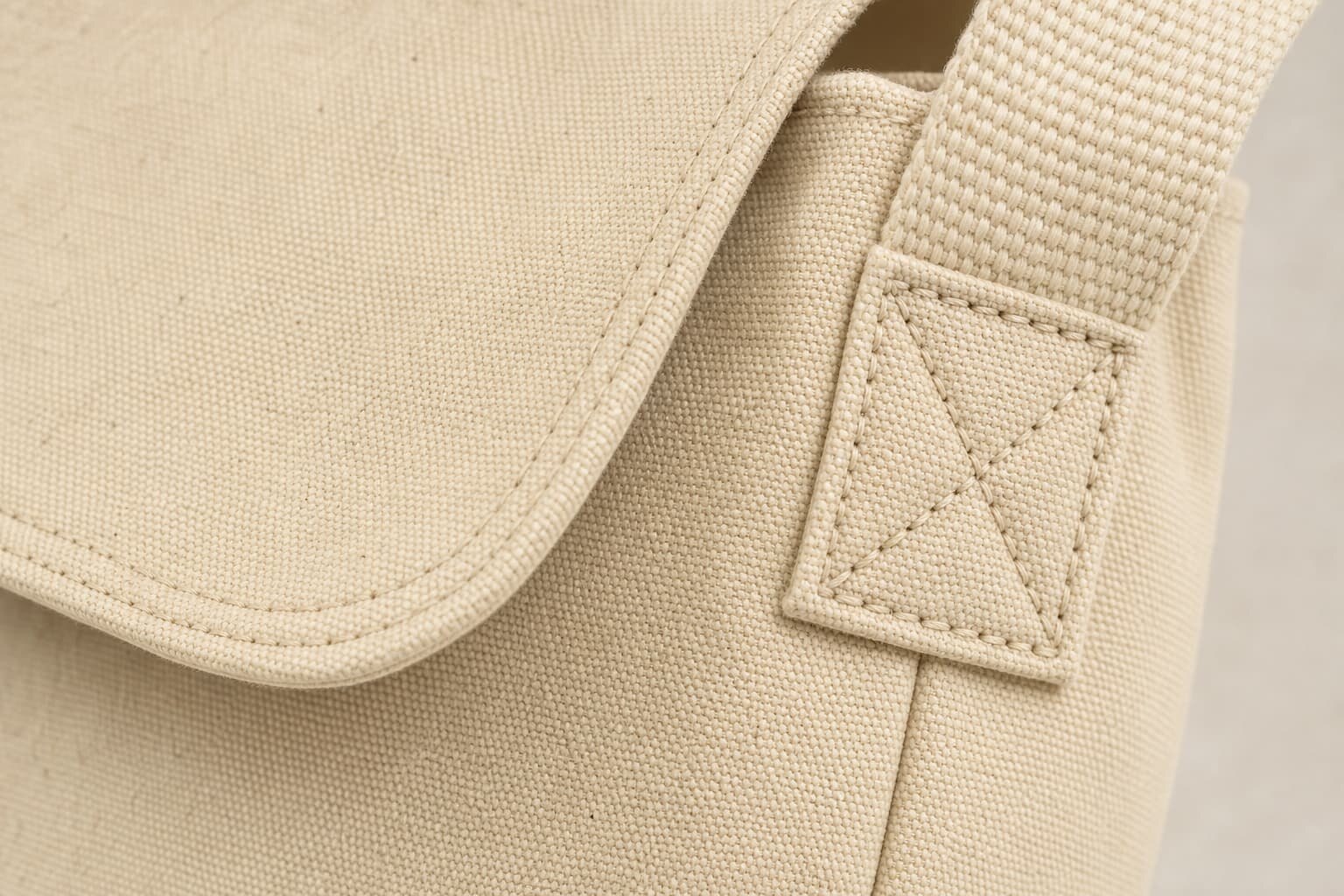
Hardware selection changes both cost and failure risk. Metal sliders look better than many plastic sliders, but low-grade metal can scratch, rust, or stain light canvas. Antique brass, nickel, black, and gunmetal finishes may each have different MOQ and lead time. The strap attachment should use box stitching, cross stitching, bar tacks, or a reinforcement patch. A single straight stitch at the strap tab is not enough for a messenger bag that will carry weight.
- Hang the loaded sample for several minutes and check whether the slider slips.
- Pull the strap tab firmly and inspect if stitch holes enlarge or the fabric starts tearing.
- Check if metal hardware leaves marks on the printed front panel during packing.
- Ask the supplier whether hardware is stock or custom; custom hardware may increase MOQ and lead time.
5. Print method: choose based on panel position and fabric surface
Screen printing is usually the most practical method for wholesale canvas messenger bags when the logo is solid color and placed on the flap or front panel. It gives good coverage on natural or dyed canvas if the ink is matched to the fabric and cured properly. For dark canvas, the factory may need a white underbase, which affects hand feel and cost. A print that looks sharp on a flat sample table can still crack if placed across a flap fold or too close to a seam.
Heat transfer can handle gradients and detailed artwork, but buyers should test adhesion on textured canvas. Embroidery gives a premium look for smaller logos, but dense embroidery can pucker the flap if backing and stitch density are not controlled. Woven labels or sewn side labels are often a safer branding method when the bag has rough canvas, washed fabric, or many color variations.
- Keep print at least 2 cm away from flap fold lines, bulky seams, and snap positions when possible.
- Request Pantone or approved color reference, but understand canvas color affects perceived print color.
- Rub the printed area after curing and check for tackiness, cracking, powdering, or ink bleed.
- For embroidery, check reverse side backing and whether threads scratch inside the flap area.
6. MOQ logic: why the same bag can have different minimums
Canvas messenger bag MOQ is not only a sewing quantity. It is driven by fabric availability, dyeing minimum, hardware purchase quantity, webbing color, label type, and print setup. A natural canvas bag using stock webbing and common hardware can often be produced at a lower MOQ than a bag using custom dyed canvas, custom webbing, non-standard buckle color, and multiple logo positions.
When comparing supplier quotes, ask what MOQ each specification is based on. A low unit price may assume available stock fabric, while your brand color may require fabric dyeing and a larger minimum. If you need a small first order, consider using natural, black, navy, or another stock canvas color and invest customization in the print or woven label first.
- Separate MOQ for fabric, sewing, print, label, and hardware in your RFQ.
- Ask whether the sample was made from stock material or from the exact bulk material.
- If the order is below fabric dyeing MOQ, ask about surcharge instead of forcing a risky substitute fabric.
- Confirm whether excess dyed fabric will be kept for reorder or charged to the first order.
7. Packing and carton planning: protect the flap, print, and shape
Packing is a cost item and a quality control item. A canvas messenger bag with a front flap, metal hardware, and printed panel can be damaged by poor packing even when sewing quality is good. If the bag is folded too tightly, the flap may develop permanent creases. If metal buckles press against the print during sea shipment, the logo may show pressure marks or abrasion.
For wholesale and retail distribution, request one sample packed exactly as bulk will be packed. Options include individual polybag, paper band, tissue protection under metal hardware, hangtag, silica gel for humid routes, and export carton with correct carton thickness. If your market requires reduced plastic, state this in the RFQ and ask for paper wrap or recyclable packing options with clear cost impact.
- Ask for carton quantity, carton size, gross weight, and net weight in the quotation.
- Check whether bags are folded, flat packed, or lightly shaped with paper support.
- Place hardware away from the printed logo wherever possible.
- Confirm carton marks, barcode labels, and inner packing before production, not after inspection.
8. Lead time: build a realistic timeline from artwork to shipment
A practical messenger bag timeline includes artwork checking, sample making, sample shipping, sample review, revision if needed, material purchasing, printing, cutting, sewing, trimming, inspection, packing, and export booking. If a supplier only says production is 25 days, ask what starts that clock. It usually starts after deposit, artwork approval, material approval, and final sample approval, not from the first email.
Lead time becomes longer when fabric must be dyed, hardware is custom, labels are woven to order, or the print requires several color approvals. Procurement teams should also allow time for pre-shipment inspection and possible corrective action. A rushed messenger bag order often creates preventable errors: wrong strap length, logo too close to the flap edge, missing reinforcement, or packing that was never tested.
- Sampling commonly needs several working days, plus courier time, depending on customization.
- Bulk fabric purchasing or dyeing should not start until key specs are approved in writing.
- Ask the factory to show a production schedule with material, print, sewing, and packing milestones.
- Reserve inspection time before the vessel or air booking deadline.
9. Quote comparison: data you need before choosing the lowest price
A useful quotation for wholesale canvas messenger bags should be more than a unit price. It should state fabric weight, fabric color, lining, dimensions, strap material and width, hardware type, logo method, logo size, packing, carton data, MOQ, sample cost if any, production lead time, payment terms, trade term, and quote validity. Without this data, two suppliers may appear to quote the same bag while actually offering different products.
A common mistake is to negotiate unit price before confirming what the sample includes. If the approved sample has 16oz canvas, cotton lining, metal slider, magnetic snap, and individual packing, but the quotation only says canvas messenger bag with logo, the supplier may later reduce quality to meet the target price. Lock the specification table first, then negotiate cost drivers one by one.
- Compare FOB or EXW terms consistently; do not mix trade terms without freight calculation.
- Ask whether print setup, label setup, and sample fees are included or separate.
- Check whether carton weight is realistic for the fabric GSM and packing method.
- Request a revised quotation after sample approval so the price matches the approved construction.
10. Sample approval workflow: turn the sample into production control
Before approving bulk production, mark the physical sample or keep a sealed reference sample with the factory. Attach a written approval sheet covering fabric swatch, logo artwork, print color, hardware finish, strap width, measurement chart, packing method, and allowed tolerance. Photos are useful, but a signed sample and a written spec sheet reduce arguments when bulk inspection finds differences.
Your approval should also define defects. For example, a slightly uneven inside seam may be minor if hidden and secure, while a twisted flap, loose strap tab, wrong logo position, stained canvas, weak snap, or slipping adjuster should be major. Messenger bags have visible front panels and load-bearing parts, so acceptance criteria must focus on both appearance and function.
- Keep one approved sample with your team and one at the factory production line.
- List major defects before production starts, especially for strap strength, print placement, stains, and closure function.
- Ask for first-piece photos after bulk cutting and first print before full production continues.
- Use pre-shipment inspection to compare bulk goods against the approved sample, not against memory or catalog photos.
Specification comparison for buyers
| Spec decision | Recommended option | When it fits | Buyer risk to check |
|---|---|---|---|
| Main fabric weight | 14oz to 16oz cotton canvas, approx. 475 to 540 GSM before washing | Retail messenger bags, school bags, conference bags, and branded merchandise needing a firm body | Too light fabric collapses after packing; too heavy fabric increases freight and may crack at folded flap edges if not softened |
| Lining construction | Unlined for budget programs; 190T polyester or 6oz cotton lining for organized retail bags | Unlined fits promotional price targets; lined fits laptop, travel, and retail display programs | Lining can hide weak seams; request inside seam photos and pocket stress points before approval |
| Shoulder strap | 38mm or 50mm cotton webbing with slider adjuster and reinforced box stitch | 38mm for light daily use; 50mm for heavier books, laptop sleeves, or premium feel | Thin webbing cuts into the shoulder and cheap sliders slip under load |
| Closure | Magnetic snap, metal buckle, or hook-and-loop depending on use | Magnetic snap for clean retail look; buckle for heritage style; hook-and-loop for school or utility bags | Magnets can fail through thick flap layers; hook-and-loop can damage print or collect lint |
| Print method | Screen print for solid logos; heat transfer for gradients; embroidery or woven label for premium small branding | Screen print works for most corporate logos and larger flat panels | Printing across seams or near flap folds can crack, distort, or register poorly |
| Bottom reinforcement | Double fabric bottom or internal PE board if shape retention is required | Book bags, retail messenger bags, or heavier giveaways | Extra reinforcement changes weight, foldability, carton size, and unit cost |
| Packing method | Individual polybag or paper band, then export carton with flap kept flat | Retail and distributor orders needing clean presentation | Over-compressed cartons create permanent flap creases and hardware marks on printed panels |
Buyer checklist before sampling
- Confirm actual fabric GSM or ounce weight from the supplier, and ask whether the weight is greige, dyed, washed, or finished fabric.
- Measure finished bag size at top width, bottom width, height, depth, flap length, and strap length instead of approving only by catalog dimensions.
- Check whether the messenger bag stands with a stable body or collapses too much for your retail or promotional use.
- Review flap alignment from the front: left and right bottom corners should be even, with no twisting caused by uneven sewing tension.
- Pull the shoulder strap by hand and inspect box stitch density, back tack points, and reinforcement patch size.
- Test the adjuster by loading the bag and checking whether the strap slips after several minutes of hanging.
- Open and close magnetic snaps, buckles, or hook-and-loop closures at least 20 times to check ease of use and fabric stress.
- Check print placement against the flap fold, seam edges, and closure hardware so the logo is not covered or distorted.
- Inspect inside seams, lining joints, and pocket corners with the bag fully opened, not only from the outside.
- Ask for packing photos showing one piece in its inner packing and the master carton layout before bulk production starts.
Factory quote questions to send
- What is the exact canvas specification: cotton content, ounce weight or GSM, yarn count if available, dyed or natural, washed or unwashed?
- Is the quoted fabric weight measured before dyeing, after dyeing, or after any washing or finishing process?
- What are the finished bag dimensions and the allowed tolerance for width, height, depth, flap length, and strap length?
- Which parts are single layer and which parts are double layer: front panel, back panel, flap, bottom, side gusset, and strap tabs?
- What shoulder strap width, material, adjuster type, and hardware finish are included in the quotation?
- Can you quote screen print, heat transfer, embroidery, and woven label separately for the same logo size so we can compare cost and risk?
- What is the MOQ for this exact fabric color and hardware color, and does the MOQ change if we use stock natural canvas?
- How many days are needed for sampling, sample revision, fabric purchasing, printing, sewing, inspection, and packing after artwork approval?
- What packing is included in the unit price: individual polybag, paper wrap, hangtag, silica gel, carton thickness, and carton marks?
- What quote validity period applies, and which items may change if cotton fabric, hardware, or exchange rate changes before order confirmation?
Quality-control points to confirm
- Fabric weight and hand feel match the approved sample, not only the written quotation.
- Finished dimensions stay within agreed tolerance after sewing and pressing.
- Front flap is centered, flat, and not twisted when the bag is closed.
- Shoulder strap webbing width, length, color, and slider function match approval sample.
- Stress points at strap tabs, side seams, flap corners, and pocket corners have back tack or reinforced stitching.
- Screen print color, opacity, curing, and placement match the approved artwork and color reference.
- Closure hardware is firmly fixed and does not cut through the canvas after repeated use.
- Inside lining, if used, is not caught in zipper, snap, or side seam stitching.
- Loose threads, needle holes, oil marks, fabric stains, and hardware scratches are controlled before packing.
- Each carton protects the flap, printed panel, and hardware from pressure marks during sea or air shipment.