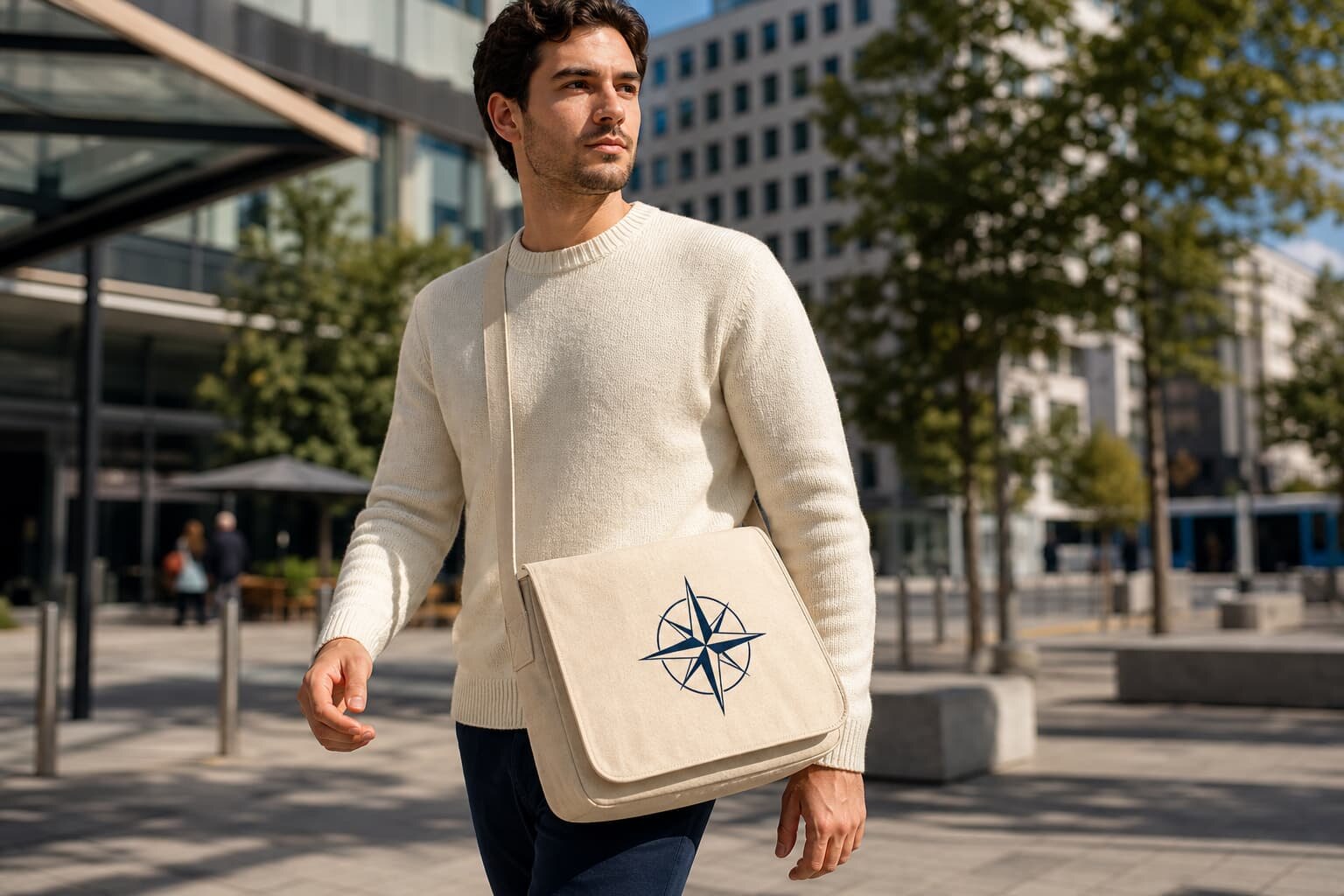
1. Why the sample review decides the real purchase, not the quote
For wholesale canvas messenger bags, the cheapest quote is often built on assumptions the buyer never approved. A factory may quote 12 oz canvas while another quotes 16 oz. One may include reinforced strap stitching, another may use a simple single seam. Both quotes can look similar in a spreadsheet, but the finished bags will not perform the same. The sample review is where procurement teams convert an attractive offer into a controlled production specification.
The main buying problem is not how to get a sample. It is how to review that sample so the bulk order is comparable, repeatable, and inspectable. A useful sample review should answer four questions: what materials are final, what workmanship level is acceptable, what packing method protects the product, and what cost drivers are included in the quotation. If those points are vague, the approved sample becomes only a nice photo, not a production standard.
- Do not approve a sample unless the factory confirms which components are final for bulk.
- Treat every revised sample as a new version with date, artwork, and quote reference.
- Compare quotes only after fabric weight, print method, hardware, pockets, packing, and inspection tolerance are aligned.
- Keep physical approval samples, not only photos, because canvas texture and stiffness are hard to judge on screen.
2. Start with the use case before choosing canvas weight
Canvas messenger bags can be made from light promotional canvas, medium retail canvas, or heavy-duty canvas. The right choice depends on the bag purpose. A giveaway conference bag does not need the same body strength as a commuter-style messenger bag carrying a tablet, notebook, and water bottle. If the RFQ only says canvas messenger bag without GSM or ounce weight, factories will choose different base materials and your quotes will not be equal.
As a practical range, 10 oz to 12 oz canvas can work for light promotional bags, but it may collapse and wrinkle more easily. A 14 oz to 16 oz cotton canvas is a common middle ground for wholesale retail or brand programs. Heavier 18 oz canvas feels premium and strong but increases material cost, sewing time, needle wear, packing volume, and freight. If the bag has a large flap, heavy canvas may also create thicker seams at the corners and around closures.
- Ask for both oz and GSM because suppliers may use different naming habits.
- For 14 oz canvas, expect roughly 475 GSM; for 16 oz, roughly 540 GSM, depending on finishing.
- Confirm whether weight is measured before or after dyeing, washing, coating, or finishing.
- Request fabric swatches if your brand cares about stiffness, slub, natural specks, or dyed color depth.
- For laptop or book carrying, review strap reinforcement and bottom seam strength, not fabric weight alone.
3. Review the sample like a production engineer, not a showroom buyer
A showroom sample can be attractive but still fail in production. The first check is measurement. Lay the bag flat without stretching it. Measure width, height, gusset, flap depth, pocket opening, strap width, and strap length at both shortest and longest adjustment. Canvas moves during sewing, so reasonable tolerances should be agreed, but large differences on the sample usually become larger disputes in bulk.
The second check is construction sequence. Look at the inside seams, not only the outside. If raw edges are exposed, ask whether they will be overlocked, bound, or hidden in bulk. If the flap corner is bulky, ask how the factory will control turning and pressing. If the bag has lining, check whether the lining pulls the outer canvas inward. Many messenger bag problems are caused by small construction choices that are not visible in a front photo.
- Check whether the flap closes straight when the bag is filled, not only when empty.
- Inspect whether the two strap attachment points sit at the same height.
- Look for skipped stitches around thick layers, especially at side seams, flap corners, and strap anchors.
- Confirm stitch density, for example 7 to 9 stitches per inch if suitable for the chosen style.
- Ask the factory to mark any sample area they consider difficult before bulk production starts.
4. Print approval: position, ink behavior, and artwork limits on canvas
Canvas is not a smooth paper surface. Its weave, slubs, and absorbency affect logo clarity. For wholesale canvas messenger bags, screen printing is usually the most economical and stable method for solid one-color or two-color logos. It works well on natural canvas and many dyed colors, but fine lines can break on coarse fabric. If your artwork has gradients, photo details, or very small text, heat transfer or a woven label may be better, but each method changes cost and feel.
During sample review, do not only check whether the logo is centered. Fold the flap, close the bag, and view it from normal retail distance. A logo that looks level on a flat table may tilt after the flap wraps over the bag body. For dark canvas, check ink opacity. For light canvas, check whether the ink bleeds into the weave. If printing crosses seam thickness or pocket layers, expect uneven pressure unless the factory has adjusted the jig.
- Specify print size in centimeters, position from seam or flap edge, and acceptable tolerance.
- Ask whether the print screen charge is included or listed separately.
- For screen print, confirm Pantone target but allow that fabric color and absorbency affect final appearance.
- For heat transfer, check edge lifting, hand feel, and cracking after folding.
- For embroidery, check backing, thread color, stitch density, and puckering around the logo.
5. Hardware and strap details that change the quote quickly
Messenger bags look simple until the hardware is specified. A metal slider, D-ring, magnetic snap, zipper pocket, rivet, or metal buckle can change both unit cost and production risk. Hardware also creates inspection issues: rust, sharp edges, weak plating, poor magnet force, loose rivets, and color mismatch. If the RFQ does not define hardware material and finish, one factory may quote basic alloy parts while another uses stronger hardware with better coating.
The shoulder strap deserves special attention because it carries the real load. Cotton webbing is common and matches the canvas look, while polyester webbing may offer smoother adjustment and better color consistency. A 3.8 cm strap can work for many standard bags, but 5 cm feels more stable for heavier styles. Ask whether the quoted strap includes an adjustable slider and whether the webbing ends are folded and stitched cleanly or simply heat cut.
- Request photos or samples of hardware in the final finish: nickel, antique brass, matte black, or painted color.
- Check whether magnetic snaps have reinforcement behind the canvas to prevent tearing.
- Avoid placing heavy metal hardware on very light canvas unless reinforced.
- For zipper pockets, specify zipper size, tape color, slider type, puller shape, and opening length.
- For strap stress points, require bar tack, box stitch, cross stitch, or another approved reinforcement.
6. MOQ logic: why small changes can raise the minimum
MOQ for canvas messenger bags is not only about sewing capacity. It is controlled by fabric sourcing, dyeing, printing setup, hardware purchasing, cutting efficiency, and packing material. A natural canvas bag with one-color screen print usually has a lower MOQ than a custom-dyed canvas bag with matched webbing, special hardware, lining, and multiple print positions. Procurement teams should ask what drives the MOQ instead of only asking for the lowest number.
Color splitting is a common hidden issue. A supplier may accept 1,000 pieces total, but not 200 pieces each across five colors if each color requires separate fabric dyeing, webbing matching, thread changes, and print setup. The same applies to logo versions for distributors. If you need multiple logos or regional designs, ask whether the factory can gang print, share fabric, or produce blank bags first and print later. Each approach affects cost, schedule, and quality control.
- Natural canvas normally has more flexible sourcing than custom-dyed canvas.
- Custom fabric color may require a minimum dye lot that is higher than the bag MOQ.
- Logo color changes can create extra screen setup and cleaning time.
- Special hardware finishes may require supplier MOQ even if sewing MOQ is low.
- If testing or retail packaging is required, MOQ may be affected by label and packaging supplier minimums.
7. Sample stages and lead time: what to approve before bulk cutting
A responsible sourcing workflow usually has three sample stages: first prototype, revised sample, and pre-production sample. The first prototype proves size, shape, pocket layout, and construction. The revised sample corrects buyer comments. The pre-production sample should use bulk fabric, final hardware, final print, final label, and intended packing. Bulk cutting should not start until the pre-production sample is approved, especially for custom-dyed canvas or large print areas.
Sample lead time depends on material availability and artwork readiness. A simple natural canvas messenger bag with screen print can often move faster than a bag requiring lab dip approval, custom webbing, special metal hardware, or printed lining. Avoid telling the factory to rush the sample without clarifying which materials may be substituted. A fast sample made with substitute webbing or stock hardware may be useful for shape approval, but it should not be treated as a final production approval.
- Label samples as prototype, revised sample, or pre-production sample.
- Ask the factory to state the sample lead time after receiving artwork, size spec, and material confirmation.
- Do not approve bulk fabric color based only on a digital photo.
- If a component is substituted in the sample, write down the final bulk replacement.
- Keep the approved sample sealed or signed to support final inspection decisions.
8. Packing review: protect the flap, print, and strap shape
Packing is often reviewed too late, but it affects customer experience and defect rate. Canvas messenger bags can crease sharply if packed under pressure. A front flap can develop a permanent fold line if cartons are over-compressed. Screen print can transfer if bags are stacked before ink is fully cured or if printed surfaces rub directly against hardware. During sample approval, ask for a packing trial, not only a bag sample.
Flat packing usually saves carton space, but it must control strap placement and flap shape. Tissue paper, kraft insert, or light board may be needed for premium retail styles. For distributor or promotional orders, simple individual polybags may be acceptable, but warning text, suffocation notice, recycling marks, or customer barcode requirements should be confirmed. Carton quantity should balance freight efficiency with compression risk; very heavy cartons increase handling damage and inspection difficulty.
- Confirm pieces per inner polybag or master carton and whether straps are folded inside or outside the bag.
- Ask for estimated carton dimensions, gross weight, net weight, and carton mark layout in the quote.
- Use interleaving paper if print transfer or hardware rubbing is a risk.
- Avoid placing metal hardware directly against printed logos during packing.
- Request packed carton photos before shipment if no onsite inspection is arranged.
9. Quote comparison: build a clean cost and risk view
A factory quote for wholesale canvas messenger bags should be more than a unit price. It should state fabric, size, print method, hardware, pockets, labels, packing, MOQ, sample cost, tooling or screen cost, lead time, trade term, payment term, and quote validity. If one supplier includes individual polybags and another quotes bulk pack, the cheaper unit price may not be cheaper after repacking or retail preparation.
Ask for a structured breakdown where possible. Factories may not disclose every internal cost, but they can usually separate major cost drivers: canvas fabric, webbing, hardware, printing, sewing labor, labels, packing, and inland transport if relevant. This helps the buyer understand what happens if the bag changes from 12 oz to 16 oz canvas, from one-color print to two-color print, or from no lining to lined construction. It also reduces negotiation mistakes that remove necessary quality features.
- Match every quote to a sample version and artwork version.
- Clarify whether pricing is EXW, FOB, CIF, DDP, or another trade term.
- Ask whether export cartons, hangtags, barcodes, and master carton labels are included.
- Check whether sample fees are refundable, credited, or separate.
- Do not compare suppliers until material weight, size tolerance, logo method, packing, and inspection level are aligned.
10. Acceptance criteria before you release the purchase order
Before issuing the purchase order, convert sample comments into measurable acceptance criteria. This does not need to be a complicated technical manual, but it should cover the points that create disputes: finished size, fabric weight, logo position, color tolerance, seam quality, strap strength, closure function, packing, and carton marks. If the buyer only writes approved as sample, the factory may interpret many details differently during bulk production.
For final inspection, define major and minor defects in a way that matches the selling channel. A slight natural slub in unbleached canvas may be acceptable, while a dirty stain on the flap is not. A small thread end inside the pocket may be minor, while a loose strap anchor is critical. Messenger bags are handled, opened, loaded, and worn, so functional defects should carry more weight than tiny cosmetic variations that do not affect retail acceptance.
- Set measurement tolerance, for example plus or minus 0.5 cm to 1 cm depending on bag size and construction.
- Define unacceptable print defects: missing ink, heavy smudge, wrong color, tilted logo, cracking, or poor opacity.
- Classify loose strap stitching, broken zipper, weak snap, sharp hardware, and open seams as serious defects.
- Confirm color tolerance by approved swatch or physical sample, not only a screen image.
- Attach approved packing instruction to the PO, including carton quantity and labeling requirements.
Specification comparison for buyers
| Spec decision | Recommended option | When it fits | Buyer risk to check |
|---|---|---|---|
| Fabric weight | 14 oz to 16 oz cotton canvas for main body | Retail messenger bags, brand merchandise, campus bags, and durable daily-use promotions | Too light fabric collapses after packing; too heavy fabric increases freight and sewing difficulty |
| Flap closure | Metal snap, magnetic snap, or hook-and-loop depending on market | Snap for cleaner retail look; hook-and-loop for lower cost and fast opening | Magnetic snaps can mark fabric if reinforcement is weak; hook-and-loop can pull lint and look cheap |
| Shoulder strap | 3.8 cm to 5 cm cotton webbing with adjustable slider | Adult unisex messenger bags and distributor stock programs | Thin straps twist under load; weak slider coating may chip during use |
| Print method | Screen print for solid logos; heat transfer for gradients; embroidery for premium small marks | Screen print suits most wholesale canvas messenger bags with simple branding | Ink cracking on heavy texture canvas; color shift on dyed canvas; embroidery puckering on flap |
| Inner structure | One main compartment plus slip pocket or zipper pocket | Retail buyers needing a useful but cost-controlled layout | Too many pockets add labor time and inconsistent sewing; zipper pocket needs puller and slider QC |
| Packing method | Flat packed with tissue or kraft insert, 25 to 50 pcs per export carton | Wholesale shipments where carton cube and fabric creasing matter | Over-compressed cartons create flap crease, print transfer, and distorted straps |
| Sample approval | Pre-production sample with bulk fabric, final hardware, final print, and packing trial | Before deposit balance or before releasing bulk cutting | Approving a sales sample made with substitute fabric leads to bulk disputes |
Buyer checklist before sampling
- Confirm the canvas GSM or ounce weight, fiber content, color standard, and whether shrinkage testing has been done before cutting.
- Measure finished bag size, flap depth, strap width, strap length range, pocket size, seam allowance, and carton size against the approved spec.
- Check print position, print size, color, opacity, ink hand feel, rub resistance, and whether the logo sits level after the flap is closed.
- Load test the sample with realistic contents such as laptop dummy, books, or retail weight requirement for at least 30 minutes.
- Open and close snaps, magnetic buttons, zippers, sliders, and buckles repeatedly to check function before approving hardware.
- Inspect stitch density, back tack positions, skipped stitches, loose threads, seam puckering, and reinforcement at strap stress points.
- Review packing method, inner protection, hangtag attachment, polybag warning text if required, carton marks, and carton compression risk.
- Ask the factory to list which sample materials are final and which are only temporary substitutes before you approve the sample.
- Request a quote version number and match it with the exact approved sample date, photo set, artwork file, and packing instruction.
- Keep one sealed approval sample at your office and one at the factory to reduce argument during final inspection.
Factory quote questions to send
- What is the exact fabric weight in oz and GSM, and is it quoted as greige fabric, dyed fabric, or finished fabric after washing or finishing?
- Is the sample made with the same canvas, lining, webbing, hardware, thread, zipper, and print method planned for bulk production?
- What is the minimum order quantity for this bag design at the quoted fabric color and logo method, and what changes if we split colors?
- Please break down the quote by fabric, webbing, hardware, printing, sewing labor, packing, sampling, mold or screen setup, and inland transport if applicable.
- What sample lead time applies for a first sample, revised sample, and pre-production sample after artwork and material approval?
- What bulk lead time is counted from deposit, from sample approval, or from material arrival, and what is the critical path item?
- How many pieces per carton are quoted, what is the estimated carton size and gross weight, and can you provide a packing trial photo?
- What inspection standard do you suggest for appearance defects, measurement tolerance, print defects, and functional testing?
- Which parts of the sample may change in bulk because of material lot, fabric shrinkage, dye batch, or available hardware stock?
- Can you provide clear sample photos of inside seams, strap attachment, bottom corners, closure reinforcement, print close-up, and packed carton?
Quality-control points to confirm
- Fabric weight tolerance should be agreed in writing, for example plus or minus 5% if acceptable for the program.
- Finished bag dimensions should be checked after pressing or normal handling, not while fabric is stretched by hand.
- Strap anchoring should use box stitch, cross stitch, bar tack, or another approved reinforcement suitable for the expected load.
- Print adhesion should be checked with dry rub, light scratch, tape pull where suitable, and folding over the printed area.
- Hardware should be checked for rust, sharp edges, coating chips, weak magnet force, loose rivets, and poor alignment.
- Seams should be inspected for skipped stitches, uneven stitch density, broken thread, raw edge exposure, and seam slippage.
- Packing should prevent print transfer, deep flap creases, moisture exposure, carton bulging, and strap deformation.
- The approval sample should be signed or labeled with date, version, artwork file name, and confirmed materials.