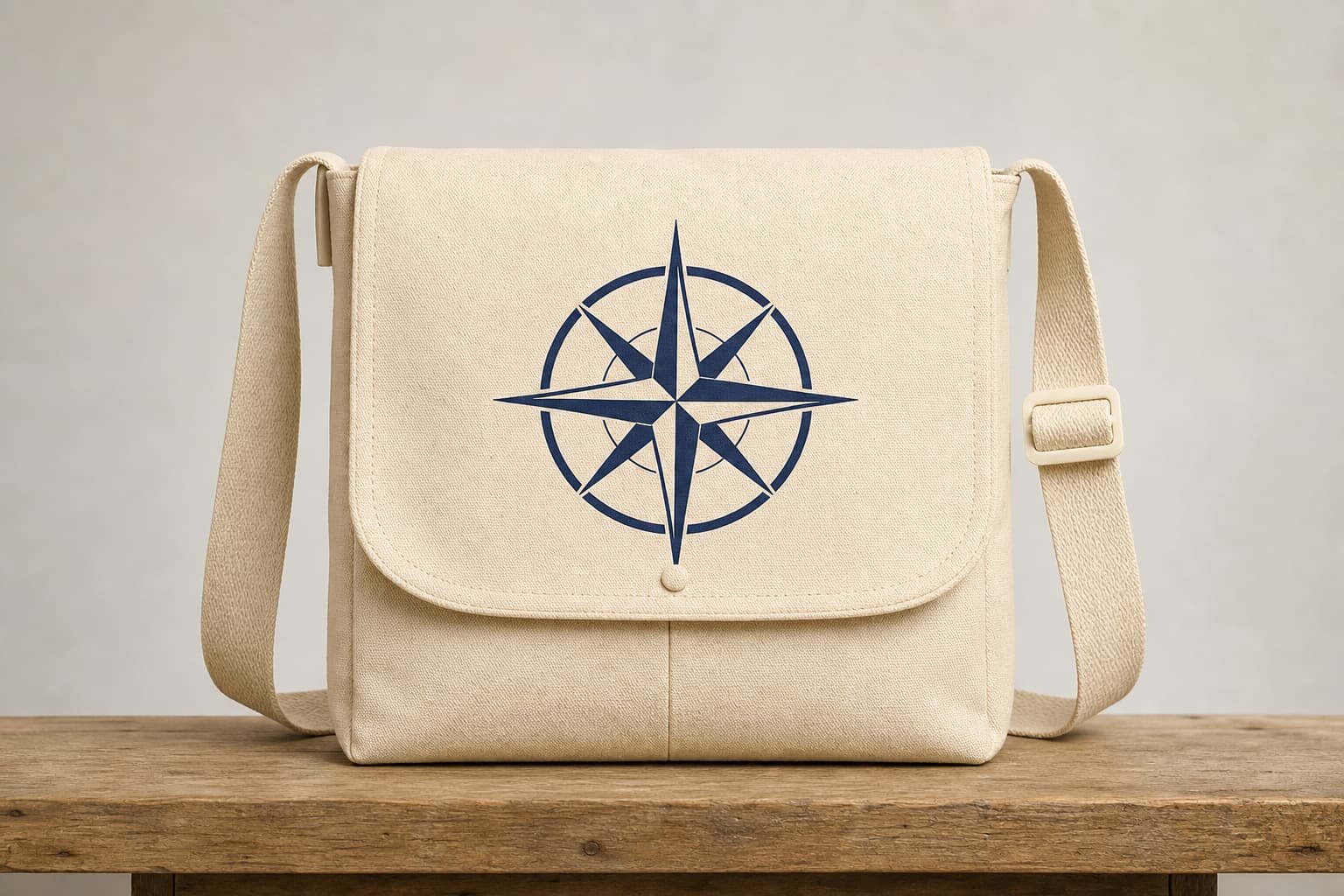
1. The buying problem: messenger bags fail at stress points, not in catalog photos
Wholesale canvas messenger bags usually look acceptable in a quotation photo. The real problem appears after bulk cutting, sewing, printing, and packing: flap corners pull out of shape, straps tear at the anchor, magnetic snaps do not meet correctly, and the front logo sits a few millimeters off-center on a very visible panel. For procurement teams, this is not a design issue only. It becomes a claims issue, a shipment delay, and sometimes a retail return problem.
A useful quality control plan must connect the RFQ, sample approval, production checkpoints, and final inspection. If the RFQ only says 12 oz canvas messenger bag with logo, the supplier has too much room to interpret fabric weight, reinforcement, hardware grade, printing method, and packing. This guide focuses on one buying problem: how to control quality before the factory cuts bulk fabric, while still keeping the quote comparable across suppliers.
- Do not approve a messenger bag only from a front-view photo; check side profile, strap anchoring, flap closure, inside construction, and packed condition.
- Treat the front flap as a high-risk branding area because every small skew, wrinkle, print shade issue, or closure misalignment is immediately visible.
- Separate appearance defects from performance defects; a loose thread is different from a weak strap anchor, and the QC plan should rank them differently.
2. Start the QC plan from the RFQ, not after bulk production
The most expensive quality problems are usually written into the order at quotation stage. A low quote may be based on lighter canvas, fewer reinforcement operations, cheaper plated hardware, single-layer flap construction, or bulk packing that crushes the bag. If the buyer discovers this during final inspection, the factory may argue that the product matches the quote because the missing details were never specified.
A strong RFQ for canvas messenger bags should define the usable product, not just the visible style. Include finished size, main fabric weight, lining requirement, closure, shoulder strap width, hardware finish, print method, pocket layout, packing, and inspection standard. If multiple suppliers quote the same drawing but different construction, the cheapest quote is not necessarily the same product.
- Request a quote sheet that lists fabric GSM, fabric color process, lining, hardware material, print method, unit packing, carton packing, MOQ, sample charge, and lead time separately.
- Ask the supplier to state what is excluded: custom dyeing, screen setup, woven label, hangtag, barcode label, individual polybag, carton mark, and inspection support.
- Use one approved technical sheet for all supplier quotes so the purchasing team is not comparing a promotional bag against a retail-grade bag.
3. Fabric weight and canvas construction: specify the bag you actually need
Canvas messenger bags are often quoted by ounces, but buyers should also ask for approximate GSM. A 10 oz canvas may suit lightweight promotional use, but it can feel soft and collapse when used for a structured messenger bag. A 12 oz canvas, roughly around 390-420 GSM depending on the mill, is a common middle option for retail and brand merchandise. For heavier laptop-style bags, 14-16 oz canvas, roughly around 470-540 GSM, gives better structure but increases sewing difficulty, unit cost, carton weight, and possibly lead time.
Fabric weight alone is not enough. Natural canvas, bleached canvas, dyed canvas, washed canvas, and coated canvas behave differently. Dyed canvas can have shade variation between lots. Washed canvas may have a softer handfeel but higher dimension variation. Coated canvas may improve water resistance but can crack at folds or affect printing. The approved swatch should be stapled or sealed with the sample record so the factory, merchandiser, inspector, and buyer all use the same reference.
- For promotional messenger bags: 10-12 oz canvas may be acceptable if load requirement is light and reinforcement is still controlled.
- For daily retail messenger bags: 12-14 oz canvas is usually a safer balance between structure, cost, and sewing efficiency.
- For laptop or work bags: consider 14-16 oz canvas, reinforced base, wider strap, stronger hardware, and better carton protection.
- Set a fabric tolerance, for example target GSM with an agreed tolerance range, instead of accepting any fabric that looks similar in photos.
4. Construction details that should be inspected before bulk sewing
Messenger bags carry weight away from the body on a long strap, so stress is concentrated at strap anchors, flap corners, zipper ends, and pocket openings. These areas require more than neat stitching. They need correct seam allowance, enough fabric overlap, bar-tacks or box stitching, and thread tension suitable for the fabric thickness. A clean-looking seam with weak reinforcement can fail after a few weeks of use.
Before bulk sewing, request a pre-production sample or at least a production-line pilot piece made with bulk fabric, bulk hardware, bulk thread, and the approved print. The sample room may sew more carefully than the production line, so a pilot piece from the actual line is more useful for risk control. The buyer should inspect both outside and inside, including whether seam allowances are trimmed too close, whether lining twists, and whether the flap sits evenly after the bag is lightly loaded.
- Strap anchors: require bar-tack, box stitch, or reinforced cross stitch, and confirm the stitching pattern in sample photos.
- Flap corners: check symmetry, thickness, edge turning, and whether the flap pulls to one side after closure.
- Zipper pockets: check zipper tape stitching, end stops, zipper puller strength, and whether the zipper scratches the canvas.
- Inner seams: require binding or clean finishing if the bag is unlined, especially for heavier canvas that frays at raw edges.
- Thread: confirm color matching or contrast stitching, thread thickness, and no skipped stitches on thick folded areas.
5. Branding and print control on textured canvas
Canvas is not a smooth paper surface. The weave, dye process, and fabric absorbency affect logo sharpness and color. Screen print is usually the best option for solid one-color or two-color artwork on canvas messenger bags. Heat transfer can handle more detail, but it may change the handfeel and needs testing at flap fold areas. Embroidery, woven labels, leather patches, and metal plates can increase perceived value, but they add placement, color, and attachment risks.
The front flap is the most common branding position, but it is also the easiest place to notice a mistake. A logo that is 5 mm off-center may be visible because the flap has straight edges and closure hardware. The RFQ should include artwork size, placement from top and side edges, print color reference, acceptable tolerance, and whether the print is applied before or after sewing. Printing before sewing can improve flatness but requires tighter cutting and sewing alignment. Printing after sewing can help final placement but may be limited by seams, flap thickness, and screen access.
- Screen print: good for bold logos, lower color count, and repeatable bulk production; require opacity check on dark canvas.
- Heat transfer: useful for detailed artwork but test adhesion, edge lifting, and handfeel after folding.
- Embroidery: durable and premium, but can pucker lighter canvas; use backing and confirm stitch density.
- Woven label: stable for repeated orders and small branding; confirm label size, fold type, and sewing position.
- Leather or PU patch: check colorfastness, edge finishing, needle holes, and compliance requirements for the target market.
6. MOQ logic: why the same bag can have different minimums
MOQ for wholesale canvas messenger bags is not only a factory preference. It is usually driven by fabric sourcing, dyeing, printing setup, hardware purchase, label production, and cutting efficiency. A natural canvas bag with a one-color screen print may support a lower MOQ than a custom dyed canvas bag with black metal hardware, woven label, inner lining, and four-color transfer print. If the buyer requests six colors and three logo versions, the real MOQ may multiply quickly.
To compare quotes properly, ask the supplier to separate MOQ by fabric color, bag size, print artwork, and hardware finish. This allows a buyer to decide whether to consolidate colors, use stock fabric, standardize hardware, or place a larger combined order. The lowest MOQ is not always the best option if it forces the factory to use leftover fabric lots or substitute hardware without control.
- Stock natural or black canvas usually has easier MOQ than custom dyed seasonal colors.
- One bag size with multiple logo prints may still require separate print setup and packing segregation.
- Custom hardware color can create a separate MOQ, especially for plated buckles, sliders, snaps, and rivets.
- Woven labels and hangtags may have their own MOQ that exceeds the bag order quantity.
- Ask if overrun and underrun tolerance applies, especially for custom dyed or printed orders.
7. Sample approval: check performance, not only workmanship
A sample approval process should confirm the product can be produced consistently, not just that one sample looks attractive. For canvas messenger bags, the buyer should approve a material swatch, then a fit sample, then a printed pre-production sample when branding and construction are both important. If timing is tight, combine steps carefully, but do not skip the stage where bulk fabric and bulk hardware are confirmed.
Use the sample as an inspection standard. Record measurements, fabric GSM, strap width, print position, closure alignment, pocket size, and packing method. Load the sample with a realistic weight for the intended use. A promotional document bag may only need light testing, while a laptop messenger bag should be tested with more weight. The goal is not to create a laboratory report for every order, but to find weak construction before the factory repeats it thousands of times.
- Measure finished width, height, gusset, flap drop, strap length range, pocket opening, and logo placement.
- Load the bag and hang it for a practical period agreed with the supplier; inspect strap anchors, seam distortion, and closure alignment afterward.
- Open and close zippers, magnets, snaps, or buckles repeatedly to identify alignment and hardware problems.
- Rub the printed area with a clean dry cloth and, if relevant, a damp cloth to check obvious ink transfer.
- Take approval photos from front, back, side, inside, bottom, close-up stitching, close-up hardware, and packed unit.
8. In-line QC: catch repeat defects before the carton is sealed
Final inspection is necessary, but it is late. In-line QC is where the factory can still correct cutting, printing, stitching, and assembly problems without unpacking finished cartons. For canvas messenger bags, important in-line checkpoints include fabric inspection before cutting, first cutting panel check, first print check, first sewing output check, and first packed carton check. Each checkpoint should compare the bulk item against the approved sample and technical sheet.
Buyers do not need to micromanage every sewing operation, but they should request evidence at the right stages. Clear production photos can reveal wrong fabric shade, wrong strap width, missing reinforcement, logo position drift, or poor carton packing before the issue becomes a full batch. For higher-risk orders, a third-party or buyer-appointed in-line inspection can be scheduled when 20-30% of goods are sewn, allowing corrective action while production is still active.
- Fabric stage: check roll shade, visible slubs, stains, GSM, and whether the fabric is relaxed before cutting.
- Cutting stage: check panel direction, size, notches, flap shape, pocket dimensions, and matching between left and right parts.
- Printing stage: check artwork size, color, opacity, registration, drying, and position against panel edges.
- Sewing stage: check seam allowance, stitch density, bar-tacks, thread tension, flap shape, and strap anchor strength.
- Packing stage: check folding method, unit protection, hangtag or barcode, carton count, carton mark, and carton weight.
9. Final inspection criteria: define what is critical, major, and minor
A final inspection plan should state sampling level, AQL, measurement tolerance, and defect classification before the purchase order is confirmed. Without this, the buyer and factory may disagree about whether a defect is cosmetic or shipment-blocking. For messenger bags, critical defects are safety or function issues such as sharp hardware, broken strap anchors, non-working zipper, strong odor, mildew, wrong logo, or wrong material. Major defects affect saleability or function. Minor defects are small workmanship issues that do not affect normal use.
Measurement should be done consistently. Canvas bags are soft goods, so inspectors should place the bag flat on a table, smooth it gently without stretching, and measure the same points used in the technical sheet. For color and handfeel, compare against the approved swatch under suitable lighting. For print, use the approved sample and artwork placement. For packing, open cartons from different positions in the shipment because compression and carton damage may not be evenly distributed.
- Critical defects: wrong logo, wrong fabric, sharp metal edge, broken closure, broken strap anchor, mildew, strong chemical odor, or insect contamination.
- Major defects: obvious print skew, flap misalignment, incorrect size beyond tolerance, non-smooth zipper, loose hardware, weak seam, visible stain, or wrong packing.
- Minor defects: small thread tail, slight crease, small removable dust mark, or minor shade variation within approved tolerance.
- Measurement checks should include body width, body height, gusset, flap depth, strap width, strap length range, pocket position, and logo placement.
- Packed inspection should include quantity per carton, carton gross weight, shipping mark, barcode accuracy, and whether the bag shape is protected.
10. Lead time and quote data: make quality part of the commercial agreement
Lead time for canvas messenger bags depends on material availability, dyeing, printing, hardware purchase, sample approval, production capacity, and packing complexity. A simple natural canvas messenger bag with stock fabric and one-color screen print is different from a heavy dyed canvas laptop messenger bag with lining, metal buckle, custom woven label, and retail packaging. Buyers should ask the factory to break lead time into milestones instead of accepting one vague shipment date.
The quote should also show the cost drivers that affect quality. If one supplier is much cheaper, the buyer should know whether the difference comes from lighter fabric, less reinforcement, cheaper hardware, simpler packing, or higher production efficiency. A transparent quote helps procurement negotiate intelligently. It also prevents the common mistake of approving a premium-looking sample and then receiving a bulk order made to a lower-cost interpretation.
- Quote data to request: unit price, currency, Incoterm, MOQ by SKU, fabric spec, print method, hardware spec, packing method, carton details, sample cost, setup charges, lead time, and payment terms.
- Lead time milestones: artwork confirmation, material purchase, sample making, sample approval, cutting, printing, sewing, packing, inspection, and shipment handover.
- Risk buffers: add time for custom dyeing, revised samples, print color correction, hardware plating, retail barcode approval, and peak-season capacity.
- Commercial control: attach the approved sample photos and technical sheet to the PO so the factory quotation and production standard are linked.
Specification comparison for buyers
| Spec decision | Recommended option | When it fits | Buyer risk to check |
|---|---|---|---|
| Main canvas fabric | 12 oz / about 390-420 GSM cotton canvas for standard retail; 14-16 oz / about 470-540 GSM for premium or laptop use | 12 oz works for promotional and lifestyle bags; heavier canvas improves structure and perceived value | Supplier may quote by ounce, GSM, or fabric width; require actual GSM tolerance and pre-production swatch approval |
| Flap and body construction | Double-layer flap, reinforced strap anchor, bound or folded internal seams | Needed when the bag carries books, tablet, laptop, or daily commute items | Weak flap corners and thin strap anchors often pass visual photos but fail load testing |
| Closure method | Magnetic snap for lifestyle retail; metal buckle or zipper plus flap for higher security | Choose based on target user and price point, not only appearance | Magnets can mark fabric or misalign; buckles add labor and must be checked for plating and pull strength |
| Printing method | Screen print for solid logos; heat transfer for multi-color detail; embroidery or woven label for premium branding | Screen print is stable for simple CTM-style logos and large batch repeat orders | Print cracking, ink bleeding, and shade mismatch increase when canvas is unwashed, dyed dark, or heavily textured |
| Shoulder strap | 38-50 mm cotton webbing or polyester webbing with adjustable metal slider | 38 mm suits light bags; 50 mm is better for laptop messenger bags | Strap length, slider movement, and anchor bar-tack strength must be inspected, not assumed from sample photos |
| MOQ planning | MOQ separated by fabric color, print artwork, hardware color, and bag size | Useful when buyers need multiple SKUs without inflating slow-moving stock | A factory may accept low MOQ but charge hidden setup, dyeing, printing, or carton change fees |
| Packing method | Individual polybag or paper band, silica gel where needed, export carton with measured gross weight | Retail and distributor orders need clean presentation; promotional orders may use bulk packing | Over-compressed cartons can deform flaps, crease canvas, and damage printed areas during ocean freight |
Buyer checklist before sampling
- Define bag size as finished external dimensions and allow tolerance, for example +/-1 cm for width and height and +/-0.5 cm for pocket placement.
- State canvas weight in both oz and approximate GSM, and request a fabric swatch with actual measured GSM before sample approval.
- Confirm whether the canvas is natural, bleached, reactive dyed, pigment dyed, washed, or enzyme washed, because shrinkage and shade variation differ.
- Specify all stress points: strap anchors, flap corners, pocket opening, zipper ends, buckle tabs, and handle joints if the bag has a carry handle.
- Approve the printing method with artwork size, Pantone or closest available color, ink type, placement tolerance, and rub test requirement.
- Check the sample with real loading weight, not only appearance; record the test weight and duration in the approval notes.
- Require pre-production photos of fabric roll label, cut panels, print panels, hardware, labels, inner pocket, and packing layout.
- Separate quote lines for fabric, printing, hardware, inner lining if any, packing, sample charge, mold or screen charge, and inland freight if applicable.
- Confirm MOQ by SKU and by combined order, including what changes create a new MOQ: color, size, logo, lining, hardware finish, or carton mark.
- Set final inspection level and AQL before PO release, and list critical defects that require rejection even if the AQL count is not exceeded.
Factory quote questions to send
- What is the exact canvas specification you are quoting: oz, GSM, yarn construction if available, fabric width, color process, and shrinkage range?
- Is the quoted price based on stock canvas or custom dyed canvas, and what MOQ applies to each fabric color?
- Which parts of the bag are single-layer and which are double-layer, including flap, base, strap tabs, and inner pocket panels?
- What stitching construction is included: stitches per inch, seam type, binding tape, bar-tacks, and reinforced cross stitching at strap anchors?
- Which hardware material and finish are included in the quote: iron, zinc alloy, brass, nickel-free finish, antique brass, black plating, or gunmetal?
- What print method is included, how many colors are included, and what is the maximum printable area on the flap or body panel?
- Are print screens, heat transfer films, woven labels, embroidery tapes, or metal logo plates charged separately?
- What sample types can you provide: material swatch, blank fit sample, printed pre-production sample, and sealed production sample?
- What sample lead time and bulk lead time are realistic after artwork approval and deposit, and what factors can extend the schedule?
- How do you inspect fabric defects before cutting, and can you share inspection photos or fabric inspection records for the bulk rolls?
Quality-control points to confirm
- Fabric GSM and handfeel must match the approved swatch; large variation changes structure, print result, and freight weight.
- Finished dimensions should be checked on a flat table after the bag is relaxed, not stretched by hand.
- Flap symmetry and closure alignment must be checked with the bag lightly loaded, because empty bags can hide closure misalignment.
- Strap anchors, buckle tabs, and handle joints require bar-tack or reinforced stitching with no skipped stitches or loose thread tails.
- Print position must follow approved artwork placement, especially on flap panels where a small tilt is very visible in retail photos.
- Screen print adhesion and color should be checked after drying and handling; dark canvas needs special attention for opacity.
- Zippers must open and close smoothly, with stopper strength and zipper tape stitching checked at both ends.
- Magnets, snaps, rivets, and buckles must be secure, correctly aligned, and free from sharp edges or plating scratches.
- Inner lining, if used, must not twist, bunch, or reduce usable capacity; seam allowances should be trimmed and secured.
- Packing must protect the flap shape and printed surface; carton compression should not create permanent creases before shipment.