Start QC Before the Price Is Final
A quality control plan for wholesale canvas messenger bags should be written before the supplier gives the final quote, not after production starts. Most disputes on this product come from unclear structure: fabric weight is quoted one way, strap reinforcement is assumed another way, and the buyer later discovers that the sample and bulk order were made to different commercial expectations.
Procurement teams should treat the QC plan as part of the RFQ. It tells each factory what they are pricing, what they must prove in samples, and which details will be inspected before shipment. This also makes quotes easier to compare. A low unit price may only be low because it excludes lining, uses thinner webbing, changes the closure, or packs the bag in a way that creates creases on the printed flap.
- Send one spec sheet to every supplier, not a casual photo plus target price.
- Ask factories to confirm any deviation in writing before they quote.
- Separate must-have details from optional upgrades so cost differences are visible.
- Do not approve bulk production from a beauty sample only; the sample must represent production materials and construction.
Define the Fabric in Factory Language
Canvas messenger bags are usually bought by appearance and handfeel, but factories build them from measurable fabric specifications. The RFQ should state cotton canvas weight in ounces or GSM, composition, weave, color, finish, and whether the fabric is natural, bleached, dyed, washed, or pigment-dyed. For many messenger bag programs, 12 oz to 16 oz canvas is a practical range. Lighter canvas can work for promotional bags, while heavier canvas gives better structure for retail or laptop-style products.
Be careful when comparing ounce weight and GSM between suppliers. Some suppliers quote greige fabric weight before dyeing or washing, while others quote finished fabric. A dense 12 oz canvas may perform better than a loosely woven heavier cloth. For dark dyed canvas, request a bulk fabric swatch before cutting and ask the factory to flag colorfastness risk, especially if the bag includes natural cotton straps, light lining, or white logo printing.
- For budget promotional messenger bags, ask if 10 oz to 12 oz canvas is enough for the expected load.
- For retail or distributor stock, 12 oz to 16 oz finished canvas is usually a better starting point.
- For structured laptop-style bags, consider heavier canvas, lining, padding, or interlining rather than fabric weight alone.
- Set a color tolerance using an approved swatch, not only a Pantone reference, because cotton canvas absorbs dye unevenly.
Build the Bag Around the Load
The main quality risk on a canvas messenger bag is not only the fabric panel tearing. It is the stress point where the strap joins the body, the bottom corner carries weight, or the flap pulls against a closure. A bag intended for documents has a different risk profile from a bag used for laptops, catalogs, books, or retail daily carry. Your QC plan should connect construction choices to the expected load.
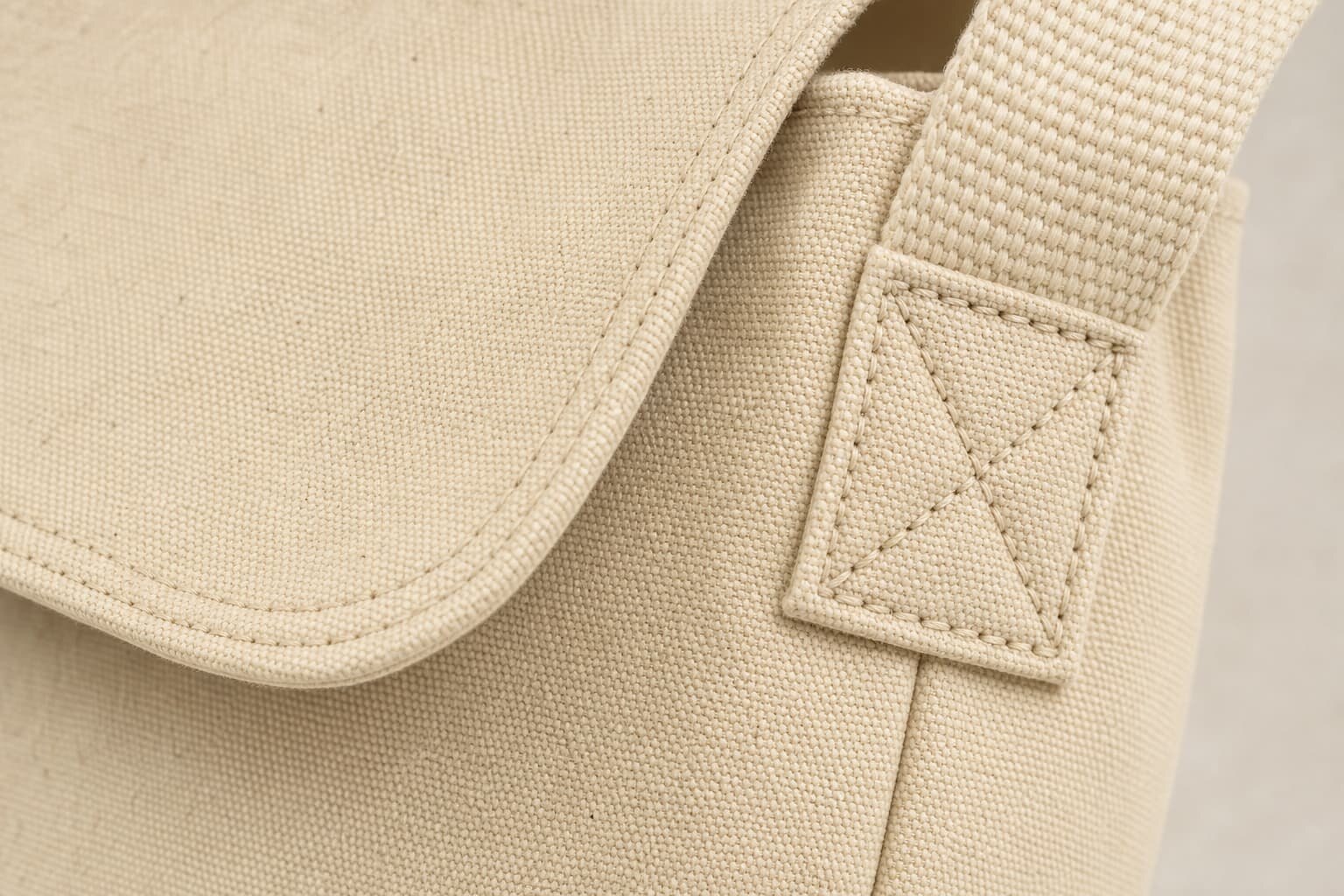
Ask the factory to specify the reinforcement method, not just write 'strong stitching.' Useful details include box stitch size, bar tack position, number of stitch lines, seam allowance, webbing width, and whether the strap is sewn into the side seam or attached with a D-ring. If metal hardware is used, check the ring thickness and finish. Thin hardware can look fine in photos but twist after repeated use.
- Use 38 mm webbing for light to medium bags; consider 50 mm for heavier carry or premium appearance.
- Require box stitching or bar tacks at strap anchors, especially on unlined bags.
- Avoid placing the logo too close to the strap anchor if the area will pucker during sewing.
- For laptop bags, confirm padding, sleeve size, and bottom protection instead of relying on heavy canvas alone.
Choose Print Method by Canvas Texture
Logo printing on canvas messenger bags needs more control than printing on flat polyester. Heavy cotton canvas has texture, absorbency, and seam interruptions. A large solid logo on the flap may look strong on the artwork file but uneven on rough canvas. Screen printing is common for simple logos and solid colors. Heat transfer can reproduce more detail but must be tested for adhesion and edge lifting. Embroidery gives a premium look but can pull the fabric if the backing and stitch density are not controlled.
The buyer should give the factory artwork in vector format when possible, with Pantone references, logo size, print position, and a clear tolerance for placement. If the logo sits on the flap, confirm whether it crosses a fold line, snap position, pocket seam, or binding. For dark canvas, ask for a strike-off or printed fabric panel before the full sample if color accuracy matters. White ink on black or navy canvas often needs an underbase or multiple passes, which affects cost and handfeel.
- Use screen print for bold one-color or two-color logos on medium to large areas.
- Use woven labels when small branding must remain sharp and durable.
- Use embroidery for premium programs, but confirm backing and thread color on actual canvas.
- Avoid printing over thick seams, snaps, flap creases, and heavy needle areas.
- Ask for rub and bend checks on the approved print panel before bulk printing.
Make Samples Prove the Real Order
A messenger bag sample is useful only if it proves the same material, construction, print, and packing logic as the bulk order. Many pre-production problems happen because the sample room uses available fabric, substitute hardware, or a simplified pocket layout to save time. That may be acceptable for a rough size sample, but it is not acceptable for production approval.
Use sample stages deliberately. First, a construction sample can confirm dimensions, flap shape, pocket layout, and strap length. Second, a print or label sample can confirm branding. Third, a pre-production sample should combine approved fabric, hardware, print, stitching, label, and packing method. Bulk cutting should not start until the buyer has approved the pre-production sample and the factory has recorded any comments.
- Measure sample width, height, gusset, flap depth, strap length, and pocket placement.
- Load the sample with a realistic weight and check strap comfort, flap coverage, and closure alignment.
- Inspect inside seams by turning the bag and checking loose threads or raw edge exposure.
- Fold the sample as it will be packed and check whether the print cracks, sticks, or receives pressure marks.
- Keep one approved sample at the factory and one with the buyer or inspection agent.
Set Acceptance Criteria Clearly
A good QC plan does not need to be complicated, but it must define what is acceptable. For canvas messenger bags, major defects usually include wrong size, weak strap attachment, incorrect fabric, damaged print, non-working zipper or closure, wrong logo, severe stains, broken hardware, and incorrect packing quantity. Minor defects may include small thread ends, slight stitch unevenness, or tiny fabric slubs within the approved standard.
Measurement tolerance should be realistic. Cotton canvas can move during cutting, sewing, washing, and pressing. For many bag programs, a tolerance of around plus or minus 0.5 cm to 1 cm on body dimensions may be workable, depending on size and structure. Strap length tolerance may need a wider range if adjustable hardware is used. Logo placement tolerance should be tighter because off-center branding is immediately visible to retailers and end users.
- Classify safety or function failures as critical where relevant, especially sharp hardware or broken strap anchors.
- Classify wrong logo, wrong color, wrong size, or unusable closure as major defects.
- Classify trim thread, tiny slub, or slight stitch waviness as minor only if it does not affect appearance at normal viewing distance.
- State AQL levels in the purchase order or inspection booking, not only in email discussion.
- Require defect photos and carton numbers in the final inspection report.
Control MOQ and Cost Drivers
MOQ for wholesale canvas messenger bags is not only about sewing quantity. It is controlled by fabric availability, dye lot size, printing setup, hardware sourcing, label production, and packing materials. A factory may accept a small sewing quantity but still need a higher MOQ for custom dyed canvas or a custom metal buckle. Buyers comparing quotes should ask which part of the order creates the MOQ.
Cost also moves quickly when the design changes. Heavier canvas, lining, zipper pockets, padded laptop sleeves, embroidery, metal hardware, custom labels, individual polybags, and smaller carton quantities all add cost. The cheapest quote may exclude details that another supplier included. Ask each factory to show a costed option list so the merchandising team can decide which upgrades matter and which can be removed without damaging the product.
- Ask for a base price with standard canvas, standard strap, one-color print, and export carton packing.
- Ask for separate adders for lining, zipper pocket, laptop sleeve, embroidery, woven label, and individual polybag.
- Confirm whether sample cost is refundable or separate from bulk production.
- Check whether the MOQ changes for custom dyed fabric, custom webbing color, or custom hardware finish.
- Ask whether mixed colors can share one MOQ or must meet MOQ per color.
Plan Lead Time by Process Step
Lead time for canvas messenger bags should be broken into sample making, sample approval, material preparation, printing, sewing, finishing, inspection, and packing. A factory quote that says '30 days production' may not include artwork revision, fabric dyeing, sample courier time, or delay caused by buyer comments. Procurement teams should request a timeline that starts from the last approval needed for production, not from the first inquiry.
Printed and dyed canvas needs special attention. If the fabric color is custom, the dye lot approval can become the longest step. If the print is large or multi-color, screens, strike-offs, drying time, and alignment checks must be scheduled before sewing. If the bag has a flap print, printing may happen before assembly, so any print delay can stop the sewing line. A practical timeline helps the buyer reserve inspection time before vessel closing or warehouse delivery dates.
- Request sample lead time separately for construction sample and pre-production sample.
- Ask when bulk fabric will be ready and whether the factory inspects fabric before cutting.
- Confirm whether printing is done in-house or subcontracted.
- Reserve time for inline inspection when the first finished pieces come off the line.
- Do not schedule final inspection on the same day cartons must leave the factory.
Inspect During Production, Not Only at the End
Final inspection is necessary, but it is late. For canvas messenger bags, inline checks catch the most expensive problems earlier: wrong fabric shade, print position drift, weak strap stitching, zipper direction errors, flap misalignment, and pocket placement mistakes. Once the factory has sewn thousands of bags with a wrong flap size or logo position, sorting will not solve the problem cleanly.
Ask for first-piece approval at each important stage. The first printed panels should be checked before mass printing. The first sewn bags should be checked before full-line sewing. Packing should be checked before cartons are sealed. If an inspection agency is used, give them the approved sample, artwork, measurement chart, packing instructions, and defect classification. Without these documents, the inspector can only check general workmanship.
- At fabric inspection, check shade, GSM, width, stains, holes, and fabric skew.
- At printing inspection, check logo color, position, curing, registration, and surface coverage.
- At sewing inspection, check seam allowance, stitch density, strap anchors, pocket position, and flap symmetry.
- At finishing inspection, check trimming, pressing, hardware function, and label attachment.
- At packing inspection, check fold method, carton count, barcode labels, moisture protection, and carton strength.
Protect the Bag in Packing
Packing is often treated as a warehouse task, but for canvas messenger bags it affects appearance at delivery. The flap is the main visual area, and it is often where the logo sits. If straps, snaps, buckles, or folded corners press against the printed front panel for several weeks in export cartons, the buyer may receive bags with marks, creases, or print transfer. The packing method should be approved with the sample.
For printed canvas bags, use tissue or protective paper between high-risk printed surfaces when needed. Arrange straps so hardware does not sit directly on the logo. Avoid over-compressing cartons just to reduce freight volume if the bag has a structured flap or padded section. Carton markings should match the buyer purchase order, SKU, color, quantity, gross weight, net weight, and destination requirements. For retail buyers, barcode and inner pack accuracy can be as important as sewing quality.
- Approve one folded packing sample before mass packing.
- Confirm units per polybag, inner carton, and master carton if the retailer has routing requirements.
- Use desiccant or moisture control when shipping heavy cotton goods during humid seasons, if appropriate.
- Check that dark dyed canvas is not packed tightly against light straps or labels without testing color transfer.
- Photograph open cartons during final inspection to verify actual packing, not only sealed cartons.
Specification comparison for buyers
| Spec decision | Recommended option | When it fits | Buyer risk to check |
|---|---|---|---|
| Main canvas fabric | 12 oz to 16 oz cotton canvas, approx. 340-540 GSM depending on weave and finish | Retail messenger bags, campus bags, conference gifts, and daily-use brand merchandise | Confirm actual GSM after washing or dyeing; loose weave can feel weak even when the quoted ounce weight looks high |
| Flap construction | Double-layer flap with edge binding or turned seam | Bags carrying laptops, books, documents, or heavier retail use | Single-layer flap may curl, show print-through, or lose shape after packing compression |
| Shoulder strap | 38-50 mm cotton webbing or polyester webbing with reinforced box stitch | Most wholesale programs; wider straps for heavier contents | Ask for webbing thickness and tensile strength; thin strap can pass visual inspection but fail in use |
| Logo method | Screen print for solid logos; embroidery or woven label for premium small branding | Corporate promotions, retail private label, and distributor stock items | Check print cracking on heavy canvas texture and color bleeding on dyed fabric |
| Closure | Metal snap, magnetic snap, zipper under flap, or hook-and-loop by use case | Snap for cleaner appearance, zipper for security, hook-and-loop for budget programs | Magnetic snaps can mark fabric if backing washers are weak; hook-and-loop can damage printing during rubbing |
| Interior structure | Lining optional; add inner pocket and laptop sleeve only when needed | Retail and corporate laptop bags need more structure; giveaway bags may not | Extra pockets raise labor time and defect points; verify seam allowance and pocket placement |
| Carton packing | Flat packed with tissue between printed panels; strap arranged to avoid pressure marks | Printed canvas bags, dyed bags, and export cartons shipped by sea | Poor folding can crease print, deform flap corners, and create strap indentation on the front panel |
Buyer checklist before sampling
- Define the exact bag size as width x height x gusset, and state whether measurements are taken flat or loaded.
- Specify fabric by ounce or GSM, weave, color, washing status, and whether shrinkage tolerance applies after dyeing or washing.
- Confirm strap width, strap length range, webbing material, and reinforcement stitch pattern.
- Provide artwork files with logo size, Pantone colors, print position, and whether the print crosses seams or flap edges.
- Decide closure type before quotation: snap, magnetic snap, zipper, hook-and-loop, buckle, or no closure.
- List inside features separately: lining, zipper pocket, slip pocket, pen slot, laptop sleeve, padding, and label position.
- Set sample approval rules for fabric handfeel, color, logo, stitching, hardware, and carton packing.
- Require pre-production sample approval before bulk cutting, especially for dyed canvas and printed flap designs.
- Define acceptable measurement tolerance for bag body, strap length, pocket placement, and logo position.
- Ask for carton dimensions, gross weight, units per carton, packing method, and whether cartons pass normal export handling.
Factory quote questions to send
- What is the actual canvas GSM after dyeing, washing, or finishing, and can you provide a fabric swatch before sample making?
- Is the quoted fabric 100% cotton canvas, recycled cotton blend, polyester-cotton canvas, or another composition?
- What fabric shrinkage tolerance do you expect, and will the bulk bag size be adjusted after washing or dyeing?
- Which print method are you quoting, and is the logo cost included for one color, multiple colors, or full-color transfer?
- What is the maximum print area on the flap without distortion from seams, folds, snaps, or edge binding?
- What strap width, webbing thickness, and reinforcement stitch are included in the quote?
- Are snaps, zippers, sliders, buckles, and D-rings metal or plastic, and what finish is quoted?
- Does the unit price include inside pocket, lining, woven label, hangtag, barcode sticker, and individual polybag if required?
- What MOQ applies to the bag style, fabric dye color, logo method, and hardware color separately?
- How many days are needed for sample making, sample revision, material preparation, production, inspection, and export packing?
Quality-control points to confirm
- Check fabric GSM, weave density, color consistency, shrinkage, stains, slubs, and handfeel against approved swatch.
- Confirm bag measurements, gusset depth, flap coverage, strap length, pocket size, and logo position against the approved sample.
- Inspect seam strength at strap anchors, side seams, bottom corners, flap edge, pocket openings, and closure attachment points.
- Test logo durability with rubbing, bending over canvas texture, light scratch checks, and packing pressure simulation.
- Verify hardware function for snaps, magnetic closures, zippers, sliders, buckles, eyelets, rivets, and D-rings.
- Review loose threads, skipped stitches, uneven topstitching, puckering, needle holes, and seam allowance consistency.
- Check colorfastness risk for dyed canvas, especially dark colors packed against natural cotton straps or light linings.
- Confirm packing fold method, printed-panel protection, strap placement, carton strength, carton markings, and barcode accuracy.
- Review final inspection records with defect photos, sample size, AQL result, carton count, and shipment quantity.