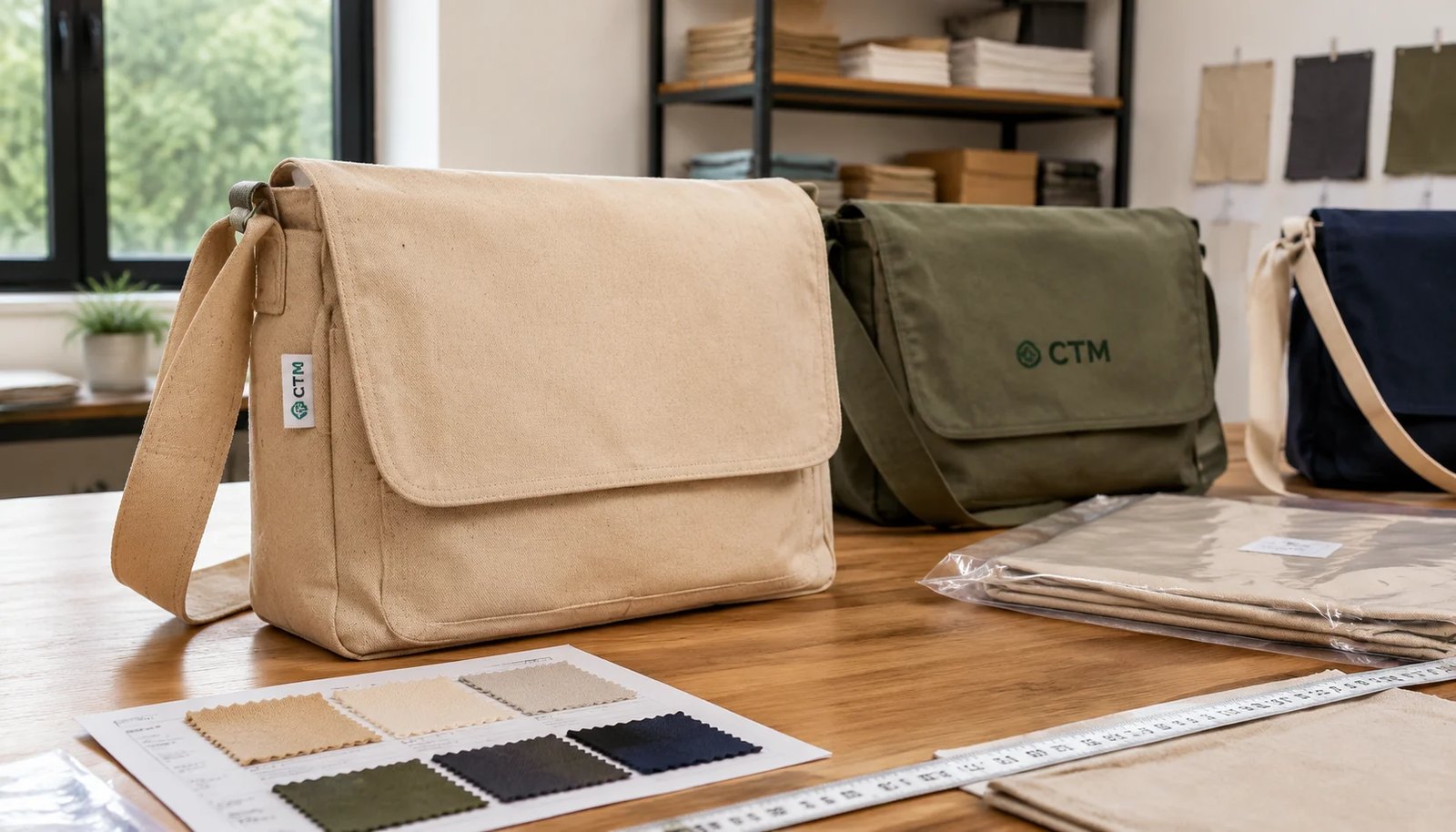
Why print proofing is the real failure point on grocery messenger bags
Natural grocers often want messenger bags for staff kits, membership programs, local produce events, or branded resale near checkout. In those programs, the bag itself is not usually the hard part. The hard part is making sure the brand mark still looks right on a flap, pocket, or body panel once canvas texture, seam layout, and bag shape are introduced. A digital proof can make the logo look centered and crisp, then the sewn sample arrives and the print sits too close to the flap edge or bends across the closure area.
That is why this buying problem should be handled as a print proofing workflow, not only a product sourcing exercise. If the RFQ does not define printable area, seam clearance, base fabric shade, and sample approval sequence, supplier quotes can look comparable while the delivered results are not. Good proofing reduces rework, delayed approvals, and arguments over whether the problem came from artwork, printing, or sewing.
- Most proof failures happen at the flap panel because it curves, folds, and carries closures.
- Natural canvas changes color perception; green, brown, and off-white grocery palettes can look dull or muddy if ink opacity is weak.
- Messenger bags combine print and hardware, so proofing must cover both visual layout and physical interference.
Choose the canvas spec around print performance, not only bag durability
For wholesale canvas messenger bags, many buyers start with weight only: 10 oz, 12 oz, 14 oz, or heavier. For print proofing, that is incomplete. You need to consider how smooth the weave is, how much slub variation appears on the front panel, and whether the body panel is supported by lining or interlining. A 12 oz to 14 oz canvas, roughly 340 to 400 GSM, is usually the most balanced range for natural grocer programs because it holds a good retail shape while still accepting screen print without heavy ink build.
Lighter canvas can work for low-cost promotions, but it moves more during printing and can wrinkle under the squeegee. Heavier canvas can look premium, yet thick folds on flap edges may create visual distortion if the logo extends too far outward. If the bag uses dyed black, olive, or kraft brown fabric, ask whether the quoted weight is before or after finishing, because the hand feel and print response can change after dyeing and softening.
- Typical balanced range: 340 to 400 GSM for front-panel print stability.
- Natural canvas shows more fiber specks through light ink than tightly dyed canvas.
- Soft-washed fabric can feel better in hand but may print less sharply than firmer unfinished canvas.
- If lining is used, request whether the print panel has backing support during printing.
Set the printable area from the bag pattern, not from the logo file
Many importers send a logo first and ask the factory to 'make it fit.' That approach leads to bad proofs because the printable area on a messenger bag depends on pattern pieces, seam turns, flap shape, buckle tabs, magnet positions, and front pockets. The cleanest result usually comes from centering the logo on the flap or the body panel below the flap with at least 20 mm clearance from construction lines. On gusseted styles, a visually centered print may not be geometrically centered once the bag is filled, so the approved proof should show the bag both flat and lightly stuffed.
For natural grocers, readable branding matters more than oversized artwork. Medium logo width often works better than a large print that wraps into side distortion. Fine script, small reverse text, and thin outlines can disappear in the canvas texture. A proof should include final print size in millimeters, placement from top and side edges, and note whether measurement references are taken before or after sewing.
- Keep artwork away from flap stitching, rivets, D-rings, and hook-and-loop fields.
- Use dimensioned placement drawings, not screenshot arrows on a photo.
- Approve placement on the exact bag size ordered; scaling artwork from another style often fails.
Match print method to order size, fabric shade, and design detail
Screen printing is usually the practical method for wholesale messenger bag orders because it scales well and handles simple grocery branding clearly. One-color or two-color logos on flap panels are the normal sweet spot. Screen print also gives better control over opacity on natural or dark canvas than many low-cost transfer routes. For short runs with multi-color art, heat transfer may be quoted, but buyers should compare not only unit cost but also edge behavior on textured fabric, long-term rub resistance, and visual feel. A transfer can look too smooth or 'stuck on' for brands leaning into natural materials.
On dark dyed canvas, white or pale green logos may require an underbase to achieve color brightness. That improves appearance but adds setup and can stiffen the print area. On natural canvas, a single dark ink may look softer than expected because fibers interrupt the edge. If the design contains fine details, ask the supplier what minimum line thickness and minimum reversed text size they can hold on the selected canvas weave.
- Screen print suits bulk orders and simple natural grocer logos.
- Heat transfer can be acceptable for small quantities or photo-like art, but it changes hand feel.
- Dark fabric often needs underbase; quote should separate that cost impact.
- Fine lines and tiny text should be tested on actual canvas, not only approved digitally.
Build MOQ logic into the artwork and color plan before requesting quotes
MOQ on messenger bags is rarely one simple number. Factories may have a base MOQ for the bag style, a separate MOQ for each canvas color, and a practical minimum for each print design or screen setup. Buyers who source for several store regions or sub-brands often increase cost unnecessarily by splitting logos, bag colors, and label variations without planning which elements can remain common. If all stores can use one shell color and one flap print, the order becomes easier to price and schedule.
A useful RFQ should present quantity breaks such as 500, 1000, 3000, and 5000 units and indicate whether artwork is identical across all quantities. If you need mixed colors, state the quantity per color and whether the print stays the same. Screen printing becomes more cost-efficient as volume rises because setup is spread across more units. At low volume, a supplier may suggest a smaller print area or one-color art to stay within target cost.
- Separate style MOQ from color MOQ and print-design MOQ.
- One logo across several bag colors usually prices better than several logos on one bag color.
- Ask whether screen charges are one-time, repeat-order reduced, or fully repeated after artwork changes.
- For distributors, align artwork versions with carton pack logic to avoid mixed-carton confusion.
Use a three-stage sample approval path to prevent bulk surprises
A reliable proofing process for messenger bags has at least three approval stages. First is the digital artwork proof with exact placement dimensions, print size, colors, and seam clearances. Second is the physical pre-production sample made with the intended canvas type and actual print method. Third is either a sealed approval sample or top-of-production photo set from the first bulk pieces after line setup. Skipping the second stage is where many buyers lose control, because digital approvals cannot show ink hand feel, edge sharpness on coarse weave, or whether the flap hardware affects the print visually.
The pre-production sample should not be treated as a style sample only. It is a measurement and print standard. If the sample uses substitute fabric or transfer print while the bulk order will use screen print, note that limitation directly in the approval record. For natural grocer programs with multiple internal approvers, circulate one annotated approval sheet rather than collecting separate informal comments that the factory cannot reconcile.
- Digital proof approves layout, not final print quality on canvas.
- Pre-production sample should show real fabric, real hardware, real print process.
- Top-of-production review catches line drift before the full order is packed.
- Keep one master approval file with dated artwork revision, bag dimensions, and comments.
Quote comparison should separate bag cost, print cost, and packing cost
A low unit quote can be misleading when messenger bags are priced as a bundle without showing what is driving the number. Procurement teams should request a split between bag body cost, print setup and per-unit print charge, sample cost, hardware, and packing. This matters because two suppliers may quote the same total while one uses lighter canvas, smaller printable area, or looser packing that increases damage risk. For imported bags, carton efficiency and CBM can be as important as a few cents on ex-works unit price.
An example comparison framework is more useful than chasing a single benchmark price. One quote may be competitive on FOB unit cost but poor on carton utilization because the strap and flap are packed inefficiently. Another may be slightly higher per bag but include better poly protection and cleaner screen print. Buyers should also ask whether print screens, color match trials, and replacement sample runs are charged separately. Those hidden line items affect landed cost and schedule.
- Request quantity breaks with the same spec basis to make quotes comparable.
- Ask for carton dimensions, pieces per carton, gross weight, and CBM.
- Separate one-time charges from repeat-order charges.
- Clarify whether individual polybags, hangtags, barcodes, and carton marks are included.
QC thresholds for print proofing need measurable pass-fail language
Print quality disputes often happen because the buyer approved a general look but never defined tolerances. A practical QC sheet for canvas messenger bags should set print placement tolerance, color reference, allowed panel shade variation, and what counts as a major visual defect on the branded face. On a textured textile product, zero imperfection is unrealistic. The goal is to define what the retail buyer or end user will actually notice from normal handling distance.
For example, a one-color flap print may permit minor fiber show-through consistent with approved sample, but not blurred edges, uneven coverage bands, or obvious off-center placement. Multi-color logos should have a registration tolerance that reflects the artwork type. Distressed art can hide slight shift; crisp outlined logos cannot. Hardware function and seam construction also belong on the same QC plan because a well-printed bag still fails commercially if the flap twists or the strap anchors pull the logo off-line.
- Define placement tolerance in millimeters from centerline or top edge.
- Use approved sample and Pantone reference together for color decisions.
- Treat severe skew, flooding, tackiness, and cracking as major print defects.
- Review the bag when flat and lightly filled; some distortions appear only in use.
Packing choices can protect or damage the print before the buyer sees it
Messenger bags are bulkier than flat totes, so packing decisions matter more. A front flap print can rub against straps, hardware, or another bag's seams during export transit. If the print is freshly cured but not fully stable, warm and humid shipping conditions can create offset marks or gloss variation. For clean retail presentation, individual polybags may be justified, especially for natural canvas that soils easily. For high-volume distributor orders, bulk packing may save cost and volume if the supplier uses interleaving or proper folding to keep the printed panel protected.
The RFQ should specify pieces per carton, maximum carton weight, folding method, moisture protection, and any barcode or carton marking rules. Buyers should also request photos of packed inner units and export cartons before shipment. Packing is not an afterthought. It affects unloading efficiency, warehouse count accuracy, and the chance of receiving front-panel scuffs that look like print faults but are really transit damage.
- Protect printed flaps from direct contact with hook-and-loop, straps, and buckles.
- Use carton weight limits suitable for your warehouse handling standard.
- Natural canvas usually needs cleaner packing discipline than dark dyed canvas.
- If retail labels are applied, define whether they go on polybag, hangtag, or carton only.
Lead time risk usually sits between artwork approval and line start
Buyers often underestimate how much schedule risk is tied to proofing and material coordination. The critical path is not only sewing capacity. It usually includes artwork correction, screen making, lab dip or dyed fabric confirmation, hardware arrival, pre-production sample remake, and final approval release. A natural grocer promotion tied to seasonal campaigns can miss launch timing if the proofing loop is vague and internal sign-off takes too long.
A better sourcing workflow is to map milestones backward from required ship date: artwork freeze, PPS approval, fabric booking, print trial, top-of-production review, finishing, packing, and container loading. If the bag uses multiple colors or several store SKUs, ask the supplier how they schedule printing lots and whether mixed-color orders extend lead time. Build in time for one realistic correction cycle rather than assuming first sample approval.
- The slowest step is often approval, not sewing.
- Dyed canvas and custom hardware add schedule dependency before printing can start.
- Mixed SKUs increase line changeovers and packing complexity.
- Ask for a milestone schedule rather than one total lead-time number.
Specification comparison for buyers
| Spec decision | Recommended option | When it fits | Buyer risk to check |
|---|---|---|---|
| Canvas weight | 12 oz to 14 oz canvas, about 340 to 400 GSM | Best for natural grocer promo bags that still need body and cleaner print laydown on flap panels | Under 10 oz can wrinkle under print and distort flap shape; over 16 oz raises freight and may crack thick ink on folds |
| Base fabric color | Dyed black or dark olive for heavy-use staff or loyalty bags; natural canvas for eco-forward retail feel | Use dyed shades when the design has light ink and must hide shelf dirt; use natural when the brand story values raw cotton look | Natural canvas has shade variation lot to lot; dyed canvas can bleed if fixation and wash fastness are weak |
| Print method | Screen print for solid logos; heat transfer only for small multi-color short runs | Screen print gives lower unit cost and better opacity on bulk orders over typical MOQ levels | Heat transfer can edge-lift on textured canvas and usually costs more at scale; screen print needs registration tolerance agreed in advance |
| Print position | Front flap center or body panel below flap, with at least 20 mm clearance from seams and edge turns | Works when natural grocer branding must stay readable after the bag is filled and worn crossbody | Artwork too close to flap stitch lines, buckles, rivets, or pockets may skew during sewing and fail proof approval |
| Logo size | Moderate width, usually 160 to 220 mm on medium messenger bags | Fits retail grocery events, staff issue, and resale programs without overwhelming the product | Oversized art near side gussets can warp visually once the bag is packed; very small details may fill in on coarse canvas |
| Closure hardware | Hidden magnetic snap under flap or simple hook-and-loop depending price target | Magnet keeps a cleaner branded look for retail buyers; hook-and-loop is cheaper for promo and store-use programs | Magnet placement can interfere with print if too close to flap center; hook-and-loop can reduce premium feel and shift flap tension |
| Packing route | Individual polybag only when retail cleanliness or barcode control matters; otherwise bulk packed in export carton | Suitable for distributors and importers balancing presentation against carton efficiency | Over-packing raises labor and CBM; no inner protection can scuff light canvas or rub fresh print in humid transit |
| Sample approval stage | Approve digital art, then pre-production sample with actual fabric and print, then top-of-production photo or sealed sample | Best when multiple stores or brand teams must sign off on visual standards before full run | Digital proof alone will not show ink hand feel, color on natural canvas, seam distortion, or hardware-shadow effects |
Buyer checklist before sampling
- State finished bag size, gusset depth, strap width, and strap adjustment range in the RFQ, not only a reference photo.
- Specify canvas composition and weight in GSM or ounces, and note whether weight tolerance applies before or after dyeing.
- Identify print location with a dimensioned artwork placement drawing showing distance from seams, flap edge, pockets, and closures.
- Define print method by panel if needed: for example one-color screen print on flap and woven label on side seam.
- Send artwork in vector format and note Pantone references, acceptable shade tolerance, and whether underbase is required on dark fabric.
- Request a pre-production sample using bulk fabric or nearest mill lot, not a studio mockup or digital print substitute.
- Set approval criteria for registration, edge sharpness, ink coverage, and acceptable fabric specks visible through print.
- Confirm whether logos must remain readable when the flap curves over a filled bag, especially for oversized center prints.
- State packing method per unit and per carton, barcode placement, carton weight limit, and whether tissue or interleaving is needed to protect print.
- Ask for quotation split by sample charge, print screen charge, unit price by quantity break, carton count, and estimated CBM.
Factory quote questions to send
- What canvas weight and weave are you pricing, and is the quoted GSM based on greige, finished, or dyed fabric?
- Which print method are you quoting for this artwork, and what is the maximum printable area on the flap after seam and fold allowances?
- How many print screens or color stations are required, and are setup charges included separately or amortized into unit price?
- What registration tolerance do you normally hold on canvas messenger bag flap prints, especially for two-color or outlined logos?
- Will the pre-production sample use the same fabric, hardware, and print ink system as bulk production?
- What is your MOQ by color, by print design, and by fabric lot, and how does MOQ change if we mix bag colors with one logo?
- What lead time do you need for sample, bulk material booking, printing, sewing, and final packing after artwork approval?
- How are bags packed after printing to prevent ink offset, rub marks, or moisture transfer during export transit?
- Can you provide carton dimensions, pieces per carton, gross weight, and estimated volume so we can compare landed cost?
- What in-line and final QC points do you use for print placement, print adhesion, seam quality, and hardware function?
Quality-control points to confirm
- Print placement tolerance should be stated on approved artwork, commonly within plus or minus 5 mm from the reference centerline unless the design is intentionally off-center.
- Color match should reference Pantone or approved physical swatch; on natural canvas, buyers should define acceptable shift because fabric undertone affects ink appearance.
- Registration on multi-color screen prints should have a written tolerance, often tighter on bold edge logos and looser on distressed artwork.
- Ink coverage should be even without excessive pinholes, flooding into fine text, tackiness, or visible cracking after normal flap bending.
- Canvas should be free from major slubs, holes, oil marks, and severe shade variation on the printed panel area selected for branding.
- Sewing around printed panels should not encroach into artwork; flap seam turn-ins, pocket topstitch lines, and buckle tabs must match the approved layout.
- Strap attachment points should hold load without skewing the front panel so much that the logo appears twisted in use.
- Hardware position should not create pressure marks or dimples through the printed area, especially where magnets sit under a flap logo.
- Final packed goods should show no print offset, no moisture staining, and no carton compression marks on visible front panels.