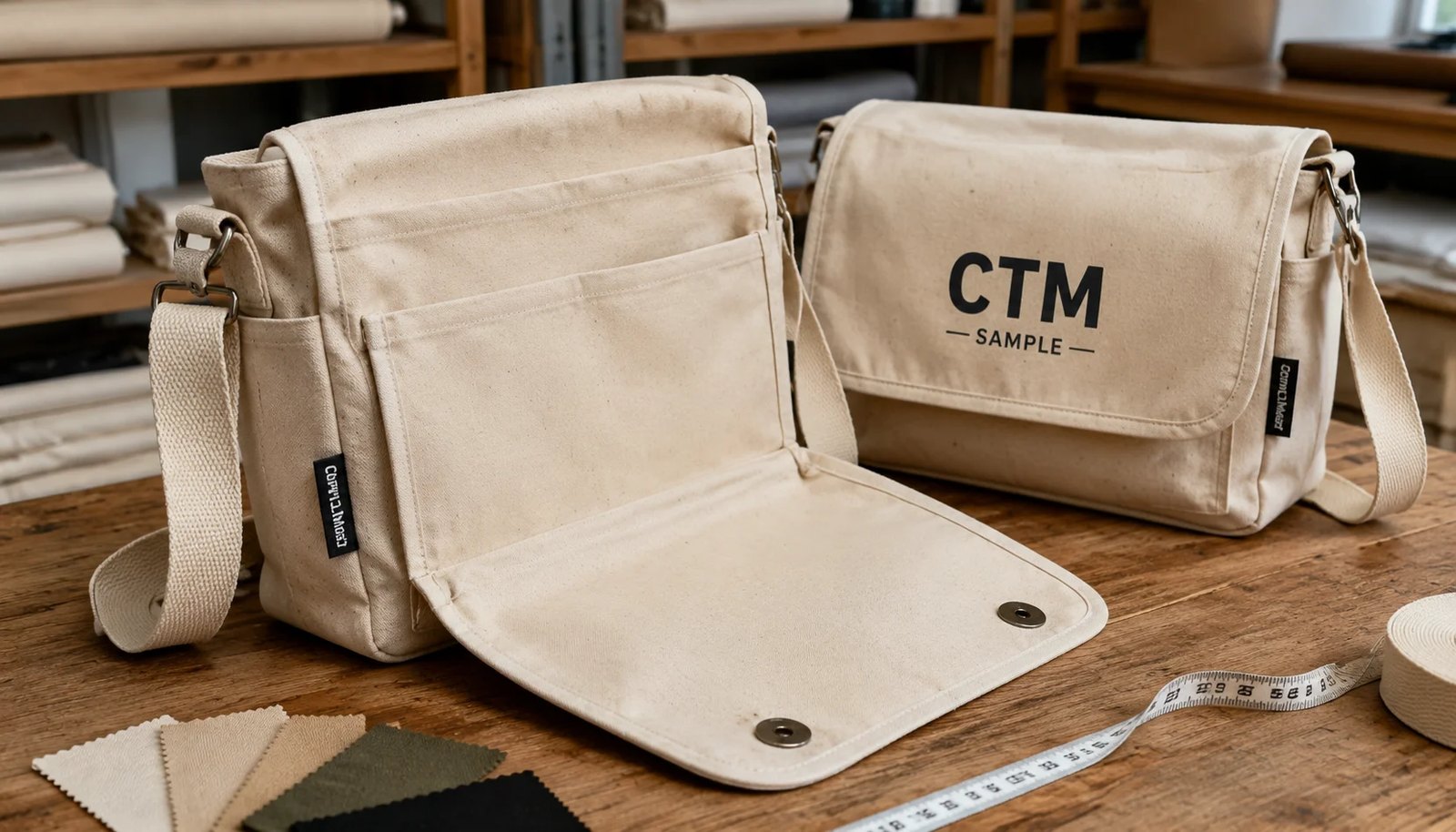
Start with the grocery use case, not a generic bag size
Wholesale canvas messenger bags for natural grocers are exposed to a different pattern of use than fashion messenger bags or lightweight conference totes. They may sit near checkout, carry produce and jars, hold staff tools, move through backroom storage, or become part of a loyalty program where the bag reflects the store’s sustainability promise. That makes durability a buying requirement, not only a product feature.
Before comparing suppliers, define the use case in plain terms. A retail merchandise bag needs clean stitching, consistent fabric shade, good flap alignment, and presentable packing. A staff utility bag needs stronger closure performance, useful pockets, and repeat load strength. A giveaway bag may tolerate simpler construction, but it still needs secure strap joints because a failed handle damages the brand more than a slightly higher unit cost would have. For natural grocers, the key is to connect construction choices to real store handling rather than asking for a “standard canvas messenger bag” and hoping every factory interprets that the same way.
- Retail sale: prioritize finish consistency, flap shape, print clarity, label placement, and clean unit packing.
- Loyalty or member giveaway: keep the design efficient but protect strap joints, side seams, and print curing.
- Staff utility use: specify closure strength, pocket reinforcement, strap comfort, and a higher load test.
- Event or vendor use: confirm carton labels, mixed artwork rules, and replenishment timing across locations.
- Grocery carry use: use a gusseted body and reinforced bottom instead of a flat document-style messenger bag.
Select canvas weight with structure and freight in mind
Fabric weight is one of the first details buyers ask about, but it should not be treated as the only durability measure. A 10 oz canvas with weak strap stitching can fail faster than a 12 oz canvas with proper bartacks and strong thread. For reusable natural grocer messenger bags, 12 oz to 16 oz cotton canvas is a practical procurement range because it gives the flap and body enough structure while staying realistic for sewing, folding, packing, and store handling.
Ask suppliers to state both ounces and approximate GSM because fabric descriptions vary by market and finishing process. As a working reference, 12 oz canvas is roughly 407 GSM and 16 oz is roughly 542 GSM, though actual values depend on weave, yarn, washing, dyeing, and finishing. Natural unbleached canvas may show seed flecks, slubs, and shade variation. Those characteristics can fit a natural grocer brand, but they should be approved on a sample so inspectors know what is acceptable. Dyed canvas needs additional shade control and may involve fabric mill minimums, especially for custom colors.
- 8 oz to 10 oz: suitable for light document bags or low-load giveaways, but risky for repeated grocery carry.
- 12 oz: a practical entry point for reusable messenger bags with moderate structure.
- 14 oz: often a good balance when buyers want better durability without very bulky seams.
- 16 oz: stronger hand feel and better structure, with higher sewing difficulty, carton weight, and freight cost.
- Recycled cotton canvas: useful when sustainability claims matter, but confirm tensile strength, shade consistency, and documentation before bulk.
- Organic cotton canvas: confirm certification scope and transaction proof instead of relying on a hangtag claim.
Turn stress points into testable specifications
Most failures occur in predictable places: strap ends, side seams, bottom gusset corners, flap corners, pocket corners, and closure points. These areas carry force when a shopper adds heavier items or when staff use the bag daily. A sample can look neat on a table while still failing under load if it has low stitch density, weak thread, unreinforced strap ends, or hardware that bends when the bag is full.
Make the durability testing checklist inspection-ready by writing the test method into the specification. For example, a promotional bag may be tested at 8 kg to 12 kg, while a retail or staff bag may need 12 kg to 15 kg. State the duration, such as 30 minutes for static load unless your internal standard requires more. State the sample size, such as three pieces from early production plus additional pieces during final inspection, or a larger quantity based on the lot size. The pass/fail record should include the load weight, start and end time, sample IDs, photos before and after testing, and notes on any seam opening, thread breakage, strap distortion, or hardware movement.
- Strap ends: require bartacks, box stitching, or dense reinforced stitching with visible thread security.
- Side seams: use construction suitable for heavy canvas, such as secure lockstitch plus overlock or bound seams where needed.
- Bottom gusset: reinforce the point where the side seam meets the base, since this area carries grocery load pressure.
- Pocket corners: add bartacks when pockets may hold phones, receipts, staff badges, tools, or member cards.
- Flap corners: control fraying, stitch tension, and fabric distortion, especially on washed or natural canvas.
- Closure points: test snaps, hook-and-loop, and magnetic closures with the bag loaded, not only while empty.
Specify strap, hardware, and closure as durability parts
The strap system often determines whether a messenger bag feels useful or cheap. A 38 mm cotton webbing strap may work for moderate loads and a clean natural look. A 50 mm strap usually improves comfort when bags may carry jars, produce, boxed foods, or staff materials. Cotton webbing supports a natural brand position, while heavy PP webbing can offer abrasion resistance and lower cost. Either option should be tested, not assumed.
Hardware and closures should be locked before prices are compared. Sliders, D-rings, snaps, magnetic buttons, and hook-and-loop tape can all change the quote and the failure risk. Metal hardware should be smooth, rust-free, and strong enough not to deform during the approved load test. Hook-and-loop tape is practical for staff utility bags but can look less retail-ready. Snaps give a cleaner presentation, yet they need reinforcement behind the fabric so repeated opening does not tear the canvas. Closure placement also matters: a bag that closes when empty may not close when filled with grocery items.
- State strap width in millimeters and define adjustable length range.
- Set maximum strap drop if the bag must work cross-body and shoulder carry.
- Require hardware finish, material, and corrosion expectations for humid storage or sea freight.
- Avoid lightweight sliders on bags tested at 12 kg or above.
- Check closure function after the bag is filled to the intended load volume.
- Inspect for sharp hardware edges that may cut webbing or scratch users.
Match branding method to canvas texture and store handling
Natural grocer artwork often uses simple marks, produce illustrations, earthy color palettes, local slogans, or sustainability messages. On cotton canvas messenger bags, water-based screen printing is usually a strong option for solid logos because it gives a softer hand than thick plastisol and can be efficient in bulk. Pigment printing may suit larger natural artwork. A woven side label can work well when the buyer wants subtle branding instead of a large front graphic.
Print durability depends on more than the print method named in the quote. Ink must be compatible with the fabric surface, cured properly, and protected during packing. A flap print can rub against other bags inside a carton, especially when cartons are compressed during shipping. Large dark prints on natural canvas may show weave texture or slight unevenness, so the buyer should approve realistic artwork expectations before production. Ask for dry rub testing, bend checks on the flap, and packed-sample review if the printed surface is stacked under pressure.
- Screen print: good for simple logos, one to four spot colors, and efficient bulk production.
- Pigment print: useful for softer natural artwork and larger print areas.
- Heat transfer: suitable for small detailed marks, but it can feel less natural on cotton canvas.
- Embroidery: premium but may pucker lighter canvas and adds cost and production time.
- Woven label: good for subtle branding, SKU separation, or retail finish without a large front print.
- Print placement: specify distance from flap edge or center line instead of using only a visual mockup.
Use sample approval as the production standard
The pre-production sample should become the working standard for the factory, buyer, and inspector. It needs to use the actual bulk fabric weight, actual strap, actual hardware, actual closure, actual thread, and actual print process. A salesman sample made from available stock fabric is useful for early discussion, but it should not be treated as approval unless every material and construction detail is confirmed for production.
Sample comments should be measurable. Instead of saying “make stronger,” identify the strap end and require bartacks or box stitching. Instead of “logo too low,” state the distance from the flap edge or the approved center line. For natural canvas, photograph and retain the accepted fabric surface so seed flecks, slubs, and tone are not debated later. If the bag will be sold at retail, approve a packed sample too, because carton compression, belly bands, hangtags, and barcode labels affect the way the bag reaches the shelf.
- Measure body width, body height, gusset, flap length, pocket size, strap width, and strap length.
- Photograph front, back, inside, side seam, bottom gusset, strap joints, closure, label, and print close-up.
- Keep one sealed approval sample with the buyer and one with factory QC.
- Record approved fabric shade under consistent lighting.
- Approve thread color, stitch density, bartack placement, and trim finish.
- Confirm that sample comments are reflected in a revised sample before bulk cutting when changes affect durability.
Add compliance and material proof to the sourcing file
Natural grocers often care about material claims, packaging choices, and restricted substances because the bag sits next to food retail branding. Procurement teams should separate verified claims from marketing language. If the bag is described as recycled cotton, ask what percentage is recycled, whether it is pre-consumer or post-consumer where applicable, and what supplier documentation is available. If the bag is described as organic cotton, confirm certification scope and transaction documents for the material rather than accepting a generic factory statement.
Compliance needs vary by buyer and selling region, but the quote should leave room for documentation. Ask for material declarations, dye or ink safety statements if required, and restricted substance confirmation aligned with your retailer policy. Packaging also matters. Some natural grocers avoid individual plastic bags, while others require protection during warehouse handling. Barcode labels, carton marks, country-of-origin marking, hangtag language, and recycling statements should be approved before packing, not after cartons are sealed.
- Request material composition by percentage, including cotton, recycled cotton, organic cotton, polyester, PP webbing, or lining materials.
- Ask for recycled or organic proof only when those claims appear on the product, packaging, invoice, or retail listing.
- Confirm restricted substance requirements for inks, dyes, coatings, hardware finish, and trims when your retailer program requires them.
- Approve country-of-origin marking, care labels, hangtags, barcode labels, and carton labels before production packing.
- Check whether individual polybags conflict with store sustainability rules or retailer packaging requirements.
- Keep compliance documents linked to the purchase order, not only stored in email threads.
Compare quotes by construction and landed cost
A low unit price can hide lighter canvas, narrower straps, fewer reinforcements, cheaper hardware, thinner thread, minimal packing, or no functional testing. For wholesale canvas messenger bags for natural grocers, quote comparison should focus on the complete build. Ask each supplier to quote the same fabric weight, dimensions, strap width, hardware grade, closure, print method, reinforcement plan, packing method, carton quantity, and inspection support.
Landed cost can shift because messenger bags are bulky relative to their unit price. A 16 oz canvas bag may make sense for retail sale, but it can raise carton weight and freight cost. A 12 oz bag may be better for a broad giveaway if the strap joints and seams are properly reinforced. Supplier region and production setup also affect assumptions. A factory with heavier sewing equipment may handle 16 oz canvas cleanly, while another may quote it but produce uneven seams. Standard natural canvas may allow lower MOQ than custom dyed fabric because fabric is easier to source without mill dyeing minimums.
- Compare EXW with EXW or FOB with FOB; do not mix terms without adjusting the cost model.
- Request carton dimensions, units per carton, gross weight, and estimated CBM before final price approval.
- Separate unit price from screen charges, sample charges, label charges, and special packing costs.
- Ask whether inspection support, load-test records, and packed-carton photos are included.
- Review price breaks at realistic quantities, not only the supplier’s preferred high-volume MOQ.
- Confirm whether multiple store logos create separate setup charges or higher packing complexity.
Control packing so good bags do not arrive damaged
Canvas messenger bags can pass sewing inspection and still arrive with mildew, crushed flaps, dirty fabric, print transfer, or distorted closures if packing is poorly planned. Natural cotton absorbs moisture, and long sea freight or humid storage increases the risk. The carton should protect the bag without compressing the flap so tightly that permanent creases remain after unpacking.
Packing choices should fit both brand values and warehouse reality. A recycled polybag keeps each bag clean but may conflict with plastic-reduction goals. A paper belly band looks better for natural grocer retail display but offers less moisture protection. A master polybag inside the export carton can be a compromise when individual plastic is not desired. Whatever the approach, approve the packed sample and carton arrangement. If bags have printed flaps, avoid stacking uncured or high-ink areas face-to-face under pressure. If cartons will be picked by store or SKU, confirm barcode labels, mixed-carton rules, and carton weight limits before production ends.
- Set a maximum carton gross weight, commonly under 15 kg to 18 kg when practical for warehouse handling.
- Use export cartons with suitable strength for stacking, sea shipment, and regional distribution.
- Add moisture-control planning for long sea freight or humid seasons when appropriate.
- Avoid over-compression that creates flap creases, bent hardware, or distorted gussets.
- Separate printed surfaces or confirm curing before tight packing.
- Approve carton marks, SKU labels, barcode labels, country-of-origin markings, and mixed-carton layout.
Build the final inspection around measurable evidence
Final inspection should combine appearance checks with functional checks. AQL visual inspection can identify stains, loose threads, size errors, shade variation, print defects, and packing issues, but it will not fully prove durability. Add targeted tests for strap strength, seam security, closure function, print rub, hardware finish, and carton condition. The inspection plan should be written before production starts so the factory knows what evidence will be required.
For load testing, record the sample count, load weight, duration, and result. For example, if the specification calls for a 12 kg static load for 30 minutes, the report should show which pieces were tested and include photos of strap joints, bottom corners, side seams, and hardware after the test. Pass/fail should be clear: no strap pull-out, no seam opening, no broken thread, no tearing, no hardware deformation, and no closure failure. If a piece fails, the report should note whether the issue is isolated or repeated and whether rework is possible. That documentation makes the durability testing checklist useful at shipment release, not just during product development.
- Check dimensions against the approved sample and tolerance sheet.
- Inspect stitch density, bartacks, loose ends, skipped stitches, broken thread, and seam alignment.
- Test load performance using the agreed kilograms, duration, and sample size.
- Perform dry rub checks on printed areas and inspect for cracking after flap bending.
- Open and close snaps, hook-and-loop, or magnetic closures repeatedly on loaded and unloaded bags.
- Review packed cartons for moisture, odor, crushing, correct labels, and approved unit count.
Specification comparison for buyers
| Spec decision | Recommended option | When it fits | Buyer risk to check |
|---|---|---|---|
| Main fabric weight | 12 oz to 16 oz cotton canvas, approximately 407 to 542 GSM before washing or heavy finishing | Best range for reusable natural grocer messenger bags that need structure for retail sale, staff use, or higher-value promotional programs | Very low GSM may tear at flap corners or bottom gussets; very high GSM can raise freight cost and create bulky seams if the factory is not equipped for heavier canvas |
| Construction style | Box-bottom body with flap, reinforced side seams, bartacks at strap ends, and reinforced bottom corner joins | Suitable when the bag may carry produce, jars, catalogs, tablets, staff materials, or membership campaign items | Flat envelope styles reduce sewing cost but fail sooner under grocery loads; missing bartacks are a common cause of strap pull-out |
| Strap material | 38 mm to 50 mm cotton webbing or heavy PP webbing with adjustable metal slider | Works for shoppers and employees with different carry preferences; 50 mm is better when the bag may carry heavier grocery items | Thin 25 mm straps dig into the shoulder; weak sliders can bend during load testing or loosen during repeated adjustment |
| Print method | Water-based screen print for solid logos; pigment print for larger natural artwork; woven label for subtle brand marks | Best for natural grocer logos, member program artwork, staff bags, and reusable retail merchandise on uncoated canvas | Poor curing can transfer ink in cartons; thick prints may crack on folded flaps; large dark artwork can look uneven on textured natural canvas |
| Closure | Hook-and-loop tape for staff utility, metal snap for cleaner retail presentation, or no closure for simple promotional bags | Choose based on how the bag will be opened, loaded, displayed, and priced in store | Poorly sewn hook-and-loop can detach; snaps need fabric reinforcement and pull testing; no closure may expose contents when used cross-body |
| Inner organization | One slip pocket or zipper pocket using 8 oz to 10 oz canvas or matching lining panel | Useful for staff badges, receipts, member cards, phones, shopping lists, or event materials without overcomplicating production | Pocket corners tear if not bartacked; low-grade zippers cause complaints even when the main bag is strong |
| Testing load | 8 kg to 12 kg for promotional use; 12 kg to 15 kg for retail or staff use, held for a defined duration | Matches natural grocer use where bags may hold produce, glass jars, boxed goods, lunch items, or staff documents | If the order only specifies size and logo, suppliers may quote lighter thread, fewer reinforcements, or lower stitch density that passes appearance checks but not functional use |
| Packing method | Paper belly band, recycled polybag, master polybag, or individual retail pack based on store handling; 20 to 50 pcs per export carton with moisture planning | Good for mixed retail replenishment, warehouse picking, store display, and brand-sensitive sustainability positioning | Over-compressed cartons create permanent flap creases; no moisture protection increases mildew risk; uncured prints can transfer under pressure |
| Inspection level | AQL visual inspection plus functional checks on straps, seams, closures, print rub, dimensions, and packed cartons | Needed when bags are sold at retail, used by staff, or tied to a natural grocer sustainability promise | Standard visual inspection alone may miss weak bartacks, loose hardware, print curing failure, fabric shading, carton damage, and incomplete compliance paperwork |
Buyer checklist before sampling
- Define the real use case: retail sale, loyalty giveaway, staff utility bag, vendor event bag, delivery handoff, or mixed store program.
- Specify finished dimensions with tolerance, including body width, height, gusset, flap length, pocket size, strap width, and adjustable strap range.
- State fabric in oz and approximate GSM, and confirm whether the weight is measured before or after washing, dyeing, coating, or finishing.
- Identify material preference: natural cotton, dyed cotton, recycled cotton, organic cotton, cotton-poly blend, washed canvas, or undyed greige-style canvas.
- Set a load test by kilograms, duration, sample size, and pass/fail criteria for strap joints, side seams, bottom corners, flap corners, closure points, and hardware.
- Require reinforcement at strap ends, pocket corners, closure points, bottom gusset joins, and any side seam that carries load.
- Include print artwork size, color references, print position, ink type preference, curing expectation, and dry rub resistance requirement.
- Request pre-production samples made with actual bulk fabric, actual strap, actual hardware, actual thread, actual closure, and actual print method.
- Define acceptable shade variation, seed flecks, slubs, and surface marks for natural canvas before production starts.
- Ask for material declarations, recycled or organic cotton proof where claimed, restricted substance statements when required, and packaging details for retailer compliance.
Factory quote questions to send
- What canvas weight in oz and GSM is included in the quote, and is the weight measured before or after washing, dyeing, or finishing?
- Will the quoted sample and bulk production use the same fabric mill or fabric grade, strap width, hardware grade, thread type, closure, and print ink?
- What static load can the finished bag pass, for how many minutes, and under what sample size per production lot?
- What is your pass/fail standard for strap pull-out, seam opening, broken thread, hardware deformation, closure failure, and visible fabric tearing?
- Are bartacks or box stitches included at strap ends, pocket corners, closure points, and bottom stress points, or are they extra-cost details?
- Which print method is quoted, how many colors are included, and what curing, dry rub, or bend test is used before packing?
- What finished tolerances do you accept for body size, gusset, flap alignment, pocket position, strap length, and print placement?
- What is the MOQ for each fabric color, print artwork, and trim color, and how does the unit price change at 500, 1,000, 3,000, and 5,000 pieces?
- Can you provide material declarations, recycled cotton transaction or supplier proof where applicable, organic cotton certification proof where applicable, and restricted substance statements if required by our retailer program?
- What packing is included in the price: paper band, individual recycled polybag, master polybag, carton strength, carton markings, barcode labels, and moisture protection?
Quality-control points to confirm
- Fabric weight should be checked against the approved sample using a cut swatch GSM test, fabric roll record, or mill document that matches the quoted construction.
- Finished dimensions should stay within agreed tolerance, commonly plus or minus 1 cm for body size and plus or minus 1.5 cm for strap length unless the purchase order states otherwise.
- Strap attachments should show dense stitching, bartacks, or box stitches with no skipped stitches, broken thread, loose ends, fabric distortion, or needle damage at the stress point.
- Static load testing should use the agreed kilogram load and duration, record the tested sample count, and document pass/fail results with photos of strap joints, side seams, bottom corners, and hardware after the test.
- A practical production check is to test at least three pieces from early production and additional pieces from final inspection; higher-risk orders should use a larger sample plan tied to the inspection lot size.
- Load testing should not create seam opening, strap pull-out, abnormal strap elongation, hardware deformation, closure tearing, audible thread popping, or visible fabric ripping.
- Print should pass dry rub testing with no obvious transfer and should not crack, flake, or stick after reasonable flap bending and stacked carton pressure.
- Hardware should be smooth, rust-free, securely attached, correctly finished, and free from sharp edges that can cut the strap or scratch users.
- Flap alignment should be centered, closure placement should work when the bag is loaded, and the flap should not twist because of uneven stitching or poor fabric grain control.
- Cartons should be clean, dry, correctly labeled, within the approved gross weight, and packed to prevent mildew, print transfer, crushed flaps, and permanent creasing.