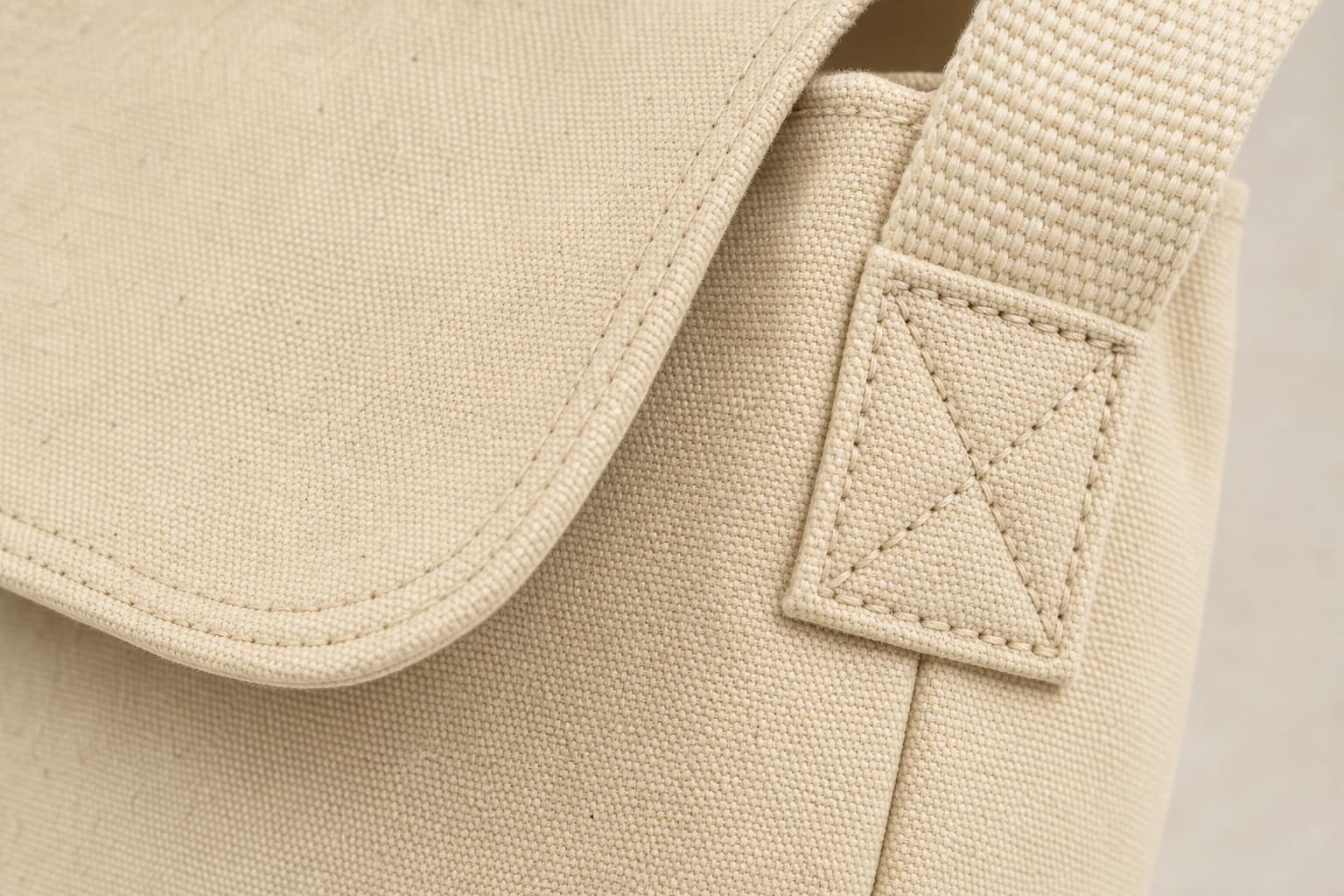
1. Why MOQ for Canvas Messenger Bags Is Often Misunderstood
MOQ is not a single number pulled from a supplier’s price list. For wholesale canvas messenger bags, the practical minimum order quantity is created by several linked decisions: fabric availability, dye lot size, cutting efficiency, sewing line setup, hardware purchasing, logo method, packing version, inspection workload, and export carton planning. A factory may say “500 pcs MOQ,” but that may mean 500 pcs in one size, one fabric color, one logo artwork, one closure type, and one packing method. If the buyer divides that into five colors, two flap prints, and three barcode labels, the real MOQ structure changes immediately.
This is why many procurement teams receive quotes that look inconsistent. One supplier may quote stock natural canvas with a one-color screen print and a standard cotton webbing strap. Another may quote custom dyed 16 oz canvas, magnetic snaps, inner zipper pocket, woven label, retail hangtag, and barcode polybag. Both offers may say “canvas messenger bag,” but they are not quoting the same production route. A useful wholesale canvas messenger bags MOQ guide should therefore help buyers identify which choices drive the minimum, not only ask suppliers to reduce it.
Factories also think about line efficiency. A messenger bag is not as simple as a flat cotton tote. It may require flap assembly, strap preparation, pocket sewing, closure reinforcement, print curing, trimming, pressing, and controlled folding. Short runs with many variations create more changeovers and more sorting risk. The buyer’s job is to make the first RFQ narrow enough that suppliers can quote accurately, then ask for quantity breaks and optional upgrades separately.
- State whether MOQ should be quoted per total order, per SKU, per fabric color, per logo artwork, per size, or per packing version.
- Do not compare MOQ unless fabric weight, color route, hardware, logo method, and packing are aligned.
- If several colors are needed, ask for a stepped quote showing minimum per color and price impact for uneven splits.
- For a first program, simplify the RFQ: one size, one base construction, one fabric route, limited colors, and one approved logo method.
2. The MOQ Math Behind Fabric Rolls, Dye Lots, and Cutting Yield
Fabric is usually the first major MOQ driver. Canvas messenger bags commonly use cotton canvas from about 10 oz to 18 oz, roughly 280 to 510 GSM depending on weave, yarn, and finishing. For many wholesale and retail programs, 12 oz to 16 oz is the practical range. A 12 oz canvas can suit promotional, school, event, and lightweight daily-use bags. A 16 oz canvas gives more body and perceived durability, but it increases material cost, cutting resistance, needle wear, sewing time, carton weight, and freight cost.
The factory’s fabric stock position matters. Natural cotton canvas is often easier to source in smaller runs because it is used across many bag types. Standard dyed colors such as black, navy, khaki, olive, or grey may also be available from stock, depending on the supplier’s normal orders. Custom Pantone dyeing is different. A mill may require a minimum dye lot, and the bag factory may need to purchase full rolls even if your order consumes only part of the fabric. If the order is small, the buyer may either pay a higher unit price, accept a stock color, or absorb leftover fabric cost.
Cutting yield is another overlooked factor. Messenger bag pattern pieces include front panel, back panel, flap, gusset, pockets, strap reinforcements, and sometimes binding. Large flaps and deep gussets can reduce fabric utilization if the pattern does not nest efficiently across the fabric width. A small change in bag width or flap shape may improve yield and lower wastage. This is a factory-side constraint worth discussing before locking the design.
- For low MOQ, start with natural canvas or stock dyed colors rather than custom Pantone dyeing.
- Ask whether the quoted price assumes full roll purchasing, partial roll usage, or existing stock fabric.
- State fabric as both oz and approximate GSM, for example 12 oz cotton canvas, approximately 340 GSM.
- Confirm whether the canvas is raw, washed, enzyme washed, bleached, dyed, coated, or water-repellent finished because finishing affects shrinkage, handfeel, and lead time.
- Ask if a small dimension change can improve fabric cutting efficiency without harming the intended product use.
3. Quantity Scenarios: 300, 500, 1,000, and 3,000 Pieces
A practical MOQ discussion becomes clearer when buyers compare real quantity scenarios. At 300 pcs, the supplier is likely to rely on stock fabric, an existing or lightly modified pattern, standard hardware, and a simple logo. This quantity can be useful for a test order, but it is not ideal for multiple colors, custom dyeing, or complicated pocket layouts. Unit price is often high because setup time is spread across fewer bags.
At 500 pcs, a first wholesale run becomes more realistic. Some suppliers may accept two stock colors if each color has enough quantity for efficient cutting, but that must be confirmed. If the buyer asks for 250 pcs black and 250 pcs natural, one logo, one packing method, and standard hardware, the order may be manageable. If the same 500 pcs are split into five colors and three logo versions, the production complexity resembles a much larger SKU program without the volume to support it.
At 1,000 pcs, buyers can usually have a stronger discussion about reinforced construction, barcode packing, woven side labels, and more stable carton planning. The order still needs discipline: three colors, two logos, and different retail hangtags should be treated as separate SKUs for planning and inspection. At 3,000 pcs, a repeat program may justify better fabric planning, custom color development, upgraded closures, or a dedicated run of labels and hardware, but it also increases inventory exposure. Procurement should use the higher quantity to standardize specifications, not to add uncontrolled variation.
- 300 pcs: keep one stock color, one logo, standard strap, standard closure, and simple packing.
- 500 pcs: consider one or two stock colors only if the factory confirms minimum per color and fabric availability.
- 1,000 pcs: suitable for a retail or distributor SKU with barcode packing and tighter QC standards.
- 3,000 pcs: better for repeat programs, possible custom color planning, and negotiated material purchasing.
- For every tier, ask which cost drops with quantity and which costs remain fixed, such as artwork setup, sample fee, tooling, or label development.
4. Construction Choices That Increase or Reduce MOQ
A messenger bag has more production steps than a basic tote. Even a simple design may include a front panel, back panel, gusset, flap, bottom seam, strap, slider, closure, inner pocket, and reinforcement stitching. Each added feature creates more cutting pieces, more sewing operations, and more defect points. A clean flap messenger bag with one main compartment is easier to quote at moderate MOQ than a laptop-style bag with padding, lining, zipper compartments, organizer pockets, and custom pullers.
Procurement buyers should ask what construction can be produced reliably at the target order size. If the goal is a 300 to 500 pcs trial, a simpler build is usually safer: one compartment, one inner pocket, adjustable cotton webbing strap, and a standard closure. If the order is 1,000 pcs or more, extra features such as a back slip pocket, reinforced bottom, or upgraded snap may be more economical because pattern making, cutting, and operator training are spread across more units.
Closures and straps also affect MOQ. Velcro is simple and common for promotional bags, but it can collect lint and may not fit premium positioning. Metal snaps and magnetic snaps improve perceived value, but they need reinforcement so the canvas does not tear. Buckles and sliders must match strap width and load expectation. If a buyer chooses uncommon hardware size, the factory may need to buy full cartons or meet a hardware supplier MOQ.
- Low complexity: one main compartment, flap closure, adjustable strap, simple inner pocket, limited reinforcement.
- Medium complexity: front pocket, back slip pocket, reinforced bottom, metal snap or magnetic closure.
- High complexity: padding, laptop divider, zipper compartments, lining, organizer slots, custom pullers, multiple logo placements.
- Ask for the base construction price and each optional feature as a separate line item.
- Confirm whether hardware is factory stock or requires a supplier MOQ by carton, finish, or size.
5. Logo, Label, and Artwork Setup Can Create Hidden Minimums
Logo method can raise MOQ even when bag sewing MOQ is acceptable. Screen printing is often the practical choice for wholesale canvas messenger bags with one to three solid colors. It works well for flap logos, pocket logos, and large brand marks. However, rough canvas texture can create small pinholes or broken edges, especially with fine type, thin lines, or heavy ink coverage. The buyer should approve a physical strike-off on the actual fabric, not only a digital mockup.
Embroidery, woven labels, leather patches, PU patches, rubber patches, and heat transfers all have different setup rules. Embroidery cost depends on stitch count and thread color changes. Woven labels may require a separate label MOQ and several days for artwork approval. Leather or PU patches may require cutting dies, embossing plates, debossing plates, edge painting, or additional sewing operations. If the importer requests four brand labels at 250 pcs each, the canvas bag MOQ may be fine but label MOQ and sorting risk may be the issue.
Artwork changes late in the process create avoidable cost. A screen may be made for a 120 mm logo, but the buyer later wants 160 mm. A woven label may be approved at one size, then changed after production labels are finished. These changes can reset setup, delay sampling, and confuse inspection. The RFQ should therefore show exact artwork size, placement from seams, color references, and acceptable tolerance before formal quotation.
- Screen print: suitable for simple solid logos and controlled cost; check ink coverage on actual canvas.
- Embroidery: premium look, but quote depends on stitch count, density, and small-letter readability.
- Woven label: good for repeat retail programs; confirm label MOQ, label lead time, and attachment position.
- Patch branding: confirm material, thickness, backing, edge finish, tooling, and stitch method.
- For logo placement, define distance from flap edge or seam, not only “centered on front.”
6. Sampling: Use It to Verify the Production Route, Not Only Appearance
A sample should test the MOQ assumptions behind the quote. If the sample uses substitute fabric, a different webbing, a showroom slider, or digital printing instead of the planned screen print, it may look acceptable but still fail as a production reference. A useful sample should confirm fabric weight, color, handfeel, logo method, hardware, strap width, closure, pocket layout, reinforcement, seam allowance, and packing method.
For a new design, it is reasonable to start with a development sample to check shape and function. After the purchase order details are fixed, request a pre-production sample made from production materials wherever possible. This signed sample should become the inspection standard. Without it, disputes often appear later: the buyer expected a stiffer handfeel, the factory used a close stock fabric, the print has texture gaps, or the flap drop is shorter than expected.
Sampling should also reveal whether the design is efficient. If the flap curls, the magnetic snap pulls through, the strap slider slips, or the gusset collapses, the problem should be solved before bulk cutting. On canvas messenger bags, many issues are not visible in flat artwork. They appear only after sewing, loading, folding, and wearing the bag across the body.
- Measure finished width, height, gusset, flap drop, pocket size, strap width, and strap adjustment range.
- Load the sample with the intended weight and check strap joins, side seams, closure points, and bottom deformation.
- Rub the print after curing and check for cracking, poor coverage, ink transfer, or unacceptable pinholes.
- Open and close snaps, Velcro, buckles, sliders, and zippers repeatedly to confirm function.
- Photograph the approved sample from front, back, inside, bottom, side gusset, strap, closure, carton packing, and logo close-up.
7. What a Professional Factory Quote Should Include
A quote for wholesale canvas messenger bags should provide enough data for landed cost comparison. Unit price alone is not enough. The buyer needs fabric specification, finished size, logo method, hardware, packing, sample cost, setup charges, production lead time, carton data, Incoterm, payment terms, and quote validity. If these details are missing, a low quote can become expensive after sample revisions, repacking, material substitutions, or missed delivery windows.
A strong supplier quote should also list assumptions clearly. For example: price based on 14 oz natural cotton canvas, finished size 38 x 30 x 10 cm, one-color screen print on flap, 38 mm cotton webbing strap, metal slider, Velcro closure, one inner pocket, individual polybag, 40 pcs per export carton, FOB port, valid for 15 days. With this level of detail, procurement can compare offers fairly and ask targeted questions.
Buyers should request alternate quotes in a controlled way. Instead of asking “please lower price,” ask the factory to quote Option A at 12 oz canvas, Option B at 16 oz canvas, and Option C with an upgraded magnetic snap. This keeps the comparison clean. It also helps the factory suggest cost-saving changes without quietly changing the product.
- Request quantity breaks at 300, 500, 1,000, and 3,000 pcs under the same specification.
- Ask for fabric weight, composition, finish, color route, and whether it is stock or custom dyed.
- Ask for finished size and measurement tolerance by main body, flap, gusset, pocket, and strap.
- Ask for logo size, position, method, color count, setup charges, and sample approval requirement.
- Ask for hardware material, finish, size, and whether it is stock or special purchase.
- Ask for carton quantity, carton dimensions, net weight, gross weight, estimated CBM, and packing method.
- Ask for the commercial term, payment term, quote validity, and what starts the production lead time clock.
8. Packing, Carton Planning, and Warehouse Requirements
Packing affects cost more than many buyers expect. Messenger bags are bulkier than flat totes because they include gussets, flaps, straps, hardware, and sometimes padding. Individual polybags protect against dust and rubbing, but add material cost, labor, and plastic-use considerations. Paper bands or tissue may fit brands reducing plastic, but they require clear folding instructions. Loose bulk packing can reduce direct cost, but it increases the chance of staining, strap tangling, hardware scratches, barcode confusion, and carton count disputes.
Retail packing should be defined before final quote. Barcode stickers, hangtags, warning labels, suffocation warnings, inner cartons, master carton marks, and carton sequence requirements all create labor and control points. Adding them after sewing may require the factory to unpack, sort, relabel, and repack goods. That can delay shipment and create extra charges.
Carton weight and volume should also be part of procurement evaluation. A heavier 16 oz canvas bag may look like a small unit cost difference but can change gross weight, CBM, warehouse handling, and freight budget. If a distributor has maximum carton weight rules, state them early. If goods will be palletized, ask for carton dimensions that work with the receiving warehouse. Packing is not an afterthought; it is part of the MOQ and landed-cost structure.
- Decide whether each bag needs polybag, paper band, tissue, hangtag, barcode sticker, silica gel, or warning label.
- Confirm folding method so the flap, print, and hardware do not create permanent creases or rubbing marks.
- Set maximum carton gross weight if your warehouse has manual handling limits.
- Ask whether metal sliders, buckles, snaps, or magnetic closures need tissue protection to avoid scratching printed panels.
- Include shipping marks, SKU labels, carton sequence numbers, and mixed-carton rules in the packing instruction.
9. Quality Control Standards Procurement Should Define Upfront
Quality control for canvas messenger bags should not be limited to general statements such as “good stitching” or “same as sample.” Procurement should define measurable tolerances before production. The approved sample is important, but inspectors also need numeric standards for dimensions, print placement, stitch density, color variation, fabric weight, hardware function, packing, and load performance. Clear QC standards protect both buyer and factory because they reduce subjective arguments at final inspection.
For dimensions, many buyers use tolerances such as +/-1 cm for main width and height and +/-0.5 cm for smaller pockets or flap alignment points, but the correct tolerance depends on design and material behavior. For print placement, +/-3 mm to +/-5 mm is often more realistic than expecting machine-like precision on thick canvas. For GSM, a tolerance around +/-5% may be practical unless the program requires a tighter fabric control. For stitch density, the approved construction should be stated, such as approximately 7 to 9 stitches per inch where suitable for the seam type.
Inspection sampling should also be specified. Many importers use ANSI/ASQ Z1.4 general inspection level II with agreed AQL limits, but the buyer and supplier must confirm the plan. Critical defects should include safety risks, sharp hardware, severe contamination, wrong logo, wrong color, and broken straps. Major defects can include incorrect dimensions outside tolerance, weak seams, print misplacement, closure failure, or wrong packing. Minor defects may include small thread ends or slight cosmetic issues within agreed limits.
- Define finished size tolerance before bulk cutting, including body, flap, gusset, pocket, and strap length.
- Set print tolerance for position, color, edge sharpness, curing, and acceptable texture gaps on canvas.
- Confirm fabric GSM tolerance, shade approval method, and whether bulk lots can be mixed in one shipment.
- Specify stitch density, reinforcement method, thread color, and unacceptable skipped stitches or open seams.
- Set a load test, such as 8 kg to 12 kg static hanging load when appropriate for the bag’s intended use.
- Use an agreed AQL sampling plan and separate critical, major, and minor defects in the inspection instruction.
10. Lead Time Planning: From Sample to Shipment
Lead time is often underestimated because buyers count only sewing days. In reality, the schedule includes artwork confirmation, sample making, sample review, fabric purchasing or dyeing, lab dip approval if needed, hardware procurement, cutting, printing, ink curing, sewing, trimming, pressing, packing, final inspection, corrective action if required, carton data confirmation, and export booking. A simple stock-fabric order can move much faster than a custom dyed canvas bag with special hardware and multiple logo applications.
Procurement teams should ask suppliers to split lead time into stages. This shows the true bottleneck. If the bottleneck is fabric dyeing, faster artwork approval will not solve the problem. If woven labels are late, sewing capacity may be available but production still cannot finish. If inspection fails and goods need rework, a shipment date with no buffer may force expensive decisions such as split shipment or air freight.
The lead time clock should be defined clearly. Some factories count from deposit receipt. Others count from final sample approval, artwork approval, or arrival of all custom materials. Buyers should not assume the earliest email inquiry starts production time. For launch programs, create an internal calendar that includes buyer-side approval days as well as factory-side production days.
- Sample stage: separate development sample time from pre-production sample time and confirm whether logo and actual hardware are included.
- Material stage: separate stock fabric, custom dyed fabric, washed fabric, labels, patches, and special hardware.
- Production stage: count from deposit, sample approval, artwork approval, and material arrival as agreed in writing.
- Inspection stage: reserve time for inspection booking, inspection report review, and corrective action if defects are found.
- Shipment stage: allow time for carton data, booking, customs documents, warehouse appointment, and forwarder coordination.
Specification comparison for buyers
| Order size scenario | MOQ setup drivers | Practical specification choices | Buyer trade-offs to evaluate |
|---|---|---|---|
| 300 pcs trial order | Usually depends on stock fabric, existing pattern, simple logo setup, and whether the factory accepts low cutting quantity | One size, one stock canvas color, 12 oz to 14 oz canvas, one-color screen print, standard cotton webbing strap, basic closure, simple polybag or bulk carton | Best for market testing, but unit price is higher; avoid custom dyeing, custom lining, multiple logos, or several packing versions |
| 500 pcs first wholesale run | Can support better cutting efficiency, limited color split if stock fabric exists, and basic production scheduling | One or two stock colors if approved by factory, 12 oz to 16 oz canvas, one to two print colors, standard hardware, one packing format | Good balance for first import order; confirm MOQ is per color and per logo, not only total quantity |
| 1,000 pcs retail or distributor SKU | More efficient for fabric purchasing, print setup, carton planning, and sewing line allocation | One to three stock colors, stronger 14 oz to 16 oz canvas, reinforced strap joins, woven label or screen print, barcode packing if needed | Lower unit cost is possible, but color splits, labels, hangtags, and carton marks must be controlled by SKU |
| 3,000 pcs repeat program | Can justify more dedicated material planning, repeat hardware sourcing, and stronger process control | Custom fabric color may become more practical, multiple production lots can be planned, upgraded closure or pocket structure may be economical | Better cost leverage and consistency, but higher inventory exposure; lock standards for dye lot, GSM, logo placement, carton quantity, and inspection level |
| Custom Pantone color at any quantity | Fabric mill dye lot minimum, lab dip approval, shade tolerance, and shrinkage testing drive MOQ more than bag sewing capacity | Use approved lab dip, define shade tolerance, keep bag design stable, and avoid splitting the order into many custom colors | Can improve brand accuracy, but adds time and risk; ask whether the stated MOQ is per color and whether excess fabric must be paid for |
| Multi-logo or multi-brand program | Print screens, embroidery files, woven label MOQ, packing labels, and inspection sorting create separate SKU controls | Treat each logo version as a separate SKU; standardize fabric, strap, hardware, and carton count across versions | Allows one base bag across brands, but too many small logo splits can erase MOQ savings and increase sorting defects |
Buyer checklist before sampling
- Define finished bag width, height, gusset, flap drop, strap width, maximum strap length, pocket size, and whether measurements are finished dimensions or pattern dimensions.
- Specify fabric in both oz and approximate GSM, including composition, finish, color route, shrinkage concern, and whether natural, bleached, dyed, washed, recycled, or coated canvas is required.
- Ask whether MOQ is based on total order quantity, per fabric color, per logo artwork, per size, per closure type, per packing version, or per delivery schedule.
- Build a quantity scenario table before RFQ: for example 300, 500, 1,000, and 3,000 pcs, with color splits and logo versions shown clearly.
- Confirm whether the factory has stock fabric rolls, stock webbing, stock hardware, and an existing pattern close to your design; these items often determine whether a low MOQ is realistic.
- Decide logo size, position, color count, and method before requesting the first formal quote because screen setup, embroidery digitizing, woven label MOQ, and patch tooling change the MOQ logic.
- Request a pre-production sample using production fabric, production hardware, production logo method, and intended packing, not only a showroom sample or similar previous item.
- Confirm strap length adjustment range, slider material, reinforcement box stitch or bar tack method, flap closure strength, and intended carrying load.
- Define numeric tolerances for size, print placement, fabric GSM, color shade, stitch density, load test weight, and acceptable defect levels before deposit.
- Confirm carton quantity, carton dimensions, gross weight, barcode or shipping mark requirements, inner carton needs, pallet limitations, and whether metal hardware needs protective wrapping.
Factory quote questions to send
- What is your MOQ for this canvas messenger bag per design, per fabric color, per logo artwork, per size, and per packing version?
- Can you quote 300, 500, 1,000, and 3,000 pcs separately using the same specification so we can see the quantity breaks clearly?
- Which part drives your MOQ most: fabric stock, dye lot, fabric roll yield, print setup, label MOQ, hardware carton MOQ, cutting efficiency, or sewing line setup?
- Which canvas weights do you keep in regular stock, and what GSM tolerance do you apply on incoming fabric inspection?
- Can you quote both 12 oz and 16 oz canvas versions using the same bag size, strap, closure, logo, and packing so we can compare cost and structure?
- For custom fabric colors, what is the fabric mill MOQ per color, lab dip lead time, bulk dye lead time, and acceptable shade tolerance?
- What print method do you recommend for our artwork size and color count on canvas, and are there screen charges, digitizing charges, patch tooling charges, or label setup costs?
- What is the minimum quantity for woven labels, patches, metal sliders, magnetic snaps, buckles, zipper pulls, hangtags, and barcode labels if they are not standard stock items?
- What is the sample lead time for a printed sample using production fabric, actual hardware, actual closure, and the intended logo method?
- What hardware options are included in the base quote, and which items are upgrades by material, finish, thickness, corrosion resistance, or pull strength?
Quality-control points to confirm
- Fabric weight should match the purchase order and approved sample; a practical tolerance is often within +/-5% GSM unless a tighter tolerance is agreed.
- Finished bag measurements should stay within the agreed tolerance, commonly +/-1 cm for width and height and +/-0.5 cm for small pockets or flap alignment points.
- Print placement should be checked against a marked artwork standard; a practical tolerance is often within +/-3 mm to +/-5 mm depending on logo size and print position.
- Bulk fabric shade should be compared to the approved swatch under consistent light; define an acceptable commercial shade range or a Delta E target if your brand requires instrument control.
- Stitch density should be consistent at key seams; many canvas bags use about 7 to 9 stitches per inch, but the approved sample and seam strength requirement should control the final standard.
- Strap joins, flap stress points, pocket corners, and bottom seams should use approved reinforcement such as box stitch, cross stitch, or bar tack where specified.
- Random load testing should match intended use; for many messenger bags, buyers define a static hanging load such as 8 kg to 12 kg for a set time, with no seam tearing, strap slippage, or hardware failure.
- Logo print should pass curing and adhesion checks agreed in advance, such as dry rub, light wet rub, or tape test on actual canvas when suitable for the ink system.
- Hardware should operate smoothly with no sharp edges, rust, plating flake, weak snap retention, slider slippage, broken zipper teeth, or magnetic snap tearing through fabric.
- Velcro, snaps, buckles, sliders, and zippers should be checked repeatedly during inspection, not only viewed visually.