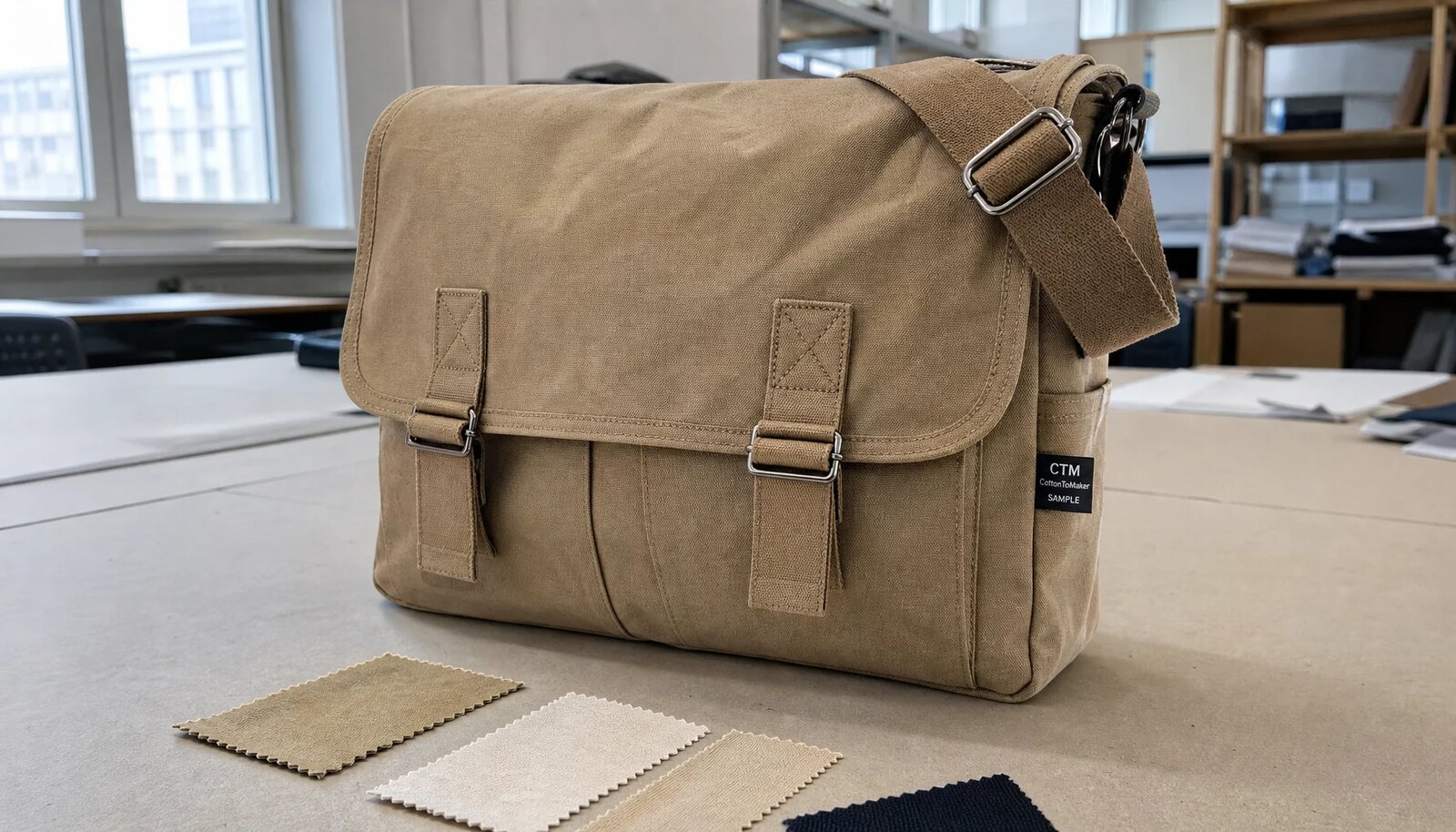
Start With the Bag's Job, Not the Fabric Name
The best wholesale canvas messenger bags are specified from the intended job backward. That sounds simple, but it is where many sourcing problems begin. An eco apparel brand may start with a preferred fiber story, while the factory starts with an available canvas. Procurement has to connect both sides: the bag must carry the planned contents, show the brand cleanly, survive packing and transport, and be repeatable when the second order arrives.
A flat messenger-style bag used as apparel packaging does not need the same material package as a daily commuter bag. The packaging version may be unlined, soft, light, and folded tightly in cartons. A commuter style may need a stronger body fabric, wider webbing, more secure closure, bar-tacked strap anchors, bound seams, and enough structure for a laptop, charger, notebook, and bottle. Both can be valid products. They should not be quoted as if they are the same bag.
Put a plain load statement into the RFQ. Instead of asking for a durable eco canvas messenger bag, say whether it will carry folded apparel, event papers, a tablet, a 13-inch laptop, or light daily contents around 2-3 kg. Add the sales role too: retail accessory, gift-with-purchase, staff issue, campus bag, conference merch, or bundled apparel carrier. With that information, a supplier can make better choices on canvas weight, gusset depth, lining, strap width, reinforcement, closure, and packing.
The goal is not to buy the heaviest canvas the budget can tolerate. A heavier fabric can create sewing bulk, freight cost, and print issues without fixing a weak strap or poor closure. The better target is a clear, honest material package: light enough to make commercial sense, strong enough for the stated use, and documented enough to support the brand's environmental language.
- Write the use case into the RFQ: retail accessory, merch item, gift packaging, commuter bag, staff issue, or campus carry.
- Define expected contents in plain terms, including target weight range when possible.
- State whether the finished bag should feel soft and packable, structured and shelf-ready, or rugged and utilitarian.
- Choose material after load, branding method, retail tier, and packing target are clear.
Read Canvas Weight as a Finished Spec
Canvas weight is one of the first numbers buyers compare, but it is often quoted too casually. Ounce weight and GSM can shift with market convention, weave, moisture, dyeing, washing, softening, coating, and the point at which the fabric is measured. A supplier quoting 12 oz canvas before finishing may not deliver the same hand feel or structure as a supplier quoting a finished 12 oz cloth ready for cutting. Ask for the finished GSM range, ounce weight if used, weave, usable width, and processing stage in writing.
For light promotional or packaging-style messenger bags, 8-10 oz cotton canvas, commonly about 270-340 GSM depending on weave and finish, can work well. It folds compactly, keeps carton weight down, and supports budget programs. The tradeoff is visible. The bag may sag when loaded, corners may collapse, and large prints may show strike-through on a looser surface. That may be acceptable for folded apparel or event documents. It is not the same standard as a bag sold for daily carry.
For many eco apparel brands, 12 oz canvas, commonly about 340-400 GSM after finishing, is a sensible starting point. It has enough substance for a retail-friendly feel, prints cleanly on many constructions, and can be used with bound seams, simple lining, or an internal pocket. Moving to 14-16 oz canvas, often about 475-540 GSM depending on weave, can make sense for premium programs, heavier flap designs, and laptop-friendly silhouettes. It also raises sewing bulk, needle stress, production time, carton weight, and freight cost.
Treat the canvas weight as one part of a system. A 16 oz body with narrow webbing and weak strap anchors is still a weak bag. A 10 oz body with smart reinforcement and honest use-case limits may be exactly right for a merch program. When comparing quotes, require every supplier to state whether the weight is greige, dyed, washed, coated, softened, or fully finished. That one sentence prevents many expensive misunderstandings.
- Use 8-10 oz canvas for light promotional use, packaging-style bags, or budget-sensitive flat packs.
- Use 12 oz canvas as a balanced starting point for retail-friendly wholesale messenger bags.
- Use 14-16 oz canvas when structure, higher load, or premium positioning justifies sewing and freight impact.
- Ask whether quoted weight is greige or finished, and require a finished GSM range on the spec sheet.
Match Fiber Claims to Verifiable Documents
Fiber selection affects availability, cost, labeling, customer trust, and reorder risk. Standard 100% cotton canvas is widely available, familiar to consumers, printable, and practical for wholesale programs. It can fit an eco apparel assortment when the brand wants a natural-fiber accessory. It should not, however, be described as organic, recycled, regenerative, certified, or lower-impact unless the supplier can provide documents that support the exact wording the brand plans to use.
Recycled cotton canvas can give a bag a matte, textured surface that suits many apparel brands. Buyers should expect more natural variation unless the supplier has a tightly controlled fabric source. Specks, slubs, neps, and shade movement may be part of the approved appearance. They become defects only when the approved standard says so. Ask for the recycled-content percentage, whether the content is pre-consumer or post-consumer if that distinction appears in marketing, and what evidence supports the claim.
Organic cotton canvas is strongest when certification-backed sourcing is part of the product value. It may bring higher fabric MOQs, fewer stock colors, longer lead time, and additional paperwork. That is not a reason to avoid it; it is a reason to plan earlier. If the brand needs organic language on hangtags, web copy, or wholesale line sheets, documentation timing should be part of the production calendar, not a last-minute request after goods are packed.
Blended canvas, such as cotton-poly canvas, deserves a careful decision rather than an automatic yes or no. A blend can improve dimensional stability, reduce shrinkage, or support a performance requirement. It also changes the care label and material story. For an eco apparel brand, the question is whether the performance reason is clear and whether the final claim is honest. A bag can include synthetic webbing, trims, or lining, but the product copy must not imply all-cotton construction if that is not true.
- Use 100% cotton canvas for straightforward natural-fiber positioning and reliable printability.
- Use recycled cotton only with stated content percentage, approved variation range, and claim documents.
- Use organic cotton when certification-backed sourcing is a requirement, not a vague preference.
- Use blends when performance justifies the labeling tradeoff and the brand accepts the material story.
Control Weave, Finish, Shrinkage, and Shade
Two canvas fabrics with the same weight can behave very differently once they reach cutting and sewing. Plain canvas, duck canvas, brushed canvas, washed canvas, and coated canvas vary in stiffness, seam bulk, print edge, shrinkage, surface texture, and shelf presentation. A tighter weave may hold shape and print sharper artwork. A washed canvas may feel more apparel-led and relaxed, but it can shift more during sewing and show more shade movement.
Shrinkage needs to be discussed before sample approval. Cotton canvas can shrink during dyeing, washing, steam pressing, or later contact with moisture. The factory should state the expected warp and weft shrinkage range and explain what cutting allowance is built into the pattern. If the body fabric shrinks more than the lining, the bag may pucker or twist. If the flap is stiffened but the front body is soft, the bag can lose balance after pressing. Body canvas, lining, binding, interfacing, labels, and trims should be approved as one material set.
Shade control is especially important when bags sit beside apparel in the same collection. Natural, ecru, undyed, and recycled cotton shades can move from lot to lot. Custom dyed canvas should move through lab dip, bulk swatch approval, and roll inspection before cutting. Dark canvas may need stronger ink opacity and can show lint. Light canvas can show oil marks, carton dust, water spots, and handling marks. None of this is unusual; it simply needs a written standard.
Give the supplier permission to manage variation by setting clear rules. Define the acceptable shade range, surface irregularity level, and roll mixing method. For visible panels such as the flap and front body, ask whether rolls will be kept together by shade group. For washed finishes, approve the finished look after the actual wash process, not only a flat fabric swatch.
- Ask for weave type, finish, usable fabric width, finished GSM, and expected shrinkage range.
- Confirm whether washing, softening, coating, or steam setting happens before or after cutting.
- Approve lining, binding, interfacing, labels, and body canvas together.
- Set shade and surface tolerance for natural, recycled, undyed, or custom dyed canvas before bulk cutting.
Specify Construction Around Failure Points
A messenger bag usually fails at stress points before the canvas body wears out. Strap anchors, flap joins, gusset corners, pocket openings, zipper ends, bottom seams, closure points, and pull areas carry repeated force. The construction spec should name the reinforcement method at each point: bar tack, box stitch, double-row stitching, binding, rivet, or another approved construction. Phrases such as reinforced stitching are too vague for price comparison or inspection.
Strap design is one of the clearest quality signals. For light merch, a 25 mm strap may be acceptable. For daily carry, many buyers look at 32-38 mm webbing depending on bag size and comfort target. Specify strap drop, total adjustable length, webbing material, edge feel, thickness or grade if available, adjuster type, hardware finish, and whether the strap is fixed, detachable, or padded. Cotton webbing supports a natural material story, but it may shrink or soften differently than the body canvas. Polyester or nylon webbing can be stable and strong, but the material must be disclosed if the brand is presenting the bag as all cotton.
Interior construction should be locked before quoting. An unlined body can work for budget or flat-pack programs. A retail messenger bag may need bound seams, lining, a hanging pocket, a padded sleeve, a clean facing inside the flap, or a bottom board for presentation. Each choice affects cost, weight, recyclability, claim language, and inspection standards. If a laptop sleeve is included, specify the target device size and padding expectations rather than using a generic term.
Hardware should be tested through the actual fabric stack. Magnetic snaps must close through the flap layers. Zippers must not catch the lining. Strap sliders must hold the webbing without slipping. Hook-and-loop tape must not damage nearby fabric or snag apparel in the same shipment. A neat trim sample on a desk does not prove the trim will work on a finished bag.
- Name reinforcement methods at strap anchors, flap joins, gusset corners, pocket openings, and closure points.
- Specify strap width, material, length range, drop, adjuster type, and attachment stitching.
- Decide whether the bag is unlined, bound, lined, padded, or built with a laptop sleeve before comparing quotes.
- Check closure and hardware function on the actual bulk fabric stack, not only loose trim samples.
Choose Decoration by Canvas Surface and Artwork
Decoration should be chosen around artwork, canvas texture, order quantity, and the durability expectation. Screen print is often the most controllable option for bold logos, simple typography, and repeat wholesale runs. It can cover larger areas without adding stitch bulk, and the setup cost becomes easier to absorb over volume. The buyer still needs to approve ink type, color standard, opacity, curing, hand feel, and placement on production-equivalent canvas.
Dark and heavy canvas needs extra attention. A white print on black 16 oz canvas has a different opacity risk than a black print on natural 12 oz canvas. Washed canvas may wrinkle around large ink areas. Recycled cotton may have fiber variation that changes the edge of fine lines. Water-based or soft-hand inks may fit the brand feel, but they should be checked for rub, transfer, curing, and odor before production release.
Embroidery can raise perceived value, yet it is not suitable for every logo or panel. Large filled embroidery may pucker lighter canvas, distort a flap, or create rough thread bulk inside the bag. It is usually safer for smaller marks, structured areas, patches, or labels. Woven side tabs, cotton patches, jacron-style patches, leather-free badges, and simple woven labels can be excellent for eco apparel brands that prefer quieter branding.
Do not approve decoration from a digital mockup alone. Canvas has texture and absorbency; a screen image does not. Request a strike-off or branded panel sample on the same fabric color, weight, finish, and washing process planned for production. For visible logos, write a placement tolerance into the spec. Plus or minus 5 mm is a common starting point when the construction allows it, but the tolerance should match the bag size and logo position.
- Use screen print for bold logos, larger marks, and repeatable wholesale production.
- Use woven labels, side tabs, or patches for subtle branding and durable identification.
- Use embroidery selectively on structured areas or smaller marks to reduce puckering risk.
- Approve decoration on production-equivalent canvas, not only on a digital proof or substitute swatch.
Build an RFQ That Makes Quotes Comparable
A vague RFQ creates false savings. One supplier may quote an unlined 10 oz bag with basic webbing and a simple print. Another may quote a lined 12 oz bag with stronger strap anchors, better hardware, and a controlled packing method. The first price may be lower, but it is not necessarily better. It may simply describe a different product.
A serious RFQ for wholesale canvas messenger bags should include finished dimensions, canvas weight, finished GSM range, fiber content, claim requirements, color, weave, finish, lining, pocket layout, flap length, closure, strap, hardware, artwork, packing, order quantity, inspection expectations, and delivery terms. Send the same sheet to every supplier. Otherwise, procurement ends up comparing guesses.
Ask suppliers to itemize cost drivers. Fabric, cutting, sewing, trims, decoration, screen or label setup, packing, testing, inspection, and freight assumptions all affect landed cost. Once the quote is broken down, negotiation becomes more useful. Cost reduction may come from moving from 16 oz to 12 oz canvas, using stock webbing color, simplifying the lining, reducing print size, packing flat, or choosing a standard hardware finish. Those are product decisions, not blind price pressure.
Lead time should be quoted by stage. Stock fabric can speed sampling, while custom dye, recycled-cotton sourcing, organic documentation, special trim, or artwork revisions can add weeks. Ask for dates covering material procurement, lab dip or swatch approval, first sample, sample revision, pre-production sample, bulk cutting, sewing, decoration, final inspection, packing, and shipment release. A realistic calendar is less exciting than an optimistic one, but it is far more useful.
- Send the same spec sheet to every supplier so prices describe the same bag.
- Ask for itemized pricing instead of only a single per-piece number.
- Request price breaks at realistic order and reorder quantities, not only the supplier's preferred MOQ.
- Require a lead-time split by material, sampling, production, decoration, inspection, packing, and shipment release.
Use Sampling to Test Function, Not Only Appearance
A sample should prove that the intended production method works. A front-view photo is not enough. Measure body width, height, gusset depth, flap length, pocket depth, opening size, strap drop, and adjustable strap range against the written spec. Load the bag with the intended contents. Watch what happens: does the flap close, does the strap twist, does the bottom sag, does the body lean, does the closure become awkward? If the product is laptop-friendly, test the actual device size or a dimensional dummy.
Sampling also exposes material compatibility. Heavy canvas with thin lining can feel unfinished. Washed canvas with a large print may wrinkle around the ink. A stiff flap with a weak magnetic snap may not stay closed. A zipper may run smoothly before assembly and then catch once lining is sewn in. If the first sample uses substitute fabric, temporary hardware, or placeholder labels, record each substitution and require a pre-production sample using bulk materials before approval.
Run simple handling checks before signing off. Rub the print with a clean white cloth and look for transfer. Open and close zippers, buckles, snaps, and hook-and-loop tape repeatedly. Hang the bag with a realistic load for a short period and inspect strap anchors for distortion. Check visible topstitching, seam allowance, binding, thread trimming, pocket openings, and flap symmetry. Compare color under daylight and indoor light.
Keep control samples organized. One signed golden sample should represent the approved finished bag. A sealed fabric and trim reference set should show the approved canvas, lining, webbing, hardware, label, thread, and logo execution. For reorders, compare new production against the same standard rather than relying on memory or old photos.
- Measure the sample against written dimensions, including strap drop, gusset, flap, and pocket measurements.
- Load the sample with intended contents and check closure, balance, sagging, and strap twist.
- Record substitute materials separately and require a pre-production sample made with bulk materials.
- Keep one signed golden sample and a sealed fabric/trim reference set for production inspection.
Set QC Tolerances Before Cutting
Quality control works best when the rules are agreed before production begins. Canvas is a textile, so normal variation in texture, shade, and hand feel will exist. The buyer's job is to define what variation is acceptable and what becomes a defect. Written tolerance gives the factory a target and gives the buyer a fair inspection standard. Without it, both sides end up arguing from photos after the goods have shipped.
Common tolerance points include body dimensions, gusset depth, flap length, strap length, strap drop, pocket size, print placement, shade, stitch quality, hardware function, and packing. Many buyers use plus or minus 1 cm for main finished body dimensions when the design allows, tighter tolerance for visible logo placement such as plus or minus 5 mm, and clear rejection rules for stains, holes, mildew odor, broken yarns, severe shade panels, skipped stitches at stress points, loose hardware, and ink transfer. The exact tolerance should fit the bag size and construction complexity.
Inspection should happen in stages. A fabric check before cutting can catch roll shade differences, stains, width issues, and surface flaws before panels are mixed. An in-line sewing check can catch missing bar tacks, incorrect seam allowance, poor binding, or wrong strap placement before hundreds of pieces are finished. A decoration check can catch print placement, ink curing, embroidery puckering, or label errors before packing. A pre-shipment inspection then verifies quantity, dimensions, workmanship, carton labels, packing method, and carton condition.
Testing should match the order risk. For a light gift bag, visual inspection and dimension checks may be enough. For a retail messenger bag, add checks such as finished fabric weight verification, colorfastness to rubbing, seam strength, strap pull, zipper cycles, snap function, and carton drop checks where relevant. The point is not to over-test every order; it is to test the areas most likely to create returns, claim disputes, or brand damage.
- Set tolerances for dimensions, print placement, strap length, shade, fabric flaws, and stitch defects in writing.
- Inspect fabric rolls before cutting when shade, shrinkage, or surface character matters.
- Use in-line checks for reinforcement, seam quality, decoration placement, and hardware attachment.
- Match testing to risk: rub, strap pull, seam strength, zipper function, snap function, or carton checks as needed.
Plan Packing and Landed Cost With the Spec
Packing is part of material selection because it changes both product condition and landed cost. A soft 10 oz messenger bag may pack flat and ship efficiently. A 16 oz lined bag with padding, hardware, and a base insert will take more carton space and weigh more per unit. If procurement compares only ex-factory or FOB price, the heavier specification may look reasonable until carton count, freight weight, warehouse handling, and storage are added.
Eco apparel brands often want reduced plastic, and that is a valid goal. The pack method still has to protect the product. Printed panels can scuff against hardware or rough canvas. Light natural canvas can pick up carton dust. Washed canvas can develop hard creases if folded too tightly. Depending on channel, options may include paper wrap, recycled polybag, tissue barrier, flat packing, hang packing, or carton dividers. The right answer depends on fabric finish, logo method, sales channel, and how the bag will be handled after arrival.
Specify whether the bag is sold folded, hung, shelf-presented, shipped inside an apparel order, or stored for later fulfillment. That choice affects folding lines, barcode placement, hangtag position, carton orientation, and unit protection. A retail accessory may need cleaner presentation than a staff-issue bag. A bag packed inside an ecommerce apparel order may need extra protection from dust and hardware marks.
Carton data belongs in every serious quote comparison. Ask for pieces per carton, carton dimensions, net weight, gross weight, packing photos, carton marks, and whether cartons are likely to exceed comfortable manual handling weight. For repeat programs, require the supplier to keep packing consistent unless changes are approved. Warehouse teams depend on predictable carton size, label placement, scan position, and unit protection. A small packing change can create real operating cost later.
- Choose packing based on fabric finish, print protection, sales channel, carton efficiency, and plastic-reduction goals.
- Ask for pieces per carton, carton dimensions, net weight, gross weight, carton marks, and packing photos before shipment.
- Protect natural or light canvas from dust, moisture, scuffing, hardware marks, and compression creases.
- Compare landed cost, not only FOB or ex-factory sewing price.
Specification comparison for buyers
| Spec decision | Recommended option | When it fits | Buyer risk to check |
|---|---|---|---|
| Supplier route | Integrated cut-and-sew factory that controls fabric sourcing, sewing, decoration coordination, QC, and packing | Best for repeat wholesale programs where one supplier must own schedule, workmanship, and defect response | Confirm actual production address, whether printing or washing is subcontracted, in-line QC records, and who approves subcontracted processes |
| Supplier route | Fabric mill plus nominated sewing factory | Best when the buyer needs custom canvas weight, custom color, certification-linked fabric, or tighter loom and dye control | Shade, shrinkage, hand feel, and fabric width changes can disrupt sewing if mill approval and sewing approval are not linked |
| Supplier route | Trading company with disclosed factory network | Useful for mixed-SKU accessory programs, early tests, or buyers sourcing bags alongside apparel | Require factory name, inspection access, sample ownership, defect responsibility, and whether certificates belong to the trader or factory |
| Canvas weight | 8-10 oz cotton canvas, commonly about 270-340 GSM depending on weave and finish | Lightweight merch, flat packaging bags, event giveaways, and folded apparel carry | May lack structure; check corner collapse, print strike-through, seam strength, and whether the bag is being oversold as daily carry |
| Canvas weight | 12 oz cotton canvas, commonly about 340-400 GSM after finishing | Balanced starting point for retail-friendly wholesale canvas messenger bags for eco apparel brands | Verify finished GSM after dyeing, washing, softening, or coating, not only greige fabric weight before finishing |
| Canvas weight | 14-16 oz cotton canvas, commonly about 475-540 GSM depending on weave | Premium retail bags, commuter styles, heavier flap designs, and laptop-friendly silhouettes | Higher sewing bulk, slower production, needle breakage risk, heavier cartons, higher freight, and possible print cracking on thick seams |
| Fiber choice | 100% conventional cotton canvas | Practical natural-fiber option with broad availability, good printability, and manageable lead time | Do not use organic, recycled, regenerative, or lower-impact claims unless documentation supports the exact wording |
| Fiber choice | Recycled cotton canvas with stated recycled-content percentage | Good for textured matte surfaces and a documented lower-impact material story | Clarify pre-consumer or post-consumer content if relevant, lot variation, shade tolerance, tensile strength, and claim documents before approving packaging copy |
| Fiber choice | Organic cotton canvas with applicable scope, transaction, or material documentation | Best for premium eco apparel lines that need certification-backed sourcing language | Certification chain, MOQ, dye-house availability, color limits, and document timing can affect production release |
Buyer checklist before sampling
- Define the bag's commercial role before quoting: retail accessory, apparel gift-with-purchase, staff issue, conference merch, campus bag, or commuter carry.
- State the intended load in the RFQ, such as 2-3 kg light daily carry, folded apparel only, tablet and notebook, or 13-inch laptop with charger.
- Lock the target body fabric by finished GSM or ounce weight, weave, fiber content, color, fabric finish, and acceptable shade range.
- Ask whether the quoted fabric weight is measured in greige, dyed, washed, coated, softened, or fully finished condition.
- Specify body width, height, gusset depth, flap length, opening size, strap drop, pocket count, closure type, and target device or document size.
- Define strap webbing width, fiber content, thickness or grade if available, adjuster type, reinforcement method, and required bar tacks at load points.
- Confirm lining fabric, binding, seam allowance, interfacing, padding, bottom board, laptop sleeve dimensions, and pocket construction before comparing prices.
- Provide artwork size, placement, number of colors, Pantone or brand color references, print tolerance, and decoration method before requesting final pricing.
- Request a print strike-off or branded panel sample on the same canvas weight, color, finish, and washing process planned for production.
- Separate the quote into fabric, cutting, sewing, decoration, trims, labels, packing, testing, sample charges, setup charges, inspection, and freight assumptions.
Factory quote questions to send
- What exact finished fabric weight, GSM range, weave, fiber content, finish, and usable fabric width are included in this quote?
- Is the canvas stock fabric, mill-made to order, dyed to order, washed after sewing, coated before cutting, or softened after dyeing?
- Is the quoted weight measured on greige fabric, dyed fabric, washed fabric, or fully finished fabric ready for cutting?
- What fiber claim can be supported for this fabric, and what documents can you provide for organic cotton, recycled cotton, or other claimed content?
- What MOQ applies separately for fabric color, custom dye, print method, woven label, lining material, zipper, webbing, and hardware color?
- Can you itemize fabric, cutting, sewing, trims, decoration, setup, labels, testing, packing, inspection, and freight assumptions instead of giving only one unit price?
- What shrinkage allowance do you build into cutting, and what are your expected shrinkage ranges in warp and weft after dyeing, washing, or pressing?
- What stitch type, stitch density, seam allowance, thread count or thread type, and reinforcement method will you use at strap anchors, flap joins, gusset corners, and pocket openings?
- What strap webbing width, material, thickness or grade, adjuster type, hardware finish, and attachment method are included in the price?
- Will the logo be screen printed, embroidered, patched, woven-labeled, heat transferred, or applied another way, and what artwork limitations apply on this canvas?
Quality-control points to confirm
- Finished fabric weight is checked against the approved GSM or ounce range from the same production stage, not compared with an unfinished greige cloth.
- Fiber content and claim language match the purchase order, care label, hangtag, website copy, and any documents supplied for recycled or organic material.
- Canvas surface is consistent within the approved standard, with no visible oil marks, mildew odor, broken yarns, severe slubs, shade bands, stains, or holes on main panels.
- Color is compared under consistent lighting against the approved lab dip, bulk swatch, or golden sample, with roll-to-roll shade variation recorded before cutting.
- Cut panels follow grain direction and approved pattern placement so the bag does not twist, lean, skew, or stretch unevenly after sewing.
- Finished body width, height, flap length, gusset depth, pocket depth, strap length, and strap drop stay within written tolerance after pressing and packing.
- Seam allowance is consistent, stress points are reinforced, and strap anchors, flap corners, pocket openings, and gusset joins receive the approved stitching method.
- Stitch density is even, loose threads are trimmed, skipped stitches are repaired, and visible topstitching remains straight on flap, pocket, and strap edges.
- Print placement is centered within tolerance, ink coverage is even, edges are clean, and no ink bleed, cracking, tackiness, odor, or reverse-side transfer is visible.
- Embroidery, patches, or woven labels are attached securely and do not pucker the canvas, distort the panel, or contradict the material claim.