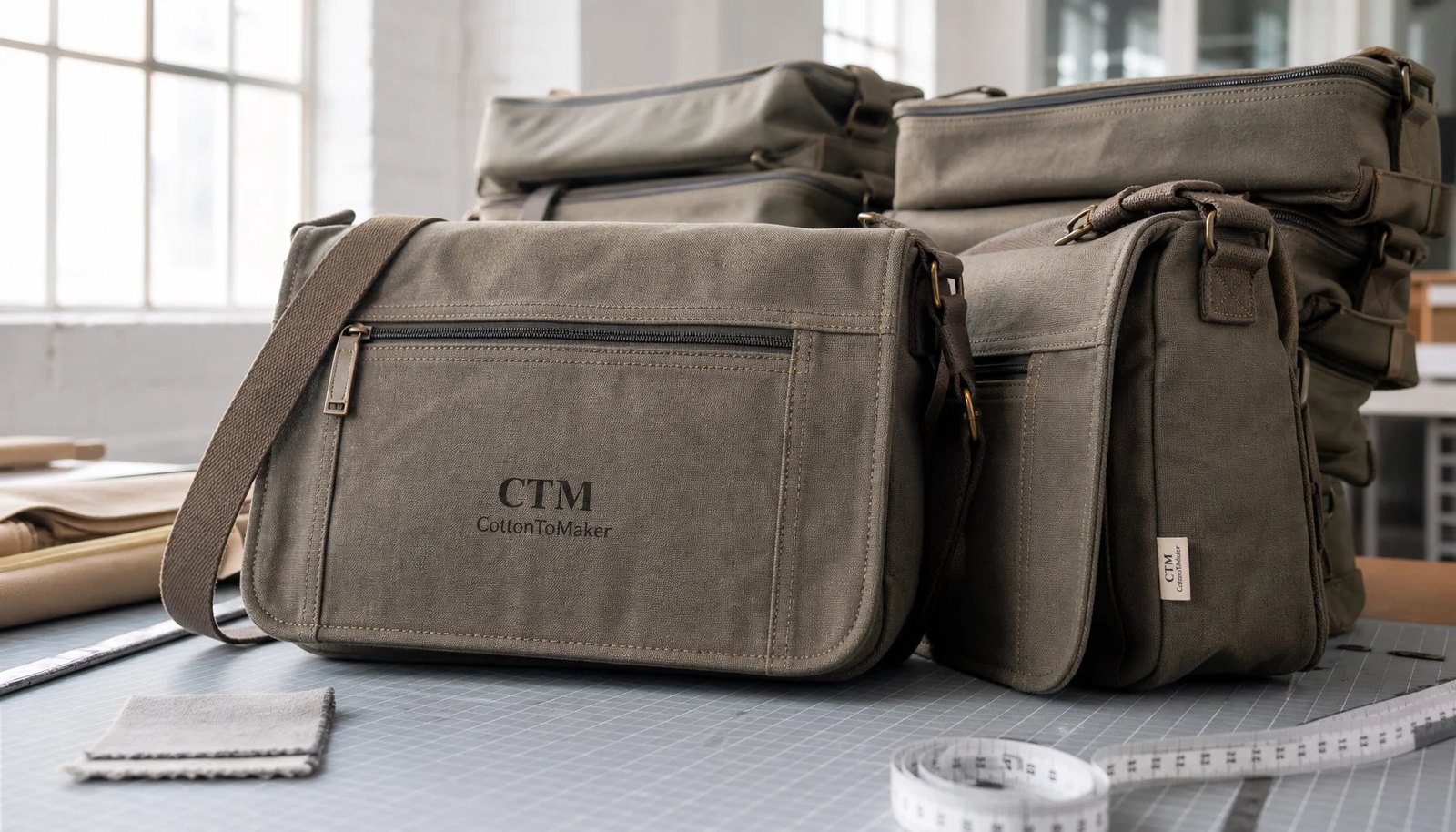
Why logo placement matters on a trade show messenger bag
A canvas messenger bag for a trade show is not a static branded item. It is worn, set down, stuffed with catalogs, folded under a seat, dragged through an airport, and seen from several angles under uneven event lighting. That is why logo placement is a production decision as much as a brand decision. The mark has to read fast from a distance, but it also has to survive the way the bag actually gets used. If the art sits too close to a seam, pocket edge, zipper track, flap fold, or strap anchor, the bag may still function, but the branding will look compromised.
Procurement teams often lose leverage when the artwork is approved before the bag geometry is frozen. A flat mockup can make a logo look larger and cleaner than it will appear on the sewn product. Once seam allowances, hems, gussets, pockets, and closures are added, the usable area changes. The visible area in a rendering is not the same thing as the decoration field on a finished bag. If the supplier is quoting against a loose concept instead of a measured bag spec, the quote may look fine but the sample will not settle the issue cleanly.
The risk is not only cosmetic. A logo that is too small, too low, or too close to an interruption can vanish in crowd photos, while an oversized logo can make the bag feel cheaper and less intentional. For exhibitor programs, the sweet spot is usually a medium-size mark in a clean field that survives handling and still reads when the bag is full. Buyers should think in terms of readability, not just area. A brand surface that survives the event is more valuable than a bold graphic that looks good only in a studio render.
This matters even more when the bags will be reused after the show. Reuse exposes weak decoration quickly. A centered, clean logo on a stable panel will keep working long after the event weekend is over. A print that depends on the bag being empty or perfectly flat will not. For bulk programs, the correct question is not 'Where can we fit the logo?' but 'Where will it still look right after the bag is used the way exhibitors actually use it?'
- A logo centered on the flat pattern can still look off-center on the finished bag if the pocket or flap shifts the visual balance.
- Large logos are not always better; on exhibitor bags, a clean medium-size mark often reads more premium and lasts longer.
- Placement should be chosen based on how the bag hangs on the body, not only how it looks laid flat in a product sheet.
- If the bag will be reused after the event, the logo needs to read well in daily use, not only in booth photography.
Freeze the bag spec before you approve the art file
The bag spec sets the limits for the logo. For wholesale canvas messenger bags, common body weights are 10 oz, 12 oz, and 16 oz canvas, which are roughly 340 GSM, 407 GSM, and 544 GSM depending on weave and finish. Those numbers matter because they change drape, print stability, and the way the bag holds shape under load. A lighter bag is usually cheaper and easier to ship, but it can show more ripple under heavy ink coverage. A heavier bag generally takes decoration better and feels more substantial, but it raises material and freight cost.
A 12 oz body is often the most practical middle ground for trade show use. It feels credible, holds shape reasonably well, and does not push the program into premium retail pricing unless the construction becomes complex. A 10 oz version can work for lower-cost giveaway programs or high-volume handouts where the bag is not expected to do heavy duty. A 16 oz version makes more sense when the bag is meant to be reused, hold catalogs and sample kits, or carry a stronger brand impression.
Construction matters as much as fabric weight. An open top, simple flap, or snap closure usually gives more uninterrupted front space than a design with a large pocket, zipper track, or layered organizer panel. Lining, stiffeners, piping, internal dividers, and reinforcement patches all reduce the clean decoration area. If the buyer does not define the structure early, the supplier may place the logo wherever the bag happens to allow it rather than where it presents best.
Treat the structure decision as part of the branding decision. A cleaner front panel often reduces decoration complexity, improves legibility, and lowers the risk of the logo being interrupted by topstitching or hardware. That can be worth more than a small fabric savings. Before quoting, decide whether the priority is lowest unit cost, best print field, or the most premium reusable bag. Those are different products, and they should not be priced as if they were the same.
For RFQs, it helps to state the shell weight, any lining weight, the presence of reinforcement, and whether the quoted GSM includes the whole bag or only the outer shell. That one clarification often prevents apples-to-oranges comparisons and cuts down on back-and-forth later in the sample process.
- 10 oz / about 340 GSM shell: suitable for low-cost giveaways and short use cycles, but less stable for heavy ink coverage.
- 12 oz / about 407 GSM shell: common for exhibitor bags because it balances cost, print quality, and structure.
- 16 oz / about 544 GSM shell: better for premium programs, embroidery, and reusable retail-style presentation.
- If the bag includes a gusset or front pocket, reserve a measured logo zone before approving the pattern.
- Ask whether the quoted GSM includes lining or only the shell so you can compare suppliers correctly.
Choose the placement by structure and visibility, not habit
For trade show use, the most reliable placements are usually the front panel, the front pocket, the flap exterior, or a woven side label. The front panel gives the largest brand surface and the best visibility in aisle traffic and event photos. The pocket can work when the face is flat and does not bulge once the bag is loaded. The flap can look more premium, but only if it lies flat when closed and does not curl at the corners. A side woven label is less visible on the floor, but it can be the cleanest choice when the brand wants a restrained finish.
The main production rule is simple: do not force artwork across a structural interruption unless you have a sample proving that it works. A logo spanning a seam, zipper track, flap fold, or gusset edge can crack in screen print and distort in embroidery. If the art must cross an interruption, the supplier should prove it on a production-like sample before bulk approval, not only on a digital mockup. In most cases, a clean single panel is cheaper and safer than trying to force a complex composition across the bag body.
Placement also changes the tone of the item. A large high-contrast front print creates immediate visibility and works well when the bag needs to advertise hard on the show floor. A smaller tonal print or woven label feels quieter and can be a better fit for executive gifting or a premium exhibitor kit. Procurement should push the marketing team to choose that intent before RFQ. If the brand objective is not defined early, suppliers will quote different interpretations of the same bag.
For repeat programs, it is smart to define one primary location and one fallback location. The primary location can be the front panel or flap. The fallback can be a woven label or smaller pocket mark if the structure changes. That gives the factory room to price alternatives without changing the product you think you are buying. A quote is only comparable when every vendor is solving the same visual problem.
In practice, the safest placements are the ones that stay flat, avoid hardware, and keep the logo clear even when the bag is full. If a placement only looks good in an empty-bag studio shot, it is not a good production placement.
- Front panel: best visibility and best for exhibitors, but needs a clean safe zone away from stitching.
- Front pocket: good if the pocket face is large and flat; poor if the pocket bulges when loaded.
- Flap exterior: premium feel, but the logo should sit where the flap stays flat when closed.
- Side woven label: useful for subtle branding and repeat programs where the body must stay minimal.
- Never approve a placement that depends on the bag being empty if the bag will be used loaded at the event.
Pick the decoration method by volume, art complexity, and surface shape
Screen printing is usually the default choice for wholesale canvas messenger bags when the logo is simple and the order volume is meaningful. It is efficient for one- or two-color logos, gives solid coverage on natural or dyed canvas, and holds up well when the print area is flat and properly cured. For buyers, the important details are not just the method but the print discipline: screen count, ink coverage, registration, cure temperature, and whether the ink is water-based or plastisol. A bag can have the right logo and still fail if the ink sits too thick, feels tacky, or cracks when folded.
Embroidery adds a premium feel when the canvas is heavy enough to support the stitch density. It works best on small logos, initials, or short wordmarks that can remain legible at a reasonable size. Fine details, tiny lettering, and thin strokes are the main risk. If the stitched area is too dense or placed on a lighter canvas, the panel can pucker and the logo can warp. Buyers should ask the supplier for a minimum text height and minimum line thickness for the chosen thread count before approving the art. If the factory cannot state that threshold clearly, the art is too detailed for the method.
Heat transfer can be practical for short runs or detailed graphics, but the buyer should inspect edge lift, hand feel, and durability after folding. Woven labels, patches, rubber badges, and debossed elements are often better when the bag itself needs to stay clean and the brand can live on a secondary mark. That is common in exhibitor programs where the bag must be ordered before the event calendar is fully locked. The method should match the art, the order size, the available lead time, and the bag surface, not personal preference.
Decoration area limits matter more than many buyers expect. A logo that looks acceptable at 80 mm wide may fall apart at 40 mm wide if the text becomes unreadable. A logo that looks fine on a flat panel may not survive a seam or pocket curve. Ask the factory to show the minimum and preferred logo dimensions for the chosen method. Also ask where the method starts to fail. That one question usually removes the most expensive mistakes before sample stage. If the answer is vague, the process is not controlled tightly enough for a bulk order.
For procurement, the real decision is not screen print versus embroidery in the abstract. It is which method will hold up on this exact bag, with this exact logo, at this exact event timeline.
- Screen print: best for flat panels, clean logo shapes, and repeatable reorders.
- Embroidery: best for premium perception, but limit fine text and tiny details.
- Heat transfer: useful for low-volume or multicolor art, but verify edge durability and surface feel.
- Woven label or patch: useful when the brand should be visible without covering a large panel.
- If the logo has small lettering, ask the supplier to confirm the minimum readable size in the chosen method before you approve art.
Specify the artwork zone so the factory does not guess
A good artwork spec removes ambiguity. Define the logo zone in millimeters, not with loose language like 'centered on the front' or 'near the middle of the flap.' The supplier needs top, bottom, and side margins measured from fixed points such as the seam, pocket edge, flap fold, or stitch line. If the bag is asymmetrical, write the reference point directly into the purchase order so the factory measures from the same place you do. If the reference is not fixed, the logo may look centered to the production team and still miss the buyer's intent.
The art file should be prepared for production, not only for brand review. Vector art is preferred for screen printing and embroidery setup because it preserves edges at scale. If the logo has thin strokes, reversed type, or tight letter spacing, ask the factory what the minimum line weight is for the chosen process. A useful buyer rule is to test the artwork at the smallest intended size before final approval. If the type becomes unclear at the chosen width, the art needs adjustment before it reaches production. That is a design correction, not a factory problem.
The strongest buyers treat artwork sign-off like engineering sign-off. They keep an annotated mockup, a measurement note, and a photo or scan of the approved sample tied to the purchase order. That matters when the final bags land a few millimeters off center but still look visually close. Without written tolerances, the factory and the buyer can both believe they approved different outcomes. A measured zone, a reference edge, and one approved sample reduce that risk materially.
A practical spec also says what cannot happen. If the logo cannot cross a seam, say so. If it must not touch topstitching, say so. If the mark must fit within a 120 x 80 mm box with no rotation, say so. Buyers do not need a long creative brief; they need a production brief that tells the supplier exactly where the logo is allowed to live and how much variation is acceptable.
If the bag has different front and back geometry, the RFQ should show which side carries the logo and whether the same placement can be reused on reorders. That small detail helps the factory keep setup stable across repeat production runs.
- Use a measured placement box with top, bottom, and side margins in millimeters.
- Identify the reference edge: seam, pocket top, flap fold, or zipper line.
- Ask the supplier for the minimum line thickness and minimum text height for the chosen process.
- Keep the approved mockup and sample photo with the purchase order so the approval is not ambiguous.
- If the bag is different on the left and right side, specify which side carries the logo.
Build the RFQ so quotes are comparable
A clean RFQ is the fastest way to avoid quote drift. Start with the bag body spec, then define the logo placement, the decoration method, the size of the print area, the quantity breakpoints, and the packing requirement. If the logo can move between front panel, pocket, or flap, state the preferred option and the fallback option separately. That gives the factory room to quote alternatives without changing the product you think you are buying.
A strong RFQ also tells the supplier what will disqualify the offer. If the logo must be centered within a certain millimeter range, if the front panel cannot bridge a seam, or if a zipper color must be matched, put that in writing. If you want no visible print bleed, no pucker at the embroidery field, or no carton count variance above 1 percent, write those acceptance conditions down as well. Suppliers quote faster and more accurately when they know the actual constraint set. The result is less back-and-forth, fewer sample surprises, and a quote set procurement can compare line by line.
The goal is not to over-specify every detail. It is to specify the details that affect cost, lead time, or quality acceptance. If a detail will change the quote or the risk, it belongs in the RFQ. If it does neither, it can stay out. That keeps the request precise and easier for suppliers to answer consistently. The best RFQs for canvas messenger bags also include one annotated image showing front, back, and side views with the exact logo zone called out. A visual reference plus a written tolerance is the fastest way to reduce interpretation errors.
For exhibitor programs, include a practical use note. Say whether the bag will hold catalogs only, catalogs plus swag, or heavier samples. That affects whether the factory should quote a lighter shell or a more structured body. The better the supplier understands the use case, the less likely they are to quote a bag that looks acceptable but fails the functional requirement at the event. A good RFQ does not just ask for price; it gives the supplier enough context to price the right bag.
One more point matters in B2B buying: put the same wording in every quote request. If one supplier sees 'front logo' and another sees 'front center print area 120 x 80 mm, no seam crossing,' the comparison is already broken. The cleaner the RFQ, the easier it is to normalize bids.
- Start with the bag size, canvas weight, color, and closure type.
- Add the logo file format, print size, decoration method, and exact placement zone.
- List quantity tiers, packaging requirements, and target ship date.
- State the acceptance standard for sample approval so the supplier knows what matters.
- Specify any no-go zones such as seams, zippers, pockets, flap folds, or hardware anchors.
Understand MOQ, setup costs, and sample terms before you compare pricing
MOQ is rarely a single number. For canvas messenger bags, it often changes by body color, logo color count, bag construction, and whether the program is stock or fully custom. A one-color screen print on a natural 12 oz bag may have a lower MOQ than a custom bag with contrast lining, extra pockets, and embroidery. The buyer should require the supplier to show those breakpoints clearly. If the quote only gives one total MOQ without showing what drives it, the procurement team cannot compare offers or plan the reorder path.
Useful quote data is specific. A good quote should name the canvas weight, bag size, artwork location, print method, number of colors, packing format, sample fee, unit price at each quantity tier, and estimated lead time. For exhibitor programs, also ask for the repeat-order price with the same screen, embroidery file, or print setup retained. That tells you whether the program is easy to reorder or whether every run resets setup costs. Reorder behavior matters because event calendars often create periodic volume spikes rather than one-time buys.
This is where buyers should push back on vague offers. A quote that hides setup, packaging, or freight can look competitive until the comparison is rebuilt line by line. Ask for separate numbers for the bag body, the decoration, the sample, the packaging, and the shipping lane. If a supplier refuses to separate these components, the team should treat the price as provisional. The goal is not just to get a number; it is to get a number that can be audited and compared across vendors.
A practical RFQ also asks whether the quote assumes stock canvas, stock hardware, or stock thread. A supplier may quote a low price on a standard body and then add charges for specific zipper colors, lining colors, or custom label options. Those changes can be small individually and significant in aggregate. If the quote is for a trade show deadline, the buyer needs to know where the hidden adders are before the event schedule makes negotiation impossible.
The sample terms matter just as much. Ask whether the quote includes a digital mockup only, a strike-off, or a full pre-production sample. Each one carries a different level of confidence. If the sample cost is high, ask whether it is credited back on bulk approval. That does not change the product spec, but it changes the real cost of getting to approval.
- Example quote line: 12 oz natural canvas, 38 x 30 x 10 cm, one-color front print, 1 pc/polybag, 50 pcs/carton.
- Example breakpoints: 300 pcs for stock body plus print, 1,000 pcs for custom panel size, higher MOQ for embroidered front logos.
- If the supplier quotes a lower MOQ for a complex build than for a simple one, the quote needs a second review.
- Ask whether the quoted price includes setup, film, screen, digitizing, or sampling.
- Request a repeat-order price so you can see whether the artwork can be reused without new setup charges.
Use the sample stage to prove placement under real production conditions
A sample is only useful if it proves the placement under real production conditions. A buyer should not approve a bag based on a flat artwork image alone. The pre-production sample or strike-off should show the actual canvas weight, the actual thread or ink, and the actual logo position relative to seams, pockets, closures, and edges. For screen print, the strike-off should expose ink coverage, edge crispness, registration, and any color shift. For embroidery, the sample should prove that the stitch density does not pull the canvas out of shape or create a raised edge that interferes with use.
The approval process should be measurable. Lock the logo center point, top-to-bottom placement, and safe zone from the nearest structural reference. A sensible buyer tolerance on a simple front print is often +/-3 mm from the approved center and no visible intrusion into the no-go zone. The exact tolerance can be tighter or looser depending on the method and size, but it should always be written down. If the sample is approved verbally, production teams have too much room to interpret what counts as acceptable.
The sample review should also check the bag as a system, not just the logo. Does the strap drop feel right? Does the flap lie flat? Does the bag close cleanly when loaded with a catalog stack or laptop-sized weight? Does the decoration wrinkle when the bag flexes? These are not cosmetic questions. They determine whether the bag will still look professional at the event. A logo can be perfect and the product can still fail if the bag shape collapses under real use.
A good approval packet includes the approved sample photo, the annotated artwork file, the measured placement notes, and the date of sign-off. The PO should reference the sample version. That is how a buyer prevents the common dispute where the factory says the batch matches the art file while the buyer expected the physical sample. For trade show products, the sample is the reference standard, not just an illustration.
If the sample and the tech pack do not match, the sample wins only if the buyer says so in writing. Otherwise the production team may treat the drawing as the controlling document and the sample as a one-off. That is how seemingly small differences become bulk rework.
- Approve the sample under the same fabric color that will be used in production.
- Measure the logo position from fixed references such as seam, pocket edge, or flap fold.
- If the sample includes a color mismatch, stop before bulk and correct the ink or thread match first.
- Keep the approved sample tied to the purchase order.
- Check the bag under load if the event audience will carry laptops, catalogs, or sample kits.
Set the packing and labeling rules before production starts
Packing is often treated as a low-value detail, but for messenger bags it affects shape, cleanliness, and unpacking speed at destination. A flat canvas bag can arrive crushed if cartons are overfilled or if the bag is folded against the wrong line. If the bag has a stiff flap, hardware, or a printed panel, the pack method should prevent pressure marks and color transfer. Most buyers should specify whether each piece is polybagged, folded with tissue, or packed in bulk master packs. That choice changes labor, carton count, and transit damage risk, so it belongs in the quote and the approval sample.
The way the bag is packed also affects the print. Raised patches, embroidery, or thick ink can rub if bags are stacked face-to-face without separation. For sensitive finishes, ask for a fold orientation that keeps decorated surfaces away from each other or a thin tissue layer between faces. If the bag has a raised logo, the supplier should confirm that carton compression will not flatten or imprint the decoration. That is a simple question, but it can prevent a costly receiving problem.
Retail buyers, distributors, and conference teams also need labeling discipline. Carton marks should match the PO, item code, color, and pack count. If barcodes, hangtags, or country-of-origin labels are required, those details need to be included in the quote instead of added later. For trade show programs, consistent fold direction and carton count matter because staff may need to count, stage, and hand out hundreds of bags quickly. A supplier that packs for easy counting saves labor on the receiving end, which is part of the real landed cost.
The buyer should also define outer carton expectations. If the shipment will move by air, carton dimensions matter for chargeable weight. If it will move by ocean, stack strength and moisture protection matter more. A well-packed bag can still arrive damaged if the carton spec is too weak for the lane. Ask the supplier what protection they use at corners, what carton burst strength they target, and whether they add desiccant or moisture barrier for humid routes.
If the packaging will be reused for storage or internal distribution, say so. Reusable cartons, consistent folding, and clear marks save time when the bags are staged for future events or split across multiple offices.
- Use internal separation if the logo print can rub against another bag face in the carton.
- Keep carton pack counts realistic so the stack height does not crush the bag body.
- Specify whether labels must be on the polybag, on the bag, or on the carton only.
- Ask for carton dimensions early if the shipment will move by air and volume matters.
- If the bag has a raised logo or patch, confirm the carton compression limit before shipping.
Plan lead time and freight around the show date, not around the factory calendar
Trade show buying is schedule-driven, so the quote needs a timeline that separates sample time from bulk time. A simple project can move quickly if the bag body is stock and the logo is straightforward, but custom construction can add weeks. The buyer should work backward from the event date and include time for artwork proof, sample production, sample approval, bulk production, inspection, packing, and freight. The most common mistake is approving art before knowing whether the decoration line can still hit the ship date. That turns a normal order into an air-freight rescue.
Landed cost is not the same as factory cost. A low unit price can be erased by a higher MOQ, a more expensive decoration method, a second sample round, extra packaging, or a rushed freight upgrade. If the order is small and urgent, domestic finishing or regional inventory may look more expensive on paper but can be cheaper after freight and delay risk are counted. For larger programs, factory direct with controlled packing is usually the better landed-cost route because the bag and decoration can be optimized together.
A practical scheduling habit is to separate 'must-have for the show' from 'nice-to-have for the program.' If the exhibit deadline is fixed, protect the date first and optimize the finish second. That keeps the team from chasing a small cost saving that creates a missed event. It also forces a realistic conversation about whether the logo is worth a second sample round or whether the current decoration method is good enough for the show objective.
For buyers managing recurring event calendars, the best control is a back schedule. Freeze the spec, set the artwork deadline, set the sample approval date, and then assign a final ship date with buffer. If the supplier cannot commit to a dated milestone, the risk should be visible in the quote. On event-driven orders, the cheapest bag is not the one with the lowest factory price; it is the one that arrives on time with acceptable decoration quality and no last-minute freight scramble.
If the program has a hard launch date, put the cutoff for artwork changes in writing. That helps marketing understand that a late color tweak or layout change is not harmless. It usually means a reset in print setup, sample timing, or packing verification.
- Build a back-schedule from the show date, not from the order date.
- Separate sample approval time from bulk production time in the PO.
- Compare sea and air only after you calculate the full landed cost and delay risk.
- For repeat programs, ask the supplier to keep the same screen, plate, or embroidery file on record.
- If the event date is fixed, give the factory a hard ship deadline and a backup freight option in writing.
Specification comparison for buyers
| Spec decision | Recommended option | When it fits | Buyer risk to check |
|---|---|---|---|
| Factory direct with in-house screen print | Best for repeat orders, one- or two-color logos, and stable placement control | You need 300 to several thousand bags and want the same factory to own bag construction and decoration | Print registration can drift if the artwork sits too close to a seam, pocket edge, flap fold, or gusset line |
| Factory direct with embroidery subline | Use for premium branding on heavier canvas and small logos near the flap or pocket | You want a tactile finish and can accept higher labor cost and a slower sample cycle | Dense stitching can pucker lighter canvas and distort fine text below about 4 to 5 mm stroke width |
| Trading company bundling bag and print | Useful when you want one contact and consolidated sourcing support | Your team manages several products and values simplified communication | The production factory may change, so the approved sample must lock construction, decoration method, and carton count |
| Domestic decorator printing imported blanks | Good for urgent events and smaller runs where lead time matters more than unit cost | You already know the blank bag spec and only need local branding | Two supply chains can create hidden freight, color mismatch, and split responsibility for defects |
| Fully custom cut-and-sew factory | Best when size, pocket layout, lining, and logo area must be engineered together | You are launching a branded trade show program or a retail version of the bag | MOQ and sample cycles are higher, and post-approval changes can trigger new tooling or new sample rounds |
| Stock program with side-label branding | Fastest path when the bag body is standard and the brand signal can be subtle | You need a quick turn and can live with a limited decoration area | The bag can feel generic if the logo is too small or too hidden |
| Regional distributor with warehouse inventory | Useful for short-notice reorders and conference deadlines | You need a few hundred pieces and cannot wait for ocean freight | Color and lot consistency can vary across different production runs |
| Hybrid route: factory bag plus local finishing | Practical when you want controlled bag quality with flexible decoration later | You have a repeat program and a local decorator for late-stage branding | The bag body and decoration line may not be synchronized on shade, shrinkage, or carton counts |
Buyer checklist before sampling
- Confirm the canvas weight in oz and GSM, and state whether the quoted weight is shell-only or includes lining and reinforcement.
- Lock the logo location with a measured artwork zone in millimeters, not a verbal description like 'centered on the front.'
- Specify the decoration method, number of colors, stitch count or print passes, and whether the logo crosses a seam, pocket, flap, or gusset.
- Request a pre-production sample or strike-off that matches the final fabric color, thread color, and ink cure method.
- State packing requirements: polybag, tissue, carton marks, barcode, hangtag, master carton count, and any inner separation needed to protect print or embroidery.
- Ask for lead time by stage: artwork proof, sample, sample approval, bulk production, inspection, packing, and ship date.
- Get a quote that separates bag body, decoration, packaging, setup, and freight so supplier bids are comparable.
- Set an acceptance rule for logo placement tolerance, stitch quality, and print coverage before mass production starts.
Factory quote questions to send
- What exact canvas weight, weave count, and finish are you quoting for the body and the lining, if any?
- What are the finished dimensions of the bag, and what tolerance do you hold on width, height, and gusset depth?
- Which logo positions are included in the price, and what is the artwork size in millimeters for each position?
- How many print colors, embroidery stitch counts, or heat-transfer passes are included before the price changes?
- What is the MOQ by bag color and by decoration method, not just the total order quantity?
- Will you send a digital mockup, strike-off, or pre-production sample before bulk approval, and what does it cost?
- What is the bulk lead time after sample approval, and what is the cutoff for rush orders or partial shipment?
- What packing configuration is included, and are polybags, carton marks, barcode labels, and master carton counts priced separately?
- What inspection standard do you follow, and can you share the AQL or defect acceptance rule you use for bulk checks?
- If I reorder the same bag, are the screens, embroidery file, or print setup retained, and for how long?
Quality-control points to confirm
- Logo placement should stay within the approved tolerance window, typically +/-3 mm for centered print zones and tighter if the artwork sits near a seam or pocket edge.
- Screen print should show full ink coverage with no pinholes, haloing, bleeding, or trapped lint visible in the print area, and the ink should be fully cured before packing.
- Embroidery should lie flat without thread loops, puckering, broken stitches, or distortion of text smaller than the approved minimum height.
- Bag dimensions should match the approved pattern, especially strap drop, flap overlap, pocket depth, gusset width, and opening alignment.
- Stitch density should be consistent at stress points such as strap joins, gusset corners, flap edges, and pocket corners, with no skipped stitches or loose ends.
- Zippers, snaps, and buckles should open and close smoothly without twisting, catching canvas, or pulling the bag body out of square.
- Cartons should arrive with the correct pack count, carton mark, and protective insert or fold method so the bag shape is not crushed during transit.
- Color should fall within the approved shade band for both the body fabric and the logo ink or thread, with the buyer defining acceptable delta rather than assuming visual match.
- For printed logos, check registration between colors at the sample stage and set a practical acceptance rule, such as no more than 2 mm color-to-color shift on simple artwork.
- For decorated bags, inspect at least one piece per carton stack and include a loaded visual check so the logo still reads when the bag is full.