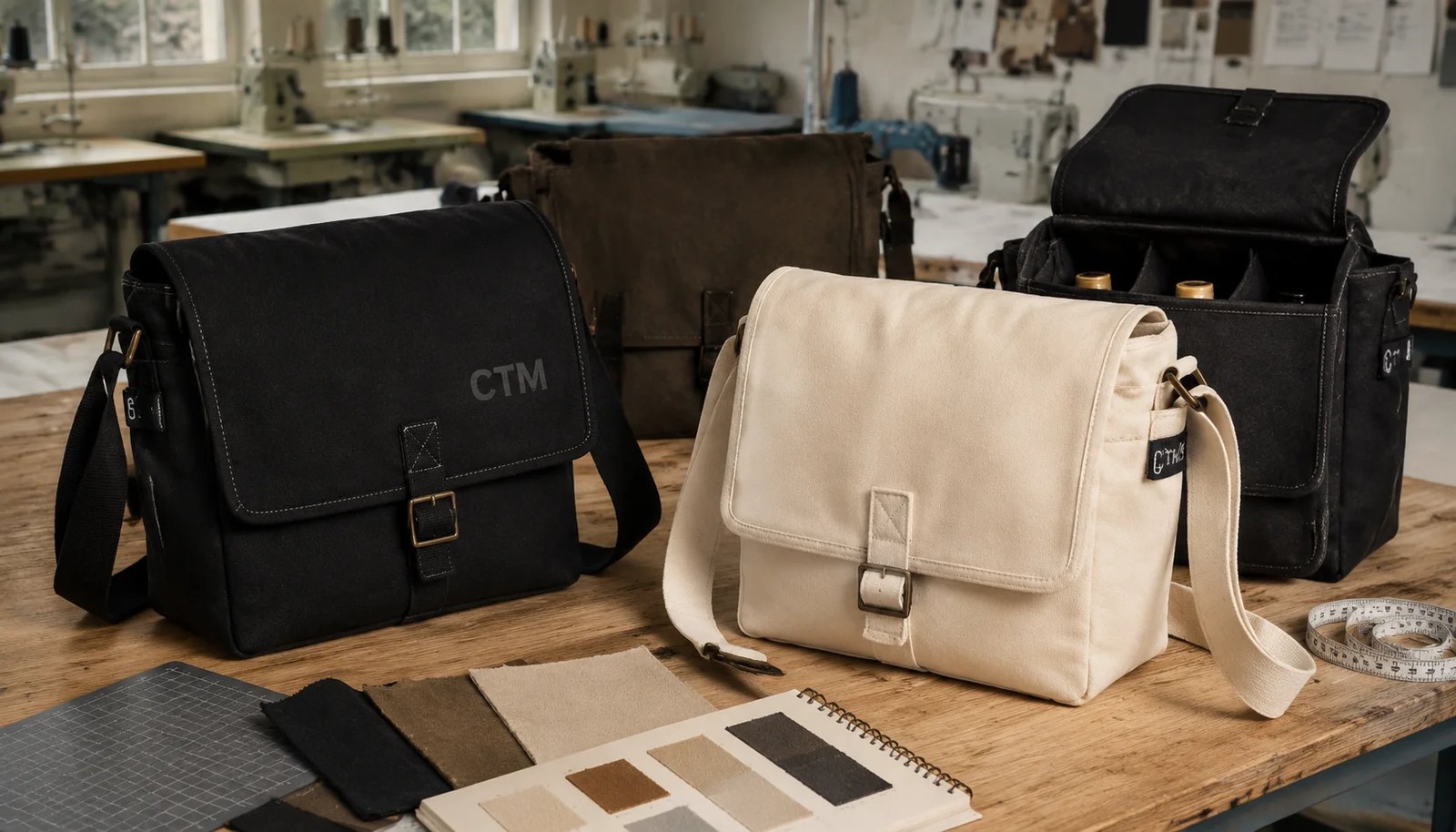
Why this checklist matters for liquor retail bag sourcing
A canvas messenger bag for liquor retail is not just a promotional textile item. It may carry fragile glass, support a branded gift program, sit near checkout as a paid reusable item, or be packed into distributor campaigns. That raises the cost of mistakes. A weak strap anchor, poor packed appearance, missing barcode, or unsupported compliance claim can create more than a cosmetic defect. It can trigger chargebacks, in-store handling issues, or product-damage complaints.
The sourcing challenge is that many suppliers can quote a canvas bag, but not all are quoting the same build. One supplier may price a light promotional construction. Another may assume a more structured bag with reinforced webbing, divider support, and retail-ready packing. If the RFQ is vague, procurement ends up comparing unlike offers and arguing about cost after sampling has already started.
This is why a supplier compliance checklist should connect commercial, technical, and document requirements in one place. For liquor retailers, the useful questions are not abstract. What payload is the bag expected to carry? What finished fabric weight is being quoted? How is the strap anchored? Which restricted-substance declarations can the supplier provide for the actual bill of materials? Who applies barcode stickers? How will the bag look after shipping in folded condition? Those details decide whether the order is repeatable.
The goal is not to create more paperwork. The goal is to reduce mismatch between the approved sample, the bulk order, and the retailer's receiving reality.
- Higher failure cost than ordinary promo totes because glass, weight, and store presentation are involved.
- Supplier comparison only works when fabric, construction, trims, packing, and documents are described at the same level of detail.
- Retailer acceptance often depends as much on labeling and carton execution as on sewing quality.
Start with the use case, payload, and channel requirements
The strongest RFQs begin with the actual job the bag must do. In this category, a messenger-style bag sold as reusable packaging for one bottle is different from a two-bottle gift-set carrier, even if both use similar silhouettes. Construction choices should follow the payload and channel, not just a reference image.
State the bottle count and representative carry load in kilograms. That gives the supplier a basis for recommending shell weight, gusset width, divider approach, and webbing reinforcement. As buyer-spec examples, a single 750 ml bottle program may fall around 1.2-1.6 kg total carried weight once the bag is included. Two 750 ml bottles plus insert can move into roughly 2.5-3.2 kg territory. These are planning examples only; the actual spec should reflect your own bottle and packaging format.
Also define the sales channel at RFQ stage. Independent stores may accept simpler bulk packing and local relabeling. Chain stores, importer warehouses, and distributor programs often need exact carton marks, SKU separation, barcode placement, gross-weight limits, and country-of-origin presentation. If these requirements arrive after quotation, the supplier either re-prices them or improvises.
A short use-case statement can prevent long rounds of avoidable clarification. For example: 'Paid reusable messenger bag for two 750 ml bottles, black dyed canvas, flap screen print, barcode sticker at origin, direct shipment to regional DC.' That one line already tells the factory more than a mood board does.
- Name the program type: resale, gift-with-purchase, checkout carry, event promo, or distributor activation.
- State representative payload in kg and bottle format.
- Clarify expected service life: one-season campaign or longer reusable use.
- Identify fulfillment path: direct-to-store, chain DC, importer, or promo distributor.
Specify fabric and body structure in measurable terms
Fabric language is one of the biggest sources of quote confusion in canvas bag sourcing. Buyers often request 12 oz, 14 oz, or 16 oz canvas without confirming whether that refers to greige cloth or finished material after dyeing, washing, shrinkage, or backing. For procurement, the safer method is to request finished shell weight in both oz and GSM.
As buyer-spec examples, lighter single-bottle or promotional builds may use lower finished weights, while more structured retail programs often move toward a midweight-to-heavier finished canvas. The point is not that one number is universally right. The point is that the supplier should quote the actual finished shell that will be cut and sewn, not a raw-fabric assumption.
Body structure should be specified separately from shell weight. A heavier shell does not automatically replace the need for sensible support. Buyers should state whether the bag is unlined, lined, backed with interfacing, fitted with a removable base board, or built with a fixed or removable divider. If a base board is included, define whether it sits loose, inside a sleeve, or is fixed. If a divider is included, define whether it is decorative separation or intended to hold bottle position.
Color affects quality control too. Natural canvas can suit a craft or premium look but should be approved against a sealed sample because slub and shade character are part of the material. Dyed dark colors may present better at retail but introduce shade consistency and crocking concerns. Buyers should choose color with inspection and transit behavior in mind, not only design preference.
- Ask for finished GSM and oz, not only nominal canvas language.
- Separate shell weight from body support features such as lining, interfacing, divider, or base board.
- Use sealed approvals for natural canvas and color standards for dyed programs.
- Treat common weight ranges as buyer-spec examples unless confirmed by supplier test data.
Construction details that matter for bottle-carry performance
For liquor retail use, the most important technical question is how the load travels through the bag. The shell can look substantial and still fail if the strap anchor, seam junction, or base support is weak. Buyers should therefore ask suppliers to describe the full load path rather than making generic durability claims.
Start with the shoulder strap and tabs. Ask the supplier whether the webbing is stitched into the side seam, attached with a reinforcement patch, backed by hidden tape, or secured using bartacks or box-x reinforcement. Also ask for webbing width and hardware type. These decisions affect both comfort and strength. On many two-bottle or gift-set programs, better webbing and reinforcement matter more than adding another ounce of shell weight.
Main seam allowance and stitch density should be discussed in practical terms. Buyers do not need to write the sewing line's work instructions, but they should know whether the supplier is using a seam construction suitable for the intended payload, especially at side-to-base junctions and flap corners. A supplier that can explain why a certain reinforcement is used for a 3.0 kg target load is more credible than one relying on general phrases like 'high quality' or 'durable build.'
If the design includes dividers, sleeves, or base inserts, these should be tested with actual bottle sizes. A divider that looks neat in an empty sample may catch labels or distort the body when loaded. A base board may improve shape but create pressure lines in packed condition if its edge finish is poor or if the fold method is wrong.
- Review the load path, not just the shell fabric.
- Strap webbing width, anchor method, and reinforcement should be written into the spec.
- Base seam junctions and divider attachment points are common stress zones to inspect.
- Test internal supports with real bottles, not only empty display samples.
Branding, trim, and presentation controls
Branding drives buyer expectations in this category because the bag often acts as visible merchandise or gift packaging. Yet many RFQs still specify branding too loosely. On textured canvas, print result depends on artwork area, fabric handfeel, curing, and where the graphic sits relative to flap folds and topstitch lines.
For simple one- or two-color logos, screen printing is often the most practical route. It is cost-efficient at volume and generally suitable for canvas when cure control is sound. Heat transfer may work for smaller runs or more complex graphics, but buyers should check whether the handfeel and fold performance suit the program. Embroidery can create a premium accent, though large fill areas may distort lighter constructions or curved flap panels.
Placement should be measured from sewn reference points, not only from a flat digital layout. A centered logo on an unsewn panel can still look off once the flap is turned, topstitched, and hanging over a loaded gusset. Buyers should define placement from stable landmarks such as flap edges after construction, pocket centerlines, or topstitch lines, then set tolerances in millimeters.
Secondary trims need equal attention. Woven labels, care labels, barcode stickers, hangtags, zipper pulls, and patch applications all affect MOQ, cost, and defect exposure. A quote is not fully comparable if one supplier includes these details and another assumes they will be added later. Packed-condition risk should also be reviewed at branding stage, especially for dark prints, metallic inks, or hardware that may mark adjacent panels in transit.
- Specify branding by location and method.
- Measure placement from sewn reference points.
- List every trim item separately in the RFQ and quotation sheet.
- Check print and hardware interaction under folded packing conditions.
MOQ and quote comparison without hidden assumptions
MOQ is rarely one number. In custom bag sourcing it usually splits across style, shell color, artwork version, custom trims, and sometimes packaging components. Buyers who compare only the headline MOQ often miss the real cost structure of the order.
For liquor retail programs, this matters because quantities may be fragmented across stores, regions, holiday variants, or private-label customers. One supplier may offer a reasonable style MOQ but require a larger threshold for custom-dyed shell fabric. Another may accept stock body colors but impose MOQ on woven labels or printed hangtags. A third may allow mixed logos but charge a separate setup for each artwork version.
A practical quote analysis should therefore compare at least five lines: style MOQ, body color MOQ, artwork MOQ, trim MOQ, and packaging MOQ. Then ask whether multiple SKUs can be combined in one bulk fabric lot or shipping lot. That answer often determines whether a smaller regional program is commercially workable.
For first orders, many buyers reduce risk by simplifying what does not drive function: standard hardware finish, stock shell color, one print route, and restrained trim count. After reorder demand is proven, more customized colors or trims can be added with better forecast confidence. This staged approach often creates better cost discipline than trying to launch the most complex version first.
- Break MOQ into style, color, artwork, trim, and packaging components.
- Ask what can be mixed within one production lot.
- Use first orders to validate demand before adding high-MOQ customization.
- Compare cost-reduction options that do not weaken load-bearing construction.
Compliance documents buyers should actually request
A useful compliance review is style-specific, not just factory-general. Start with the bill of materials: shell fabric, lining, webbing, thread, labels, print system, hardware, patches, inserts, polybags, and cartons. Then ask what document support exists for each component and which items depend on supplier declarations rather than independent testing.
For many markets and retailer programs, buyers commonly ask for some combination of fiber-content declaration, REACH or SVHC-related statements where applicable, AZO-free dye declarations when relevant, heavy-metal or restricted-substance declarations for prints and hardware, and acknowledgment of any retailer-specific restricted substance list. If the product is sold into markets or channels where CPSIA, Prop 65, or other consumer-product rules may become relevant, the buyer should confirm applicability with their compliance team and request supporting review early rather than after production. The key is relevance: ask for the documents that match your market, retailer, and product classification.
Labeling also belongs in this section. Buyers should confirm country-of-origin marking, fiber-content or care labeling if required by the selling market, barcode location, and any retailer packaging rules. These are easy to overlook because they seem administrative, but failures here can delay receipt even when the bag itself is physically acceptable.
Finally, ask which operations are subcontracted. Printing, washing, embroidery, woven labels, hardware finishing, and even packaging supply often sit outside the sewing factory. That is normal. What matters is whether the supplier can show who approved each component and who owns corrective action if a problem appears.
- Review compliance at BOM level, not with broad sales claims.
- Request only market-relevant documents, but request them early.
- Include hardware, inks, labels, and packaging in the document review.
- Map subcontracted processes and QC ownership before PO release.
Sampling and approval workflow that reveals real risks
The sample stage should answer practical sourcing questions, not just produce a photogenic prototype. For a liquor-retail messenger bag, approval should cover fit, loaded balance, closure behavior, comfort, branding, and packed appearance.
Use real bottle dimensions during sample review whenever possible. Buyers should check whether bottles insert easily, whether labels scrape against dividers, whether the flap closes neatly when loaded, and whether the bag stands or tips when placed on a counter. A sample that looks clean when empty can behave badly under actual payload.
Packed-condition review is often skipped and then regretted. If the shipment method is flat folded, hardware tucked inside, or base boards pre-inserted, the buyer should request a packed sample or at least packed-condition photos. Leave the sample folded, then reopen it and check for print transfer, pressure lines, hardware scuffing, and stubborn flap creases.
Keep sample comments measurable. 'Too soft' should become 'increase finished body support' or 'add removable base board.' 'Logo looks low' should become a revised measurement from the finished flap edge. Objective comments make PP approval stronger and final QC easier to defend.
- Test with actual bottle sizes and intended payload.
- Review empty and loaded appearance.
- Approve packed condition, not just display condition.
- Translate comments into measurable corrections.
Packing, barcoding, and retailer-ready shipment planning
Packing decisions directly affect landed cost and retailer acceptance. Flat packing usually saves freight space but can increase the chance of flap creases, hardware marks, and print transfer. More protective packing can improve receipt condition while increasing carton volume and labor. Buyers need to decide where that tradeoff should land before bulk production starts.
Retail-prep work should also be assigned clearly. Some programs want the origin supplier to apply barcode stickers, attach hangtags, sort assortments, insert dividers, and print exact carton marks. Others prefer to receive simpler bulk packing and finish these tasks locally. Either model can work, but the cost and error responsibility should be visible in the quote.
Carton planning deserves line-item review. Ask for unit count per carton, outer dimensions, gross weight, and whether the plan changes if inserts or dividers are pre-installed. Heavy or oversized cartons can create warehouse problems even when the bags themselves are correct. Carton mark format matters too if the receiving team relies on PO, SKU, or barcode references for fast intake.
Protection should reflect the actual materials used. Natural canvas may need cleaner inner protection to reduce dust or transfer. Dark printed panels may need interleaving. Hardware may need wrapping or controlled positioning to avoid embossing the fabric during transit. Good suppliers discuss this before packing trials, not after claims occur.
- Approve carton quantity, dimensions, and gross weight before PO finalization.
- Assign retail-prep work clearly between origin and destination.
- Treat folded condition as product quality, not only freight planning.
- Match packing protection to fabric color, print type, and hardware exposure.
Final QC and release criteria for repeatable bulk performance
Final inspection should combine visual, dimensional, functional, and documentation checks. For this category, that means more than looking at general appearance. The release decision should confirm that the bulk goods match the approved sample and that the shipment file matches retailer requirements.
At minimum, inspect body dimensions, flap and pocket measurements, strap range, logo placement, stitching at stress points, hardware operation, odor, label correctness, and carton marks. For messenger bags intended to carry bottles, representative load testing should also be defined. The purpose is not to over-engineer inspection. It is to confirm that the order performs as intended in realistic use.
Buyers should also classify defect severity in advance. Detached strap anchors, missing labels, sharp hardware burrs, major print misplacement, or large measurement failures typically deserve stronger escalation than minor thread ends or acceptable natural-canvas slub character. Pre-agreed defect logic reduces disputes with suppliers and third-party inspectors.
If the supplier can support a clear milestone schedule, sealed sample control, first-piece review, and final packed-condition check, the program is more likely to reorder smoothly. In practice, repeatability is what most procurement teams are buying.
- Use milestone-based controls from PP approval through ex-factory release.
- Inspect labels, carton marks, and packed appearance alongside sewing quality.
- Define representative load checks for bottle-carry builds.
- Agree defect severity logic before inspection begins.
Specification comparison for buyers
| Supplier option | What to verify | Commercial advantage | Buyer risk to control |
|---|---|---|---|
| Direct sewing factory | hardware trim card, strap-load photo, lining close-up, approved flap sample, and first-piece production photos | Better sample-to-bulk control and faster production feedback | May be weaker on export paperwork or branded packing unless checked early |
| Trading company | Factory name, production photos, trim-source proof, and who owns QC decisions | Can coordinate small mixed orders and extra services | Markup can hide real factory capability and slow defect decisions |
| Specialized bag workshop | flap shape, strap webbing, buckle, D-ring, inner pocket, zipper pocket, seam allowance, and load path | More practical for detailed construction, trims, and repeat programs | Capacity may be limited during peak seasons |
| Low-price general supplier | 10-16 oz canvas, washed canvas, rPET canvas, lining fabric, interfacing, and hardware finish | Useful for simple promotional runs with loose specs | Material downgrades, weak packing, and vague inspection scope can erase savings |
| Retail-ready supplier | shape support, strap folding, hardware protection, individual bag, carton drop expectation, and retailer hangtag placement | Can handle labels, SKU separation, carton marks, and receiving rules | Higher unit cost must be compared against reduced warehouse work |
| Compliance-focused supplier | Fabric records, labeling review, test plan, and production traceability | Safer for retail programs and repeat brand orders | Documentation claims need evidence, not only sales language |
| Local sample room plus bulk factory | Signed sample, bulk factory handoff, first-piece photos, and deviation owner | Good for complex branding before large production | Sample room quality may not match bulk line unless handoff is controlled |
Buyer checklist before sampling
- Define the exact use case in one line: paid reusable bag, bottle gift bag, checkout carry, distributor promo, or seasonal gift-with-purchase.
- State representative payload in kilograms and bottle format. Example: 2 x 750 ml glass bottles, total carry load about 3.0 kg including bag and insert.
- List finished dimensions with tolerances by feature: body width, height, gusset, flap depth, pocket size, divider width, base-board size, and strap range.
- Specify finished shell fabric weight in GSM and oz after finishing, not greige weight only.
- Confirm body construction: unlined shell, shell plus lining, shell plus interfacing, removable base board, fixed divider, removable divider, or no support insert.
- Write strap requirements separately: webbing width, attachment method, reinforcement patch, bartack or box-x requirement, and whether a shoulder pad is needed.
- Define branding by location and method: flap print, front pocket embroidery, woven side label, care label, barcode sticker, hangtag, and no substitutions without approval.
- Clarify hardware and trim standards: finish, snap or zipper type, D-ring size, adjuster style, no sharp edges, no visible corrosion, and no severe plating loss.
- Approve color by Pantone, dyed swatch, or sealed sample, and note whether natural-canvas shade variation is commercially acceptable within agreed limits.
- Set packing format before quotation: flat fold or stuffed, hardware protection, inner-pack quantity, carton size target, gross-weight cap, and retailer mark format.
Factory quote questions to send
- What exactly is included in the unit price by component: shell, lining, webbing, thread, labels, print, hardware, divider or base board, polybag, stickers, hangtag attachment, and export carton?
- What is the finished shell fabric weight in GSM and oz after dyeing or finishing, and what tolerance do you control in bulk?
- What fabric construction are you quoting: cotton canvas, cotton-poly canvas, washed canvas, recycled-content canvas, or another blend? If recycled, what percentage is claimed and how is it documented?
- For this payload and bag size, what strap construction do you recommend, and can you share close-up photos of similar strap anchor points?
- What stitch density and seam allowance do you normally use on main seams and on webbing attachment zones for this type of bag?
- Have you produced bottle-carry or messenger bags in the 2.5-4.0 kg use range, and what in-house load or seam checks do you perform before shipment?
- Which branding method is included, how many colors, what artwork area is assumed, and what placement tolerance can you hold on flap prints and sewn labels?
- What are the MOQs by style, body color, artwork version, woven label, custom hardware finish, and custom packaging item?
- What sample stages do you offer: blank fit sample, branded mock sample, PP sample, revised counter sample, and shipment retention sample?
- What is the planned packing method for this style, including fold direction, hardware protection, interleaving, carton quantity, carton dimensions, and gross weight?
Quality-control points to confirm
- Check finished measurements by feature, not by one overall size. A practical starting point is body width and height ±1.0 cm, gusset ±0.7 cm, flap depth ±0.7 cm, pocket dimensions ±0.5 cm, and strap range ±1.5 cm unless hardware limits differ.
- Verify shell fabric weight on finished bulk fabric. For dyed or washed canvas, use an agreed commercial tolerance such as about ±5 percent from approved finished GSM.
- Review color under agreed lighting against the approved standard. For natural canvas, use a sealed sample because slub and shade variation are normal.
- Write logo tolerances by application. Example: flap print centered within ±5 mm from approved reference points; woven side label position ±3 mm; no obvious skew at retail viewing distance.
- Check print cure and handling resistance for cracking, offset, powdering, pinholes on textured weave, and excessive rub-off.
- Inspect stress points closely: strap anchors, base-to-side seam junctions, flap corners, divider attachments, D-ring tabs, shoulder-pad joins, and base-board sleeves.
- Check hardware function and finish: smooth adjuster movement, secure snap or zipper action, no sharp burrs, no severe plating loss, and no visible corrosion on arrival.
- Include odor in final inspection because inks, adhesives, damp cartons, or sealed packing can create store-receipt problems.
- Review a packed-condition sample in actual shipment fold format for flap creasing, print transfer, hardware marking, and board pressure lines after dwell time.
- Run representative load testing on agreed samples using the intended payload, then check seam integrity, strap anchoring, closure usability, and base stability afterward.