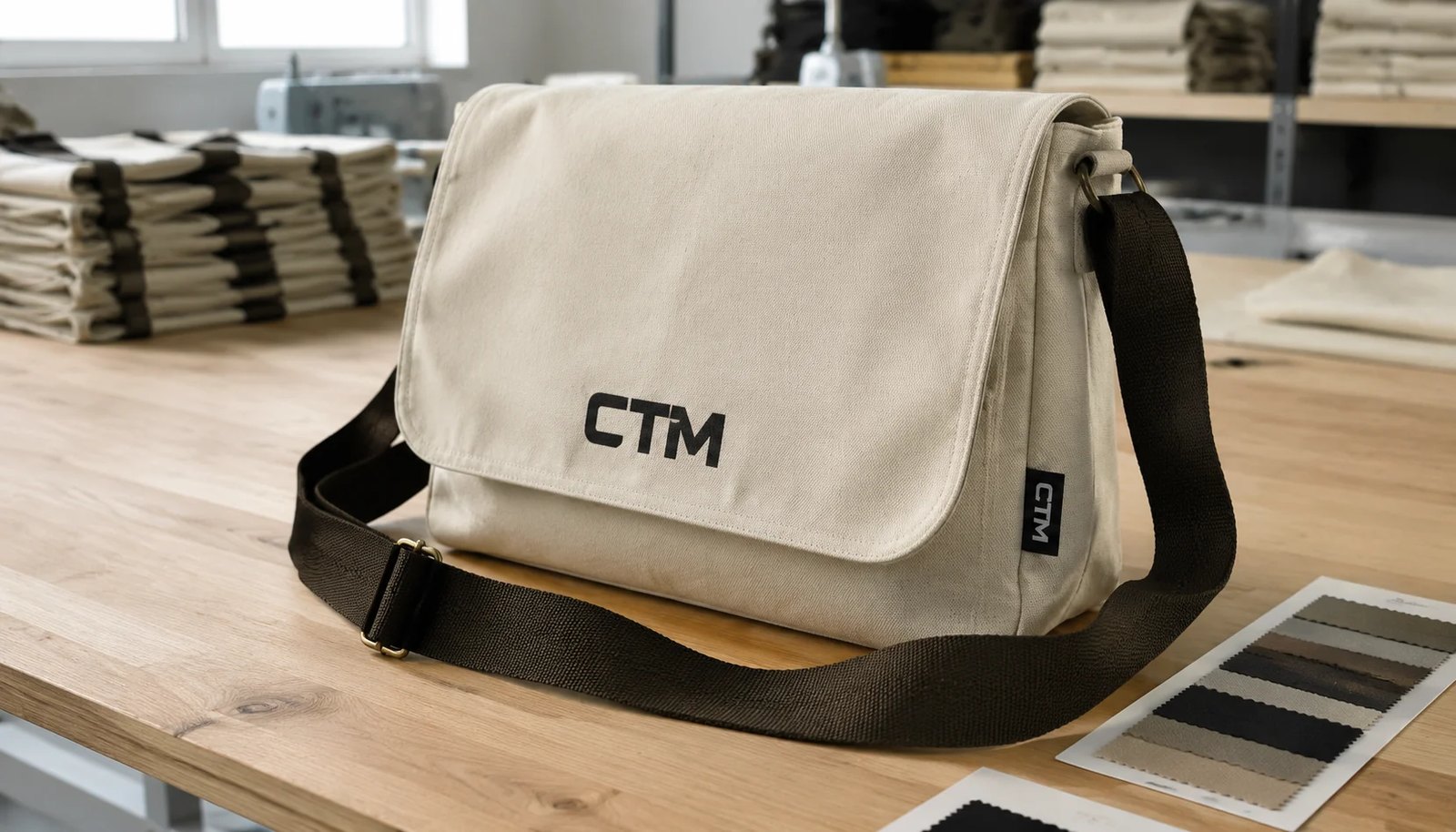
Why MOQ gets difficult on canvas messenger bags for liquor retail
Liquor retail buyers often treat canvas messenger bags like a simple promotional tote with a flap. Factories do not. A messenger bag usually includes more sewing operations, more reinforcement, longer straps, and sometimes hardware, lining, pockets, or closures. That means MOQ is shaped by labor setup and trim sourcing, not just fabric consumption. When a buyer only pushes for a lower piece count without changing the build, the factory either refuses, raises the unit price sharply, or quietly substitutes lighter fabric and simpler construction.
The practical issue for liquor retailers is that demand can be seasonal, tied to holiday gift packs, distillery events, membership clubs, or local promotions. Procurement teams need enough flexibility to test a design without locking into a volume that ties up cash and warehouse space. The right negotiation is not just 'What is your MOQ?' but 'Which part of the bag is driving the MOQ, and what can be standardized to lower it without hurting retail use?'
- MOQ usually rises when the bag has custom dyed fabric, lining, metal hardware, embroidery, or multi-color print
- MOQ is easier to reduce when using stock natural canvas, stock webbing colors, and single-color screen print
- Liquor retail programs often need stronger load performance than fashion gift bags; fabric and reinforcement cannot be negotiated away blindly
Start with the use case, not the artwork
For liquor retailers, the first buying decision is load profile. A messenger bag used for store merchandise, tasting event handouts, and branded collateral can work in 10 oz to 12 oz canvas. A bag expected to carry boxed spirits, 2-4 wine bottles, or heavy promotional kits usually needs the upper end of that range plus better reinforcement at strap joins. If you do not state the intended load in the RFQ, suppliers will quote based on appearance rather than performance.
This is where many quote comparisons go wrong. One supplier prices a lightweight unlined bag suitable for flyers and one bottle. Another quotes a heavier version with reinforced webbing and a zipper. On paper, both are 'canvas messenger bags'. In production, they are different products. The bag should be described by function, weight target, and retail handling requirement before graphic design details are discussed.
- Typical body fabric: 280-340 GSM for most liquor retail messenger programs
- Heavy-use programs may need 14 oz equivalent fabric or partial lining in stress areas
- Strap width commonly ranges from 3 cm to 5 cm; wider straps distribute weight better for bottle-carry use
- If dividers or bottle sleeves are required, mention them early because they change labor and packing volume
Which specifications lower MOQ without making the bag look cheap
Natural canvas is usually the easiest route for lower MOQ because the mill or factory may already hold greige or stock natural fabric. Once you move to custom dyed colors, the order minimum may jump from a stitching-floor MOQ to a fabric mill MOQ. The same logic applies to webbing. Standard black, natural, or navy webbing is usually easier than a Pantone matched strap. If your retail concept can accept a stock body color with branded print, you gain leverage immediately.
Construction simplicity also matters. A flap with Velcro closure is normally easier than a full zip-top under the flap. One outside slip pocket is simpler than multiple internal organizers. A sewn-in woven side label adds brand detail with less setup cost than embroidery across small runs. Buyers should prioritize visible brand value that does not trigger extra component MOQs.
- Lowest-friction spec path: natural canvas body, black or natural webbing, single-color print, Velcro flap, no lining
- Mid-tier retail spec: 12 oz canvas, reinforced strap joints, inside pocket, screen print, woven label
- Higher MOQ triggers: custom dyed lining, metal buckles in custom finish, all-over print, embroidery, molded inserts
Print method selection changes MOQ more than many buyers expect
For liquor retailers, branding is often event-driven and campaign-based, so print flexibility matters. Screen print is usually the best value when artwork is simple and quantities are meaningful. It gives good opacity on natural canvas and a durable retail look. Each color requires setup, so MOQ tends to be easier when artwork is one color or two simple spot colors. This is often enough for distillery logos, festival marks, or gift-with-purchase branding.
Digital print or heat transfer can help with lower quantities or more detailed artwork, but they are not automatically cheaper. On canvas, digital results depend heavily on fabric texture and base tone. Buyers who switch to digital only to cut MOQ sometimes end up with a more expensive unit cost and a softer or less consistent color result. For a bag that will sit in-store and represent a liquor brand, visual consistency across cartons matters more than getting every graphic effect on a small run.
- Screen print: best for bold logos, lower unit cost at scale, stronger consistency on natural canvas
- Heat transfer: useful for detailed graphics, but test edge adhesion and cracking risk on textured canvas
- Digital print: suitable for low-run art-heavy designs, but request actual fabric print photos rather than paper proofs
- Embroidery: premium appearance, but adds labor and may distort lighter fabric around the logo area
How to negotiate MOQ with the factory using shared inputs
The most effective MOQ negotiation point is not usually the finished bag quantity. It is the shared material plan. If your company is buying tote bags, wine bags, or pouches in the same natural canvas and same black print, the factory may be willing to treat fabric and printing as one combined material run while sewing different SKUs separately. This only works if the actual inputs are shared, including body fabric, webbing color, label type, and print ink.
Another route is phased commitment. Instead of forcing the factory to cut MOQ immediately, buyers can offer a release plan: one smaller opening order with a written projection for a repeat within a fixed window if quality and sell-through perform. This does not guarantee a lower MOQ, but it can reduce resistance if the supplier sees a reasonable production future instead of a one-off custom nuisance order.
- Negotiate MOQ by fabric color lot, not just by final bag SKU
- Combine seasonal messenger bag and wine bag programs if the same canvas roll can be used
- Use stock trims and labels across multiple SKUs to avoid separate trim MOQs
- If MOQ cannot move, ask for price breaks at 2-3 realistic quantity levels rather than one high-volume target
Read quotes line by line or you will compare different bags
Quote review should separate material, printing, trims, labor, packing, and trade terms. Messenger bag quotes often hide differences in webbing width, closure type, and reinforcement. A cheaper quote may exclude inner pocket construction, use a lighter GSM than your target, or pack more tightly in cartons in a way that creates flap creasing. The unit price alone tells very little unless the quote format forces the same basis across all suppliers.
Procurement teams should request at least three quantity breaks and identify one 'quote lock' sample specification that all suppliers must price. Example only: 12 oz natural canvas, size 36 x 28 x 10 cm, 4 cm black webbing strap, single-color screen print 20 x 12 cm, Velcro flap closure, woven side label, packed 40 pcs per export carton. Without this level of control, quote variance is not a negotiation advantage; it is just hidden spec drift.
- Separate screen/setup charges from unit price
- State whether sample fee is refundable after bulk order
- Ask if quote includes export carton, polybag, silica gel, barcode labels, and drop-test suitable carton grade
- Request FOB and EXW pricing if comparing different freight arrangements
Sample approval should test production reality, not just appearance
A pre-production sample for a canvas messenger bag should be treated as a production test piece. Buyers often approve a sample because the logo looks right and the size feels close enough. That is not enough for liquor retail use. The sample should be loaded with the intended contents or equivalent weight, carried by the strap, and inspected after use for seam stress, flap distortion, print rub, and comfort. If the bag is meant for gift-with-purchase or resale, store staff should be able to pack it quickly without the mouth collapsing or the flap fighting the contents.
Sample review should also separate hand-made showroom quality from bulk feasibility. A factory sample room can produce a very neat one-off. Bulk output depends on repeatability. That means the buyer should review print placement tolerances, webbing end finishing, internal seam binding if any, and how the bag looks after carton compression. Approval notes should be measurable enough that inline and final inspectors can use them.
- Load test sample with actual bottle count or equivalent kilograms
- Measure print placement from edge references, not by eye
- Approve webbing width, strap drop, and attachment angle
- Review flap alignment when the bag is empty and when filled
- Photograph approved sample from front, side, top opening, interior, strap join, and label close-up
Packing rules affect cost, damage rate, and store handling
Packing is often treated as an afterthought, but it changes landed cost and presentation. For wholesale retail distribution, loose packing in master cartons is usually the most economical. It reduces poly consumption and labor. However, if messenger bags are being routed through a retail distribution center that needs barcode-ready individual units, each bag may require a polybag, barcode sticker, and folded insert. That can raise unit cost and carton cube more than buyers expect.
Canvas messenger bags with flaps and long straps can also crease badly if packed too tightly or folded against hardware. If the bag carries a premium liquor brand, severe fold marks can undermine presentation at shelf or gift counter level. Buyers should decide early whether cosmetic creasing is acceptable, and if not, whether they want tissue interleaving, strap tucking instructions, or lower carton density.
- Typical carton planning should include carton dimensions, pcs per carton, net weight, and gross weight cap
- Keep export carton gross weight practical for warehouse handling; many buyers prefer under 15-18 kg depending on route
- If individual polybags are required, define thickness and warning print requirements by market
- Clarify whether inner carton assortment is needed for store allocation by color or artwork
Lead time risk is usually in approvals and materials, not only sewing
Factories can often sew a standard messenger bag faster than buyers assume, but the schedule gets delayed upstream. Common bottlenecks are artwork release, print strike-off approval, custom fabric dyeing, and waiting on webbing or hardware. If the bag uses stock natural canvas and one-color screen print, lead time can be relatively stable compared with a bag requiring custom dyed body and matching trim. The buyer's own approval cycle is often the biggest preventable delay.
For liquor retail programs with launch dates tied to holidays or local events, backward planning matters. Do not count production days from PO date unless every approval item is already frozen. The safer approach is to define a critical path based on artwork approval, pre-production sample sign-off, and trim readiness. If any one of those remains open, the nominal lead time in the quote is not meaningful.
- Sample room timing and bulk timing should be listed separately in the quote
- Custom dyed fabric and custom woven labels usually need longer than stock natural canvas and stock labels
- Request top-of-production photos or approval if the retail launch is time sensitive
- Buffer time is needed before vessel cut-off or DC appointment windows
Set QC thresholds that match retail use, not just export basics
A messenger bag for liquor retail has to survive handling at store level, customer carry, and often repeated reuse. Basic export quality is not enough if straps pull, logos scuff, or flap closures misalign after a few uses. Buyers should define what defects are critical, major, and minor before production. Light natural canvas especially reveals dirty marks, oil stains, and inconsistent print density, so visual standards need to be tighter than on dark promotional bags.
QC also needs practical acceptance criteria. Saying 'good workmanship' does not help the inspector. A better standard is to define measurement tolerance, stitch security, closure functionality, and print location tolerance. Even if the final AQL plan is handled by the buyer's QC team or third-party inspector, the production file should carry these thresholds from the start.
- Dimension tolerance should be stated in cm for width, height, gusset, and strap length
- Print placement tolerance should be linked to fixed seam or edge references
- No open seams, skipped stitches, or untrimmed thread clusters at visible areas
- No obvious shade difference within one shipment if multiple production lots are packed together
- Random load-bearing test should be defined for straps and bottom seams
Specification comparison for buyers
| Spec decision | Recommended option | When it fits | Buyer risk to check |
|---|---|---|---|
| 10 oz to 12 oz canvas body, approx. 280-340 GSM | Use 12 oz canvas for most liquor gift and retail carry programs | Best when bags may carry 2-4 bottles, gift sets, catalogs, or mixed store merchandise | Some suppliers quote lighter 8 oz canvas to win on price; confirm finished GSM tolerance and whether GSM is before or after washing |
| Single-color screen print on flap or front panel | Choose screen print for logos, event branding, or seasonal liquor promotions | Fits medium to large runs where artwork is solid color and consistent across SKUs | Low MOQ digital print may look different on natural canvas and can increase unit cost; request print adhesion and color consistency photos |
| Reactive dyed dark canvas vs natural canvas | Natural canvas usually gives lower MOQ and easier replenishment | Works for classic retail branding and programs where logo color matters more than fabric color | Dyed canvas can trigger higher MOQ per color lot and shade variation between batches; define acceptable color tolerance in approval |
| Webbing shoulder strap with box-x reinforcement | Cotton or polyester webbing with reinforced stress points | Suitable for reusable store bags, staff kits, loyalty gifts, and heavier bottle loads | Some quotes omit reinforcement stitching or use narrow webbing; verify strap width, bartack count, and load-bearing stitch construction |
| Velcro flap closure vs zipper top | Velcro under flap is usually lower MOQ and simpler to produce | Good for promotional messenger bags used for gifting, point-of-sale campaigns, or quick-access retail use | Velcro placement can be noisy and wear over time; zipper top adds cost and assembly time but improves security |
| Shared-material production with other bag styles | Negotiate MOQ based on total fabric color and shared trim usage, not only one SKU | Useful when importer buys wine bags, totes, and messenger bags in the same canvas and print color | Factory may still impose MOQ by print screen, lining color, or hardware finish; split MOQ only works if core inputs are really shared |
| Individual polybag vs carton-packed loose | Loose packed in export carton usually lowers total cost | Best for wholesale distribution where stores re-ticket on arrival | Individual polybags add labor, material, and carton volume; if needed, define suffocation warning rules and barcode placement |
| Factory-direct production vs trading company consolidation | Factory-direct for stable repeat SKUs; trader route for mixed small programs | Factory-direct works when one messenger bag spec runs in volume and repeat orders are likely | Trading companies may offer lower MOQ but less control over GSM, print registration, and final packing consistency |
Buyer checklist before sampling
- Define the real load requirement in the RFQ: number of bottles, target weight, and whether inserts or dividers are needed
- State canvas weight as oz and GSM, and clarify whether tolerance applies to finished fabric
- Specify bag dimensions with measurement tolerance, including flap size, strap drop, gusset width, and internal pocket position
- List print method, print size, ink colors, Pantone targets, and where print is allowed on seams or textured areas
- Decide whether MOQ should be based on one SKU, one fabric color, one artwork, or combined material usage across styles
- Approve strap material, width, reinforcement stitch method, and hardware finish before bulk production
- Set sample approval stages: material swatch, pre-production sample, print strike-off, and top-of-production reference
- Define packing method, carton count, carton gross weight limit, barcode labeling, and store-ready packaging requirements
- Request quote separation for ex-works, FOB, sample cost, screen cost, polybag cost, and carton upgrade cost
- Include lead time assumptions tied to artwork approval date, deposit date, and final sample sign-off
Factory quote questions to send
- What is your standard MOQ for this canvas messenger bag by fabric color, print color count, and hardware finish?
- Can MOQ be reduced if the same canvas and webbing are shared with tote bags or wine bags in the same order?
- What finished fabric weight are you quoting in GSM and oz, and what tolerance do you allow in bulk?
- Is the quote based on natural canvas stock fabric or a custom woven/dyed fabric run?
- Which print method is included in the quote: screen print, heat transfer, digital print, or embroidery?
- What sample stages are chargeable, and which sample fees can be credited back after bulk order placement?
- What reinforcement construction is included at strap joints: box-x stitch, bartack, or both?
- What are the standard export carton dimensions, carton quantity, and maximum gross weight per carton?
- How many days are needed for lab dips, print strike-off, pre-production sample, and bulk production after approval?
- Which defects would you sort at final inspection for print misregistration, stitch gaps, fabric slubs, and dirty marks?
Quality-control points to confirm
- Verify body fabric GSM on bulk material against approved sample, especially if suppliers quoted by oz only
- Measure finished bag dimensions across at least 5 pieces per lot for width, height, gusset, flap, and strap length
- Check print placement from fixed reference points such as flap edge and side seam, not by visual estimation only
- Perform color comparison on natural canvas because base fabric tone affects final ink appearance
- Inspect reinforcement stitches at all strap joints for skipped stitches, unraveling, or weak bartacks
- Run a practical load test based on intended bottle quantity to detect seam stress or flap distortion
- Review Velcro adhesion, zipper smoothness, snap alignment, or magnetic closure position before packing approval
- Check for oil marks, dust, mildew smell, needle damage, and loose thread trimming on light natural canvas
- Confirm inner and outer carton markings match PO, color, quantity, and store distribution requirements
- Verify barcode label position and scan readability if bags ship to retail DCs or 3PL fulfillment centers