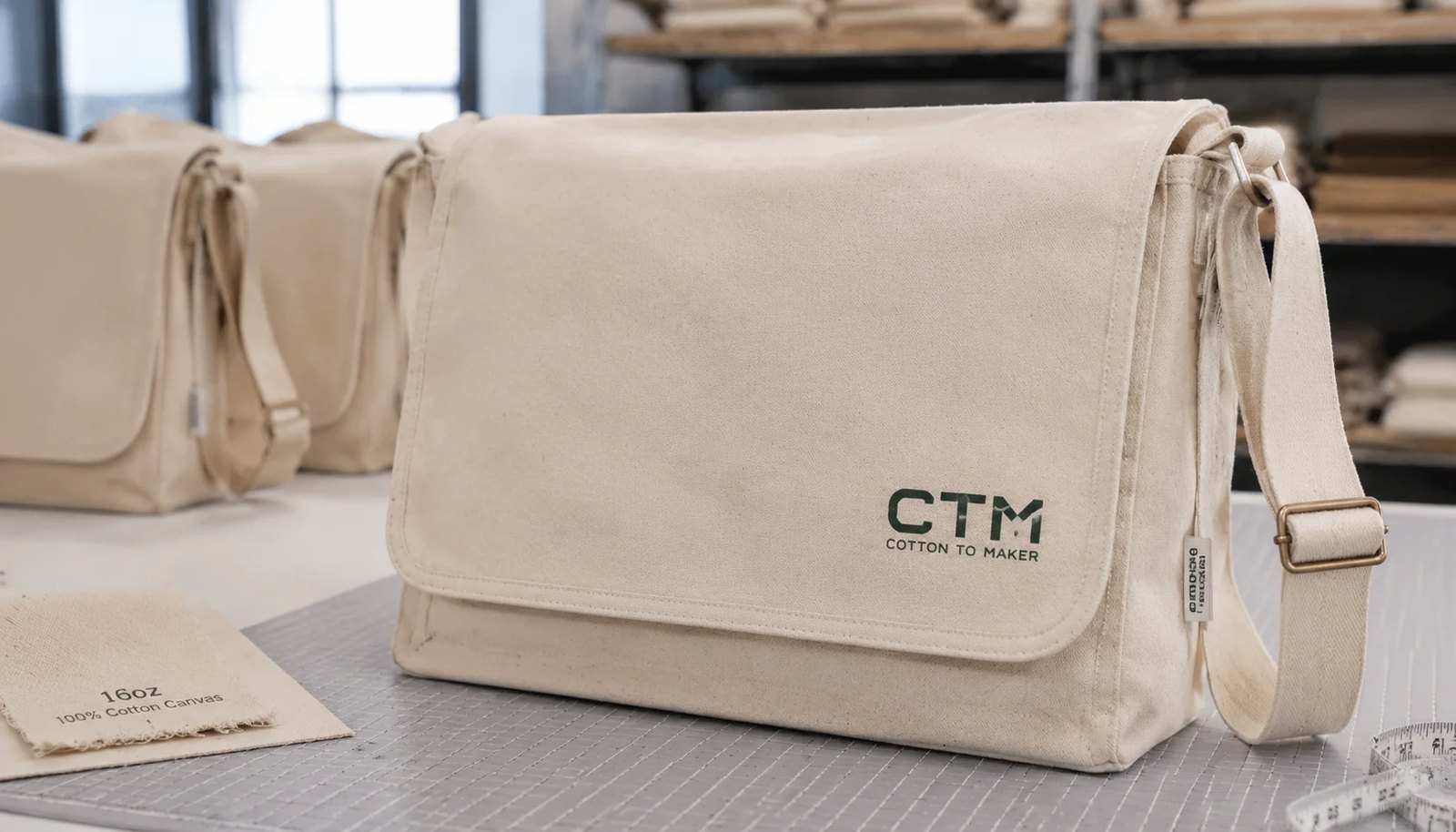
The buying problem: logo visibility without production trouble
Liquor retailers usually buy canvas messenger bags for a practical purpose: a store anniversary gift, wine club member pack, staff tasting kit, distributor roadshow, or branded reusable bag for premium customers. The logo must be visible enough to support the campaign, but it also has to survive folding, strap movement, storage, and repeated handling. A good logo placement decision is not just a design choice. It affects print method, sewing sequence, inspection tolerance, packing style, carton size, and final landed cost.
The common mistake is approving artwork on a flat PDF without considering how the flap bends, where the magnetic snap sits, and how coarse canvas absorbs ink. A clean logo mockup may become off-center after sewing, partially hidden when the flap closes, or cracked along the fold line after packing. For wholesale canvas messenger bags for liquor retailers, the best RFQ should define the finished bag construction first, then position the logo based on real sewing and packing limits.
- Best high-visibility area: front flap, centered or slightly lower depending on flap depth.
- Best subtle area: woven side label, lower corner patch, or small embroidery on flap.
- Highest risk area: across a flap fold, close to snap hardware, or directly over bulky seams.
- Most controllable process: print on cut panels before sewing, with placement marks and approved tolerance.
Choose the canvas weight before fixing the logo method
Canvas messenger bags used by liquor retailers need more body than a simple cotton tote. A thin 8-10 oz canvas can work for very light giveaways, but it will not look structured when carried with catalogs, point-of-sale cards, bar tools, small tasting bottles, or a tablet. For most wholesale programs, 14-16 oz cotton canvas is a practical range. In GSM terms, buyers are usually looking at about 475-540 GSM, depending on weave, finishing, and supplier conversion method.
Fabric weight changes logo results. A heavier canvas has stronger texture, which gives the bag a premium hand feel but can make fine logo lines look broken. A lighter canvas prints more smoothly but may wrinkle around the flap and distort the logo after repeated use. If your liquor retail logo includes small serif text, vintage crest lines, or detailed bottle illustrations, request a print test on the actual bulk canvas weight before approving the order.
- 10-12 oz canvas: lower cost and lighter freight, but less structure for a messenger bag.
- 14 oz canvas: balanced option for promotional retail bags and event use.
- 16 oz canvas: stronger hand feel for premium campaigns and higher perceived value.
- 18 oz and above: durable but heavier, more expensive, and may require adjusted seams and needle settings.
- Natural canvas shade variation should be expected unless the buyer sets a shade band with approved swatches.
Practical logo placement zones for messenger bags
The front flap is the most commercially useful logo zone because it is visible when the bag is worn or displayed. For liquor retailers, a centered flap logo usually works well for store names, wine and spirits club marks, and event branding. A lower right or lower left flap logo can feel more premium and less like a giveaway, especially when the bag is used by staff or loyalty customers after the campaign.
Placement should be dimensioned from physical reference points, not described only as "center logo on front." The RFQ should show the distance from the flap top fold, bottom flap edge, left and right edges, snap position, and any stitch lines. A practical clear margin is often 25-35 mm from seams or hardware. For large logos, keep them away from the flap fold line because the fabric bends there during use and during flat packing.
- Centered flap: highest visibility and easiest for retail campaign photos.
- Lower corner flap: cleaner premium look, good for upscale bottle shops and tasting clubs.
- Body panel under flap: protected from abrasion, but hidden when the flap is closed.
- Strap logo: possible with woven jacquard or print, but MOQ and alignment cost increase.
- Side seam label: low-cost brand detail, not a substitute for main campaign visibility.
Print, embroidery, patch, or woven label: what fits liquor retail branding
Screen printing is the usual starting point for wholesale canvas messenger bags because it is reliable for solid logos, store names, and one- to three-color artwork. It gives good cost efficiency at bulk quantities, but the artwork must be suitable for canvas texture. Very small text, thin outlines, and distressed vintage graphics may fill in or break up unless the factory adjusts mesh, ink thickness, and curing conditions.
Embroidery gives a premium result, but it can pucker on flap fabric if the design is large or dense. It is better for small marks, initials, or simple icon branding. A sewn cotton patch or woven patch works well when the buyer wants texture and logo consistency across different bag colors. Heat transfer can reproduce gradients or complex artwork, but it should be tested for flexing and peeling on the flap because messenger bags bend more than flat totes.
- Screen print: best for solid brand marks, campaign slogans, and medium to high quantity orders.
- Embroidery: best for small premium logos; avoid large dense fills on soft canvas flaps.
- Sewn patch: good for heritage liquor stores, wine clubs, and reusable gift programs.
- Woven label: controlled detail and color, but smaller visibility.
- Heat transfer: useful for short runs or multi-color graphics; needs flex and wash-risk review.
MOQ logic: why logo placement can change the minimum order
MOQ is not only about how many bags the factory wants to sew. For a custom messenger bag, separate minimums may apply to canvas dyeing, screen setup, woven labels, strap webbing color, metal trims, and individual retail packing. If you choose natural canvas, standard black or natural webbing, and a one-color screen print on the flap, MOQ can be more flexible. If you require custom dyed canvas, matching straps, antique brass hardware, and a woven patch, the effective MOQ increases because each material supplier has its own minimum.
Logo placement also affects cutting and sewing workflow. Printing a logo on the flap before sewing is efficient and accurate for many orders, but it requires the cutting room and print room to manage panels carefully. Printing after sewing may be possible for some positions, but hardware, thickness, and flap shape can restrict screen contact. When comparing quotes, a lower MOQ may reflect a simpler post-print process, thinner fabric, or less strict placement control.
- Lowest complexity: stock natural canvas, standard trim, one-position screen print.
- Medium complexity: custom size, inner pocket, printed flap, sewn side label.
- Higher complexity: dyed canvas, custom strap, patch, metal logo plate, retail packaging.
- MOQ should be listed by component when trims or logo accessories are customized.
- Artwork setup charges should be separated from unit price for transparent comparison.
Sample approval: what a buyer should approve before mass production
A pre-production sample should be more than a shape reference. It should use the same canvas weight, same flap construction, same strap width, same closure, same thread color, and the actual logo method planned for bulk production. If the factory sends a blank bag first, treat it as a construction sample only. Do not approve logo placement, color, or print quality from a blank sample or from a digital mockup.
For liquor retail programs, the sample should be loaded lightly during review because the flap position can change when the bag contains real items. Put in a tablet, brochures, tasting notes, or similar campaign contents and see whether the logo stays visible and level. Also check whether the snap or Velcro closure pulls the flap out of alignment. Approval photos should include a front view, side view, open flap view, strap attachment view, logo close-up, and packing fold view.
- Measure logo position from flap edges and record tolerance on the approved sample sheet.
- Compare printed color against Pantone target under neutral light, not only phone photos.
- Rub the printed area with a white cloth after curing to detect weak adhesion or excess pigment.
- Flex the flap several times across the natural bend area and inspect logo cracking.
- Keep one sealed approval sample at the buyer side and one signed sample at the factory.
Cost drivers that matter more than the visible unit price
The cheapest quoted unit price often hides differences in fabric, print size, packing, and inspection scope. A quote for a 12 oz canvas messenger bag with small one-color logo and bulk carton packing should not be compared directly with a 16 oz bag with inner pocket, magnetic snap, large flap print, hang tag, and individual paper sleeve. For procurement teams, the useful comparison is cost per approved specification, not cost per loosely named item.
Fabric is usually the first major cost driver, followed by labor complexity, logo process, trims, and packing volume. A messenger bag has more sewing minutes than a tote because it includes flap, strap attachments, closure alignment, gusset, and often inner pockets. Packing can also affect cost and freight. Flat packing protects shape and logo better, but increases carton dimensions compared with compressed bulk packing.
- Fabric cost driver: oz/GSM, dyed versus natural, washed versus unwashed finish.
- Labor cost driver: number of pockets, flap shape, reinforcement stitches, strap adjuster.
- Logo cost driver: print size, color count, patch sewing time, embroidery stitch count.
- Trim cost driver: metal buckle, magnetic snap, Velcro, zipper pocket, custom webbing.
- Packing cost driver: individual bag, hang tag, barcode label, tissue divider, carton strength.
- Freight cost driver: carton cube, not only piece weight.
QC thresholds for logo placement and bag construction
The inspection plan should separate critical, major, and minor defects. Critical issues include wrong logo, unsafe hardware, mold, severe color bleeding, or unusable closure. Major issues include off-center logo beyond tolerance, weak strap attachment, poor print adhesion, broken stitches, wrong fabric weight, or visible stains on the logo face. Minor issues include small loose threads or slight shade differences within the approved range.
For logo placement, a practical tolerance for a standard flap print is often plus or minus 5 mm from the approved position, unless the artwork is very small or the bag has a complex curved flap. If the brand mark must align with a pocket seam or snap, tolerance may need to be tighter, but that should be priced and sampled. Inspection should include both empty and lightly loaded bags because flap alignment changes under real use.
- Logo centerline: compare to approved sample and measured artwork sheet.
- Print coverage: no obvious pinholes, streaking, ghosting, or double image at normal viewing distance.
- Stitching: no skipped stitches at strap joints, flap edge, pocket mouth, or gusset corners.
- Strap strength: reinforced attachment with box stitch or bar tack based on target load.
- Closure: snap or Velcro must align after loading, not only on an empty flat bag.
- Colorfastness: dark canvas and print should be rubbed against white cloth for transfer risk.
Packing decisions that protect the logo before the bags reach stores
Many logo defects happen after production, not during printing. If a freshly printed flap is folded under pressure, the ink can mark another surface or develop a crease line. If cartons are overfilled, the magnetic snaps, buckles, or strap adjusters can press into the printed area. Liquor retailers often store promotional bags before a launch date, so packing has to survive warehouse stacking and local distribution.
For most wholesale canvas messenger bag orders, flat packing with the logo facing a protective tissue sheet or kraft divider is safer than aggressive compression. Individual polybags reduce dust and moisture risk but may not match sustainability goals. Recycled paper sleeves or master polybag bundles can be used if the buyer wants less plastic. The RFQ should state whether retail units need barcode labels, store allocation labels, carton marks, or pallet packing.
- Avoid folding directly through the printed logo unless tested and approved.
- Use tissue, kraft sheet, or clean paper divider when the logo face contacts hardware or another bag.
- Limit carton weight so lower cartons are not crushed during stacking.
- Mark cartons by SKU, color, logo version, quantity, gross weight, net weight, and carton number.
- For multi-store rollouts, request carton-level allocation labels to reduce repacking at destination.
Lead time and schedule risks for liquor retail campaigns
Canvas messenger bag programs often connect to fixed dates: holiday liquor promotions, wine club launches, tasting festivals, new store openings, or distributor sales meetings. The schedule risk is not only sewing time. Time is consumed by artwork review, fabric sourcing, sample making, sample shipping, buyer approval, bulk material preparation, printing, curing, sewing, final inspection, packing, and freight booking.
A practical planning model separates sample lead time from bulk lead time. For example, a factory may need time to prepare a logo screen, cut sample panels, print, sew, and ship the sample before the buyer can approve. Bulk production should not start until placement, fabric, and logo color are approved. If the order uses dyed canvas or custom woven patches, build in extra time for material approval and shade checking.
- Fastest route: natural canvas, standard trims, one-color screen print, no retail packaging.
- Moderate route: custom dimensions, inner pocket, two-color print, hang tag, flat packing.
- Slower route: dyed canvas, custom strap, woven patch, embroidery, barcode packing.
- Peak season risk: print room capacity and fabric availability can become bottlenecks.
- Approval delay risk: unclear logo placement files can stop sampling and push freight dates.
Specification comparison for buyers
| Spec decision | Recommended option | When it fits | Buyer risk to check |
|---|---|---|---|
| Main fabric weight | 14-16 oz cotton canvas, about 475-540 GSM | Liquor retail promotions, bottle club gifts, staff kit bags, and reusable event bags that need structure without becoming too heavy | Below 12 oz can sag when loaded with catalogs, small bottles, or tasting tools; above 18 oz raises freight weight and may require stronger sewing machines |
| Logo position | Centered on flap or lower right flap panel with 25-35 mm clear margin from seams | Most retail logos, liquor store anniversary programs, distributor promotions, and private-label gift campaigns | Artwork too close to flap edge may distort during sewing, especially if print is applied before assembly |
| Print method | Screen print for solid one- to three-color logos; heat transfer only for gradients or small runs | High-volume wholesale canvas messenger bags where color blocking and durability matter more than photographic detail | Thick ink can crack on heavy canvas folds; heat transfers may peel if the flap bends sharply or is packed under pressure |
| Branding alternative | Woven side label or cotton patch sewn onto flap | Premium spirits retailers wanting a quieter logo or when artwork has very fine text that will not print cleanly on coarse canvas | Patch sewing adds labor and placement tolerance; side labels are less visible in retail photography |
| Bag size | Approx. 35 x 28 x 10 cm with flap coverage and adjustable strap | Fits brochures, a tablet, tasting notes, store catalogs, bar tools, or a compact gift set without looking oversized | Oversized bags increase carton volume and landed cost; small bags may not justify the perceived value of a wholesale gift item |
| Closure choice | Magnetic snap or hidden Velcro under flap, tested for alignment after loading | Liquor retail staff, event teams, and customers who need quick access during tastings or store visits | Velcro can catch lint and feel less premium; magnets must be positioned away from printed art and checked for pull strength |
| Inside structure | One inner slip pocket with reinforced top stitch | Useful for loyalty cards, flyers, order forms, or small tasting accessories | Too many pockets increase sewing time, inspection points, and MOQ pressure; pocket fabric should not bleed through a light outer canvas |
| Packing method | Flat packed with tissue or kraft divider at logo face, 50-80 pcs per export carton depending on GSM | Best for preserving flap print and controlling carton dimensions for wholesale shipment | Aggressive folding across the logo can create ink cracking, crease marks, or transfer staining before arrival |
Buyer checklist before sampling
- Define the exact bag use: retail gift, staff bag, club member welcome kit, tasting event giveaway, or distributor sales tool.
- Select canvas weight in oz and GSM, not only one unit; common buyer range is 14-16 oz or about 475-540 GSM.
- Provide finished bag size with tolerance, flap depth, gusset depth, strap width, and strap length range.
- Mark logo placement on a flat dieline with distance from flap edge, seams, snap, and fold line.
- Choose print method according to artwork: screen print for solid logos, embroidery or patch for textured premium branding, transfer for multi-color short runs.
- Specify Pantone color or acceptable delta for printed brand color on natural or dyed canvas.
- Require a pre-production sample using bulk fabric, bulk trims, and actual logo process, not a substitute blank bag.
- Set visible acceptance criteria for logo centering, print coverage, edge bleeding, stitch line straightness, and strap pull strength.
- Confirm whether retail units need hang tags, barcode labels, polybags, recycled paper sleeves, or plain bulk packing.
- Compare quotes using the same fabric weight, print size, packing method, carton quantity, and Incoterm.
Factory quote questions to send
- What cotton canvas weight in oz and GSM is included in the quote, and is it greige, bleached, dyed, or washed?
- Is the logo printed before or after sewing, and how will placement tolerance be controlled on the flap?
- What is the maximum print area included in the base price, and what is the surcharge for additional colors or larger screens?
- What MOQ applies to the bag body, dyed fabric, custom strap color, woven label, and individual packing?
- Can the sample be made with the same bulk fabric, thread, closure, strap webbing, and logo method planned for mass production?
- What testing can be performed in-line for strap pull, seam strength, snap alignment, color rubbing, and print adhesion?
- How many pieces are packed per carton, what are estimated carton dimensions, and is the logo protected from pressure marks?
- What is the sample lead time, production lead time after approval, and risk point during peak season or before major retail holidays?
- Which quote basis is used: EXW, FOB, CIF, DDP, or another Incoterm, and what is excluded from the unit price?
- Will overrun or underrun tolerance apply, and how are defective printed pieces handled before final packing?
Quality-control points to confirm
- Logo placement tolerance should normally be controlled within plus or minus 5 mm on the flap centerline for standard messenger bag sizes.
- Printed logo edges should show no obvious bleeding, pinholes, double images, or ink build-up visible at normal arm length.
- Screen print adhesion should pass a basic tape pull and rubbing check after drying or curing; heat transfer should not lift at corners after flexing.
- Canvas weight should be verified against the approved swatch; substitution from 16 oz to 12 oz changes structure and should require buyer approval.
- Flap, pocket, and body seams should have consistent stitch density, no skipped stitches, and back-tacking at stress points.
- Shoulder strap attachment points should be reinforced with box stitch or bar tack suitable for the intended load.
- Closure position should align when the bag is lightly loaded, not only when empty on the inspection table.
- Dark dyed canvas and printed areas should be checked for dry and wet rubbing transfer against white fabric.
- Carton packing should avoid folding directly across the printed logo unless the print process has been approved for that fold.
- Random inspection should open cartons from different positions in the shipment to detect packing pressure marks and color shade variation.