Buying Problem
For liquor retailers, a canvas messenger bag is not just a casual shoulder bag. It may be used as a gift-with-purchase item, a bottle club carrier, a tasting event bag, or a premium reusable retail bag. The buying problem is that the bag must look good in store, hold weight without complaint, and still meet a commercial price point for wholesale distribution.
Fabric weight is the first specification buyers usually mention, but it is not the only factor that decides performance. A 16 oz canvas body with weak strap stitching can fail faster than a 12 oz body with proper reinforcement. The RFQ should connect fabric weight with bottle load, gusset shape, handle engineering, print method, packing, and final landed cost.
- Use case matters more than a heavy fabric label by itself.
- Liquor retail bags often need a structured base because bottles create point load, not soft load.
- The quote should show fabric weight, construction, print, packing, and lead time in one comparable format.
- A sample must be tested with actual bottle weight before bulk approval.
Fabric Weight Range
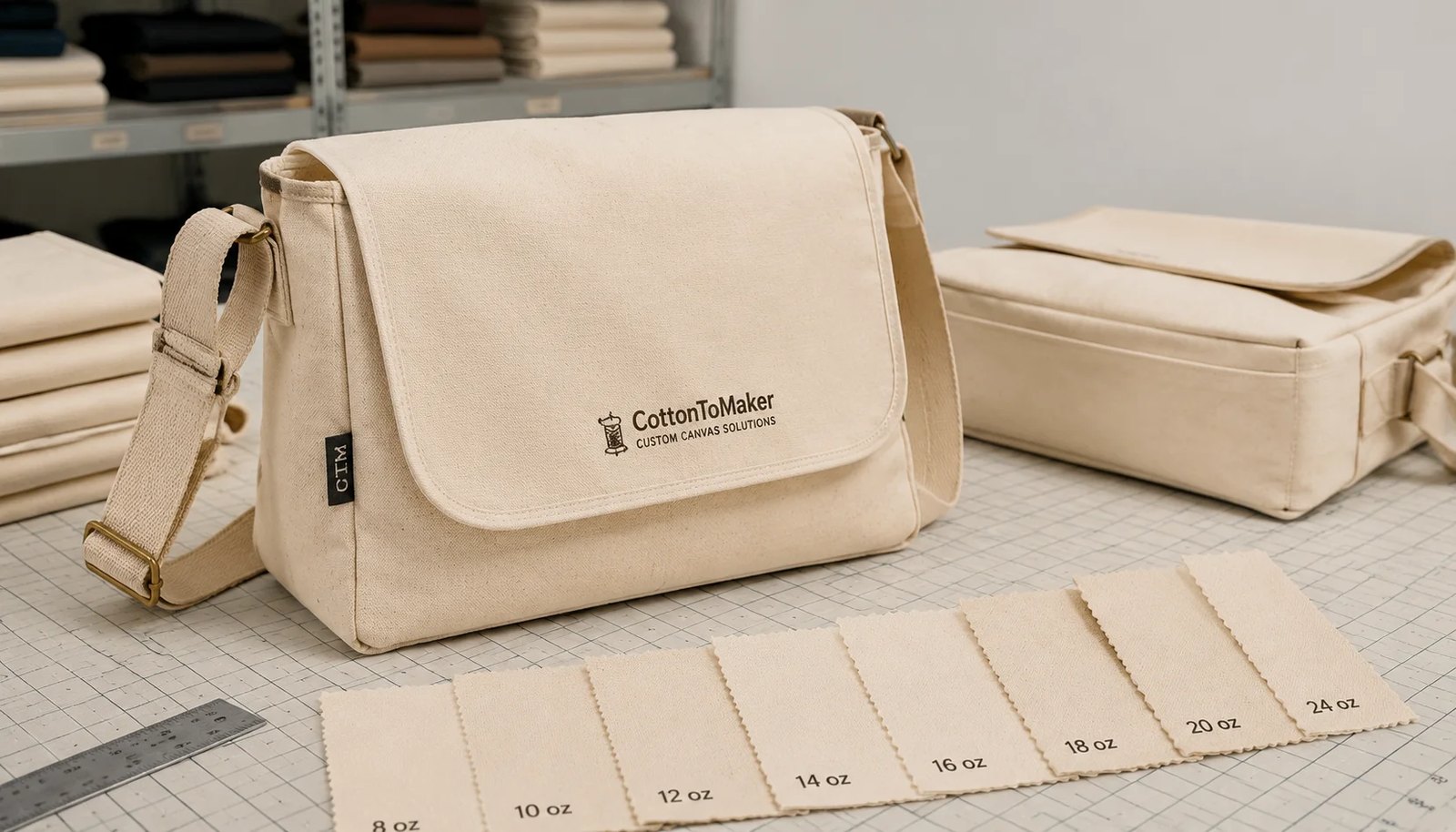
Most wholesale canvas messenger bags for liquor retailers sit in the 12 oz to 16 oz range. In GSM terms, that is roughly 407 to 542 GSM, depending on the mill and finishing. A 10 oz canvas may work for light event handouts, but it usually feels too soft for a bottle-related retail program unless the bag is small and well reinforced. An 18 oz canvas feels premium, but the buyer pays for it in fabric cost, sewing time, needle wear, carton weight, and ocean or air freight.
The practical choice is to match fabric weight to the carrying requirement. If the bag is intended for one bottle plus tasting notes, 12 oz or 14 oz can be enough with a reinforced base. If it must carry two bottles, boxed spirits, glassware, or retail accessories, 14 oz to 16 oz is safer. If the brand wants a long-life merchandise piece, 16 oz to 18 oz can be justified, but only after checking the sample weight and final carton CBM.
- 10 oz canvas: light promotional use, lowest cost, limited structure.
- 12 oz canvas: entry retail quality, acceptable for one bottle if reinforcement is correct.
- 14 oz canvas: balanced option for most liquor retail messenger bags.
- 16 oz canvas: stronger hand feel and better structure for premium retail programs.
- 18 oz canvas: heavy-duty positioning, higher cost and slower sewing speed.
GSM Versus Ounces
Buyers should not rely only on the ounce rating printed in a supplier quote. Some suppliers quote canvas by oz per square yard, while others translate loosely from GSM. Finishing also changes hand feel. A tightly woven 14 oz canvas can feel more stable than a loosely woven 16 oz canvas. Washed canvas may feel softer and look more casual, but it can also shrink, wrinkle, and change print behavior.
For a clean comparison, request both oz and GSM with tolerance. A useful RFQ line is: 14 oz cotton canvas, approximately 475 GSM, plain weave, natural color, no washing, GSM tolerance plus or minus 5 percent. If dyed canvas is required, add shade tolerance and request a lab dip before cutting. For natural canvas, define whether specks and cotton seed particles are acceptable because they are normal in unbleached fabric but can affect logo presentation.
- Ounce rating alone is not enough for quote comparison.
- GSM tolerance should be stated before production fabric is purchased.
- Washed canvas changes shrinkage, touch, and print edge sharpness.
- Natural canvas may show cotton seeds; white or dyed canvas gives cleaner logo contrast.
- A swatch from the actual production fabric lot is stronger evidence than a catalog swatch.
Messenger Construction
A liquor retail messenger bag needs more structure than a simple document bag. The gusset depth, bottom panel, strap attachment, and flap length decide how the bag behaves when loaded. A flat body can look fine in photos but twist around a bottle. A boxed gusset with reinforced bottom allows bottles to sit lower and keeps the bag from swinging awkwardly on the shoulder.
The strap is a common failure point. For wholesale orders, specify the strap width and reinforcement method, not just adjustable shoulder strap. A 38 mm cotton webbing strap is common for mid-weight bags, while 50 mm feels better for heavier loads. Strap ends should be secured with box stitching, cross stitching, bar tacks, or a tested equivalent. If metal D-rings and sliders are used, their plating and edge finish should be checked because rough hardware can cut webbing over time.
- Recommended gusset for bottle use: usually 80 mm to 120 mm depending on bottle count and box size.
- Recommended strap width: 38 mm for standard retail bags, 50 mm for heavier premium bags.
- Reinforcement zones: strap ends, bottom corners, flap corners, and side gusset seams.
- Closure choices: magnetic snap for cleaner retail appearance, buckle for rugged style, hook-and-loop for low-cost utility.
- Bottle stability improves when the base panel is wide enough and the side seams are aligned.
Print Method Choice
Liquor retailers often use strong logos, store names, club marks, tasting event graphics, or seasonal artwork. Screen printing is the usual cost-effective method for one to three solid colors. It works well on 12 oz to 16 oz canvas when the ink is matched to the fabric and cured correctly. Large solid print areas need more attention because heavy canvas absorbs differently and rough texture can break fine edges.
Heat transfer can reproduce gradients and small details, but it changes the hand feel and may not suit a rustic canvas program. Embroidery gives a premium impression but can pucker if the fabric is not stabilized, and it is usually better for smaller marks. Woven labels are useful when the buyer wants branding that lasts without a large printed panel. For liquor retail, the best choice often combines a screen printed front flap with a small woven side label for a more finished look.
- Screen print: best for bold logos, store names, and solid event graphics.
- Heat transfer: suitable for detailed multicolor art, but test flexibility and edge adhesion.
- Embroidery: premium for small logos, less ideal for large filled artwork.
- Woven label: durable and neat for retail merchandise positioning.
- Print approval should include strike-off on the exact canvas weight and color.
MOQ And Cost Drivers
MOQ logic depends on fabric procurement, dyeing, printing setup, cutting efficiency, and packing labor. A supplier may accept 300 pieces for a simple natural canvas bag using stock fabric, but the price will usually be higher because setup costs are spread across fewer units. A more efficient wholesale canvas messenger bag order often starts around 500 to 1,000 pieces per size, fabric color, and artwork.
The largest cost drivers are fabric weight, bag size, construction complexity, print area, hardware, lining, and packing method. Heavy fabric increases material cost and shipping weight. A lined bag adds cutting and sewing operations. Custom dyed canvas adds lab dip, dye lot control, and higher MOQ. Individual polybags, hangtags, barcodes, and inner cartons help retail distribution but add labor and carton volume. Buyers should compare total landed cost, not only FOB unit price.
- Lower MOQ works best with stock natural or black canvas and one-color print.
- Custom fabric dyeing usually requires higher MOQ and longer schedule.
- Large flap print area can cost more than a small chest-style logo.
- Metal hardware changes both cost and inspection requirements.
- Retail-ready packing may reduce warehouse work but increases factory packing cost.
Sample Approval
A good sample process prevents most bulk production disputes. Start with a construction sample if the bag shape is new, then approve print strike-off on the selected canvas. For liquor retailers, the sample should be loaded with the intended bottle format and worn by the strap for a short handling test. Do not approve only by front photo, because the most expensive failures usually happen at the gusset, base, strap, or closure.
The approved sample should become the control sample for factory production and final inspection. Mark the fabric weight, dimensions, print color, hardware, label position, packing fold, and acceptable tolerances. If the buyer changes fabric weight after sampling, the sample cycle should restart because print behavior, sewing tension, flap stiffness, and carton weight may all change.
- Approve fabric swatch before the factory cuts sample panels.
- Approve print strike-off before bulk printing screens or transfer films are finalized.
- Test sample with real bottles, not only paper filling.
- Measure the bag after loading because weak bases can sag and change usable height.
- Keep one approved sample with the buyer and one sealed sample with the factory.
QC Thresholds
Inspection criteria should be written before production starts. For messenger bags used by liquor retailers, the main thresholds are load strength, seam security, print durability, dimensional accuracy, and clean appearance. A reasonable load test might be 6 kg or 8 kg for one hour, depending on the intended bottle count. The acceptance standard should state no broken stitches, no strap tearing, no hardware release, and no visible seam opening after the test.
Dimensional tolerance should be realistic for sewn canvas. For many cotton canvas bags, plus or minus 5 mm on small dimensions and plus or minus 10 mm on larger panels may be workable, but the buyer should align this with the design. Print placement tolerance is often plus or minus 5 mm to 10 mm depending on print size and bag structure. The key is to define what affects retail appearance and usability before the inspection team opens cartons.
- Load test: define weight, duration, and failure conditions.
- Stitching: no skipped stitches at strap ends, flap corners, or bottom seam.
- Print: no major color deviation, poor curing, cracking, or obvious off-center placement.
- Fabric: control stains, oil marks, holes, severe slubs, and shade variation.
- Hardware: no sharp edges, rust marks, loose rivets, or weak magnetic closure.
Packing And Freight
Canvas messenger bags are bulky compared with flat totes, especially when they include gussets, flap closures, metal hardware, or structured bases. Packing too tightly can leave permanent crease marks on the flap or push hardware into the printed panel. Packing too loosely increases CBM and freight cost. The correct packing method balances appearance, protection, and carton efficiency.
For retail distribution, buyers may need individual polybags, hangtags, carton labels, and barcodes. For a distributor shipping to many liquor stores, inner packs can simplify allocation. For a direct import program with one warehouse, bulk flat packing may be more economical. Request carton dimensions, pieces per carton, gross weight, net weight, and estimated CBM at quote stage so the logistics team can compare landed cost before order placement.
- Use tissue or paper protection where hardware touches printed fabric.
- Avoid sharp fold lines across the front flap logo.
- Confirm whether bags are packed flat, half-folded, or folded into polybags.
- Request carton burst strength suitable for heavy canvas goods.
- Add desiccant or moisture-control packing when shipping during humid seasons.
Lead Time Risk
Lead time is not only sewing time. A realistic schedule includes fabric booking, dyeing or fabric preparation, sample making, artwork approval, print setup, cutting, sewing, trimming, inspection, packing, and export handling. Stock natural canvas with one-color screen print is usually faster than custom dyed canvas with lining and metal hardware. Any change after sample approval can reset part of the timeline.
Liquor retailers often plan bags around store openings, holiday promotions, tasting events, or brand campaigns. Missing the event date can make the goods much less valuable. Build the schedule backward from the required in-warehouse date, including inspection time and freight buffer. If air freight is the backup plan, compare the cost impact before choosing an 18 oz construction because heavy canvas can make emergency freight expensive.
- Fastest route: stock canvas, standard hardware, one-color screen print, simple packing.
- Slower route: custom dyed fabric, lining, embroidery, special hardware, retail barcode packing.
- Sample revisions can add more delay than the sewing process itself.
- Peak season production should include extra buffer for fabric and printing capacity.
- Freight choice should be reviewed with carton CBM and gross weight, not unit price only.
Specification comparison for buyers
| Spec decision | Recommended option | When it fits | Buyer risk to check |
|---|---|---|---|
| Main body fabric weight | 12 oz to 16 oz cotton canvas, roughly 407 to 542 GSM before washing or finishing | Good balance for liquor retailers selling gift sets, tasting kits, or loyalty merchandise that may carry one to three bottles plus small accessories | Quotes using the same ounce rating may not feel equal if yarn count, weave density, or finishing differs; request GSM tolerance and a physical swatch |
| Heavy-duty premium option | 18 oz canvas or 16 oz canvas with reinforcement panels at stress zones | Useful for premium spirits retailers, bottle club programs, and reusable carrier positioning where the bag must feel substantial | Higher fabric weight increases freight, sewing difficulty, needle marks, and minimum cutting waste; confirm sample weight and carton weight before approval |
| Lining choice | Unlined for cost control, cotton lining for cleaner interior, or PE-coated lining only when wipe-clean function is needed | Unlined works for dry retail merchandise; lining improves perceived value for gift sets and corporate liquor promotions | Low-cost lining can shrink or pucker after pressing; coated lining may create odor or stiffness if not specified properly |
| Bottom and side support | Gusseted base with 12 oz to 16 oz canvas reinforcement or removable board covered by fabric | Needed when the buyer expects bottles to stand upright or when the bag is used as a retail gift carrier | A flat messenger pattern without base support can collapse around bottles; specify bottle diameter and target load |
| Print method | Screen print for solid logos, heat transfer for detailed multicolor artwork, embroidery or woven label for premium low-color branding | Screen print fits most liquor store logos and event branding; woven label works when the bag may be reused for years | Large ink coverage on heavy canvas can crack if cured poorly; request print adhesion and rub test results on production fabric |
| Closure and hardware | Canvas flap with magnetic snap, metal buckle, or hook-and-loop depending on retail positioning | Magnetic snap feels cleaner for gift bags; buckle looks durable; hook-and-loop is practical but noisy and less premium | Weak magnets fail through thick canvas; plated hardware can rust if packed before fully dry or stored in humid conditions |
| MOQ structure | One fabric color and one print setup at 500 to 1,000 pieces is usually more efficient than many small color splits | Best for distributors and retail chains testing a seasonal spirits campaign without excessive inventory complexity | Splitting 1,000 pieces into many colors raises cutting, print setup, packing, and shade control risk |
| Packing format | Flat packed with tissue at flap crease, individual polybag only when retail cleanliness or barcode control is required | Flat packing reduces carton cube; individual bags help retail warehouse receiving and store allocation | Over-compressed cartons can create permanent flap creases, distorted gussets, or hardware impressions on printed panels |
Buyer checklist before sampling
- Define the actual carry scenario: one 750 ml bottle, two bottles, boxed spirits, tasting set, or general merchandise.
- State the required fabric weight in oz and GSM, with an acceptable tolerance such as plus or minus 5 percent.
- Request a fabric swatch from the quoted lot or a production-equivalent swatch, not only a photo of previous goods.
- Specify finished bag dimensions, gusset depth, flap length, strap width, strap drop, and whether bottles must stand upright.
- Set a target load test such as 6 kg or 8 kg for one hour, based on the heaviest expected retail use.
- Identify reinforcement points: strap ends, flap corners, bottom seam, side gusset, and any inner bottle divider.
- Choose print method by artwork and usage: screen print for solid marks, transfer for detail, woven label for long-term brand finish.
- Require print placement tolerance, color reference, curing standard, and rub resistance on the actual canvas fabric.
- Confirm whether hardware is magnetic snap, buckle, D-ring, slider, zipper, or hook-and-loop, including plating color and anti-rust packing.
- Clarify packing: flat pack, fold line, tissue protection, carton quantity, carton dimensions, gross weight, and retail barcode needs.
Factory quote questions to send
- What is the actual GSM and oz rating of the canvas you are quoting, and what tolerance will you control in bulk production?
- Is the quoted canvas greige, dyed, washed, enzyme-washed, or finished with any coating or stiffener?
- Can you provide fabric swatches in the proposed natural, black, navy, or custom dyed color before sample approval?
- What yarn count and weave density are used for the quoted canvas, and is it regular plain weave or heavier duck canvas?
- What is the maximum safe load you recommend for this construction, and where are the reinforcement stitches placed?
- For liquor retail use, can the base hold one or two 750 ml bottles upright without the bag twisting or sagging?
- Which print method is included in the quote, what is the maximum print area, and how many colors are priced?
- Will the print be tested for dry rub, wet rub, adhesion, and cracking on the selected fabric weight?
- What is the MOQ for one size, one fabric color, and one artwork, and how does price change at 500, 1,000, 3,000, and 5,000 pieces?
- Are sample charges refundable against bulk order, and how many rounds of sample revision are included?
Quality-control points to confirm
- Fabric GSM verified against approved swatch and purchase specification before cutting.
- Finished dimensions checked at top width, bottom width, height, gusset, flap length, strap width, and strap adjustment range.
- Strap attachment reinforced with box stitch, bar tack, or equivalent construction approved in sample.
- Load test completed using the buyer-defined weight and duration, with no seam opening, strap tearing, or hardware failure.
- Print color, placement, edge sharpness, curing, rub resistance, and cracking checked on bulk canvas, not only on paper proof.
- Needle holes, skipped stitches, loose threads, puckering, stains, oil marks, and fabric slubs controlled against agreed AQL level.
- Hardware inspected for plating consistency, sharp edges, magnet strength, rust risk, and secure attachment.
- Bag mouth, flap, gusset, and base alignment checked so bottles can sit correctly and the bag does not twist when loaded.
- Packing inspected for fold marks, flap protection, carton strength, carton label accuracy, barcode placement, and moisture control.