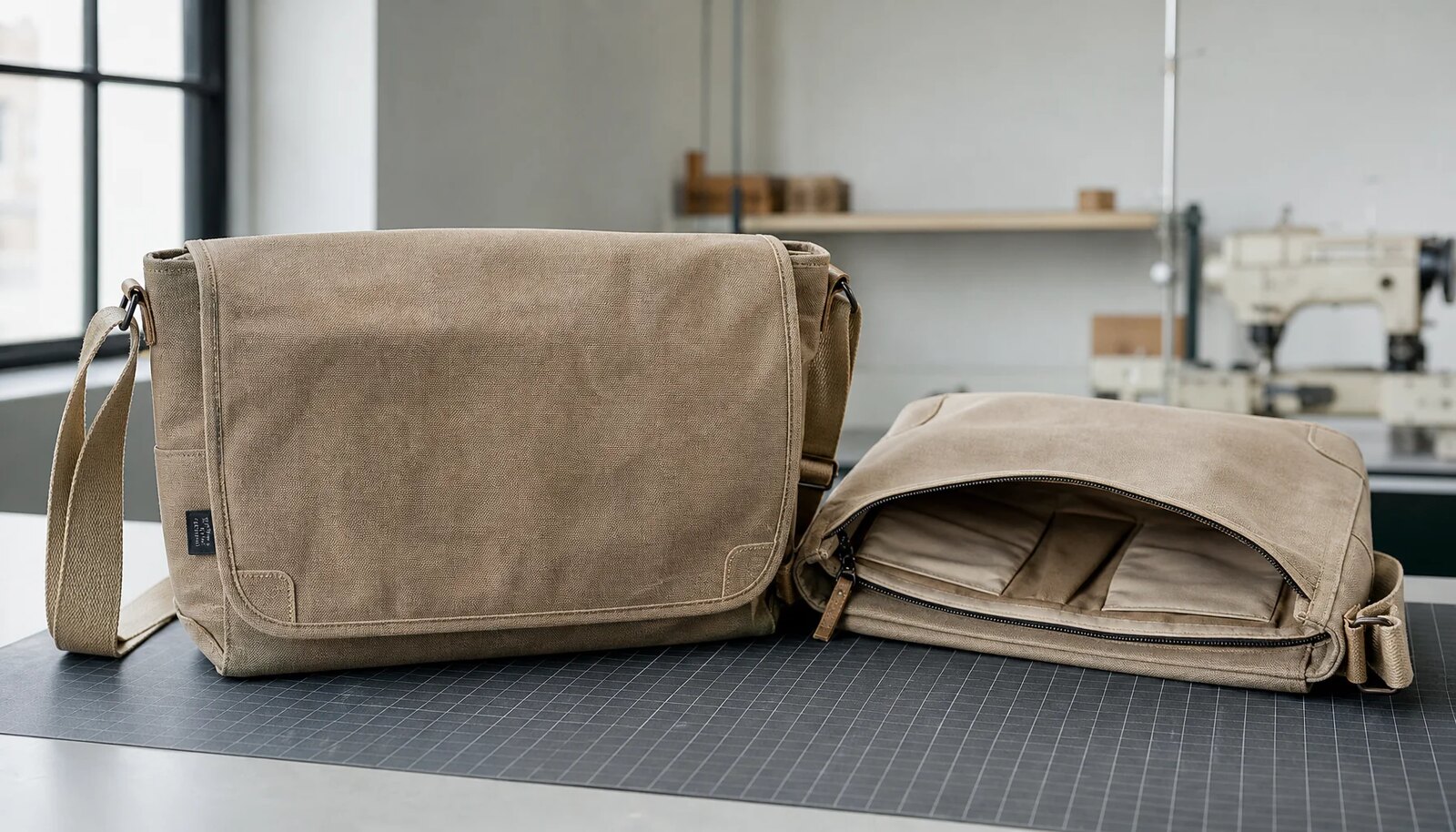
Start with the use case, not the logo placement
When buyers source wholesale canvas messenger bags for eco apparel brands, the conversation often starts with artwork. That is understandable; the logo is what the customer sees first. Still, procurement gets better results when the first question is simpler and more practical: what does this bag need to carry, and how will it be judged after delivery?
A retail accessory sold beside organic cotton tees needs a cleaner finish than a giveaway bag added to an apparel shipment. A staff bag for store teams may need stronger strap anchors, a secure closure, and enough depth for catalogs or folded garments. A commuter-style messenger bag may need more structure at the bottom so it can hold a notebook, tablet, or small laptop without sagging. Those are different products, even when the outside shape looks similar.
Write the intended use into the RFQ before suppliers quote. Include expected load, selling channel, frequency of use, and presentation level. This helps the factory choose sensible fabric weight, reinforcement, trims, and packing. It also makes quotes easier to compare because each supplier is pricing the same quality target rather than guessing what strong, premium, or eco means.
Separate natural material character from workmanship defects early. A small slub in cotton canvas may fit the brand story. A twisted flap, off-center logo, weak zipper end, or strap anchor that opens under tension does not. That line should be clear before the first sample is made.
- Define the bag as retail resale, staff use, e-commerce packaging, event distribution, or daily carry.
- State the expected load in plain terms: garments, catalogs, tablet, small laptop, or light personal items.
- Choose a presentation level: promotional, utility, retail accessory, or premium brand merchandise.
- Tell the factory where natural slubs and minor shade variation are acceptable, and where they are not.
- Send the same use-case statement to every supplier so quote comparisons start from the same brief.
Turn the style idea into a buildable spec sheet
A useful specification sheet makes the bag inspectable. It should cover body dimensions, gusset depth, flap size, pocket layout, strap length, strap width, closure method, lining details, fabric weight, trim quality, decoration placement, and packing method. Vague words such as medium size, heavy canvas, durable strap, and clean logo are easy to write but expensive to manage later.
Messenger bags need more measurement detail than a flat tote. Body width and height are only the beginning. Add flap length and width, gusset depth, zipper opening, internal pocket opening, strap drop, anchor position, and logo distance from the nearest seam or edge. If the bag must fit a catalog, folded apparel pack, device sleeve, or store kit, include those item dimensions and the clearance required. A bag can pass flat measurements and still feel too tight if the opening or gusset was underspecified.
Use centimeters or millimeters throughout the spec sheet and include tolerances next to the measurements. For many body measurements, plus or minus 0.5 cm is a reasonable starting point, while longer straps or soft panels may need a wider tolerance. Logo placement, pocket position, and flap alignment usually need tighter control because small shifts are visible in retail presentation.
Version control matters more than buyers expect. Artwork revisions, trim substitutions, and sample comments often move through separate email threads. Put the file name, revision date, and approval status on the spec sheet. If a supplier quotes against version one but bulk approval uses version three, confusion is almost guaranteed.
- Specify body, flap, gusset, pocket, strap, zipper opening, and logo placement measurements.
- Add tolerance ranges to the spec sheet instead of discussing them after inspection.
- Attach measured artwork showing logo size, print color, orientation, and distance from seams.
- Name every trim: zipper, puller, D-rings, adjuster, snaps, label, thread, lining, binding, and shoulder pad if used.
- Require suppliers to quote against one controlled spec sheet version.
Choose canvas weight and finish with production reality in mind
Canvas weight is one of the biggest signals of quality, and one of the easiest places for quotes to drift. For many retail-ready messenger bags, finished canvas in the 12 oz to 14 oz range, roughly 340 to 400 gsm, is a practical starting point. It gives more structure than lightweight tote fabric while staying sewable and foldable. Lighter canvas can work for low-load promotional programs. Heavier canvas can look substantial, but it can also increase seam bulk, needle issues, packing volume, and unit cost.
Ask for finished fabric weight, not only greige weight. Dyeing, washing, brushing, coating, or enzyme finishing can change handfeel, shrinkage, shade, and apparent thickness. A supplier may describe fabric as heavy canvas while quoting a base material that feels thinner after finishing. Procurement should request the finished gsm and oz on the production fabric and keep a swatch or sample reference.
Composition and finish should be written plainly. Is the fabric 100% cotton canvas, a cotton-rich blend, recycled cotton blend, organic cotton, raw natural canvas, bleached canvas, stock-dyed canvas, custom-dyed canvas, washed canvas, coated canvas, or water-repellent finished canvas? Each route affects MOQ, lead time, color control, and price. Natural beige canvas can show oil marks and handling dirt. Dark cotton canvas can show rubbing, chalk marks, and shade variation. Both need clear inspection standards.
Eco claims need documentation. If the product will be marketed as organic, recycled, certified, undyed, or low-impact dyed, ask what support the supplier can provide before the claim appears in sales copy. When documents are not available, describe the material honestly as cotton canvas or cotton-rich canvas and let the product quality, reusability, and transparent specification carry the story.
- Ask for finished gsm and oz after all fabric processing, not just base fabric weight.
- Confirm composition before using organic, recycled, certified, undyed, or low-impact language.
- Approve a shade standard for natural canvas, dyed canvas, and washed canvas before bulk production.
- Consider shrinkage, seam bulk, and folding volume when moving from 12 oz to 14 oz or heavier fabric.
- Inspect natural canvas for stains, weaving defects, dark fibers, oil marks, and visible handling dirt.
Quote the interior, closure, and pockets as separate decisions
The inside of the bag changes cost, inspection scope, and customer perception. An unlined messenger bag can suit eco apparel brands that want a simple, natural canvas product. It keeps the construction direct and often supports a sharper target price. The tradeoff is visibility. Raw edges, thread tails, uneven binding, and loose seam ends have nowhere to hide.
A lined bag creates a cleaner interior and allows zipper pockets, slip pockets, or a divider. It also adds new failure points: loose lining, puckering, twisted panels, pocket openings that sit unevenly, trapped threads, or lining that pulls when the bag is loaded. A padded compartment should be specified only when the bag is expected to carry devices or heavier daily-use items. Padding adds value when it solves a real use case; otherwise it may add cost and bulk without improving the product.
Closures deserve the same discipline. A zipper top improves security and suits commuter or travel use. A flap gives classic messenger styling and creates a clear area for branding. Magnetic snaps look clean but need alignment control and enough pull strength. Hook-and-loop is functional, though some brands may find it too casual or noisy. Open-top construction can reduce cost, but it is a poor match for a bag expected to protect contents in transit.
If the target price is still moving, ask suppliers to quote versions separately: unlined versus lined, zipper versus flap, stock pocket layout versus custom pockets. This gives the buyer real levers. It is much better than asking for a lower price on the same spec and hoping nothing important changes.
- Quote unlined, lined, and padded versions separately when the structure is not final.
- For unlined bags, inspect seam finishing, binding, thread trimming, and fray control closely.
- For lined bags, check lining attachment, pocket alignment, seam puckering, and pull under light load.
- Choose zipper, flap, snap, hook-and-loop, or open top based on use case and brand positioning.
- Include closure function checks in final QC rather than treating hardware as decoration only.
Build the strap system around real stress points
The strap system is where many canvas messenger bags either earn repeat orders or create complaints. A product photo can make a narrow strap, weak anchor, or slipping adjuster look acceptable. Actual use is less forgiving. Buyers should specify strap width, strap length range, webbing material, adjuster type, anchor position, stitch method, and shoulder pad requirement where needed.
Reinforcement must be named, not implied. Strap anchors, zipper ends, pocket openings, flap corners, side seams, bottom corners, and top openings are all stress points. The method may be bar-tack, X-box stitching, double-row stitching, seam binding, an extra fabric patch, or another approved factory method. What matters is that the method appears on the pre-production sample and is repeated in bulk.
Comfort matters too. A strap that is technically strong may still twist, dig into the shoulder, or slip through the adjuster. If the bag is intended for staff use, retail resale, campus carry, or commuter use, ask whether the strap length works over outerwear. Check that cut webbing ends are sealed or finished properly so they do not fray after limited use.
Not every order needs a formal lab test, but the factory should be able to describe its practical strength checks. Inline QC may include a light load hang test, a manual pull at strap anchors, repeated adjustment movement, or stress checks at pocket corners. The purpose is not to create paperwork for its own sake. It is to make sure reinforcement is treated as production control, not decoration.
- Specify strap width, length range, webbing material, adjuster type, anchor position, and shoulder pad details.
- Require reinforcement at strap anchors, zipper ends, pocket corners, flap corners, side seams, and bottom corners.
- Approve the actual stitch method on the pre-production sample.
- Check that webbing does not twist badly, cut into the shoulder, slip through the adjuster, or fray at cut ends.
- Ask how the factory checks anchor strength during inline and final inspection.
Make decoration and labels measurable
Decoration is often the most visible reason a finished bag fails approval. Screen print is usually efficient for simple logos, clear line art, and one or two colors. It works well on flat canvas panels when placement, ink coverage, and curing are controlled. Large ink areas need more caution because heavy ink can feel stiff, crack when folded, or look uneven on textured canvas.
Embroidery can give small logos, initials, or tonal marks a more premium finish. It also brings risks: puckering, thread breaks, backing show-through, poor tension, and panel distortion. Dense embroidery on heavy canvas can pull the fabric out of shape. Woven patches, side labels, and sewn logo tabs are often strong options for eco apparel brands because they feel durable and can reduce large ink coverage. They still need measurement checks for position, edge stitching, color, orientation, and lifting corners.
Decoration should be specified in millimeters. State artwork size, color reference, method, position from top edge or side seam, and acceptable tolerance. If the logo sits on a flap, confirm whether it is visible when the bag is worn and whether the flap can be sewn consistently without distortion. If the logo crosses a seam or pocket, confirm the factory can produce that detail repeatedly before bulk approval.
Ask whether decoration happens before sewing or after sewing. Printing before sewing can improve flatness but creates alignment risk after assembly. Printing after sewing may help placement relative to the finished bag but can be harder around seams and bulky areas. Either route can work. The buyer's job is to approve the chosen route and inspect against it.
- Use one artwork file with clear size, placement, color reference, and revision date.
- Ask whether printing happens before sewing or after sewing, because the route affects placement control.
- For screen print, inspect opacity, edge sharpness, curing, cracking, tackiness, and color transfer.
- For embroidery, inspect puckering, thread breaks, backing, loose threads, and fabric distortion.
- For woven patches and labels, inspect position, edge stitching, color, orientation, and lifting corners.
Read supplier quotes like build sheets
Two factories can quote what appears to be the same canvas messenger bag at very different prices because they are not actually quoting the same construction. One may include 14 oz finished canvas, zipper closure, reinforced strap anchors, individual packing, and a physical pre-production sample. Another may include lighter fabric, open-top construction, basic stitching, loose packing, and no clear sample stage. The unit price alone does not show that difference.
A procurement-ready quote should state the major cost drivers: fabric, lining, trims, zipper, strap webbing, decoration, setup charges, sewing labor, packing, carton configuration, sample fee, tooling, screen charges, MOQ, quote validity, and lead time assumptions. Ask what changes if the order moves from one-color screen print to embroidery, from stock canvas to custom dye, from unlined to lined, or from bulk packing to retail-ready packing.
This kind of quote structure also makes negotiation cleaner. If the target cost is too high, the buyer can choose a visible adjustment: reduce print size, use stock fabric color, change custom hardware to standard hardware, simplify lining, or modify packing. Asking for a lower price without changing the written spec often invites hidden downgrades, and hidden downgrades are exactly what final inspection tends to find too late.
For supplier selection, communication quality belongs beside price. A supplier that answers tolerance, sample, subcontracting, and packing questions clearly is usually easier to manage than one that gives a fast low quote with missing details. Procurement does not need perfect answers on day one, but it does need traceable assumptions.
- Require every supplier to quote against the same spec sheet, artwork file, MOQ, and packing method.
- Separate material, decoration, setup, sewing, packing, carton, sample, and tooling costs where possible.
- Ask which specification items drive MOQ and which ones drive lead time.
- Check quote validity and whether cotton, dyeing, hardware, or labor costs can change before order placement.
- Write and reapprove every cost-saving specification change before production.
Approve samples with measurements, not just impressions
The pre-production sample is the bridge between the quote and bulk production. It should represent final or production-ready canvas, trims, decoration, lining, reinforcement, and packing. For new suppliers, new artwork, custom-dyed fabric, or retail-level orders, photo approval is not enough. A physical sample lets the buyer feel the canvas, test the strap, open the zipper, inspect the inside, fold the bag, and compare color under neutral light.
Sample review should be structured. Measure body width, height, gusset, flap, pocket, zipper opening, strap length, and logo placement. Check seam straightness, reinforcement, fabric shade, hardware function, decoration quality, and packing result. Then record comments in a table with clear outcomes: approved, revise before bulk, acceptable variation, or rejected.
Be careful with small flaws. If a defect is accepted on the sample, state whether it is accepted only for that sample or accepted in bulk within a limit. Otherwise, the factory may treat the flaw as the approved production standard. That is how a slightly crooked label or loose thread tail can become a carton-wide argument.
Once the sample is approved, both sides should keep a reference. The buyer's sealed sample supports inbound inspection and internal sign-off. The supplier's sealed sample supports line training and final QC. This is especially important for canvas messenger bags because shade, handfeel, stitch appearance, and natural fabric variation are difficult to judge accurately from screen images.
- Approve a physical pre-production sample before bulk whenever fabric, decoration, or construction is new.
- Measure the sample and record actual dimensions against the tolerance table.
- Photograph key points: front, back, inside, strap anchors, closure, logo, label, and packing.
- Keep a sealed sample and do not allow bulk production to start from an unapproved revision.
- If changes are needed, request a revised sample or a documented correction plan before production release.
Inspect function, appearance, and packing together
A quality inspection checklist for wholesale canvas messenger bags should cover more than surface appearance. Finished goods need checks for measurement, fabric condition, cutting accuracy, seam strength, reinforcement, hardware function, decoration quality, internal finishing, cleanliness, packing, and carton marks. The inspection standard should be discussed before production, while the factory still has time to build inline controls.
Start with dimensions because a visually acceptable bag can still fail the approved size. Common issues include short straps, uneven flap width, shallow gussets, narrow zipper openings, and pocket placement drift. Compare bulk units against the signed spec sheet and sealed sample. Do not rely on a product photo as the only reference.
Workmanship checks should focus on skipped stitches, broken stitches, loose tension, needle holes, seam waviness, open seams, weak backtacking, raw edges, thread tails, and unfinished seam ends. High-stress areas come first: strap anchors, zipper ends, side seams, bottom corners, flap corners, and pocket openings. Cosmetic areas matter, but a clean front panel cannot compensate for a weak strap.
Decoration and packing deserve their own checks. Compare logo size, placement, color, alignment, print sharpness, ink cure, embroidery tension, patch stitching, and label position against the approved artwork and sealed sample. Rub and fold decorated areas lightly to check cracking, tackiness, flaking, color transfer, puckering, or excessive stiffness. Then open cartons and confirm unit count, fold method, individual protection, carton dimensions, gross weight, carton marks, and whether compression has distorted the bag shape.
- Check dimensions before lower-risk cosmetic details.
- Inspect high-stress points early: strap anchors, zipper ends, side seams, and bottom corners.
- Separate major, minor, and critical defects so lot decisions stay consistent.
- Compare decoration against the approved artwork file and sealed sample.
- Open packed cartons to confirm count, fold method, unit protection, and carton marking accuracy.
Control MOQ, lead time, packing, and landed cost before award
MOQ is usually tied to setup. Stock canvas, standard webbing, simple screen print, and unlined construction can often support lower quantities than custom-dyed fabric, special lining, embroidery, unique hardware, or retail packing. When a factory gives a high MOQ, ask which part of the specification creates the threshold. The answer may reveal a controlled compromise, such as using a stock fabric color for the first order while keeping reinforcement and decoration standards unchanged.
Lead time should be broken into milestones: sample making, sample transit, sample review, revision time, material booking, cutting, decoration, sewing, inline QC, final inspection, packing, and shipment handover. A single promise such as 35 days after approval is less useful than a milestone plan. First orders need breathing room for sample review and possible correction. Rushing pre-production usually moves the delay into bulk, where fixes are harder and more expensive.
Packing belongs in the award decision, not only the shipping conversation. A lower unit price can become expensive if cartons are oversized, bags arrive crushed, prints crease during folding, or warehouse teams must repack units before allocation. Ask for fold direction, unit protection, carton dimensions, units per carton, gross weight, and carton marks before placing the order.
For apparel brands shipping multiple products together, carton consistency can reduce warehouse work and allocation errors. Supplier selection should balance price with repeatability, inspection readiness, packing control, and response quality. The best quote is not always the lowest quote. It is the quote most likely to produce the approved bag, in the approved condition, at the approved handover date.
- Ask which choices increase MOQ: fabric color, fabric weight, lining, hardware, decoration, or packing.
- Build the schedule around milestones instead of relying on one broad lead-time number.
- Require carton dimensions, gross weight, unit count, fold method, and carton marks before shipment planning.
- Include inspection cost, freight volume, repacking risk, and sample revision time in the landed-cost view.
- Award the order to the supplier most likely to repeat the approved sample consistently.
Specification comparison for buyers
| Spec decision | Recommended option | When it fits | Buyer risk to check |
|---|---|---|---|
| Body fabric weight | Finished 12 oz to 14 oz canvas, about 340 to 400 gsm after dyeing, washing, or finishing | Retail accessories, staff bags, commuter carry, and eco apparel merchandise that need structure without becoming overly rigid | Confirm finished gsm on production fabric, not only greige weight or a marketing phrase like heavy canvas; finishing can change handfeel, shrinkage, and apparent thickness |
| Fabric composition and finish | 100% cotton canvas or cotton-rich canvas with a declared finish, shade standard, and shrinkage tolerance | Eco-positioned apparel brands that want a natural handfeel and a material story aligned with garments and packaging | Ask whether the fabric is stock-dyed, custom-dyed, washed, enzyme-treated, coated, or water-repellent finished; each route affects MOQ, lead time, shade control, and cost |
| Supplier route | Direct bag factory with cutting, sewing, decoration, inspection, and packing controlled in-house or through named partners | First-time production, repeat retail programs, and orders where the approved sample must be repeated closely in bulk | Check whether any step is subcontracted; hidden outsourcing can blur accountability when defects appear |
| Closure type | Zipper top, flap with magnetic snap, or flap with hook-and-loop based on use case and brand positioning | Zipper top for security, flap closure for classic messenger styling, open top only for low-load promotional use | Cheap zipper tape, weak end stitching, noisy hook-and-loop, and poorly aligned flaps can make the bag feel lower grade even if the canvas is acceptable |
| Strap construction | Cotton webbing strap with defined width, length range, anchor reinforcement, and optional shoulder pad | Daily carry, campus use, retail programs, staff kits, and bags expected to hold catalogs, garments, or small devices | Thin webbing may pass a photo review but twist, dig into the shoulder, or fail at the anchor; require stitch pattern and reinforcement in writing |
| Decoration method | One-color screen print for simple logos, embroidery for small premium marks, or woven patch and sewn label for durable branding | Eco apparel brands that need clean retail presentation and repeatable logo placement across bulk lots | Large ink areas can crack, shade shift, or feel stiff; embroidery can pucker heavy canvas if backing, thread tension, and stitch density are not controlled |
| Interior build | Unlined for natural utility, light lining for a cleaner finish, padded compartment only when load and price justify it | Unlined for simple merchandise, lined for retail accessories, padded section for laptop or sample-carry use | Unlined bags expose seam construction and thread trimming; lined bags add inspection points for puckering, loose lining, and pocket alignment |
| Measurement tolerances | Set explicit tolerances such as plus or minus 0.5 cm on body measurements and tighter placement rules for logos and pockets | Any order where repeatability matters across multiple colorways or replenishment programs | Without tolerances, suppliers may deliver bags that are technically similar but inconsistent in retail presentation and packing efficiency |
| Packing route | Fixed fold method, individual protection, carton quantity, carton dimensions, gross weight, and carton marks approved before shipment | E-commerce fulfillment, distributor handling, retail allocation, and apparel launches with multiple SKUs | Loose folding and overfilled cartons create crushed corners, print creases, distorted flaps, and rework labor at the warehouse |
Buyer checklist before sampling
- Confirm finished fabric weight in gsm and oz after dyeing, washing, coating, or other finishing, not only the supplier's description of heavy canvas.
- State fabric composition, color standard, finishing route, shrinkage tolerance, and whether natural slubs or shade variation are acceptable for the brand look.
- Define bag dimensions in centimeters or millimeters, including body width, height, gusset depth, flap length, pocket size, zipper opening, and strap drop.
- Specify whether the bag is unlined, lightly lined, fully lined, or padded, and name the lining fabric, color, pocket layout, and seam finish if used.
- Define the exact decoration method, artwork size, color count, Pantone or thread color, logo placement, edge distance, and approval file version.
- Specify strap width, strap length range, adjuster type, shoulder pad requirement, webbing weight, and whether the strap must sit comfortably over outerwear.
- List reinforcement points clearly: strap anchors, side seams, bottom corners, zipper ends, flap corners, pocket openings, and any laptop or inner divider seams.
- Request a physical pre-production sample made with final fabric, final trims, final decoration, and proposed packing method before releasing bulk production.
- Keep a sealed approved sample and a signed spec sheet so final inspection has a physical and written standard, not only email comments.
- Set measurable quality tolerances for dimensions, logo placement, stitch defects, color shade, zipper function, print defects, carton count, and packing condition.
Factory quote questions to send
- What is the finished canvas weight in gsm and oz after dyeing, washing, or finishing, and can you share the base fabric specification?
- Is the fabric 100% cotton, recycled cotton blend, organic cotton, or another composition, and what documentation can be provided if the claim is used in our marketing?
- Which steps are completed in your own facility, and which steps such as dyeing, printing, embroidery, washing, or packing are handled by subcontractors?
- What closure, zipper size, puller finish, D-ring, adjuster, snap, and thread quality are included in the quoted unit price?
- Which decoration method is included in the quote, what artwork limitations apply, and what are the setup charges for one color, multiple colors, embroidery, or woven patches?
- What is the MOQ for the exact quoted specification, and how does MOQ change if we adjust fabric weight, custom color, zipper type, lining, or decoration method?
- Can you confirm strap width, strap length range, stitch count at strap anchors, and whether bar-tack, X-box, or another reinforcement method is included?
- What measurement tolerances do you normally apply for body size, gusset depth, flap alignment, strap length, pocket placement, and logo placement?
- What sample stages do you offer before bulk production, and will the pre-production sample be made from final fabric and final trims?
- Is the sample fee, screen charge, mold charge, or artwork charge deductible from the bulk order, and what changes trigger a new charge?
Quality-control points to confirm
- Measure finished size against the signed spec sheet and sealed sample, especially body width, height, depth, flap length, pocket opening, zipper opening, and strap length.
- Check finished fabric handfeel, weave consistency, shade, slub level, wash effect, and visible defects under neutral light against the approved physical sample.
- Inspect cutting accuracy and panel symmetry so the flap, gusset, side seams, bottom panel, and pocket openings are not twisted or visibly uneven.
- Review stitch quality at all seams for skipped stitches, broken stitches, loose tension, needle holes, seam waviness, open seams, and weak backtacking.
- Confirm reinforcement at high-stress points, including strap anchors, zipper ends, pocket corners, flap corners, side seams, and bottom corners, using the approved stitch method.
- Test strap performance by checking webbing width, adjuster movement, anchor security, shoulder pad position, and whether the strap twists or slips under light load.
- Inspect zipper, snaps, D-rings, adjusters, and pullers for smooth operation, consistent finish, secure attachment, sharp edges, rust marks, and color mismatch.
- Confirm logo placement, print sharpness, ink opacity, print cure, embroidery tension, patch stitching, label position, and alignment against the approved artwork file.
- Rub and fold the decorated area lightly to check cracking, tackiness, color transfer, flaking, puckering, or excessive stiffness before accepting packed goods.
- Check internal finishing, including thread trimming, seam binding, lining attachment, pocket corners, hidden fabric fray, loose labels, and unfinished seam tails.