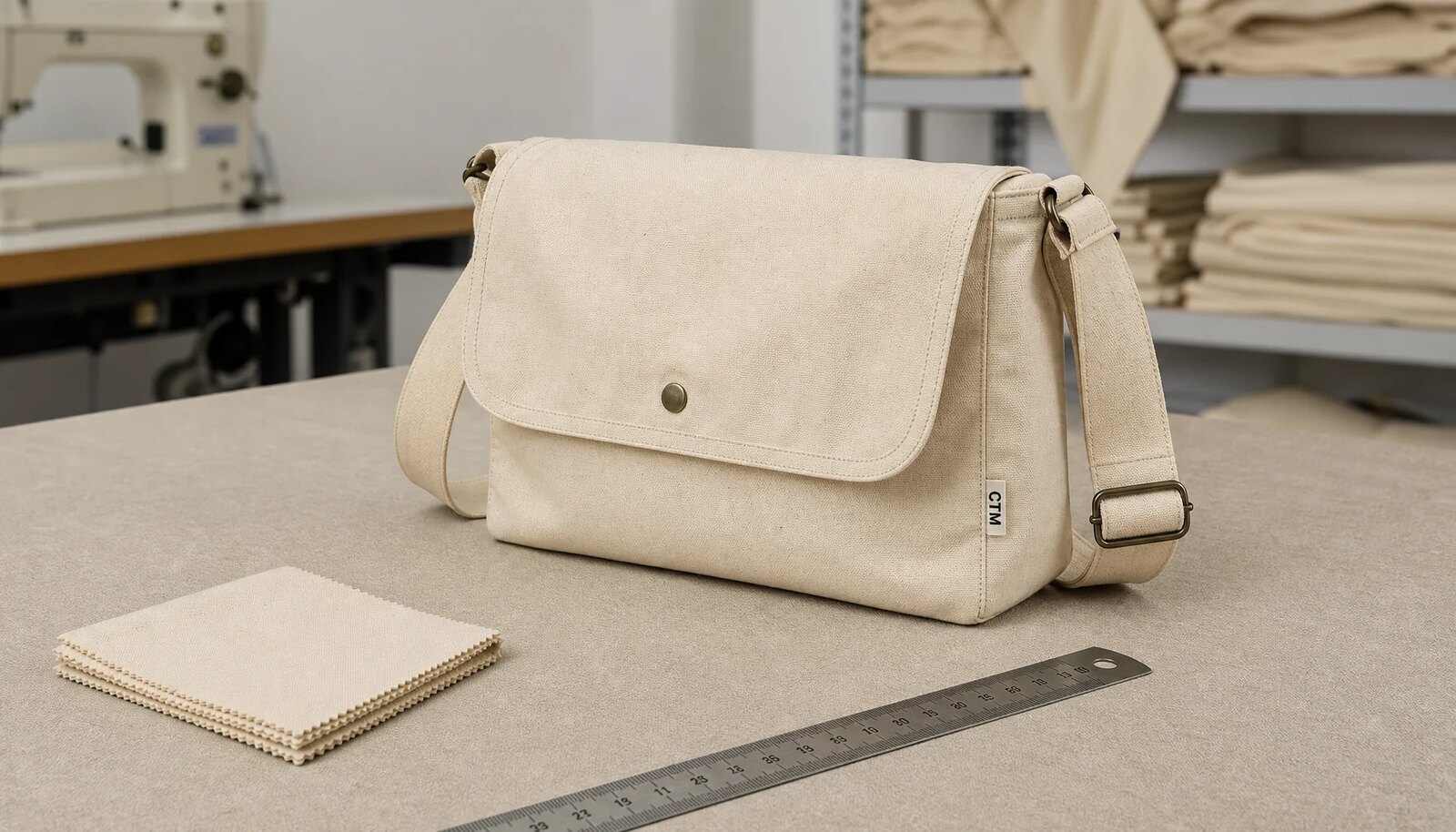
Start With the Retail Failure You Want to Prevent
A hotel retail canvas messenger bag has a different risk profile from a basic promotional tote. It sits on a shelf, carries a visible property or lifestyle logo, and is often bought as a travel item rather than a free giveaway. The main buying problem is not only whether the supplier can sew a bag. It is whether the bag still looks retail-ready after production, packing, inland handling, sea freight, and store display.
The RFQ should therefore be written around visible quality and functional stress points. Procurement teams should define the bag as a finished retail product: fabric weight, body structure, flap alignment, strap comfort, hardware finish, print durability, packing method, and inspection limits. A low quote can be acceptable only when the supplier shows the same measurable construction, not when the cheaper price comes from lighter fabric, thinner webbing, smaller bag size, or skipped reinforcement.
- Treat stains, odor, crooked logo placement, and crushed flap corners as retail failures, not minor cosmetic issues.
- Use a physical approved sample as the control standard for bulk inspection.
- Require the supplier to quote the same construction details instead of comparing only unit price.
Choose Canvas Weight by Shelf Shape and Carry Load
For wholesale canvas messenger bags in hotel retail, the practical range is usually 12 oz to 16 oz canvas, roughly 390 to 540 GSM. A 10 oz canvas may reduce cost and freight weight, but the bag can look soft, wrinkle easily, and lose shape on a retail hook. An 18 oz canvas can feel premium, but it may make the flap stiff, increase needle breakage, slow sewing output, and raise carton volume.
The fabric description must be more exact than cotton canvas. Natural canvas, dyed canvas, washed canvas, and waxed canvas behave differently in cutting, printing, and packing. Washed fabric gives a softer lifestyle look but can vary more in shade and size. Dyed fabric needs colorfastness checks, especially if light hotel towels, white uniforms, or guest clothing may touch it. Waxed canvas looks premium but complicates printing and may show scratches during packing.
- 12 oz canvas: good for value hotel shops, lighter retail price points, and folded packing.
- 14 oz canvas: balanced option for most resort, conference, and boutique hotel retail orders.
- 16 oz canvas: stronger shelf presence, better structure, higher freight and sewing cost.
- Dyed canvas: request lab dip approval and colorfastness to rubbing before bulk fabric booking.
- Washed canvas: approve shade range and shrinkage tolerance, not only one attractive sample.
Build the Bag Around Real Use, Not a Flat Photo
Many quote problems start when a buyer sends a front-view image and asks for the best price. Messenger bags need side, bottom, strap, flap, and closure decisions. A retail customer will handle the flap, adjust the strap, carry the bag across the body, and place travel items inside. If the RFQ does not define these points, factories may simplify the structure to win the price comparison.
Useful specs include finished width, height, gusset, flap depth, strap width, strap length range, lining requirement, pocket count, and closure type. A boxed bottom improves capacity and shelf shape but costs more than a flat envelope construction. A wider strap feels better but uses more cotton webbing or canvas strap material. Interior pockets add perceived value but require tighter sewing control because uneven pocket lines are very visible when customers open the bag.
- Specify whether the bottom is flat, boxed, or gusseted, and include finished measurements.
- Define strap width and adjustable length range for crossbody use.
- Mark reinforcement points at strap ends, side seams, and flap corners.
- Clarify whether lining, interior pocket, zipper pocket, or laptop sleeve is included.
- State closure type: snap, magnetic snap, zipper under flap, buckle, or Velcro.
Select the Logo Method Before Comparing Prices
Print method changes the cost, lead time, and defect risk. Screen printing is usually the most stable choice for simple hotel logos, resort names, and one to three solid colors. It works well on flat panels before sewing, but heavy canvas texture can affect fine lines. The buyer should provide vector artwork, Pantone references, print size, placement distance from edges, and whether the logo must sit centered under the flap or visible when the flap is closed.
Embroidery can make a small logo feel premium, but it can pucker canvas if backing, stitch density, and logo size are not controlled. Heat transfer may handle complex artwork, gradients, or small details, but the edge must be tested for lifting, especially on washed or textured canvas. For hotel retail, the safest route is to approve the logo method on the actual fabric, then use that sample as the inspection standard for color, handfeel, registration, and wash or rub performance.
- Screen print: best for clean solid logos and larger flat areas.
- Embroidery: best for small premium marks, labels, or badges, not oversized dense logos.
- Heat transfer: useful for detailed art, but test edge adhesion and surface feel.
- Woven label: practical for repeat programs where the bag may be reordered in several colors.
- Debossed leather patch: premium option, but confirm material compliance and stitch position.
Read MOQ by Material, Trim, and Process
MOQ is not one number. A supplier may accept 300 pieces for a standard natural canvas messenger bag, but the same style can require a higher MOQ when the buyer requests custom dyed fabric, custom metal hardware, a branded lining, special hangtags, or individual retail boxes. Procurement teams should separate the bag sewing MOQ from the fabric dyeing MOQ, print setup MOQ, hardware MOQ, and packing MOQ.
This matters when comparing supplier quotes. One supplier may quote a low unit price because the bag uses stock canvas and standard hardware. Another may quote higher because the price includes custom dyed canvas, screen setup, thicker strap webbing, and retail packaging. Without an MOQ breakdown, the buyer may approve a sample that cannot be produced economically at the actual order quantity.
- Stock natural canvas usually supports lower MOQ and faster sampling.
- Custom dyed canvas needs lab dip approval and may require a minimum fabric lot.
- Custom hardware color or logo engraving can create a trim MOQ above the bag order quantity.
- Multi-color screen printing adds setup cost even when the bag quantity is modest.
- Retail boxes increase MOQ, carton volume, and warehouse handling cost.
Use Samples to Lock the Production Standard
A sales sample proves the concept. A pre-production sample proves the production method. For hotel retail orders, the pre-production sample should use the planned bulk fabric, final logo method, final hardware, final strap, final seam construction, and the intended folding or packing method. If a supplier cannot make this sample before mass cutting, the buyer carries the risk of discovering problems only during final inspection.
Sample review should be structured. Measure the bag after it is packed and unpacked. Test whether the flap returns to shape after folding. Pull the strap joints by hand and review the stitch pattern. Rub the logo with a dry and slightly damp white cloth. Open and close snaps or zippers repeatedly. Place common travel items inside, such as a tablet, guidebook, water bottle, or folded shirt, to see whether the body shape and strap comfort match the retail positioning.
- Keep one signed sample with the buyer and one with the factory.
- Photograph measurement points and logo placement for the QC team.
- Approve acceptable natural canvas slubs if they are part of the intended look.
- Reject sample shortcuts such as substitute hardware, different strap width, or unapproved fabric.
- Record changes in a written sample approval sheet before bulk production starts.
Set Inspection Thresholds Before Goods Are Finished
Final inspection works best when the factory knows the defect definitions before production. For canvas messenger bags, critical defects include sharp metal edges, broken straps, mold, severe odor, missing required labels, and incorrect branding. Major defects include visible stains, crooked flap, weak strap stitching, wrong fabric shade, logo misplacement, skipped stitches, broken snaps, and carton quantity errors. Minor defects may include small loose threads or slight natural fiber marks within the approved sample range.
An AQL final random inspection can be used, but buyers should be careful with visible logo defects. Even if the AQL result passes, a hotel retail program may still suffer if many logo faces look dirty or off-center on the shelf. For first orders or high-visibility hotel launches, it is reasonable to request factory internal 100 percent visual sorting for the logo panel and exterior face before the random third-party inspection.
- Size tolerance: commonly plus or minus 0.5 cm for body dimensions if the construction allows it.
- Logo skew: set a measurable limit, such as no obvious visual tilt and within the approved placement tolerance.
- Stitch density: define stitches per inch or match the approved sample if the factory standard is acceptable.
- Strap joint strength: require reinforcement and a practical pull check on inspected samples.
- Odor and mildew: treat as major or critical depending on severity and destination requirements.
Control Packing So Retail Shape Survives Freight
Packing is part of quality, not an afterthought. Canvas messenger bags with flaps can develop hard creases if folded too tightly or compressed under heavy cartons. Metal hardware can leave pressure marks on natural canvas. Dark straps can rub against light body fabric. If bags arrive with distorted flaps, dirty corners, or barcode labels on the wrong face, the distributor may need local rework before delivery to hotel shops.
The packing plan should include individual protection, fold method, inner quantity, master carton quantity, carton board strength, carton dimensions, gross weight, carton marks, and barcode placement. For sustainability targets, buyers can request recyclable polybags, paper bands, or no individual polybag, but the decision should be tested against moisture, dust, and handling risk. A clean retail presentation often costs less to protect at the factory than to repair after arrival.
- Place tissue or separator material where hardware may press into the canvas face.
- Avoid over-compressing flaps; keep carton height realistic for the bag structure.
- Use silica gel when humidity risk is high and destination rules allow it.
- Keep gross carton weight practical for warehouse handling, often under 15 to 18 kg where possible.
- Match carton labels to the purchase order, SKU, color, quantity, and destination warehouse.
Compare Quotes With Landed Cost in Mind
The cheapest ex-factory quote is not always the lowest landed cost. A 16 oz bag may have a stronger retail feel but fewer units per carton and higher sea freight volume. A boxed bottom may improve function but increase carton size. Retail boxes can make shelf presentation easier but can quickly raise CBM. Air freight for late goods can erase the savings from a low unit price.
A practical quote comparison should include unit price, sample fee, mold or screen charge, fabric weight, print method, MOQ by component, carton quantity, carton size, gross weight, lead time, payment term, and inspection responsibility. Buyers should calculate cost per sellable unit after expected defect allowance, local relabeling risk, and freight volume. This is especially important for distributors supplying multiple hotel properties, where carton labeling errors and uneven assortments create downstream handling costs.
- Compare CBM per 1,000 units, not only unit price.
- Add setup charges across the actual order quantity to see real piece cost.
- Include local rework risk if the supplier does not control packing and labeling well.
- Check whether quote validity covers fabric and cotton price movement.
- Request the same Incoterm from each supplier before ranking prices.
Protect the Schedule With Visible Milestones
Canvas messenger bag lead time depends on material availability, sample approval speed, printing capacity, sewing line loading, and packing complexity. A realistic schedule should separate artwork proof, lab dip if needed, material booking, pre-production sample, bulk cutting, printing or embroidery, sewing, finishing, inspection, and export packing. A single statement such as 30 days after deposit is too vague for a hotel retail launch tied to a season, event, or property opening.
Schedule risk usually appears when the buyer changes artwork after screen setup, approves a sample with comments but no revised sample, or requests custom fabric after assuming stock fabric pricing. The safest workflow is to freeze artwork and material first, approve the pre-production sample, then release bulk cutting. If the order has several hotel names or destination labels, separate the assortment plan early so the factory can avoid mixed cartons and wrong barcode placement.
- Reserve time for lab dip or strike-off approval when color matching matters.
- Do not allow bulk cutting before the pre-production sample is approved in writing.
- Place inspection booking before the factory finishes packing, not after cartons are sealed.
- Require daily or weekly production status for cutting, printing, sewing, and packing.
- Confirm whether holidays, power limits, or peak season capacity affect the ship date.
Specification comparison for buyers
| Spec decision | Recommended option | When it fits | Buyer risk to check |
|---|---|---|---|
| Fabric weight | 12 oz to 16 oz canvas, roughly 390-540 GSM depending on yarn and weave | Hotel gift shops, resort boutiques, conference retail, and mid-range lifestyle merchandise | Low GSM may collapse on shelf; high GSM may raise freight cost and make flap folding bulky |
| Construction style | Full flap messenger with boxed bottom and reinforced strap joints | Retail bags expected to carry tablets, amenity kits, travel documents, or light shopping items | Flat envelope styles look cheaper and fail faster at strap attachment points |
| Print method | Screen print for solid hotel marks; heat transfer only for complex small-color graphics; embroidery for premium small logos | Brand owners balancing durability, unit cost, and retail appearance | Ink cracking on heavy texture, transfer edge lift, and embroidery puckering on untreated canvas |
| Hardware choice | Antique brass or matte nickel snaps, sliders, and D-rings with salt-spray or rub test evidence | Coastal hotels, resort retail, and bags handled daily by shop staff | Plated hardware can stain canvas or corrode in humid storage |
| Supplier route | Direct bag factory with in-house cutting, sewing, and print coordination | Bulk wholesale orders needing consistent construction and repeat production | Trading-only suppliers may quote fast but have weak control over seam allowance, print registration, and carton packing |
| Sample approval | Pre-production sample using booked fabric, approved logo method, final hardware, and actual packing fold | Orders where retail display quality matters and the buyer cannot inspect every unit before shipment | Sales samples made from substitute cloth hide shrinkage, color, and sewing problems |
| Inspection level | AQL-based final random inspection plus 100 percent visual sorting for visible logo defects if budget allows | Hotel retail programs with multiple properties or repeat replenishment orders | Only checking carton count misses stains, crooked flaps, strap defects, and barcode errors |
| Packing format | Individual recyclable polybag or paper band, silica gel when needed, export carton under practical lift weight | Wholesale distribution to hotel warehouses, retail shops, and third-party logistics centers | Over-compression causes flap creases; weak cartons crush bottom corners during sea freight |
Buyer checklist before sampling
- Define finished bag size with tolerance, not only a photo reference; include width, height, gusset, flap drop, and strap range.
- State fabric by weight and finish, such as 12 oz natural canvas, washed canvas, dyed canvas, or waxed canvas, and request GSM confirmation.
- Approve one print method with logo size, Pantone reference, placement distance from seams, and acceptable registration tolerance.
- Require reinforcement at strap joints, flap corners, and bottom stress points; specify bar tacks or cross-stitch where load is expected.
- Confirm hardware material, color, corrosion resistance expectations, and whether metal parts may touch printed or light-colored fabric in packing.
- Request a pre-production sample made with booked bulk fabric and the same sewing line setup before releasing mass cutting.
- Set inspection thresholds for stains, loose threads, skipped stitches, crooked flaps, print defects, odor, and carton damage.
- Define retail packing, carton markings, barcode labels, inner quantity, master carton quantity, and maximum carton weight.
- Ask for lead time split by material booking, sample approval, bulk production, inspection, and packing instead of one optimistic ship date.
- Collect quote data in the same format from all suppliers: fabric GSM, print method, MOQ, sample fee, unit price, carton size, gross weight, and payment terms.
Factory quote questions to send
- What exact canvas weight, yarn count, and GSM are included in this quotation, and can the factory provide a fabric swatch from the planned bulk lot?
- Is the price based on natural, dyed, washed, or coated canvas, and what shrinkage or colorfastness test is available for that material?
- Which logo method is quoted, what is the maximum print area included, and how many colors or screens are included in the unit price?
- Are strap sliders, D-rings, snaps, zippers, or magnetic closures included, and what hardware finish and plating standard will be used?
- What stitch density, seam allowance, and reinforcement method are planned at the strap joints and flap edge?
- What MOQ applies to the bag body, fabric dyeing, custom hardware, printed lining, and branded packing separately?
- How many days are needed for lab dip, artwork proof, pre-production sample, bulk cutting, sewing, printing, final inspection, and export packing?
- What are the carton dimensions, units per carton, gross weight, and recommended loading quantity for sea or air shipment?
- What defects are considered critical, major, and minor in the factory's internal QC report for this bag style?
- If the hotel group reorders after the first season, what materials or trims should be pre-approved to keep color and handfeel consistent?
Quality-control points to confirm
- Finished size should stay within the agreed tolerance, usually plus or minus 0.5 cm for main body dimensions and plus or minus 1 cm for strap length.
- Canvas fabric should match approved GSM, color, texture, and handfeel; visible slubs may be acceptable only if approved on the reference sample.
- Flap alignment should be even from left to right, with no twisting, uneven drop, or exposed raw edge when closed.
- Logo placement should match the approved sample, with no major skew, ink bleeding, missing print, heat-transfer lifting, or embroidery puckering.
- Strap attachment points should include the approved reinforcement and should not show broken stitches, needle holes, or fabric tearing after pull testing.
- Hardware should open and close smoothly without sharp edges, rust marks, plating scratches, or stains transferred to the canvas.
- Interior seams should be clean, overlocked or bound as specified, and free from loose threads that can be seen by retail customers.
- Odor, mildew, oil stains, water marks, and dirty handling marks should be treated as major defects for hotel retail merchandise.
- Individual packing should protect the flap, logo face, and hardware from rubbing; cartons should pass practical handling without crushed corners.
- Carton labels, barcode stickers, retail hangtags, and assortment quantities should match the purchase order and packing list exactly.