Start with the retail job
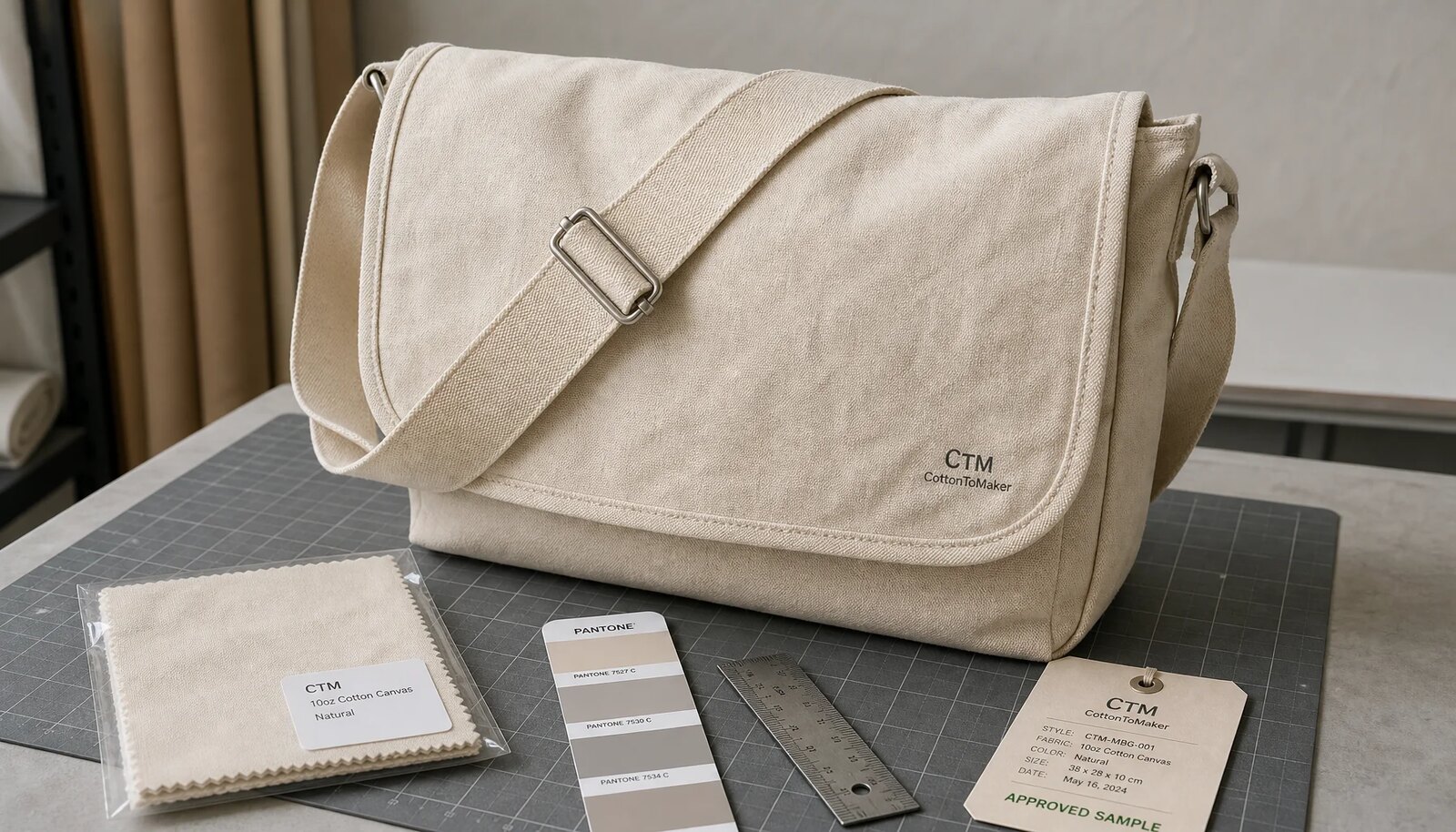
A canvas messenger bag in a hotel shop is judged as merchandise, not as a giveaway. Guests handle it beside apparel, guidebooks, spa products, local food, and travel accessories. They notice whether the canvas has structure, whether the strap feels secure, whether the flap sits cleanly, and whether the logo looks intentional rather than pasted on.
The buying brief should begin with the bag’s role. A resort store may need a casual carry bag for sunscreen, books, and travel items. A city hotel may prefer a slimmer messenger for maps, tablets, or daily outings. A conference hotel may value fast replenishment and consistent logo placement. A design hotel may accept a higher unit cost for quieter branding, better hardware, and a more tactile canvas.
This early decision keeps the project from drifting. The same bag cannot be optimized for lowest freight cost, premium shelf price, heavy daily carry, and a complex multi-color logo unless tradeoffs are named. Before asking for wholesale canvas messenger bags for hotel retail, define the customer, the expected use, and the retail price band.
- State the channel: boutique, resort shop, conference store, staff shop, gift-with-purchase, or distributor replenishment.
- Define expected use: light souvenir carry, tablet carry, bookstore merchandise, amenity packaging, or daily travel.
- Set target shelf price and acceptable landed-cost range before upgrading canvas, hardware, or packing.
- Decide how the bag will display: folded shelf stack, peg hanging, boxed unit, flat carton, or backroom replenishment.
- Identify launch timing, reorder expectations, destination markets, and any hotel group SKU structure.
Choose supplier type deliberately
Supplier type shapes the risk profile. A cut-and-sew factory can control dimensions, seams, straps, and fabric use, but printing may be outsourced. A factory with in-house screen printing can reduce proofing loops, yet buyers still need finished-bag inspection. A promotional-products supplier can be efficient for stock bodies, but its standard construction may not suit a premium boutique shelf.
For a single property logo, a factory with both sewing and printing can be practical. For a hotel group with several property marks, a trading company or sourcing partner may help coordinate barcode labels, mixed cartons, and split shipments. For a luxury or heritage property, a smaller soft-goods workshop may produce better hand feel, but procurement should check repeat capacity and inspection discipline before rolling out chain-wide.
The lowest quote is not automatically the best quote. A supplier that includes physical samples, carton data, barcode support, print strike-offs, and final inspection cooperation may prevent more cost than it adds. Quote comparison should show who controls each process and who pays when a defect appears.
- Ask which party handles cutting, sewing, printing, embroidery, labels, packing, inspection, and rework.
- Use stock-body suppliers only when size, strap, canvas weight, and seam quality match the retail plan.
- Use custom factories when flap shape, pocket layout, strap comfort, or reinforcement details matter.
- Confirm whether decoration occurs before or after sewing and how finished placement is checked.
- Require one accountable owner for off-position print, wrong labels, packing damage, and failed inspection.
Translate the brief into measurements
Terms like “medium messenger bag” or “premium canvas satchel” leave too much room for interpretation. A workable specification uses finished dimensions, component details, and measurement methods. Width, height, gusset depth, flap depth, pocket size, strap width, and strap adjustment range should be stated in millimeters or inches, with tolerances.
Hotel retail buyers should also define how the bag must sit in the store and ship through the supply chain. A bag that looks good open on a sample table may not hang well on a peg, stack neatly on a shelf, or fit the property’s backroom storage. If the bag must fit a standard barcode hangtag, display hook, shelf depth, or carton dimension, that requirement belongs in the product brief.
Reinforcement is part of the spec, not an afterthought. Messenger bags carry weight through strap joints, flap closures, pocket corners, buckle points, and bottom gussets. Reinforcement can include bartacks, box stitches, rivets, backing pieces, binding, extra seam allowance, or heavier webbing. Ask the supplier to show these details on the sample and confirm they remain in the bulk price.
- Specify finished width, height, gusset, flap depth, front pocket, inner pocket, and strap adjustment range.
- Name measurement points, such as finished seam to seam, outer binding to outer binding, or folded flap edge.
- Set tolerances separately for body dimensions, strap length, and logo placement.
- Define closure type: magnetic snap, metal snap, buckle, zipper, hook-and-loop, or no closure.
- Approve reinforcement at strap ends, pocket corners, closure backing, zipper stops, and bottom gusset corners.
Specify canvas without guessing
Canvas weight affects hand feel, shelf structure, sewing bulk, decoration, carton volume, and freight. Buyers often compare 10 oz, 12 oz, or 14 oz canvas, but ounce labels are not enough. Two fabrics with the same nominal ounce weight can differ because of yarn, weave density, finishing, moisture content, and test method.
As a general sourcing reference, 10 oz cotton canvas may often fall around the low-300 GSM range, 12 oz around the high-300 GSM range, and 14 oz around the mid-400 GSM range. These are not universal conversions. If weight affects price or quality, ask for a stated GSM range, tolerance, and testing context. For formal product claims, request third-party testing through a recognized lab.
Finish changes both appearance and risk. Natural canvas can suit resort and boutique retail because slubs and shade variation feel authentic, but it can soften print edges. Dyed canvas needs shade approval and may require colorfastness or crocking checks if it will touch light clothing. Washed canvas is softer but may distort more. Waxed or coated canvas can feel premium, yet ink adhesion must be tested before bulk production.
Acceptance standards should separate acceptable canvas character from defects. Small slubs within the sealed swatch may pass. Oil stains, mold, holes, heavy shade bands, dark contamination, strong odor, or obvious weaving faults should be rejected even if the supplier calls them natural variation.
- Use ounce weight plus GSM range; do not compare quotes on ounce weight alone.
- Approve a sealed fabric swatch for shade, texture, slub level, hand feel, and finish.
- Identify the fabric as natural, bleached, dyed, washed, coated, waxed, laminated, or recycled-content canvas.
- Request shrinkage, colorfastness, crocking, fiber content, or restricted-substance testing when the market requires it.
- Ask for documentation before using recycled-content or sustainability claims in retail copy.
- Define unacceptable fabric defects separately from approved natural variation.
Select decoration for the fabric
Decoration must be chosen for the actual canvas, not for a flat digital mockup. Screen printing is often a strong option for one- to three-color hotel marks because it is cost-effective at wholesale volume and works well for bold artwork. The proof still needs to show color, opacity, edge clarity, curing, odor, and placement on the selected fabric.
Embroidery can make a crest, monogram, or small property mark feel more premium, but dense stitches can pucker lighter canvas or distort a flap. The reverse side also matters if the inside of the flap is visible. Woven labels are useful for subtle branding, hotel group programs, or multiple property versions because the bag body can stay consistent while the label changes.
Digital print, heat transfer, puff ink, metallic ink, reflective ink, and other specialty methods need extra proofing. A messenger flap is handled, folded, pressed in cartons, and repeatedly opened by shoppers. Any decoration on the flap should be checked for cracking, tackiness, rub-off, transfer, odor, and crease behavior after packing.
- Use screen print for bold marks, repeat orders, and balanced setup-to-unit cost.
- Use embroidery for small premium marks after checking puckering, backing, and reverse-side appearance.
- Use woven labels for subtle branding, shared hotel group bodies, or easier property-version management.
- Test heat transfer and specialty inks for peel, cracking, rub, odor, and packed compression.
- Set minimum line thickness, registration tolerance, and print opacity expectations before tools are made.
- Approve decoration on selected canvas or production-lot fabric, not only on paper or generic sample cloth.
Build a useful proofing checklist
A proof should become a production standard. It needs more than a good-looking logo. The approved record should include artwork version, logo size, color target, decoration method, placement references, placement tolerance, fabric swatch, construction details, hardware, label placement, packing method, approval date, and any permitted deviation.
Placement must be measured from finished references. If the logo sits on the flap, use the finished flap edge, binding, seam line, snap center, buckle strap, or bag centerline. Measuring from a flat cut panel can create problems once fabric is folded, sewn, bound, and pressed. For centered marks, even a few millimeters can be visible.
Color control should be physical. PMS references and brand guidelines are helpful, but natural canvas shade, absorbency, ink opacity, and curing conditions change the visible result. If an exact brand color cannot be achieved on raw canvas, approve the closest acceptable physical standard and keep it with the sealed sample.
The final pre-production sample should use final fabric, final construction, final decoration, intended webbing, hardware, labels, and proposed packing. A print strike-off helps evaluate ink behavior, but it does not prove flap alignment, seam distortion, snap position, fold impact, barcode placement, or carton pressure.
- Record logo width, height, print location, and distance from finished references in millimeters.
- Define whether artwork is centered on the flap, visible fold, body panel, pocket, or full bag width.
- Approve color under D65, daylight, or another agreed light condition and keep a physical target.
- Seal one approved sample with the supplier and one with the buyer, distributor, or inspection team.
- Require written approval for changes to fabric lot, ink, hardware, webbing, labels, or packing.
- Avoid vague notes such as “approved except improve logo”; state exactly what passes and what must change.
Control MOQ price and SKU splits
MOQ is rarely only a sewing quantity. It may be driven by fabric purchase, dye lot, screen setup, embroidery digitizing, woven label production, hardware finish, barcode labels, carton marks, or line changeover. A 1,000-piece order with one logo can be simpler than a 1,000-piece order split across five property logos.
For hotel groups, ask what causes each minimum. If fabric color drives the MOQ, a shared stock natural canvas may help. If label production drives it, one shared woven label or one common hangtag format may reduce complexity. If print setup drives it, schedule property versions together and separate setup charges clearly.
Price breaks should separate the base bag from variable branding and packing costs. Ask for one quote for one fabric color and one logo, then request adders for extra logos, colors, screens, barcodes, hangtags, carton labels, split shipments, and special packing. This makes landed cost easier to compare and prevents extra property marks from being treated as minor artwork edits.
- Request price breaks at practical quantities such as 500, 1,000, and 3,000 pieces for one fabric color and one logo.
- List setup charges for screens, digitizing, woven labels, hangtags, barcode labels, and artwork revisions.
- Ask whether extra property logos require strike-offs, pre-production samples, inspection references, or carton marks.
- Confirm overrun and underrun tolerance, quote validity, payment terms, and production-start trigger.
- Clarify whether split shipments add labeling, handling, palletizing, export documentation, or destination charges.
- Compare Incoterm, port, carton size, gross weight, net weight, units per carton, and estimated CBM.
Compare quotes like a buyer
A strong quote comparison shows what is included, what is excluded, and which risks remain with the buyer. A low price may exclude sample remakes, retail packing, barcode labels, carton marking, inspection support, or decoration setup. A higher quote may be better value if it includes the controls that prevent rework, delays, and retail markdowns.
Lead time should be broken into sample time, material preparation, production, inspection, and shipment readiness. If a supplier says “30 days,” ask whether the clock starts after deposit, after artwork approval, after fabric arrival, or after pre-production sample signoff. Hotel retail launches often depend on seasonal windows, property openings, or event dates, so approval delays have commercial impact.
Supplier responsiveness during proofing is also a useful signal. A supplier that answers measurement questions clearly, updates artwork files, confirms carton data, and explains MOQ drivers is easier to manage than one that only repeats a unit price. Procurement should reward clarity, not just the lowest number.
- Separate base unit price from decoration setup, samples, labels, retail packing, carton marks, and inspection support.
- Ask what happens after a failed inspection: sorting, rework, replacement, discount, reinspection, or shipment hold.
- Confirm whether packed samples, barcode scans, and mixed-SKU packing checks are included before shipment.
- Compare quote validity, deposit requirement, sample approval deadline, and lead-time assumptions.
- Do not accept a lower price unless fabric, construction, decoration, packing, and QC scope are equal.
- Keep quote versions tied to the same artwork, sample, swatch, Incoterm, and packing format.
Set final inspection standards
Quality control works best when standards are named before production starts. Many buyers use ANSI/ASQ Z1.4 or ISO 2859-1 sampling plans, often at General Inspection Level II unless another level is required. AQL values should be agreed in advance rather than negotiated after cartons are packed.
For hotel retail messenger bags, buyers commonly set zero tolerance for critical defects, with major and minor limits adjusted to the program’s risk level. Premium boutique retail may need stricter limits than a short-term promotional order. What matters is a product-specific defect list: wrong logo, wrong barcode, mold, sharp hardware, broken strap attachment, open seam, print cracking, failed closure, and heavy staining should not be treated like small thread ends.
Inspection should cover measurements, function, appearance, decoration, packing, and labeling. Measure finished width, height, gusset, flap depth, pocket size, and strap length after sewing and pressing. Operate snaps, zippers, sliders, and buckles. Rub and fold printed areas. Scan barcodes on packed units. Open cartons to confirm mixed-SKU accuracy, destination labels, carton marks, odor, and moisture protection.
- Name the sampling plan, inspection level, AQL limits, and defect classes before bulk production.
- Classify critical defects as safety issues, mold, severe contamination, wrong logo, wrong barcode, or broken load-bearing parts.
- Classify major defects as visible print failure, open seams, poor closure function, slipping sliders, heavy stains, or crooked flaps.
- Classify minor defects as small thread ends, removable dust, or slight natural variation within the sealed standard.
- Set body measurement tolerance separately from logo placement tolerance and strap adjustment tolerance.
- Require inspection of finished packed bags, not only loose panels, blank samples, or unpacked pieces.
Pack for shelf-ready arrival
Packing can damage a bag that passed sewing and print inspection. Messenger bags are often folded through the flap, exactly where the hotel logo appears. If ink is under-cured, the carton is over-compressed, or the fold crosses heavy artwork, the print can crack, turn glossy, block, transfer, or develop a permanent crease.
The right packing format depends on retail presentation and sustainability policy. Recycled polybags protect against dust and moisture but may conflict with plastic-reduction goals. Glassine, tissue, and paper bands can look better but provide less moisture protection. No individual packaging reduces waste, but cartons must then control abrasion, dirt, and humidity more carefully.
Carton labeling matters for hotel groups. If several property logos ship together, cartons should identify property, SKU, barcode, color, quantity, purchase order, and destination. Mixed cartons should follow an approved assortment plan so receiving teams do not open every carton to find the correct hotel logo.
Approve a packed sample before mass packing. Compress it in the planned fold and carton arrangement, then reopen it to check logo appearance, barcode scan, hangtag position, odor, fold line, print transfer, and shelf presentation. This simple step often prevents a good bag from arriving as damaged retail stock.
- Avoid fold lines across large printed artwork when the bag shape allows another fold method.
- Use tissue, insert boards, longer curing time, or lower carton quantity if transfer or creasing appears.
- Define individual packing as recycled polybag, glassine, paper band, tissue wrap, carton unit, or no individual pack.
- Confirm carton dimensions, units per carton, gross weight, stacking limit, desiccant use if needed, and carton marks.
- Scan barcodes on packed units and verify hangtags do not hide decoration or required product information.
- Approve mixed-SKU carton rules before shipment to prevent property-logo receiving errors.
Specification comparison for buyers
| Supplier type | Best fit for hotel retail buyers | Cost and lead-time profile | Tradeoffs to manage |
|---|---|---|---|
| Canvas bag cut-and-sew factory | Custom messenger bag bodies with defined size, flap shape, gusset, pockets, strap width, reinforcement, and retail packing | Often strong value once quantity supports custom cutting; timing depends on fabric availability, sampling, and sewing capacity | Decoration may be subcontracted, so name one party responsible for print placement, curing, packing, and final defects. |
| Factory with in-house printing | Repeat hotel logos, resort marks, and programs where screen print proofing speed matters | Can shorten sampling loops; setup costs still apply by logo, color, and print location | Confirm inspection is performed on finished packed bags, not only printed panels. |
| Trading company or sourcing agent | Hotel group orders with several property logos, mixed SKUs, special labels, barcodes, or split destinations | Quoting may be faster across supplier options; margin is built into unit price | Ask who owns sealed samples, defect sorting, rework decisions, and communication with subcontracted printers. |
| Promotional-products supplier | Stock-body messenger bags for events, conference retail, gift-with-purchase, or lower-complexity souvenir programs | Fastest when using existing bag bodies and standard canvas colors | Stock bags may have lighter canvas, narrow straps, simplified seams, and limited logo placement tolerance. |
| Premium soft-goods workshop | Boutique hotel, design hotel, heritage property, or small-batch retail programs needing elevated materials | Higher unit cost and lower throughput; sampling may be more detailed | Check repeatability, reorder capacity, carton discipline, and inspection readiness before scaling. |
| Decoration specialist plus sewing factory | Embroidery, woven labels, specialty inks, heat transfer, or multi-process branding | Can improve decoration options but adds handling and schedule risk | Define liability for print damage, off-position artwork, fabric marks, missed curing, and rework after decoration. |
Buyer checklist before sampling
- Define the retail role: boutique merchandise, resort souvenir, conference store, staff shop, gift-with-purchase, or replenishment SKU.
- Set target shelf price, expected load, display method, and brand position before selecting canvas weight or decoration.
- Specify finished width, height, gusset, flap depth, pocket layout, strap width, and adjustable strap length with one measurement method.
- State canvas type, ounce weight, GSM range, finish, color, shrinkage expectation, and acceptable natural variation.
- Approve decoration on the selected canvas or approved production fabric lot, not only from a PDF mockup or paper proof.
- Measure artwork from stable finished references such as flap edge, seam line, binding, snap center, buckle strap, or bag centerline.
- Control color with PMS or brand standard plus a physical approval under D65, daylight, or another agreed viewing condition.
- Confirm reinforcement at strap joints, flap stress points, closure backing, zipper ends, pocket corners, and bottom gusset corners.
- Compare quotes by supplier type, included setup, sample responsibility, packing scope, carton data, MOQ drivers, Incoterm, and inspection support.
- Set final inspection rules before production, including sampling plan, AQL limits, defect classes, measurement tolerance, barcode checks, and packing review.
Factory quote questions to send
- Are you the cut-and-sew factory, printer, trading company, or combined supplier, and which processes are completed in-house?
- What exact canvas weight, GSM range, weave description, finish, and color are included in the quoted unit price?
- Is the fabric stock natural canvas, bleached canvas, dyed canvas, washed canvas, coated canvas, waxed canvas, recycled-content canvas, or custom-developed fabric?
- What fabric test data can you provide or arrange for shrinkage, colorfastness, crocking, fiber content, or restricted substances if required?
- What MOQ applies per fabric color, logo design, hardware finish, label design, packing format, and shipment destination?
- Which decoration method is quoted, how many colors are included, and are screens, embroidery digitizing, woven labels, plates, or revisions charged separately?
- Will the print strike-off be made on approved canvas, and will the pre-production sample use final hardware, labels, webbing, and packing?
- Who is responsible if decoration is off-position, under-cured, transferred in packing, cracked, or inconsistent with the approved sample?
- What are the cost and timing for swatch, lab dip if needed, blank sample, print strike-off, pre-production sample, packed sample, and shipment sample?
- Which inspection standard do you support, such as ANSI/ASQ Z1.4 or ISO 2859-1, and how do you classify critical, major, and minor defects?
Quality-control points to confirm
- Use an agreed sampling plan such as ANSI/ASQ Z1.4 or ISO 2859-1, commonly with General Inspection Level II unless another level is specified.
- Define AQL targets before inspection, for example 0 critical defects, 2.5 major defects, and 4.0 minor defects, or stricter limits for premium retail.
- Classify critical defects as safety issues, mold, severe contamination, wrong hotel logo, wrong barcode, incorrect SKU, broken load-bearing strap, or sharp exposed hardware.
- Classify major defects as visible logo misplacement, poor opacity, cracked or tacky ink, non-functioning closure, slipping slider, broken stitches, open seams, heavy stains, or severe shade mismatch.
- Classify minor defects as small thread ends, slight slub variation within the approved standard, minor removable dust, or small measurement variation that does not affect use or shelf appearance.
- Check fabric GSM against the agreed tolerance and compare hand feel, shade, weave density, slub level, odor, and finish to the sealed swatch.
- Measure finished width, height, gusset, flap depth, pocket size, and strap length after sewing and pressing, using the agreed method and tolerance.
- Inspect print color, placement, opacity, registration, curing, odor, edge sharpness, rub resistance, folding behavior, and transfer risk on finished bags.
- Verify strap joints, bartacks, box stitches, rivets, magnetic snap backing, zipper ends, buckle points, pocket corners, and bottom gusset reinforcement.
- Open packed samples after compression to check print creasing, blocking, barcode visibility, hangtag position, carton marks, mixed-SKU accuracy, odor, and moisture protection.