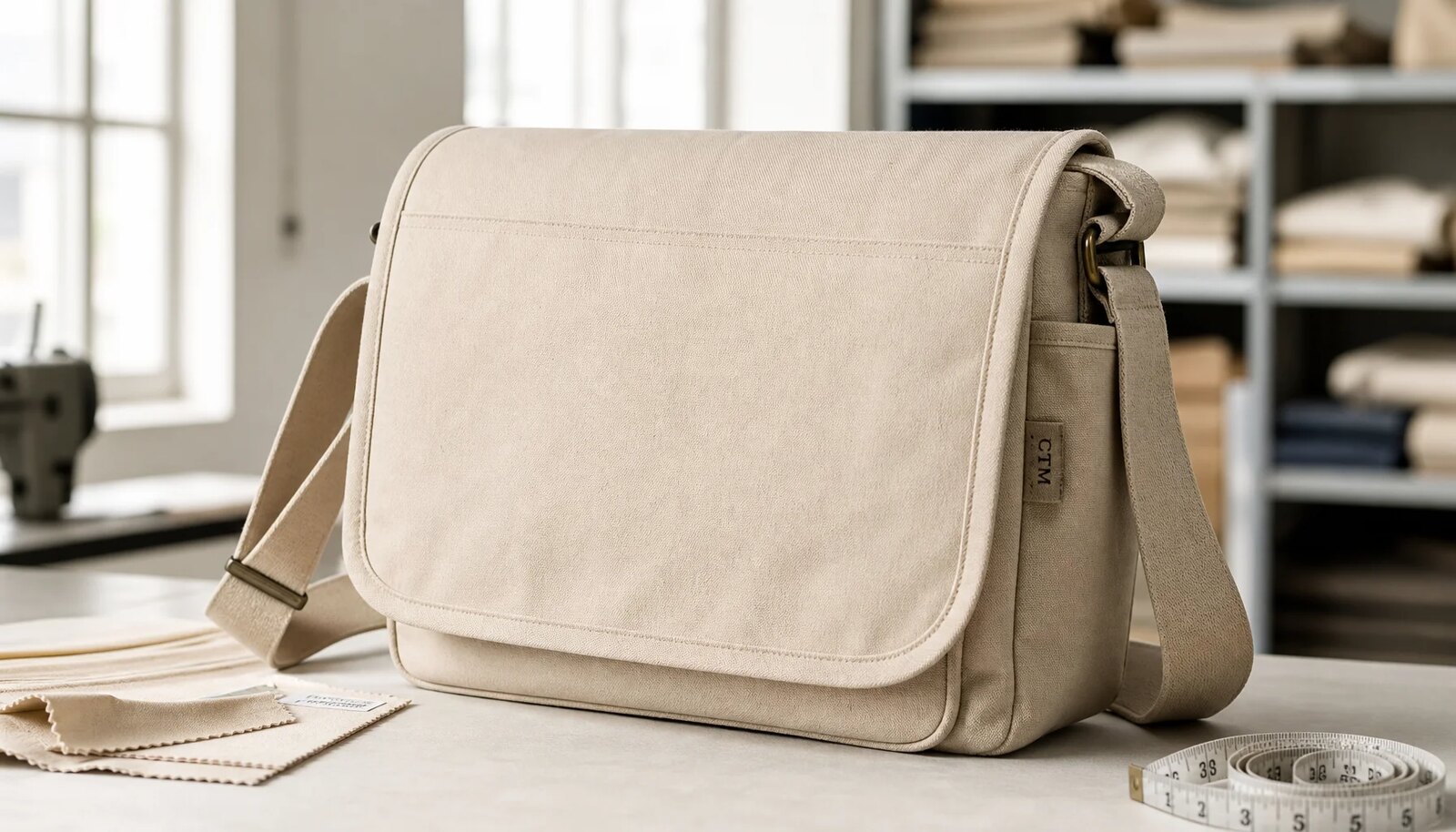
Start With the Hotel Retail Job
A canvas messenger bag sold through a hotel shop has to do more than carry a logo. It needs to look credible in a lobby store, spa boutique, resort retail corner, gallery display, or in-room retail program. Staff should be able to unpack it, place it on a shelf or hook, and sell it without steaming, trimming threads, replacing tags, or explaining defects. That is why procurement should begin with the retail job, not with a generic bag photo.
The strongest briefs describe use in plain operational terms. A light souvenir bag may only need to carry a map, phone, wallet, and sunglasses. A guest travel bag may need space for A4 papers, an 11-inch tablet, a guidebook, sunscreen, and a small water bottle. A premium boutique bag may call for a cleaner silhouette, subtler branding, better hardware, and more disciplined packing. Each version pushes the specification in a different direction: fabric weight, gusset depth, strap width, lining, pocket layout, and reinforcement all change.
Hotel groups should also decide whether the bag is a one-property item or a repeatable platform for several locations. A shared body with property-specific labels or hangtags can reduce development time and make reorders easier. A unique custom bag for each property may feel more tailored, but it increases MOQ, artwork control, inspection work, and inventory complexity. Make that decision before asking suppliers for prices.
- Define the retail role: souvenir, functional carry, boutique product, event item, employee gift, or multi-property SKU.
- State the selling environment: shelf stack, peg display, wall hook, front desk, spa boutique, in-room card, or warehouse replenishment.
- List what the bag must hold: A4 papers, tablet, phone, guidebook, sunscreen, small bottle, wallet, or room key wallet.
- Describe the desired retail impression: relaxed natural canvas, polished dyed canvas, premium structured bag, or casual resort item.
- Decide whether one body must support multiple logos, because that affects MOQ, labeling, packing, and reorder planning.
Turn the Brief Into a Measurable Spec
Suppliers can quote accurately only when the buyer gives them measurable requirements. A reference image is useful, but it is not a specification. If the RFQ is built around a photo alone, one supplier may price 10 oz canvas while another prices 12 oz. One may include lining; another may omit it. Strap width, gusset depth, pocket construction, seam finish, and reinforcement may all vary. The lowest quote may simply be the lightest or least controlled version of the product.
A workable spec sheet should cover finished width, finished height, gusset depth, flap length, strap width, strap length range, pocket dimensions, closure type, lining, seam finish, and reinforcement method. It should also define tolerances before sampling begins. For many canvas messenger bags, buyers can start discussion with ±1.0 cm for overall body dimensions, ±0.5 cm for pocket placement, and ±0.3 cm to ±0.5 cm for visible logo alignment. These are starting points, not universal rules. Washed canvas, thick seams, hand finishing, and structured flaps may need wider tolerances.
Include how the bag should look when empty. Hotel retail teams often display bags folded, stacked, or hanging. A bag that twists at the strap, collapses at the gusset, or carries a hard crease through the printed logo may meet a vague written description but still fail at store level. Put those visual expectations into the RFQ so the factory can price the right construction and packing method.
- Include all finished dimensions: width, height, gusset, flap length, strap width, strap length range, and pocket depth.
- Define closure clearly: flap only, zipper, snap, magnetic closure, buckle, hook-and-loop, button, or combined closure.
- Specify structure: unlined, lined, bound seams, internal facing, bottom panel, interfacing, or reinforced flap.
- Set tolerances before sampling, then measure the pre-production sample and bulk goods with the same method.
- Add visual requirements: centered flap, straight strap, clean corners, no logo crease, trimmed threads, and balanced hanging shape.
Choose Canvas Weight and Finish
Canvas weight is a helpful shortcut, but it is not enough on its own. Ask whether the supplier is quoting oz/yd² or gsm, and whether the stated weight is measured before or after dyeing, washing, coating, or other finishing. A natural 12 oz canvas and a washed 12 oz canvas may feel very different. One can be crisp and structured; the other can be softer, more relaxed, and more variable in size. Coated canvas may add practical value, but it can also affect ink adhesion, odor, stiffness, and fold marks.
For hotel retail, 10 oz canvas usually fits softer, price-sensitive souvenir bags where structure is not the main selling point. A 12 oz canvas is often a practical starting point for standard messenger bags because it balances body, sewing efficiency, cost, and freight weight. A 14 oz or heavier canvas can feel more substantial, but buyers should check seam bulk, needle holes, folded corners, flap stiffness, and carton volume. Heavier is not automatically better, especially when the design has small pockets, multiple layers, or tight curves.
Finish decisions should be made before quoting. Natural canvas has a warm hospitality feel, but it may show cottonseed flecks and shade variation. Dyed canvas gives a cleaner color story but needs lab dip or shade approval. Washed or enzyme-washed canvas feels softer and more lifestyle-oriented, yet shrinkage and dimension control become more important. Water-resistant or coated finishes can suit travel retail, but logo testing must happen on the actual finished canvas.
- Use 10 oz canvas for light souvenir programs where softness and price matter more than structure.
- Use 12 oz canvas as a common starting point for standard hotel retail messenger bags.
- Use 14 oz or heavier only after checking seam bulk, folded edges, empty shape, and freight impact.
- Specify finish: natural, bleached, dyed, pigment dyed, washed, enzyme washed, brushed, coated, or pre-shrunk.
- Approve both a swatch and a finished sample because weight alone does not define stiffness, shrinkage, or hand feel.
Specify Construction, Strap, and Hardware
Messenger bag quality often comes down to details that are easy to skip in an RFQ. Strap width, attachment method, flap construction, gusset shape, pocket openings, and bottom seams determine whether the bag feels dependable in use. In a hotel retail setting, a strap that twists, pulls at the side seam, or looks too narrow can make the whole product feel cheaper, even when the front logo is attractive.
Procurement should require clear reinforcement at the stress points. Strap anchors, side seams, flap corners, pocket openings, bottom corners, and hardware attachments should use a defined method such as bar-tacks, box stitching, double stitching, backing patches, or bound seams. If the design includes rivets, snaps, buckles, sliders, magnets, zippers, D-rings, or pullers, the quote should state material, finish, plating color, corrosion expectations, and substitution rules. Hardware that changes shade or finish between batches can make reorders look mismatched.
Strap length also deserves attention. A fixed shoulder strap may work for a small souvenir bag, but a functional messenger bag normally needs an adjustable crossbody strap. Strap width should match the intended load and retail position. Narrow webbing can reduce cost, but it may feel uncomfortable and look weak. During sample review, check webbing color, weave, hand feel, adjuster movement, and whether the strap stays flat when the empty bag hangs.
- Define strap type: fixed shoulder strap, adjustable crossbody strap, cotton webbing, self-fabric strap, or blended webbing.
- Specify reinforcement at strap anchors, flap corners, pocket openings, gusset corners, and hardware attachment points.
- Ask for stitch density, seam allowance, thread type, and edge finish on visible and load-bearing seams.
- Confirm hardware finish and substitution rules for sliders, D-rings, snaps, magnets, buckles, zippers, and pullers.
- Treat strap twist, flap pull, and uneven hanging shape as construction issues, not minor presentation issues.
Match Logo Method to the Artwork
Logo execution is one of the most common sources of disagreement in wholesale canvas messenger bags for hotel retail. A digital mockup cannot show how ink sits on canvas texture, how embroidery pulls a panel, or how a woven label looks after folding. Approve decoration in stages: artwork proof, physical strike-off on actual canvas, and then a pre-production sample with the logo on the finished bag.
Screen printing is usually efficient for simple one- or two-color hotel logos, property names, icons, and destination artwork. It works best when line weight is practical and the ink system is matched to the canvas finish. Small text, thin lines, halftones, and light ink on dark canvas need physical testing. Ask for ink color references, curing method, acceptable color tolerance, and a basic dry rub or handling check before bulk production.
Embroidery, woven labels, and patches can lift the retail impression when they are specified carefully. Embroidery should be tested for puckering, backing marks, and thread coverage. Woven labels are useful for subtle branding and multi-property programs because the same bag body can accept different labels or hangtags. Patches can feel premium, but they add material sourcing, edge-finish decisions, and attachment inspection. The buyer should define patch edge, label position, stitching color, and alignment tolerance.
- Use screen print for simple logos, spot colors, and cost-controlled retail programs.
- Use embroidery only when the artwork is bold enough and the canvas panel can support stitching without puckering.
- Use woven labels for subtle branding, repeat bodies, and property-specific versions.
- Use patches when the target retail price supports added material, attachment labor, and inspection time.
- Approve color, scale, alignment, edge quality, and rub resistance on actual canvas before bulk production.
Control MOQ, Variants, and Reorders
MOQ is rarely one clean number. A supplier may have one minimum for the bag body, another for dyed fabric, another for webbing color, another for woven labels, and another for custom packing. A buyer may see one messenger bag style, while the factory sees separate variants by canvas color, logo color, label version, hardware finish, lining, and packing format. Separate these variables in the RFQ so the quote reflects the real production setup.
For a first hotel retail run, fewer variants usually means better control. One canvas color, one logo method, one trim set, and one retail packing format reduce setup charges, inspection complexity, and receiving errors. If several properties need unique branding, procurement can often keep the same base body and change the woven label, hangtag, barcode sticker, or insert card. That approach keeps the shelf presentation consistent while limiting production fragmentation.
Reorder control should be discussed before the first purchase order is released. Ask how the supplier stores patterns, logo files, approved samples, fabric references, trim references, and packing instructions. Natural canvas shade, dyed fabric lots, webbing texture, hardware finish, and label color can all drift between batches if records are weak. A physical golden sample plus a written specification gives both sides a shared reference when the next order is placed.
- Request MOQ separately by style, canvas color, logo version, trim color, lining, hardware, label, and packing format.
- Ask suppliers to itemize setup charges, strike-off fees, sample fees, label costs, and packing costs separately.
- Simplify first runs when sell-through is unproven: one body, one logo method, one trim set, one packing format.
- Use shared bodies with property-specific labels or hangtags when buying for several hotel locations.
- Keep a golden sample, approved swatch, artwork file, trim record, and packing photo set for reorders.
Compare Supplier Routes by Control
The best supplier route depends on risk, timing, and control, not only unit price. A direct cut-and-sew factory can give stronger control over pattern, cutting, sewing, reinforcement, and final packing. A trading company can be useful when one office needs to coordinate several hospitality retail categories, but it can also put distance between the buyer and the production floor. A domestic stockist can solve urgent replenishment, though customization and shade continuity may be limited. A boutique workshop may produce a distinctive low-volume bag, but repeatability and capacity should be checked closely.
Map who controls each step: fabric sourcing, cutting, decoration, embroidery, label production, sewing, washing, pressing, packing, inspection, and export documentation. Outsourcing is normal in bag production. Hidden outsourcing is the problem. If printing is subcontracted, ask who manages strike-offs, color approval, curing checks, and rework. If washing is subcontracted, ask how shrinkage and shade are measured. If packing happens off-site, ask who checks barcode placement, carton marks, and final counts.
A serious supplier should be able to explain the process from artwork approval to cargo-ready date. They should also be able to state what happens if bulk goods fail inspection. Ask who pays for rework, how replacement goods are prioritized, how defects are documented, and what evidence is required for a quality claim after receipt. These answers are often more useful than a small price difference.
- Choose direct factory sourcing when repeat quality, custom construction, and private-label control matter most.
- Use trading companies when coordination value is real and the actual production source is disclosed.
- Use stock bodies for speed and lower development risk, but confirm future availability and shade consistency.
- Use domestic stockists for urgent replenishment where timing outweighs deep customization.
- Evaluate suppliers by process transparency, sample discipline, QC reporting, and claim handling, not only unit price.
Make Sampling an Approval Gate
Sampling should work like a formal approval process, not a casual preview. A nice-looking prototype is not enough if it uses substitute canvas, temporary hardware, approximate webbing, or different packing. The pre-production sample should use final canvas, final strap, final thread, final hardware, final label, final logo method, final closure, and final retail packing. If any element is substituted, the supplier should identify it in writing and explain what will change in bulk.
A clear approval sequence reduces avoidable risk. First approve artwork and decoration method. Then approve fabric swatch or lab dip for dyed canvas. Next approve the logo strike-off on actual production canvas. Then approve the full pre-production sample. If retail packing matters, approve fold direction, unit bag or paper wrap, hangtag, barcode sticker, insert card, carton mark, and carton quantity. This prevents the common problem of approving the bag body and later discovering that packing creases the logo or hides the label.
Measure and photograph the approved sample. Record finished width, height, gusset, flap length, strap range, pocket dimensions, logo position, total weight if relevant, and fold direction. Photograph the front, back, side, inside, label, logo, stress points, closure, hardware, unit packing, and carton mark. Keep one physical golden sample for inspection and future reorder comparison.
- Do not release bulk production from a sample that uses substitute canvas, trim, logo method, or packing.
- Approve artwork, swatch or lab dip, strike-off, full pre-production sample, and packing reference in order.
- Measure the sample using the same points the inspector will use during bulk inspection.
- Keep the golden sample, fabric swatch, strike-off, trim card, packing sample, and signed spec together.
- Require written approval before bulk cutting, because changes after cutting usually create cost or schedule claims.
Define Packing, Cartons, and Landed Cost
Packing is both a retail specification and a logistics specification. A bag that arrives folded through the printed logo, crushed in an overfilled carton, or missing barcode labels creates labor for hotel staff and weakens shelf presentation. The RFQ should state whether units are bulk packed, individually polybagged, paper wrapped, folded with tissue, packed with a belly band, or prepared with retail hangtags and barcode stickers.
If the hotel wants to reduce plastic, ask which paper wrap, belly band, glassine bag, or bulk-pack alternative the supplier can support and what protection trade-offs apply. Plastic reduction may support brand goals, but the goods still need protection from staining, moisture exposure, abrasion, and fold damage during transit. The right packing method depends on freight route, warehouse handling, and display method.
Carton assumptions should be quoted before PO release. Ask for units per carton, carton dimensions, gross weight, net weight, and estimated CBM. For multiple properties or logo versions, cartons should be separated and marked by style, color, logo, property, purchase order, and quantity. Landed-cost comparison should include sample fees, setup fees, unit price, packing cost, inspection cost, inland freight, ocean or air freight, duties if applicable, warehousing, local delivery, and expected defect allowance.
- Approve fold direction so the logo, flap, and front panel are not creased in retail packing.
- Specify hangtag, barcode, price sticker, care label, insert card, and brand label placement.
- Ask for carton quantity, carton dimensions, gross weight, net weight, and CBM in the formal quote.
- Mark cartons by property, style, color, logo version, PO, destination, and quantity when variants are mixed.
- Compare landed cost per sellable unit, not only FOB or ex-works unit price.
Build QC Into the Purchase Order
Quality control should be agreed before production begins. The buyer and supplier should define critical, major, and minor defects. Critical defects may include mold, sharp hardware, unsafe metal edges, severe contamination, incorrect brand, or mixed goods. Major defects may include wrong dimensions, weak strap reinforcement, crooked logo, wrong canvas weight, broken zipper, missing label, poor stitching, wrong packing, or stains visible in retail display. Minor defects may include small thread tails, light wrinkles, or cosmetic variation that remains within the approved range.
Inline checks stop problems before they reach the final carton. During cutting, the factory should check fabric shade, panel direction, stains, holes, and cutting accuracy. During decoration, it should check logo scale, color, curing, registration, embroidery puckering, and label alignment. During sewing, it should check strap anchors, seam tension, flap symmetry, pocket openings, and hardware attachment. During packing, it should check fold direction, hangtag position, barcode readability, unit count, and carton marks.
Pre-shipment inspection should compare bulk goods against the signed spec sheet and golden sample. Inspection should pull units from multiple cartons, not only the easiest carton at the top of the stack. The QC report should include measurements, defect photos, carton photos, logo closeups, reinforcement closeups, packing photos, and a clear pass/fail summary. For hotel retail, the practical standard is simple: goods should be sellable as received.
- Define critical, major, and minor defects in the PO or inspection instruction.
- Inspect fabric, dimensions, logo, stitching, reinforcement, hardware, closures, labels, packing, and cartons.
- Measure several units across cartons and record actual results, not only pass/fail comments.
- Request photos of logo placement, strap anchors, pocket seams, hardware, unit packing, and carton labels.
- Use the approved golden sample as the final reference for appearance, structure, and retail readiness.
Specification comparison for buyers
| Spec decision | Recommended option | When it fits | Buyer risk to check |
|---|---|---|---|
| Canvas weight | 10 oz, 12 oz, or 14 oz cotton canvas; confirm gsm or oz/yd² when the supplier can provide it | 10 oz for soft souvenir bags; 12 oz for most hotel retail programs; 14 oz when the bag needs more body | Do not compare prices until fabric weight, finish, shrinkage expectation, yarn count if available, and hand feel are defined |
| Finished size tolerance | Set target dimensions with written tolerances, often ±0.5 cm for small placements and ±1.0 cm for full body measurements | You need consistent shelf presentation, barcode pack fit, and repeatable appearance across orders | Confirm whether tolerance is measured after cutting, after sewing, after washing, or after final pressing |
| Stock body with custom logo | Use an existing messenger bag body and add print, embroidery, woven label, patch, hangtag, or barcode sticker | You want to test sell-through, shorten development, or keep the first order simple | Check stock availability, shade continuity, placement limits, and whether the supplier may change the body pattern without notice |
| Fully custom hotel retail bag | Specify dimensions, gusset, flap, strap, pockets, lining, closure, trims, labels, and packing from the start | The product is part of a branded property line, boutique program, or multi-location rollout | Approve a pre-production sample made with final materials; do not approve bulk from a prototype using substitute canvas or trim |
| Screen print logo | Use spot-color screen printing on actual production canvas with a physical strike-off | Artwork is simple, cost control matters, and the logo must read clearly on a shelf or wall display | Ask about ink type, curing method, acceptable color tolerance, dry rub check, and fine-line performance on textured canvas |
| Embroidery or woven label | Use embroidery for bold marks and woven labels for subtle private-label branding | The hotel wants a more premium, durable, or understated retail presentation | Inspect puckering, backing, thread color, label straightness, stitch density, edge fray, and attachment strength |
| Direct cut-and-sew factory | Work with a factory that controls pattern, cutting, sewing, final QC, and export packing | Repeat orders, private-label construction, and stable presentation matter more than the lowest one-time quote | Verify whether decoration, washing, labels, and hardware are in-house or subcontracted; ask who signs the final inspection report |
| Trading company or sourcing office | Use when one contact must coordinate several hospitality retail SKUs | You are buying bags together with robes, pouches, amenity kits, slippers, or other store items | Require production factory name, process map, sample retention plan, and written claim-resolution procedure |
| Domestic importer or stockist | Use for urgent replenishment, small top-ups, or late-season hotel shop demand | Speed and low MOQ matter more than custom construction or lowest FOB price | Compare landed cost per sellable unit, local freight, stock shade continuity, and customization limits |
Buyer checklist before sampling
- Define the retail role before quoting: souvenir item, guest carry bag, premium boutique product, event merchandise, employee gift, or multi-property private-label SKU.
- State the target carry capacity in concrete terms: A4 papers, 11-inch tablet, 13-inch laptop, guidebook, room key wallet, sunscreen, small water bottle, or daily personal items.
- Put finished bag size, gusset depth, flap length, strap width, strap length range, pocket dimensions, closure, lining, seam finish, and reinforcement method into one written spec sheet.
- Lock the canvas basis before comparing quotes: 10 oz, 12 oz, or 14 oz canvas, with gsm or oz/yd² if available, plus finish and shrinkage expectation.
- Name the fabric finish clearly: natural greige, bleached, dyed, pigment dyed, washed, enzyme washed, brushed, coated, water-resistant finish, or pre-shrunk canvas.
- Set practical tolerances in the RFQ, such as ±1.0 cm for overall width and height, ±0.5 cm for pocket placement, and ±0.3 cm for logo placement when alignment is critical.
- Separate MOQ by body color, logo version, trim color, lining, hardware finish, and packing format so the quote reflects real production constraints.
- Approve logo work in stages: digital artwork proof, strike-off on actual canvas, then pre-production sample with the logo on the finished bag panel.
- Require a pre-production sample using final canvas, final thread, final strap, final hardware, final logo method, final labels, and final retail packing.
- Check that the empty bag lies flat or hangs straight, with no twisted strap, pulled flap, collapsed gusset, or retail fold crease running through the logo.
Factory quote questions to send
- What exact canvas weight are you quoting in oz/yd² or gsm, and is the weight measured before or after dyeing, washing, coating, or finishing?
- What fabric construction and finish are included: natural, dyed, pigment dyed, washed, enzyme washed, coated, brushed, or pre-shrunk canvas?
- What shrinkage range should we expect after production finishing and normal handling, and is the finished-size tolerance measured after washing or after pressing?
- What finished dimensions, gusset depth, flap length, strap width, strap length range, pocket dimensions, and measurement tolerances are included in this price?
- Is your MOQ calculated by total style, body color, logo version, trim color, webbing color, lining color, hardware finish, label version, or packing format?
- Which logo method is included in the unit price, and what separate setup, screen, digitizing, mold, label, patch, or strike-off charges apply?
- Can you provide a logo strike-off on the actual production canvas before making the pre-production sample, and what color tolerance will you use for approval?
- Where are the stress points reinforced, including strap anchors, flap corners, pocket openings, side seams, gusset corners, and hardware attachment points?
- What stitch type, stitch density, thread specification, seam allowance, and edge finishing method are used for the main body, flap, lining, and strap joints?
- Which hardware grade and finish are quoted for zippers, snaps, magnets, sliders, D-rings, adjusters, buckles, pullers, and rivets, and are substitutions allowed?
Quality-control points to confirm
- Canvas weight, fabric finish, shade, weave character, stiffness, and hand feel match the approved swatch and golden sample within the agreed tolerance.
- Finished width, height, gusset depth, flap length, strap width, strap length, pocket size, and logo position are measured against the signed spec sheet.
- Overall body dimensions stay within the written tolerance, commonly ±1.0 cm unless the buyer approves a different range for washed or heavily structured styles.
- Logo placement stays within the approved alignment tolerance, commonly ±0.3 cm to ±0.5 cm for front-panel artwork where visible retail alignment matters.
- Fabric panels show no unapproved stains, oil marks, mold, shade bands, holes, heavy slubs, broken yarns, needle damage, or obvious cutting distortion.
- Body color, strap color, lining color, thread color, label color, and trim finish remain consistent across cartons and do not create mixed-shade shelf presentation.
- Screen print is centered, correctly scaled, fully cured, sharp at the edges, free of pinholes or ghosting, and passes the agreed dry rub or handling check.
- Embroidery, woven labels, patches, and hangtags are straight, securely attached, cleanly trimmed, and free of puckering, loose threads, glue marks, or frayed edges.
- Strap anchors, flap corners, pocket openings, gusset corners, bottom seams, and hardware points have approved bar-tacks, box stitches, backing patches, or reinforced seams.
- Stitching is even and secure, with no skipped stitches, broken threads, loose backstitching, exposed seam allowance, seam twisting, open seams, or excessive thread tails.