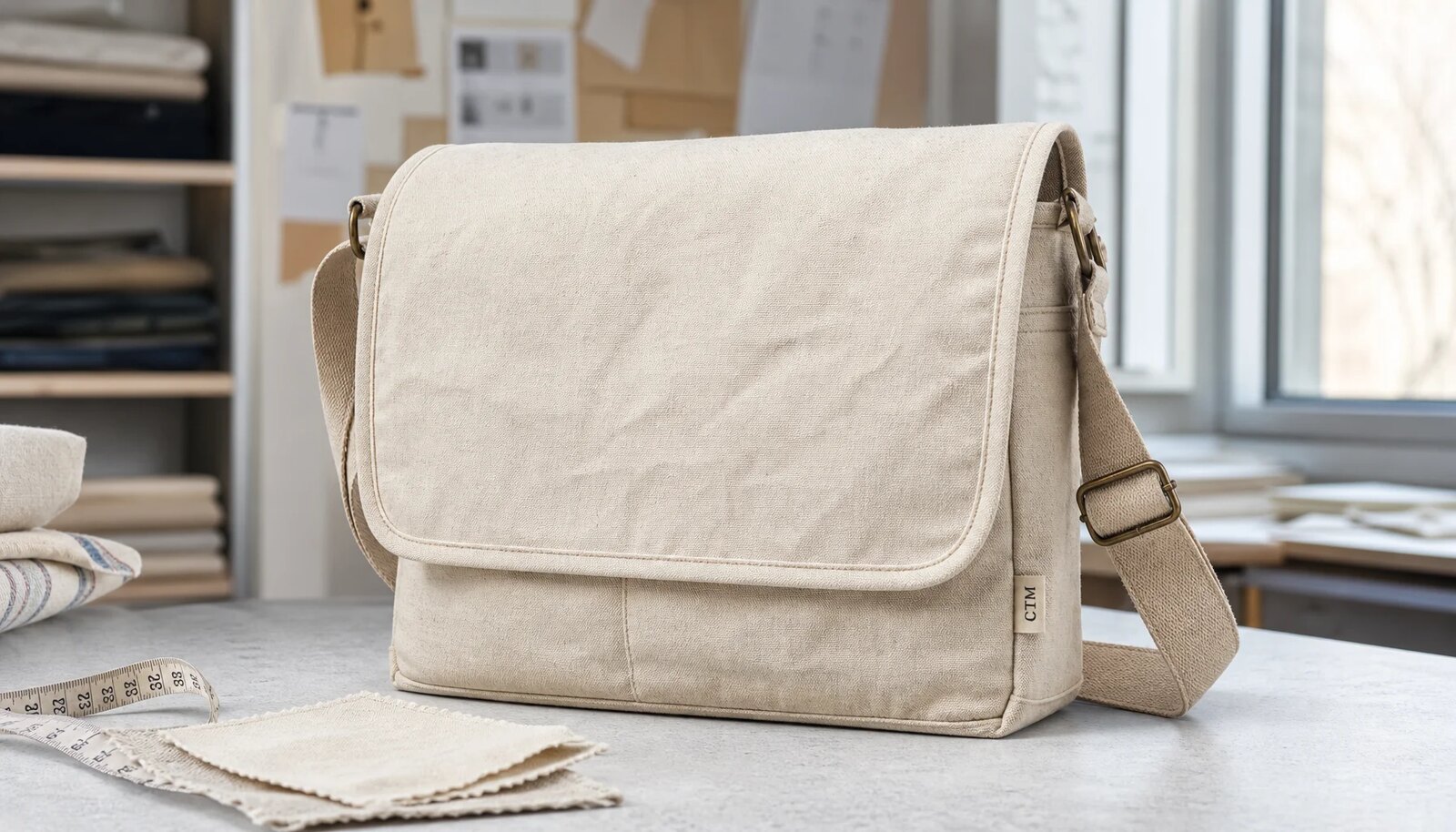
Start With the Retail Margin, Not the Bag Sketch
For wholesale canvas messenger bags for hotel retail, the buying problem is usually not finding a factory that can sew a flap bag. The hard part is building a specification that can sit on a hotel retail shelf at the planned retail price while still leaving margin after freight, duty, local handling, and markdown risk. A messenger bag with heavier canvas, metal hardware, inner zipper pocket, and retail hangtag may look right in the sample room, but it can move outside the target landed cost if procurement does not control each cost driver before quoting.
A practical bulk pricing plan starts with three numbers: target retail price, target landed cost, and order quantity by delivery window. Hotel retail buyers often need a bag that feels better than a basic promotional tote but does not behave like a leather goods item with long development time. That means the RFQ should separate the visible value features from the hidden cost features. Fabric weight, flap shape, strap quality, and print execution affect perceived value. Complicated lining, custom hardware, and excessive individual packing can raise cost without improving sell-through.
- Use one target landed cost for the approved retail price, not only a target FOB price.
- Quote the same design at several quantities before negotiating, because setup costs dilute sharply after the first production tier.
- Decide whether the bag is a souvenir purchase, a practical city bag, or a premium boutique item; each needs a different spec ceiling.
- Keep optional features visible in the quote so merchandising can add or remove value without restarting sourcing.
Canvas Weight and Handfeel Drive the First Price Difference
Canvas messenger bags are usually quoted by fabric weight, but buyers should not rely on oz descriptions alone. A 12 oz cotton canvas is often suitable for light retail or promotional use, roughly around 400 GSM depending on weave. For hotel retail where the bag must keep a better shape and support a higher shelf price, 14 oz to 16 oz canvas, roughly 475 to 545 GSM, is a stronger starting point. Above 18 oz, the material looks premium but sewing time, needle wear, shipping weight, and folding volume all increase.
Handfeel also changes the quote. Natural unwashed canvas is normally more stable and economical. Washed canvas feels softer and more casual, but it can shrink, wrinkle, and vary in shade. Dyed canvas adds fabric MOQ, dye lot control, and lab dip approval time. If the hotel brand needs a specific navy, olive, sand, or terracotta tone, the RFQ must define color tolerance and whether the buyer accepts standard fabric color or needs custom dyeing.
- Entry retail: 12 oz canvas for simple messenger styles with light loading and lower price points.
- Balanced hotel retail: 14 oz to 16 oz canvas for better body, durability, and print stability.
- Premium position: 18 oz canvas only when the retail price can absorb heavier sewing and freight cost.
- Color control: approve lab dip or fabric swatch before sample if custom dyeing is required.
Build the Spec Around Use, Load, and Shelf Appearance
The most common mistake in messenger bag RFQs is copying a fashion bag layout without confirming how the hotel guest will use it. A resort shop may need space for a beach towel, water bottle, and book. A city hotel shop may sell to guests carrying a tablet, guidebook, and documents. A museum hotel may need a flatter silhouette for books and catalogues. The same outside size can behave differently depending on gusset, flap depth, bottom construction, and strap attachment.
For bulk pricing, define the finished size in a way the factory can measure. Include width, height, gusset, flap height, strap width, strap adjustable range, and pocket size. If a boxed bottom is required, state the finished bottom depth. If the bag must fit a tablet or brochure size, give the object dimensions instead of saying medium size. This avoids a low quote based on a flat envelope bag when merchandising expected a true carrying bag.
- Flat profile: lower material use and cleaner shelf stacking, but limited capacity.
- Gusseted body: better practical use, higher fabric and sewing consumption.
- Boxed bottom: helps the bag stand and improves retail display, but adds sewing operations.
- Deep flap: improves appearance and security, but increases fabric use and can crease during packing.
- Adjustable strap: better for retail fit range, but hardware and labor must be included in the quote.
Print and Branding Choices Change Both Cost and Reject Rate
Hotel retail artwork often includes crests, fine text, destination names, property icons, or illustrated maps. The print method should be chosen from the artwork, not from habit. One-color screen print is usually the most economical and reliable for solid logos on natural canvas. Multi-color screen print works when registration tolerance is realistic. Embroidery gives a more premium look for small logos or monograms, but dense embroidery on heavy canvas can pucker the flap if backing and stitch count are not controlled.
Heat transfer can reproduce detailed color artwork, but it is not always the right answer on coarse canvas. It may sit on the surface rather than becoming part of the fabric handfeel, and some transfers can crack or peel if the wrong film is used. For hotel retail, the safer process is to approve the print at actual size on the final canvas, then rub test and fold test the sample. A logo that looks good on a PDF can become unreadable when reduced onto textured fabric.
- Screen print fits bold hotel names, simple icons, and one to three solid colors.
- Embroidery fits small premium marks, initials, side patches, and tone-on-tone branding.
- Woven labels fit subtle retail branding and avoid large print defects on washed canvas.
- Heat transfer fits detailed artwork only after testing adhesion and surface feel on the chosen canvas.
- Artwork approval should include actual print size, Pantone reference, placement from seams, and tolerance for skew.
MOQ Logic: Why the First Quantity Tier Looks Expensive
Small bulk orders of canvas messenger bags carry fixed costs that do not disappear just because the bag looks simple. Pattern setup, sample making, screen preparation, label weaving, cutting table setup, machine adjustment, carton mark preparation, and packing setup are spread over the order quantity. At 300 pieces, these costs are heavy per unit. At 1000 or 3000 pieces, the same setup is diluted, so the unit price often drops even if the fabric and sewing time stay similar.
Procurement teams should request price breaks using one locked specification. If the 300-piece quote uses stock natural canvas and the 3000-piece quote quietly assumes custom dyed fabric, the tiers cannot be compared. The useful method is to ask for a base quote at 300, 500, 1000, 3000, and 5000 pieces with the same material, same print, same trims, same packing, and same trade term. Then request separate lines for optional upgrades.
- Bag MOQ may be lower than custom fabric MOQ; stock colors help trial orders.
- Custom dyed canvas may require fabric MOQ that exceeds the bag order quantity.
- Woven labels, custom buckles, and printed retail boxes can each have their own MOQ.
- A sample charge is normal, but clarify whether it is refundable against bulk order.
- Screen charges and artwork setup should be listed separately instead of hidden in the unit price.
Quote Data That Makes Supplier Offers Comparable
A messenger bag quote is only useful when it contains enough data to compare landed cost and risk. A one-line price such as natural canvas messenger bag, logo print, FOB, 1000 pieces does not protect the buyer. It leaves open the fabric weight, trim grade, strap type, closure method, pocket construction, carton size, inspection standard, and sample approval process. Two suppliers can quote the same sentence and deliver very different bags.
The RFQ should force each supplier to price the same object. Include a drawing or reference photo, but do not rely on photos alone. A factory needs measurement points, construction notes, and material requirements. If the buyer has not finalized the design, request a costed option sheet instead of a single price. This is especially useful for hotel retail because merchandising may need to see how much each feature affects the shelf price.
- Base price: body fabric, lining if any, standard strap, standard closure, one print, and bulk packing.
- Upgrade lines: heavier canvas, custom dyed fabric, inner zipper pocket, magnetic snap, embroidery, woven label, hangtag, barcode, and individual polybag.
- Logistics data: pieces per carton, carton dimensions, gross weight, net weight, and CBM per order quantity.
- Commercial terms: sample cost, setup cost, payment terms, lead time, validity period, and Incoterm.
- Quality basis: AQL level, inspection timing, defect categories, and buyer approval samples.
Sample Approval Should Lock the Factory Standard
A good sample is not just a selling tool. It is the production standard. For canvas messenger bags, sample approval should cover fabric weight, fabric color, stiffness, stitching, strap comfort, hardware function, print accuracy, flap alignment, pocket construction, and packing method. If the buyer approves only the look of the front panel, the factory may still change hidden details during bulk production to meet price or material availability.
The pre-production sample should be made with bulk-intended materials. If the factory uses substitute hardware or leftover fabric for the first sample, mark it clearly as a development sample and do not use it as the final standard. Before mass cutting, approve a pre-production sample with the correct canvas roll, final print process, final labels, final thread color, and final packing. Keep one signed sample at the factory and one with the buyer or inspection company.
- Measure the sample against the spec sheet and record actual dimensions.
- Load test the strap with a realistic weight such as books, tablet, and small retail items.
- Open and close all snaps, buckles, zippers, and adjusters several times before approval.
- Rub the print with a dry white cloth and fold the printed area to observe cracking or flaking.
- Photograph the approved sample from front, back, side, inside, bottom, label, and carton packing angles.
QC Thresholds for a Retail-Ready Messenger Bag
Hotel retail buyers should treat these bags as consumer products, not disposable giveaways. Visible defects on the flap, logo area, strap, and front body directly affect shelf acceptance. Common reject reasons include dirty canvas, oil spots, uneven flap, crooked logo, loose threads, weak bar tack, mismatched hardware, sharp metal edges, and poor carton folding. Natural canvas also shows marks easily, so cutting and sewing areas must be kept clean.
Set measurable acceptance criteria before production starts. For example, logo placement can be allowed within plus or minus 3 mm to 5 mm depending on size and seam position. Body dimensions may allow plus or minus 0.5 cm to 1 cm. Stitch density should match the approved sample, and strap attachments should have reinforced stitching or bar tack. For color, approve under neutral light and avoid judging only from mobile phone photos taken under yellow factory lamps.
- Major defects: broken seam, failed closure, severe stain, wrong print color, missing label, incorrect size, or unsafe hardware.
- Minor defects: small thread end, slight wrinkle, small non-front mark within agreed limit, or minor carton scuff.
- Critical areas: front flap, logo panel, strap attachment, closure point, and retail label area.
- Inspection timing: inline check after first finished pieces and final random inspection after packing.
- Acceptance basis: define AQL or an agreed defect limit before deposit, not after shipment.
Packing and Carton Planning Affect Landed Cost
Packing is often treated as a final detail, but it can change freight cost and retail presentation. A canvas messenger bag with a flap and strap can be packed flat, folded, or stuffed depending on shape and display needs. Flat packing usually controls carton volume best, but it can crease the flap if the canvas is heavy or washed. Individual polybags protect the product, but some hotel retail buyers prefer reduced plastic and use tissue, belly bands, or paper sleeves instead.
Before comparing quotes, request carton dimensions and pieces per carton for the exact packing method. A lower FOB price can lose advantage if the carton CBM is much larger. For ocean freight, volume matters; for air freight, both weight and volume weight matter. If the product will go directly to hotel properties or retail distribution centers, carton marks, inner counts, barcode labels, and mixed SKU separation must be defined early.
- Retail shelf packing: belly band, hangtag, barcode, and neat fold can be enough for many hotel shops.
- Ecommerce-ready packing: individual bag, barcode, warning label if required, and better scuff protection.
- Distributor packing: consistent inner packs, carton labels, PO number, SKU, color, quantity, and gross weight.
- Freight control: compare CBM per 1000 pieces, not only pieces per carton.
- Damage prevention: protect printed flaps from rubbing against metal hardware during transit.
Lead Time Risks and How to Keep Launch Dates Realistic
Canvas messenger bag schedules often slip because buyers count only sewing days. A realistic timeline includes artwork review, sample making, sample shipping, buyer comments, revised sample if needed, fabric booking, printing or embroidery setup, cutting, sewing, trimming, inline inspection, final inspection, packing, export booking, and customs clearance. If custom dyed fabric, woven labels, special hardware, or retail packaging are involved, those components can control the timeline more than sewing capacity.
For hotel retail launches, work backward from the floor date. A reorder of an approved stock canvas bag may move quickly, but a new custom dyed messenger bag with embroidery and branded packaging needs more buffer. The buyer should also account for hotel decision cycles, photography needs, internal barcode setup, and distribution to multiple properties. A rush order can be possible only if the specification is simplified and materials are available.
- Fastest route: stock canvas, stock trims, one-color screen print, standard packing.
- Moderate route: stock canvas plus custom label, inner pocket, and approved retail hangtag.
- Longer route: custom dyed fabric, embroidery, custom hardware, and branded packaging.
- High-risk delay points: late artwork approval, failed sample, fabric color correction, holiday factory closure, and inspection rework.
- Schedule control: approve the pre-production sample before bulk fabric cutting and keep change requests out of mass production.
Specification comparison for buyers
| Spec decision | Recommended option | When it fits | Buyer risk to check |
|---|---|---|---|
| Fabric weight for hotel retail shelf quality | 14 oz to 16 oz cotton canvas, roughly 475 to 545 GSM, pre-shrunk if washing is planned | Best balance for resort shops, museum hotels, boutique properties, and gift retail where the bag must hold shape without becoming too expensive | Some quotes use 12 oz canvas but describe it as heavy duty; compare actual GSM, finished handfeel, and whether the fabric is washed, dyed, or untreated |
| Entry bulk pricing route | Stock natural canvas with one-color screen print and standard strap | Useful for first hotel retail programs, seasonal gift shops, and distributors testing sell-through before committing to custom dyeing | Price may look low but can rise after adding inner pocket, metal hardware, woven label, hangtag, and individual polybag |
| Premium retail route | Custom dyed canvas, flap print or embroidery, cotton webbing strap, magnetic snap, and inner zipper pocket | Fits boutique hotel collections and retail brands that need a product line, not a giveaway bag | Dye lot variation, embroidery puckering, and hardware color mismatch must be approved on pre-production sample before cutting bulk fabric |
| Print method for hotel artwork | Screen print for solid logos, embroidery for small premium marks, heat transfer only for detailed color artwork on suitable fabric | Screen print controls cost on 300 to 3000 pieces; embroidery supports a higher retail feel on thicker canvas | Fine hotel crests and small serif text can fill in on screen print or distort in embroidery; approve artwork at actual size |
| MOQ and price break planning | Quote 300, 500, 1000, 3000, and 5000 pieces with the same spec sheet | Allows procurement to see where fixed setup costs, fabric purchase, and packing labor dilute | If each tier uses a different assumption, the price comparison is misleading; lock fabric, print, trim, carton, and inspection basis |
| Interior construction | Bound seams, reinforced stress points, one inner zipper pocket, and boxed bottom if the bag must stand | Important for guest shoppers carrying books, tablets, brochures, or small resort purchases | Unbound raw seams can fray in use; weak strap bar tacks are a common failure point when the bag is loaded |
| Packing format | Flat pack in master cartons with tissue or belly band only if retail presentation needs it | Keeps freight volume controlled while protecting the flap and printed area | Over-packing increases carton CBM and landed cost; under-packing causes flap creases, print scuffing, and poor shelf appearance |
| Supplier evidence before deposit | Request fabric GSM report, sample photos under neutral light, carton data, production capacity, and previous product category examples | Useful when comparing factory direct quotes, trading company quotes, and distributor replenishment offers | A low unit price without trim details, QC standard, and carton volume can become the most expensive landed option |
Buyer checklist before sampling
- Define the retail use first: souvenir bag, guest amenity, bookshop item, beach shop carry bag, or premium branded merchandise.
- State finished bag dimensions with tolerance, not only approximate size; include flap depth, gusset, strap width, and strap drop.
- Specify fabric by oz and GSM, plus color, dye method, shrinkage expectation, and whether the canvas must be washed or stiff.
- Attach artwork at actual print size with Pantone references, placement measurements, and minimum readable line thickness.
- Separate mandatory features from optional cost add-ons such as inner zipper pocket, magnetic snap, metal buckle, woven label, hangtag, and barcode sticker.
- Request tiered pricing at identical specs for 300, 500, 1000, 3000, and 5000 pieces so procurement can see the true bulk pricing curve.
- Require pre-production sample approval for fabric, print, stitching, hardware, packing, hangtag, and carton mark before mass cutting.
- Set QC thresholds for dimensions, print placement, stitch strength, color difference, hardware function, stains, odor, and carton count.
- Confirm export carton size, gross weight, net weight, pieces per carton, and CBM before comparing FOB, CIF, DDP, or warehouse-delivered quotes.
- Build the hotel launch schedule backward from retail floor date, allowing time for sampling, corrections, production, inspection, vessel booking, customs, and local delivery.
Factory quote questions to send
- What exact canvas weight are you quoting in oz and GSM, and is the fabric greige, bleached, dyed, washed, or pre-shrunk?
- Is the quoted size measured flat, finished, or before sewing, and what dimensional tolerance will you accept in bulk production?
- Which print method is included, how many colors, what print size, and what setup or screen charges are separated from the unit price?
- Which hardware, strap material, closure, pocket, lining, woven label, hangtag, barcode label, and retail packing items are included in the base quote?
- What MOQ applies to the bag itself, custom fabric color, custom webbing, hardware color, woven labels, and printed retail packaging?
- How many days are needed for artwork proof, first sample, revised sample, pre-production sample, bulk production, inspection, and packing?
- What are the carton dimensions, quantity per carton, estimated gross weight, and CBM per 1000 pieces for this exact packing method?
- Which defects are considered major or minor, and what AQL level or internal inspection standard will be used before shipment?
- Can you provide photos of fabric roll inspection, cutting, printing, sewing, inline inspection, and final packing for this production order?
- What payment terms, sample charges, mold or screen charges, and cost changes apply if the buyer increases or reduces order quantity after sample approval?
Quality-control points to confirm
- Fabric weight should match the approved sample within the agreed tolerance, with no substitution from 14 oz to 12 oz canvas without written approval.
- Finished size should stay within the agreed tolerance, commonly plus or minus 0.5 cm for small panels and plus or minus 1 cm for larger body dimensions.
- Print placement should follow the approved sample, with no visible skew, ghosting, pinholes, cracking, dye migration, or unreadable small text.
- Stitch density should be consistent, with secure backstitching, clean thread trimming, no skipped stitches, and reinforced strap attachment points.
- Hardware should open and close smoothly, with no sharp burrs, plating peel, rust marks, color mismatch, or weak magnetic pull.
- Flap alignment should be centered when the bag is closed, especially on styles with front print, buckle straps, or magnetic snap closures.
- Interior seams should be bound or finished as specified, with no loose yarns that can fray during normal retail use.
- Color difference should be judged against approved swatch under neutral light, not only from phone photos under factory lighting.
- Odor, mildew, oil stains, chalk marks, needle holes, and dirty folding marks should be treated as retail-facing defects.
- Carton count, barcode label, hangtag, inner packing, and carton marks should match the purchase order before the final balance is released.