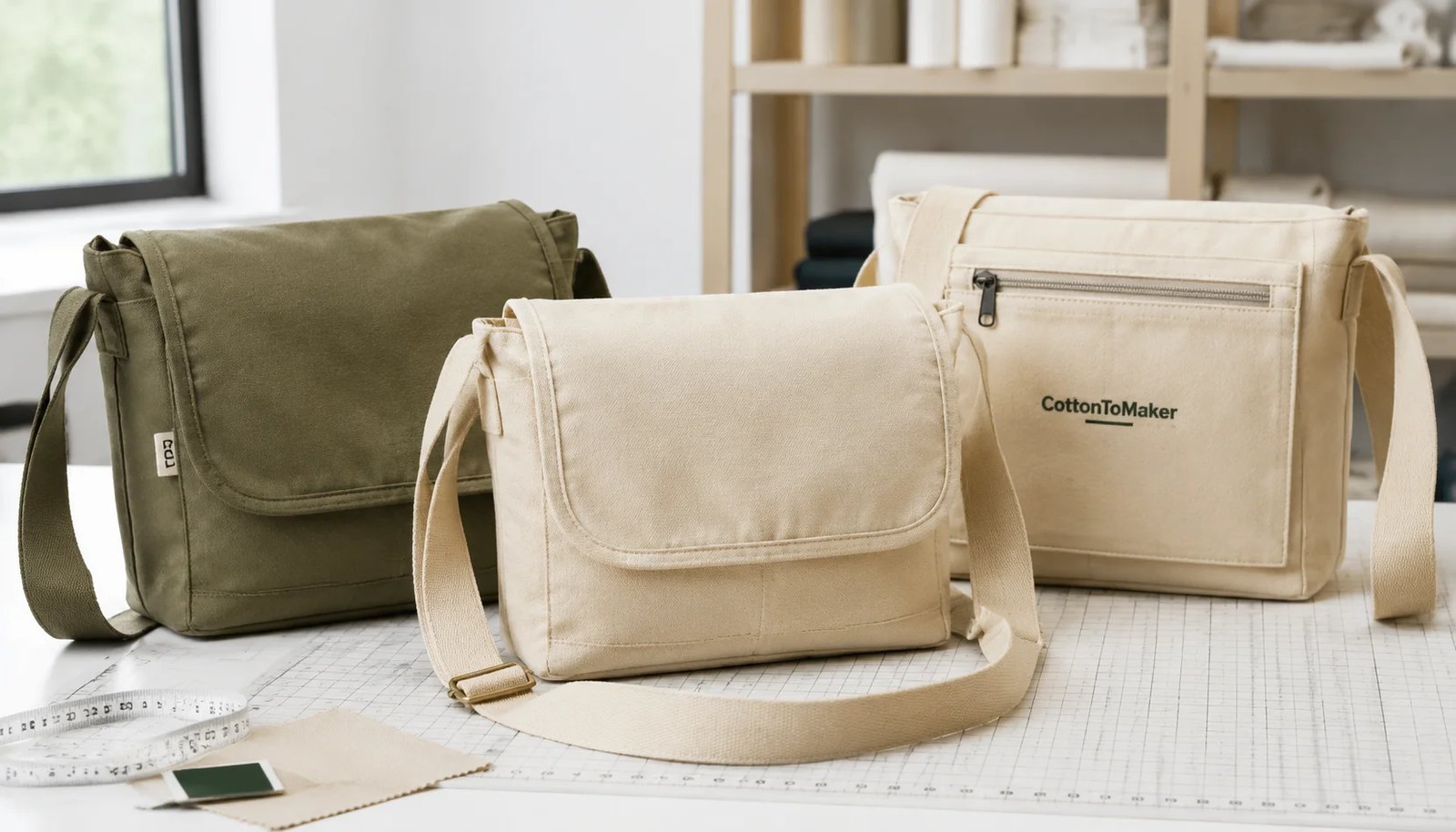
Why messenger bags create a different RFQ problem than grocery totes
Natural grocers often know how to source tote bags, but messenger bags behave more like a light-use carry case than a simple shopping bag. That changes the RFQ. A tote RFQ can survive with broad dimensions and a logo file. A messenger bag RFQ usually fails if it does not define flap shape, strap width, closure, internal organization, and expected load. The result is easy to spot in supplier quotes: one factory prices a slim promo bag, another prices a semi-structured work bag, and procurement ends up comparing numbers that do not represent the same product.
The core buying problem is quote distortion caused by incomplete construction detail. For natural grocers, the end use can vary widely: staff onboarding packs, member gift-with-purchase, store-branded resale, community event bags, or wellness campaign merchandise. Those uses look similar in a mood board, but they require different body weight, print route, and hardware quality. The cleanest RFQ is the one that states function first and then pins down the build details that affect cost and failure rate.
- Typical buyer mistake: using tote-bag wording such as 'canvas bag with shoulder strap' for a messenger-style bag
- Typical quote problem: one supplier includes zipper top and adjustable strap; another assumes flap-only and fixed strap
- Practical fix: describe intended contents, expected carry weight, and whether the bag is sold at retail or given away
- If the bag is for resale, add stronger appearance standards for print, shape retention, and packaging finish
Start with the use case before you lock the spec
A messenger bag for a natural grocer usually falls into one of three sourcing lanes. First is promotional distribution, where cost per piece matters most and the bag is expected to carry light items such as brochures, coupons, notebooks, and small samples. Second is operational use, where store teams or field reps need a durable bag for documents, tablets, and daily travel. Third is retail merchandise, where the customer pays for the bag and appearance standards need to support shelf sell-through. These lanes should not share the same RFQ template without changes.
Once use is defined, the spec becomes easier. Promotional programs often work with 10 oz to 12 oz canvas and simpler closures. Daily-use staff bags usually need 12 oz to 16 oz body fabric, wider webbing, and reinforced strap anchors. Retail resale may need dyed fabric, inside pockets, cleaner edge finishing, and better print registration. If the procurement team does not choose a lane early, suppliers will fill in the blanks differently, and the lowest quote may simply be the least durable build.
- Promo giveaway fit: 10 oz to 12 oz canvas, flap-only or simple zipper top, one-color print
- Operational fit: 12 oz to 16 oz canvas, adjustable webbing strap, zipper top, inside pocket
- Retail resale fit: 14 oz to 16 oz canvas, better finishing, branded label, premium print or embroidery
- If tablet or binder carry is expected, specify minimum internal width and gusset depth
The spec fields that most often change the quote
Fabric weight is the first cost lever, but not the only one. A supplier can reduce price by quoting lighter canvas, narrower webbing, generic zipper tape, fewer reinforcement stitches, or a smaller flap than your reference image suggests. Messenger bags also carry hidden variables that are easy to miss in early quote rounds: number of pockets, binding or self-fabric seam finish, bottom panel reinforcement, adjustable hardware count, and whether the strap is detachable. Any of these can move the unit price enough to make quote comparisons unreliable.
For natural grocer programs, practical specification language is better than decorative language. Instead of saying 'premium thick canvas,' specify 12 oz cotton canvas, natural color, zipper top opening, flap with magnetic snap, front slip pocket, 38 mm cotton webbing shoulder strap adjustable from X to Y length, and one inside zipper pocket. Clear fields narrow quote spread and reduce factory back-and-forth. They also protect the buyer from later claims that a reinforcement or pocket was never included in the quoted build.
- Body fabric: 340-450 GSM is a workable range for many messenger bag programs
- Lining: unlined saves cost; full lining improves perceived value and helps hide seam allowances
- Closure: zipper top adds cost but reduces product complaints in daily use
- Hardware: metal looks better but can scratch; plastic can reduce cost and weight
- Pockets: every extra panel changes labor time, especially inside zip pockets
- Bottom board or foam insert: useful for shape retention, but often unnecessary for promo use
Print method, artwork placement, and why photos are not enough
Canvas messenger bags for grocers are usually logo-driven, so print quality affects both branding and complaint rate. Screen printing remains the most stable option for medium and large quantities when the artwork is simple and bold. It gives good opacity on natural or dyed canvas and usually holds cost better than transfer methods at scale. Heat transfer or DTF can make sense for smaller runs or multi-color art, but buyers should expect different hand feel, edge appearance, and wear behavior. Embroidery works for premium retail use, but it can distort lighter canvas if backing and stitch density are not controlled.
Artwork placement matters more on messenger bags than flat totes because flap folds, seam lines, and straps interrupt the print field. A logo centered on a computer rendering may shift visually once the flap closes or the bag is worn. For this reason, the RFQ should name exact print panels and maximum print area, then require a strike-off or printed sample on actual fabric. A digital mockup does not show ink penetration, fabric slub effect, or whether a dark print sits too close to a stitched edge.
- Screen print best fit: solid logos, 1-3 colors, repeat orders, medium to high volume
- Transfer best fit: small volume, complex artwork, variable designs, but evaluate rub and feel
- Embroidery best fit: premium branding on flap or pocket, not large filled areas on light canvas
- State logo location by panel: front flap center, back panel lower right, inner pocket, woven side label
- If using natural canvas, expect visible specking and a less flat print surface than coated synthetic bags
MOQ logic: how to lower risk without forcing a bad supplier quote
MOQ for messenger bags is not just a factory rule; it is the sum of fabric efficiency, dye lot logic, print setup, and sewing line complexity. Buyers often push for very low MOQs while also asking for custom dyed fabric, multiple colorways, and several print locations. That combination usually produces an inflated quote or a weak supplier response because the order does not fit efficient production. A better approach is to decide which variable truly needs customization in the first order.
For a natural grocer pilot, the most practical route is often stock natural or stock dyed canvas with one print layout and one or two colorways. This avoids dye-lot minimums and shortens material lead time. Once the program proves sell-through or operational value, a second order can justify custom Pantone dye, woven labels, or upgraded lining. Procurement teams get better quote integrity when the first RFQ is designed around manufacturable volume rather than ideal branding on every detail.
- Lowest-risk pilot route: stock canvas color plus custom screen print
- Higher-risk route: custom dyed body, contrast lining, metal hardware finish matching, and multiple SKUs in one small order
- Ask for price breaks at several volumes so annual demand can be evaluated, not just trial quantity
- If multi-store rollout is likely, tell suppliers the forecast range even if the first PO is modest
How to evaluate supplier evidence, not just the unit price
For this product, quote quality depends heavily on the supplier's experience with sewn bags that use webbing, flap alignment, and print on heavier cotton canvas. A supplier can be strong in flat totes and still struggle with messenger bag shape control. Instead of relying on generic catalog claims, request evidence tied to this build type: sample photos showing inside construction, close-ups of strap anchor stitching, zipper top finishing, and previous examples with similar fabric weight. These details reveal whether the supplier actually makes the product or is simply reselling a broad bag range.
The other issue is route transparency. Procurement teams should know whether they are quoting a direct factory, a trader, or a hybrid sourcing office. A trading company is not automatically wrong, especially if it adds communication discipline, QC coverage, and export handling. The problem starts when the route is hidden. Hidden subcontracting blurs responsibility for print defects, fabric substitution, and packing mistakes. If two quotes are close, the route with cleaner process control is often the safer commercial choice, especially for repeat replenishment.
- Request inside-out sample photos, not only front beauty shots
- Ask whether cutting, printing, sewing, and packing happen in one facility or several
- Review previous messenger bag examples with similar strap and flap construction
- Look for evidence of production planning, not just sales responsiveness
- If a supplier avoids naming fabric weight tolerance or stitching method, quote accuracy is likely weak
Sample approval should test function, not only logo appearance
Messenger bag development usually needs two sample stages when the style is new. A plain prototype proves shape, dimensions, pocket access, and strap usability before artwork is involved. This is the moment to catch issues like a flap that covers the zipper too tightly, a strap adjuster placed where it rubs the shoulder, or an inside pocket that cannot hold the intended item. If those problems are discovered only after printed samples are made, the development cycle slows and the buyer pays for redesign with both time and money.
After prototype approval, a pre-production sample should use the real canvas, print method, webbing, and hardware planned for bulk. This is the sample that should be signed against measurable criteria: dimensions within tolerance, print position, color reference, hardware finish, and packing format. For natural grocer buyers, this stage also helps settle retail presentation questions such as whether natural canvas variation is acceptable and whether the bag looks too promotional for a paid merchandise program.
- Plain proto checks: size, flap proportion, pocket usability, strap range, bag hang
- Pre-production checks: actual fabric hand feel, print quality, hardware finish, final seam appearance
- Fill the bag during review with the real intended contents, not just tissue or air
- Photograph approved sample with ruler and notes to reduce disputes at bulk stage
- Approve care label and country-of-origin labeling before mass sewing starts
QC thresholds that prevent the most common production failures
The most common production mistakes on canvas messenger bags are not dramatic defects; they are cumulative annoyances that make a shipment feel low-grade. Uneven flap alignment, weak bar tacks, drifting logo position, rough zipper action, and mismatched fabric shade across components can all pass a casual inspection if the QC plan is vague. Procurement teams should define what matters at incoming inspection and at final random inspection so the factory knows which issues will block acceptance.
For this category, useful QC thresholds are dimensional tolerance, print position tolerance, visible seam quality, and strap strength consistency. If the order is for retail sale, add odor, stain visibility, and folding marks caused by poor packing. If the bag contains hardware, inspect scratches and sharp burrs. If a woven side label is included, verify orientation and placement because these are often sewn inconsistently in mixed-color orders. Clear thresholds reduce the temptation to debate defects one carton at a time after production is complete.
- Example dimensional tolerance: within agreed range on width, height, and gusset after normal finishing
- Print position tolerance should be stated in millimeters, especially on flap-centered logos
- Reject visible skipped stitches at stress points such as strap anchors and zipper ends
- Shade variation should be evaluated between body panels, flap, and strap if all are dyed components
- Inspect one full carton for folding pressure marks before approving full pack-out
Packing, carton planning, and the hidden cost of a bad fold
Packing decisions can change both landed cost and product condition. Messenger bags contain more shape and hardware than totes, so careless folding can leave permanent creases, crack heavy ink areas, or imprint buckles onto the front panel. Flat packing usually protects appearance better, but it reduces carton efficiency. Tighter folding lowers freight cost but raises complaint risk. The correct choice depends on whether the order is promotional distribution, direct-to-store retail, or ecommerce fulfillment.
Carton planning should be part of the quote stage, not an afterthought. Procurement teams should request units per carton, carton dimensions, estimated gross weight, and whether straps are tucked, rolled, or left extended. If stores or distributors need fast receiving, barcode and assortment labeling should be finalized before mass packing begins. A cheap ex-works price can quickly lose its advantage if the packing route creates higher volumetric freight, carton damage, or extra relabeling at destination.
- For printed flap panels, avoid fold lines directly across large logo areas where possible
- If individual polybags are not required, confirm dust protection and friction risk between bags in carton
- Set maximum carton weight if destination warehouse has manual handling limits
- For mixed-color assortments, require carton-level packing list and external color breakdown marks
- If ecommerce replenishment is planned, ask whether inner pack labeling can match SKU flow
Lead time planning and how to compare landed cost instead of ex-works only
Lead time on this product is usually shaped more by materials and approvals than by sewing alone. Stock fabric and one-color screen print can move quickly once artwork is approved, while custom dye, multiple sample rounds, and upgraded hardware can extend the path significantly. The procurement risk is not only the nominal factory lead time; it is the approval chain. When merchandising, legal, sustainability, and operations all review the sample at different times, a two-week internal delay can erase any advantage from choosing the fastest quote.
A disciplined comparison should also look beyond ex-works price. Messenger bags can vary in packed volume, weight, defect risk, and rework requirement. A slightly higher unit cost from a supplier that packs flatter, controls print better, and avoids strap failures may deliver a lower landed cost after freight and claims are considered. For importers and distributors, the right buying decision often comes from comparing cost scenarios: entry spec pilot, operational-use spec, and retail-ready spec. That makes commercial tradeoffs visible before the PO is placed.
- Split your timeline into sample lead time, approval time, bulk production time, and transit time
- Ask suppliers which materials are stock-supported and which are on a critical path
- Compare quote scenarios at identical FOB or EXW basis before judging price differences
- Include likely add-ons such as labeling, polybags, or premium hardware when modeling landed cost
- If one supplier's carton efficiency is meaningfully better, freight savings may offset a higher unit price
Specification comparison for buyers
| Spec decision | Recommended option | When it fits | Buyer risk to check |
|---|---|---|---|
| Body fabric weight | 12 oz to 16 oz canvas, about 340-450 GSM | Daily retail staff use, in-store pickup kits, promo resale programs where structure matters | Suppliers may quote lighter 8 oz to 10 oz fabric that looks similar in photos but collapses faster and changes print result |
| Canvas composition | 100% cotton canvas or recycled-blend canvas with declared blend ratio | Buyers needing natural hand feel or specific sustainability claims on hangtags | Do not print sustainability claims until blend, source documents, and labeling language are approved |
| Bag construction | Top zipper plus front flap or open-top flap with inside pocket depending theft risk | Zipper top fits staff carry and customer reuse; flap-only works for lower-cost promotions | A flap can hide weak top edge finishing; request internal photos and seam construction details |
| Strap material | 1.5 inch to 2 inch cotton webbing with box stitch reinforcement | Heavier contents such as catalogs, tablets, or grocery membership packs | Narrow straps reduce quote cost but cut into the shoulder and can fail at attachment points |
| Print method | Silk screen for solid spot art; heat transfer or DTF only for small variable runs; embroidery for premium logos | Screen print is usually best for grocer logos in medium and large volume | Low quotes may exclude print strike-off, Pantone control, underbase, or extra location charges |
| MOQ route | Stock fabric color with custom print for lower MOQ; dyed-to-match fabric for higher annual volume | Importers testing one region should start with stock greige, black, or olive | Custom dye lots often trigger higher MOQs, longer lead time, and shade variation risk across repeat orders |
| Sampling approach | Plain proto first, then pre-production sample in actual fabric and print | Best when several departments approve function, branding, and budget | Skipping the plain proto saves a little time but often causes rework when pocket size, strap drop, or flap proportion is wrong |
| Packing format | Individual polybag only if needed, then export carton by flat pack with strap tucked inside | Programs focused on clean retail receipt and lower carton volume | Overfolding creates permanent crease marks on printed panels; carton count must match receiving plan |
| Supplier route | Direct factory for repeat runs over a few thousand pieces; trading company only if they add compliance coordination and local service | Procurement teams that can manage spec control and approvals directly | Indirect routes can hide subcontracting, delay communication, and blur responsibility for fabric, print, and final QC |
Buyer checklist before sampling
- Define the use case first: staff carry bag, loyalty merchandise, event giveaway, or retail resale, because fabric weight and construction change with use.
- State finished bag size in centimeters and inches, including gusset depth, flap overhang, handle or strap drop, and pocket dimensions.
- Specify canvas weight in GSM or oz and whether tolerance is acceptable, for example plus or minus 5 percent.
- List exact fabric color route: natural greige, stock dyed color, or custom Pantone dye, and note whether shade continuity matters for repeat orders.
- Name the print method by logo location, size, number of colors, and whether interior care label or hangtag branding is required.
- Describe closure type clearly: zipper top, magnetic snap flap, Velcro flap, open top, or mixed construction.
- Set strap requirements: webbing width, adjustable range, hardware finish, reinforcement method, and comfort expectations under load.
- Request a plain prototype before artwork approval if the bag includes pockets, a laptop sleeve, bottle holder, or non-standard flap proportion.
- State packing format by unit and carton: folded or flat, polybag yes or no, barcode sticker placement, and target carton weight limit.
- Add acceptance criteria for print position, seam defects, loose threads, odor, metal scratches, and carton count accuracy.
Factory quote questions to send
- What exact fabric specification are you pricing: cotton content, weave, oz or GSM, dyed or natural, and fabric origin?
- Is the quoted body fabric stock-supported or made to order, and what is the lead-time difference between those routes?
- What finished bag dimensions and tolerances are included in your quote, including flap and gusset measurements?
- Which print method is included by logo position, and does the quote include screens, strike-off, underbase, setup, and color matching?
- What webbing width, thickness, and attachment reinforcement are included for the shoulder strap?
- Which hardware is priced: metal slider, D-ring, snap, zipper brand or generic zipper, and what finish tolerance applies?
- What is the MOQ by color, by artwork, and by total order, and how do prices change at higher quantity breaks?
- Can you provide a plain prototype first and then a pre-production sample in bulk fabric and print before mass production starts?
- What inner packaging and carton pack are included, and what are the estimated carton dimensions, gross weight, and units per carton?
- How many production days are needed after sample approval and deposit, and what steps usually cause delay on this bag style?
Quality-control points to confirm
- Fabric weight should match approved spec within agreed tolerance; random rolls should be tested before cutting if weight consistency matters.
- Body panels must be cut on grain where required so the bag hangs square and flap alignment remains centered.
- Print location must match approved artwork placement tolerance; logos drifting too close to seams or flap fold lines should be rejected.
- Screen print color should be compared against approved strike-off or Pantone reference under normal daylight conditions.
- Zipper opening should run smoothly with no skipped teeth, wave, or severe puckering at top seam.
- Shoulder strap attachment points need clean box stitch or bar tack reinforcement with no missed stitches or exposed raw stress points.
- Flap symmetry, pocket alignment, and gusset depth should be checked on filled and unfilled bags, not only flat on table.
- Loose threads, oil stains, needle holes in visible areas, and sharp metal burrs should be treated as defects before packing.
- Carton count, assortment ratio, barcode placement, and shipping marks should be verified against packing list before container loading.
- If bags are packed folded, inspect for permanent print blocking, severe crease whitening, or hardware impression marks on front panel.