Start With the Event Use Case, Not the Unit Price
Wholesale canvas messenger bags for trade show exhibitors should be sourced around the job the bag has to do. A bag handed out at registration is not the same product as a staff bag that needs to survive three days on the show floor with a tablet, charger, notebooks, product samples, and a water bottle. Procurement teams usually get more accurate pricing when the RFQ begins with the use case, carry load, distribution method, and delivery path instead of a vague request for the cheapest possible messenger bag.
For a B2B buyer, the use case drives what is worth paying for. A zipper top may be unnecessary for a quick literature giveaway, but it matters when the bag carries electronics or sponsor kits. A lined interior may not change the performance of a one-day handout, but it can make sense for premium visitor gifts or sales team bags. A wider strap with reinforced joins often costs more than a narrow strap, yet it reduces the chance of strap failure when attendees carry heavy catalogs across a convention center.
Write the brief in operational language. State who receives the bag, what it carries, whether it must fold flat for fast distribution, whether it is packed into exhibitor kits, and whether it will be sent to a venue, warehouse, distributor, or multiple regional events. That level of detail helps the supplier quote the right build instead of filling gaps with assumptions that later come back as surcharges, substitutions, or quality disputes.
- Classify the program as attendee giveaway, staff-use bag, VIP kit, sponsor package, or retail-style merchandise.
- List expected contents by weight and shape, such as brochures, tablet, product samples, charger, notebook, or catalog set.
- Decide whether the bag must fold flat for distribution or hold shape for a higher-value presentation.
- Define the expected carry load, such as light collateral, 2-3 kg mixed contents, or a heavier sample kit.
- Tell suppliers whether the order is one event, a seasonal program, or a repeat replenishment item.
Turn the Concept Into a Spec Sheet a Factory Can Price
A procurement-ready messenger bag spec needs more than a photo and a target number. The factory needs finished dimensions, construction type, fabric description, strap details, closure method, pocket layout, decoration requirements, packing method, and tolerances. Without those details, two suppliers can both quote a canvas messenger bag while pricing very different products. One may include a lined body and reinforced base. Another may quote an unlined shell with lighter canvas and a narrow strap.
For trade show programs, a common reference point is a bag around 350-400 mm wide by 280-320 mm high with a gusset around 60-100 mm, depending on the contents. Those are not universal standards. They are useful starting points when building an RFQ because they give the factory a size class and a practical load expectation. Strap width commonly ranges from 38 mm to 50 mm for a messenger-style bag. Wider webbing usually feels more stable under load, while narrower webbing can lower cost and reduce bulk. If the bag must hold a tablet or document folder, specify the actual item dimensions instead of using a general phrase like tablet pocket.
Tolerances should be written into the spec before sampling. A practical approach is to allow tighter tolerance on logo placement and pocket position than on soft fabric body dimensions. For example, buyers may set logo placement tolerance at +/-5 mm from the approved location, body dimensions at +/-10 mm, and strap drop at +/-15 mm, depending on the construction. The exact tolerance should match the design and supplier capability, but it should be measurable and agreed before bulk production starts.
- Include finished width, height, gusset depth, flap length, pocket dimensions, strap width, strap length, and strap drop.
- Specify seam type: bound seam, overlocked seam, French seam, lined construction, or another agreed finish.
- State reinforcement method at strap joins, flap corners, pocket openings, and base corners.
- Use written tolerances for body size, pocket location, strap drop, logo placement, and carton pack count.
- Attach technical drawings or annotated photos when possible so the quote is tied to a shared reference.
Choose Canvas Weight With the Load, Budget, and Handfeel in Mind
Canvas weight is one of the biggest cost and quality signals in a canvas messenger bag. Lighter cotton canvas around 10 oz, roughly 330-350 gsm, can work for short-term promotional bags and literature handouts. A midweight 12 oz canvas, roughly 400-420 gsm, is often the practical starting point for trade show messenger bags because it gives the bag more body without pushing the order into premium sewing and freight costs. Heavier 14-16 oz canvas, roughly 475-540 gsm, can make sense for VIP programs, sales team use, and heavier contents, but it changes sewing difficulty, carton weight, and sometimes print behavior.
Be careful with the way fabric is described in quotes. Canvas weight can be given in ounces per square yard or grams per square meter, and suppliers may round the numbers differently. Natural cotton canvas, dyed canvas, washed canvas, organic cotton canvas, and recycled cotton canvas can all have different cost, handfeel, shade consistency, and availability. Washed canvas may feel softer and more premium, but washing can change shrinkage, shade, and final dimensions. Dyed canvas needs shade approval and colorfastness review, especially if the bag will rub against light clothing or printed materials.
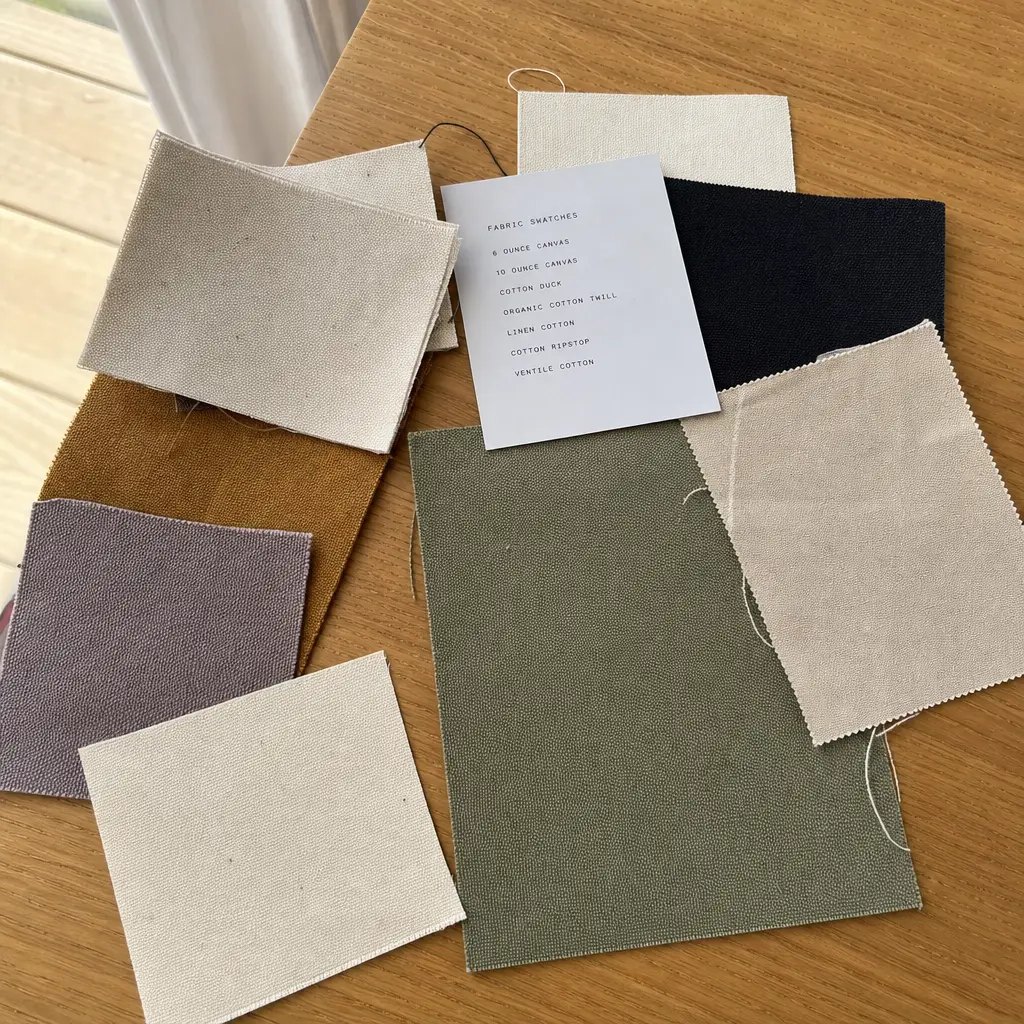
Ask whether the quoted fabric is greige, bleached, dyed, washed, or finished after weaving. Also ask for the fabric lot source once production is booked. A pre-production sample made from leftover stock is useful only if the bulk order uses the same or equivalent fabric. For repeat programs, keep a labeled fabric swatch and production sample so future orders can be compared by weight, handfeel, color, and construction instead of by memory.
- Use 10 oz / about 330-350 gsm for cost-sensitive literature bags and lighter giveaway programs.
- Use 12 oz / about 400-420 gsm as a balanced starting point for most exhibitor messenger bags.
- Use 14-16 oz / about 475-540 gsm when the bag must feel premium or carry heavier contents.
- Ask for fabric composition, nominal gsm, acceptable gsm tolerance, finish, color process, and shrinkage risk.
- Do not approve bulk based only on a photo of canvas texture; request a physical swatch or sample.
Specify Construction Details That Decide Whether the Bag Lasts
Durability is not only a fabric-weight issue. A 16 oz canvas bag with weak strap attachment can fail sooner than a 12 oz bag with better reinforcement. For messenger bags, the highest-risk areas are strap joins, top opening, flap corners, pocket openings, gusset corners, base seam, and closure points. Those areas should be named in the spec and checked in sampling. If the bag will carry event materials for several days, the RFQ should state the expected load and ask how the factory reinforces load-bearing points.
Strap construction deserves close attention because it affects comfort, appearance, and failure risk. Cotton webbing often fits the look of canvas bags and can be comfortable, but width, thickness, weave tightness, and colorfastness matter. A common B2B range is 38-50 mm wide. The strap may be fixed, adjustable with a metal or plastic slider, or removable with hooks. Each choice changes cost and failure modes. Metal hardware feels more substantial but adds weight and may need corrosion checks. Plastic hardware lowers weight and cost but must be strong enough for the stated load.
Closures should match the event workflow. Velcro is economical and fast, but it can collect lint and may feel less premium. Magnetic snaps look cleaner, but placement and pull strength matter. A zipper top adds security and a more finished feel, yet it requires extra sewing, functional testing, and zipper-quality control. Buyers should specify zipper gauge, zipper tape color, slider type, and whether the zipper is nylon coil, metal, or another agreed style. The same logic applies to pocketing: if the bag needs an inside sleeve, pen slots, or a tablet divider, those elements should be drawn and measured rather than left open-ended.
- Require bartack, box stitch, X stitch, or another named reinforcement at strap attachment points.
- State strap width, strap material, strap drop, adjustability, hardware material, and color.
- Define closure type and closure placement instead of leaving the factory to choose the lowest-cost option.
- Check gusset corners, flap corners, pocket openings, and base seams for extra stress resistance.
- Ask the supplier to confirm the expected carry load used when engineering the bag.
Choose the Decoration Method Before the Quote Gets Too Loose
Decoration is often where a quote looks attractive until the buyer asks how the logo is actually applied. One-color screen printing is usually efficient for simple logos, sponsor marks, and event names. It works well on natural canvas when the ink is opaque enough and the artwork does not rely on fine gradients. Multi-color screen print adds setup, registration risk, and more inspection points. Heat transfer can handle more complex artwork, but buyers should test cracking, edge lift, and appearance after folding or rubbing against the textured canvas surface.
Embroidery can raise perceived value, especially on heavier canvas or small logo placements, but it is not automatically better. Dense embroidery on lighter canvas can distort the panel, pull the fabric, or create an uncomfortable reverse side if the bag is unlined. Woven labels and side tags are a good option when the brand should feel integrated rather than printed across the main panel. They also help when the buyer wants a repeatable private-label look across multiple bag styles.
For procurement, the key is to make decoration measurable. Confirm print size, placement from fixed edges, Pantone or brand color reference, number of colors, ink type if relevant, and whether the logo is printed before or after sewing. A print applied before sewing may give cleaner production flow, but panel alignment must be controlled. A print applied after sewing may simplify placement approval on the finished bag, but the bag shape can make printing more difficult near seams or pockets. Ask the supplier to state whether the quoted decoration method is intended for the final fabric weight, because a technique that works on a sample swatch may behave differently on the sewn bag.
- Use screen printing for simple one-color or two-color graphics and high-volume event runs.
- Use transfer printing only after testing adhesion, edge lift, fold performance, and surface feel.
- Use embroidery for smaller premium logos and heavier panels, with distortion checks during sample approval.
- Use woven labels or side tags when subtle branding matters more than large imprint area.
- Set logo placement tolerance from fixed edges, such as +/-5 mm or another agreed measurable limit.
Build a Bulk Pricing Ladder That Shows the Real Cost Drivers
A useful bulk pricing plan should show where cost changes and why. Ask suppliers to quote the same specification at several quantity breaks, such as 500, 1,000, 2,500, 5,000, and 10,000 units. The actual breaks can change by supplier and program, but the principle is the same: the bag specification should stay constant while quantity changes. That lets procurement see whether savings come from material purchasing, setup absorption, cutting efficiency, sewing-line utilization, or freight density.
MOQ is rarely a single number. A factory may have one MOQ for blank natural canvas bags, another for dyed canvas, another for custom woven labels, and another for special zipper pulls or printed packaging. If the program includes multiple colorways or artwork versions, ask whether the supplier can pool the base bag quantity before decoration. For example, one base natural canvas bag with three logo versions may be easier to manage than three different fabric colors with separate webbing, zipper, and label combinations.
The quote should separate blank bag cost, decoration cost, packing cost, sample charge, setup charge, and freight assumption. This prevents false comparisons. A supplier quoting a lower unit cost may be excluding screen setup, carton upgrades, insert placement, or export handling. Another supplier may look higher but include decorated samples, custom labels, and stronger carton packing. A clean pricing ladder makes those differences visible before the buyer commits to a purchase order.
- Request price breaks using the same spec, same packing method, and same incoterm at each quantity.
- Ask for MOQ by total order, fabric color, decoration version, trim, label, and packing configuration.
- Separate fixed setup charges from per-unit costs so reorders can be forecast accurately.
- Ask whether colorways or logo versions can share one base production lot before decoration.
- Do not use a small trial-order price as the long-term program benchmark without a repeat-volume quote.
Use Samples to Lock the Product Before Bulk Starts
Sampling is the point where procurement turns a quote into a controlled product. A proto sample can confirm shape and construction, but it may not use final fabric or final decoration. A decorated sample or strike-off confirms logo method, color, print feel, and placement. A pre-production sample should match the final fabric, final trims, final sewing method, final decoration, and final packing as closely as possible. Buyers should state which sample stage is required before bulk approval and how approval will be documented.
The approved sample should be measured and recorded against the spec sheet. Measure finished body width and height, gusset depth, flap length, strap drop, pocket placement, and logo position. Check the canvas handfeel against the approved swatch. Test zipper or closure operation. Inspect stress points for the agreed reinforcement method. If the order has a lining, turn the bag inside enough to review seam finish, raw edges, loose threads, and pocket construction. If the supplier changes fabric lot, trim, ink, or packing after approval, require written confirmation and a new approval where the change is material.
Do not let a photo approval replace a physical approval for a custom bulk order unless the risk is genuinely low and the timeline forces it. Photos hide fabric weight, handfeel, odor, seam strength, lining behavior, and actual print thickness. A physical sample is especially important for wholesale canvas messenger bags for trade show exhibitors because the end user will handle the item immediately and judge it by touch, structure, and visible stitching, not only by artwork alignment. If a rework or replacement sample is required, make clear whether the factory or the buyer pays for it before the sample is made.
- Use proto samples for shape, decorated samples for branding, and pre-production samples for final approval.
- Record measurements and tolerances on the approved sample sheet before bulk production starts.
- Keep one sealed approval sample for final inspection and one working sample for internal review if possible.
- Require written approval for any fabric, trim, closure, ink, label, or packing substitution.
- Reject vague approvals such as looks good when the purchase order depends on measurable specifications.
Write QC Requirements the Inspector Can Actually Use
Quality control should be defined before production, not negotiated after cartons arrive. For canvas messenger bags, the inspection plan should cover materials, measurements, sewing, decoration, function, cleanliness, labeling, packing, and carton count. Many buyers use an AQL-style random inspection for pre-shipment release. The exact level depends on risk and order size, but a common approach is to define critical, major, and minor defects in advance, then apply a sampling plan agreed with the supplier or third-party inspector.
Critical defects should include anything that creates safety, legal, or severe functional risk, such as sharp exposed metal, mold, wrong country-of-origin marking, or a strap attachment that fails under a basic load check. Major defects can include wrong canvas weight outside tolerance, incorrect logo, major print misplacement, broken zipper, open seams, missing reinforcement, wrong carton count, or visibly stained bags. Minor defects may include small thread tails, slight cosmetic marks, or minor shade variation within an agreed commercial range. The classifications should be written into the purchase order or inspection instruction.
Inspection should include measurements, not just visual review. Pull samples from different cartons, measure key dimensions, operate zippers and closures, check pocket alignment, verify label placement, and compare the decorated panel to the approved sample. If load testing is required, define it carefully so it is repeatable and does not damage normal samples unnecessarily. For example, the buyer may specify a static hanging test with a defined weight and time on a small sample set, or a manual stress pull at strap joins during inspection. The method should match the bag's intended use and be agreed before production.
- Define critical, major, and minor defects before bulk production starts.
- Use random carton selection rather than inspecting only top cartons or factory-selected samples.
- Measure body dimensions, strap drop, logo placement, pocket placement, and carton counts.
- Function-test zippers, snaps, Velcro, buckles, adjustable sliders, and magnetic closures.
- Compare production samples against the sealed approval sample for fabric, handfeel, print, stitching, and finish.
Plan Packing for Venue Delivery, Warehouse Receiving, and Freight
Packing is part of the product specification because it affects cost, damage risk, and event readiness. A canvas messenger bag can be packed flat, folded, nested, individually polybagged, bundled, or retail-ready with hangtags and inserts. Flat packing is often efficient for trade show distribution, but too much compression can crease canvas, distort gussets, or mark printed panels. If the bag is going into exhibitor kits, the buyer should define the exact kitting sequence and whether inserts are placed inside the bag or packed separately.
Carton planning affects landed cost. Bulky soft goods can cube out before they weigh out, which means carton dimensions and pack count can matter as much as unit cost. Ask for units per carton, carton dimensions, net weight, gross weight, carton board strength, and stacking guidance. A carton that is too large wastes freight volume. A carton that is too heavy or overpacked can crush bags, split seams, or create handling issues at the venue. Many event teams also need cartons labeled by booth, region, sponsor, SKU, or distribution batch, so marks should be specified in the RFQ.
If sustainability or venue policy matters, state packaging restrictions up front. Some buyers restrict individual polybags unless the product needs moisture protection or clean handling. Others require recyclable cartons, reduced plastic, or specific labeling. These choices can affect labor and cost, so they should not be introduced after pricing. The packing spec should support both freight efficiency and the way the bags will actually be unpacked at the trade show. Ask for packing photos before shipment if the cartons are going directly to a venue or advance warehouse, because a simple label or carton mark error can become expensive very quickly.
- Specify flat pack, folded pack, nested pack, individual polybag, bundled pack, or retail-ready pack.
- Confirm units per carton, carton dimensions, net weight, gross weight, carton marks, and label format.
- Set a practical carton weight limit for manual handling and venue receiving.
- State whether inserts, hangtags, sponsor cards, or catalogs are packed inside each bag.
- Ask for packing photos before shipment when the delivery goes directly to an event venue.
Map the Lead Time Before the Show Calendar Forces the Issue
Lead time for canvas messenger bags includes more than sewing. The schedule starts with final artwork, technical spec confirmation, fabric booking, trim sourcing, sample making, sample approval, print setup, cutting, sewing, finishing, inspection, packing, export handling, and transit. Any custom component can become the longest lead item. Dyed canvas, special webbing colors, custom woven labels, nonstandard zipper pulls, and retail packaging can all delay a project that looked simple at the quote stage.
Build the timeline backward from the required arrival date, not the trade show opening day. Event shipments need buffer for customs, receiving appointments, venue rules, warehouse processing, internal kitting, and last-mile delivery. If the order must arrive at an advance warehouse, use that deadline as the receiving date. If the bags are split to multiple locations, include time for labeling and routing. A supplier may quote a production lead time of several weeks after sample approval, but the buyer still needs to budget time for sample review and freight.
Ask the supplier to identify the critical path in writing. Which component must be ordered first? When is artwork frozen? What date does fabric need approval? What is the last date to change carton marks? What is the inspection booking deadline? These questions reduce the risk of discovering too late that a small artwork revision delayed screens, or that a label approval delayed sewing because labels had to be inserted into a seam. If the schedule is tight, insist on a milestone list before placing the order.
- Set milestones for spec lock, artwork lock, sample approval, material booking, bulk start, inspection, packing, and shipment.
- Ask which component has the longest lead time and what standard alternative is available if it slips.
- Keep a buffer between factory completion and the required venue or warehouse receiving date.
- Freeze carton marks and routing labels before packing begins.
- Require the supplier to notify procurement before making substitutions to protect the schedule.
Specification comparison for buyers
| Spec decision | Recommended option | When it fits | Buyer risk to check |
|---|---|---|---|
| Canvas weight | 12 oz / about 400-420 gsm cotton canvas as the baseline | Most trade show exhibitor programs that need a reusable but cost-controlled messenger bag | Confirm actual gsm tolerance, fabric finish, shrinkage risk, and whether the quoted weight is before or after washing |
| Lighter giveaway build | 10 oz / about 330-350 gsm canvas with simple binding | Short events, literature bags, attendee giveaways, and programs with strict freight limits | Do not use it for heavy samples unless strap joins, gusset, and seam reinforcement are upgraded |
| Premium build | 14-16 oz / about 475-540 gsm canvas with reinforced base and stronger hardware | VIP kits, sales team bags, media events, or repeat-use field marketing programs | Check sewing capability, needle size, seam puckering, carton weight, and whether the heavier fabric changes print appearance |
| Closure method | Flap with Velcro or magnetic snap for simple access; zipper top for added security | Use flap closures for quick booth distribution and zipper tops when contents include tablets, chargers, or sales materials | Confirm magnet pull strength, zipper gauge, zipper tape color, and whether closures pass open-close function checks |
| Strap construction | 38-50 mm cotton webbing with reinforced box stitch or bartack at stress points | Most messenger bag programs where attendees may carry brochures, samples, and small devices | Ask for strap length tolerance, webbing weight, colorfastness, and reinforcement method, not just strap width |
| Decoration method | One-color screen print for volume efficiency; embroidery or woven label for premium branding | Screen print fits large runs and simple logos; woven labels fit subtle private-label looks | Check ink opacity on natural canvas, print placement tolerance, embroidery distortion, and setup charges by color |
| MOQ strategy | One base construction with controlled color or logo variants | Programs needing multiple exhibitor teams, regions, or sponsor versions | Mixing fabric weights, trims, linings, or closures can create separate MOQs even when the bag looks similar |
| Packing format | Flat pack in master cartons unless presentation or kitting requires individual packaging | Trade show deliveries, warehouse replenishment, and cost-sensitive bulk distribution | Confirm carton quantity, carton dimensions, gross weight, crush protection, polybag policy, and receiving labels |
| Inspection plan | Pre-shipment random inspection using agreed AQL plus functional stress checks | Any custom order where the buyer cannot inspect every unit before the event | Add measurable tolerances for dimensions, print placement, seam defects, carton count, and critical safety issues |
Buyer checklist before sampling
- Define the exact bag role: attendee giveaway, exhibitor staff bag, VIP kit, sponsor gift, or sales enablement item.
- Confirm finished dimensions in millimeters or inches, including width, height, gusset depth, flap length, pocket size, and strap drop.
- Specify canvas composition, nominal weight in oz and gsm, acceptable gsm tolerance, finish, color, and whether the fabric is washed, dyed, raw, or recycled cotton.
- State expected carry load, such as brochures only, 2-3 kg event materials, or heavier samples requiring reinforced stress points.
- Lock construction details: lined or unlined, inner seams bound or overlocked, base reinforcement, zipper top, flap closure, inner pocket, pen slots, or tablet sleeve.
- Choose decoration method, artwork size, print color count, Pantone reference, placement tolerance, and whether a decorated strike-off is required.
- Define MOQ by total order, colorway, artwork version, fabric color, and trim variation so suppliers cannot quote different assumptions.
- Ask for price breaks at realistic quantity levels, such as 500, 1,000, 2,500, and 5,000 units, with the same spec at each level.
- Separate product cost, decoration cost, sample cost, setup charges, label or trim charges, packing cost, freight assumption, and duty or tax assumptions.
- Confirm sample requirements: proto sample, decorated sample, pre-production sample, approval deadline, and who pays for remake samples.
Factory quote questions to send
- What exact canvas composition, weave, finish, nominal oz, gsm, and gsm tolerance are included in the quoted unit price?
- Is the fabric weight measured before washing, after washing, or on finished cut panels, and can you provide a swatch from the planned production lot?
- What are the finished bag dimensions, flap length, gusset depth, strap width, strap drop, pocket sizes, and acceptable production tolerances?
- What is the quoted carry-load assumption, and how are strap joins, flap corners, pocket openings, and base seams reinforced?
- Is the price for a blank bag, decorated bag, packed export carton, or retail-ready unit, and which costs are excluded?
- How does the unit price change at 500, 1,000, 2,500, 5,000, and 10,000 units with the same construction and packing method?
- What is the MOQ by total quantity, fabric color, logo version, trim color, zipper style, woven label, and packaging format?
- Which decoration method is quoted, what is the maximum print area, how many colors are included, and what are the setup or screen charges?
- Can you provide a decorated strike-off and a pre-production sample using final fabric, final strap, final closure, and final artwork?
- What are the sample lead time, bulk lead time after sample approval, and longest-lead components such as dyed fabric, labels, zipper pulls, or custom webbing?
Quality-control points to confirm
- Fabric should be checked against the approved swatch or pre-production sample for weight, handfeel, weave, shade, shrinkage risk, odor, stains, slubs, and obvious weaving defects.
- Finished body width, height, gusset depth, flap length, pocket placement, and strap drop should be measured against the approved tolerance, commonly +/-5 mm for small features and +/-10 mm for larger body dimensions unless another tolerance is agreed.
- Canvas weight should be verified by supplier records or spot measurement, with an agreed tolerance such as +/-5 percent from the nominated gsm where commercially practical.
- Strap attachment points should use the agreed reinforcement method, such as bartack, box stitch, X stitch, or doubled seam, with no skipped stitches or loose thread tails at load-bearing points.
- Stitch density should be consistent on visible seams, commonly specified as stitches per inch or stitches per centimeter, and should not create puckering, seam grin, or needle damage on heavier canvas.
- Print placement should be measured from fixed edges, not judged by eye, with a written tolerance such as +/-5 mm to +/-8 mm depending on logo size and panel construction.
- Printed logos should be checked for color density, opacity on natural canvas, registration, edge sharpness, ink smears, curing, abrasion resistance, and cracking after light folding.
- Embroidery should be checked for thread color, backing removal, stitch density, thread breaks, panel distortion, and whether the reverse side is acceptable if the bag is unlined.
- Zippers, snaps, Velcro, buckles, and magnetic closures should be function-tested on random samples, including repeated open-close cycles and alignment checks.
- Interior finishing should be checked for raw edges, loose lining, twisted pockets, exposed seam allowance, trapped fabric, and debris inside pockets.