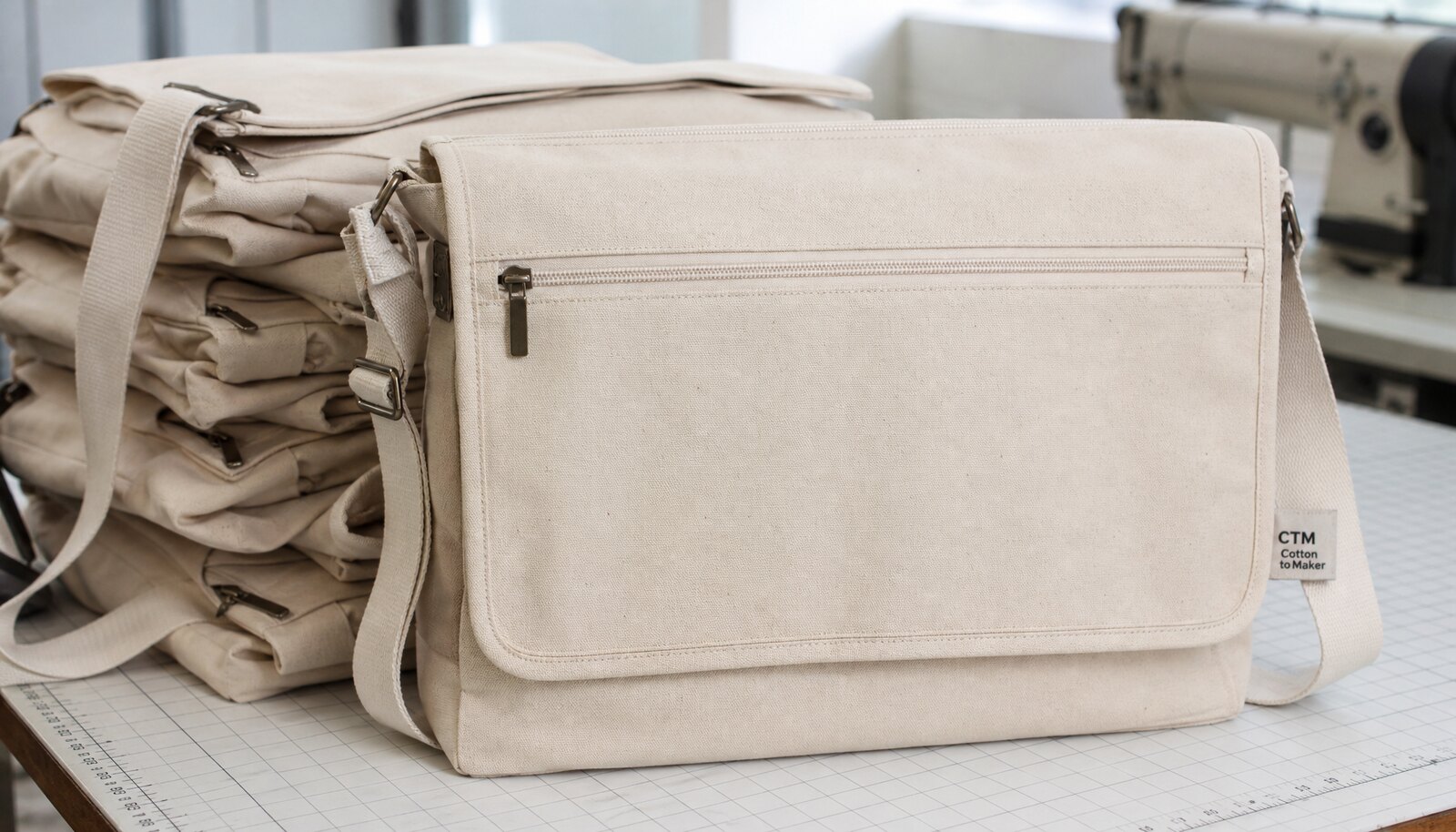
Why this checklist matters for retail buyers
Gift shops buy canvas messenger bags for display appeal as much as for function. The bag has to look clean on a hook, stand up in a shelf-facing presentation, and still survive daily customer use. That makes this a procurement item with both merchandising and quality risk, not just a simple sewn good. A supplier that can price the bag but cannot hold the finishing details will create hidden cost later in returns, repacking, or markdowns.
The fastest way to lose margin in this category is to let the quote drift away from the sample. A bag can look acceptable in a sales photo and still arrive with weaker canvas, different hardware, or packaging that crushes the front panel. Buyers need a checklist that forces the supplier to quote the same object they approved, with the same materials, labeling, and packing format.
This matters even more when the assortment is seasonal or graphic-driven. Tourist shops, museum stores, destination retailers, and souvenir counters often need repeatable artwork, smaller MOQ flexibility, and packaging that is ready for retail handling. Those are commercial requirements. If you do not write them down, the supplier will optimize for sewing cost instead of sell-through.
- Use a physical sample and a written spec together, never one without the other.
- Treat the approved version as the contract reference for bulk production.
- Compare suppliers on evidence, not polished sales language.
Lock the bag specification before asking for price
For this product type, the first buying decision is not the artwork. It is the bag structure. A practical retail range is often 10 to 12 oz canvas for a stable feel, with lighter constructions acceptable for low-cost souvenir use and heavier constructions better when the bag carries books, catalogues, or other dense items. Ask for both oz and GSM so the numbers can be compared across suppliers and markets. If the supplier only says canvas, the quote is too vague to control.
The rest of the structure should be equally specific. Messenger bags usually need a gusset that gives the bag some volume without turning it into a bulky tote, plus a strap that is wide enough to carry weight without cutting into the shoulder. A 1 to 1.25 inch webbing strap is often a sensible starting point for retail programs, but the real answer depends on load and positioning. Strap anchors, bottom corners, and zipper ends should show visible reinforcement in the sample, not just in a sales claim.
Retail presentation also depends on shape retention. If the front panel collapses in the carton, the bag can look cheap even if the sewing is acceptable. Ask whether the bag has lining, interfacing, or other structure support and whether that support is part of the approved cost. A slightly firmer bag often sells better in gift channels because it photographs and hangs more cleanly.
- Ask for canvas weight in both oz and GSM and keep one approved reference.
- Define bag width, height, gusset, strap drop, and pocket layout up front.
- Do not let the supplier quote a shape that cannot survive carton packing.
Compare supplier types on operating fit, not just unit price
The comparison table should be read as a risk tool, not a ranking. A direct sewing factory can usually give the best control over fabric and construction, but the buyer has to manage documentation, packing, and export detail carefully. A trading company may be better at consolidating services, but only if the buyer knows who actually owns the factory decisions and quality sign-off. A specialized bag workshop can be strong on construction detail, while a generic low-price supplier may need more oversight to avoid material substitutions.
The pricing signal matters because the headline unit price rarely includes every cost that procurement cares about. Tooling, print setup, sample fees, barcode application, carton marking, and label changes can turn an attractive quote into an expensive landed result. The useful question is not which supplier is cheapest on paper. It is which supplier can repeat the same bag with the least rework and the fewest commercial surprises.
- Ask every supplier to separate unit price, setup cost, and packing cost.
- Confirm whether the supplier is quoting a factory price or a managed-service price.
- Use the same spec sheet and the same sample when you compare offers.
Get branding under control before the bulk run
Print is where good quotes often stop being comparable. Screen printing is usually the most predictable choice for simple logos, one-color artwork, or repeat runs. It is usually easier to control on textured canvas and can be cost-effective when the order is large enough to absorb setup. Transfer methods can work for smaller runs or more complex graphics, but the approval standard needs to be stricter because fine details can soften or shift on woven fabric.
If the bag uses multiple colors, a patch, embroidery, or a woven label, ask the supplier to show the final placement on the actual bag, not on a flat artwork mockup. Buyers should specify the distance from the top edge, side seam, zipper line, and bottom seam so the print is repeatable. The same artwork can look very different if it is moved a few millimeters on a compact messenger bag.
Branding also affects customer perception after the bag is unpacked. A crooked label, loose embroidery tail, or misaligned patch can make a good product look like a reject. For retail programs, a clean front panel and a well-placed side label matter more than a small savings on decoration. If the supplier cannot hold the print or label placement, the bag should not go to bulk.
- Lock print method, color count, and placement dimensions before production.
- Require a true sample on the final canvas, not a smoother substitute fabric.
- Define the acceptable shift tolerance from seams and edges in writing.
Build the compliance pack for the destination market
Canvas messenger bags are usually textile products, so labeling must be checked by market. In the U.S., buyers should verify fiber content, country of origin, and any care labeling rules that apply to the product as sold. If the bag is marketed to children or presented as a children's product, the compliance path changes and may require CPSIA-related review or the local equivalent. In the EU and UK, textile fiber labeling and chemical restrictions such as REACH or UK REACH can matter depending on components and claims.
The right approach is to match the label and document set to the market before production starts. That means deciding whether care instructions are printed, sewn in, or omitted, and whether the product needs importer identity, origin copy, or retail-specific barcode formatting. If the supplier says they are compliance-focused, ask them to show an example label and document set from the same market. Generic assurances are not enough for procurement approval.
Chemical and safety concerns are usually component-driven rather than bag-driven. Dyes, coated fabrics, trims, inks, and metal finishes can each create a separate question. Ask whether any third-party test reports exist for the specific material set being quoted, and make sure the report matches the actual sample revision. A test on a different color or different hardware finish is not a valid substitute.
- For U.S. retail, check textile labeling rules for fiber content and origin, and add children's-product review if applicable.
- For EU or UK sales, confirm textile fiber-label compliance and any relevant chemical restriction checks.
- Make the supplier show the exact label copy and document set before you approve bulk production.
Set QC thresholds that a warehouse team can actually use
Procurement value increases when QC is defined as a set of pass or fail checks, not a vague notion of good quality. Start with a clear defect structure: critical defects are zero-tolerance issues such as a broken strap anchor, missing component, or label problem that blocks sale; major defects are functional or visible issues such as crooked print, seam failure, or a zipper that jams; minor defects are cosmetic issues that stay within a written limit. Many retail programs use AQL 0 for critical, 2.5 for major, and 4.0 for minor under a defined sampling standard, but the specific numbers should match your retailer or channel requirements.
The bag should also have measurable functional thresholds. Ask the supplier to state the strap load method and pass value. For a light retail messenger bag, a documented load in the 15 kg to 20 kg range can reveal weak reinforcement. For a heavier-use program, the target may need to move to 20 kg to 25 kg. The exact number is less important than the fact that it is written down and tied to the intended use, rather than guessed after a failure.
Use lab evidence when the product claims justify it. If the bag is sold as durable, washable, or color-stable, ask for test reports mapped to the actual material set. Fabric tensile, seam strength, rub resistance, colorfastness, and zipper cycling are the tests that usually matter most. A report is only useful if it names the sample revision, the standard used, and the pass result for the actual components in your order.
- Split defects into critical, major, and minor before the first PO goes out.
- Write a load target for strap anchors and ask how the factory measures it.
- Match test reports to the exact sample revision, not to a similar style.
Make sample approval a control point, not a formality
A sample is only useful if it locks the retail version. That means the sample should include the actual fabric, trim, print method, label, hangtag, folding method, and carton presentation that will be shipped in bulk. If the supplier sends an attractive shell sample without the final labels or pack method, you do not yet have a usable approval. The bulk order can still change in ways that cost time or margin.
Version control helps prevent that drift. Date the sample, note the revision, and keep the approved spec sheet with it. If the supplier later changes the zipper pull, hardware finish, lining weight, print density, or logo placement, you should be able to compare the change against the agreed reference in seconds. That discipline matters more on reorders, where the original team may not be involved anymore.
The approval process should also include a deviation rule. If the factory wants to swap a zipper brand, change the lining, or alter the carton count, the change should not happen silently. Buyers should require written approval before any deviation is released to production. That protects the buyer from receiving something that is technically usable but commercially off-spec.
- Approve the full retail unit, not just the sewn bag shell.
- Date and archive the gold sample with the matching spec sheet.
- Require written approval for any substitution after sample sign-off.
Control packing, carton strength, and warehouse handling
Packing is part of the product because it determines whether the bag reaches the retailer in sellable condition. Ask for pieces per carton, carton dimensions, gross weight, and inner pack details. Do not accept a generic carton size reused from another item. Messenger bags vary in thickness, and a poor pack plan can crush the front panel, crease the canvas, or deform hardware against the bag face.
The carton also affects warehouse work. If the order includes multiple colors or print versions, SKU-specific carton marks and clear barcode labels reduce receiving mistakes and cross-mixing. That is especially important for chain stores or distribution centers that do not want to sort product by hand. A slightly better carton and label plan can save far more than it costs if the bags are moving through a busy retail system.
If the route is rough or the shipment is export-heavy, ask how the supplier protects the bag from abrasion and crush. Tissue, insert cards, separators, or a better fold can keep the product looking retail-ready without adding much cost. The goal is not premium packaging for its own sake. The goal is to make sure the first item the buyer sees is the bag, not damage from transit.
- Confirm carton size, gross weight, and pack count before freight is booked.
- Use SKU-specific carton marks when the order has multiple colors or versions.
- Ask whether the fold method protects print, hardware, and the front panel from crush.
Read the quote as a landed-cost document
Many bad buys start with a good-looking unit price. To compare suppliers properly, break the quote into the pieces that affect landed cost: bag body, print setup, label application, packing, carton, freight assumptions, and any sample or tooling charges. A supplier can look inexpensive while quietly charging for every extra step needed to make the bag retail-ready. If the quote does not say what is included, it is not a comparable quote.
You should also understand whether the supplier is quoting stock materials or make-to-order materials. Stock canvas can shorten lead time and reduce MOQ pressure, but it may limit color control or make repeat matching harder. Custom materials can improve consistency, but they usually add booking time and may introduce substitution risk if the factory did not reserve enough fabric or hardware. The quote should say which model applies.
For reorder programs, the real commercial advantage is repeatability. A supplier that keeps the same fabric reference, trim sources, label file, and carton pattern on file can often save more money over time than a supplier with a slightly lower first-order price. Procurement teams should compare the reorder path as carefully as the first buy.
- Separate bag cost from print, labeling, packing, and freight assumptions.
- Ask whether the quote is based on stock materials or custom-ordered components.
- Value reorder control and document retention as part of total cost.
Send a cleaner RFQ packet and you will get better answers
The easiest way to improve supplier responses is to send one RFQ packet that contains the measured sample photo, the spec sheet, the artwork file, the target market, the pack requirement, and the QC standard. If you send only a product image and ask for a price, you will get a weak quote back. If you send the same information every time, suppliers can answer on a like-for-like basis and you can compare them without guessing what they changed.
For procurement teams, the RFQ packet should make three things obvious: what the bag is, what market it is going into, and what evidence is required before shipment. That means stating whether the order is for U.S., EU, UK, or mixed-market retail, whether the bags are gift-shop display items or heavier-use merchandise carriers, and whether the buyer expects third-party testing or factory documentation only. Clear scope creates better pricing and fewer disputes.
The last step is reorder memory. Ask the supplier to keep the final spec, artwork, test results, and packaging setup on file under one revision number. That makes the second order far easier to control and reduces the chance of drift when a new salesperson or production manager takes over the account.
- Send one RFQ packet with the same inputs to every supplier.
- State the destination market and the required documentation up front.
- Require one revision number for the approved spec, artwork, and packing plan.
Specification comparison for buyers
| Supplier option | What to verify | Commercial advantage | Buyer risk to control |
|---|---|---|---|
| Direct sewing factory | hardware trim card, strap-load photo, lining close-up, approved flap sample, and first-piece production photos | Better sample-to-bulk control and faster production feedback | May be weaker on export paperwork or branded packing unless checked early |
| Trading company | Factory name, production photos, trim-source proof, and who owns QC decisions | Can coordinate small mixed orders and extra services | Markup can hide real factory capability and slow defect decisions |
| Specialized bag workshop | flap shape, strap webbing, buckle, D-ring, inner pocket, zipper pocket, seam allowance, and load path | More practical for detailed construction, trims, and repeat programs | Capacity may be limited during peak seasons |
| Low-price general supplier | 10-16 oz canvas, washed canvas, rPET canvas, lining fabric, interfacing, and hardware finish | Useful for simple promotional runs with loose specs | Material downgrades, weak packing, and vague inspection scope can erase savings |
| Retail-ready supplier | shape support, strap folding, hardware protection, individual bag, carton drop expectation, and retailer hangtag placement | Can handle labels, SKU separation, carton marks, and receiving rules | Higher unit cost must be compared against reduced warehouse work |
| Compliance-focused supplier | Fabric records, labeling review, test plan, and production traceability | Safer for retail programs and repeat brand orders | Documentation claims need evidence, not only sales language |
| Local sample room plus bulk factory | Signed sample, bulk factory handoff, first-piece photos, and deviation owner | Good for complex branding before large production | Sample room quality may not match bulk line unless handoff is controlled |
Buyer checklist before sampling
- Approve a full retail sample that includes the exact canvas, lining, zipper, strap, label, hangtag, fold method, and carton presentation you expect in bulk.
- Ask for the fabric spec in both oz and GSM, plus weave type, finish, and whether the canvas is natural, dyed, washed, coated, or pre-shrunk.
- Request a component list for zipper, slider, puller, webbing, thread, label, and any metal parts so you can spot hidden substitutions.
- Confirm the print method, ink or transfer type, color count, placement dimensions, and the allowed shift tolerance from seams, zipper tape, and edge lines.
- Set the bag dimensions, gusset depth, strap drop, and pocket layout against the retail use case, not just the sample photo.
- Require reinforcement details at strap anchors, bottom corners, flap corners, and zipper ends, and ask for a stitch map or construction sketch.
- Ask for a compliance pack that matches the destination market, including U.S. textile labeling rules, EU or UK fiber-label rules, and chemical-restriction checks where applicable.
- If the bag is marketed to children or could be sold as a children's item, ask for the relevant children's-product compliance path before you approve artwork or labels.
- Agree the inspection method and AQL or defect threshold before mass production, with critical defects at zero and separate limits for major and minor defects.
- Request test evidence or a test plan covering fabric tensile or seam strength, strap load, colorfastness or rub resistance, zipper cycling, and carton drop or transit handling if shipping long distance.
Factory quote questions to send
- What exact canvas construction are you quoting, including oz, GSM, weave, finish, and any allowed tolerance on the finished fabric?
- Which components are fixed and which are optional: zipper brand or size, strap width, slider finish, lining weight, and label type?
- Is the price based on blank bags, one-color screen print, multi-color print, embroidery, patch work, or transfer print, and what setup charges apply to each version?
- What MOQ applies by color, by print version, by hardware finish, and by packaging format, and do mixed colors count toward the same run?
- What load test do you run on strap anchors or handles, what is the minimum pass value, and do you have a written internal method for it?
- What inspection standard do you use before shipment, and what defect limit applies to crooked print, broken stitches, loose threads, stains, or zipper problems?
- Can you share the sample lead time, bulk lead time, and the latest artwork approval date that will not move the shipment date?
- Which compliance documents can you provide before production: product specification sheet, labeling copy, packing list, test reports, and inspection report?
- What is your carton pack plan, including pieces per carton, carton size, gross weight, and whether retail labels or barcodes are applied at the factory?
- If we reorder, what records do you keep on file so the second run matches the approved sample for fabric, color, and components?
Quality-control points to confirm
- Canvas weight should match the approved spec within a written tolerance, typically around plus or minus 5 percent, with incoming fabric logs or cut-ticket evidence.
- For woven-fabric strength checks, ask for a lab method mapped to your requirement such as ASTM D5034 or ISO 13934-1 where tensile performance matters.
- Strap anchors, bottom corners, and zipper ends should pass a documented load test with no seam opening, bar-tack failure, or hardware deformation at the agreed use-case load.
- A practical buyer target is 15 kg to 20 kg for lighter retail bags and 20 kg to 25 kg for heavier carry programs, adjusted to the actual design and market use.
- Set the zipper requirement before production: no snagging, no broken teeth, no puller detachment, and acceptable cycling on first-off samples and final inspection samples.
- For repeat programs, request a higher-cycle durability check, such as 500 cycles or your retailer standard, if the bag will be used frequently or sold as a long-life item.
- Print quality should be judged on registration, edge sharpness, ink density, and legibility on the actual canvas, with no visible shift beyond the approved artwork tolerance.
- If the product claims washability or regular cleaning, ask for rub or colorfastness evidence using a recognized method such as AATCC 8, AATCC 61, ISO 105-X12, or ISO 105-C06 as relevant.
- Dimensional tolerances should be written for width, height, gusset, and strap drop, usually within plus or minus 6 mm or the buyer's own shelf-fit requirement.
- Use separate defect classes: critical at zero, major with a written AQL or sampling limit, and minor with a lower but defined tolerance under ANSI/ASQ Z1.4 or ISO 2859-1 if your team uses standard sampling.