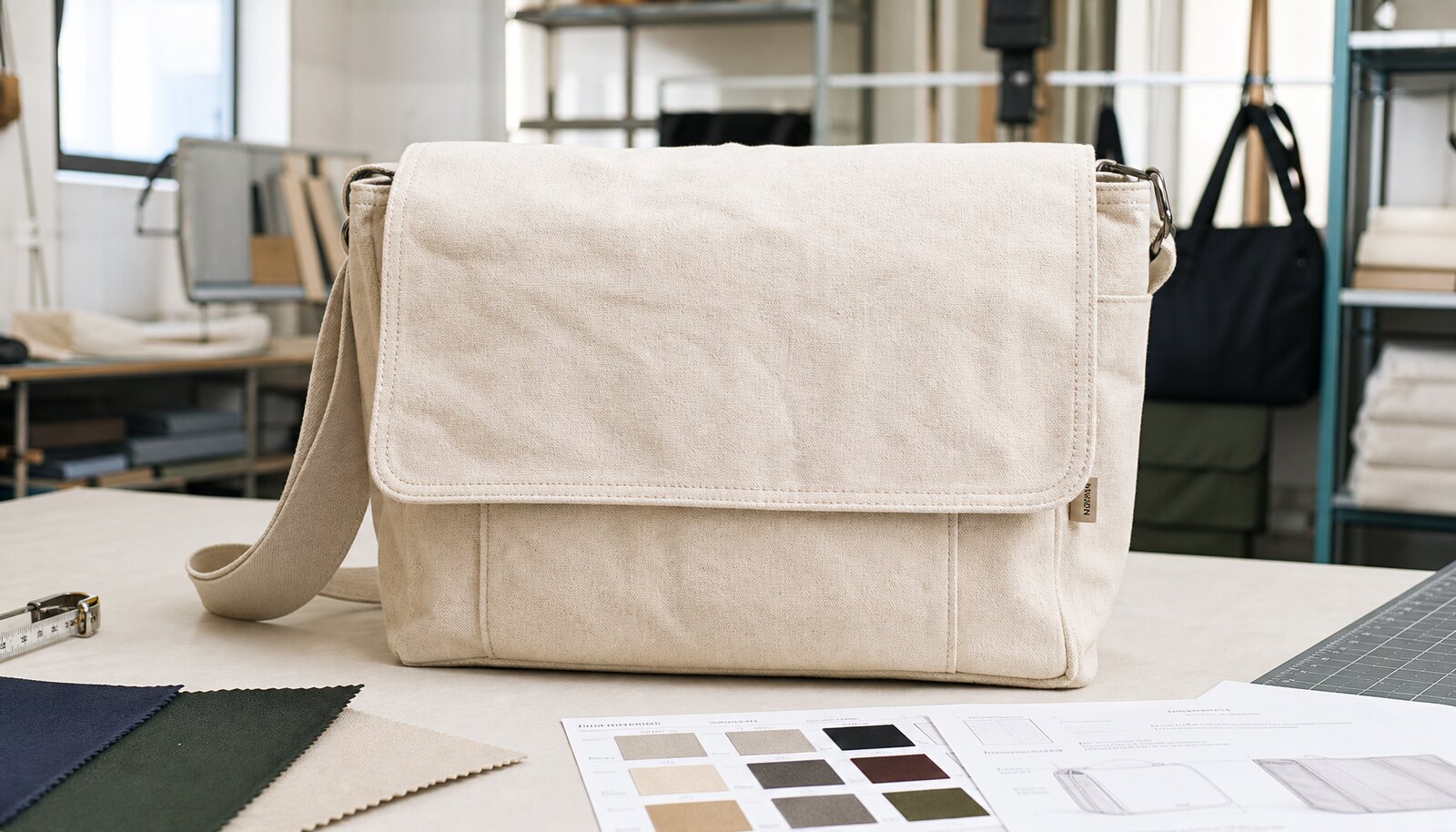
Start with the retail use case, not the art file
For gift shops, a canvas messenger bag is not just a carry bag. It is a retail item that has to look intentional on a shelf, survive handling, and print cleanly enough that the logo reads from a few feet away. The proofing process should begin with the buying use case: souvenir sales, museum stores, tourist destinations, seasonal gifting, or branded merchandise. Those channels do not all need the same fabric weight, closure style, or print detail.
The fastest way to create quote noise is to send artwork before you define the bag. Start with a short spec set: intended retail price band, target hand feel, size range, closure type, and whether the bag will be sold folded, tagged, or pre-packed. Once the factory knows the commercial target, it can recommend the right canvas weight, stitch count, and print route without forcing you into a generic sample that does not match the sales channel.
- Define the buyer role: souvenir shop, chain gift shop, museum store, tourist retail, or promotional resale.
- State whether the bag must stand upright, fold flat, or hang on a peg hook.
- Decide if the bag is a fashion accessory, a utility carry item, or a lower-cost impulse buy.
Choose the canvas spec that will survive print and shelf handling
Canvas weight matters because the print proof only tells part of the story. For wholesale canvas messenger bags, a practical range is usually 10 oz to 12 oz, or about 340 to 400 GSM, when the buyer wants a balanced retail product that holds shape without feeling overly stiff. Lighter fabric can reduce cost, but it can also show print strike-through, wrinkle more in transit, and make flap edges look weak after folding and unpacking. Heavier fabric gives better body and usually supports cleaner print registration, but it increases freight weight and may require stronger sewing to keep the bag comfortable.
Do not specify GSM alone. Ask for the finished fabric construction, weave tightness, shrinkage allowance, and whether the factory is using pre-shrunk canvas or raw cloth. For gift shop buyers, the practical issue is consistency from sample to repeat order. If the first batch is stiff and the next batch softens after washing or weather exposure, the printed area can distort and the retail presentation changes. A simple RFQ should include fabric color, canvas weight, lining if any, strap material, and any reinforcement patches under stress points.
- For simple one-color logos, 10 oz to 12 oz canvas is usually the safest working range.
- For heavier retail items or larger messenger formats, ask whether 12 oz plus reinforcement is needed at the flap and strap anchors.
- If the bag will be steam-pressed, folded for carton packing, or displayed open, ask the factory to show how the fabric recovers.
Match the print method to the artwork, not the other way around
Print failures on canvas messenger bags are usually artwork problems disguised as production problems. A logo with fine text, gradients, thin outlines, or small reverse areas can look sharp on a screen, then break apart when transferred to textured canvas. For gift shop programs, screen printing is often the most stable choice for one- or two-color logos because it gives good opacity and consistent placement on natural fabric. When the design has more detail, tight registration, or multiple colors, a transfer or digital method may be the better route, but you need a proof on the actual canvas surface before approving bulk.
Do not approve a proof from a white art file alone. The same color can look darker, duller, or more porous on natural canvas, especially when the bag is beige, oatmeal, or undyed cotton. Ask for the proof on the actual bag color, with the final print size and exact position relative to seams, flap edge, pocket line, and strap anchor. If the logo sits too close to stitching, the factory will either shift it later or crop it in bulk. That is a preventable mistake, not a surprise.
- Screen print is usually strongest for opaque, low-complexity logos and repeat retail programs.
- Transfer or digital print is more useful when the design needs detail, but it is more sensitive to heat, curing, and fabric texture.
- Embroidery works for a premium look, but it changes the hand feel and can distort on thinner canvas if the design is too dense.
Use proofing stages to eliminate guesswork before bulk sewing
A proper proofing workflow for wholesale canvas messenger bags should have more than one gate. The first gate is the digital proof: artwork size, placement, color reference, and print method. The second gate is the physical sample, ideally a strike-off or a full sewn sample on the final fabric. The third gate is final pre-production approval, where the buyer signs off on the exact bag construction that will run in bulk. If the supplier wants to skip directly to bulk from a PDF, the buyer is carrying too much risk.
The sample should answer production questions, not just design questions. Measure the print against actual seam lines and the finished fold of the flap. Open and close the bag several times. Check whether the logo cracks when the flap flexes, whether the strap stitches interfere with the image field, and whether the ink feels dry or still tacky after curing. These are the things that turn into claim disputes later if they are not solved at proof stage.
- Approve print position using a marked sample with dimensions, not a verbal description.
- Inspect the sample after folding and refolding, because retail packing can create crease lines through the print.
- Keep one sealed reference sample in procurement and one with the factory as the bulk standard.
Compare supplier routes by proof control, not just unit price
The cheapest quote is not always the best sourcing route for printed messenger bags. Direct factories, trading companies, local decorators, and stock bag printers each handle proofing differently. If the bag construction and the print happen in the same factory, the supplier can control fabric, stitch placement, and print alignment as one process. If the work is split across vendors, a slight shift in bag size or flap shape can make the logo placement fail after approval. That is how a quote that looked simple becomes a rework problem.
For gift shop buyers, the correct comparison is not only landed cost. It is proof discipline, repeatability, and the supplier's ability to hold the same result across reorders. A trading company may be helpful when you need multiple sourcing options or a faster quote spread, but you still need to know who is responsible if the approved sample does not match the final carton. A local decorator can be useful for speed, yet the blank bag quality must be locked down first. If you compare routes on those terms, the decision gets clearer.
- Use direct factory sourcing when repeat orders, private label control, and construction consistency matter most.
- Use a trading company when you need speed across several factories and can manage extra coordination risk.
- Use local decorating when lead time matters more than maximum customization and the blank bag spec is already stable.
Treat MOQ as a production logic issue, not a sales number
MOQ for wholesale canvas messenger bags is usually driven by how much setup the factory needs, not by the buyer's budget alone. One-color screen print on one fabric color may allow a lower MOQ because screens, curing, and color control are simpler. Multi-color art, embroidery, special labels, or custom linings push MOQ upward because each change adds setup time and rejects more trial pieces. If the quote does not separate MOQ by print method, artwork version, and bag color, the buyer cannot compare suppliers cleanly.
The practical solution is to ask for tiered MOQ logic. For example, request the minimum for a stock canvas color with one print location, then the increase required for a second color, a second print area, or a special label. This is especially important for gift shops that buy in seasonal drops or test a new product line before committing to deeper replenishment. You want to know where the breakpoints are before the sample is approved, not after the supplier has started ordering materials.
- Separate MOQ by construction, artwork, and colorway so you can see what is actually driving the number.
- Ask whether the factory can mix sizes in one run or whether each size needs a separate order.
- Confirm if reorder MOQ drops after the first run when screens, patterns, or stitching guides already exist.
Build the sample approval around measurable acceptance criteria
A sample approval should read like a production standard, not a design comment thread. The buyer needs measurable criteria for size, print placement, stitch quality, hardware function, and color behavior. If the proof only says the bag looks good, the factory will interpret that differently than procurement will. Set tolerances in writing: acceptable size variance, acceptable print shift from center, acceptable shade variation from the approved reference, and whether minor thread ends must be trimmed before packing.
Use the sample to test the entire user experience. Put in a typical gift-shop item, close the flap, carry the bag, and inspect the print where the fabric bends. If the bag is lined, check whether the lining pulls the outer panel and shifts the logo. If it has a pocket, inspect whether the pocket opening deforms the visible front area. The best proofing checklist is one that exposes the real use pattern, not just a bench-top inspection.
- Measure finished size, strap drop, flap length, and pocket depth against the approved spec sheet.
- Check print edges for feathering, cracking, ghosting, and any visible fabric texture that reduces legibility.
- Record one approved sample number, date, and photo set so reorder checks are easy.
Get packing right before you lock the artwork
Packing decisions change how the bag looks when the customer opens the carton. A canvas messenger bag that arrives folded too tightly can show crease lines through the print, especially if the logo sits on the fold point. For gift shop programs, the packing method should be aligned with shelf presentation: individual polybag, insert card, hangtag, barcode label, master carton packing, or a retail-ready inner pack. Every choice affects cost, appearance, and carton efficiency.
Ask how the factory folds the bag, what surface touches the printed area, and whether any desiccant or moisture barrier is used for sea freight. If the product has a raised print, embroidery, or a sewn patch, the packing method must prevent abrasion during transit. This matters more than many buyers expect because light scuffing can make a bulk order look inconsistent even when the sewing is correct. A clean packing spec protects the approved visual standard.
- Avoid placing hard folds directly through the logo or any dense printed area.
- Confirm whether polybags are vented, resealable, or heat-sealed, and whether that affects print transfer or scuffing.
- Make carton marks match the SKU system used by retail and distribution teams.
Plan the schedule around sample correction, not just sewing time
Lead time is often quoted as if it were only a sewing calendar, but print proofing adds its own timeline. A realistic schedule has artwork review, sample development, proof corrections, sample shipment, final approval, material booking, bulk sewing, print curing, packing, and inspection. If the buyer wants to launch before a holiday or tourist season, the proof cycle is usually the critical path. A one-week delay in approval can become a freight problem later, especially if you need sea shipment for margin control.
The buyer should ask where delays usually happen. Is the issue fabric sourcing, screen making, color matching, or buyer-side revision time? When the supplier answers clearly, procurement can manage the schedule instead of reacting to it. For a gift shop buyer, the target is not the fastest quote; it is the best-controlled schedule from sample approval to arrival. That means locking artwork early, minimizing revisions, and keeping one decision owner on the buyer side.
- Ask for a production calendar with separate dates for sample, bulk start, packing, and inspection.
- Build in time for one correction round if the artwork is being translated from a brand file to production format.
- Do not release bulk until the approved sample and final PO match exactly on spec, artwork, and packing.
Compare landed cost with the proof risk attached to each quote
A clean quote comparison should not stop at unit price. For wholesale canvas messenger bags for gift shops, the landed cost includes setup charges, sample charges, print plates or screens, labels, packing, carton configuration, and freight assumptions. A quote that looks low may omit one of those items, or it may rely on a proof that was never checked on the actual bag color. When buyers compare on landed cost plus proof risk, they usually find that the most expensive quote is not always the most costly option.
The practical method is to compare three things side by side: the quoted unit cost, the included proofing steps, and the production control the supplier is offering. If Supplier A gives a lower price but only provides a PDF proof, while Supplier B gives a slightly higher price with a strike-off, pre-production sample, and carton-level packing confirmation, Supplier B may be the safer business decision. Gift shop buyers need repeatable retail quality, not just an attractive quote page.
- List every extra cost line in the RFQ so the quotes are comparable on the same basis.
- Treat proof sample cost as part of development, not as an optional add-on.
- Compare freight and packing together, because a slightly smaller carton or better fold can change the economics.
Specification comparison for buyers
| Spec decision | Recommended option | When it fits | Buyer risk to check |
|---|---|---|---|
| Sourcing route | Direct factory with in-house printing and sewing | Best for repeat programs, private label control, and buyers who need proof changes handled before bulk runs | Confirm the same factory makes the bag and the print; mixed sourcing can create fabric and print mismatch |
| Sourcing route | Trading company managing multiple factories | Useful when you need fast quotation coverage across several constructions or when the buyer has limited Asia sourcing bandwidth | Check who owns the final proof approval and who is responsible if the bag body and print come from different sites |
| Sourcing route | Local decorator applying print to imported blank bags | Works for low-volume replenishment, urgent events, or domestic delivery deadlines | Verify whether the blank bag GSM, thread count, and ink curing are consistent across lots |
| Sourcing route | Stock bag with post-production print | Fits short lead-time gift shop programs with fewer structural changes | Risk is limited customization and weaker consistency if the stock lot changes between seasons |
| Fabric weight | 10 oz to 12 oz canvas, or about 340 to 400 GSM | Good balance for gift shop resale, print clarity, and enough body to hold shape on the shelf | Too-light fabric can show show-through or wrinkle the print; confirm shrinkage after washing or steaming |
| Print method | Screen print for simple logos, transfer or digital for detail-heavy art, embroidery only where the design tolerates texture | Choose based on artwork complexity, order volume, and the number of colors in the logo | Check ink opacity on natural canvas and ask for proof on the actual fabric color, not white paper |
| MOQ logic | Lower MOQ with one-color print, higher MOQ for multi-color, complex placements, or special trim | Useful when testing a new gift shop program before larger seasonal buys | Make sure MOQ is tied to one artwork version and one fabric color so the quote cannot move later |
| Proof stage | Pre-production digital proof plus physical strike-off or sewn sample for final approval | Necessary when placement, flap alignment, pocket size, or logo scale must be exact | Do not approve bulk from a PDF only; ask for a sample on the actual material and construction |
| Packing route | Individual polybag, bulk packed by carton, then shipper carton with carton mark | Best for retail-ready inventory or mixed-SKU gift shop distribution | Verify fold direction, moisture control, and whether the print rubs against the polybag during transit |
Buyer checklist before sampling
- Confirm the exact canvas weight, weave type, and finished size before discussing logo placement.
- Approve the proof on the same fabric color and print method that will be used in bulk.
- Lock artwork dimensions, print position, and one approved Pantone or reference color before sampling.
- Request one pre-production sample with the final closure, strap length, pocket layout, and label treatment.
- State the acceptable tolerance for bag size, print shift, stitch density, and color variation in writing.
- Ask how the factory packs finished bags to avoid crease marks, scuffed prints, and crushed corners.
- Confirm whether quote includes carton marks, inner polybags, hangtags, barcode labels, and export packing.
Factory quote questions to send
- What canvas GSM, finished fabric width, and shrinkage allowance are you quoting?
- Which print method is included, and is the proof based on the actual bag color or only on artwork files?
- What is the MOQ by color, by print method, and by artwork version?
- What sample stage do you provide before bulk approval: digital proof, strike-off, or full sewn sample?
- What are the standard tolerances for size, print placement, and stitching on bulk production?
- How are bags packed for shipment, and can you separate retail packing from master carton packing in the quote?
- What is the expected production lead time after sample approval, and what usually extends it?
- Which items are extra: plates/screens, embroidery digitizing, labels, hangtags, carton marks, or testing?
Quality-control points to confirm
- Canvas weight matches the approved spec, with no obvious hand-feel drop between sample and bulk lot.
- Print sits within the agreed placement tolerance and does not crowd seams, pockets, or flap edges.
- Ink coverage is even, with no pinholes, patchy color, smearing, or off-center registration on multi-color art.
- Stitching is straight and secure at strap anchors, stress points, and pocket corners, with no loose threads.
- Closure hardware, magnetic snaps, Velcro, or zippers operate smoothly and line up correctly after packing.
- Bag dimensions fall within the agreed tolerance for width, height, gusset, strap drop, and flap length.
- Polybag, carton, and shipping marks match the purchase order and do not damage the printed surface.
- The first and last cartons from the bulk lot match the approved sample in print shade and construction.