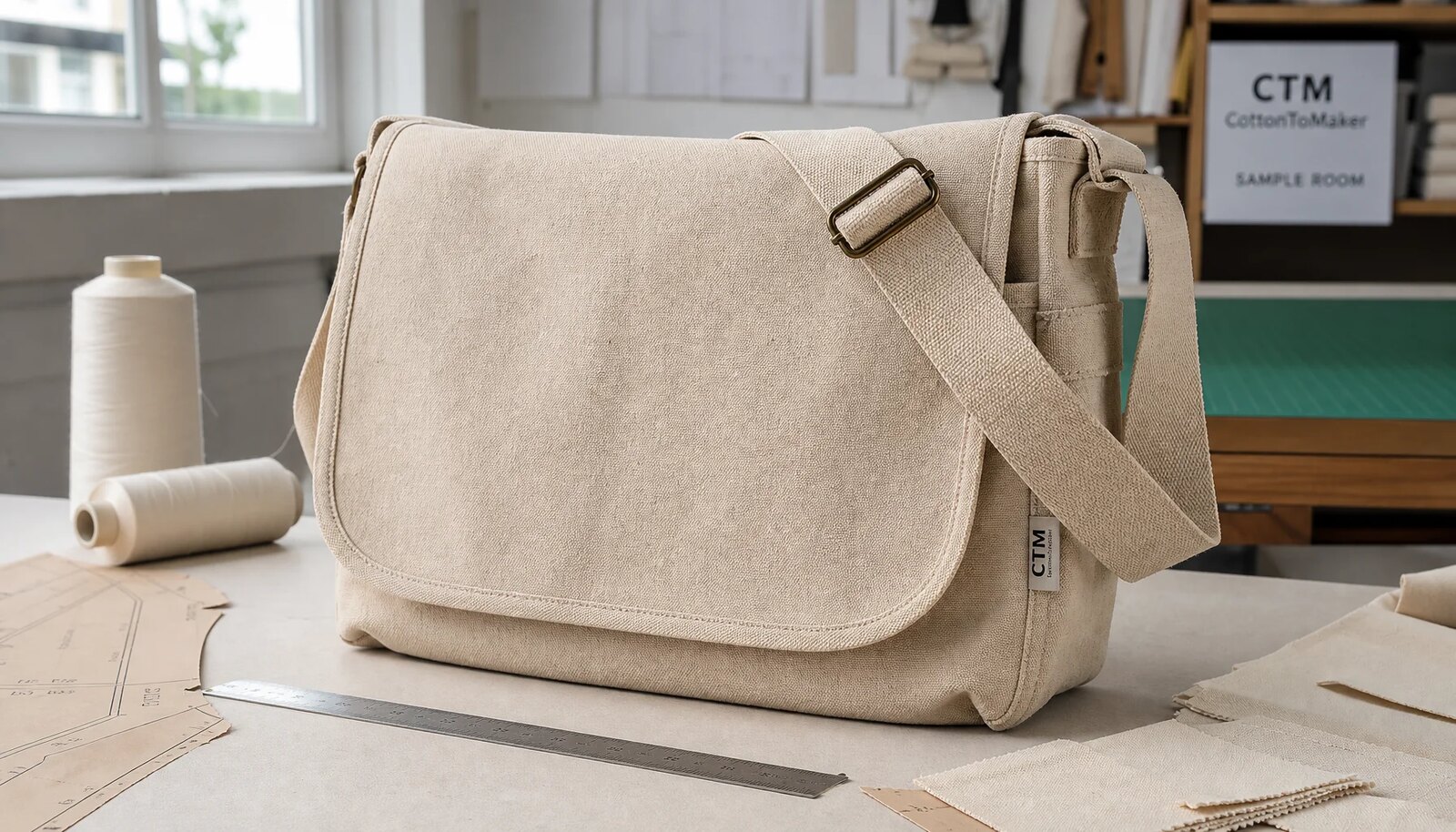
Start with the market-day job, not the product photo
A canvas messenger bag sounds simple until it is used by a farmers market vendor on a busy morning. It may hold a phone, card reader, cash pouch, receipt book, pens, order forms, menu cards, table clips, seed packets, sample products, a tablet, or small setup tools. It may be placed on pavement, grass, truck beds, wooden crates, folding tables, and occasionally damp ground. Those details should shape the material choice before a buyer compares unit prices.
The mistake is treating the item like a basic promotional giveaway. A giveaway only needs to look presentable for a short event. A working vendor bag has to open quickly, carry uneven contents, keep small business tools accessible, and withstand weekly handling. If the buyer is a market association, food co-op, farm shop, retailer, distributor, or private-label brand, the bag is also part of the customer-facing brand experience. Clean stitching, natural fabric character, print placement, and reorder consistency all matter.
Before sending an RFQ, write a short use profile. Who carries the bag? What goes inside? Is it sold, issued to staff, bundled into a CSA kit, or used as a vendor welcome pack? What practical load should the sample survive? Without that profile, suppliers will fill in the blanks. One may quote a 10 oz flat shoulder bag with a logo. Another may quote a 14 oz gusseted messenger with lining, zipper, and reinforced webbing. Both quotes may be technically responsive, but they are not the same product.
For most farmers market vendor programs, a sensible starting spec includes midweight or heavyweight canvas, an adjustable webbing strap, reinforced strap anchors, at least one secure pocket, and a closure matched to the contents. Brochures and order forms may only need a flap. Payment devices, cash, and personal items usually call for a zipper, snap, or zipper under flap.
- Define the likely contents: card reader, phone, cash pouch, receipts, pens, signage, samples, tools, or small produce items.
- Set a practical load target: light 3 kg, moderate 5 kg, or heavier 8 kg testing.
- Separate retail appearance requirements from internal staff or vendor-kit utility needs.
- Clarify whether the bag is a giveaway, paid merchandise item, staff issue, CSA kit, or distributor SKU.
- Describe the environment: outdoor sun, damp grass, rough tables, crates, weekly transport, and repeated folding.
Choose canvas weight with GSM, tolerance, and sewing behavior in mind
Canvas weight is where many wholesale quotes stop being comparable. Words such as heavy, premium, thick, and durable are not specifications. A procurement-ready inquiry should state both ounces per square yard and GSM. For wholesale canvas messenger bags for farmers market vendors, the common practical range is about 10-16 oz/yd², roughly 340-540 GSM, depending on finish, lining, structure, and intended load.
A 10-12 oz canvas, about 340-400 GSM, can be suitable for light vendor kits, association giveaways, brochure carry, and pilot programs. It folds easily, ships with lower cube, and often accepts simple screen printing well. The limitation is structure. Under uneven contents, lighter canvas may sag, wrinkle at pocket openings, or distort at strap anchors if reinforcement is weak. With no lining, no binding, and no bottom support, the finished bag can feel closer to a promotional shoulder tote than a working messenger bag.
A 12-14 oz canvas, about 400-475 GSM, is often the safest starting point. It gives the bag enough body for a flap, gusset, pockets, and moderate contents while remaining practical for sewing, printing, and freight. This range suits many repeat wholesale orders because it balances hand feel, cost, durability, and decoration options. It also gives bar-tacks and box stitches enough base material to hold, provided the seam allowance and thread are appropriate.
A 14-16 oz canvas, about 475-540 GSM, moves the product toward a utility or workwear feel. It can improve abrasion resistance and shape retention, especially when paired with a reinforced base and a 50 mm strap. It also raises cost. Expect more seam bulk, heavier cartons, slower sewing, greater needle and thread demands, and a stiffer hand. Heavy canvas can show needle holes if operators have to unpick and resew, so sample accuracy matters.
Do not buy weight in isolation. A lined 12 oz bag with a wide strap and proper reinforcement may perform better than an unlined 14 oz bag with narrow webbing and weak anchors. Washing, dyeing, coating, or pressing can also change the final weight and dimensions. Ask whether the quoted weight is before or after finishing and set a bulk tolerance, often around ±5% to ±8% unless the mill provides a tighter standard.
- 10-12 oz / about 340-400 GSM: light-duty use, lower carton cube, easier folding, less structure.
- 12-14 oz / about 400-475 GSM: balanced default for many farmers market vendor messenger bags.
- 14-16 oz / about 475-540 GSM: stronger work-bag feel, higher cost, heavier cartons, more sewing complexity.
- Ask whether fabric weight is controlled before or after dyeing, washing, coating, or finishing.
- Replace vague terms like premium canvas with oz, GSM, weave, finish, and tolerance.
Check fiber, weave, finish, and color before approving material
Fabric weight tells only part of the story. Fiber content, weave density, finishing, and color control affect strength, print appearance, hand feel, shrinkage, and marketing claims. Standard cotton canvas is familiar, printable, and consistent with the natural look many farmers market buyers want. Cotton-poly canvas may improve dimensional stability or reduce cost in some programs, but it changes hand feel and may not match an all-cotton product story. Recycled cotton canvas can be appropriate for co-ops and sustainability-minded retailers, but it needs documentation and realistic expectations about lot variation.
The weave should be stable enough for strap anchors, pocket edges, zipper seams, and base corners. A loose weave may look fine as a small swatch but pull or distort after sewing and loading. Ask for a swatch large enough to fold, sew, and test with the proposed branding method. A narrow cutting does not show how the material behaves once it becomes a flap, gusset, or reinforced strap area.
Natural canvas needs especially clear language. Many buyers like the unbleached color, seed specks, slubs, and irregular texture. Those same characteristics become disputes if they are not defined. Natural canvas can move from cream to beige across lots. Some seed specks and slubs may be acceptable; oil marks, dark stains, holes, yarn breaks, and severe shade bands should not be. Keep a retained swatch from the approved lot and ask the supplier to send bulk fabric photos under consistent lighting before cutting.
Dyed canvas needs lab dips and bulk shade control. If the bag uses a market association color, retailer palette, or private-label seasonal shade, do not approve it from a screen photo. Request lab dips, approve one standard, and define acceptable variation. If testing is required, discuss dry rubbing, wet rubbing, and light-cleaning colorfastness before production. Pigment dye, reactive dye, and washed finishes can behave differently, so write the finish into the spec.
Finishing also affects shrinkage and softness. Greige canvas may be economical and rigid. Washed canvas can feel more retail-friendly but may vary more in measurement. Enzyme washing can reduce harshness and lint, while adding cost and affecting shade. Pre-shrunk fabric can reduce dimensional change, but it does not mean zero shrinkage. Care instructions should be based on the actual fabric and finish, not a generic cotton assumption.
- Confirm fiber content and documentation before using cotton, recycled, organic, or low-impact claims.
- Evaluate weave stability at stress points, not only fabric weight.
- For natural canvas, define acceptable shade, slub, seed speck, and surface irregularity range.
- For dyed canvas, approve lab dips and ask how bulk shade will be controlled.
- For washed or enzyme-washed canvas, confirm shrinkage, hand feel, lint, and finished-size impact.
Specify construction before negotiating logo cost
Decoration is visible, but construction decides whether the bag has real value. Two bags with the same front logo can be very different. One may use narrow self-fabric straps, single stitching, raw seams, and no base support. Another may use wide webbing, bound seams, reinforced patches, locked bar-tacks, and a cleaner pocket layout. For farmers market vendors, those differences are not cosmetic. They determine how the product carries, wears, and reorders.
Start with the body shape. A flat messenger is cheaper, easier to cut, and efficient to pack. It works for documents, light samples, and event kits. A gusseted messenger costs more but carries better, holds bulkier contents, and sits more naturally when filled. Utility messenger gussets often fall around 60-100 mm, but the better approach is to specify what the bag must hold rather than copy a generic dimension.
Closure affects security, price, and sewing complexity. A flap-only design gives a large branding panel and some weather coverage, but little protection against loss. Snaps or magnetic snaps improve speed; they must be reinforced so the canvas does not tear around the attachment. A zipper top is more secure for cash pouches and electronics. A zipper plus flap is often the practical premium option for public market use. Check zipper waviness, slider movement, and end reinforcement at sample stage.
The strap deserves special attention. For moderate and heavier vendor use, 38-50 mm webbing is usually more practical than a narrow decorative strap. Cotton webbing matches the canvas look but may absorb moisture and stretch more than polyester. Polyester webbing can be stronger and more dimensionally stable, though the hand feel is different. Specify the adjuster, slider, D-ring or buckle material, finish, and attachment area. Strap anchors should be bar-tacked, box-stitched, or sewn through a reinforcement patch, not held by a few straight stitches.
Internal organization should make the vendor’s day easier. Too many pockets add cost and slow production, but one secure pocket sized for a phone, card reader, receipt book, or cash pouch can make the bag much more useful. If the bag is unlined, seams should be bound or clean-finished. If it is lined, inspect lining corners and pocket mouths so the lining does not pull out when users remove items.
- Use a flat body for lower cost and dense packing; use a gusseted body for better capacity and load shape.
- Consider 60-100 mm gussets for utility carry, but confirm actual contents first.
- Use 38-50 mm adjustable webbing for comfort under moderate vendor loads.
- Reinforce strap anchors, zipper ends, flap corners, pocket mouths, side seams, and base corners.
- Specify pocket dimensions so phones, card readers, receipt books, and cash pouches actually fit.
Match branding to the canvas surface and reorder plan
Branding should be chosen after the material and construction are known. Canvas texture affects line sharpness, ink coverage, color appearance, and edge definition. A heavy natural canvas with slubs will not print like smooth polyester or coated fabric. Send vector artwork, logo size, color references when relevant, placement from fixed points, and minimum line thickness. Otherwise, the supplier may quote a decoration method that cannot reproduce the artwork reliably on the selected canvas.
Screen printing is usually the practical default for simple farmers market logos, co-op marks, farm names, and one- or two-color graphics. It has clear setup costs and works well for repeat wholesale orders. It is best on flat panels before final assembly or on open finished areas. Ask about ink type, curing, print hand feel, dry rub performance, and whether printing occurs before or after sewing. Printing before sewing gives a flatter surface but requires accurate cutting and panel control. Printing after sewing can suit smaller runs, but seams and pockets may limit placement.
Heat transfer and digital printing can help with detailed artwork, small orders, or multi-color designs, but they must be tested on the actual canvas. Transfers may create a film-like feel and can crack or lift when folded repeatedly. Digital print can handle complex graphics, but color variation may be more visible on textured cotton. For bags used outdoors every week, abrasion and fold resistance may matter more than photographic detail.
Embroidery, woven labels, and sewn patches can create a more premium or durable appearance. Embroidery can pucker if the artwork is too dense or large, so backing and tension control matter. Woven patches are repeatable and can be approved as separate components, although they add lead time and placement checks. Leather or faux-leather patches may suit some farm brands, but confirm colorfastness, care compatibility, and whether the trim fits the buyer’s sustainability or vegan positioning.
Reorders need records. A market association or distributor ordering season after season should not rely on a photo from the first batch. The factory should retain print screen size, ink reference, patch dimensions, thread colors, label placement, and artwork revision. Put logo placement tolerance in writing, such as ±5-8 mm from the approved position when construction allows.
- Screen print: best for simple logos, repeat orders, and clear unit economics.
- Heat transfer: useful for detailed art, but test fold marks, edge lift, and abrasion.
- Digital print: suitable for complex graphics, but confirm color control on textured cotton canvas.
- Embroidery: durable appearance, but dense logos can pucker without proper backing.
- Woven patch or label: clean and repeatable, but requires component approval and placement tolerance.
Choose the supplier route by risk, not price alone
A low unit price only helps if the quoted product meets the specification. Messenger bags have more failure points than flat totes: fabric, cutting, strap attachment, pocket sewing, closure installation, branding, trimming, packing, and carton protection. A quote may be cheaper because the supplier uses lighter canvas, narrower webbing, fewer reinforcement stitches, weaker hardware, simpler packing, or no in-line inspection. Those savings disappear quickly if bags fail in vendor use or arrive with crooked branding.
Blank-stock wholesalers are useful for urgent programs, low MOQs, fast replenishment, and simple logo decoration. The buyer gains speed and avoids development work. The tradeoff is limited control. Fabric, trims, dimensions, and future lot consistency may change without notice. This route works best when the product is not a long-term private-label SKU and the buyer accepts the supplier’s existing construction.
General tote suppliers can be a fit for simple messenger-style conversions. Still, confirm whether they regularly make gusseted messenger bags, adjustable straps, zippers, snaps, and reinforced anchors. A factory that is excellent at flat totes may not automatically be strong at messenger construction, especially when the design includes lining, hardware, or load-bearing strap patches.
Dedicated bag factories and custom OEM suppliers are better for repeat programs, distributor assortments, and retailer/private-label orders. They are more likely to manage pattern development, cutting control, hardware sourcing, reinforcement, inspection, and packing as one system. The process is more formal: sample fees, longer lead time, written approvals, and usually higher MOQs. For B2B procurement, that structure often reduces risk because it creates traceability.
Normalize quotes before comparing them. Ask each supplier to price the same GSM, dimensions, gusset, strap width, closure, pocket layout, logo method, packing, carton count, and inspection requirement. If a supplier proposes an alternative, request a deviation list that explains what changed and how it affects price, lead time, and performance. Phrases like standard canvas, normal quality, or same as picture are not enough for a repeat wholesale item.
- Blank stock: fastest and simplest, but least control over material and future lot consistency.
- General tote supplier: workable for simple bags; verify messenger construction capability.
- Dedicated bag factory: better for reinforced straps, gussets, closures, and repeat QC.
- Custom OEM factory: best for private-label repeatability and documented specifications.
- Compare total landed value: unit price, carton cube, freight, defect risk, reorder consistency, and inspection cost.
Build the RFQ around measurable specifications
A strong RFQ helps every supplier quote the same bag. If the inquiry includes only a reference photo, target price, and logo file, each factory will make different assumptions. One may reduce canvas weight. Another may remove reinforcement. Another may quote bulk packing instead of retail-ready packing. The buyer receives numbers, but not a clean comparison. For wholesale canvas messenger bags for farmers market vendors, the RFQ should cover material, measurements, construction, branding, packing, inspection, commercial terms, and approval sequence.
Include a compact specification table in the RFQ. List finished width, height, gusset depth, flap length, strap width, strap length range, pocket size, fabric weight, composition, finish, lining, closure, thread color, logo size, and logo position. Add tolerances. As a practical starting point, main finished dimensions may use ±10 mm, small pocket details ±5 mm, strap length ±20 mm, and logo placement ±5-8 mm, subject to the construction and the factory’s capability.
Ask for a line-item commercial quote. Price breaks at 300, 500, 1,000, and 3,000 pieces may be useful if they match the buying plan. Request separate costs for sample, pre-production sample, print screen, embroidery digitizing, woven labels, hangtags, barcodes, inner packing, desiccant, export cartons, and tooling if any. A low unit price can be offset by setup charges, low carton counts, or packing that increases freight.
Tie the purchase order to a controlled revision. If the strap changes from 38 mm to 50 mm, or the closure changes from snap to zipper, update the spec number and request a revised quote. Many disputes begin when an email chain contains old artwork, old dimensions, new pricing, and informal approval. The quotation, sample, artwork, inspection checklist, and PO should all point to the same revision.
Define the approval sample clearly. Identify it by date, sample number, fabric swatch, logo file, and photos. State which characteristics are controlled by the physical sample and which are controlled by numeric tolerances. Hand feel and overall appearance may be sample-based. Dimensions, logo placement, carton quantity, and packing marks should be numeric.
- Include oz/GSM, composition, finish, color, and fabric tolerance in the RFQ.
- Specify dimensions, gusset, strap range, pockets, logo size, and placement from fixed points.
- Use written tolerances instead of relying on factory standard.
- Request quantity breaks and separate setup, sample, label, packing, and carton fees.
- Version-control every specification change and tie the PO to the approved revision.
Use samples to test function, not just appearance
Sampling is where construction problems should surface. A messenger bag can photograph well when empty and still twist on the shoulder, collapse when loaded, block access to the phone pocket, or strain around strap anchors. Evaluate the sample the way a vendor will use it: empty, filled, worn, opened, closed, set down, picked up, and handled repeatedly.
Create a sample approval sheet with measurable checkpoints. Record finished width, height, gusset, flap length, strap width, strap adjustment range, pocket size, logo size, and logo position. Compare the canvas hand feel against the approved swatch. Check whether the structure fits the intended purpose. A soft promotional bag may be fine for documents. A vendor utility bag should keep a usable shape when loaded.
Load testing should be realistic and written down. For light programs, test around 3 kg. For moderate vendor carry, use around 5 kg. For heavier utility use, test up to 8 kg if that reflects the actual use profile. Load the bag long enough to see whether the base sags, side seams pull, strap anchors distort, or the strap becomes uncomfortable. Open and close the zipper, snap, or flap while the bag is loaded. If the zipper waves, catches, or pulls away from the seam, revise before approval.
Inspect the likely failure points: strap anchors, bar-tacks, pocket corners, zipper ends, flap corners, bottom corners, hardware tabs, and reinforcement patches. Stitching should be neat, locked, and consistent. Loose thread ends at stress points are not minor if the bag is intended for working use. If the supplier says bulk production will be better than the sample, ask what will change and request either a corrected sample or a written deviation approval.
For branding, run simple handling checks. Fold the printed area where the bag naturally bends. Rub the print with a dry white cloth and, if relevant, a slightly damp cloth. Check whether transfers lift at corners, embroidery puckers, or patches sit crooked. These checks do not replace laboratory testing, but they catch many preventable problems before bulk production.
- Measure the sample and record actual numbers against the specification sheet.
- Wear the sample with realistic contents to check strap comfort, twisting, and pocket access.
- Load test at 3 kg, 5 kg, or 8 kg according to the intended use profile.
- Reject samples with weak strap anchors, skipped stitches, zipper waviness, severe print drift, or unstable pocket corners.
- Approve only when hand feel, construction, branding, dimensions, and functional carry behavior are acceptable.
Define QC for fabric, sewing, branding, and final inspection
Quality control should be agreed before production starts. If standards are defined only at final inspection, disputes are harder to solve. Canvas messenger bag QC should cover incoming fabric, cutting, sewing, decoration, hardware, measurements, cleaning, packing, and carton marks. The purpose is not to make the order complicated. It is to make sure the shipment matches the approved specification.
Fabric QC begins before cutting. For larger orders, ask whether the factory checks rolls for weight, shade, stains, holes, shade bands, loose weave, and excessive slubs. Natural canvas will not be perfectly uniform, but the boundary between acceptable character and rejectable defect should be written. Dyed canvas should be compared with the approved lab dip or bulk standard under consistent lighting. Panels with oil marks, dark stains, holes, or severe yarn defects should not enter sewing.
Sewing QC should focus on load-bearing areas. Inspect stitch density, seam allowance, thread tension, skipped stitches, and reinforcement. Main seams on canvas bags often show consistent stitch density in the range of about 7-10 stitches per inch depending on fabric, thread, and machine setup, but the buyer should confirm the supplier’s standard and the approved sample. Strap reinforcement must be consistent across operators and production lines.
Branding QC covers placement, clarity, color, and durability. A logo that is 10 mm off center can look obvious on a flap. Screen prints should be cured and not tacky. Transfers should not lift at the edges. Embroidery should not pucker more than the approved sample. Patches and labels should be straight and securely sewn. If the bag includes both an external logo and an internal label, inspect both.
Final inspection should include measurement and function. Open and close every sampled zipper, snap, buckle, and adjuster. Confirm pockets are usable and not sewn shut. Check that the strap adjusts through the required range. Review loose threads, trimming, chalk marks, odor, stains, and needle damage. For B2B orders, define the sampling method in advance. If using AQL, state inspection level and limits. If using a custom checklist, define critical, major, and minor defects before PO release.
- Incoming fabric: verify GSM, shade, surface defects, weave stability, and roll-to-roll consistency.
- In-line sewing: inspect strap anchors, seam allowance, stitch density, zipper insertion, pocket corners, and base reinforcement.
- Branding: verify logo size, placement, color, curing, patch alignment, embroidery tension, and rub/fold behavior.
- Finished goods: check dimensions, closure function, strap adjustment, loose threads, stains, odor, and usability.
- Inspection method: agree on AQL or another sampling plan before purchase order release.
Plan packing, carton cube, and logistics with the material choice
Packing affects landed cost and defect risk. Heavy canvas messenger bags take more space than flat totes, especially with a gusset, flap, reinforced bottom, metal adjuster, or structured insert. A bag that looks inexpensive ex-factory may be less competitive once carton count, gross weight, carton cube, and logo protection are included.
Decide early whether the bag is bulk packed or retail ready. Vendor kits may prioritize dense packing and low carton cube. Farm shop, gift, or retail programs may require individual bags, paper wraps, hangtags, barcode labels, or protective tissue. If natural canvas is part of a reduced-packaging message, buyers may prefer less plastic. Even then, the packing must protect against moisture, dust, scuffing, and hardware abrasion.
Printed panels and hardware need a specific folding plan. A metal adjuster resting directly on a screen print can scuff during transit. A transfer folded sharply across the graphic can develop crease marks. Natural canvas packed in humid conditions without moisture control may arrive with odor, mildew risk, or staining. Ask the supplier to show the folding method, inner protection, and carton layout before the full lot is packed.
Request carton information during quotation, not after production. Freight estimates, warehouse receiving, pallet planning, distributor handling, and e-commerce preparation all depend on carton dimensions, units per carton, net weight, and gross weight. If two suppliers quote similar unit prices but one ships at lower cube without damaging the bag, the landed economics may be better.
Clarify carton labeling early. B2B orders often require SKU labels, purchase order numbers, carton numbers, country-of-origin marks, barcodes, mixed-carton rules, or retailer routing labels. Late labeling requests can delay shipment or create relabeling costs. Include packing and labeling requirements in the RFQ so the factory can price and schedule them correctly.
- Request carton dimensions, units per carton, net weight, and gross weight with the quote.
- Confirm flat pack, folded pack, bulk pack, paper wrap, individual bag, hangtag, or barcode needs.
- Protect printed panels from metal hardware abrasion and sharp fold marks.
- Specify carton marks, SKU labels, PO references, country-of-origin marks, and mixed-carton rules.
- Balance reduced packaging goals with protection against moisture, dust, scuffing, and compression.
Specification comparison for buyers
| Spec decision | Recommended option | When it fits | Buyer risk to check |
|---|---|---|---|
| Entry vendor program | 10-12 oz canvas, approximately 340-400 GSM, 1-color screen print, simple flap or open top | Light-duty farmers market kits, association giveaways, brochure carry, CSA paperwork, and pilot programs where load is usually below 3-4 kg | Confirm actual fabric weight tolerance, shrinkage after finishing, print curing, seam strength, and whether the quoted bag is a true messenger pattern or a flat tote conversion |
| Balanced wholesale specification | 12-14 oz canvas, approximately 400-475 GSM, 38-50 mm adjustable webbing strap, reinforced strap anchors, one secure pocket | Most farmers market vendor use: phone, card reader, cash pouch, receipts, small signage, pens, order forms, and light samples with practical loads around 3-6 kg | Check strap bar-tack size, stitch density, pocket dimensions, finished-size tolerance of ±10 mm, print placement tolerance of ±5-8 mm, and carton packing method |
| Heavy vendor utility bag | 14-16 oz canvas, approximately 475-540 GSM, gusseted body, zipper plus flap, reinforced bottom, 50 mm strap | Vendors carrying payment equipment, dense samples, tools, jars, or market setup items; repeated weekly carry and outdoor exposure | Higher fabric and freight cost, stiffer hand feel, thicker seam bulk, possible needle damage, longer sewing time, and need for stronger thread and larger seam allowances |
| Natural unbleached canvas | Virgin or blended cotton canvas in natural shade with defined acceptable slub, seed speck, and shade range | Farm shops, market associations, organic-style branding, and programs where a natural surface is part of the product look | Natural shade can vary by lot; define acceptable cream/beige range, dirt marks, seed specks, and whether optical brighteners or bleaching are excluded |
| Dyed canvas program | Reactive or pigment-dyed canvas with lab dip approval and bulk shade control | Private-label retail, distributor assortments, color-coded staff bags, farm brand merchandise, and seasonal color programs | Require lab dip, bulk roll approval, colorfastness expectations, shade band control, and tolerance for color difference against the approved standard |
| Recycled-cotton canvas route | Recycled cotton blend with documented composition, approved shade range, and realistic durability testing | Buyers with sustainability messaging, co-ops, farm brands, and retailers that need a material story supported by supplier documentation | Do not make unsupported claims; check fiber-content documents, lot variability, pilling, linting, tear strength, and repeatability across reorders |
| Blank-stock wholesaler | In-stock 10-12 oz messenger or shoulder bag with limited logo decoration | Urgent events, small trial orders, fast replenishment, and low-development promotional purchasing | Limited control over fabric, trims, future lot consistency, carton dimensions, and exact reinforcement; sample may not match next reorder lot |
| Custom OEM bag factory | Custom body size, canvas GSM, strap, closure, lining, pockets, labels, carton plan, and inspection criteria | Repeat private-label programs, distributor SKUs, retailers, market associations, and buyers needing reliable reorders | Requires clearer RFQ, sample fee, longer approval cycle, artwork control, written tolerances, and disciplined pre-production sign-off |
Buyer checklist before sampling
- State the canvas weight in both oz/yd² and GSM, with a fabric tolerance such as ±5% to ±8% by lot unless the mill provides a tighter standard.
- Confirm fiber composition and claim support: virgin cotton, recycled cotton blend, cotton-poly, organic cotton, or other blend; request documentation before using organic, recycled, or low-impact claims.
- Specify fabric finish: greige, desized, dyed, pigment-dyed, washed, enzyme-washed, pre-shrunk, water-repellent, or untreated natural canvas; ask whether quoted weight is before or after finishing.
- Set finished dimensions for width, height, gusset, flap length, pocket openings, strap width, strap adjustment range, and logo placement; use tolerances such as ±10 mm for main dimensions and ±5-8 mm for logo position where feasible.
- Define expected working load: light 3 kg, moderate 5 kg, or heavier 8 kg practical testing; avoid asking factories for unsupported load claims without a test method.
- Specify strap construction by width, material, webbing thickness or GSM where available, adjuster type, attachment area, reinforcement stitch pattern, and thread type.
- List all stress points that require reinforcement: strap anchors, side seams, flap corners, zipper ends, pocket mouths, base corners, hardware tabs, and any D-ring or buckle connections.
- Match branding method to canvas texture and use: screen print, heat transfer, digital print, embroidery, woven patch, sewn label, or leather/faux-leather patch; include artwork size, color references, and minimum line thickness.
- Clarify closure and security level: open top, flap only, snap, magnetic snap, zipper, zipper plus flap, or buckle; include hardware material and finish if appearance or corrosion resistance matters.
- Require line-item quotes for MOQ, sample fee, setup fee, label cost, tooling if any, unit price by quantity break, packing cost, carton count, carton dimensions, gross weight, lead time, and trade term.
Factory quote questions to send
- What is the exact canvas weight in oz/yd² and GSM, and what tolerance do you control on bulk fabric by roll and by production lot?
- Is the fabric weight quoted before washing, after washing, or after dyeing/finishing, and can you state expected shrinkage after steam pressing or first cleaning?
- What is the fiber composition, yarn count or yarn construction if available, weave type, and mill origin, and can you provide a fabric specification sheet for bulk orders?
- For natural canvas, what shade variation, slub level, seed speck level, and weave irregularity are considered acceptable, and how will you control bulk shade against the approved sample?
- For dyed canvas, can you provide lab dips and confirm the colorfastness expectation for dry rubbing, wet rubbing, and light cleaning if testing is required?
- What finished-size tolerances can you hold for width, height, gusset, flap length, pocket opening, strap drop, and logo position? Please state numeric tolerances rather than 'normal'.
- What strap width, webbing material, adjuster material, reinforcement patch, and stitch pattern do you recommend for a messenger bag carrying 3-6 kg of vendor supplies?
- Can you quote open top, flap with snap, zipper top, and zipper plus flap as separate options, including unit price change, lead-time impact, and MOQ impact?
- Which print or branding method do you recommend for our artwork on this exact canvas, and what minimum line thickness, color tolerance, curing method, and rub/fold performance can you support?
- What stitch density do you use on main seams and stress points, what thread type is standard, and how do you prevent skipped stitches on 14-16 oz canvas?
Quality-control points to confirm
- Fabric weight is verified against the agreed oz/GSM range, ideally with roll records or a mill sheet for larger B2B orders; unexplained underweight fabric is treated as a material deviation.
- Bulk fabric shade, surface cleanliness, slub level, seed specks, and weave stability match the approved standard; natural canvas character is accepted only within the written tolerance.
- Fabric defects such as oil stains, yarn breaks, holes, severe shade bands, dirty fold marks, and excessive loose weave are removed before cutting, not discovered after sewing.
- Finished dimensions stay within the buyer's written tolerance for width, height, gusset, flap length, pocket dimensions, strap width, strap adjustment range, and logo placement.
- Stitch density and thread tension are consistent on main seams, binding, flap edges, pocket openings, strap anchors, zipper seams, and base corners; skipped stitches are not accepted on load-bearing areas.
- Strap anchors use the agreed reinforcement method, such as bar-tack, box-and-cross, backstitch, reinforced patch, or double-needle sewing, and the pattern is consistent across the lot.
- Zippers, snaps, magnetic closures, sliders, D-rings, and buckles operate smoothly, align correctly, and do not stain, snag, dent, or abrade the canvas during handling and packing.
- Prints, transfers, embroidery, woven patches, and labels match approved size and placement; screen prints are cured, transfers do not lift, embroidery does not pucker beyond the sample, and patches are straight.
- Practical load checks are performed at the agreed weight range, such as 3 kg for light carry, 5 kg for moderate vendor carry, or 8 kg for heavier use, without seam opening, strap tearing, or severe distortion.
- Loose threads, needle marks, chalk marks, odor, dust, stains, and trimming debris are controlled before packing; final goods should be clean enough for wholesale or retail receiving.