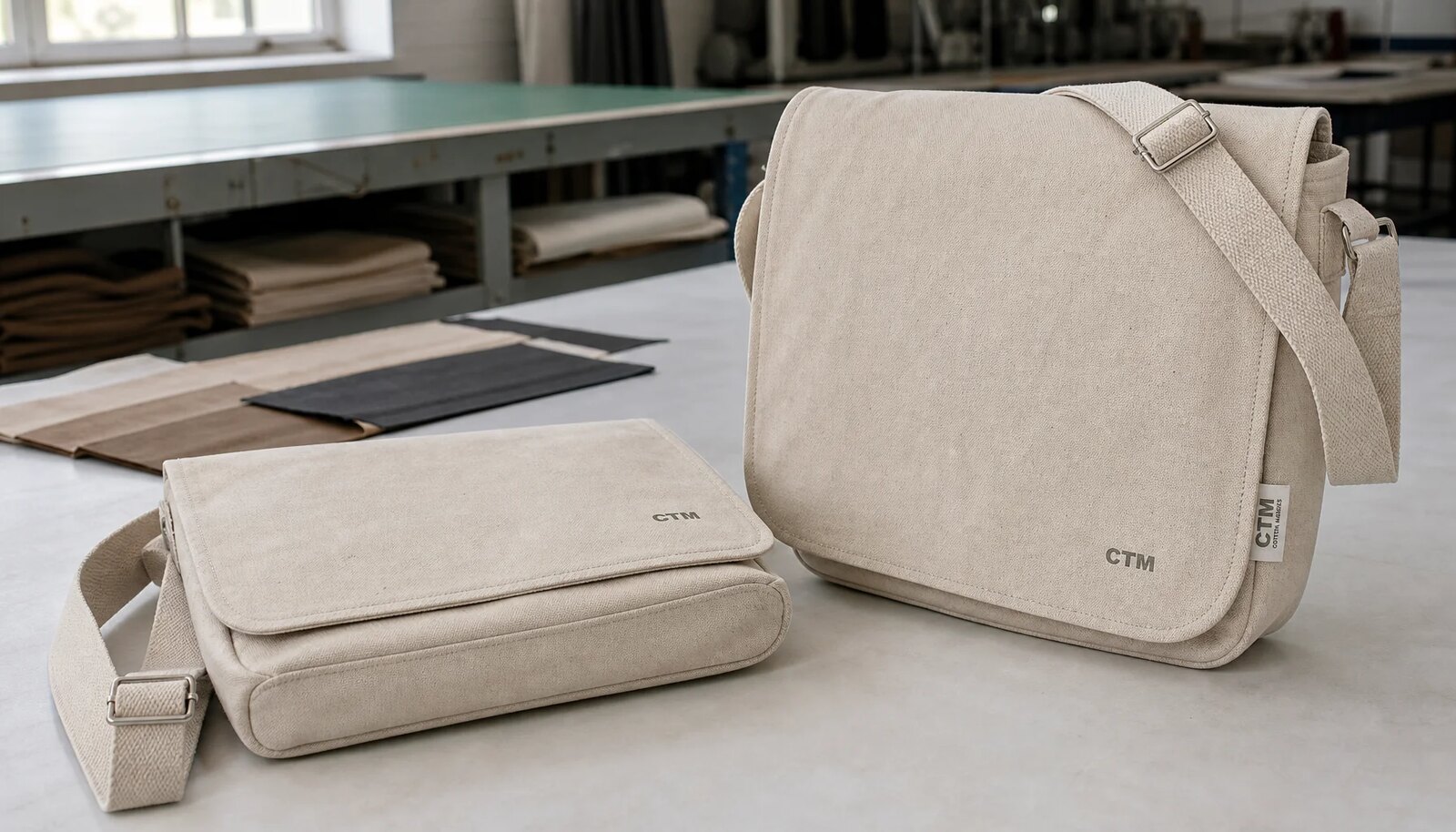
1. Start with the vendor use case
Wholesale canvas messenger bags for farmers market vendors are handled differently from event giveaways or office-style fashion bags. A vendor may wear the same bag during early setup, selling hours, restocking, payment handling, and end-of-day breakdown. The contents are mixed and uneven: labels, receipt books, card-reader accessories, cash envelopes, pens, stall notes, reusable ties, small tools, jars, produce samples, a water bottle, an apron, and personal items.
That use case should shape the sourcing brief before artwork or price is discussed. The bag must be comfortable enough for several hours of wear, structured enough to hold mixed contents, and strong enough at stress points. A reference photo only shows a shape; it does not define fabric weight, gusset, reinforcement, strap width, closure, or inspection criteria.
For B2B buyers, the common mistake is asking for a heavy canvas messenger bag with logo. One supplier may quote 10 oz natural canvas with a simple flap, while another quotes 14 oz dyed canvas with lining and reinforced webbing. Both quotes may be honest, but they are not comparable. A useful RFQ starts with the commercial role: vendor work bag, staff kit, market association merchandise, CSA gift, or premium retail accessory.
- Classify the bag's role before requesting price.
- List expected contents and approximate load.
- Prioritize strap anchors, bottom gusset, top hem, pocket joins, and print durability.
- Quote from a written specification, not only a photo or mockup.
2. Canvas weight: practical oz and GSM ranges
Fabric weight is the core decision in a wholesale canvas messenger bags for farmers market vendors fabric weight guide, but it must be defined carefully. Canvas is often quoted in ounces per square yard and sometimes in GSM. For this category, a practical range is usually 12 oz to 16 oz finished canvas, roughly 340 to 540 GSM depending on weave, yarn count, dyeing, washing, and finishing.
Weight alone does not guarantee durability. A tightly woven 12 oz canvas with good reinforcement can outperform a loose 14 oz canvas with weak stitching. A washed 16 oz canvas may feel softer and more retail-ready than an unwashed fabric, but washing can affect shade, shrinkage, and final dimensions.
The safest RFQ wording is to request a finished fabric weight and acceptable range. For example: 14 oz finished cotton canvas, target approximately 475 GSM, final range to be confirmed by supplier and approved by swatch. If a supplier quotes greige or loomstate weight, ask for the expected finished weight after dyeing, washing, coating, or finishing.
- 10-11 oz: possible for light promotions, but usually risky for regular vendor use.
- 12 oz: good entry point when construction and reinforcement are controlled.
- 14 oz: balanced choice for everyday vendor carry and private-label resale.
- 16 oz: stronger structure for premium bags or heavier contents.
- 18 oz and above: test comfort, sewing quality, foldability, print quality, and freight impact.
3. Example buyer specs for faster RFQs
Example specifications help buyers avoid vague terms such as durable, premium, thick, or heavy-duty. They also help suppliers understand the intended price tier. The following examples are starting points, not universal standards; each should be adjusted for target cost, market channel, and sample results.
A budget vendor bag should not be underbuilt. It can use simpler materials and fewer features, but the strap anchors, top hem, and gusset still need reinforcement. A retail merchandise bag should look cleaner at unpacking and may need stronger color and branding control. A premium lined messenger bag can justify more features, but every lining, pocket, closure, and hardware item adds inspection work.
Use these sample specs to normalize quotes before comparing unit price.
- Budget vendor bag: 12 oz finished natural cotton canvas, unlined, overlocked or bound key seams, box gusset, 38 mm cotton/poly webbing strap, flap with snap or flap-only closure, one-color screen print, reinforced strap anchors, bulk or simple individual packing.
- Retail merchandise bag: 14 oz finished canvas, natural or piece-dyed color, bound internal seams or simple lining, 40-50 mm adjustable strap, external or internal pocket, woven label plus screen print, carton packing that protects shape and presentation.
- Premium lined messenger bag: 16 oz finished outer canvas, light cotton/poly lining, organized pocket, zipper under flap or magnetic snap, metal slider and D-rings, X-box or bar-tack reinforcement, sewn patch or woven label, individual packing with barcode if required.
4. Finish, shrinkage, and color control
Natural canvas is often the simplest first-order option. It has a familiar farmers market look, avoids custom dyeing, and usually supports a lower MOQ when stock fabric is available. The tradeoff is that natural cotton shows dirt, oil marks, and warehouse handling marks more easily than darker shades.
Piece-dyed canvas gives buyers more merchandising control. Olive, black, navy, charcoal, rust, brown, and forest green can hide outdoor use better and may look more retail-ready. Dyed canvas requires shade approval, dye-lot control, and print-opacity checks. Dark colors may need higher-opacity ink or an underbase.
Washed, enzyme-washed, or pigment-dyed canvas can create a softer hand and relaxed premium look, but the process must be controlled. Washing after sewing can change finished dimensions, create uneven shading, and affect flap alignment. If a bag is lined, the lining and outer shell must be compatible so one layer does not shrink more than the other.
Be clear about measurement timing. Finished dimensions should mean after all processes that affect size, including washing, pressing, and final finishing if used. If the approved sample is washed and bulk production is not, the order will not match.
- Natural canvas: cost-effective and classic, but shows dirt more easily.
- Dyed canvas: better color strategy, but needs lab dip and shade tolerance.
- Washed canvas: softer hand, but more shrinkage and shade-control risk.
- Dark canvas: practical outdoors, but test print opacity and rubbing.
5. Construction matters as much as fabric weight
A heavier canvas body does not automatically create a durable bag. Many failures happen at construction points: strap anchors pull loose, side seams slip, bottom corners wear, flap stitching distorts, or pocket openings tear. Farmers market vendors carry uneven loads and hard-edged items, so reinforcement and seam quality are as important as ounces per square yard.
A bottom gusset or box gusset is usually more practical than a flat envelope shape. The gusset gives contents a stable base and reduces pressure on side seams. If the bag must stand upright when partially loaded, state that requirement. The factory may need a wider gusset, reinforced bottom seam, heavier canvas, lining, or a removable base insert.
The strap needs specific wording. A narrow strap may look neat but feel uncomfortable when loaded. For many vendor messenger bags, 38 mm to 50 mm webbing is more practical. Cotton webbing gives a natural look; polyester or cotton/poly webbing can improve dimensional stability. Adjustable straps are useful for different users, but sliders, D-rings, buckles, and stitching become QC points.
Reinforcement should be specified, not assumed. Common options include bar-tacks, X-box stitching, double stitching, binding, internal reinforcement patches, or rivets. A well-sewn bar-tack or X-box at the strap anchor is often more valuable than increasing the body fabric from 14 oz to 16 oz.
- Specify gusset depth and standing requirement if needed.
- Define strap width, composition, fixed length or adjustment range, and strap drop.
- Require bar-tack, X-box, or approved reinforcement at strap anchors.
- Check bottom corners, pocket joins, flap fold, and top hem on the sample.
6. Lining, pockets, closures, and branding
Extra features can improve value, but each one adds cost, lead time, and inspection risk. An unlined bag can be rugged and cost-controlled, but the interior seam finish must be intentional. If the bag is sold at retail, buyers may prefer bound seams or a simple lining for a cleaner presentation.
Lining improves appearance and supports pockets for phones, pens, receipt books, or POS accessories. A light cotton or cotton/poly lining is often enough. Heavy lining can add bulk and create puckering. Inspect whether the lining is caught cleanly in seams and whether corners sit flat.
Closure choice should match vendor behavior. Flap-only designs reduce parts and allow fast access. Magnetic snaps keep the flap closed while preserving speed. A zipper under the flap protects valuables but adds complexity. Buckles can look premium, but they may slow access during busy selling hours.
Branding should be durable and measurable. One or two-color screen printing is usually practical for market logos and co-op branding. Woven labels and sewn patches create a more premium look. Embroidery works best for small marks; large embroidery can pucker canvas. Heat transfer or digital print should be tested for adhesion, fold resistance, and rubbing on the actual fabric.
- Use unlined construction for rugged utility, but define interior seam finish.
- Use lining when retail presentation or organized storage justifies the cost.
- Choose flap-only or snap for fast access; choose zipper for valuables.
- Approve logo placement with measured distances, not visual judgment.
7. Quote comparison and MOQ control
A quote is only useful when the assumptions are visible. Two bags based on the same reference photo can differ in canvas weight, lining, strap width, thread, reinforcement, zipper grade, print method, label type, carton packing, and inspection support. A low unit price may be efficient, or it may be missing important construction.
Ask suppliers to list cost drivers clearly: canvas weight and finish, lining or seam finish, strap type and width, hardware, pockets, closure, print method, number of print colors, label or patch, sample cost, setup charge, packing method, carton dimensions, and Incoterm.
MOQ should be discussed by variable. A supplier may accept 1,000 pcs total, but five colors and four artworks create many small lots. Each lot needs separate cutting, printing, labeling, carton marking, and inspection. For first orders, limit variations where possible: one base construction, one or two fabric colors, and a small number of artwork versions.
Compare landed cost, not only FOB price. Heavier canvas, wide gussets, hardware, and stiff flaps can reduce carton efficiency. A lower unit price can become expensive after oversized cartons, low pack counts, relabeling, rework, or failed inspection.
- Normalize quotes by fabric, finish, construction, reinforcement, print, label, and packing.
- Request price breaks at 300, 500, 1,000, 1,500, and 2,000 pcs.
- Confirm MOQ per color, artwork, size, label version, and destination.
- Review EXW, FOB, and landed cost separately.
8. Sampling, lead time, and approval sequence
Sampling should prove production reality, not just appearance. A practical approval path includes fabric swatch, lab dip if dyeing is involved, print strike-off, trim or hardware sample, construction sample, and pre-production sample. For a simple natural canvas order, some steps can be combined; for a repeat retail SKU, they should be documented carefully.
A realistic sourcing timeline has stages. RFQ clarification may take several business days depending on spec completeness. Fabric swatches, lab dips, and print strike-offs add time when custom color or artwork is involved. Sample making and revisions can be quick for stock materials but longer for custom trims, lining, dyeing, washing, or special hardware. Bulk production begins only after pre-production approval, and final inspection, packing, booking, and freight handoff require their own planning window.
Do not treat lead time as a universal guarantee. It changes with fabric availability, factory capacity, sample rounds, holiday periods, inspection results, and shipping method. Seasonal farmers market programs should build in approval time before the selling window, especially if bags need barcode labels, retail packaging, or warehouse routing compliance.
Approve samples with measurements and load checks. Fill the sample with contents similar to market use, carry it, and look for strap twisting, flap gapping, bottom sagging, hardware slip, or anchor distortion. Comments should be measurable: move logo 15 mm higher, increase strap to 40 mm, add bar-tack, reduce flap by 10 mm, or change to 14 oz finished fabric.
- Approve swatch, strike-off, trims, and pre-production sample before bulk cutting.
- Measure after all finishing processes, including washing if used.
- Seal and label the approved sample for factory QC and buyer inspection.
- Build the timeline around approval stages, not only production days.
9. QC criteria, inspection, and packing
Quality control should focus first on function, then appearance. Critical defects include weak strap anchors, missing reinforcement, seam slippage, unstable hardware, incorrect dimensions, dirty fabric, wrong fabric weight, poor print curing, and incorrect packing. Minor thread trimming may be repairable; a missing bar-tack or wrong canvas weight is not a small issue.
Set acceptance criteria before production. Common starting points include body dimensions within +/-1 cm, strap length within +/-2 cm, logo placement within +/-5 mm to +/-10 mm, and stitch density matched to the sealed sample or defined range. Many canvas bag seams fall around 7-10 stitches per inch, but the approved spec should control the final standard.
Add simple performance checks. For load testing, use the buyer's target contents or an agreed equivalent weight, carry or suspend the sample for a defined period, then inspect strap anchors, bottom seam, gusset, hardware, and stitch distortion. For printing, perform dry rub checks and inspect for tacky ink, transfer, cracking, poor opacity, ghosting, pinholes that affect branding, and misregistration. For dyed dark canvas, add a crocking check if color transfer would create returns.
Final inspection should use an agreed sampling plan, such as ANSI/ASQ Z1.4 with AQL levels selected by the buyer. Incoming inspection checks fabric and trims before cutting. In-line inspection catches construction problems while they can still be corrected. Final random inspection checks dimensions, function, appearance, labels, and packing.
Packing must be specified. Confirm individual polybag, paper band, tissue, or bulk packing; inner pack; master carton quantity; carton dimensions; gross and net weight; carton marks; barcode labels; SKU separation; and pallet requirements. For warehouse shipments, buyers may add carton drop, compression, or packing-photo checks to reduce receiving issues.
- Check strap anchors, bottom corners, gusset, top hem, pocket joins, and flap fold.
- Measure size and logo placement against the spec sheet.
- Test hardware operation and slider hold.
- Verify carton marks, pack counts, barcode labels, and carton condition.
10. Compliance and reorder planning
Compliance depends on destination and channel. Buyers should confirm fiber content labeling, country-of-origin marking, care label wording, packaging warnings, barcode format, restricted substance expectations, and retailer routing requirements where applicable. If the bag uses metal hardware, coatings, dyed fabric, or printed inks, confirm any buyer-specific testing requirements before production.
Reorder planning should begin with the first purchase order. Ask the supplier to retain the approved pattern, swatch, lab dip, sealed sample, print screen, artwork file, trim references, carton specification, and QC notes. Also ask which inputs are stock-supported and which may change between runs.
A slightly simpler bag that can be repeated consistently is often better than a highly customized pilot that cannot be reordered with the same hand feel, color, cost, or lead time. For recurring farmers market programs, document the base construction and keep seasonal variation limited to artwork, label, or controlled color options.
- Confirm labeling, packaging, and restricted substance requirements early.
- Retain approved swatches, sealed samples, patterns, artwork, and trim references.
- Ask which components are stock items and which require new MOQ or lead time.
- Plan reorders before market season deadlines.
Specification comparison for buyers
| Buyer decision | Recommended spec range | Best fit | Procurement risk to check |
|---|---|---|---|
| Canvas weight | 12 oz to 16 oz finished canvas, approximately 340 to 540 GSM depending on weave and finishing | Most farmers market vendor work bags, market association merchandise, CSA kits, co-op resale, and staff carry bags | Below 10 oz can feel promotional; above 18 oz can increase stiffness, sewing defects, carton volume, and freight weight |
| Measurement stage | State whether oz/GSM is greige, finished, dyed, washed, or post-wash | Any RFQ comparing multiple suppliers or fabric sources | A quoted 14 oz greige canvas may not match a 14 oz finished canvas in hand feel, shrinkage, or finished bag weight |
| Construction | Box or bottom gusset, reinforced strap anchors, secured top hem, controlled seam allowance, bar-tack or X-box stitching | Bags carrying jars, labels, notebooks, card readers, water bottles, cash envelopes, and stall supplies | Heavy canvas will still fail if strap joins, side seams, bottom corners, or flap seams are underbuilt |
| Strap and hardware | 38-50 mm webbing; adjustable strap if needed; reinforced anchors; hardware only where function or brand value justifies it | Vendor work bags, staff kits, premium retail messenger bags | Thin webbing, weak sliders, sharp hardware, poor plating, and missing reinforcement cause complaints faster than fabric wear |
| Finish and color | Natural, piece-dyed, garment-washed, pigment-dyed, or coated canvas with approved swatch and finished GSM range | Natural for cost control; darker dyed shades for outdoor use and retail presentation | Shade variation, crocking, shrinkage, and print opacity must be approved before bulk cutting |
| Decoration | 1-2 color screen print, woven label, sewn patch, or small embroidery; transfer only after adhesion and fold testing | Farm logos, market association marks, grocery co-op branding, seasonal merchandise | Ink cracking, poor curing, misregistration, ghosting, or print placed on a fold line can reduce resale value |
| MOQ strategy | 300-500 pcs for simple stock-fabric pilots; 800-1,500 pcs for dyed fabric, lining, custom labels, or special hardware | Pilot orders, repeat wholesale SKUs, retail merchandise, community market bags | MOQ may apply per fabric color, artwork, size, label version, and destination |
| QC acceptance criteria | Use sealed sample, agreed tolerance, AQL plan, load check, rub/crocking check, and carton inspection | B2B orders where repeatability and warehouse acceptance matter | Vague approval wording allows disputes over size, fabric weight, print quality, reinforcement, and packing |
| Timeline planning | Allow stages for RFQ, swatch/lab dip, sample, revisions, pre-production approval, bulk production, inspection, and freight booking | Seasonal market programs and retail delivery windows | Lead time changes with fabric availability, dyeing, print complexity, sample rounds, holiday periods, and inspection results |
Buyer checklist before sampling
- Define the commercial role: vendor work bag, retail merchandise, staff uniform bag, CSA member gift, shopper promotion, or premium private-label accessory.
- Specify canvas weight in both ounces and GSM, and state the measurement stage: greige, finished, dyed, washed, or post-wash.
- Provide finished dimensions: width, height, gusset depth, flap depth, strap width, strap length or adjustment range, pocket size, and required strap drop.
- List the expected load: jars, small tools, notebooks, POS accessories, labels, water bottle, apron, cash envelopes, or produce samples.
- Choose the structure before decoration: unlined or lined, bound seams or overlocked seams, flat or box gusset, flap-only or zipper closure, fixed or adjustable strap.
- Send final-size artwork with Pantone, CMYK, or physical color reference, plus measured logo placement from flap edge, side seam, pocket seam, or top edge.
- Set core tolerances before sampling: body dimensions, strap length, logo placement, stitch density, shade range, and carton packing method.
- Request the right approvals before bulk cutting: fabric swatch, lab dip if dyed, print strike-off, trim samples, and pre-production sample.
- Ask for quote separation: unit price, sample cost, setup charge, label charge, dyeing or washing cost, packing cost, inspection support, and Incoterm.
- Confirm carton details: individual packing, inner pack, master carton quantity, carton dimensions, gross weight, barcode labels, carton marks, and SKU separation.
Factory quote questions to send
- What exact canvas weight are you quoting in oz and GSM, and is it greige, finished, dyed, washed, or post-wash measured fabric?
- Can you provide a swatch from the same stock or mill source intended for bulk production?
- What finished GSM tolerance do you control, and how is fabric weight checked during incoming inspection?
- Is the fabric natural, piece-dyed, pigment-dyed, yarn-dyed, enzyme-washed, garment-washed, coated, or water-repellent finished?
- Does the price include lining, binding, pockets, flap, gusset, strap, reinforcement, closure, hardware, labels, print, hangtag, individual packing, and export carton?
- What finished size tolerance can you hold for width, height, gusset, flap length, pocket opening, strap length, and strap placement?
- What strap width, strap composition, adjustment range, and reinforcement method are included: double stitch, bar-tack, X-box, box stitch, rivet, or combination?
- If hardware is included, what material and finish are used for sliders, D-rings, snaps, buckles, magnets, zippers, or pullers?
- What is your MOQ per fabric color, artwork, size, label version, and shipping destination, and what price breaks apply at 300, 500, 1,000, 1,500, and 2,000 pcs?
- What is the estimated timeline for swatch approval, sample making, pre-production approval, bulk production, inspection, packing, and freight handoff?
Quality-control points to confirm
- Incoming canvas is checked against the approved swatch for fabric type, color, hand feel, visible defects, and finished GSM range before cutting.
- Fabric shade is compared to the approved swatch, lab dip, or sealed sample under agreed lighting; obvious roll-to-roll or panel-to-panel mismatch is segregated.
- Finished dimensions are measured against the spec sheet, commonly using starting tolerances such as body +/-1 cm, strap length +/-2 cm, and logo placement +/-5 mm to +/-10 mm where appropriate.
- Stitch density is checked against the sealed sample or approved range; many canvas bag seams commonly fall around 7-10 stitches per inch, but the final range should be product-specific.
- Strap anchors use the approved reinforcement method, with no skipped stitches, loose bar-tacks, incomplete X-box stitching, needle cuts, weak back-tacking, or frayed webbing ends.
- Sample load testing is performed on approved samples or inspection samples using the buyer's target load, held or carried for a defined period, then checked for seam slippage, strap distortion, hardware slip, and bottom sag.
- Printed areas are checked for curing, alignment, opacity, cracking, and basic dry rub; dark or dyed canvas should also be checked for crocking risk on light cloth where relevant.
- Hardware functions smoothly and safely: zippers run without snagging, snaps align, magnets sit correctly, buckles do not distort, sliders hold strap length, and metal edges are not sharp.
- Final inspection uses an agreed sampling plan, such as ANSI/ASQ Z1.4 with AQL levels appropriate to the buyer's risk tolerance, rather than checking only top-carton samples.
- Packing inspection verifies carton quantity, SKU separation, barcode labels, carton marks, gross weight, polybag or paper-band method, and carton condition; carton drop or compression checks may be added for warehouse shipments.