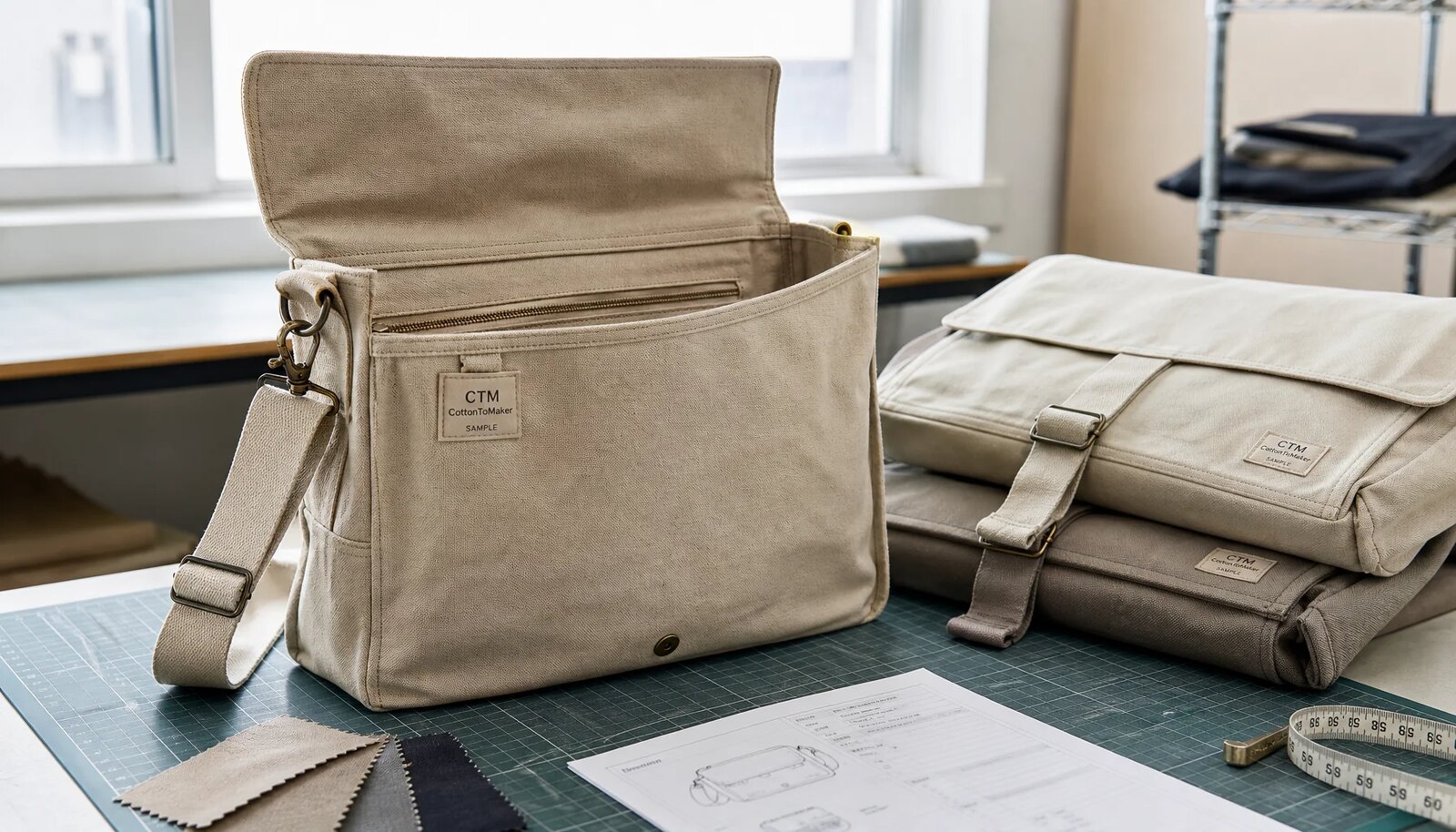
Start the RFQ from the event program, not the artwork
Event planners usually buy messenger bags for a defined program: registration packets, sponsor kits, speaker folders, VIP welcome sets, or staff materials. That use case matters because it determines size, weight, opening style, strap comfort, and how much structure the bag needs once filled. A bag that looks acceptable empty may fail once you add brochures, boxed gifts, chargers, notebooks, or a tablet.
Many weak RFQs start with only quantity, logo artwork, and a target budget. Suppliers then price their easiest assumption: lighter canvas, unlined construction, a smaller gusset, narrower webbing, or simpler packout. Procurement receives quotes that look comparable but are built on different products. The result is avoidable re-quoting, sample churn, and late cost movement when the real use case finally appears.
Open the RFQ with the operating scenario. State whether the bags are handed out at check-in, shipped to multiple venues, stuffed with inserts at origin, or packed empty and filled on site. Those details influence the correct closure type, the fold method, labeling, and how much abuse the cartons must survive. When the supplier understands the event workflow, the quote is more likely to match the program instead of just the photo.
- List the contents that must fit, with approximate dimensions and combined weight.
- State where the bags will be filled, stored, and distributed.
- Call out non-negotiables such as tablet fit, zipper closure, sponsor branding, or a fixed delivery date.
- If several internal teams are involved, name one approval owner so suppliers are not receiving conflicting instructions.
Fix the bag architecture before you compare quotes
The term messenger bag covers several very different constructions. One supplier may quote a flat document-style bag, another a gusseted courier bag, and another a zip-top conference bag with an internal pocket. In a product photo they can look close enough to confuse a rushed review, but the material usage, sewing time, and carrying performance are not the same. If the bag body is still vague, price comparison is mostly noise.
Define the finished measurements around actual inserts, not guesswork. If the bag must hold an A4 folder, event program booklet, water bottle, badge packet, or 13-inch tablet, test those items together and specify the required usable space. Write down body width, height, gusset depth, opening width, flap coverage, and pocket dimensions. A messenger bag that fits a brochure stack but cannot close cleanly over a boxed sponsor gift is not fit for the event, even if the sample looked fine on a table.
Reinforcement details also belong in the base spec. Adjustable shoulder straps, box-X stitching at strap anchors, bound or turned seams, bottom support, and closure attachment points all affect service life and appearance. These features are often omitted from first-pass quotes because they are not obvious in a logo brief. Put them in writing so the lowest quote is not simply the least durable construction.
- Attach a line drawing or marked reference image with all finished dimensions shown.
- Specify whether the bag needs a flap, zip-top, magnetic snap, buckle, or open-top construction.
- Define pockets, lining, organizer features, and whether a reinforced bottom is required.
- Treat strap anchors and seam finish as functional requirements, not cosmetic details.
Lock fabric, lining, webbing, and hardware with measurable specs
Canvas weight is a major cost driver, but it is not enough on its own. Procurement should specify fiber content, weight in oz or GSM, and any weave or construction note that matters to the final feel. A 12-14 oz cotton canvas is often a practical starting point for event distribution because it feels substantial without making the bag overly heavy. If the program calls for a more structured look or repeated reuse, a 16-18 oz body or reinforced base panel may be justified, but that needs to be intentional rather than assumed.
Fabric finish changes both look and manufacturing behavior. Pre-washed or enzyme-washed canvas may feel softer and more premium, but it can affect final dimensions, print sharpness, and batch consistency. Water-repellent coating, brushed finish, or pre-shrink treatment should be written explicitly because each changes cost and may also change how the logo behaves. Natural cotton canvas deserves its own note: minor shade variation is common, so buyers should define what level of variation is acceptable instead of arguing about it after bulk arrives.
Trim specifications deserve equal attention. State webbing width and material, the strap length adjustment range, zipper type, metal finish, lining material if used, and any woven labels, inner care labels, or hangtags. If the bag will be handled by attendees in business attire, scratched hardware, cheap-feeling sliders, or loose webbing weave will stand out quickly. Measurable trim specs keep the quote honest and reduce the chance that the factory swaps in easier stock components once bulk starts.
- Specify fabric composition, weight, and finish in the RFQ and tie them to an approved swatch or reference sample.
- Write down strap webbing width, adjustment range, and hardware material instead of saying standard hardware.
- If lining is required, note lining material, color, pocket configuration, and whether seams must be bound or turned.
- If testing matters for your market, state it early, such as colorfastness, restricted substance compliance, or basic physical performance.
Match decoration method to artwork, schedule, and reuse expectations
Screen print remains a strong option for simple branding on wholesale canvas messenger bags for event planners because it is cost-efficient on repeated artwork and gives a direct ink feel that suits canvas well. It works especially well for one or two spot colors, larger logos, and standard placements on the front panel or flap. However, screen print needs setup time and clear artwork rules. Fine lines, tight type, and dark bag colors may require an underbase or artwork adjustment, so those details should be discussed before the quote is treated as final.
DTF or heat transfer can be the better commercial answer when the artwork is detailed, multi-color, or likely to change between short runs. These methods reduce some setup complexity and can reproduce gradients or photographic elements more easily than a basic screen print job. The tradeoff is different hand feel and different failure modes. Buyers should inspect edge cleanliness, cracking risk on fold lines, cure quality, and whether the transfer remains presentable after bags are folded, packed, and handled during setup at the venue.
For more premium or quieter branding, ask whether a woven patch, embroidered badge, or sewn label could perform better than a large print. That is especially relevant when multiple sponsors are involved and you need a brand area that looks intentional rather than crowded. The right question is not which method sounds most premium in theory. The right question is which method fits the artwork, the budget, the production calendar, and the expected life of the bag after the event.
- Provide vector artwork, color references, and the smallest logo detail that must remain readable.
- State the exact print size and placement measurements from seams or edges, not just centered front.
- Ask suppliers to quote at least one alternative decoration method when the artwork is complex.
- Require a decoration approval sample or close-up photo that shows line quality, opacity, and edge definition.
Build MOQ and cost logic into the request
MOQ is rarely one simple factory policy number. It changes with fabric color, print screen count, custom labels, dyed webbing, zipper color, and whether the bag uses stock or made-to-order trims. A supplier may honestly offer a low MOQ on a natural canvas blank bag and a much higher MOQ once you ask for custom lining or matching hardware. That is not necessarily a problem, but buyers need to see those breakpoints clearly or the quote becomes misleading.
Request quantity breaks and cost breakout in the same response. A useful quote separates base bag price, decoration cost, sample fees, setup charges, labels, packaging, and freight basis. Ask for at least two or three quantity tiers such as pilot, confirmed event volume, and a higher replenishment level. That lets procurement see whether the price curve is reasonable or whether the supplier is relying on one specific volume to make the order work.
It is also worth asking how the supplier handles uncertainty. Event registration can move, sponsor inserts can change, and internal approvals can slide. If you may need a pilot run first, say so. A smart pilot uses the final construction but limits cost-driving variables such as custom-dyed trims or multiple print positions. That gives the team real feedback on size, strap comfort, and packing without forcing a large commitment before the design is operationally proven.
- Ask for MOQ by blank bag, decorated bag, and fully custom configuration.
- Request quantity breaks with separate prices for bag body, decoration, labels, and packing.
- Make the freight basis visible so you can compare EXW, FOB, and delivered options honestly.
- Clarify overrun or shortage tolerance, remake policy, and whether partial shipment is allowed.
Use a staged sample process with pass-fail criteria
A development sample and a pre-production sample solve different problems, so do not treat them as interchangeable. The development sample is where you confirm architecture: size, gusset, flap behavior, pocket usability, strap length, and general construction. Materials may still be provisional at that stage. The pre-production sample should then prove the actual bulk intent, including approved fabric, correct decoration method, final trim selection, and production-level packing approach.
Sample approval should be measurable. Put real inserts into the bag. Check whether the flap closes cleanly, whether the zipper catches, whether the strap sits comfortably, and whether the bag keeps a professional shape once loaded. Measure overall dimensions and pocket openings, not just the outer silhouette. On printed styles, confirm logo size, position, and color behavior on the actual canvas chosen for bulk rather than on a substitute base.
Record the approval in writing. Save photos from front, back, side, top opening, inner pocket, label area, and packed condition. Note any approved natural canvas variation, thread color, and hardware finish. If a supplier changes fabric source, strap width, print method, or packing fold after the pre-production sample is approved, that should trigger re-approval. A clean sample trail reduces disputes later because the purchase order is anchored to evidence instead of memory.
- Define the sample stages, expected turnaround time, and who signs each stage.
- Test the sample with the actual event contents or a realistic weight equivalent.
- Measure key points and record them on the sample approval sheet rather than approving by eye.
- Keep one sealed reference sample and a photo set for use during bulk inspection.
Quality control needs in-line checks, not just a final glance
Canvas messenger bags have more failure points than a simple tote, so final random inspection alone is not enough. In-line quality control matters because many defects become expensive or impossible to correct once the bag is fully assembled. Strap anchors, side seams, pocket joins, flap alignment, and closure placement should be checked early in sewing. If the bag uses heavy canvas, operators may need different needle and stitch settings than on lighter promotional bags, and that should be visible in workmanship.
Printed orders need their own control points. For screen print, inspect registration, edge sharpness, opacity, and cure consistency. For transfer methods, inspect film alignment, edge lift, rubbing behavior, and fold sensitivity. Natural canvas programs also need lot consistency checks so one carton does not look noticeably warmer or darker than another when bags are displayed together at an event. These are not abstract quality topics; they directly affect how professional the bags look when unpacked in front of sponsors or attendees.
Agree the inspection framework before production starts. Many procurement teams use a pre-shipment inspection against an agreed AQL, but that only works well if pass-fail criteria are already written into the PO and sample approval. Ask for defect photos during production if issues arise, and require rework approval on major visible defects. The point is not to create bureaucracy. The point is to catch defects while they are still cheap to fix and before cartons are sealed.
- Set in-line checkpoints for strap anchors, gusset seams, pocket attachment, and closure alignment.
- Define acceptable tolerances for dimensions, logo placement, and visible shade variation before bulk starts.
- Require practical load testing and decoration durability checks appropriate to the bag design.
- Use a final inspection standard that includes workmanship, function, appearance, and carton count accuracy.
Packing, labeling, and cartonization decide how event-ready the order is
Packing is where a well-made bag can lose points quickly. Overfolded flaps can crease transfers, packed corners can deform, and tightly compressed cartons can leave the bag looking tired before anyone touches it at the venue. Buyers should specify whether the bag is shipped flat, lightly stuffed, or folded in a particular way. If appearance on arrival matters, the packing method should protect the visible brand area instead of treating every bag like a generic utility item.
Receiving operations also matter. Some event teams receive into a warehouse, some into a hotel loading dock, and some through a sponsor kit assembler or a 3PL. Each route needs different labeling clarity. If cartons must be sorted by color, destination room, event date, or kit type, write that into the RFQ. A cheap quote can become expensive if staff spend hours opening cartons to identify where the bags belong because carton marks were not defined.
Cartonization affects both freight and handling. Ask for the maximum carton weight your team can handle safely, whether mixed cartons are allowed, and whether moisture protection is required for long transit. If the order ships by ocean or sits in temporary storage, odors and damp packaging can become real issues. These details may feel operational, but they belong in procurement because they directly affect landed condition and labor cost.
- Specify fold method, unit pack, and whether each bag needs an individual polybag or bundle packing.
- Set carton quantity and maximum carton weight so receiving teams can move cartons safely.
- Define carton marks, barcodes, destination labels, and whether mixed colors or mixed SKUs are permitted.
- If transit conditions are demanding, ask for moisture control measures and packed-condition photos before shipment.
Validate supplier capability, timeline, and communication discipline
The right supplier is not only the one with the best sample or the lowest quote. For event programs, reliability under a fixed calendar matters just as much. Ask whether the supplier controls cutting, sewing, printing, and packing directly or manages part of the work through subcontractors. Subcontracting is not automatically a problem, but unclear ownership is. Procurement needs to know who controls the sample, who approves bulk changes, and who is accountable if decoration or packing drifts from the approved spec.
Lead time should be broken into stages rather than given as one round number. Material sourcing, lab-dip or color approval, sample revisions, production slot booking, sewing, decoration, inspection, and shipment booking all consume time. Build the calendar backward from the event date with realistic buffer for approvals and transport. A quote that looks attractive but leaves no time for a corrected pre-production sample is often more dangerous than a slightly higher quote with a safer schedule.
Communication discipline is part of capability. Ask who sends work-in-progress updates, how often they are sent, and what information each update includes. Good suppliers can show sample status, material readiness, bulk start date, inspection plan, and packing progress without being chased repeatedly. When deadlines are immovable, you want a supplier that escalates risk early, not one that surfaces problems after booking has already become difficult or expensive.
- Verify which processes are in-house, which are outsourced, and who owns quality approval at each step.
- Request a stage-by-stage production calendar rather than a single total lead-time number.
- Build schedule buffer for artwork approval, sample revision, and transport, especially for event-critical dates.
- Set expectations for weekly progress reports, issue escalation, and approval turnaround from both sides.
Turn the guide into a procurement-ready RFQ template and scorecard
A strong RFQ is short enough to answer and specific enough to protect the purchase order. Page one should cover item name, event use case, quantity breaks, destination, ship window, Incoterm requested, and response deadline. The next section should contain the technical spec: finished measurements, fabric, lining, webbing, hardware, pocket layout, closure type, decoration, and packaging. Attach artwork files and one marked reference image so suppliers are not interpreting placement from a mockup alone.
Use the response format to force comparability. Ask each supplier to fill in the same commercial fields: MOQ, unit price by quantity tier, setup charges, sample charges, sample lead time, production lead time, QC standard, packing assumptions, and exclusions. Then score the responses using a simple matrix. Most B2B procurement teams will care about spec compliance, total landed cost, sample quality, lead-time confidence, communication quality, and payment terms more than any single price line.
That structure is what makes this a practical wholesale canvas messenger bags for event planners RFQ template guide rather than a generic product article. The value is not in making the document longer. The value is in removing silent assumptions so each supplier quotes the same bag, the same decoration, the same packout, and the same delivery basis. When those variables are aligned, procurement can negotiate from real information instead of spending the process untangling avoidable ambiguity.
- Keep one controlled RFQ file as the source of truth for sales, branding, logistics, and procurement.
- Require suppliers to answer in the same quote format so price differences are easier to diagnose.
- Score suppliers on compliance, landed cost, sample performance, timeline confidence, and responsiveness.
- Carry the approved RFQ details into the PO so bulk production is tied to the same spec and approvals.
Specification comparison for buyers
| Spec decision | Recommended option | When it fits | Buyer risk to check |
|---|---|---|---|
| Sourcing route | Direct factory with in-house cutting, sewing, and controlled decoration | You need repeatable fabric quality, tighter print placement control, and clear accountability on packing | Verify which steps are truly in-house and which trims or print processes are subcontracted |
| Sourcing route | Trading company with a named factory network and documented QC ownership | You need one contact for mixed event merchandise or multi-destination coordination | Confirm who owns the tech pack, sample approval, and final shipment signoff |
| Bag construction | Gusseted messenger with adjustable webbing strap and flap or zip-top closure | You need room for folders, literature, gift packs, or light tech items without a flat bag collapsing | Some lower quotes may switch to a flat document bag with less usable volume |
| Fabric weight | 12-14 oz canvas for standard event distribution | You want a solid hand feel and reasonable freight weight for attendee or staff kits | Below-spec fabric can sag when filled and may distort the logo area |
| Fabric weight | 16-18 oz canvas with reinforced bottom panel or extra seam support | You expect heavier inserts, repeated reuse, or a more structured premium look | Heavier fabric can affect sewing quality, carton weight, and production lead time |
| Print method | Screen print for 1-2 spot colors and larger simple logos | You have repeat artwork, need a lower decoration cost, and want direct ink feel on canvas | Fine text, tight registration, and dark fabric underbases need sample proofing |
| Print method | DTF or heat transfer for detailed multi-color artwork at moderate volumes | You need gradients, photo elements, or fast artwork changes across short runs | Check hand feel, cure quality, edge lift risk, and how folding affects the transfer |
| Sample approval | Development sample followed by a sealed pre-production sample | You need one sample to prove construction and a second to confirm bulk-ready materials and print | Do not approve bulk against a concept sample made with substitute canvas or stock hardware |
| Packing | Individual polybag plus controlled carton count under the buyer's weight limit | You need cleaner arrival condition and easier venue or 3PL receiving | Overpacked cartons can crease prints, crush corners, and slow event-day sorting |
Buyer checklist before sampling
- The RFQ states the exact event use case, the items that must fit inside the bag, and the approximate loaded weight per bag.
- Finished dimensions are written clearly, including width, height, gusset depth, flap size if any, and usable internal opening.
- Fabric composition, canvas weight in oz or GSM, weave or construction notes, and any finish such as pre-wash, pre-shrink, or water-repellent coating are specified.
- Webbing width, adjustable strap length range, hardware material and finish, zipper or snap type, and any lining or pocket requirements are listed.
- Artwork files are attached in editable vector format, with Pantone references, print size, placement measurements, and any minimum readable text requirement.
- The RFQ makes clear whether branding is screen print, transfer, embroidery patch, woven label, or a quote for multiple decoration options.
- Sample stages are defined, including development sample, pre-production sample, approval deadline, and who has final signoff authority.
- Pass-fail tolerances are written for key dimensions, logo placement, acceptable shade variation, stitch appearance, and closure function.
- QC expectations are stated, including inspection stage, defect reporting, load or pull test expectation at strap anchors, and count verification before shipment.
- Packing instructions cover fold method, polybag type, pieces per carton, maximum carton weight, carton dimensions target, and moisture protection if needed.
Factory quote questions to send
- What exact canvas are you quoting, including fiber content, fabric weight, weave, dyeing method, and finishing treatment?
- Is the quoted price based on blank bags, decorated bags, or fully packed units ready for shipment, and which Incoterm is the price built on?
- Which components are stock items and which are custom for this project, including fabric color, webbing color, labels, zippers, snaps, and packaging?
- What is the MOQ for this exact specification, and how does MOQ change if we change fabric color, print size, hardware finish, or private label details?
- Which decoration method are you recommending for this artwork, what setup charges apply, and what limitations should we expect for fine text, gradients, or dark canvas?
- What sample stages do you provide, what are the fees and lead times for each stage, and how many revision rounds are included before bulk production starts?
- What QC method do you follow for stitching, dimensions, logo placement, print durability, and carton count accuracy, and do you inspect to an agreed AQL standard?
- Do you subcontract any part of the order such as printing, washing, labels, or packing, and if yes, who controls those approvals and inspections?
- Please break down the production timeline from material approval to ship date and identify the most common causes of delay for this type of bag.
- What costs or terms are excluded from the quote, such as testing, destination labeling, barcode stickers, overrun allowance, freight, duties, or local delivery?
Quality-control points to confirm
- Dimension checks should follow the tolerance written in the PO, such as +/-1 cm on body width and height and a tighter tolerance on pocket or print placement if those areas are critical.
- Canvas should be verified against the approved material standard for weight, color, hand feel, and finish rather than accepted only by visual similarity.
- If natural canvas is used, shade variation limits should be agreed in advance so mixed lots or visibly mismatched panels are not treated as acceptable bulk output.
- Webbing width, strap adjustability range, and hardware finish should match the approved sample, and metal or plastic parts should be free from burrs, scratches, or sharp edges.
- Stress points at strap anchors, flap corners, pocket joins, and side seams should show the agreed reinforcement method, such as bar-tacks or box-X stitching, with no skipped stitches or seam opening.
- A practical load test or pull test should be performed on samples or early bulk units using the agreed contents or force standard before the full run is packed.
- Logo placement should stay within the agreed tolerance, and printed artwork should be checked for opacity, clean edges, registration, cure quality, rub resistance, and fold-mark sensitivity.
- Closures such as zippers, magnetic snaps, hook-and-loop, or buckles should be cycled across a sample set, not just one piece, to confirm smooth function and alignment.
- Final inspection should include stains, needle damage, loose threads, odor, moisture exposure, and inner debris so bags do not arrive event-ready in appearance only.
- Carton audit should confirm piece count, mixed-SKU rules, shipping marks, barcode accuracy, carton weight, and carton integrity before booking shipment.