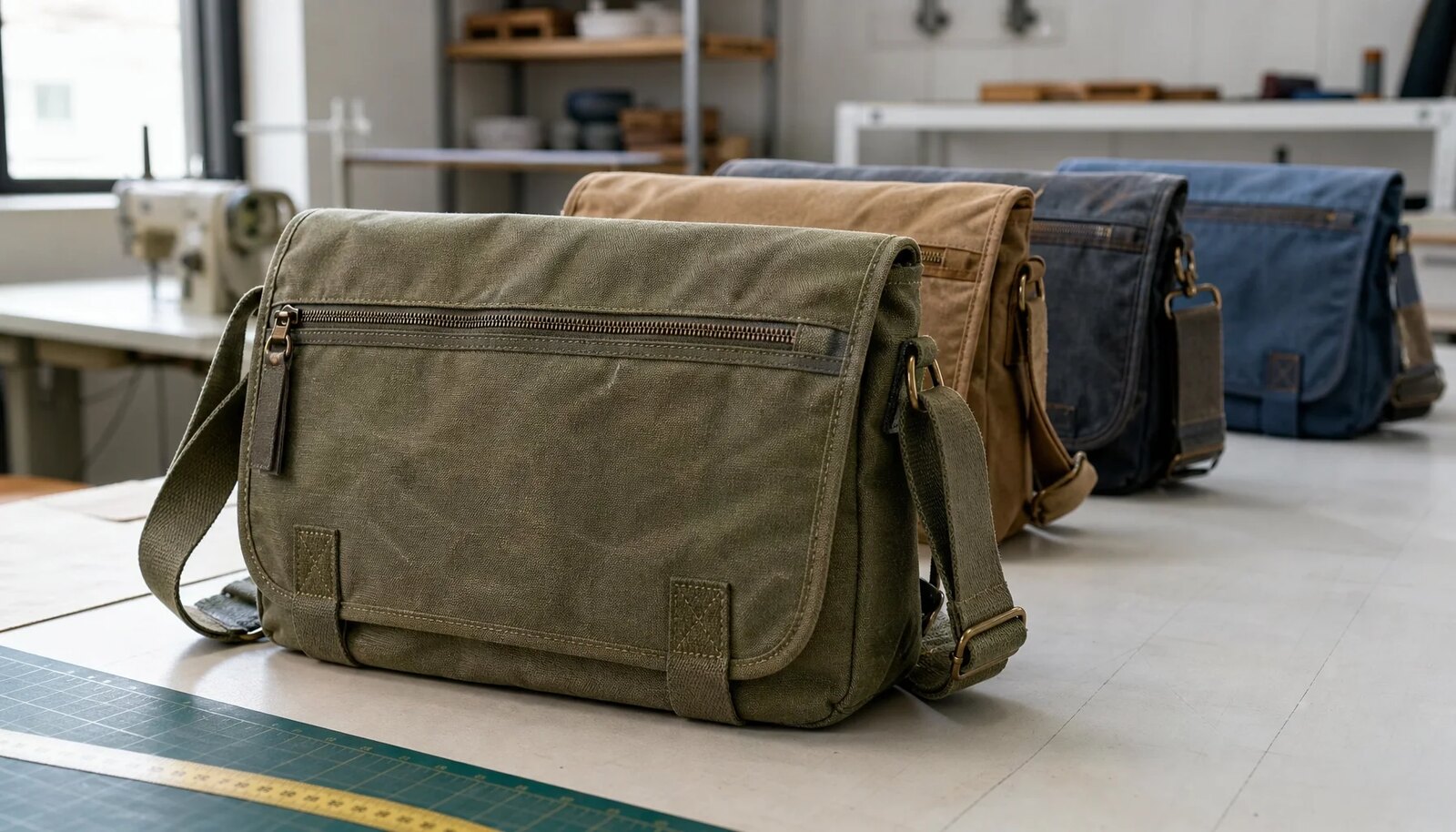
Start with the event load, not the bag photo
A canvas messenger bag used at an event has a harder job than it appears to have in a catalog image. It may be handed out at registration, pre-packed with sponsor materials, carried through a trade show floor, placed under chairs, stacked in a hotel receiving room, and reused after the event. A photo can show style, but it cannot prove that the flap closes over a loaded kit, the opening is wide enough for fast packing, or the shoulder strap feels acceptable once a notebook, bottle, charger, badge holder, and brochure pack are inside.
That is why B2B buyers should describe the job first. A one-day conference giveaway can be built differently from a staff messenger bag used for several weeks. A sponsor-heavy program may need a clean, flat front flap with stable print placement. A training kit may need a gusset deep enough to stop documents from curling. A premium attendee gift may justify heavier canvas, stronger hardware, a woven label, and more careful packing. These are procurement choices, not decoration details.
Before asking suppliers for prices, write down the planned contents, target loaded weight, distribution method, event date, venue receiving rules, and reuse expectation. If the bags will be filled at the factory, opening size, carton order, and destination labels become part of product quality. If temporary staff will pack bags onsite, the design should be forgiving: easy to open, consistent from carton to carton, and simple to sort by version.
A useful wholesale canvas messenger bags for event planners quality inspection checklist connects the expected use to the physical standard. It should tell the supplier what the bag must carry, how the brand must appear, where the product can vary, and which defects will block shipment. Without that control, the buyer may receive a bag that looks acceptable when empty but performs poorly during the actual event.
- List the exact event contents and estimated loaded weight before selecting canvas weight, strap width, or closure style.
- Decide whether the bag is a one-day giveaway, multi-day attendee kit, staff tool, VIP gift, or reusable branded item.
- Confirm whether bags will ship empty, pre-packed, sorted by attendee group, or delivered to multiple venues.
- Treat the logo panel as a controlled surface that must stay flat, centered, and visible when the bag is filled.
Convert expectations into measurable specifications
A strong RFQ turns soft expectations into measurable details. For messenger bags, the core measurements are finished width, finished height, gusset depth, flap depth, front pocket size, internal pocket size, handle drop, shoulder strap width, adjustable strap range, and usable opening. Buyers should also state how each dimension is measured: flat or filled, seam-to-seam or edge-to-edge, and before or after pressing. That one sentence can prevent several rounds of avoidable sample confusion.
Tolerance language matters because canvas is cut, sewn, folded, and sometimes washed. For many custom canvas bags, +/- 10 mm on larger finished dimensions is a practical starting point. Logo placement often needs tighter control, such as +/- 5 mm from the approved centerline, seam, flap edge, or pocket edge. If the bag must hold A4 documents, letter-size folders, tablets, catalogs, or boxed gifts, the usable opening and pocket depth should be controlled more closely than general appearance dimensions.
Construction choices should be named clearly. A flap-over messenger bag with an open main compartment is simple, economical, and quick to pack. A zipper improves security but adds checks for zipper grade, sewing alignment, slider smoothness, and opening width. Magnetic snaps are fast for attendees, yet they must line up when the bag is loaded. Hook-and-loop closures may work for staff or school-style programs, though they can feel less premium. Adjustable straps improve fit but add buckle, slider, webbing, and stitch quality variables.
A reference photo helps communicate shape, but it should not replace a specification sheet. Photos rarely define fabric weight, seam allowance, pocket depth, strap length, stitch density, or carton packing. If an event has VIP, speaker, sponsor, staff, and general-attendee versions, quote each version separately when size, color, logo, or packing changes. Combined pricing can hide the real cost and risk of complexity.
- Specify finished width, height, gusset, flap depth, pocket sizes, strap width, handle drop, and adjustable strap range.
- State whether measurements are taken flat, filled, seam-to-seam, or edge-to-edge after sewing and pressing.
- Set agreed tolerances for dimensions and logo placement before the supplier calculates price.
- Ask the supplier to flag any requested feature that is difficult to control in bulk production.
Choose canvas by weight, weave, finish, and print behavior
Canvas weight is one of the first cost and performance decisions. A 12 oz to 14 oz cotton canvas or cotton-rich blend is often suitable for lighter conference kits, brochures, notebooks, badges, and cost-sensitive attendee programs. It keeps material cost and carton weight under control, but it may slump if the bag is large or heavily loaded. A 15 oz to 16 oz canvas gives the bag more body and a stronger perceived value for programs that expect repeated handling. An 18 oz or heavier canvas is better reserved for premium gifts, heavier catalogs, tablet kits, or reuse-focused orders because it increases sewing effort, carton bulk, and freight exposure.
Ask for fabric weight in oz/yd2 or gsm, and make sure everyone uses the same unit. Approximate conversions vary by convention, but 12 oz canvas is roughly 407 gsm, 14 oz is roughly 475 gsm, and 16 oz is roughly 542 gsm. Weight alone is not enough. A tighter weave can print more cleanly and feel more stable than a looser weave with the same nominal weight. A loose weave may cause fuzzy print edges, uneven ink coverage, distortion near seams, and weaker abrasion performance.
Composition should be stated in procurement language. Cotton canvas has a natural handfeel and usually accepts common decoration methods well, but it can shrink, wrinkle, and show natural slubs. Cotton-poly blends may improve dimensional stability or reduce wrinkling, but they can change dye shade, handfeel, and print response. If the buyer requires natural cotton, recycled cotton, organic cotton, or a certified material, the requirement should be stated before quotation, along with any documentation needed for internal compliance.
Finish affects both appearance and decoration. Washed canvas feels softer but can wrinkle more in cartons. Stiffened canvas holds shape but may crease at fold lines. Dyed canvas creates dye-lot control questions, especially when panels, straps, binding, and pocket parts are cut from different lots. Water-repellent or coated finishes can help for outdoor programs, but they may reduce ink adhesion or change the handfeel. Always test the logo method on the same fabric finish planned for bulk.
- Use 12 oz to 14 oz canvas for lighter event handouts where cost and freight efficiency matter.
- Use 15 oz to 16 oz canvas when the bag needs better structure, repeated handling, and stronger perceived value.
- Use 18 oz or heavier canvas only when load, premium positioning, or reuse goals justify added cost and bulk.
- Approve fabric weight, weave, color, finish, and decoration together because each one affects the final result.
Engineer the stress points before they fail
The weakest areas of a messenger bag are rarely in the middle of a clean fabric panel. Failures usually appear at shoulder strap joins, D-rings, handle anchors, bottom corners, flap corners, zipper ends, and pocket openings. For event use, buyers should define the expected loaded weight and ask the supplier to build reinforcement around that load. A bag carrying a few handouts does not need the same construction as one holding a tablet, charger, catalog, and bottle.
Stitch density should be visible in the specification or confirmed during sampling. Many canvas bag constructions use roughly 7 to 10 stitches per inch, but the correct range depends on fabric weight, thread, seam type, and machine setup. Too few stitches can weaken seams and look crude. Too many stitches can perforate the fabric, especially around stress points. The factory should recommend a construction for the selected canvas and confirm it on the pre-production sample.
Name the reinforcement method instead of hoping the sewing line interprets the design correctly. Common options include bartacks at strap ends, box stitches with cross stitches, double-needle seams, bound raw edges, rivets, reinforced webbing tabs, and extra fabric patches behind stress areas. Rivets can add strength or a retail detail, but poor rivet setting can create sharp edges, loose movement, or fabric tearing. Webbing should be checked for width, thickness, weave, colorfastness, and whether the adjuster grips without slipping.
Closures also deserve a functional review. Zippers secure contents but must glide smoothly and align with the bag opening. Magnetic snaps are convenient, though they need correct polarity, placement, and holding strength. Buckles look structured but slow access. Hook-and-loop may be practical for some staff or school-style programs but can collect lint and may not fit a premium brand. Open flaps are fast and economical, but they give less protection during travel or venue handling.
- Define expected loaded weight and reinforce strap anchors, D-rings, handle joins, bottom corners, and pocket openings.
- State stitch density, seam allowance, thread type, and reinforcement pattern in the RFQ.
- Check rivets, snaps, magnets, buckles, adjusters, and zipper ends for smooth edges and secure attachment.
- Test loaded samples by carrying from both the handle and shoulder strap, not by visual inspection alone.
Match logo method to artwork and inspection risk
Brand decoration often creates the most tension because event deadlines leave little room for rework. Screen printing is usually the most predictable choice for bold event marks, sponsor logos, and one to three solid colors on a flat flap or front panel. It can provide strong coverage on canvas, but the buyer must define print size, placement, color reference, and whether an underbase is needed for colored fabric. Small text, fine lines, gradients, and tight multi-color registration become harder on textured canvas.
Heat transfer or digital transfer can handle complex artwork, gradients, short runs, or campaign graphics with many colors. The tradeoff is durability control. The supplier must manage film selection, curing temperature, pressure, dwell time, peel timing, and compatibility with the canvas finish. Inspect transfers for edge lifting, cracking, cloudy areas, poor adhesion, color shift, and damage from folding. If bags will be folded in cartons, the fold should not cross a sensitive decorated area unless the sample proves it will survive.
Embroidery, patches, and woven labels can make a bag feel more finished, but they are not automatically safer. Embroidery needs backing, realistic letter height, correct stitch density, and thread color control. Dense embroidery can pucker lighter canvas panels. Woven labels need approved size, fold type, edge finish, color, placement, and stitch method. Patches may add stiffness to the flap and can introduce adhesive or edge-fray issues if poorly made.
Artwork approval should happen on the finished bag or a production-method strike-off, not only on a digital mockup. The proof should show the logo at final size with distances from finished seams, flap edge, pocket edge, and centerline. If the logo sits on a flap, inspect it while the bag is loaded. A logo that looks centered on an empty flat sample can appear tilted, low, or distorted once the event kit is inside.
- Use screen print for bold logos, sponsor marks, and simple solid-color artwork on flat panels.
- Use transfer or digital methods for gradients, many colors, or short runs, but require adhesion, flex, and rub checks.
- Use embroidery, woven labels, or patches when premium texture matters and the artwork is suitable for the method.
- Approve a decorated pre-production sample or strike-off before bulk production begins.
Compare supplier quotes on the same assumptions
A low unit price is only useful when every supplier is pricing the same product. Messenger bag cost can move with canvas weight, composition, dye method, lining, strap width, pocket count, hardware grade, closure type, decoration method, logo size, packing format, carton size, and freight term. A 12 oz unlined canvas bag with a one-color print is not comparable to a 16 oz lined bag with a zipper pocket, custom label, and individual packing.
Ask suppliers to break out the price where possible. Separate the blank bag, decoration setup, decoration unit cost, label or patch cost, special hardware, packing material, cartonization, export fees, inland trucking, and international freight assumptions. This makes repeat ordering easier and shows whether a supplier has omitted a cost. It also helps the buyer decide what to simplify if the target budget is not met.
MOQ should be traced to the cost driver. Minimums may come from fabric roll purchase, dye lot size, print setup, embroidery setup, custom hardware, label production, cutting efficiency, or packing labor. A supplier using stock natural canvas may offer a lower MOQ than a supplier dyeing custom navy canvas. Mixed colors, multiple logo versions, destination sorting, and split shipments can add complexity even when the total quantity looks high.
Quote comparison should include payment terms, inspection terms, and incoterms. EXW, FOB, CIF, and DDP prices can look similar at first and very different after inland freight, export handling, duties, customs clearance, and final delivery are counted. For event planners, landed cost and delivery certainty matter more than the first unit price. Ask each supplier to state what is included, what is excluded, and which assumptions may change after sampling.
- Normalize fabric weight, bag size, decoration, trims, packing, and freight basis before comparing unit prices.
- Ask for separate costs for blank bag, decoration, setup, labels, packaging, cartonization, and freight assumptions.
- Confirm MOQ by bag color, fabric dye lot, logo version, trim color, packing method, and shipment split.
- Treat missing quote details as procurement risk, even when the unit price looks attractive.
Build an RFQ that keeps sampling clean
A good RFQ is not long for the sake of being long. It removes guessing. Include a product spec sheet, reference photo or sketch, finished dimensions, tolerances, fabric details, color standard, strap and hardware requirements, closure type, pocket layout, logo method, logo size, logo position, expected load, packing format, carton labeling, inspection rules, and required delivery date. The supplier should be able to quote, sample, and plan production from the same control document.
Artwork should be production ready whenever possible. Vector files are preferred for screen printing, embroidery digitizing, woven labels, and many transfer workflows. If brand colors matter, provide Pantone references or physical standards. Phone screens and monitor previews are not reliable color standards. If sponsor logos are involved, confirm final artwork before sampling because late sponsor changes can affect screen count, print area, setup cost, placement, and production time.
Define the sample type in plain terms. A fit sample checks size and construction and may use substitute fabric or trims. A print strike-off checks decoration on the intended fabric or panel. A pre-production sample should represent the bulk order with production canvas, trims, thread, closure, decoration method, label, and packing plan. A sealed approval sample becomes the reference for production and inspection. These samples do different jobs, and confusing them creates risk.
Ask the supplier to list assumptions and exceptions on the quote. If the exact fabric is unavailable for the first sample, the zipper grade is being substituted, the label size is pending, or carton dimensions are estimates, the buyer should know before approval. Written exceptions are much easier to manage than discovering differences during final inspection.
- Send the spec sheet, artwork, placement guide, packing rules, and delivery timeline in the first RFQ package.
- State whether you need a fit sample, print strike-off, pre-production sample, or sealed approval sample.
- Ask suppliers to list assumptions, exclusions, and proposed substitutions in writing.
- Update the quote and spec sheet whenever the sample changes size, fabric, trim, closure, decoration, or packing.
Approve samples with real event handling
Sample approval should treat the bag as a working event item, not a photo prop. Load the sample with the planned kit or a close substitute weight. Carry it by the shoulder strap and handle. Open and close it repeatedly. Pack and unpack documents at the speed event staff would use. Check whether the flap catches on contents, the zipper opening is too narrow, the strap twists, or the bag collapses awkwardly when filled.
Measure the sample and record actual results beside the requested specifications. Check width, height, gusset, flap depth, pocket depth, handle drop, strap range, logo position, and opening width. If a dimension is outside tolerance but acceptable, mark it as an approved deviation. If it must change, ask the supplier to confirm whether the pattern, price, or timeline changes. A casual email comment can be missed by production; a revised spec sheet travels better.
Inspect the inside as carefully as the outside. Raw edges, loose threads, open pocket corners, exposed embroidery backing, rough zipper tape, weak lining seams, and trapped threads affect attendee experience. Smell the bag as well, especially when dyed fabric, rubberized prints, transfers, adhesives, or fast packing are involved. Strong chemical odor, mildew odor, or dampness should be investigated before bulk approval.
The sealed sample should match the purchase order, artwork proof, and written specification. If those documents conflict, the sewing line may follow whichever version is easiest or most recent. Keep one approved sample with the buyer or inspection team and one at the factory. For high-value or time-sensitive orders, ask for photos of first bulk units before the full run proceeds.
- Load the sample with the planned event kit and carry it for several minutes before approving production.
- Check closure function, strap comfort, pocket access, logo visibility, and bag stability when filled.
- Record sample measurements beside requested measurements and identify approved deviations.
- Approve the sealed sample, artwork proof, purchase order, and spec sheet as one matched control set.
Use defect classes, tolerances, and functional tests
A practical quality inspection checklist focuses on issues that affect function, appearance, brand presentation, and event readiness. For canvas messenger bags, the highest-risk areas are fabric, color, measurements, stitching, strap attachment, logo placement, decoration quality, hardware function, pocket construction, odor, stains, packing, and labeling. Inspection can happen in-line after first production pieces are made and again as a final random inspection after packing.
Define major and minor defects before inspection starts. Major defects affect use, safety, brand presentation, or event distribution. Examples include wrong fabric weight, wrong color, broken zipper, loose strap anchor, open seam, missing logo, severely crooked logo, major stain, sharp hardware, wrong carton assortment, or incorrect destination label. Minor defects are small appearance issues that do not affect use and are not obvious at normal viewing distance, such as a short loose thread or a natural slub inside the approved range.
Use tolerances that match sewn canvas production. For many event bag orders, practical targets include +/- 10 mm for large finished dimensions and +/- 5 mm for logo placement, with no visible logo tilt when viewed from normal distance. These figures should be confirmed with the supplier because fabric weight, washing, gusset construction, and sewing method affect control. Pocket depth, tablet fit, and document fit may need tighter limits because they directly affect usability.
Inspection should include simple function tests. Randomly load selected bags with the agreed weight and lift by the handle and shoulder strap. Open and close zippers, snaps, magnets, buckles, and adjusters several times. Rub the print with a dry white cloth to check obvious crocking. Flex transfers to look for cracking or lifting. Pull gently at pocket corners and strap joins. Check cartons from the beginning, middle, and end of the packed run so production variation is not hidden.
- Check fabric weight, color, weave, finish, odor, stains, slubs, holes, shade panels, and dampness against the approved standard.
- Measure finished size, flap, gusset, pocket, handle drop, strap range, opening width, and logo placement.
- Inspect stitching for skipped stitches, open seams, thread nests, uneven bartacks, puckering, raw edges, and loose ends.
- Test hardware, zippers, snaps, magnets, rivets, buckles, strap adjusters, and webbing under normal use.
- Classify defects as major or minor before inspection so rework decisions are not negotiated under deadline pressure.
Control packing, cartons, and venue receiving
Packing is part of quality for event orders. Bags that arrive dusty, crushed, damp, wrinkled, mislabeled, or mixed between attendee groups create urgent labor at the venue. Decide whether bags ship bulk packed, individually polybagged, paper wrapped, flat packed, folded, or pre-kitted with other materials. Each choice affects presentation, cost, carton cube, inspection time, and onsite handling.
Canvas messenger bags can be light by piece but bulky by volume. Freight may be charged by dimensional weight instead of actual gross weight, especially for air shipments. Ask for carton dimensions, pack count, net weight, gross weight, total carton quantity, and estimated cubic meters before freight booking. If the schedule requires air freight, carton efficiency and packing compression become cost-sensitive. If bags are folded to save space, approve the fold position and check whether creases cross the logo.
Carton labeling should mirror the receiving process. Each carton should show PO number, SKU, bag color, logo version, quantity, carton number, and destination. If the event has VIP, staff, sponsor, speaker, or general-attendee versions, labels must make that distinction clear without opening every carton. For multiple venues, hotels, or advance warehouses, destination labels and packing lists should be checked carefully before release.
Final inspection should verify carton contents as well as bag quality. Open cartons from different points in the packed order, confirm assortment and quantity, and compare carton marks with the packing list. Check carton strength, tape closure, moisture protection, and whether inner packing prevents color transfer or abrasion. For event planners, a carton label error can disrupt distribution as much as a sewing defect.
- Choose flat pack, folded pack, bulk pack, individual pack, or pre-kitting based on venue labor and presentation needs.
- Confirm carton size, pack count, gross weight, total cartons, and cubic meters before booking freight.
- Use carton labels showing PO, SKU, color, logo version, quantity, carton number, and destination.
- Inspect cartons from the first, middle, and last packed batches before authorizing shipment.
Specification comparison for buyers
| Procurement decision | Typical B2B specification | Best fit for event buyers | Quality or cost risk to verify |
|---|---|---|---|
| Sourcing route | Direct factory with written spec, production sample, and final inspection | Repeat event programs, private label bags, custom dimensions, controlled trims, and bulk orders where consistency matters | Requires complete buyer input on artwork, tolerances, packing, and approvals; vague RFQs lead to inconsistent quotes |
| Sourcing route | Trading company consolidating bags with other event merchandise | Programs buying bags plus lanyards, notebooks, pouches, badge holders, or gift kits from one contact | Confirm who owns QC, who approves substitutions, and whether the factory source changes between sample and bulk |
| Sourcing route | Domestic stock bag with local decoration | Rush events, small pilot quantities, low MOQ needs, or projects with limited design flexibility | Stock size, canvas weight, color, pocket layout, and logo placement may be fixed; local decoration may not match factory-level integration |
| Canvas weight | 12 oz to 14 oz cotton canvas or cotton-rich blend | Light conference kits, brochures, badges, notebooks, and cost-sensitive attendee bags | Check actual gsm or oz/yd2, weave tightness, shrinkage, and print bleed; light canvas can slump when loaded |
| Canvas weight | 15 oz to 16 oz cotton canvas | Mid-range branded event programs needing better structure, repeated handling, and cleaner perceived value | Confirm needle size, seam reinforcement, strap anchoring, and carton gross weight because heavier fabric affects sewing and freight |
| Canvas weight | 18 oz or heavier canvas | Premium gift bags, heavier catalogs, tablet kits, or reuse-focused programs | Higher material cost, slower sewing, bulkier cartons, possible crease marks, and increased dimensional or gross freight weight |
| Logo method | Screen print, usually 1 to 3 solid colors | Bold sponsor logos, event marks, large front flap graphics, and repeat orders with stable artwork | Small text, gradients, and tight registration are risky; require approved strike-off and placement tolerance |
| Logo method | Heat transfer or digital transfer | Short-run multicolor graphics, gradient artwork, or photo-style campaign visuals | Verify film quality, curing temperature, pressure, peel timing, adhesion, cracking, and dry/wet rub performance |
| Logo method | Embroidery or woven label | Premium programs, staff bags, subtle branding, or long-use merchandise | Tiny lettering may fill in; confirm stitch count, backing, thread color, label size, edge finish, and needle marks on canvas |
Buyer checklist before sampling
- Define the event load in kilograms or pounds, including notebook, brochure pack, tablet, charger, water bottle, badge holder, sponsor inserts, and any boxed gift.
- Confirm finished width, height, gusset, flap depth, front pocket size, handle drop, shoulder strap width, adjustable strap range, and usable opening size.
- State whether dimensions are measured flat, filled, seam-to-seam, or edge-to-edge, and set practical tolerances such as +/- 5 mm for logo placement and +/- 10 mm for large sewn dimensions unless the supplier confirms tighter control.
- Specify canvas composition, fabric weight in oz/yd2 or gsm, weave description, color standard, shrinkage allowance, and whether natural slubs or shade variation are acceptable.
- Define fabric finish: greige, dyed, washed, softened, stiffened, water-repellent finish, or untreated canvas, and require the supplier to disclose any coating that changes handfeel or printability.
- Approve artwork at final size with placement distance from finished seams, flap edge, pocket edge, and centerline; do not approve placement from cut panels only.
- Select the decoration method before sampling and require the sample to use the same ink, transfer film, embroidery thread, backing, curing process, or label construction planned for bulk.
- State stitch density target, seam allowance, reinforcement method, bartack or box-stitch locations, thread type, and minimum load-handling expectation for handles and shoulder straps.
- Request a pre-production sample made with production fabric, trims, closure, lining, print method, label, and packing format; list any sample differences in writing.
- Ask suppliers to quote blank bag cost, decoration setup, decoration unit cost, tooling, labels, packaging, cartonization, inland freight, export fees, and international freight assumptions separately.
Factory quote questions to send
- What exact canvas composition, yarn or weave description, fabric weight in oz/yd2 or gsm, and shrinkage allowance are included in this quote?
- Is the quoted fabric greige, dyed to order, washed, softened, coated, water-repellent, or stock color canvas, and how will you control dye lot variation?
- What finished dimensions are included, and are they measured flat, filled, seam-to-seam, or edge-to-edge after sewing and pressing?
- What measurement tolerances do you normally hold for width, height, gusset, flap depth, pocket placement, strap length, and logo placement on bulk production?
- Is the decoration price based on blank bags, one-side print, two-side print, flap print, pocket print, woven label, embroidery, patch, or multiple logo positions?
- What maximum print area is included in the price, and how does pricing change for larger artwork, more colors, underbase printing, or tighter color matching?
- Can you provide a print strike-off or decorated pre-production sample using the same canvas, ink, transfer film, thread, curing method, and placement guide as bulk production?
- What minimum order quantity applies by bag color, fabric dye lot, print design, print color count, hardware finish, trim color, and packing method?
- How many calendar days are required for artwork proof, sample making, sample transit, sample revision, material booking, bulk production, inspection, and export packing after deposit?
- What closure, zipper grade, snap type, magnet size, D-ring thickness, buckle material, rivet specification, strap webbing, and sewing thread are included?
Quality-control points to confirm
- Finished size should be checked after sewing and pressing against agreed tolerances for width, height, gusset, flap depth, pocket position, handle drop, adjustable strap range, and usable opening.
- Canvas weight should match the approved swatch, PO, or lab reference; inspectors should verify by fabric certificate or by cutting and weighing a known area when the order value justifies it.
- Fabric appearance should be reviewed under consistent light for stains, oil marks, large slubs outside the approved range, shade panels, weaving defects, holes, excessive wrinkling, dampness, and odor.
- Color should be checked against the approved standard or swatch, with attention to side panels, flap panels, straps, binding, and pocket pieces that may come from different fabric lots.
- Stitching should be straight, secure, and evenly spaced, with no skipped stitches, broken stitches, open seams, loose thread nests, raw edges, or fraying at stress points.
- Handle anchors, shoulder strap joins, D-rings, webbing loops, rivets, and bottom corners need extra inspection because they carry the highest load during venue handling and attendee use.
- Print placement should stay within the approved tolerance from the centerline, flap edge, pocket edge, and side seams; visibly tilted or shifted logos should be classified as major defects for branded events.
- Print quality should be checked for ink coverage, edge sharpness, color match, registration, curing, transfer adhesion, cracking, peeling, crocking, and dry rub resistance.
- Embroidery or woven-label branding should be checked for thread color, stitch density, loose threads, backing exposure, label alignment, edge fraying, and distortion of the canvas panel.
- Hardware must function smoothly and be attached without loose rivets, weak magnets, cracked snaps, rough zipper teeth, sharp edges, corrosion, misalignment, or noisy movement that feels cheap.