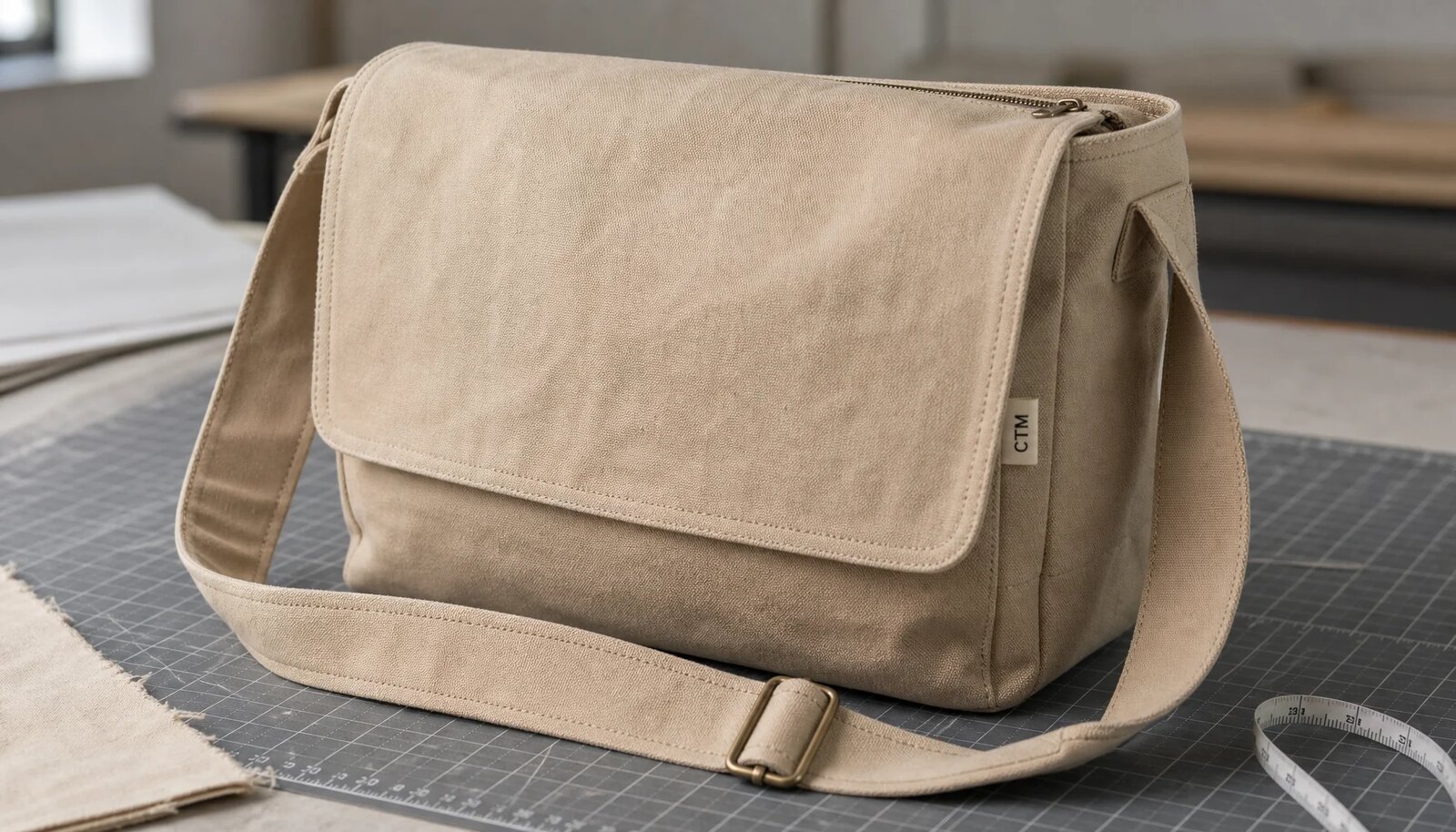
Define the Event Load Before Negotiating MOQ
MOQ becomes hard to negotiate when the product is described only as a canvas messenger bag. Event planners may use the same phrase for very different jobs: a one-day registration handout, a sponsor kit, a staff operations bag, a VIP gift, a retail-style conference item, or a reusable carrier for a multi-day program. Each use creates a different load, wear expectation, decoration need, and packing requirement. A bag meant to carry a badge, agenda, and folded brochure can be lighter and simpler than a bag expected to carry catalogs, a tablet, bottled water, charger, notebook, and sponsor samples.
Start by converting the event plan into a physical requirement. Estimate the heaviest likely contents and note whether the items are flat, bulky, sharp-edged, or heavy in one corner. A tablet or hardcover notebook changes the pressure on the bottom seam. A water bottle adds point load and may require a deeper gusset. A stack of catalogs may make strap comfort more important than an extra pocket. This translation helps the supplier quote construction instead of guessing at it.
This matters because factories do not set minimums around a product name. They set minimums around fabric buying, cutting efficiency, trim procurement, decoration setup, sewing line time, inspection, packing labor, and shipment handling. If the use case is vague, a supplier may quote a conservative higher spec or a low price built on weak assumptions. A precise use case gives the factory room to identify which elements can be simplified without making the bag unsuitable for the event.
- List expected contents and approximate total load before sending the RFQ.
- Classify the program as disposable handout, reusable attendee bag, staff kit, retail resale, or premium gift.
- State whether the bag must survive one event day, several event days, or repeated use after the event.
- Separate must-have features from optional features before asking for a lower MOQ.
Translate Bag Construction Into Purchasable Specs
A procurement-ready canvas messenger bag spec should include finished size, gusset depth, canvas weight, fabric color, lining, pocket layout, closure, strap webbing, hardware, reinforcement, decoration, labels, packing, and carton marks. Finished size is especially important. Pattern size and finished size are not the same because seam allowance, folding, shrinkage, and washing can reduce the usable dimensions. For event buyers, usable capacity matters more than the pattern measurement on a factory worksheet.
Canvas weight should be stated clearly. In many bag quotes, 10oz, 12oz, 14oz, and 16oz refer to ounces per square yard. Approximate metric equivalents are about 339 GSM for 10oz, 407 GSM for 12oz, 475 GSM for 14oz, and 542 GSM for 16oz. These numbers are useful for comparison, but they are not a substitute for a sample because finishing, dyeing, washing, and coating can change hand feel, stiffness, shrinkage, and apparent thickness. Ask whether the quoted weight is before or after finishing.
For event messenger bags, 10oz canvas may suit light handouts where cost and speed matter. 12oz is a common middle range for agendas, notebooks, badges, and brochures. 14oz gives more body for reusable programs, heavier inserts, or a more substantial hand feel. 16oz can work for premium kits or heavier use, but it may raise cost, sewing difficulty, carton weight, and minimums. The best choice is not always the heaviest one; it is the lightest construction that safely matches the load and presentation standard.
- Specify finished width, finished height, gusset, flap length, pocket opening, and strap adjustment range.
- Use ounce and GSM references carefully, and require the supplier to state how fabric weight is measured.
- Keep the first order to one body color, one strap color, one closure type, and one decoration method when MOQ is tight.
- Ask for the construction drawing or marked sample photos if the bag has multiple pockets or reinforcement points.
Use Standard Materials Where Minimums Are Real
Many MOQ problems begin with material choices. A stock natural, black, navy, gray, or other common canvas may be available in smaller quantities because the factory or fabric mill already carries it. A custom-dyed canvas may require a minimum fabric run, lab dip approval, dyeing lead time, and shade tolerance. If the bag also needs custom webbing, a special zipper tape color, plated hardware, printed lining, and a woven label, the order may collect several separate minimums even before sewing begins.
Procurement teams should ask which components control the minimum. Sometimes the bag body is flexible, but the woven label supplier has a higher minimum. Sometimes the canvas can be purchased in a small lot, but the custom dyed webbing cannot. Sometimes the factory can sew 300 bags, but it will not set up four print versions under 100 pieces each. The negotiation is strongest when buyers identify the bottleneck instead of asking only for a lower number.
A production-friendly specification usually uses stock canvas, standard webbing, standard metal or plastic hardware, and a decoration method the factory runs often. Premium choices can still be justified, but they should support a commercial need such as sponsor visibility, long reuse, retail presentation, or brand consistency. If the event is a one-time giveaway, custom hardware may be a poor place to spend MOQ leverage. If the program repeats across regions, a custom label or controlled fabric color may be worth the setup.
- Ask whether canvas, webbing, zipper tape, buckle, slider, thread, lining, and labels are stock or custom.
- Replace custom-dyed fabric with stock natural canvas if timing or MOQ is the main constraint.
- Use standard hardware finishes unless the brand requirement is documented and worth the minimum.
- Confirm whether future repeat orders can reuse labels, screens, plates, or approved components.
Break MOQ Into the Lines That Actually Matter
An MOQ stated as 500 pieces can mean several different things. It may mean 500 pieces total, 500 per body color, 500 per canvas lot, 500 per artwork, 500 per woven label, 500 per packing format, or 500 per shipment. These differences are critical for event planners because programs often involve sponsor versions, regional versions, department versions, or venue-specific packing. A supplier that accepts 500 total but requires 250 per logo is not offering the same flexibility as one that can handle 500 total across five logo versions with separate setup charges.
The right way to negotiate is to make the supplier define the minimum by driver. If fabric is the issue, consolidating body colors may help. If decoration setup is the issue, reducing print colors or versions may help. If sewing-line efficiency is the issue, using a standard body size may help. If packing labor is the issue, bulk packing or fewer carton splits may help. Each concession should be tied to a real production cost, not a vague discount request.
Quantity breaks should be quoted using the same spec. Ask for 300, 500, 1,000, and 2,000 units only if those quantities are realistic for the event or future replenishment. Require setup fees to remain visible. A low unit price that hides a large setup charge can be misleading on a short run, while a higher unit price with reusable screens or labels may be better for repeat programs. For budget approval, show both first-order cost and likely repeat-order cost.
- Ask the supplier to identify the MOQ driver: fabric, trim, cutting, printing, label, packing, or order value.
- Quote total order MOQ and per-version MOQ separately.
- Request quantity breaks with setup charges shown outside the unit price.
- Ask whether overruns or underruns are allowed, and set exact-quantity rules for kitted events.
Compare Supplier Routes Before You Push Price
Not every supplier route is designed for the same order profile. Domestic stock distributors are useful when the event date is close and the bag body can be standard. They may offer lower practical minimums and fast decoration, but the buyer gives up control over canvas weight, exact construction, hardware, and long-term restock consistency. This route can be excellent for urgent attendee bags, but weaker for a controlled reusable program.
Direct overseas factories are stronger when the order volume supports setup and the construction needs to be controlled from fabric through packing. They can quote specific canvas weight, reinforcement, labels, carton marks, and inspection standards, but lead time is longer and custom changes usually carry real minimums. Trading companies or sourcing agents can help when the order includes multiple products, documentation, consolidation, or language coverage. The buyer should still require clear specs, factory capability, and cost lines.
Hybrid routes are common in events. A team may import unbranded messenger bags in one consistent base spec and decorate locally when sponsor artwork is final. This reduces artwork timing risk, but it separates bag quality from decoration quality. If the print cracks or the blank bag shrinks, responsibility can become unclear unless the buyer defines testing, proof approval, spoilage allowance, and rejection rules before placing the order.
- Use stock distributors when speed matters more than custom construction control.
- Use direct factories for repeat programs, higher volume, controlled specs, and formal inspection.
- Use sourcing agents when consolidation or documentation is worth added margin.
- Use hybrid finishing when artwork timing is uncertain, but define defect responsibility in writing.
Build an RFQ That Makes Quotes Comparable
A vague RFQ creates quotes that appear close but are not comparable. One supplier may assume 12oz natural canvas, bulk packing, and one-color screen print. Another may assume 14oz dyed canvas, individual polybags, and a woven label. A third may quote only EXW unit cost and exclude screens, sample fees, export documents, and inland freight. Procurement teams should prevent this by sending one structured RFQ package and requiring each supplier to quote against the same assumptions.
The RFQ should include finished dimensions, canvas weight, fabric color, composition, closure, strap width, adjustable strap range, pocket count, lining, reinforcement, decoration method, logo size, logo colors, placement diagram, label requirements, packing format, carton marks, quantity breaks, destination, delivery date, and Incoterm. If alternates are acceptable, list them separately. For example, quote Option A as 14oz natural canvas with one-color screen print and individual polybag, and Option B as 12oz natural canvas with woven label and bulk pack.
Commercial clarity matters as much as product detail. Ask for unit cost, setup fees, sample fees, strike-off fees, lab dips, screen charges, digitizing, label setup, packing cost, carton cost, inland freight, export documents, courier sample cost, and lead time. If the buyer has a target landed budget, share the target range carefully and ask the supplier to identify spec changes that would meet it. Good suppliers can often suggest a simpler pocket, standard webbing, or alternate decoration that protects function while lowering MOQ pressure.
- Attach artwork files, Pantone references, logo dimensions, placement diagrams, and clear-space rules.
- Require each supplier to quote the same quantities, Incoterm, packing method, and destination.
- Separate unit cost from setup, sample, packing, freight, and document charges.
- Ask suppliers to mark every assumption they made where the RFQ was incomplete.
Choose Decoration With Setup, Durability, and Versioning in Mind
Decoration is often where event bag MOQ becomes complicated. Screen printing is usually practical for flat logos on canvas, especially one or two colors on a smooth panel. It requires screens, print setup, and placement control, but it can be cost-effective when the artwork is stable. Multi-color printing adds registration risk and setup time. Large solid prints on textured canvas may show more ink variation than the same artwork on smooth synthetic material, so buyers should approve a strike-off rather than relying only on a digital mockup.
Embroidery can look premium, but it adds digitizing, stitch-count cost, and fabric distortion risk on lighter canvas. It is better for smaller logos, patches, or areas with enough structure. Woven labels are useful for subtle branding and repeat programs because they can be sewn consistently and may avoid large print-quality concerns, but label production can create its own MOQ. Heat transfer can support detail and gradients, yet buyers should ask about heat setting, adhesion, rub resistance, and whether the transfer hand feel is acceptable on cotton canvas.
For multi-sponsor events, versioning is as important as decoration method. Five sponsor logos on one shared bag may be cheaper than five separate artwork versions. If separate versions are required, ask for setup cost and minimum per version. Also define print placement tolerance. For many bag programs, plus or minus 3 mm to 5 mm may be reasonable for logo placement depending on panel size and sewing variation, but the agreed tolerance should be written on the spec sheet and checked against the approved sample.
- Approve a print strike-off or decorated pre-production sample before bulk printing.
- Confirm number of print colors, logo size, placement, ink type, and setup charges.
- Ask whether embroidery pricing is based on stitch count, thread colors, and logo location.
- Set per-artwork MOQ and setup fees before promising sponsor-specific versions.
Approve Samples Against Production Conditions
A reference sample is not a production approval. It may show general shape and workmanship, but it usually does not prove the final fabric lot, final color, final logo, final strap, final hardware, final label, or final packing. For a controlled event order, the best approval sample is a pre-production sample made as close as possible to the actual bulk order. If time does not allow one complete sample, approve separate references: fabric swatch or lab dip, blank construction sample, print strike-off, label sample, and packing mockup.
Sample review should be physical and measured. Check width, height, gusset, flap coverage, pocket opening, strap width, and strap adjustment range. Load the bag with actual event contents and carry it by the strap. Open and close the zipper, snap, buckle, or magnetic closure repeatedly. Look at strap anchors, zipper ends, flap corners, and pocket corners for reinforcement. Inspect inside seams for raw edges, loose threads, or areas that may catch paper, tablets, or sponsor inserts.
The approved sample should become the inspection benchmark. Take clear photos of front, back, inside, strap anchor, closure, print, label, and packing. Record measurements and any allowed deviations. Attach this approval record to the purchase order or production file. If the supplier later changes fabric lot, webbing, hardware, print method, or packing, the change should require written buyer approval. This discipline prevents the common problem where a good sample is approved but bulk production quietly shifts to easier or cheaper components.
- Approve final canvas, final decoration, final strap, final closure, final label, and final packing whenever possible.
- Measure the sample and record agreed tolerances before bulk production starts.
- Test with real event contents, not only empty-bag appearance.
- Keep approved sample photos and notes in the PO file for final inspection reference.
Set QC Standards Before Cutting Starts
Quality control is easier when the supplier knows the standard before production begins. For wholesale canvas messenger bags, the most important checks are fabric weight, shade, finished dimensions, seam strength, strap attachment, decoration quality, closure function, packing accuracy, and carton labeling. These details affect event operations. A weak strap anchor can fail during registration day. A wrong carton mark can delay venue receiving when dock time is limited. A mixed artwork carton can disrupt sponsor commitments.
Define defect categories in practical language. Critical defects may include unsafe hardware, broken straps, unusable closures, incorrect logo, wrong product, severe mold or odor, or major short shipment. Major defects may include dimensions outside tolerance, open seams, missing labels, visible print misregistration, wrong packing, failed zipper, or incorrect carton count. Minor defects may include small loose threads, slight removable marks, or minor stitch variation within the approved sample standard. If using AQL inspection, state the level and acceptance limits in the purchase order rather than assuming the supplier applies the same standard.
Inspection can happen in stages. Fabric inspection checks stains, shade bands, wrong weight, or unacceptable flaws before cutting. Inline inspection catches sewing issues before the full run is complete. Final inspection checks finished bags, decoration, measurements, packing, and carton quantities before shipment release. For higher-risk orders, request third-party inspection or detailed inspection photos before balance payment. For lower-risk stock orders, at least require photos of representative finished bags, close-ups of decoration and reinforcement, carton marks, packing list, and carton dimensions.
- Set finished-size, logo-placement, and color-approval tolerances in writing.
- Require reinforcement at strap anchors and load points to match the approved sample.
- Use a basic load check based on the actual event contents.
- Verify carton marks, SKU labels, artwork versions, and packing list quantities before shipment release.
Control Packing, Cartons, and Venue Receiving
Packing is not an afterthought; it changes cost, labor, damage risk, and sometimes MOQ. Bulk packing is usually the lowest-cost option because it reduces handling and material. Individual polybags add labor and material, and recycled or branded bags may add cost or minimums. Insert cards, hang tags, barcode labels, retail stickers, inner cartons, and special carton marks all create additional operations. A quote with bulk packing should not be compared directly with one that includes retail-ready packing.
Event distribution should drive the packing decision. If bags are handed out at registration, cartons may need to be organized by venue zone, sponsor version, attendee category, or staff team. If bags ship to multiple cities, carton labels should show event name, destination, SKU, artwork version, quantity, carton number, and total cartons. If a fulfillment center is involved, barcode format, label placement, carton size, and pallet requirements may be mandatory. The cheapest packing can become expensive if it forces manual sorting at the venue.
Ask the supplier for carton quantity, carton dimensions, gross weight, net weight, folding method, and whether the print face touches another panel. Canvas messenger bags can be folded flat, but aggressive folding may crease the flap or transfer ink if curing or packing is not controlled. Heavy cartons may reduce freight cost per unit but slow temporary event crews. If the bag has a large print, ask whether tissue, paper interleaving, or print-facing orientation is needed. Set carton weight limits if the receiving team has handling constraints.
- Quote bulk pack, individual polybag, recycled polybag, and retail-ready packing separately.
- Define carton marks by event, destination, SKU, artwork version, quantity, and carton sequence.
- Ask for carton size, gross weight, units per carton, and folding method before approving freight.
- Check that packing does not cause creases, trapped moisture, print transfer, missing inserts, or mixed versions.
Specification comparison for buyers
| Sourcing route | Best-fit order profile | MOQ negotiation lever | Buyer risk to check |
|---|---|---|---|
| Domestic stock distributor | Small event runs, urgent replenishment, speaker gifts, or venue kits where the bag body can be standard | Negotiate available inventory, decoration method, carton split, and rush handling rather than custom construction | Higher unit cost, limited fabric-weight control, inconsistent restock shade, fewer logo locations, and decoration capacity limits |
| Overseas stock factory | Moderate quantities using an existing messenger body with stock canvas, standard webbing, and simple branding | Ask for stock fabric colors, shared cutting across similar styles, and quantity breaks based on one bag body | Stock fabric may vary by lot; print setup, inland freight, export timing, and carton volume can change landed cost |
| Direct custom factory | Repeat programs, corporate roadshows, retail-adjacent kits, or orders where construction and packing must be controlled | Consolidate colors, remove unusual trims, use standard hardware, and negotiate MOQ by production run rather than every small variant | MOQ may apply per canvas color, artwork, label, hardware finish, lining, packing format, or shipment release |
| Trading company or sourcing agent | Multi-item event kits, language support, supplier screening, documentation help, or factory consolidation | Request side-by-side factory options and require the same spec sheet, Incoterm, packing, and inspection standard for each option | Margin and factory details can be bundled; vague quotes may hide substitutions or make defect responsibility harder to assign |
| Local decorator on imported blanks | Late artwork, tight delivery, domestic sponsor approval, or programs where blank inventory is easier to secure than finished branded goods | Buy blanks in one controlled spec, then negotiate decoration setup, spoilage allowance, and proof approval separately | Blank quality and decoration durability depend on two suppliers; failures can become disputed unless responsibility is defined |
| Hybrid import plus local finishing | Multi-venue rollouts, staggered shipping, regional kitting, or events with sponsor artwork changing close to launch | Import a consistent base bag, then complete printing, inserts, labels, or kitting near destination | Two handoffs increase risk of carton mix-ups, color drift, relabeling errors, rework labor, and schedule compression |
| Small workshop or artisan maker | Prototype runs, VIP kits, internal pilots, or low-volume gifting with flexible sewing changes | Negotiate simpler trims, fewer pockets, standard thread colors, and written tolerances instead of factory volume breaks | Repeatability, capacity, seam consistency, and delivery discipline may weaken as quantities rise |
| Large export factory | Higher-volume orders, recurring corporate programs, institutional buyers, or retail buyers needing documentation and repeat production | Offer forecast visibility, fewer SKUs, repeat tooling, and approved standard materials in exchange for a lower first-run threshold | Less flexibility for short lead-time changes, small split lots, unusual trims, last-minute artwork, and frequent sample revisions |
Buyer checklist before sampling
- Define the event use first: attendee handout, sponsor kit, staff field bag, retail resale, VIP gift, or reusable conference carrier.
- Estimate the actual load: agenda, notebook, brochure stack, tablet, water bottle, badge kit, samples, charger, and any sponsor inserts.
- Specify finished dimensions, not only flat pattern size: width, height, gusset, flap length, pocket opening, strap width, and adjustable strap range.
- State canvas weight and unit clearly, such as 12oz per square yard, 14oz per square yard, or GSM, and ask whether it is measured before or after dyeing, washing, coating, or finishing.
- Confirm fabric composition, weave, color route, shrinkage expectation, and whether the quoted material is stock, greige-to-dye, or custom dyed.
- Define construction: lining or unlined, zipper or flap closure, snap or magnetic closure, pocket count, seam binding, reinforcement method, webbing, buckle, slider, and hardware finish.
- Separate MOQ by total order, body color, artwork version, decoration method, label, packing format, delivery location, and shipment release.
- Ask suppliers to quote the same quantity breaks, such as 300, 500, 1,000, and 2,000 units, using the identical spec and Incoterm.
- Require unit cost, setup fees, sample fees, artwork fees, screen or digitizing fees, label setup, packing cost, carton cost, inland freight, export documents, and courier charges as separate lines.
- Choose one primary decoration method and one approved backup method, such as screen print first and woven label second, so alternate pricing is controlled.
Factory quote questions to send
- Is the MOQ quoted per style, per body color, per canvas lot, per print design, per label, per packing method, per shipment, or per total order value?
- Which canvas weights are available from stock, and are the ounce or GSM values measured before or after dyeing, washing, coating, or finishing?
- Can you provide fabric composition, weave type, approximate GSM, shrinkage expectation, stock color list, and fabric-lot traceability for the quoted canvas?
- For 12oz, 14oz, and 16oz options, what is the unit-price difference, MOQ difference, and expected production lead-time difference?
- What finished-size tolerance do you apply for width, height, gusset, flap, pocket opening, and strap length?
- Which decoration method is included in the unit price, and what logo size, number of colors, print locations, and artwork revisions are included?
- Are screen charges, embroidery digitizing, woven-label setup, heat-transfer plates, print strike-offs, lab dips, courier charges, and sample fees included or separate?
- What print-placement tolerance, color-matching method, and acceptable registration tolerance will be used during inspection?
- What strap webbing width, webbing material, buckle material, slider type, zipper type, puller style, snap grade, and seam reinforcement are included?
- Can the same base bag be split across multiple artwork versions, and if yes, what is the minimum quantity and setup cost per version?
Quality-control points to confirm
- Canvas weight matches the approved spec and the supplier can identify whether the checked weight is raw fabric, dyed fabric, washed fabric, or finished fabric.
- Fabric color matches the approved lab dip or swatch under agreed lighting, with visible shade variation controlled within the same production lot.
- Finished dimensions stay within written tolerance, commonly plus or minus 0.5 inch for standard event bags or a tighter tolerance if agreed before production.
- Gusset depth, flap coverage, pocket opening, and strap adjustment range match the approved sample and do not reduce usable capacity.
- Stress points at strap anchors, side seams, zipper ends, flap corners, and pocket corners use the approved reinforcement, such as bar-tacks, box stitch, rivets, or extra seam tape.
- Stitch density is consistent across visible seams, with no skipped stitches, broken threads, loose thread nests, open seams, excessive puckering, or uneven topstitching.
- Raw edges are properly enclosed, overlocked, bound, or turned according to the approved construction so the bag does not fray during handling.
- Print size, placement, color density, edge sharpness, and registration match the approved artwork, with no bleed-through, ghosting, cracking, pinholes, or obvious misalignment.
- A basic dry rub and handling check does not lift print ink, transfer color to adjacent panels, or leave visible residue on hands or packing material.
- Embroidery, if used, has clean backing, no puckering beyond the approved sample, no loose loops, and no sharp thread ends inside the bag.