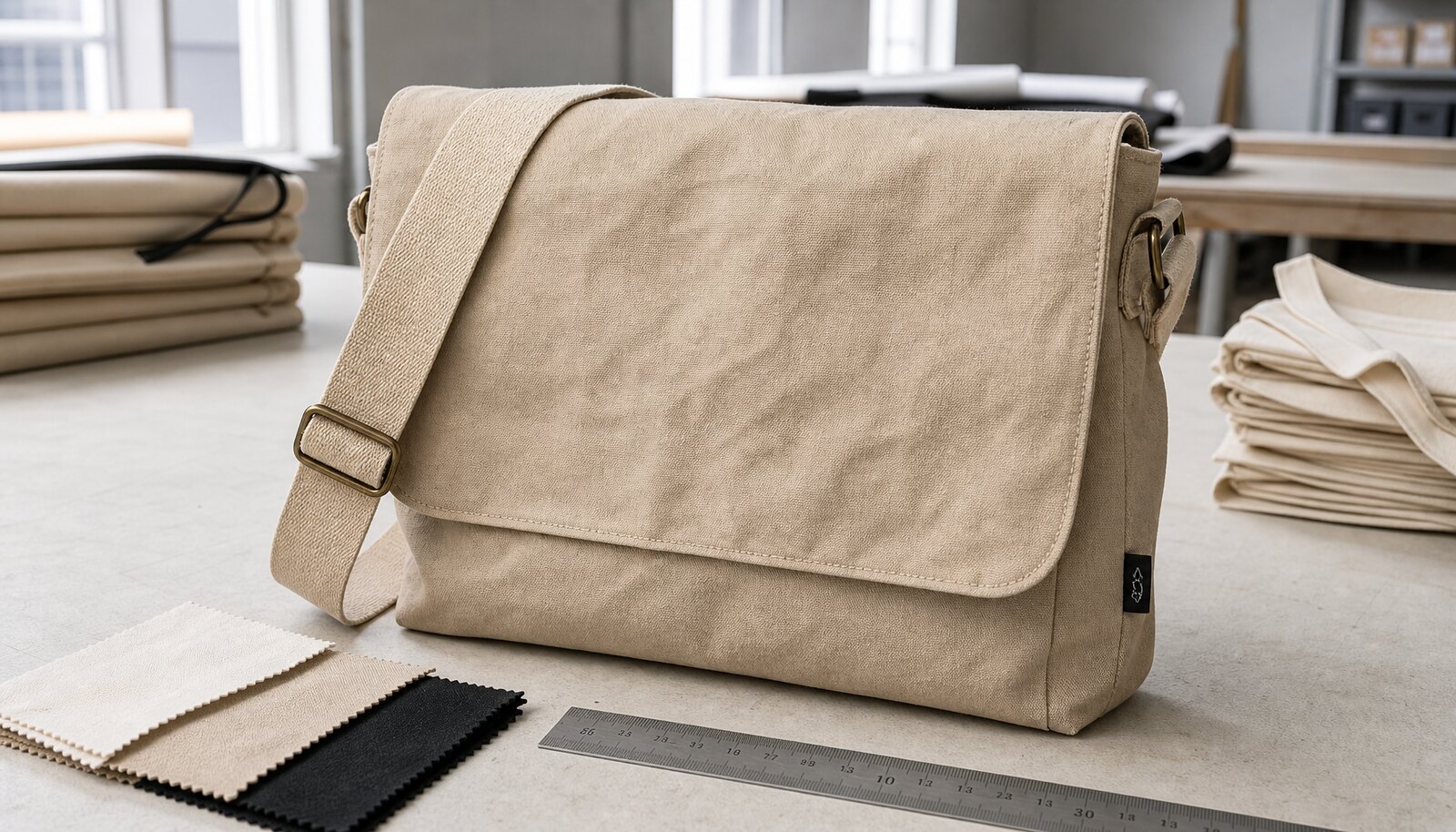
Set the Commercial Goal Before Negotiating MOQ
Canvas messenger bags are more complex than flat totes because they usually combine a flap or zipper closure, shoulder strap, gusset, lining, pockets, hardware, reinforcement stitching, and branded decoration. Each feature adds setup work. For B2B buyers, MOQ negotiation should begin with the commercial goal: what the bag must do for the recipient, the brand, and the delivery schedule.
Corporate gifting rarely rewards the cheapest possible bag. A weak strap, thin fabric, crooked front logo, or crushed carton can make a useful gift feel careless. The better target is a stable specification that can be sampled, inspected, shipped on time, and repeated if the program returns next season.
MOQ is mainly a reflection of supplier risk. Custom fabric, special trims, multiple logo colors, retail-style packing, and uncertain reorder potential all increase that risk. A buyer can often improve the minimum by standardizing details the recipient will not notice while protecting the elements that define the gift experience.
Treat MOQ as a negotiation around tradeoffs, not a demand for a lower number. The supplier needs to know which elements are fixed, which are optional, and which can follow factory standards. That clarity helps both sides avoid silent substitutions later.
- Protect visible quality, strap durability, logo placement, and delivery timing before chasing the lowest unit price.
- Lower MOQ by reducing setup complexity, not by weakening construction.
- Tell suppliers whether the order is a trial, one-time campaign, or repeat gifting program.
- Separate must-have brand details from optional presentation details before requesting price breaks.
Define the Recipient, Contents, and Use Case
A conference giveaway, employee welcome kit, dealer incentive, and executive client gift can all use a messenger bag, but they do not need the same construction. A light event bag may only carry brochures and a notebook. A client gift may need a more structured body, cleaner hardware, and better packing. A field team bag may need stronger stitching and a more reliable zipper than a premium hang tag.
Translate the use case into measurable requirements. If a laptop is expected, state the device size, sleeve dimensions, padding requirement, and whether the sleeve must close. If the bag will hold a welcome kit, list the items and approximate total weight. If it will ship to multiple offices, include carton labeling and destination sorting early.
This step prevents the common problem of comparing quotes for different products. One supplier may assume an unlined 12 oz canvas bag with one front pocket. Another may quote a lined 16 oz bag with zipper top, laptop sleeve, and metal adjuster. Both may be reasonable, but they are not comparable.
Prioritization also helps when internal stakeholders request changes. If the main purpose is daily employee use, keep strap width, reinforcement, and pocket function. If the bag is mostly a presentation piece, logo finish and packing may matter more than a complex organizer panel.
- Name the recipient group and distribution channel.
- List expected contents, sizes, and approximate loaded weight.
- Set the required arrival date and latest acceptable delivery date.
- Choose the primary quality priority: presentation, durability, speed, low cost, sustainability positioning, or exact brand matching.
- Decide whether the program needs repeatability for future reorders.
Build a Specification Suppliers Can Price Accurately
A reliable quote needs more than a reference photo and logo file. The supplier should receive finished dimensions, fabric weight, lining, closure, pockets, strap construction, hardware, decoration, labels, and packing. Without those details, every factory fills in the blanks differently.
Canvas weight should be stated in ounces or GSM, with room for practical production tolerance. As supplier-dependent examples, 12 oz canvas may suit light event use, 14 oz often works as a balanced corporate-gift option, and 16 oz or reinforced builds may suit heavier loads or a more premium hand feel. The correct choice depends on bag size, lining, expected contents, and desired structure.
Construction details can influence cost as much as fabric. A top zipper plus flap, padded sleeve, inner organizer, two exterior pockets, adjustable strap, and metal hardware require more labor than a simple flap bag. Reducing one pocket or accepting a standard interior can sometimes lower MOQ more effectively than shrinking the bag.
A good specification marks each detail as fixed or flexible. Fixed items might include finished size, logo location, front appearance, and strap strength. Flexible items might include zipper tape color, lining material, hang tag format, or carton pack. This gives the factory room to propose lower-MOQ alternatives without damaging the intended gift.
- Define width, height, gusset depth, flap depth, pocket size, strap width, and strap drop.
- Specify canvas weight, color, finish, and whether stock fabric is acceptable.
- Confirm lining: unlined, cotton twill, polyester, padded sleeve, or printed lining.
- Name the closure: flap only, zipper top, magnetic snap, buckle, hook-and-loop, or combined closure.
- State hardware material and finish, including D-rings, sliders, buckles, snaps, rivets, and pullers.
- Provide decoration size, position, method, artwork file type, and placement tolerance.
Understand What Actually Drives MOQ
Factories build minimums from fabric purchasing, cutting efficiency, decoration setup, trim sourcing, sewing labor, and packing requirements. A stock-color canvas bag with one-color printing may be possible at a lower quantity because materials and trims are already available. A custom-dyed canvas bag with unique hardware and printed lining may need a higher minimum because leftover materials cannot easily be reused.
Fabric is often the biggest driver. Stock natural, black, navy, or common neutral shades are easier to source in smaller lots. Custom dyeing usually needs lab dips, shade approval, dye-house scheduling, and enough yardage to justify the run. Washed or enzyme-finished canvas can add shrinkage risk and extra processing time.
Decoration can create its own minimum. One-color screen printing is usually the simplest option for a lower-quantity program. Multi-color print requires more setup and registration control. Embroidery needs digitizing, thread selection, backing, and stitch-density review. Woven patches, debossed patches, and custom labels may come from outside trim suppliers with separate MOQs.
Packing should not be ignored. Insert cards, custom cartons, printed tissue, barcode labels, and destination-specific packs can add material minimums and labor. When a supplier says the MOQ is high, ask which component is responsible. The answer tells you where to negotiate.
- Ask whether MOQ is controlled by fabric, print, trim, sewing line setup, or packing.
- Use stock canvas when exact body color is not essential.
- Keep custom trims only when they are visible and meaningful to the gift.
- Reduce print complexity before reducing strap reinforcement or zipper quality.
- Confirm whether labels, patches, insert cards, or cartons have separate supplier minimums.
Verify the Supplier Before You Push for a Lower Minimum
Supplier verification matters because messenger bags include many small failure points. A supplier that mainly handles flat totes may not be strong in flap alignment, laptop sleeves, zipper insertion, strap anchoring, or metal hardware. Before negotiating hard on MOQ, confirm that the supplier can actually produce the construction you need.
Ask for evidence that is specific to messenger bags or similar shoulder bags. Useful signals include production photos, previous sample photos with comparable closures and straps, trim sourcing records, material information, and the ability to show factory QC checkpoints. These are not a guarantee, but they are more useful than broad claims about bag experience.
For larger or compliance-sensitive programs, ask whether factory audit documents, social compliance records, fabric composition information, or material certificates are available. Not every gift program requires formal certification, but the supplier's ability to respond cleanly tells procurement how organized they are.
Also clarify accountability. If you are buying through a trading company, ask who owns sample correction, production follow-up, inspection booking, defect claims, and replacement decisions. A coordinator can be valuable, but responsibility must be explicit before the purchase order is placed.
- Request photos of prior messenger bag or structured shoulder bag work.
- Ask for current production photos when your order reaches cutting, sewing, decoration, and packing.
- Confirm whether trims are stock items or sourced from named trim suppliers.
- Ask if material certificates, composition details, or colorfastness reports are available when relevant.
- Check whether third-party inspection or factory audit access is allowed.
- Clarify who approves corrective action if production defects appear.
Negotiate With Tradeoffs the Factory Can Use
The phrase lower the MOQ is too broad to help a factory. A better request is specific: what minimum is possible if the canvas stays stock, the print is one color, hardware is standard, lining is plain, and packing is bulk? This gives the supplier practical levers to reduce risk.
Request several price breaks. Quotes at 300, 500, 1,000, and 2,000 units can show where the real cost curve changes. If the price improves sharply at 500, setup cost may be the issue. If it stays relatively flat, custom materials or trim minimums may be the constraint. These breakpoints help procurement build a clearer internal recommendation.
Do not trade away the parts that protect the recipient experience. Weak strap anchors, very light canvas, unreliable zippers, and loose hardware can create visible failures after distribution. Better compromises include a stock fabric shade, simpler pocket layout, plain lining, standard zipper tape, one-color logo, or efficient carton packing.
If the order is below a factory's efficient sewing minimum, consider a staged path. Pay for development and a small pilot at a higher unit cost, then negotiate the bulk price after sample approval. This is cleaner than forcing a supplier to absorb risk and later discovering material substitutions.
- Ask for the lowest MOQ under a simplified specification and under the preferred specification.
- Compare price breaks rather than only the headline minimum.
- Keep reinforcement, zipper function, and front-logo quality off the chopping block.
- Offer flexibility on hidden lining, zipper tape color, standard trims, or packing where acceptable.
- Ask the supplier to identify the single change that would reduce MOQ most.
Make the RFQ Comparable Across Suppliers
A strong RFQ reduces quotation noise. It should include the bag spec, a dimension sketch, artwork, packing requirements, destination, requested quantities, sample expectations, inspection expectations, and delivery deadline. The purpose is to make each supplier quote the same product under the same assumptions.
Include a simple sketch even if it is not a technical drawing. Label the main body, flap, gusset, strap anchors, pockets, zipper, lining, logo position, and closure. If the bag must fit a laptop or gift kit, include those dimensions. If the bag must keep a structured look, say so because that may require heavier canvas, interlining, or careful carton packing.
Artwork files should be production-ready. Send vector artwork, Pantone references if needed, logo size, placement, and whether exact color matching or a close visual match is acceptable. Canvas absorbs and shows ink differently than coated paper or a digital mockup, so important logos should be tested on the actual or nearest production fabric.
Ask suppliers to separate unit price from setup costs, sample costs, packaging costs, inspection support, and freight assumptions. A low unit price can become less attractive when it excludes items needed for receiving, distribution, or brand presentation.
- Attach dimension sketch, target quantity, destination, and delivery deadline.
- Request sample, pilot, and bulk production pricing separately.
- Ask suppliers to state inclusions and exclusions line by line.
- Require quote validity date and lead-time assumptions.
- Confirm whether quoted materials are stock, reserved, or custom sourced.
- Ask for the MOQ basis in writing so later changes do not reset the quote unexpectedly.
Use Sampling as a Production Test
A messenger bag sample should prove more than appearance. Review seam straightness, strap reinforcement, zipper action, closure alignment, flap coverage, pocket placement, logo position, lining attachment, and hardware security. A bag that looks fine empty may distort when loaded with a laptop, notebook, charger, or bottle.
Sampling often has stages. An early prototype may use available fabric to confirm size and pattern. That is useful, but it should not approve bulk production if the canvas, trims, logo method, or packing differ from the final order. The pre-production sample should match bulk materials and decoration as closely as possible. Any substitute material should be disclosed in writing.
Test the approved sample in realistic use. Load it, adjust the strap, open and close every zipper or snap, check the flap when the bag is full, and view the logo from normal distance. If the bag will be packed tightly, request a packing test because creasing and compression can change presentation.
Once approved, create a controlled reference. Keep one gold sample with the factory and one with the buyer or inspection team. Approval notes should include fabric, trim, dimensions, logo placement, packing, and any accepted tolerance. Bulk goods should be judged against that reference.
- Approve pattern, materials, logo method, and packing before bulk cutting.
- Check the sample both empty and loaded with expected contents.
- Measure finished dimensions, strap length, pocket size, and sleeve fit.
- Record every change after each sample round.
- Keep matched gold samples for factory and inspection use.
- Do not let a digital mockup replace a physical logo proof on canvas.
Set QC Standards With AQL and Defect Classes
Quality standards should be agreed before the purchase order. Canvas has natural texture, so minor slubs or small shade variation may be acceptable depending on positioning. Stains, broken stitches, detached straps, incorrect fabric, crooked logos, sharp hardware, and nonfunctioning zippers are not the same level of issue.
Use defect classification to avoid inspection arguments. Critical defects are safety, compliance, or severe functional failures. Major defects make the bag unsuitable for corporate gifting, such as wrong dimensions, missing pockets, broken closure, weak strap anchor, badly misaligned logo, or incorrect material. Minor defects might include small loose threads, slight wrinkles, or minor shade variation within the approved tolerance.
For larger orders, many buyers use an AQL-based final random inspection. Commonly used consumer-goods inspection frameworks often apply tighter limits for critical defects and defined acceptable quality limits for major and minor defects. The exact AQL level, sample size, and acceptance number should be agreed with the inspection provider and supplier before production, because they depend on order quantity, risk level, and buyer policy.
Inspection should concentrate on high-risk areas. Strap anchors, D-ring tabs, zipper ends, pocket corners, base corners, flap edges, and logo panels deserve close attention. Packed-carton checks should confirm count, label accuracy, barcode readability, origin marks, carton condition, and compression damage. If inspection fails, define whether goods will be reworked, replaced, reinspected, discounted, or held until corrective action is documented.
- Set critical, major, and minor defect examples in the PO or inspection checklist.
- Agree on AQL level, inspection sample size logic, and pass/fail handling before bulk production.
- Measure dimensions, logo placement, strap strength indicators, stitch quality, and hardware function.
- Photograph defects with carton number, unit reference, and defect classification.
- Require corrective action notes for failed inspections.
- Do not approve shipment until rework, replacement, reinspection, or commercial settlement is agreed.
Plan Packing, Cartons, and Delivery Early
Packing can change cost, MOQ, freight, and recipient experience. A correctly sewn bag can still disappoint if it arrives crushed, dusty, wrinkled, mislabeled, or mixed across destinations. Individual polybags, tissue wrap, insert cards, hang tags, barcode labels, cardboard shapers, and custom cartons all add material and labor decisions.
Choose packing based on distribution. Bulk polybags may be enough when bags ship to a central warehouse for kitting. Destination sorting and carton marks may be needed when shipping to regional offices or event venues. Gift-ready presentation may require cleaner folding, inserts, tissue, or individual sleeves, but printed materials can create separate minimums.
Carton planning affects damage risk and logistics cost. Structured messenger bags may need fewer pieces per carton to protect shape. Soft unstructured canvas bags can be packed more tightly. Overpacking can deform flaps and crease panels; underpacking can raise freight cost. Request carton dimensions, gross weight, net weight, and pieces per carton before logistics approval.
Labeling is part of procurement control. Country-of-origin marks, customer SKU labels, barcodes, warning labels, PO numbers, destination marks, and routing labels should be supplied before packing begins. Final inspection should include packed-carton accuracy, not only loose product quality.
- Approve individual pack method, inner pack, master carton, and destination labels.
- Confirm whether shape supports or cardboard inserts are required.
- Review carton dimensions, gross weight, net weight, and pieces per carton.
- Provide barcode, SKU, origin, warning, and carton-mark files early.
- Inspect carton count, label accuracy, moisture risk, compression damage, and destination sorting.
- Include packing photos in production updates when goods are ready for final inspection.
Specification comparison for buyers
| MOQ driver | Lower-MOQ path | When higher MOQ is justified | Buyer risk to check |
|---|---|---|---|
| Body canvas | Use stock natural, black, navy, or other available canvas shades | Exact brand-color canvas, washed canvas, enzyme finish, or special hand feel is required | Confirm whether the quote uses stock fabric or dyed-to-order yardage |
| Canvas weight | Keep to a supplier's standard 12 oz, 14 oz, or 16 oz construction | Laptop use, premium structure, or heavy contents require reinforced fabric or interlining | Check weight tolerance, shrinkage, and whether lining or padding changes the feel |
| Branding method | Use one-color screen print in a standard print zone | Embroidery, woven patch, multi-color print, or debossed patch is central to the gift value | Ask for setup charges, artwork limits, placement tolerance, and decoration MOQ |
| Trim package | Choose standard zipper tape, D-rings, sliders, snaps, and webbing | Custom pullers, plated hardware, branded buckles, or special strap colors are visible brand details | Verify trim sourcing proof and whether trims have separate supplier minimums |
| Interior build | Use a plain lining, standard pocket layout, or no printed lining | Laptop sleeve, organizer panel, padded divider, or printed lining is required for function | Test loaded capacity and confirm sleeve dimensions before bulk cutting |
| Labels and packaging | Use standard woven label, hang tag, polybag, and export carton | Retail-style presentation, insert cards, barcodes, destination packing, or gift-ready wrapping is required | Check printed packaging MOQ, carton dimensions, labeling accuracy, and compression risk |
| Sourcing route | Use stock bag plus decoration or a semi-custom factory build | A repeat program needs controlled pattern, material, branding, and reorder consistency | Confirm factory identity, prior messenger bag work, inspection access, and sample retention |
Buyer checklist before sampling
- Define the gifting scenario: executive gift, employee welcome kit, conference bag, dealer incentive, client appreciation item, or internal team merchandise.
- List the expected contents by size and weight, including laptop, notebook, charger, bottle, documents, apparel, or insert cards.
- Specify finished width, height, gusset depth, flap depth, strap width, strap drop, pocket layout, lining, closure, and hardware finish.
- State whether the first order is a trial, a one-time event, or the first run of a repeat corporate gifting program.
- Separate fixed requirements from negotiable details such as lining color, zipper color, label type, hang tag, carton pack, and exact fabric shade.
- Ask whether MOQ is based on total order quantity, body fabric color, print design, trim option, lining color, or packaging version.
- Request price breaks at practical quantities such as 300, 500, 1,000, and 2,000 units instead of accepting one MOQ and one unit price.
- Send vector artwork with print size, position, Pantone guidance, acceptable visual tolerance, and no-print zones near seams, folds, zippers, and flap edges.
- Approve a pre-production sample that matches bulk fabric, trim, logo method, and packing before authorizing cutting or decoration.
- Confirm carton quantity, carton dimensions, gross weight, polybag rules, barcode labels, origin marks, destination marks, and inspection plan before deposit or purchase order release.
Factory quote questions to send
- What is your MOQ by total order, by canvas color, by print method, by lining color, by hardware option, and by packaging version?
- Which part of this specification creates the highest minimum: fabric, decoration, trim, sewing setup, or packing material?
- Can you quote the same design at 300, 500, 1,000, and 2,000 units, with setup charges shown separately?
- What canvas weight and construction do you recommend for the intended load: 12 oz, 14 oz, 16 oz, reinforced canvas, or lined canvas?
- Is the quoted material stock canvas, greige fabric dyed to order, washed canvas, enzyme-finished canvas, recycled-content canvas, or another fabric?
- What tolerance should we allow for fabric weight, finished dimensions, logo placement, and shade variation?
- What is included in the unit price: bag body, lining, zipper, magnetic snap, buckle, D-rings, slider, strap pad, woven label, hang tag, polybag, insert card, carton, and export marks?
- Which trims are standard stock options, and which require separate MOQ, custom tooling, custom color, plating, or extended sourcing time?
- Can you provide photos of previous messenger bag production, production-line photos during our order, and trim or material sourcing proof where relevant?
- Are material certificates, fabric composition information, colorfastness reports, or factory audit documents available if our compliance team requests them?
Quality-control points to confirm
- Canvas weight, fabric composition, color, texture, and finish match the approved sample within agreed tolerance.
- Finished dimensions, gusset depth, flap coverage, strap length, pocket size, and laptop sleeve size match the specification.
- Stitch density is even at strap anchors, pocket corners, zipper ends, base corners, flap edges, and gusset joins.
- Bar tacks, box stitching, rivets, or other reinforcements are present where approved, with no missed stress-point reinforcement.
- Print color, opacity, edge sharpness, registration, placement, and curing are acceptable on the actual canvas surface.
- Embroidery, woven patch, leather alternative patch, or sewn label is straight, centered, secure, and free from puckering or adhesive bleed.
- Zipper, magnetic snap, buckle, slider, D-ring, rivet, and puller function correctly and show no sharp edges, rust, weak attachment, or plating defects.
- Lining is clean, correctly attached, free from open seams, and not caught in zipper teeth or closure hardware.
- Color variation across body fabric, lining, webbing, zipper tape, thread, labels, and trims stays within the approved shade band.
- Packing protects shape and cleanliness, with correct polybag, insert, barcode, origin label, carton mark, carton count, and destination label.