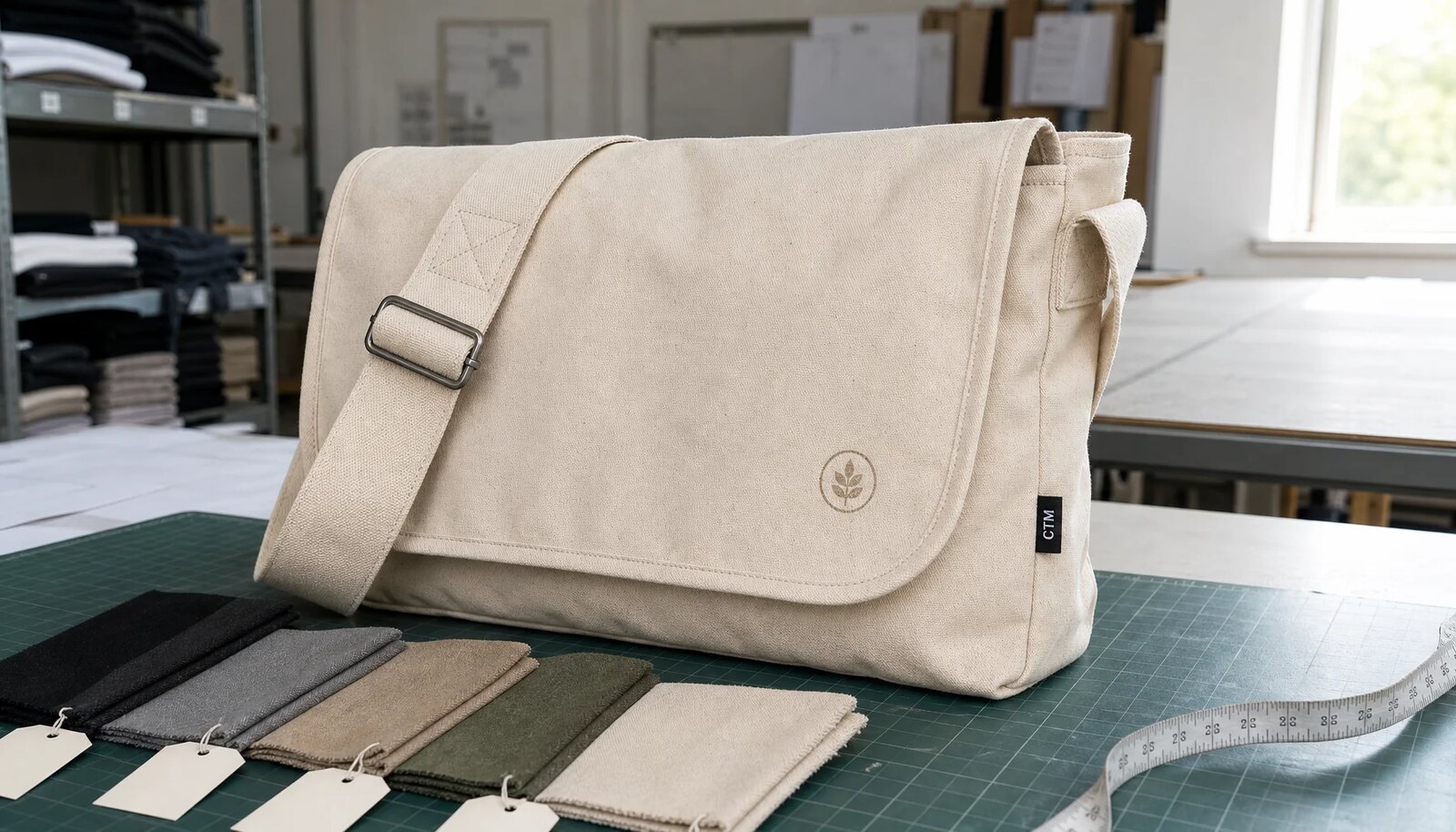
Start with the buying job, then choose the canvas weight
For wholesale canvas messenger bags for corporate gifting, fabric weight is not just a fabric preference. It affects structure, logo clarity, sewing difficulty, perceived value, carton weight, and the risk of complaints after the order is distributed. A 10oz canvas messenger bag and a 14oz canvas messenger bag can look close in a supplier photo, but they will not behave the same when the flap is printed, the strap carries real contents, and the bag is folded into cartons for shipment.
Procurement teams should begin with the business use. A conference giveaway carrying a badge, brochure, and pen has a different requirement from an employee welcome kit carrying a notebook, bottle, charger pouch, and HR documents. A client appreciation gift needs a cleaner handfeel and more controlled finishing than a one-day event bag. This is why the cheapest quote is often not the most useful quote. It may be based on lighter canvas, fewer reinforcements, thinner webbing, unlined seams, simpler hardware, or looser inspection.
The RFQ should describe what the bag must do before it describes what it should cost. Buyers should name the recipient group, contents, wear expectation, delivery date, logo requirement, and packing destination. Once those details are fixed, the fabric weight range becomes easier to defend internally. The goal is not to buy the heaviest canvas possible. The goal is to select a finished canvas weight that matches the gift tier, survives normal handling, supports the logo, and ships within the landed cost target.
- Use 10oz to 12oz finished canvas for budget-driven, high-volume distribution with light contents.
- Use 12oz to 14oz finished canvas for most corporate gifting programs that need structure, printability, and a credible handfeel.
- Use 14oz to 16oz finished canvas for premium gifts, heavier contents, or retail-adjacent presentation.
- Avoid vague RFQ terms such as thick canvas, premium canvas, or heavy duty unless they are paired with finished GSM, construction, and sample approval standards.
Use finished GSM and oz so quotes are comparable
Canvas is commonly quoted in ounces per square yard, while many factories and fabric mills also work in grams per square meter. A useful wholesale canvas messenger bags for corporate gifting fabric weight guide should include both. As a rough reference, 10oz canvas is about 339 GSM, 12oz is about 407 GSM, 14oz is about 475 GSM, and 16oz is about 542 GSM. These conversions help buyers compare quotes, but they do not replace a production fabric swatch because weave density, finish, yarn, and coating change the handfeel.
The key sourcing term is finished fabric weight. Greige fabric is the unfinished fabric before dyeing, washing, coating, or other treatment. Finished fabric is what the factory actually cuts and sews. A supplier may quote 12oz greige canvas, but the finished fabric after processing may feel different from a 12oz finished canvas approved by another supplier. Washing can soften the fabric, dyeing can change shrinkage and shade, and coating can increase stiffness or surface stability without making the bag feel naturally heavier.
A strong RFQ states the target as finished canvas after all treatment. For example: 12oz to 14oz finished cotton canvas, approximately 410 to 475 GSM, natural or dyed to approved shade, suitable for screen printing, final approval by production swatch and pre-production sample. This wording creates a measurable standard and reduces the chance that suppliers quote different fabric bases under the same product name.
- Request both ounces per square yard and GSM in the quote.
- Ask whether the number is greige weight, finished weight, or an estimate from a previous batch.
- Require a production fabric swatch from the planned source, not only a showroom swatch.
- Record the approved fabric weight, shade, weave, finish, and supplier source for repeat orders.
Select the weight range by gift tier and contents
The best canvas weight is tied to the gift contents and the recipient expectation. For light giveaways, a 10oz to 12oz finished canvas can be practical if the construction stays simple. It can carry documents, a leaflet, or small event items without pushing the budget or freight cost too high. The buyer should not load this route with large embroidery, heavy buckles, multiple pockets, or sharp folding requirements because the fabric may not support those details cleanly.
For most B2B gifting, 12oz to 14oz finished canvas is the safest middle range. It gives the messenger silhouette enough body, helps the flap sit better, and usually supports screen printing more predictably than lighter fabric. It is often appropriate for employee onboarding, conference delegate bags, sales kits, partner meetings, and internal recognition programs. At this weight, reinforcement and strap quality matter as much as the canvas itself.
For premium gifting, 14oz to 16oz finished canvas can create a more substantial product, especially with full lining, stronger webbing, and upgraded hardware. The tradeoff is cost, sewing time, carton volume, and stiffness. Buyers should test whether the flap bends naturally, whether the bag folds into the intended packing format, and whether the weight feels useful rather than bulky. Heavier canvas can look impressive as a swatch but become awkward after lining, pockets, buckles, and a printed flap are added.
- Event giveaway: 10oz to 12oz canvas, simple flap, limited pocketing, economical screen print, bulk or basic individual packing.
- Employee welcome kit: 12oz to 14oz canvas, reinforced strap points, practical inner pocket, clean seam finish, controlled logo placement.
- Client gift: 12oz to 14oz or 14oz to 16oz canvas, better lining, upgraded hardware, tighter visual inspection, and protected packing.
- Premium retail crossover: 14oz to 16oz canvas, full lining, stronger webbing, refined trim, hangtag or label control, and more detailed carton standards.
- Gift box or kitting program: test actual contents, fold thickness, shape recovery, and carton compression before approving production.
Specify the full bag, not only the fabric body
Fabric weight is the anchor specification, but a messenger bag is a built product. The body panel, flap, gusset, strap, lining, pockets, closures, labels, and packing all affect cost and quality. If the RFQ says only 12oz canvas messenger bag with logo, each supplier will fill the missing details differently. One factory may quote unlined seams and narrow webbing. Another may include partial lining, reinforced strap ends, and better hardware. The unit prices will not be comparable.
The strap deserves specific attention because it carries load and receives repeated pulling. For corporate messenger bags, a 30mm to 40mm cotton webbing strap is common, but the right width depends on bag size, contents, and desired look. A self-fabric canvas strap can match the body, but it may need more sewing and reinforcement. The attachment should be defined by box stitch, cross stitch, bar tack, backing patch, rivet, or another approved method. Strap ends should not rely only on a single seam if the bag is expected to carry real weight.
The interior also changes the gift impression. Unlined construction may be acceptable for budget orders, but the seam finish must still be clean. Partial lining can improve the flap, zipper pocket, or front panel without the full cost of lining the whole bag. Full lining gives a more premium finish, but it can hide weak seams unless inspectors check openings and stress points carefully. Buyers should specify what the recipient will see and touch, not just what appears in the front product photo.
- State finished measurements for width, height, gusset, flap depth, pocket size, strap width, and strap length range.
- Define whether seams are raw, overlocked, bound, topstitched, or hidden by lining.
- Specify lining type, lining weight, lining color, pocket layout, and whether lining is partial or full.
- Name closure details such as magnetic snap, zipper, buckle detail, hook-and-loop, hidden snap, or flap-only construction.
- List label and compliance needs, including woven side label, care label, fiber content label, hangtag, barcode, and removable insert.
Give suppliers a measurement and tolerance table
B2B buyers reduce disputes when the RFQ includes a simple measurement table. Messenger bags are sewn products, so very tight tolerances may be unrealistic on heavy canvas, but open-ended tolerances are risky. A reasonable measurement sheet gives the supplier a target and gives the inspector a pass-fail basis. Tolerances should be agreed before bulk cutting, not negotiated after final inspection.
For many canvas bags, larger finished dimensions may use a tolerance around plus or minus 10mm, while smaller details such as logo placement or pocket opening may need a tighter tolerance such as plus or minus 3mm to 5mm. The exact standard depends on pattern complexity, canvas thickness, washing, and whether the bag is structured or soft. Washed canvas may need more dimensional tolerance because shrinkage and hand finishing create natural variation.
The measurement table should reference fixed points. For example, logo placement should be measured from the flap bottom edge and the vertical centerline, not from a flexible fold that may shift. Strap length should state minimum and maximum adjustable length. Gusset should be measured at a defined location. This level of detail is not excessive for corporate gifting; it is what keeps the approved sample from drifting during production.
- Overall width: measure across the top or widest approved point, tolerance commonly plus or minus 10mm.
- Overall height: measure from top edge to bottom edge with bag laid flat, tolerance commonly plus or minus 10mm.
- Gusset depth: measure at side or bottom as specified, tolerance commonly plus or minus 5mm to 8mm.
- Flap depth: measure from top fold line to flap edge, tolerance commonly plus or minus 5mm to 8mm.
- Logo placement: measure from fixed edge and centerline, tolerance commonly plus or minus 3mm to 5mm for visible branding.
- Strap width: measure finished webbing or fabric strap, tolerance commonly plus or minus 2mm.
- Adjustable strap length: state minimum and maximum usable length, tolerance commonly plus or minus 20mm depending on hardware and design.
Choose logo decoration around the canvas surface
Canvas texture changes decoration results. A smooth digital mockup can make small text, thin lines, gradients, and tight registration look easy. On actual canvas, weave texture can break fine edges, absorb ink unevenly, or create a less crisp result. The logo method should be chosen after the canvas weight, shade, and finish are known. A natural 12oz canvas, a dyed washed canvas, and a coated 14oz canvas may each require different decoration settings.
Screen print is often the most practical method for simple corporate logos, especially one-color or two-color artwork at higher quantities. Buyers should approve a strike-off on the actual canvas because Pantone color can shift against natural cotton, dyed fabric, or textured surfaces. Large solid print areas need special attention to ink coverage, curing, cracking, and handfeel. If the logo crosses a flap fold or seam bulk, distortion risk increases.
Heat transfer or digital transfer can work for multicolor logos, gradients, and shorter runs, but the buyer should inspect film edge, adhesion, opacity, and flexibility. Embroidery can look premium for small marks, patches, or labels, but large embroidery on lighter canvas can pucker the flap and add weight. Woven patches and sewn labels can be useful when the brand wants a cleaner, repeatable mark across fabric colors. In every case, the approval sample should show final artwork size, placement, color, and method on the production fabric.
- Ask for minimum line width guidance for the selected print or embroidery method.
- Keep logo artwork away from seam bulk, flap fold lines, snap positions, zipper tracks, and gusset curves.
- Use Pantone references, but approve the visual result on actual canvas under realistic lighting.
- Set logo placement tolerance in millimeters from fixed reference points.
- Perform rubbing or tape checks when the logo has heavy ink coverage, transfer film, or a dark print on light canvas.
- Approve one production strike-off for each canvas color and logo color combination when brand consistency is critical.
Separate MOQ, setup cost, and sampling gates
MOQ is often misunderstood because buyers ask for one number and suppliers answer based on assumptions. A stock natural canvas messenger bag may have a low MOQ. Custom dyed fabric, special webbing, custom hardware finish, woven label, full lining, or multiple logo versions can raise the real minimum. Procurement teams should separate base bag MOQ, fabric MOQ, decoration MOQ, trim MOQ, and packing MOQ. This makes the cost floor visible.
Sampling should be treated as a control process, not a formality. A fabric swatch proves weight, shade, texture, and finish. A strike-off proves decoration on the actual surface. A proto sample proves shape and construction, though it may use substitute materials in early development. A pre-production sample should combine the final canvas, final dimensions, final logo, final strap, final lining, final hardware, and intended packing. That sample becomes the reference for bulk production.
For repeat or high-visibility programs, ask for a sealed production reference. It should be tagged with order number, fabric weight, GSM, fabric color, logo method, hardware finish, approval date, and any approved deviations. The factory should keep one reference, and the buyer or inspector should have access to one. This prevents quiet changes when a reorder is placed months later or when production shifts to another line.
- Ask MOQ by fabric color, lining color, strap color, hardware finish, zipper tape, logo version, label, and packing format.
- Confirm whether sample charges are refundable, credited against bulk order, or separate development cost.
- Require strike-off approval before mass decoration for strict brand colors or fine artwork.
- Approve the pre-production sample before bulk cutting when fabric or construction is custom.
- Use the approved sample, measurement sheet, artwork file, and packing standard together as the production specification.
Control quality with inspection standards buyers can enforce
Quality control should be specific enough for an inspector to check without guessing. General phrases such as good stitching, strong strap, or clean logo are not inspection standards. The buyer should define measurable checks for fabric weight, finished dimensions, logo placement, stitch quality, reinforcement, hardware function, interior finish, cleanliness, odor, and packing. The standard should be shared before production, not after defects appear.
Fabric inspection should cover both measurable weight and visible appearance. Natural canvas may have slubs and minor yarn variation, but corporate gifting usually requires a cleaner standard than a casual distressed retail style. Buyers should define whether slubs, neps, shade bands, stains, crease marks, coating spots, and lint are acceptable. If the bag is natural canvas, the approved swatch should show the expected shade range. If it is dyed, the buyer should agree how much shade variation is allowed between panels and lots.
Functional checks are critical because messenger bags are loaded and handled repeatedly. Inspectors should pull the strap through the slider, open and close snaps or zippers, check reinforcement at strap ends, inspect gusset corners, and look for skipped stitches or loose backstitching. Logo QC should include color, edge clarity, coverage, placement, curing, transfer adhesion, embroidery puckering, and whether the design is distorted by texture. Packing QC should confirm the bag is clean, dry, protected from hardware pressure, and folded in the approved way.
- Use finished fabric weight tolerance, commonly plus or minus 5 percent from the approved swatch or agreed GSM.
- Classify missing reinforcement, broken strap stitching, non-functioning closure, sharp hardware, severe stain, wrong logo, or wrong material as major or critical defects.
- Check dimensions against the approved measurement sheet rather than against a supplier photo.
- Inspect logo placement from fixed points and record actual deviations in millimeters.
- Open and close hardware during inspection instead of checking only visual appearance.
- Inspect interiors, seam binding, pockets, and thread trimming because recipients notice these details when they first use the gift.
Approve packing before it becomes a freight problem
Canvas weight affects freight through unit weight and carton volume. Heavier canvas may not fold as tightly, may need a larger carton, and may increase chargeable weight for air or courier shipments. Even for ocean freight, carton cube matters. Buyers who approve the bag sample without approving the packing method may find that the landed cost changes once carton dimensions and gross weight are confirmed.
Corporate gifting often needs cleaner packing than general promotional merchandise. Bags may ship to event venues, kitting centers, regional offices, warehouses, or directly into welcome kits. Individual polybags may protect against dust and moisture, but some buyers prefer recycled polybags, paper wrap, or bulk packing for sustainability reasons. Any barcode label, carton mark, destination sort, insert card, or hangtag should be included in the quote and sample approval.
The fold method should be tested. Heavy canvas flaps can crease under pressure. Printed areas can rub against hardware, zipper pulls, or another printed surface. Magnetic snaps and sliders can leave pressure marks if the bag is compressed. Ask for packing photos during sample approval and confirm carton quantity, carton size, net weight, gross weight, and maximum carton weight. If destination warehouses have manual handling limits, state them in the RFQ.
- Define individual polybag, recycled polybag, paper wrap, tissue, bulk pack, or gift-ready packing before PO.
- Ask for carton dimensions, carton quantity, net weight, gross weight, and expected chargeable weight.
- Set a maximum carton gross weight when the order ships to warehouses or event teams with manual handling limits.
- Protect printed flaps from ink transfer, hardware pressure, and abrasion during transit.
- Check whether the bag recovers shape after folding and carton compression.
- Include barcode labels, carton marks, destination sorting, and kitting instructions in the quote, not as late add-ons.
Compare landed cost instead of only unit price
The lowest unit price can become the wrong decision if it creates defects, rework, late delivery, or excessive freight. For wholesale canvas messenger bags, landed cost should include unit price, logo setup, sample fees, inspection, packing, carton volume, gross weight, freight mode, duty assumptions, destination handling, and any kitting cost. A heavier but better specified bag may be the right buy if it reduces rejection risk and fits the gift purpose.
Price differences usually come from construction choices. Lining, pocket count, zipper quality, strap width, reinforcement, stitch density, hardware finish, logo method, trim sourcing, and packing can each change cost. Buyers should ask suppliers to quote against the same spec and also show optional savings separately. This prevents a supplier from winning by silently removing reinforcement or changing the strap.
A useful bid comparison has two columns: required specification and optional value engineering. Required specification is the version that must be met. Optional value engineering may include removing a pocket, switching from full lining to partial lining, simplifying hardware, reducing logo colors, or changing packing. Those changes should be reviewed by procurement, marketing, and the business owner before approval because each one affects recipient experience.
- Compare suppliers only after fabric weight, lining, strap, hardware, logo, packing, and inspection scope are aligned.
- Ask suppliers to identify which three specifications drive the most cost in their quote.
- Request carton data before final freight budgeting, especially for air, courier, or urgent event shipments.
- Treat inspection cost as part of landed cost, not an optional afterthought.
- Do not accept savings that remove hidden reinforcement or change approved fabric without written approval and a revised sample if needed.
Specification comparison for buyers
| Spec decision | Recommended option | When it fits | Buyer risk to check |
|---|---|---|---|
| Canvas weight basis | Quote finished fabric weight in both oz per square yard and GSM, confirmed by swatch and pre-production sample | Any custom wholesale canvas messenger bag order where suppliers are being compared | Supplier may quote greige weight before dyeing, washing, coating, or finishing; the finished bag can feel lighter or stiffer than expected |
| Budget canvas route | 10oz to 12oz finished canvas, approximately 340 to 410 GSM, with simple pocketing and minimal hardware | High-volume event giveaways, internal campaigns, roadshows, and light literature kits | Lower body structure, more print distortion risk, less premium handfeel, and weaker stress points if reinforcement is not specified |
| Core corporate gift route | 12oz to 14oz finished canvas, approximately 410 to 475 GSM, with reinforced strap points and controlled logo placement | Employee welcome kits, conference bags, partner meetings, sales kits, and gifts carrying notebooks or catalogs | Needs a complete sewing spec; factories may reduce reinforcement, lining, stitch density, or strap webbing to meet a target price |
| Premium gift route | 14oz to 16oz finished canvas, approximately 475 to 540 GSM, with full or partial lining, stronger webbing, and upgraded trim | Executive gifts, retail-adjacent merchandise, client appreciation programs, and heavier gift contents | Higher material cost, slower sewing, larger cartons, more freight exposure, and possible stiffness around flap folds |
| Logo method | Screen print for simple marks, transfer for complex color, embroidery or patch for small premium branding | Brand-led gifting where logo legibility and repeatability matter across a bulk order | Rough canvas can break fine lines; strike-off approval must check ink coverage, edge quality, placement, and rubbing |
| Lining and seams | Unlined for cost control, partial lining for cleaner flap and pocket zones, full lining for premium finish | Unlined for giveaways, partial for practical gifts, full lining for retail-ready or higher-value gifting | Unlined bags expose seam finish and lint; full lining can hide weak stitching unless inspected at openings and stress points |
| Strap construction | Cotton webbing or canvas strap, normally 30mm to 40mm wide, with box stitch, cross stitch, bar tack, or backing patch | Messenger bags expected to carry documents, bottles, notebooks, samples, or tech accessories | Strap failure is a visible defect; confirm attachment method, stitch density, thread, and load expectation before production |
| Hardware and closures | Magnetic snap, zipper pocket, slider, buckle detail, rivet, or hook-and-loop based on use case and brand positioning | Office carry, conference use, laptop-adjacent documents, gift kits, or retail presentation | Low-grade plating, weak magnets, sharp edges, noisy hardware, or rough zipper tape can damage perceived quality |
| Packing method | Approve fold method, individual protection, carton quantity, carton dimensions, and gross weight before PO | Orders shipping to event sites, kitting centers, warehouses, or multiple corporate destinations | Heavy canvas can crease, printed flaps can rub, hardware can mark fabric, and carton volume can change landed cost |
Buyer checklist before sampling
- Define the commercial purpose first: event giveaway, employee onboarding kit, conference bag, sales meeting gift, client appreciation item, or retail-ready branded merchandise.
- List the actual contents the bag must carry, including notebook size, bottle diameter, catalog thickness, tablet sleeve, charger pouch, boxed insert, or documents by weight.
- Specify finished canvas weight in both ounces per square yard and GSM, and state that approval is based on finished fabric after dyeing, washing, coating, or other treatment.
- Request the fabric construction details available from the mill or supplier, such as cotton content, weave type, yarn count if available, finish, color method, and expected shrinkage.
- Provide finished bag measurements with tolerances: width, height, gusset, flap depth, pocket dimensions, strap width, minimum and maximum strap length, and logo placement.
- Define construction details: lining type, seam finish, stitch density target, reinforcement method, thread color, pocket layout, closure, zipper size, puller style, and hardware finish.
- Send vector logo files with Pantone references, artwork size, color count, placement measurements, and restrictions on ink handfeel, transfer film edge, or embroidery puckering.
- Require a decoration strike-off on the actual production canvas when the logo has fine lines, solid coverage, strict brand color, transfer film, or embroidery.
- Separate MOQ by bag color, fabric dye lot, lining color, strap color, hardware finish, logo version, label type, and packaging format so setup costs are visible.
- Ask for a sample sequence: fabric swatch, logo strike-off, proto sample if needed, pre-production sample, sealed production reference, and final inspection sample retention.
Factory quote questions to send
- What exact canvas weight are you quoting in ounces per square yard and GSM, and is it greige fabric weight or finished fabric weight after dyeing, washing, coating, or softening?
- What tolerance can you hold on finished fabric weight, and will you accept plus or minus 5 percent against the approved finished GSM unless another tolerance is agreed?
- What is the fabric composition, weave, yarn count or mill construction if available, and can you provide a swatch from the same fabric source planned for bulk production?
- Is the canvas natural, bleached, dyed, garment-washed, enzyme-washed, pigment-dyed, waxed, PU-coated, or water-resistant finished, and how does that finish affect shrinkage, printability, odor, and lead time?
- What finished bag dimensions are included in the quote, and what measurement tolerance do you recommend for width, height, gusset, flap depth, pocket size, strap width, and strap length?
- Is the bag unlined, partially lined, or fully lined, and what lining material, weight, color, seam finish, and pocket construction are included in the price?
- What strap material, width, thickness, adjustable length range, slider material, attachment method, reinforcement patch, box stitch, cross stitch, or bar tack is included?
- What thread type, thread size if available, stitch density range, needle size, and seam allowance are planned for the approved canvas weight?
- What reinforcement is included at strap ends, flap corners, pocket openings, zipper ends, snap areas, gusset corners, and side seams?
- Which logo method do you recommend for this artwork on the selected canvas, and what are the setup costs, color limits, minimum line width, print placement tolerance, and durability limits?
Quality-control points to confirm
- Fabric weight tolerance: define acceptance against the approved finished fabric, commonly plus or minus 5 percent in GSM or equivalent oz, measured from production fabric rather than a showroom swatch.
- Fabric appearance: check weave consistency, slubs, stains, dye streaks, shade variation, odor, lint, broken yarns, coating marks, and color difference across body, flap, gusset, pockets, and strap.
- Finished dimensions: inspect width, height, gusset, flap depth, pocket opening, strap width, and adjustable strap length against the approved measurement sheet with stated tolerance, often plus or minus 5mm to 10mm depending on the dimension.
- Cutting and symmetry: check that the flap is centered, corners are balanced, gussets are even, pockets are aligned, and stripes or weave direction, if visible, are consistent.
- Stitch density and seam integrity: inspect strap ends, side seams, bottom gusset, flap corners, pocket openings, zipper ends, and lining joins for even stitches, no skipped stitches, no broken thread, and secure backstitching.
- Reinforcement: verify that strap attachments, pocket openings, snap areas, and gusset stress points use the approved box stitch, cross stitch, bar tack, backing patch, rivet, or seam reinforcement shown on the production sample.
- Logo placement: printed, embroidered, woven, patch, or debossed marks should stay within the agreed tolerance from fixed reference points and should not run into seams, darts, flap folds, snaps, buckles, or zipper tracks.
- Logo quality: check ink coverage, edge sharpness, Pantone or approved color match, transfer adhesion, embroidery puckering, patch alignment, label stitching, curing, rubbing risk, and distortion caused by canvas texture.
- Hardware function: snaps, zippers, buckles, sliders, rivets, adjusters, and magnetic closures should open, close, slide, align, and hold as intended without sharp edges, loose setting, plating flaws, or fabric marking.
- Interior finish: inspect lining, seam binding, raw edges, thread trimming, loose fibers, pocket openings, hidden seam strength, and internal labels because recipients often inspect the inside during first use.