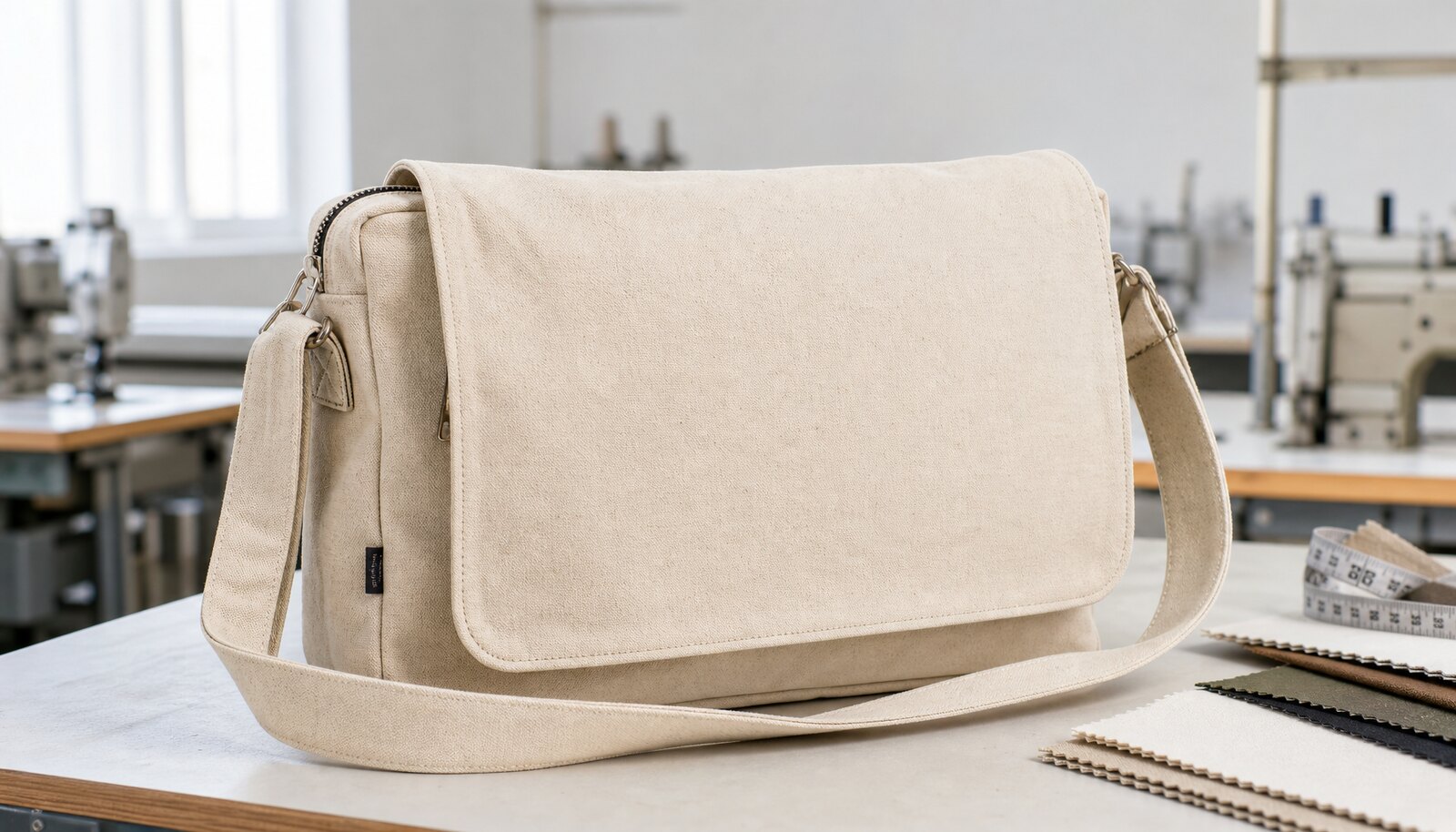
Why boutique wineries buy canvas messenger bags differently
A boutique winery usually buys messenger bags for a specific commercial use, not as a generic tote replacement. The bag may carry tasting notes, menus, a bottle, small retail items, or staff essentials. That changes the build. Buyers who write an RFQ like a fashion accessory order often miss the functional details that drive price, MOQ, and complaint rate.
For this product, the most common mistake is overspecifying branding and underspecifying durability. A logo-heavy bag with weak straps or a thin body may look good in the sample room and fail when used by customers or staff. The right buying problem is not just “what is the cheapest bag,” but “what spec can hold up in real use while staying within a manageable MOQ and freight budget.”
- Use case decides capacity, closure, and strap reinforcement.
- Repeatable branding matters more than decorative complexity.
- Packaging and carton efficiency affect landed cost more than many first-time buyers expect.
Start with the fabric spec, not the logo
Canvas messenger bags for wineries are usually built from cotton canvas in the 10 oz to 16 oz range. For a structured retail bag, 12 oz or 14 oz is the practical middle ground. Twelve ounce canvas keeps the bag lighter and cheaper, while 14 oz gives better body and better protection against sagging when the bag holds catalogs, point-of-sale material, or a small bottle arrangement.
If you need a premium feel, ask whether the factory is quoting oz per square yard or GSM, and whether the fabric is pre-shrunk. Buyers often receive a quote based on nominal fabric weight but later discover the final bag feels softer or smaller after finishing. If the bag is supposed to sit neatly on a retail shelf or carry a rigid insert, this matters more than the logo application method.
- Common working range: 12 oz to 14 oz cotton canvas.
- If structure matters, request reinforcement at base corners and strap points.
- If lower freight weight matters, compare 12 oz canvas against a lighter lining plus reinforced body panel instead of just choosing the cheapest fabric.
MOQ negotiation works best when you separate stock-body and custom-body routes
The cleanest way to negotiate MOQ is to ask for two quotes: a stock-body bag with custom decoration, and a fully custom cut-and-sew bag. The stock-body route usually gives the lowest entry point because the factory already has the fabric width, pattern, and sewing flow established. That works well for a first order or a seasonal winery campaign where the buyer wants to test sell-through before committing to a larger run.
Fully custom cut-and-sew is the better route when the bag needs a specific pocket layout, custom flap shape, unique trim color, or a very tight brand presentation. The MOQ rises because the factory must reserve fabric, make patterns, and often create new production documentation. If you try to force a fully custom bag to a stock-bag MOQ, you usually pay for it through a surcharge, lower service priority, or unstable quality on the first run.
- Ask the factory to quote both routes on the same RFQ sheet.
- Compare the price break at 300, 500, 1,000, and 3,000 pieces if your buying volume is not fixed.
- Negotiate by simplifying size and trim before pushing for a lower MOQ.
Compare supplier routes before you compare unit price
When buyers compare quotes, they often compare only the piece price. That is not enough. A factory-direct quote, a trading company quote, and a stock-lot or mixed-sourcing route can all arrive at the same apparent price while carrying very different risks. The real comparison is control over fabric, print consistency, sample accuracy, and production accountability.
For boutique winery programs, factory direct is usually the best route if the artwork is stable and the buyer can wait for normal production timing. A trading company can be useful if you need mixed products, combined shipping, or a single contact across several categories, but the buyer should be clear about where production happens and who signs off on QC. A stock-body reseller may be acceptable for a test launch, but not if the bag must match an exact brand color or closure style.
- Do not compare only unit price; compare quote structure and ownership of QC.
- Ask who buys fabric, who prints, and who packs the cartons.
- If a supplier will not disclose production route, treat the MOQ and lead time as less reliable.
Table: sourcing routes for wholesale canvas messenger bags
The table below is meant to help procurement teams compare practical sourcing paths, not just spec fields. Use it to decide whether the first order should be a low-risk test run or a true custom build. The right answer depends on how stable your artwork is, how strict your quality expectations are, and whether the bag is a retail product or a functional winery accessory.
The sample record for wholesale canvas messenger bags for boutique wineries moq negotiation guide should include front, back, side, seam, logo, label, inside, and packed-carton photos. For important programs, keep one signed physical sample and record the sample version in the approval file.
- Write decisions in measurable language, not only descriptive wording.
- Ask for sample photos plus one physical approval sample for important orders.
- Keep quotation, sample approval, and inspection notes tied to the same spec version.
How to read a quote without missing hidden cost drivers
A useful quote for wholesale canvas messenger bags should separate fabric, sewing, print, label, packing, and carton costs. If everything is wrapped into one number, you cannot compare suppliers accurately or understand what changes when the MOQ shifts. The lower the MOQ, the more the setup and labor components dominate the final unit price.
One practical way to read the quote is to compare unit price at your target quantity against the setup fees that disappear when volume increases. For example, if a screen print setup is spread over 500 pieces, the per-unit effect is moderate. If the same setup is spread over 100 pieces, the quote may look cheap at first glance but become expensive once you add packaging and freight. Buyers should also request a separate cost line for any special trim, such as a woven label, metal snap, zipper pull, or custom hangtag.
- Separate unit price from setup fees and special packing charges.
- Ask whether carton dimensions are optimized for sea freight or just warehouse convenience.
- Compare landed cost, not ex-factory cost.
Print method choice should follow artwork, not preference
For canvas messenger bags, screen print is still the most practical method when the logo is one to three colors and the artwork is not too detailed. It gives good opacity on cotton canvas and is easier to control for repeat batches. The tradeoff is setup cost and the risk of filling in thin lines if the artwork is too small or the canvas surface is too coarse.
Heat transfer can work for detailed logos, gradients, or smaller runs, but it may not age as well under repeated folding and abrasion. Woven patches or embroidered badges look premium and can lift retail perception, yet they add labor and may require a higher MOQ. For winery buyers, the best choice is the one that matches brand positioning and real wear, not the one that simply looks best in a single sample photo.
- Use screen print for simple brand marks and larger logo areas.
- Use transfer for detailed art only if you accept wear tradeoffs.
- Use woven or sewn branding when the bag is sold as a premium merchandise item.
Sample approval should test use, not just appearance
A pre-production sample should be treated as a functional prototype. Hold it to the same standard as the bulk order: fabric color, print placement, strap length, seam finish, zipper operation, label position, and final packed appearance. A bag that looks correct in an email photo can still be wrong in the hand if the canvas is too soft, the strap feels narrow, or the flap sits unevenly.
The best sample review includes basic handling tests. Load the bag with the planned use weight, open and close the zipper several times, and inspect stress points after a short carry test. Compare the sample against your approved spec sheet and mark acceptance criteria in writing. If the supplier needs corrections, provide one clean round of comments rather than a scattered list that causes contradictory changes.
- Check color under daylight and indoor light.
- Verify logo placement with a ruler, not by eye.
- Test strap comfort and edge binding with the intended load.
Packing, carton planning, and shipping details that change landed cost
Packing can materially change your landed cost. A flat-packed messenger bag without individual polybags takes less carton space and lowers freight cost, but may increase scuff risk if the surface finish is sensitive. If the bags are for retail shelves, individual polybags and insert cards may be necessary; if they are for wholesale distribution or internal use, bulk inner packing is usually enough.
Carton planning matters because canvas bags are bulky relative to their value. Ask for carton dimensions, gross weight, and the number of bags per carton before you approve the order. Small changes in fold method or strap placement can alter cubic volume enough to affect sea freight or courier charges. For warehouse buyers, readable carton marks and count consistency are just as important as the bag itself.
- Confirm whether bags are flat packed, folded once, or packed with tissue and insert.
- Ask for outer carton strength if the route includes multiple transloads.
- Match packing spec to the channel: retail, wholesale, or direct-to-consumer fulfillment.
A practical MOQ negotiation approach for winery buyers
If your target volume is uncertain, use the supplier’s own efficiency levers to negotiate rather than forcing a random lower number. The simplest levers are fabric color, print colors, accessory trims, and packaging complexity. Removing one print color or switching from custom zipper pull to standard pull often lowers the MOQ pressure more effectively than demanding a blanket reduction in piece count.
If the factory resists a low MOQ, ask for a phased order structure. For example, place a first run at a smaller quantity with a clearly defined re-order price band if the bag performs well. This gives the factory a reason to keep your pattern active while protecting you from overcommitting before the market test is complete. The key is to lock the conditions in writing so the second order does not become a new quotation exercise from zero.
- Reduce complexity before reducing quantity.
- Use phased orders when the market response is uncertain.
- Protect the re-order price band in the RFQ or purchase agreement.
Specification comparison for buyers
| Spec decision | Recommended option | When it fits | Buyer risk to check |
|---|---|---|---|
| Fabric weight | 14 oz canvas for structure; 12 oz if you need lower cost and lighter carry | Boutique wine clubs, tasting-room retail, staff kits, and gift-with-purchase programs | Too-light canvas can sag under bottles, catalogs, or a laptop sleeve; confirm finished bag weight and seam strength, not only fabric GSM |
| Bag build | Single main compartment with flap or zipper; internal slip pocket optional | Merchandise carry, event kits, tasting notes, POS materials, and medium daily-use bags | Complex pocket layouts add labor and can push MOQ up; every extra pattern piece affects defect risk |
| Print method | Screen print for simple logos; heat transfer or woven patch for multi-color or smaller runs | Short-run seasonal programs or one-color winery branding | Fine type can fill in on heavy canvas with screen print; ask for strike-off and Pantone tolerance |
| MOQ route | Stock-body + custom print for the lowest entry point; fully custom cut-and-sew for repeat programs | New buyer testing a design before scaling | Stock-body routes limit size, color, and trim control; custom cut-and-sew raises MOQ but improves brand fit |
| Closure choice | Zipper closure for retail value; magnetic snap or flap for easier access | Premium tasting kits, premium gift bundles, or travel-friendly merch | Cheap zippers or weak pullers fail in use; specify zipper gauge, slider type, and cycle expectations |
| Handle and strap | 40-45 mm cotton webbing or canvas strap with reinforced X-box stitching | When bags will carry catalogs, bottles, or point-of-sale kits for repeated use | Thin straps cut into shoulders and may fail at stress points; demand stitch count and load test evidence |
| Supplier route | Factory direct for repeat orders; trading company only if you need mixed factory consolidation | Buyers with stable artwork and forecast volume | Trading layers can hide actual MOQ and quality control responsibility; confirm who owns fabric, print, and final inspection |
| Packing method | Flat packed with size labels and carton pack list; polybag only if retail-ready is required | E-commerce, wholesale distribution, and warehouse receiving | Overpacking raises freight cost; underpacking increases abrasion, creasing, and contamination risk |
| Lead time profile | 25-35 days after sample approval for standard canvas specs | Simple logo programs with normal fabric availability | Peak-season dyeing, custom webbing, and print delays can stretch timing; book fabric and print slots early |
Buyer checklist before sampling
- Define use case first: retail merch, tasting-room staff bag, event kit, or gift-with-purchase. Capacity, closure, and strap comfort depend on the use case.
- Lock the fabric spec in writing: canvas weight in oz or GSM, weave type, color, and whether the fabric is pre-shrunk or enzyme washed.
- Send vector artwork and specify logo placement, Pantone references, print size, and minimum line thickness.
- State target MOQ by SKU and acceptable mix: single color only, color/print variants, or mixed sizes.
- Request sample photos plus a pre-production sample before bulk approval.
- Define packing: individual polybag yes/no, hangtag yes/no, carton count, carton mark format, and master carton dimensions.
- Set QC thresholds for seams, print alignment, zipper operation, stains, loose threads, and dimensional tolerance.
- Ask for lead time split by sample, fabric, printing, sewing, inspection, and shipment booking.
Factory quote questions to send
- What fabric weight, weave count, and finishing are you quoting, and is the weight before or after washing?
- Is the MOQ based on fabric stock, printing setup, sewing line efficiency, or carton packing constraints?
- Can you quote both stock-body with custom print and fully custom cut-and-sew so we can compare landed cost?
- What print method are you recommending for our artwork, and what are the setup fees, color limits, and artwork line-width limits?
- What is included in the sample fee, and will the pre-production sample reflect the final stitching, labels, zipper, and packing?
- What are the exact carton dimensions, carton count, and gross weight per carton for freight planning?
- What inspection standard do you use for stitching, print registration, and dimension tolerance?
- What is the realistic production lead time after sample approval, and what parts of the schedule are at risk?
- Can you separate unit price, print charge, label charge, carton charge, and any special packing charge?
Quality-control points to confirm
- Fabric weight tolerance should be tight enough that hand feel and structure stay consistent across cartons; large swings usually show up in drape and seam puckering.
- Stitching at strap attachment points should show reinforced bartacks or X-box stitching with no skipped stitches, loose thread bundles, or uneven seam allowance.
- Print registration should stay within the approved artwork boundary, with no obvious smearing, cracking, or fill-in on fine text.
- Zippers should run smoothly across the full length without snagging on lining, seam allowance, or zipper tape.
- Finished size should stay within an agreed tolerance, especially for messenger bags used as retail packaging or insert carriers.
- Cartons should be dry, clean, and packed to prevent corner crush; sample one carton for compression marks and dust contamination.
- Side labels, woven logos, embossing, or patches must match the approved position and color tone on the golden sample.
- No oil stains, broken needles, exposed raw edges, or asymmetry at flap corners and pocket openings.