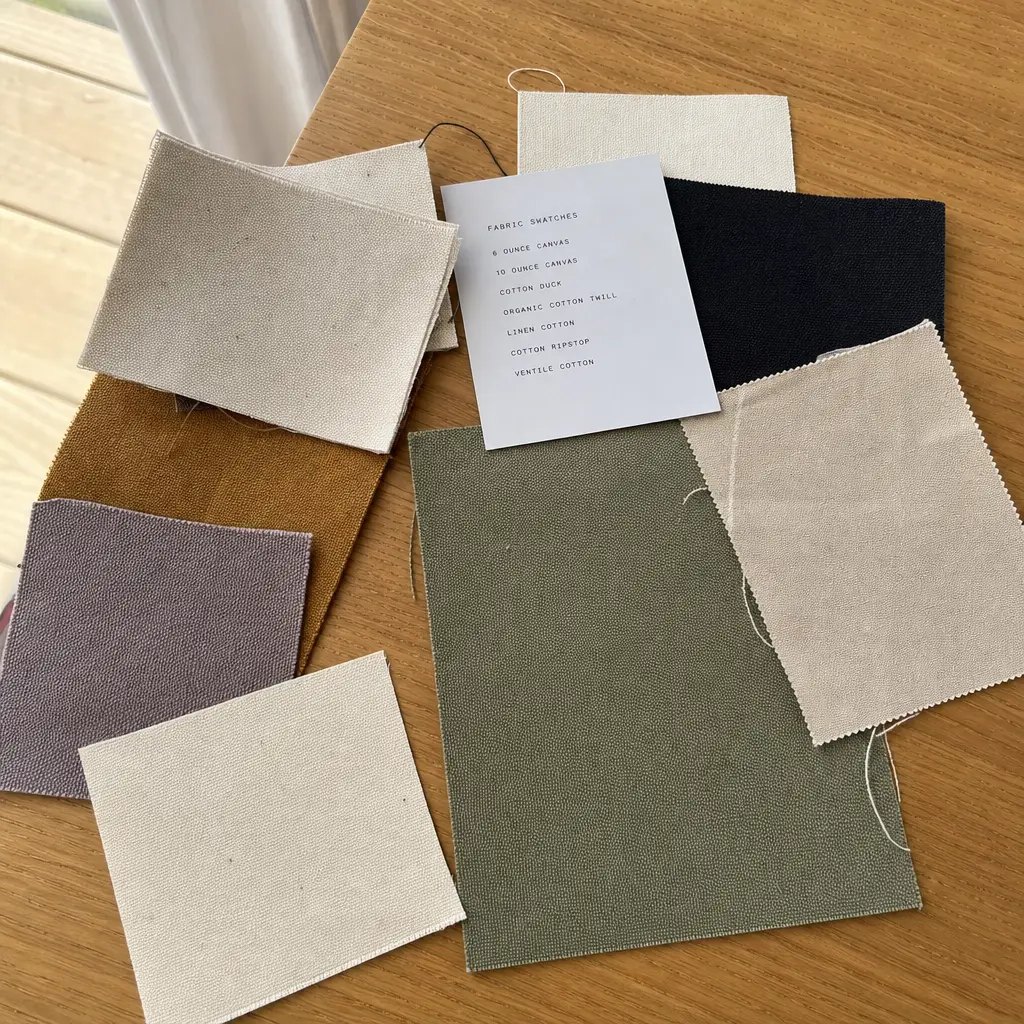
Why fabric weight is the main buying decision for grocer messenger bags
For wholesale canvas messenger bags, fabric weight is not just a materials line on the quote. It changes structure, print behavior, carton yield, carrying comfort, seam performance, and freight cost. Natural grocer programs usually want a bag that feels reusable and substantial, but not so heavy that the customer stops using it after two trips. That is why the wrong GSM creates downstream problems even when the first quote looks attractive.
Messenger bags are also less forgiving than simple totes. The flap has to sit flat, the strap joints take repeated stress, and the bag often carries uneven loads such as boxed goods, bottles, produce, brochures, or a tablet. A lightweight body may look acceptable on a hanger sample but fail in real use. A heavyweight body can improve shape but raise landed cost enough to make the retail math difficult. Buyers should frame the RFQ around use case first, then select the fabric range.
- 10 oz or about 339 GSM is typically a budget entry point
- 12 oz or about 407 GSM is the common all-round choice
- 14 oz or about 475 GSM suits more structured or premium programs
- The same bag pattern can quote very differently once GSM changes because print, labor, and carton count all move with it
Best GSM ranges for different natural grocer use cases
If the bag is intended for promotional handouts, membership sign-ups, or light daily carry, 10 oz canvas can work. It keeps unit cost down and improves carton efficiency. The tradeoff is that the flap tends to show wrinkles after bulk packing, and the body can lose shape if users carry jars, bottles, or dense pantry items. This option needs stronger communication in retail because buyers may assume all canvas messenger bags have the same durability.
For most natural grocer resale or loyalty programs, 12 oz canvas is the safest recommendation. It supports clean flap presentation, takes one- or two-color printing well, and holds up better at stress points without becoming uncomfortably heavy. Move to 14 oz only when the bag is sold as a premium item, carries heavier mixed loads, or needs a more upright retail look on shelf. Above that range, the bag often becomes too stiff for the value segment unless the design is very simple.
- Choose 10 oz for event or price-led programs with lighter loading
- Choose 12 oz for broad retail and reusable daily use
- Choose 14 oz for premium resale, heavier contents, or more rigid shape
- Test the same sample pattern at two GSM levels before making a bulk decision if the target retail price is tight
How GSM changes print quality, logo clarity, and panel appearance
Canvas texture is part of the product look, but it affects how logos reproduce. On lighter and looser canvas, ink can spread more, small text can blur, and thin line art may break where the weave is uneven. Buyers who need a clean natural grocer logo, product category icon, or store message on the flap should match artwork complexity to the actual cloth. Screen printing is usually the best commercial route for simple branding because setup is manageable and the result is durable when the art is not too fine.
Heavier canvas generally gives a more stable print surface, but it also has a denser hand and stronger fold memory. If the flap is compressed in cartons, a heavy ink deposit can show stress lines where the flap bends. For that reason, a one-color or two-color water-based print often performs better than a thick plastisol effect on this type of bag. If the artwork has gradients or small details that cannot be simplified, buyers should budget for a different print method and accept the feel and durability differences.
- Screen print works best for bold logos and limited spot colors
- Require minimum line thickness and text size guidance from the printer
- Approve print strike-offs on the real bag fabric, not a smoother substitute swatch
- Define acceptable variation for natural fabric because base cloth specking can slightly shift perceived color
The hidden cost drivers behind each fabric weight option
Many buyers compare canvas messenger bag offers only by unit price, then find the cheapest quote changed assumptions in the background. Fabric weight is one of the easiest ways for suppliers to make a quote look competitive. A lower GSM reduces cloth consumption by weight, can speed sewing slightly, and increases pieces per carton. But if the bag then needs extra reinforcement, higher claim rates, or replacement stock, the landed program cost is no longer low.
On the other side, moving from 12 oz to 14 oz does not only add raw material cost. It can affect needle wear, sewing speed around folds, print setup tuning, and export volume because fewer bags fit in each carton. Freight becomes more important when the destination warehouse charges by cube and pallet position. The right comparison is not only ex-factory price per piece. Buyers should model cost per usable bag in the market and cost per delivered carton.
- Fabric cost rises with GSM, but so do bag weight and freight
- Heavier body fabric may reduce return risk if the use case is demanding
- Lower GSM can seem cheaper until reinforcement, claims, or lower retail perceived value are factored in
- Quote requests should ask for unit weight and carton quantity alongside unit price
MOQ logic: how to keep options open without inflating cost
Messenger bags become MOQ-heavy when buyers change too many variables at once. A common mistake is requesting separate GSMs, separate webbing colors, multiple closure types, and several artwork versions in one launch. That creates fabric remnants, hardware fragmentation, slower line balancing, and a higher effective minimum per SKU. The cleaner approach is to standardize the body fabric and most trims, then create variety through print or label changes.
For natural grocer programs with multiple store groups or seasonal graphics, a 12 oz base fabric shared across all SKUs usually gives the best MOQ efficiency. Webbing can stay natural or black across the range, and only the front flap print changes by customer or campaign. This lets importers consolidate volume and compare suppliers more fairly because everyone is costing the same underlying construction.
- Use one body fabric and one strap construction across the program if possible
- Limit hardware variations unless the retail margin supports complexity
- Separate artwork changes from structural changes when comparing MOQs
- If a supplier offers a very low MOQ, verify whether the quote assumes stock fabric rather than custom-milled canvas
Sample approval flow that actually prevents bulk surprises
A single pre-production sample is not enough when fabric weight is the main risk. Buyers should split approval into stages so each stage validates a different issue. First, approve a blank fit sample to verify dimensions, flap proportion, strap drop, and overall body feel in the target GSM. That step catches pattern issues before printing or labels are added. Then approve a print strike-off on actual canvas. Finally, approve a full pre-production sample using real trims, real webbing, and the intended packing method if flap presentation matters.
This sequence saves time because each sample has a narrow purpose. A blank sample confirms whether 10 oz is too soft or 14 oz too stiff. The strike-off shows whether logo details fill in on the weave. The final PP sample confirms that bulk construction and packing do not distort the flap or shift print placement. Buyers who skip the blank stage often approve art on a bag that still has a structural problem.
- Blank fit sample: size, GSM feel, shape, strap comfort, flap drop
- Print strike-off: color, line clarity, ink feel, registration
- PP sample: full construction, labels, reinforcement, packing result
- Seal sample: keep one approved piece at both buyer and factory for inspection reference
QC thresholds that matter more than generic inspection language
Canvas messenger bags often pass basic count inspection but still fail in use because the wrong details were controlled. The major functional areas are strap joints, flap symmetry, fabric weight consistency, and print placement on the front panel. If the fabric comes in below target GSM, the entire bag may feel weaker and print differently. If the front flap is cut off grain, it can twist after sewing even though the dimensions appear correct on paper.
Buyers should translate quality expectations into measurable thresholds. Instead of writing 'good stitching,' define no skipped stitches at stress points, reinforcement pattern required, and acceptable loose thread standard. Instead of 'correct size,' set tolerance bands for width, height, gusset, and strap length. Instead of 'nice print,' define print location, registration tolerance, and limits for pinholes or edge feathering.
- Weigh cut panels or finished bags from random cartons to confirm GSM consistency
- Measure flap left-right symmetry and centerline alignment to the body
- Test strap seam strength on loaded samples, not only visual appearance
- Inspect front-facing panels for loom defects, oil stains, and obvious slubs before printing
- Use practical defect categories tied to retail acceptance, not vague wording
Packing and carton planning: where heavy canvas can erase a price win
Packing is often left until the end of the conversation, but it should be part of the fabric decision. A heavier messenger bag takes more cube per piece and creates more pressure on printed flaps when cartons are overfilled. If the factory compresses too aggressively to hit a carton target, the print may show transfer marks, flap edges can crease, and the bag shape arrives tired. That is especially visible on natural canvas with broad front-flap branding.
For most export programs, flat packing is the best route, with the flap inserted neatly and straps folded consistently. Carton gross weight should stay manageable for warehouse handling, usually under 15 kg unless the buyer's logistics system allows more. Freight teams should get sample carton dimensions early, because changing from 10 oz to 14 oz may reduce pieces per carton enough to affect palletization and sea freight planning.
- Request packed photos of trial cartons before mass packing starts
- Specify whether individual polybags are required or avoided for sustainability positioning
- Set a carton weight ceiling and target dimensions
- Protect printed flap surfaces from abrasion and pressure marks during transit
Lead time planning by fabric weight and print route
Lead time for wholesale canvas messenger bags is not only sewing time. Fabric booking or weaving, dyeing if any, printing queue, hardware matching, sample approvals, and packing all affect the schedule. Heavier custom canvas can require more fabric preparation lead time than lighter stock cloth. If a buyer waits too long to lock the GSM, the factory may need to rebook cloth and restart sample work, which is where avoidable delays begin.
As an example workflow, a program using stock natural 12 oz canvas with one-color screen print can move faster than a dyed 14 oz body with custom webbing and complex artwork. Buyers should ask suppliers to separate sample lead time from bulk material lead time and production lead time. That exposes where the risk sits. If the supplier only gives a single total number, it is harder to manage critical path changes.
- Stock natural canvas usually shortens booking time compared with custom dyed cloth
- Screen print queue can become a bottleneck in peak seasons
- Late artwork approval can delay cutting if print placement affects panel nesting
- Ask for time split by material booking, sample, production, inspection, and handover
How to compare supplier quotes on a landed-cost basis, not just ex-factory price
A practical quote comparison should normalize four things: finished GSM, unit bag weight, carton quantity, and included process details. Without that, one supplier may quote 10 oz stock cloth, another 12 oz finished cloth, and a third a blend fabric that prints differently. The result is a false price gap. For importers and distributors, the landed cost difference per usable retail unit often depends more on weight, packing density, and defect risk than on the initial few cents in ex-factory price.
Build a comparison sheet that includes ex-factory unit price, sample fees, print screen charges, estimated units per carton, cubic volume, gross carton weight, and expected claim risk based on construction. If one quote is lower because it omits reinforced strap joints or uses lighter webbing, that should be visible. The goal is not to choose the highest or lowest number. It is to identify which quote is based on a spec that supports the intended program without hidden substitutions.
- Normalize all offers to the same finished GSM and bag dimensions
- Add freight effect using carton cube and weight, not just unit price
- Separate one-time setup charges from repeat-order costs
- Note whether the supplier quote includes inspection, export packing, and spare quantity
- Flag any quote that uses a fabric description without stated GSM tolerance
Specification comparison for buyers
| Spec decision | Recommended option | When it fits | Buyer risk to check |
|---|---|---|---|
| Body fabric weight | 12 oz canvas, about 407 GSM | Best balance for grocer messenger bags carrying catalogs, tablets, packaged foods, and daily retail use without becoming too heavy | Some suppliers quote 12 oz based on greige cloth before finishing; require final finished GSM tolerance and weigh sample panels |
| Lightweight budget version | 10 oz canvas, about 339 GSM | Promotional runs, event distribution, or price-sensitive programs where structure matters less than unit cost | Bag can collapse, flap may wrinkle after printing, and seam stress increases if users load glass jars or bottles |
| Premium structured version | 14 oz canvas, about 475 GSM | Higher-end retail resale, wine-and-grocery mixed loads, or messenger bags expected to hold heavier product assortments | Heavier fabric raises freight, reduces carton quantity, and can crack on dense print areas if ink deposit is not tuned |
| Print method for natural canvas | Water-based screen print with 1-2 spot colors | Clean logo applications on natural grocer programs that want soft handfeel and low minimums on straightforward art | Fine lines can blur on coarse canvas; require strike-off on actual bag fabric, not only paper or smooth swatch |
| Artwork with many tones | Heat transfer or digital pigment print only for limited SKUs | Short runs or artwork that cannot be simplified into spot colors | Transfers can feel plasticky and age differently on flap fold lines; digital print penetration and wash fastness vary by mill and printer |
| Inner structure | No lamination, optional 210D lining only on organizer styles | Natural grocers wanting recyclable-looking, soft-hand bags with simple inside finish | Without lining, interior seam allowances show; require neat binding or overlock and define acceptable thread trimming |
| Strap construction | 38 mm cotton webbing with boxed X reinforcement | Daily carry programs where comfort and stitch strength matter more than the lowest price | Thin webbing twists and cuts into shoulder; inspect bartack or box stitch density and strap joint alignment |
| MOQ strategy | Use one base fabric and shared hardware across multiple prints | Importers building 3-6 SKU colorways and trying to keep MOQ practical | If each SKU changes GSM, webbing color, and closure type, MOQ and dead stock rise fast and quote comparison becomes misleading |
| Export packing | Flat packed with flap inserted, 25-50 pcs per poly master, carton under 15 kg | Most sea freight and DC receiving environments where carton cube and clean arrival matter | Over-compression can crease print and distort flap shape; specify carton dimensions and no metal hardware pressure marks |
Buyer checklist before sampling
- State finished fabric weight in GSM and tolerance, not only oz shorthand
- Specify bag size, gusset depth, flap shape, and whether dimensions are taken empty or stuffed
- Define intended load: paper goods only, mixed groceries, glass bottles, or laptop plus retail items
- List print method by panel, color count, print size, and acceptable color variance
- Call out strap width, strap length range, and reinforcement method at stress points
- Note whether inside seams must be overlocked, bound, or fully lined
- Request sample weight, finished bag weight, and carton pack quantity for freight planning
- Set approval flow for blank sample, print strike-off, pre-production sample, and bulk seal sample
- Include AQL level or practical major/minor defect thresholds for appearance and function
- Specify packing details: individual polybag yes or no, silica gel if needed, carton weight limit, shipping marks, and barcode label placement
Factory quote questions to send
- What is the finished body fabric GSM after washing, dyeing, or shrinkage allowance, and what tolerance do you control in bulk?
- Is the quoted canvas 100% cotton, cotton-poly blend, or recycled cotton mix, and how does that affect print and shrinkage?
- What bag weight in grams do you estimate for 10 oz, 12 oz, and 14 oz options in the same size?
- Which panels are cut on straight grain versus cross grain, and does that affect flap shape stability?
- What print method are you quoting, what is the setup cost per color, and what line thickness can you hold on this canvas texture?
- How many units per carton fit for each GSM option, and what are the carton dimensions and gross weight?
- What is the MOQ by colorway if body fabric stays the same but print changes?
- Can you provide a blank fit sample first, then a printed pre-production sample using actual bulk fabric and actual webbing?
- What reinforcement is used at strap joints, bottom corners, and closure points, and can you share close-up production photos before bulk starts?
- What is the lead time split for lab dip or fabric booking, cutting, printing, sewing, inspection, and vessel handover?
Quality-control points to confirm
- Finished body fabric GSM within agreed tolerance, measured from conditioned sample panels
- Bag dimensions within agreed tolerance for width, height, gusset, and flap drop
- Print position centered to approved artwork placement and free from pinholes, ghosting, or major shade drift
- Strap length and width consistent across carton samples; strap joints securely reinforced with no skipped stitches
- Top flap edge smooth and symmetrical with no twisting caused by off-grain cutting
- Needle holes, oil marks, slubs, and weaving faults controlled on front-facing panels
- Inside seam finish neat with trimmed threads and no raw edge exposure beyond approved standard
- Closure parts, if used, aligned and functional without scraping, rust marks, or sharp edges
- Carton count, carton weight, barcode labels, and shipping marks match packing instructions
- Random drop test and carry test passed on sealed samples based on intended load profile