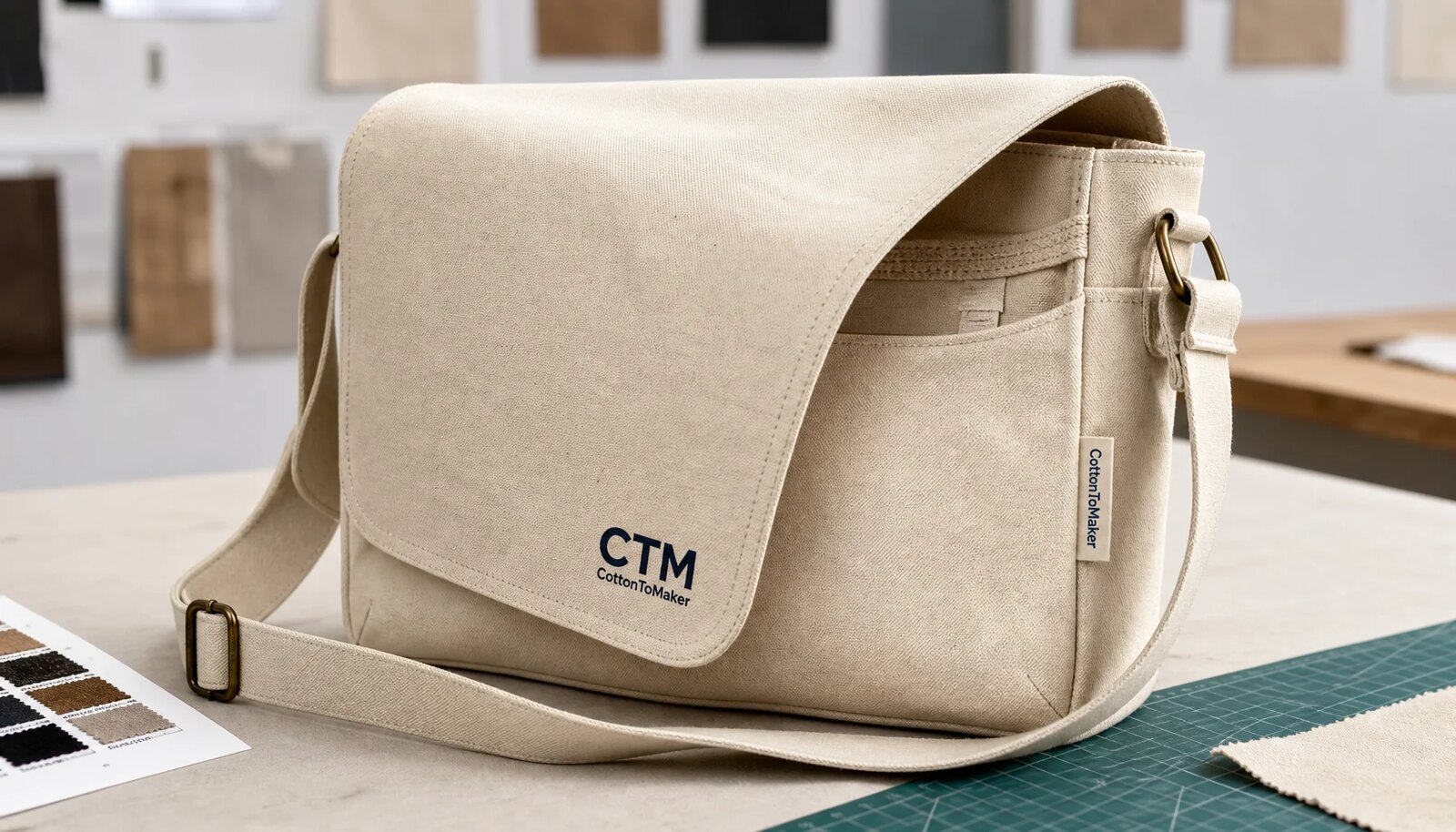
Start With The Selling Channel
Wholesale canvas messenger bags for craft fairs are not always simple giveaway bags. They may be sold from a booth, used as branded merchandise, packed with craft kits, shipped to event vendors, or placed in museum shops after the fair. Each channel changes the specification. A booth seller may care most about handfeel and display. A distributor may care most about barcode accuracy and carton separation. A retailer may require correct textile labels, country-of-origin marking, and approved hangtag wording.
Begin the RFQ with the commercial use, not only a product photo. State whether the bag must hold A4 papers, notebooks, a small tablet, packaged handmade goods, or light event materials. Define how it will be displayed: folded on a table, hanging from a rack, packed inside a kit, or shipped in SKU-separated cartons. This helps the supplier quote the right canvas weight, flap structure, strap reinforcement, and packing method from the start.
Separate preferences from approval conditions. A soft washed handfeel may be preferred; correct artwork, safe hardware, origin marking, approved labels, and accurate carton quantities are not optional. That distinction keeps the order easier to inspect and prevents end-of-production disputes.
- Define the channel: craft fair, artisan market, fundraiser, museum shop, distributor, vendor kit, or brand merchandise.
- State the intended load: documents, tablet, craft kit, product bundle, or buyer-defined carry weight.
- Clarify display method: folded, hanging, shelf-ready, gift packed, bulk packed, or direct-to-vendor shipment.
- Identify required labels before sampling: fiber content, country of origin, care wording, barcode, hangtag, and carton mark.
- Map each artwork version to quantity, label set, carton mark, delivery address, and approval owner.
Fix Canvas Specs Before Pricing
Canvas quotes are hard to compare until the material is defined. Suppliers may describe several fabrics as canvas even when weight, weave, finish, shrinkage, and handfeel differ. Ask for both oz and GSM because mills and suppliers may calculate weight differently. As a practical reference, 10 oz cotton canvas is often around 330-360 GSM and 12 oz cotton canvas is often around 390-430 GSM, but the supplier must confirm the actual fabric and measurement basis.
For many craft fair resale programs, 10 oz canvas is a useful starting point because it balances handfeel, printability, carton weight, and cost. 12 oz canvas gives a firmer flap and more substantial retail feel, but it increases sewing resistance at layered seams. 8 oz canvas can work for lightweight promotional use. 14 oz canvas may look premium, yet it can become bulky, stiff, and more expensive to ship.
Finish changes both appearance and compliance needs. Natural greige canvas may show seed flecks and shade movement. Bleached canvas gives a cleaner print base but shows dirt easily. Dyed canvas needs shade approval and colorfastness expectations. Washed canvas needs shrinkage control. Treated or water-resistant canvas may affect odor, ink adhesion, and documentation.
- Request swatches from the planned bulk source, not only showroom fabric.
- Define composition: cotton, cotton-poly blend, recycled cotton blend, rPET blend, lining fabric, and strap material.
- State whether substitutions require written approval before cutting or packing.
- Ask for fabric weight tolerance, shade range, shrinkage expectation, and roll-to-roll variation.
- Record finished sample weight in grams as a simple bulk comparison check.
Specify Construction In Factory Terms
A phrase such as canvas messenger bag with shoulder strap leaves too many decisions to the supplier. The construction spec should list finished dimensions, seam finishing, stitch density, thread, closure, strap attachment, pocket layout, and reinforcement. Use photos or drawings when possible, but do not rely on images alone. Measurements and tolerances are what factory QC and third-party inspectors can apply.
The highest-risk area is usually the load path from bag body to strap. Stress concentrates at strap joints, upper side seams, flap corners, and pocket openings. Call out bartacks, box stitches, reinforced tabs, or another approved reinforcement method. If the bag has a zipper under the flap, magnetic snap, buckle, D-ring, or hook-and-loop tape, each trim adds its own inspection point.
Straps need a separate line in the spec. Cotton webbing fits a natural craft-positioned bag. Polyester webbing can be consistent and strong but may look shinier. Recycled polyester webbing should only be marketed as recycled when documentation supports the claim. For adjustable straps, define the usable range, not just total webbing length.
- Define body width, height, gusset, flap length, opening width, pocket size, and optional lining.
- Specify strap width, material, color, adjuster type, usable range, and attachment method.
- Set seam allowance, stitch density, thread type, edge finishing, bartack positions, and box-stitch positions.
- Choose closure type: none, magnetic snap, hook-and-loop, buckle, zipper under flap, button loop, or tie closure.
- Avoid raw edges unless the frayed look is intentional and included in the approved inspection standard.
Match Branding To Artwork And MOQ
Branding is a common reason quotes change. A buyer may request a simple messenger bag, then add a large flap print, second print position, woven label, hangtag, barcode sticker, and individual sleeve. Put every branding element into the first RFQ: method, artwork size, color count, placement reference, file format, setup charges, and approval steps.
Screen printing usually suits solid logos and one to three flat colors on cotton canvas. Define Pantone references, print size, and distance from a seam, flap edge, or centerline. Avoid large prints that cross folds, snaps, heavy seams, and uneven pockets. Ask about ink type, curing, and rest time before packing.
Heat transfer works for gradients and short multicolor runs but must be tested on the actual canvas texture. Check edge lift, scorching, bubbling, adhesive residue, and cracking along the flap fold. Embroidery can look premium for small marks, but dense embroidery may pucker lighter canvas. Woven labels are useful for repeat private-label programs because the same bag body can carry different brand versions.
- Screen print: best for solid logos, repeat SKUs, and economical bulk production.
- Heat transfer: useful for complex art but requires flex, rub, edge-lift, and heat-mark review.
- Embroidery: premium for small marks but needs backing and pucker control.
- Woven label: efficient for private-label programs and repeat versioning.
- Hangtags and barcode stickers: useful for event details but must be approved before packing.
- Confirm whether MOQ applies per artwork, print color, label design, or total order.
Understand MOQ And Price Breaks
MOQ is not only a supplier preference. It often comes from fabric roll use, cutting efficiency, screen setup, label production, webbing availability, hardware sourcing, dye-lot control, and packing labor. A stock natural canvas bag with one front print can have a much lower operational burden than a custom dyed, lined, multi-pocket messenger bag with branded hardware and retail barcode packing.
Ask what the MOQ applies to. It may be per style, fabric color, print design, label design, packing method, or shipment. This matters for craft fair programs with multiple artists, dates, or regional versions. A quoted 1,000-piece minimum may mean 1,000 total or 1,000 per design.
Request price breaks that match real buying decisions, such as 500, 1,000, 2,500, and 5,000 pieces when relevant. Separate the unit price from one-time costs: screens, sample fees, label setup, artwork conversion, custom hardware, test charges, and special packing labor. If a fee repeats on reorder, include it in the margin model.
- Confirm MOQ by style, color, print, label, packing method, and total purchase order.
- Ask whether custom dyed fabric, woven labels, webbing, and branded hardware have separate minimums.
- Compare unit price with landed cost, carton volume, inspection risk, relabeling labor, and warehouse sorting.
- Simplify with one body color, one strap, one closure, and controlled artwork versions where possible.
- Ask whether reorder MOQ or price improves after the first approved production run.
Use A Real Supplier Compliance Checklist
For this keyword, supplier compliance checklist must mean more than asking for certificates. Compliance evidence should connect to the actual canvas, strap, lining, ink, thread, labels, closures, packaging, and destination market. Generic factory profiles and broad claims such as eco-friendly, non-toxic, premium, export quality, or sustainable are not enough for a purchase file.
Start with textile labeling. Confirm fiber content for the bag body, strap, lining, and any material that affects required labeling. Review country-of-origin marking for the destination market. Check care wording against the canvas finish and print method. If hangtags make recycled, organic, plastic-free, or low-impact claims, request evidence before artwork approval, not after cartons are packed.
Restricted substance testing should be used where the market, retailer, product claim, or risk profile requires it. Ask whether the buyer needs testing or declarations for azo dyes, heavy metals in hardware, phthalates in transfers or coated materials, or other restricted substances. CPSIA may be relevant if the bag is marketed for children in the United States. Prop 65 may be relevant for California sales depending on materials and exposure. REACH may be relevant for EU distribution. Do not request every test by default; define what applies and who pays.
Recycled-content evidence also needs discipline. If the bag uses recycled cotton, rPET canvas, recycled polyester webbing, or recycled labels, request material declarations, supplier certificates, transaction records, or other documentation suitable for the claim and sales market. Claims on hangtags, websites, and cartons should match the evidence.
Carton and retail labeling are part of compliance and receiving accuracy. Confirm barcode format, SKU, PO number, style number, quantity, carton count, gross weight, net weight, country-of-origin wording if required, and any retailer-specific label layout. If the order ships to events, incorrect carton labels can create the same commercial damage as a product defect.
- Request textile labeling support: fiber content, care wording, country-of-origin marking, and label placement.
- Request restricted substance documents only where applicable: CPSIA, Prop 65, REACH, azo, heavy metals, phthalates, or retailer protocols.
- Request recycled-content evidence for recycled cotton, rPET canvas, recycled polyester webbing, recycled labels, or sustainability claims.
- Review packaging documents: polybag material, plastic-free claim support, carton label layout, barcode data, and retail label requirements.
- Require substitution approval for fabric, webbing, lining, thread, ink, transfer film, closure, label, packaging, and carton marks.
- Keep the compliance file with the PO, approved sample, test reports or declarations, inspection report, packing list, and shipment documents.
Approve Samples With Measurable Gates
Sample approval should not be only a photo approval. Measure the body, gusset, flap, strap, pocket, closure, print position, label placement, and packed fold. Load the sample with the intended contents and wear it briefly. Check strap comfort, hang angle, flap coverage, seam pulling, odor, and whether the bag looks good folded or hanging.
Use two gates when possible. The development sample confirms pattern, shape, construction direction, and branding concept. The pre-production sample confirms actual bulk fabric, strap, closure, thread, label wording, print method, print color, and final packing. Bulk cutting should wait until the pre-production sample and open comments are approved in writing.
Tolerances must be simple enough for factory QC to apply. For many canvas messenger bags, plus or minus 1 cm works for body width, height, gusset, and flap length. Logo and label placement can often be controlled to plus or minus 0.5 cm from a defined reference point. Fixed strap length may need plus or minus 2 cm; adjustable straps should be checked by minimum and maximum usable range.
- Measure body width, height, gusset, flap length, opening width, pocket size, strap width, and strap length.
- Approve actual canvas, strap, thread, closure, label wording, branding method, print color, and packing fold.
- Keep one sealed approved sample with the buyer and one with the factory.
- Send the measurement chart, tolerances, photos, and defect definitions to any third-party inspector.
- Do not release bulk cutting until artwork, trims, construction comments, compliance labels, and packing are closed.
Set Inspection Criteria Before Production
Inspection rules should be agreed before production starts. AQL or another sampling plan can be useful for larger orders, but it does not define what is important. The buyer still needs defect classifications specific to canvas messenger bags: critical, major, and minor.
Critical defects include sharp metal, broken needle fragments, mold, severe contamination, unsafe hardware, and anything that makes the bag unsafe or unusable. Major defects include weak strap attachment, open seams, dimensions outside tolerance, wrong artwork, wrong label, print cracking, ink transfer, missing closure, mixed SKU packing, barcode errors, and carton shortages. Minor defects may include small loose threads, light lint, slight shade variation within the approved range, or small cosmetic marks away from the main display area.
Pull samples from finished cartons, not only the sewing line. Folding, compression, hardware contact, damp cartons, and rushed packing can create defects after sewing. Open the flap, check pockets, review strap reinforcement, compare labels, inspect print cure, verify carton marks, and match quantities against the packing list.
First-piece production review reduces rework. Ask for early photos or video with a measurement tape, plus close-ups of strap reinforcement, seam finishing, label position, print quality, closure attachment, and packing fold. This does not replace final inspection, but it catches drift before the full order is made.
- Classify sharp metal, broken needle risk, mold, severe contamination, and unsafe hardware as critical defects.
- Classify weak straps, open seams, wrong artwork, wrong labels, print failure, and mixed SKU packing as major defects.
- Set loose-thread limits, such as no loose threads longer than 5 mm unless trimmed before packing.
- Check strap reinforcement with a practical load review based on intended use.
- Compare carton quantities, SKU separation, gross weights, carton marks, and barcode data against the packing list.
Plan Packing And Distribution
Packing affects landed cost, retail presentation, warehouse labor, and defect risk. Messenger bags may be packed flat, folded once, folded under the flap, paper banded, tissue wrapped, individually sleeved, or bulk packed. Flat packing reduces creasing but increases carton volume. Folding saves space but may leave a line across the flap or printed logo. Approve the packing fold on a physical sample.
Cotton canvas can absorb moisture and odor, so packing should reflect the route and storage conditions. Clean export cartons, dry handling, carton liners, desiccants where appropriate, and moisture checks may be needed for sea freight or humid seasons. If the buyer requires plastic-free packing, ask how the supplier will prevent scuffing, carton dust, and moisture damage.
SKU separation matters for craft fair and distributor orders. Carton marks should show artwork version, color, quantity, PO number, style number, carton number, and destination where needed. Mixed cartons should be used only with an approved inner-pack map. A good bag in the wrong carton still creates sorting cost and missed selling time.
- Approve flat pack, folded pack, paper band, tissue wrap, individual sleeve, compostable sleeve, or bulk carton packing.
- Define carton quantity, carton size, maximum gross weight, net weight, and cubic meters per 1,000 pieces.
- Protect printed flaps from buckles, D-rings, magnetic snaps, rough seams, and carton surfaces.
- Separate SKUs by carton unless mixed cartons are approved with a clear inner-pack map.
- Approve carton marks, barcode labels, packing list format, pallet requirements, and retail receiving labels before final packing.
Build Lead Time Around Approval Gates
Lead time should be counted from complete approvals, not from the first inquiry. A supplier may quote 25-35 production days, but that usually assumes approved artwork, confirmed material, paid deposit, approved pre-production sample, available trims, and final packing instructions. If the buyer changes logo size, delays barcode files, rejects a shade, or revises labels, the ship date moves unless the factory compresses quality steps.
Custom materials are common schedule risks. Dyed canvas, washed canvas, custom webbing, woven labels, branded hardware, and multicolor print strike-offs can each add time before sewing starts. If the craft fair date is fixed, a stock natural canvas body with one-color print and standard packing may be safer than a highly custom build.
A usable schedule includes sample development, sample review, revisions, pre-production sample, material booking, cutting, sewing, printing or embroidery, curing, in-line QC, final inspection, packing, document review, freight booking, and delivery buffer. Ask the supplier for the latest approval date that protects the quoted ship date. If a gate slips, request a revised schedule instead of relying on an informal promise to catch up.
- Build the schedule from artwork approval, sample approval, material availability, deposit, and packing confirmation.
- Reserve time for testing or document review if labels, restricted substances, recycled claims, or retailer rules apply.
- Avoid new custom fabric or hardware when the event deadline is close and approvals are not complete.
- Compare freight by carton cubic meters, gross weight, delivery deadline, and margin impact.
- Do not let the factory shorten print curing, fabric drying, inspection, or packing checks to recover lost approval time.
Specification comparison for buyers
| Supplier option | What to verify | Commercial advantage | Buyer risk to control |
|---|---|---|---|
| Direct sewing factory | hardware trim card, strap-load photo, lining close-up, approved flap sample, and first-piece production photos | Better sample-to-bulk control and faster production feedback | May be weaker on export paperwork or branded packing unless checked early |
| Trading company | Factory name, production photos, trim-source proof, and who owns QC decisions | Can coordinate small mixed orders and extra services | Markup can hide real factory capability and slow defect decisions |
| Specialized bag workshop | flap shape, strap webbing, buckle, D-ring, inner pocket, zipper pocket, seam allowance, and load path | More practical for detailed construction, trims, and repeat programs | Capacity may be limited during peak seasons |
| Low-price general supplier | 10-16 oz canvas, washed canvas, rPET canvas, lining fabric, interfacing, and hardware finish | Useful for simple promotional runs with loose specs | Material downgrades, weak packing, and vague inspection scope can erase savings |
| Retail-ready supplier | shape support, strap folding, hardware protection, individual bag, carton drop expectation, and retailer hangtag placement | Can handle labels, SKU separation, carton marks, and receiving rules | Higher unit cost must be compared against reduced warehouse work |
| Compliance-focused supplier | Fabric records, labeling review, test plan, and production traceability | Safer for retail programs and repeat brand orders | Documentation claims need evidence, not only sales language |
| Local sample room plus bulk factory | Signed sample, bulk factory handoff, first-piece photos, and deviation owner | Good for complex branding before large production | Sample room quality may not match bulk line unless handoff is controlled |
Buyer checklist before sampling
- Define the selling channel before quoting: craft fair booth, artisan market, museum shop, school fundraiser, event merchandise, wholesale distributor, subscription kit, or retail-ready program.
- State the canvas weight in oz and approximate GSM, such as 10 oz around 330-360 GSM or 12 oz around 390-430 GSM, and ask when and how GSM is measured.
- Specify fabric composition and finish: natural cotton canvas, bleached cotton, dyed canvas, washed canvas, recycled cotton blend, rPET blend, lined canvas, or treated canvas.
- Provide finished dimensions with tolerances for body width, body height, gusset, flap length, usable opening, pocket size, strap width, and strap length or adjustable range.
- Define the intended load in practical terms: paper inserts, notebooks, a small tablet, packaged craft kit, vendor sample pack, or buyer-approved recommended carry weight.
- Lock construction details: seam allowance, stitch density, thread type, edge finishing, bartack or box-stitch locations, closure type, lining, inner pocket, zipper pocket, and hardware finish.
- List every branding and label position: front flap print, back print, side seam woven label, inner care label, hangtag, barcode sticker, swing ticket, carton mark, and master carton label.
- Match branding method to artwork: screen print for solid logos, heat transfer for gradients, embroidery for small premium marks, woven label for repeat private-label programs.
- Require a pre-production sample made with bulk-intended canvas, strap, closure, thread, branding method, label wording, and final packing fold.
- Set written inspection tolerances, commonly plus or minus 1 cm for body size, plus or minus 0.5 cm for logo placement, and plus or minus 2 cm for fixed strap length.
Factory quote questions to send
- Is the MOQ calculated per bag style, canvas color, print design, print position, label design, packing method, shipment, or total purchase order?
- What exact canvas weight are you quoting in oz and GSM, and is GSM measured before washing, after washing, or from the incoming fabric roll?
- What is the fabric composition and finish: 100 percent cotton, cotton-poly blend, recycled cotton blend, rPET blend, natural greige, bleached, dyed, washed, or treated?
- What fabric weight tolerance, shade tolerance, shrinkage expectation, and roll-to-roll variation should we allow in the written specification?
- Can you send swatches from the planned bulk sources for canvas, strap webbing, lining, label material, thread, and closure hardware?
- What finished dimensions and construction details are included in the price: gusset, flap length, pocket, lining, closure, strap width, adjuster, and reinforcement?
- Is the strap cotton webbing, polyester webbing, recycled polyester webbing, self-fabric, or mixed material, and what width, thickness, and reinforcement are included?
- What stitch density, seam allowance, thread specification, and bartack or box-stitch reinforcement will be used at strap joints, side seams, flap corners, pocket openings, and closure points?
- Which branding method is included in the unit price, and how many colors, positions, screens, setup charges, artwork revisions, and strike-offs are covered?
- For screen printing or transfer printing, what ink or film is used, what curing or pressing process is applied, and how long will bags rest before packing?
Quality-control points to confirm
- Canvas weight should match the approved sample and written spec within the agreed tolerance, commonly plus or minus 5 percent for cotton canvas unless tighter control is required.
- Fabric shade should be compared with the approved swatch or lab dip under consistent lighting; natural cotton flecks should be accepted only if visible on the approved sample.
- Finished measurements should be checked for body width, body height, gusset, flap length, opening width, pocket size, strap width, strap length, and closure position.
- Common starting tolerances are plus or minus 1 cm for body dimensions, plus or minus 0.5 cm for logo or label placement, and plus or minus 2 cm for fixed strap length.
- Seam allowance, stitch density, and reinforcement should match the technical sheet, with no skipped stitches, broken stitches, open seams, loose bartacks, or unapproved raw edges.
- Strap attachments should use bartack, box stitch, reinforced tabs, or another approved method and show no obvious seam pulling, webbing fray, or panel distortion after a practical load check.
- Print color should be checked against a Pantone reference, approved strike-off, or physical production sample under stable lighting, not only by phone photos.
- Screen prints should show sharp edges, full cure, even opacity, no pinholes, no smearing, no cracking, no ink bleed, and no ink transfer after a basic dry rub check.
- Heat transfers should show no edge lifting, bubbling, scorching, adhesive residue, cracking, or gloss inconsistency when the flap is flexed along the normal fold line.
- Embroidery should be checked for correct thread color, backing control, no excess puckering, no loose thread loops, and no scratchy inside finish.