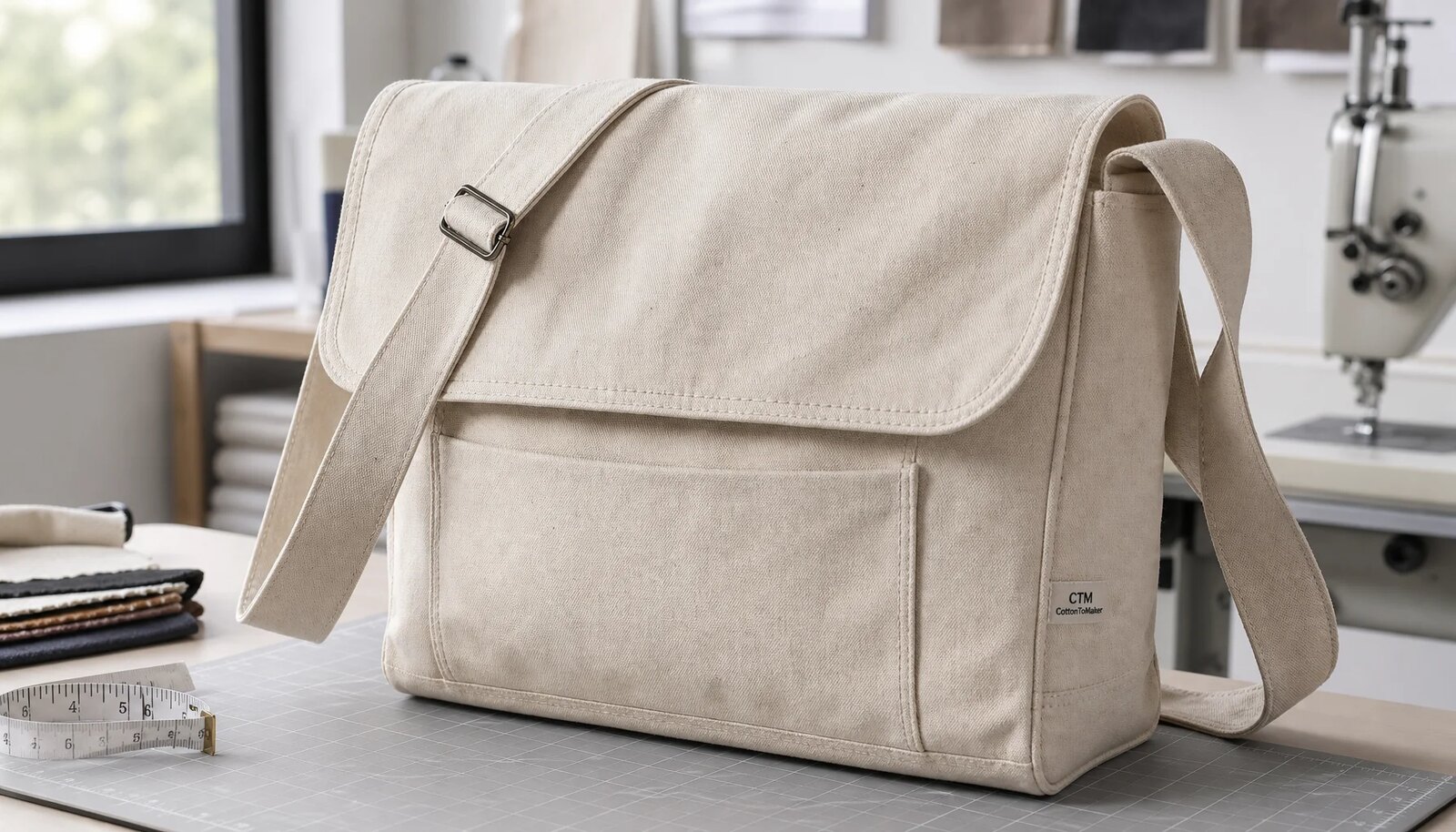
Start With the Selling Use, Not a Product Photo
A product photo is a useful starting point, but it is not an RFQ. For wholesale canvas messenger bags for craft fairs, the photo will not tell the factory the fabric weight, finished size, gusset depth, strap strength, closure style, print process, labels, or packing method. Those details decide the cost and the finished quality. They also decide whether the bag feels like a resale product or a lightweight giveaway.
Begin by telling the supplier how the bag will be used. Is it a retail item sold at a craft fair booth? A branded bag for handmade goods? A kit component for candles, soaps, notebooks, or textile products? A distributor stock item that needs repeatable neutral specs? Each use pushes the specification in a different direction. Retail resale needs cleaner seams, better front-panel appearance, barcode readiness, and tighter shade control. Event packaging may need simpler sewing, compact cartons, and faster delivery more than premium hardware.
Display method matters too. A bag hanging on a peg exposes flap symmetry and logo placement. A bag folded on a table may show creases, hardware marks, or print abrasion. A bag packed into a gift kit needs usable internal dimensions and low lint. Add this context to the RFQ before asking for price. A good factory can then quote the right construction instead of guessing from a generic messenger bag image.
- For retail resale, prioritize fabric hand-feel, flap symmetry, clean front panels, barcode readiness, and low visible-defect tolerance.
- For event packaging, prioritize MOQ flexibility, stable logo color, compact carton volume, simple construction, and repeat delivery speed.
- For distributor stock, prioritize repeatable dimensions, stock fabric colors, common hardware, and specifications that multiple customers can accept.
- For branded merchandise, prioritize print placement, curing, label consistency, shade control, and appearance after folded packing.
- For craft kit bundling, prioritize usable internal dimensions, gusset capacity, low lint, and packing that prevents creasing before assembly.
Specify Canvas by GSM, Finish, and Shrinkage Risk
The word canvas covers a wide range of fabrics. A 10 oz canvas, a 12 oz canvas, and a 14 oz canvas may all appear in similar online photos, but they do not sew, print, pack, or price the same way. For many craft fair retail programs, 12 oz cotton canvas, typically about 380-410 GSM after finishing, is a practical middle ground. It gives the bag visible structure without creating excessive seam bulk or freight weight.
Lighter canvas can still be the right choice. If the bag is mainly low-cost event packaging, 10 oz canvas may be acceptable, as long as the buyer is comfortable with a softer body and less structured flap. Heavier 14 oz canvas can look more substantial, but it brings trade-offs: higher material cost, thicker corners, slower sewing, heavier cartons, and more stress at needles, seams, and strap anchors. Do not compare prices until every supplier has confirmed the same fabric basis.
Finishing should be written into the RFQ, not left for later. Natural, greige, bleached, dyed, washed, laminated, and pre-shrunk canvas behave differently. Washed canvas can feel softer and more casual, but it can also increase shade and size variation. Custom dyeing may require higher material MOQ and shade approval. Pre-shrink control matters when repeat orders, tight dimensions, or consumer washing instructions are important. Request swatches early, approve them in writing, and keep a sealed reference for future production lots.
- Quote fabric in both oz and GSM, and ask whether the GSM refers to greige fabric or finished fabric after dyeing, washing, or coating.
- State fiber content, such as 100% cotton or cotton-poly blend, because it affects labeling, print behavior, shrinkage, and brand positioning.
- Use supplier stock colors for trial orders when schedule and MOQ are more important than exact custom shade matching.
- Allow wider finished-size tolerance for washed canvas because washing can change shrinkage, edge behavior, shade, and hand-feel.
- Require fabric swatches before sample approval if color consistency, retail display appearance, or repeat-order matching matters.
- Ask whether the fabric is in stock, custom dyed, or custom woven before committing to craft fair delivery dates.
Lock Finished Dimensions and Construction Details
Messenger bags look straightforward from the front, but small pattern choices change both function and cost. Your RFQ should use finished sewn dimensions, not cutting dimensions. A common craft fair messenger bag may finish around 36 x 28 x 10 cm, but the right size depends on what the bag must hold: notebooks, catalogs, small craft kits, boxed soaps, candles, wallets, textile goods, or event merchandise. Measure after sewing, pressing, and shaping because seam allowance and gusset construction reduce the usable interior.
Be specific about the build. State whether the bottom is flat, boxed, darted, or only side-gusseted. Define flap length, flap shape, front pocket position, pocket opening width, inner pocket if used, closure position, seam binding, lining, and edge treatment. A lined messenger bag with zipper pocket, binding, metal hardware, and adjustable strap is not the same product as an unlined flap bag with a fixed strap, even when both are described as canvas messenger bags.
For many wholesale canvas messenger bags for craft fairs, a balanced specification is an unlined canvas body, flap closure, one front or inner pocket, and an adjustable cotton webbing strap. It adds practical value without creating too many sewing operations or inspection failure points. Use a tolerance chart in the RFQ. Body width and height are often around +/- 10 mm, gusset +/- 8-10 mm, pocket and flap position +/- 5 mm, print placement +/- 3 mm, and strap width +/- 2 mm unless the retail buyer needs tighter control.
- State finished width, height, gusset, flap depth, pocket size, strap width, strap length, and strap adjustment range in the specification sheet.
- Define bottom and side gusset construction so the bag has the required capacity and does not collapse unexpectedly on display.
- Specify seam construction, binding, trimming, thread color, stitch density, and whether raw inner seams are acceptable.
- Avoid complex linings unless the retail price supports the added labor, material, inspection time, and puckering risk.
- Confirm whether the supplier’s quote includes pattern making, grading if multiple sizes are needed, and first sample revisions.
- Use a measurement chart with tolerances rather than approving only by photo or descriptive wording.
Engineer Strap, Closure, and Hardware for Real Use
The strap is one of the first places a weak messenger bag fails. Shoppers may load the bag with more than expected: books, jars, candles, catalogs, craft supplies, or several purchases from a show. A 38-40 mm cotton webbing adjustable strap usually feels better for daily carry than a narrow self-fabric strap. It also gives the product a more retail-ready look. Side tabs should be reinforced with box-X stitching, back-tacks, or another approved stitch pattern.
Closure choice affects both appearance and complaints. Magnetic snaps look clean and suit boutique resale, but they must be set securely and aligned well. Poorly installed magnets can loosen, mark light canvas, or press into printed areas during packing. Hook-and-loop is usually lower cost and easy to sew, but it can collect lint, catch threads, and feel less premium. Either option can work. The key is to define position, alignment tolerance, and acceptable hardware finish before sampling.
Do not let hardware be described only as metal or plastic. Ask for the size, material, finish, color, and supplier’s standard. Buckles, sliders, D-rings, rivets, and snaps should be free from sharp edges and corrosion. If the bag is intended for daily carry or heavier goods, ask for a practical load check, such as suspending a filled bag at 5-8 kg for a defined time. It is a simple request, and it gives the supplier a clear stress point to control before packing.
- Use 38-40 mm webbing when comfort, durability, and retail feel matter; use narrower straps only for lightweight budget programs.
- Define strap attachment pattern, such as box-X plus back-tack, and require consistent thread tension at all stress points.
- Ask whether sliders, D-rings, snaps, rivets, and buckles are metal or plastic, and specify finish such as nickel, antique brass, black, or matte black.
- Check magnetic snap position from flap edge and body panel so closure alignment remains consistent across production.
- Request a practical load check, for example 5-8 kg suspended for a defined time, when the bag is sold for daily carry or heavier goods.
- Classify strap detachment, broken hardware, insecure snaps, sharp edges, and closure misalignment as major defects in the QC file.
Choose the Logo Method by Artwork and Quantity
For simple logos, bold typography, and 1-3 solid colors, screen printing is often the most practical choice. It usually gives better unit economics once the order quantity can absorb screen setup, and it tends to look natural on cotton canvas. The RFQ should include the final artwork file, print size, color count, Pantone or CMYK target, print location, orientation, and placement reference points. Measure placement from seams, flap edges, or pocket edges so production can repeat it.
More complex artwork may need a different method. DTF, heat transfer, or digital print can support full-color graphics, gradients, illustrated craft fair artwork, and smaller per-design quantities. These methods can be useful, but they need sample approval on the exact canvas. Transfers may feel like a film on textured cotton. Digital color may shift with fabric shade. Embroidery can look premium, but it may pucker lighter canvas, need backing, and become expensive on large designs.
Avoid approving print from a computer mockup alone. Canvas shade, weave texture, and ink absorption change the final result. Natural cotton can make black, cream, white, and muted colors look different from the screen proof. Heavy ink deposits need proper curing. Large solid areas may crack, feel stiff, or abrade if the process is not matched to the fabric. If the logo sits on the flap, check that folding, magnetic snaps, and carton pressure will not mark or distort the print.
- Use screen print for simple logos, line art, solid color blocks, limited color counts, and larger repeat quantities.
- Use DTF, heat transfer, or digital print when multi-color artwork, gradients, or low per-design quantity justify the different hand-feel.
- Set print placement tolerance, commonly +/- 3 mm for standard production and tighter only when the design aligns with a seam or pocket.
- Keep artwork away from thick seams, flap folds, snap areas, and abrasion zones unless testing proves the method can handle it.
- Approve print on production-equivalent fabric color, weight, and finish, not only on a paper proof or digital mockup.
- Ask for curing method, dry-rub check, scratch check, and packing protection when the print is large or front-facing.
Separate MOQ Drivers Before Negotiating Price
MOQ is rarely one number. It can be driven by fabric purchasing, cutting efficiency, print setup, hardware sourcing, label production, packing labor, and sewing-line scheduling. A supplier may accept 300 pieces for a blank natural canvas bag but need 500 or 1,000 pieces for custom dyed fabric, custom webbing, woven labels, special hardware, or individual retail packing. If these minimums are not separated, price discussions become muddy.
Craft fair buyers often want multiple designs in smaller quantities. One practical approach is to keep the base bag identical and change only the print. The factory can cut and sew one common body, then handle different artwork batches if the workflow supports it. State the total order quantity, number of designs, pieces per design, and whether mixed artwork must be packed by SKU. This avoids surprises after the quote is accepted.
Price negotiation becomes easier when fixed and variable costs are visible. Screens, sample labor, pattern work, label setup, and carton mark setup may not change much between 300 and 3,000 pieces. Fabric and sewing cost scale more directly with quantity. For a first run, buyers may choose stock materials, fewer hardware options, bulk packing, or a higher unit price. That is often better than forcing a low price that removes the very features needed for resale.
- Ask for MOQ by blank bag, print artwork, fabric color, webbing color, label type, hardware type, hangtag, barcode sticker, and packing method.
- Request quantity breaks such as 300, 500, 1,000, and 3,000 pieces so trial and replenishment economics are visible.
- For market testing, use natural, black, or other stock canvas instead of custom dyeing to reduce MOQ and schedule risk.
- For split designs, keep the same bag body, strap, hardware, labels, and packing to reduce complexity.
- Clarify whether overproduction or underproduction tolerance is allowed, such as +/- 3-5%, when fabric yield or print waste affects final count.
- Ask whether blank extra units can be produced for later printing if future craft fair events may need quick replenishment.
Request Quote Data Suppliers Can Be Compared On
A useful supplier quote is more than a unit price. Ask every factory for the same commercial basis: Incoterm, loading port, currency, quote validity, payment terms, production lead time, sample lead time, sample fees, setup charges, MOQ, packing data, carton dimensions, gross weight, net weight, and estimated CBM. Without those fields, the lowest quote may simply be missing important costs.
Equal assumptions matter. One supplier may quote EXW while another quotes FOB. One may include individual polybags, while another assumes bulk packing. One may include screen charges, and another may list them later. Ask for unit prices at the same quantity breaks and request setup fees as separate line items. This gives procurement, logistics, design, and finance a cleaner cost comparison.
Carton data should not wait until shipment. Canvas messenger bags can be bulky, and freight can affect landed cost. Ask for units per carton, carton size, gross weight, net weight, estimated CBM per 1,000 pieces, and packing method during the quote stage. If the bags must arrive before a fixed craft fair season, carton volume and weight may decide whether air freight is realistic or whether the production schedule needs to move earlier for ocean freight.
- Require Incoterm, loading port, currency, quote validity, payment terms, production lead time, and production start trigger.
- Request unit price at agreed quantity breaks and minimum quantity per split artwork or color.
- List sample, screen, setup, label, hangtag, barcode, carton mark, and special packing charges separately.
- Ask whether the price includes pre-production sample approval, packing sample approval, final inspection support, and export carton marks.
- Require carton quantity, carton dimensions, gross weight, net weight, estimated CBM, and packing method for landed-cost calculations.
- Confirm whether duties, freight, sample courier, local delivery, or documentation fees are included or excluded.
Approve Samples in a Controlled Sequence
Treat sampling as a sequence, not a single pass. A material swatch confirms fabric weight, color, hand-feel, and finish. A blank construction sample proves finished size, flap shape, gusset depth, strap length, strap attachment, pocket position, and closure placement. A printed sample proves artwork scale, color, curing, registration, hand-feel, and placement. A pre-production sample brings the approved material, construction, print, labels, hangtags, packing, and carton assumptions together before bulk cutting starts.
A sealed reference sample prevents many later disputes. Photos help with shape and layout, but they cannot prove fabric stiffness, strap comfort, hardware quality, or print adhesion. Keep one sealed sample with the supplier and one with the buyer, warehouse team, or inspection company. Reference the approved sample date in the purchase order, and record any approved changes in writing.
Be careful with approvals that include comments. If the buyer approves a sample but asks for the strap to be longer, the flap to be adjusted, or the print to move 5 mm, the supplier must confirm exactly how bulk production will differ from the physical sample. Otherwise, the factory may follow the sample while the buyer expects the comments to be applied. A strong approval record includes the measurement chart, fabric weight, color reference, strap width, hardware finish, print method, print size, logo position, label placement, packing method, and carton plan.
- Approve fabric swatches before construction sampling when shade, hand-feel, or repeat-order matching is important.
- Approve blank construction first when size, gusset, flap, strap, pocket, or hardware arrangement is custom.
- Approve printed samples on bulk-equivalent canvas, especially for natural fabric, dark ink, large solid graphics, or transfer prints.
- Record sample measurements, material references, hardware finish, print method, logo position, label placement, and packing method.
- Do not approve bulk cutting from photos alone if the buyer is sensitive to hand-feel, stiffness, flap shape, or strap comfort.
- If approving with changes, require a written change list and supplier confirmation before deposit, bulk material purchase, or cutting.
Set QC Standards Before Production Starts
Canvas messenger bags have two kinds of risk: visible presentation issues and functional stress-point failures. Both need inspection standards. Common defects include crooked flaps, twisted straps, uneven gussets, skipped stitches, loose threads, print smudges, ink bleeding, hardware misalignment, shade variation, dirty canvas, and uneven pocket openings. These problems are easier to prevent when the factory sees the defect list before production begins.
Many buyers use AQL sampling for final inspection. The chosen level should match the buyer’s risk tolerance, but the defect definitions must be clear. Strap detachment, broken seams, wrong material, wrong print method, missing origin label, insecure snap, sharp hardware, and incorrect packing are major or critical issues because they affect function, compliance, or saleability. A tiny hidden mark inside the bag may be minor. A crooked front logo is more serious because craft fair messenger bags are displayed front-facing.
Bulk production should be checked against both the sealed pre-production sample and the written specification. Inspect finished width, height, gusset, flap depth, pocket opening, strap width, and strap adjustment range. Check print adhesion after curing, not immediately after printing. Confirm that threads are trimmed, hardware is secure, and packing will not damage adjacent panels. If a third-party inspection is used, send the inspector the sealed sample, purchase order, artwork file, measurement chart, defect list, and packing standard before the inspection date.
- Measure finished dimensions after the bag is opened and shaped, not while compressed in the carton.
- Classify broken seams, strap failure, insecure hardware, wrong fabric, wrong print, missing labels, and incorrect packing as major defects.
- Use the agreed tolerance chart for body size, flap depth, pocket placement, strap dimensions, and logo position.
- Check print color, registration, curing, dry rub, scratch resistance, edge sharpness, and placement before final carton sealing.
- Inspect front flap symmetry, shade consistency, panel cleanliness, and visible stitching because these affect retail presentation.
- Verify carton marks, barcode labels, unit count, carton weight, moisture protection, and packing method before shipment release.
Plan Packing to Prevent Creases and Freight Surprises
Packing affects both quality and landed cost. Canvas messenger bags with flaps can develop hard creases when they are compressed too tightly, folded across the logo, or packed with hardware pressing into the fabric. A visible fold line through a front print can make new craft fair inventory look tired before it reaches the booth. The RFQ should state folding method, strap position, interleaving, polybag requirement, hangtag visibility, unit count per carton, and export carton strength.
Bulk packing is usually more economical and may reduce plastic use. Individual polybags can still be the better choice for retail distribution, barcode control, dust protection, warehouse picking, or boutique resale. Compare both options using carton data, not just unit price. A carton that is too large raises freight cost. A carton that is too tight increases deformation, print abrasion, moisture risk, and flap creasing. If the bag uses magnets, sliders, buckles, or D-rings, packing should stop hardware from pressing into printed panels.
Logistics teams need packing information early. Units per carton, carton dimensions, gross weight, net weight, and estimated CBM per 1,000 pieces influence ocean freight, air freight, courier rates, pallet planning, storage, and event-site delivery budgets. If the craft fair season has a fixed date, carton volume and weight can decide whether urgent air shipment is commercially reasonable or whether the production calendar must allow for ocean transit.
- Define whether bags are flat-packed, half-folded, strap-tucked, paper-interleaved, individually polybagged, or packed with hangtags exposed.
- Avoid folding directly across the printed logo, center flap, magnetic snap area, or any front-facing display panel.
- Require carton data in the quote so logistics can calculate ocean, air, courier, warehouse, or event-site delivery cost.
- Use export cartons strong enough for stacked handling, especially with metal hardware or high carton quantities.
- Consider desiccants, inner liners, or moisture-control steps for natural cotton canvas moving through humid routes or long ocean transit.
- Request packing photos or a packing sample before mass packing if flap creases, barcode placement, or retail presentation are important.
Specification comparison for buyers
| Spec decision | Recommended option | When it fits | Buyer risk to check |
|---|---|---|---|
| Body fabric weight | 12 oz cotton canvas, typically about 380-410 GSM after finishing; ask for GSM test method and fabric swatch | Balanced choice for craft fair resale, boutique merchandise, branded kits, and daily-carry style bags that need visible structure without excessive seam bulk | A supplier may quote 10 oz, 280-340 GSM canvas under the same product photo; require actual GSM, fiber content, and approved swatch before comparing prices |
| Finished size | Common finished size around 36 x 28 x 10 cm, or buyer-defined dimensions based on the products the bag must hold | Fits notebooks, catalogs, small craft kits, boxed handmade goods, wallets, textile items, and event merchandise without becoming oversized | Factories may quote cutting dimensions; require finished sewn dimensions measured after pressing and packing trial, with tolerance such as +/- 10 mm for body size |
| Strap construction | 38-40 mm cotton webbing adjustable strap with metal or plastic slider, reinforced side tabs, and box-X plus back-tack stitching | Useful when shoppers may carry books, candles, jars, craft supplies, catalogs, or multiple purchases after a show | Narrow self-fabric straps reduce cost but twist, stretch, crease, and may fail earlier at stress points; request stitch pattern and load-check method |
| Closure method | Flap with magnetic snap for retail presentation, or hidden hook-and-loop for lower-cost utility programs | Magnetic snap suits boutique resale and giftable bags; hook-and-loop suits event stock, school programs, and budget merchandise | Magnets can mark light canvas or shift if poorly set; hook-and-loop can collect lint and catch threads; confirm closure alignment tolerance and hardware finish |
| Print method | Screen print for 1-3 solid colors; DTF, heat transfer, or digital only when artwork complexity requires it | Screen print usually gives better unit economics and a natural appearance for wholesale canvas messenger bags at craft fair quantities | Print proofs must be tested on production-equivalent canvas; check curing, dry rub, edge sharpness, hand-feel, and placement tolerance, not only digital mockups |
| Inner organization | One front slip pocket or one flat inner pocket; unlined body unless the target retail price supports lining | Adds practical value while keeping sewing time, inspection workload, and tolerance control manageable | Extra compartments, zippers, and lining increase labor, seam bulk, puckering risk, and major defect points if not clearly specified |
| Labels and marks | Woven side label, inside care/origin label, hangtag, barcode sticker, SKU sticker, and carton marks defined before sample stage | Needed for retailers, distributors, boutique resale, inventory control, and compliant cross-border shipments | Late label or origin changes can delay production and create rework; define fiber content, country-of-origin marking, and barcode placement early |
| Packing format | Bulk pack with tissue or paper interleaving for cost control, or individual polybag with barcode if retail distribution requires it | Bulk pack fits event stock and wholesale replenishment; polybags fit boutique resale, warehouse picking, dust protection, and SKU control | Over-compressed cartons crease flaps, abrade prints, and bend straps; require folding diagram, carton quantity, GW/NW, and CBM per 1,000 pieces |
| Inspection plan | Use sealed pre-production sample plus measurement chart, defect list, print standard, packing standard, and AQL level | Best for B2B buyers who need repeatable production quality instead of one attractive sample | If defect definitions are not agreed before deposit, suppliers and buyers may dispute loose threads, shade variation, flap skew, print defects, and strap strength |
Buyer checklist before sampling
- Define the sales channel first: resale product, craft fair booth merchandise, event packaging, retail kit component, distributor stock, brand merchandise, or promotional giveaway.
- Specify finished dimensions for width, height, gusset, flap length, front pocket, inner pocket if used, strap width, strap length, and strap adjustment range.
- State tolerances in the RFQ: body size commonly +/- 10 mm, pocket and flap position +/- 5 mm, print placement +/- 3 mm, and strap width +/- 2 mm unless your retail standard requires tighter control.
- Quote fabric in both ounce weight and GSM, and require the supplier to state fiber content, finishing, shrinkage expectation, and whether the canvas is greige, natural, bleached, dyed, washed, laminated, or pre-shrunk.
- Provide fabric color requirements using a physical swatch, Pantone reference, or approved supplier standard, and state whether repeat orders must match the first shipment within an agreed shade range.
- Attach artwork at final scale with vector file, print size, Pantone or CMYK targets, number of colors, print position from seams, maximum print area, and acceptable registration and placement tolerance.
- Separate MOQ for the base bag, each print design, custom fabric color, custom webbing color, woven label, hardware, hangtag, barcode label, and individual polybag because each item may have a different minimum.
- Request quotation breaks at practical quantities such as 300, 500, 1,000, and 3,000 pieces, and ask whether split artwork quantities are allowed under one production lot.
- Require a blank construction sample, printed sample, sealed pre-production sample, and packing sample before authorizing bulk cutting for a new custom design.
- List all required labels, hangtags, barcode stickers, SKU marks, country-of-origin marking, warning marks, carton marks, and packing inserts before sampling begins.
Factory quote questions to send
- Which exact canvas are you quoting: ounce weight, GSM range, fiber content, weave, finish, color, shrinkage expectation, and stock or custom-dyed availability?
- Are the quoted measurements finished sewn dimensions or cutting dimensions, and what tolerance do you propose for width, height, gusset, flap, pocket, strap length, and strap width?
- What is the MOQ for the blank bag, each print artwork, each fabric color, each webbing color, custom label, custom hardware, hangtag, barcode sticker, and special packing?
- Which print method is included in the unit price, and what are the screen charges, setup fees, curing method, maximum print area, color matching limits, and registration tolerance?
- What stitch density, thread type, seam construction, reinforcement method, and bar-tack or box-X pattern will be used at strap anchors, side tabs, flap stress points, and pocket corners?
- Can you perform a practical strap load check, such as hanging the filled bag at 5-8 kg for a defined time, and how will failures be recorded before packing?
- What sample stages are included: material swatch, blank construction sample, artwork proof, printed sample, pre-production sample, sealed reference sample, and packing sample?
- What are the sample cost, sample lead time, sample courier cost, revision fee if needed, and refund or credit policy if the bulk order proceeds?
- What is the standard packing method, units per inner pack if any, units per export carton, carton size, gross weight, net weight, and estimated CBM per 1,000 pieces?
- What lead time is calculated after artwork approval, fabric approval, deposit receipt, label approval, pre-production sample confirmation, and final purchase order confirmation?
Quality-control points to confirm
- Finished dimensions should match the approved measurement chart within agreed tolerance, with width, height, gusset, flap, pocket, and strap measured after the bag is fully opened and shaped.
- Canvas weight should be verified by fabric specification, supplier test report, or GSM cutting test rather than hand-feel because sizing, starch, washing, and finishing can make lighter fabric feel stiff.
- Fabric shade should be checked against the approved swatch or sealed sample under consistent lighting, especially for natural, dyed, washed, or repeat-order canvas lots.
- Fabric defects such as slubs, stains, oil marks, weaving holes, heavy shade bands, and panel-to-panel mismatch should be classified by visibility on the front flap, body, and strap.
- Print color should be checked against the approved sample and Pantone or agreed target, allowing only controlled absorption variation on natural cotton canvas.
- Print adhesion should pass dry rub, light scratch, and tape or peel checks appropriate to the print method after full curing, especially on heavy ink deposits or dark fabric.
- Print placement should be measured from fixed seams, flap edges, or pocket edges, because front-facing messenger bags show logo tilt and off-center placement quickly on craft fair displays.
- Stitching should show no skipped stitches, broken threads, loose loops, weak back-tacking, needle cuts, seam opening, or uneven box-X stitching at strap attachment points.
- Magnetic snaps, sliders, buckles, D-rings, and rivets should be aligned, securely fixed, corrosion-free, and free from sharp edges that can damage fabric or packaging.
- Flap symmetry should be inspected against the sealed sample because cutting, pressing, and sewing differences are obvious when messenger bags are displayed front-facing.