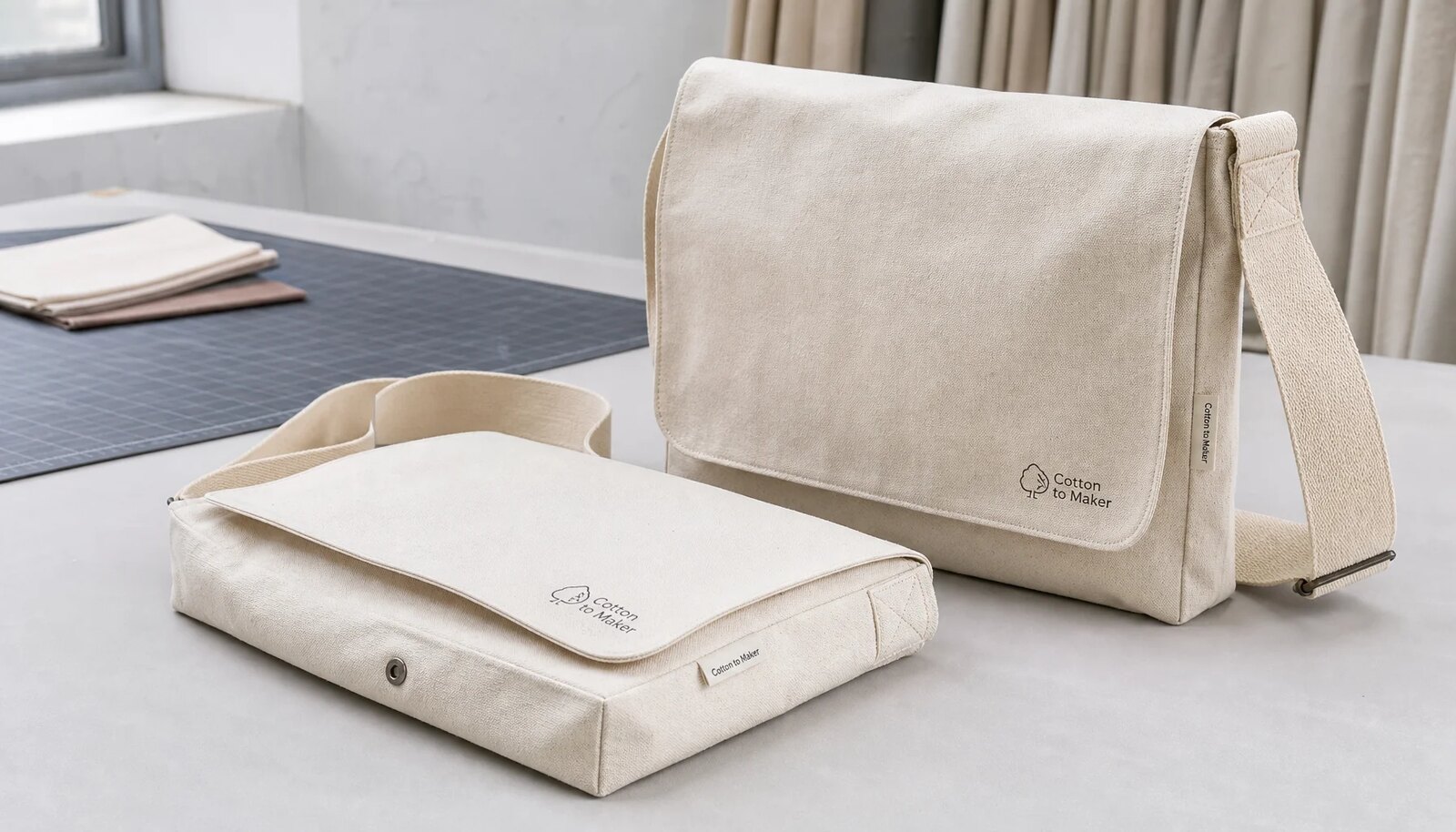
Start MOQ Talks With the Factory Workflow
MOQ negotiation for wholesale canvas messenger bags for craft fairs works best when it starts with production reality, not with a target number. The supplier is not only counting finished bags. It is estimating fabric purchase quantity, fabric width and cutting yield, pattern setup, sewing line efficiency, print setup, trim sourcing, inspection time, packing labor, and the risk of leftover materials. A vague RFQ such as “canvas messenger bag with logo, best price” leaves too many blanks. Most factories will protect themselves with a higher MOQ, a conservative unit price, or exclusions that only appear later.
Craft fair buyers often need design variety before sales volume is proven. The cleanest way to create that variety is through artwork, not through construction changes. Five or ten printed designs can still be one production program if they share the same natural canvas body, same strap, same closure, same pocket, same label, and same carton plan. Once each design has a different fabric color, strap color, trim, flap shape, or packing rule, the order stops behaving like one job and starts behaving like several small jobs.
Separate confirmed demand from forecast demand. A forecast can support the discussion, especially if it is tied to a calendar of fairs or seasonal launches, but the supplier still carries risk on the first purchase order. Buyers have more leverage when they show a repeat plan using the same construction and fabric, with possible replenishment at 60, 90, or 120 days, rather than promising general future volume. Repeatability is what makes a lower trial MOQ believable.
- Open with the base bag specification before asking for a lower MOQ.
- Keep construction, fabric, strap, closure, label, and carton plan consistent when artwork variety is required.
- Ask which MOQ is a true material minimum and which is a setup, split, or handling charge.
- Negotiate confirmed PO quantity separately from forecast or repeat-order potential.
- Freeze construction before MOQ negotiation is finalized because pattern and consumption changes can reset the quote.
Define Canvas Specs So Quotes Match
Canvas messenger bag quotations can look similar while using very different fabrics. For craft fair resale, customers will touch the bag, lift the flap, and compare it with handmade goods on the table. Handfeel, structure, and flap behavior matter. A 10 oz cotton canvas can work for lightweight promotional use, but it may collapse on display and may not carry a clean retail look. A 12 oz natural cotton canvas, often around 380-410 GSM depending on yarn and finishing, is a practical starting point for many craft fair programs. A 14 oz canvas feels more substantial, but it raises material cost, carton weight, sewing difficulty, and sometimes needle or thread requirements.
Use both ounce weight and GSM because suppliers do not all quote in the same system. Add fiber content, weave, color route, finish, coating or no coating, and tolerance. Natural cotton canvas usually gives better MOQ flexibility than custom-dyed canvas because it avoids dye-lot minimums and lab-dip approval delays. Dyed canvas can suit a brand program, but it brings shade approval, continuity checks, and extra minimums that must be visible in the quote.
Do not ignore fabric width and shrinkage. A wider roll can improve cutting yield, while a small change to flap depth or gusset can increase consumption more than expected. If the bag must fit A4 papers, US letter folders, tablets, catalogues, workshop tools, or small retail purchases, state that requirement in the RFQ. A photo of a competitor bag is useful for style direction, but it is not a specification.
- Budget route: 10 oz cotton canvas for lightweight giveaways or low-price market merchandise.
- Balanced route: 12 oz natural cotton canvas, plain weave, unlaminated, about 380-410 GSM, with agreed GSM tolerance.
- Premium route: 14 oz canvas for stronger handfeel and higher retail positioning, with freight impact checked early.
- Avoid terms such as heavy, premium, thick, sustainable, or eco unless they are tied to measurable material standards.
- Request a swatch, roll inspection standard, and shrinkage expectation before bulk cutting.
Separate MOQ Drivers From Cost Drivers
Not every specification change affects MOQ in the same way. Some items create real upstream minimums because the factory must buy them from another supplier. Custom-dyed canvas, special webbing colors, custom hardware finishes, woven labels, printed care labels, hangtags, belly bands, and printed cartons can each carry separate minimums. Other items mainly affect unit cost because they add sewing time, material consumption, or inspection time without necessarily raising MOQ. A larger inner pocket, wider flap, bigger print area, or extra topstitching may cost more, but may not be the reason the supplier refuses a small first order.
That difference matters. Removing an inner pocket may reduce price, but it will not solve the MOQ barrier if the real issue is a custom-dyed fabric minimum. Accepting stock natural canvas, stock cotton webbing, and standard magnetic snaps can reduce MOQ faster than arguing over a few cents of labor. Good suppliers can explain these drivers and separate one-time setup charges from repeatable unit cost.
For a first craft fair order, protect the features customers notice and use: fabric structure, strap security, print clarity, and clean closure. Simplify items that do not add enough retail value, such as special hardware plating, several sewn labels, many fabric colors, or printed master cartons. Once demand is proven, repeat orders can carry more colors and trim options with stronger volume support.
- MOQ-sensitive: dyed canvas, custom webbing, special hardware, woven labels, printed cartons, unusual closures, and custom trim colors.
- Unit-cost-sensitive: bag size, fabric weight, gusset depth, pocket count, lining, flap shape, print size, and sewing complexity.
- Setup-cost-sensitive: print screens, transfer films, embroidery digitizing, artwork revisions, sample remakes, and carton artwork.
- Freight-sensitive: fabric weight, carton cube, fold method, paper interleaving, individual polybags, and carton gross weight.
- Best negotiation target: the bottleneck causing MOQ, not the feature that only changes unit price.
Specify Messenger Construction for Real Use
A craft fair messenger bag is not a flat promotional tote. Customers may carry notebooks, wallets, phones, small purchases, maker tools, class materials, or a water bottle. The bag should look good on a booth table and still behave well when loaded. A sample that photographs nicely but twists, sags, or tears at the strap joint can damage the buyer’s brand and create avoidable complaints.
The RFQ should describe construction in practical language. State whether the bag is lined or unlined, whether it has a gusset, whether the flap covers the full width, whether the strap is adjustable, whether the strap is cotton webbing or self-fabric, and whether the inner pocket is open, zippered, or divided. For MOQ-sensitive programs, a single unlined body with one open inner pocket and reinforced strap points is usually easier to produce consistently than several versions with lining, zippers, hardware adjusters, and different pocket layouts.
Closure choice should balance use, appearance, and MOQ. A stock magnetic snap gives a cleaner retail look, but it needs proper reinforcement and accurate alignment. Hook-and-loop is lower in hardware complexity, though it can collect lint and may feel less premium. Buckles or side-release clips create a rugged style, but they add sourcing work, assembly labor, weight, and possible trim minimums. Test the closure on a lightly loaded sample, not only on an empty sample lying flat.
- Confirm required fit for A4, US letter, tablet, notebook, catalogue, tools, or water bottle before final dimensions.
- Use box-X stitching, bartack reinforcement, or an approved equivalent at load-bearing strap points.
- Define strap width, strap length, strap drop, and whether adjustability is required.
- Approve flap depth and closure placement on a loaded sample.
- Avoid lining, zippers, multiple pockets, and special hardware unless the target retail price supports them.
Control Artwork, Printing, and Labels
Screen printing is often the most practical branding method for canvas messenger bags when designs use solid colors, simple illustrations, logos, slogans, or event names. It becomes more efficient when print size and placement stay consistent across designs. The buyer should provide vector artwork, print dimensions, Pantone or approved color reference, print position, and tolerance from a fixed reference point such as the flap edge or center line. Artwork too close to the flap fold, seam, pocket edge, or snap area can increase rejects.
Heat transfer can work for detailed multicolor graphics, gradients, or smaller artwork runs, but it must be tested on the actual canvas texture. Approve handfeel, edge behavior, adhesion, rub resistance, and bending before bulk. A transfer that looks clean on smooth polyester may lift, crack, or feel heavy on textured cotton canvas. Embroidery can look premium for small marks, but large dense embroidery on a flexible flap can distort the fabric and add backing that changes handfeel.
Labels and retail trims deserve the same discipline. A woven side label, printed inner label, hangtag, belly band, care label, or retail sticker can strengthen identity, but each may need artwork approval, setup, and minimums. For a first run, keep label rules simple and shared across all artwork designs. If different makers, sponsors, or events need individual branding, keep those differences in the print artwork instead of changing sewn labels for each design.
- Use screen print for 1-3 solid colors, repeat placements, simple graphics, and clean event or maker logos.
- Use heat transfer only after approving adhesion, edge lift, rub, bend, and handfeel on the selected canvas.
- Use embroidery for small premium logos, not large dense filled graphics across a flexible flap.
- Keep artwork at least 15-20 mm away from seams, flap folds, pocket openings, and closure pressure points unless sampled.
- List artwork count separately from construction SKU count so setup, inspection, and packing are quoted correctly.
Group SKUs to Improve MOQ Leverage
MOQ flexibility improves when the order structure matches factory workflow. A strong first-order structure might be 1000 pieces total using one natural 12 oz canvas body, one strap, one magnetic snap, one woven side label, and one carton plan, split into five print designs of 200 pieces each. That gives the supplier one fabric purchase, one cutting marker, one sewing setup, and controlled print changes. A weak structure splits the same 1000 pieces across five fabric colors, five strap colors, three closures, and several packing rules.
Show the grouping in the RFQ as a table. Include construction code, fabric color, artwork name, print method, print colors, quantity, packing method, carton mark, and destination. This prevents confusion between total order quantity and per-design quantity. It also helps the supplier identify shared costs, separate costs, and the exact point where MOQ pressure appears.
Negotiate total sewing quantity and artwork minimum separately. Some factories can accept lower artwork quantities if total sewing volume is high enough, but the print room may still charge per-design setup. If the total order is small and each design is also small, reduce artwork count, accept a higher unit price, use a simpler print method, or start with fewer best-selling designs.
- Best leverage: one construction, one natural fabric color, one closure, one packing plan, and multiple print designs.
- Moderate leverage: two fabric colors, same construction, limited artwork count per color, and shared carton plan.
- Weak leverage: many fabric colors, small quantities per artwork, different straps, different trims, and custom packing per SKU.
- Ask for one sewing MOQ with separate artwork setup charges where possible.
- Provide exact quantities by design instead of using assorted, mixed, seasonal, or TBD.
Use Sampling as a Production Gate
A sample should prove more than appearance. It should confirm body dimensions, flap behavior, strap comfort, load response, closure alignment, print placement, pocket usefulness, label position, and packed presentation. For craft fair use, handle the sample the way customers will handle it: load it, open and close it repeatedly, stack it, fold it as packed, hang it, and display it flat on a table.
A practical sampling sequence has three stages. The proto sample confirms pattern, dimensions, strap, pocket, gusset, flap, and closure. The print strike-off confirms ink or transfer color, artwork scale, adhesion, handfeel, and placement on the selected canvas. The pre-production sample should use bulk fabric, final trims, final thread, final reinforcement, final print, final label, and final packing. That PP sample becomes the reference for bulk approval.
Document every approval while the details are fresh. Photograph the sample from the front, back, inside, side, flap open, strap joint, closure close-up, print close-up, label view, and packed view. Record measured dimensions, approved tolerances, print location, closure position, and any approved deviations. If the buyer later changes strap length, flap depth, pocket size, or artwork location, the supplier may need a new sample, new cutting marker, or new quote.
- Approve the proto sample for shape and function before final artwork approval.
- Approve print color, adhesion, handfeel, and placement through a strike-off on selected canvas.
- Approve bulk production only after PP sample review with final fabric, trims, print, label, and packing.
- Load-test the sample with realistic contents such as notebook, phone, wallet, bottle, and small tools.
- Keep one approved sample with the buyer and one signed or sealed reference sample at the factory when possible.
Write QC Criteria Before Cutting
Canvas messenger bags have predictable failure points: strap attachments, side seams, flap symmetry, closure alignment, print durability, pocket reinforcement, stains, and packing damage. These issues are easier to prevent when inspection criteria are written before bulk cutting. If requirements appear only at final inspection, the discussion becomes subjective and expensive.
Use tolerances that fit sewn cotton products. Many buyers use about ±10 mm for main body dimensions and about ±3-5 mm for logo placement, but the correct tolerance depends on bag size, pattern, artwork, reference point, and the factory’s process. Fabric weight tolerance should be written into the purchase order, for example nominal 12 oz or 380-410 GSM with an agreed tolerance after conditioning. If fabric is cut before GSM and shade are approved, replacement becomes much harder.
Define defect classification before production starts. Critical defects can include wrong artwork, wrong fabric, unsafe hardware, sharp metal edges, mold, contamination, or mixed shipment errors. Major defects can include broken strap reinforcement, closure failure, severe print smudge, incorrect size outside tolerance, missing label, wrong carton mix, or holes. Minor defects can include a short loose thread, slight stitch waviness away from stress points, or small shade variation within the approved range. AQL levels should be agreed by buyer and supplier; many soft-goods inspections use general inspection level II with AQLs set by defect class, but the exact standard should be written in the PO.
- Inspect incoming fabric rolls for GSM, shade, width, stains, holes, slubs, skew, bowing, and match to approved swatch.
- Measure finished bags flat for width, height, gusset, flap depth, strap length, strap drop, pocket size, and print placement.
- Check strap joints for approved reinforcement, stitch density, thread security, and no skipped or broken stitches.
- Run agreed print checks such as dry rub, tape pull, scratch, bend, and visual curing review before packing.
- Pull inspection samples across all artwork designs and from early, middle, and late production cartons.
Plan Packing for Freight and Booth Selling
Packing affects landed cost and retail condition. Canvas messenger bags are bulkier and heavier than many flat totes, so carton quantity, fold method, and compression need control. If bags are folded too aggressively, the flap can crease, magnetic snaps can mark the fabric, and prints can rub during transit. Flat packing or a controlled fold with print-face protection is usually safer for retail-ready craft fair goods.
The quote should include pieces per carton, carton dimensions, net weight, gross weight, carton cube, inner protection, polybag or plastic-free method, carton marks, and mixed-carton rules. Plastic-free packing may suit craft and maker brands, but it changes moisture protection and labor. If the front print is large, paper interleaving, face-to-back stacking, or another approved abrasion-control method may be needed.
Distribution format must match the buyer’s operation. Single-design cartons make inventory counting easier and reduce picking errors. Mixed-ratio cartons help event teams receive a ready-to-sell assortment, but they require strict packing lists and clear carton labels. Event allocation cartons are useful for direct shipment to multiple fairs, yet they add sorting labor and inspection risk. Decide this before production so the supplier can price labor and carton marks accurately.
- Request carton quantity, dimensions, net weight, gross weight, and cube before comparing freight options.
- Use flat packing or controlled folding when the bag has a structured flap, magnetic snap, or large print.
- Protect printed panels with tissue, paper interleaving, or approved stacking if abrasion risk is high.
- Choose single-design cartons for inventory accuracy and mixed cartons only with fixed ratios and clear marks.
- Set maximum carton weight based on warehouse or event-team handling limits, not only shipping efficiency.
Build Lead Time Around Approval Gates
Lead time should be counted from defined approvals, not from the first email. A real procurement calendar includes RFQ clarification, supplier feedback, artwork preparation, sample making, sample courier time, buyer review, sample revision, fabric purchasing, strike-off approval, PP sample approval, cutting, printing, sewing, inline inspection, final inspection, packing, export booking, freight, customs, inland delivery, and event allocation. If the craft fair date is fixed, every approval gate needs a deadline.
Suppliers define production lead time differently. Some count from deposit, some from artwork approval, and some from PP sample approval. Clarify the trigger in writing. The most common avoidable delay is late artwork approval or a construction change after material planning starts. A small change to flap depth, print position, closure placement, or strap length can affect cutting markers, print screens, trim placement, or the inspection checklist.
Discuss partial shipment early if certain fairs have earlier dates. Partial shipment can protect an event deadline, but it may increase freight, export paperwork, inspection cost, and warehouse handling. If timing allows, consolidating all artwork designs into one production and inspection lot is usually simpler. The right route depends on delivery risk, event priority, and the cost of missing the selling window.
- Confirm whether lead time starts after deposit, artwork approval, fabric approval, strike-off, or PP sample approval.
- Freeze construction before bulk fabric purchase and freeze artwork before screens, transfers, or embroidery setup.
- Build calendar buffer for sample shipping, buyer review, inspection booking, export documents, customs, and inland delivery.
- Use partial shipment only when event timing justifies extra freight, handling, and inspection complexity.
- Maintain a written approval log for fabric, sample, artwork, print color, packing, carton marks, and shipment release.
Specification comparison for buyers
| Sourcing variable | Buyer-ready specification | MOQ effect | QC or cost point to verify |
|---|---|---|---|
| Base construction | One shared unlined messenger body, one gusset depth, one flap shape, and one strap style across first-order SKUs | Keeps pattern making, cutting marker, sewing setup, inline inspection, and packing flow consolidated | Any change to size, flap, strap, gusset, pocket, lining, or closure can be treated as a separate construction MOQ |
| Canvas fabric | Natural cotton canvas, plain weave, 12 oz nominal, about 380-410 GSM, with an agreed tolerance such as ±5% GSM after conditioning | Stock natural canvas usually has lower material MOQ than custom-dyed canvas and avoids dye-lot approval delays | Require roll inspection for GSM, width, shade, stains, holes, slubs, bowing, skewing, and shrinkage before cutting |
| Artwork strategy | Several 1-3 color screen-printed artworks on the same bag body, with the same print size and placement | Lets sewing quantity stay consolidated while artwork minimums and screen charges are negotiated separately | Each artwork may need screens, color matching, strike-off approval, setup time, and separate packing counts |
| MOQ question format | Ask MOQ per construction, fabric color, artwork, print method, trim, carton mix, shipment, and repeat order | Separates true upstream material minimums from negotiable setup fees, split charges, and handling costs | A single blended MOQ can hide minimums for dyed fabric, webbing, snaps, woven labels, hangtags, or printed cartons |
| Closure | Stock magnetic snap with reinforcement patch, or hook-and-loop strip when lower hardware complexity matters | Stock trims reduce sourcing lead time and avoid special plating, mold, or color minimums | Check snap alignment, pull feel, fabric distortion, rust, burrs, magnet strength, and secure attachment |
| Strap system | 30-38 mm cotton webbing strap or self-fabric strap, reinforced with box-X stitching or bartack at load points | Standard webbing is easier to source and supports lower first-order quantities | Define load test method, stitch density, thread type, strap length tolerance, seam slippage limit, and reinforcement appearance |
| Branding extras | Screen print plus optional woven side label or printed inner label shared across all designs | Simple branding keeps trim minimums controlled while preserving retail identity | Custom woven labels, hangtags, belly bands, care labels, and printed cartons can each carry separate MOQ and approval steps |
| Sample sequence | Proto sample, print strike-off, then pre-production sample using bulk fabric, final trims, final print, and final packing | Reduces the risk of approving a good-looking sample that cannot be repeated at bulk scale | Do not release bulk cutting until PP sample, artwork, fabric, trims, and packing are approved in writing |
| Inspection criteria | AQL-based final inspection with written tolerances for size, print, strap, closure, stitching, stains, and packing | Objective pass/fail rules reduce disputes when several artwork designs ship together | Define critical, major, and minor defects before production, not after final inspection |
Buyer checklist before sampling
- Define the commercial role first: craft fair resale item, maker-market merchandise, workshop kit bag, event staff bag, sponsor gift, or retail-ready branded product. This choice affects fabric weight, target unit cost, expected load, branding method, and packing presentation.
- Issue finished dimensions in centimeters or millimeters, not just a reference photo. Include body width, body height, gusset depth, flap depth, strap width, strap length, strap drop, inner pocket size, seam allowance assumptions, and whether the bag must fit A4 documents, US letter folders, tablets, notebooks, small tools, catalogues, or water bottles.
- Specify canvas in measurable terms: fiber content, weave, nominal ounce weight, GSM range, finish, color, coating or no coating, shrinkage expectation, and tolerance. Example: natural 100% cotton plain-weave canvas, 12 oz nominal, 380-410 GSM, unlaminated, with ±5% GSM tolerance after conditioning.
- Separate construction SKUs from artwork SKUs. Confirm whether every artwork shares the same body fabric, strap, closure, pocket, label, hangtag, carton quantity, and packing method before asking for per-design pricing.
- Ask for MOQ by construction, fabric color, artwork design, print method, print color count, trim type, closure, label, carton mix, shipment, and repeat order. Require the supplier to identify which MOQ comes from material purchase and which comes from setup cost.
- Request price breaks at realistic B2B quantities such as 300, 500, 1000, 2000, and 3000 pieces using the same specification. Ask that one-time fees such as screens, digitizing, sample charges, label setup, and carton printing be shown separately from repeatable unit cost.
- Send artwork files with print size, color standard, placement reference, minimum seam distance, flap fold distance, and placement tolerance. For screen print, specify Pantone or an approved color reference and confirm the color match on natural canvas rather than coated paper.
- Use a controlled approval sequence: proto sample for pattern and function, fabric swatch or lab dip if color matters, print strike-off for color and adhesion, and pre-production sample using bulk fabric, final trims, final label, final closure, and final packing.
- Set measurable QC limits before cutting. Include GSM tolerance, finished size tolerance, print placement tolerance, stitch density expectation, strap reinforcement, closure alignment, contamination rules, carton weight limit, carton marks, and defect classification.
- Confirm packing around the distribution model. Decide whether cartons are single-artwork, mixed by fixed ratio, packed by event allocation, or packed for retailer receiving. Require carton dimensions, quantity per carton, gross weight, net weight, and carton mark format before freight booking.
Factory quote questions to send
- What is your MOQ per bag construction, fabric color, print design, print method, closure type, label type, packing method, shipment, and repeat order?
- Which MOQ items come from your own factory setup, and which come from outside suppliers such as the fabric mill, webbing supplier, label supplier, hardware supplier, or carton printer?
- Can multiple craft fair artwork designs share one fabric purchase, one cutting marker, one sewing run, and one final inspection lot if the bag body, strap, closure, label, and packing remain identical?
- What canvas are you quoting by fiber content, weave, nominal oz weight, GSM range, fabric width, finish, shrinkage, color, and acceptable incoming material tolerance?
- Is the quoted material stock natural canvas, stock dyed canvas, custom-dyed canvas, washed canvas, organic cotton canvas, recycled-content canvas, or another fabric route, and what minimum applies to that route?
- What branding method is included in the unit price: screen print, heat transfer, embroidery, woven label, printed label, patch, hangtag, belly band, or printed carton?
- How many print colors, print positions, print sizes, screens, transfer films, embroidery stitches, or label placements are included before extra charges apply?
- What artwork file format, Pantone or color reference, print placement reference point, seam-distance requirement, and strike-off approval step do you need before production?
- Will the pre-production sample use actual bulk fabric, final thread, final closure, final strap reinforcement, final print ink or transfer, final label, final packing, and final carton marks?
- What are your standard finished tolerances for body width, body height, gusset depth, flap depth, strap length, strap drop, pocket dimensions, print position, and label placement?
Quality-control points to confirm
- Incoming fabric should be inspected before cutting for GSM or oz weight, roll width, shade continuity, stains, holes, oil marks, slubs beyond the approved limit, weaving defects, skewing, bowing, and match to the approved swatch or reference sample.
- Finished dimensions should be measured flat and recorded against the approved sample, including body width, body height, gusset depth, flap depth, strap length, strap drop, pocket dimensions, flap symmetry, and closure position.
- Common sewn-product tolerances should be stated in the purchase order. Many cotton canvas bags use about ±10 mm for main body dimensions and about ±3-5 mm for logo placement, but final tolerances should match the design and be agreed with the supplier.
- Strap attachment should use approved reinforcement such as box-X stitching, bartack, or another documented method, with no skipped stitches, broken threads, loose thread tails at stress points, seam slippage, or puckering that weakens the joint.
- Stitch density, thread color, thread strength, seam allowance, and topstitch appearance should match the approved pre-production sample, especially at side seams, flap edges, strap joints, pocket top corners, and closure reinforcement areas.
- Print curing or transfer adhesion should pass buyer-agreed checks such as dry rub, tape pull, light scratch, bend or flex review, and surface inspection before packing. The test method should be simple enough for factory QC and final inspection to repeat consistently.
- Logo placement should remain within the approved tolerance from a fixed reference point such as flap edge, center line, side seam, pocket edge, or closure center. Avoid judging placement by eye only.
- Closures should align when the bag is empty and lightly loaded, with no twisting, fabric distortion, excessive force, weak attachment, exposed sharp edges, rust, burrs, or visible misplacement on the front flap.
- Inner pocket stitching should be straight and reinforced at top corners because phones, wallets, pens, small tools, and retail purchases create repeated stress in this area.
- Hardware and trims should be checked for color consistency, plating defects, rust risk, burrs, magnet strength, webbing shade, label accuracy, care label content if used, and compatibility with final packing.