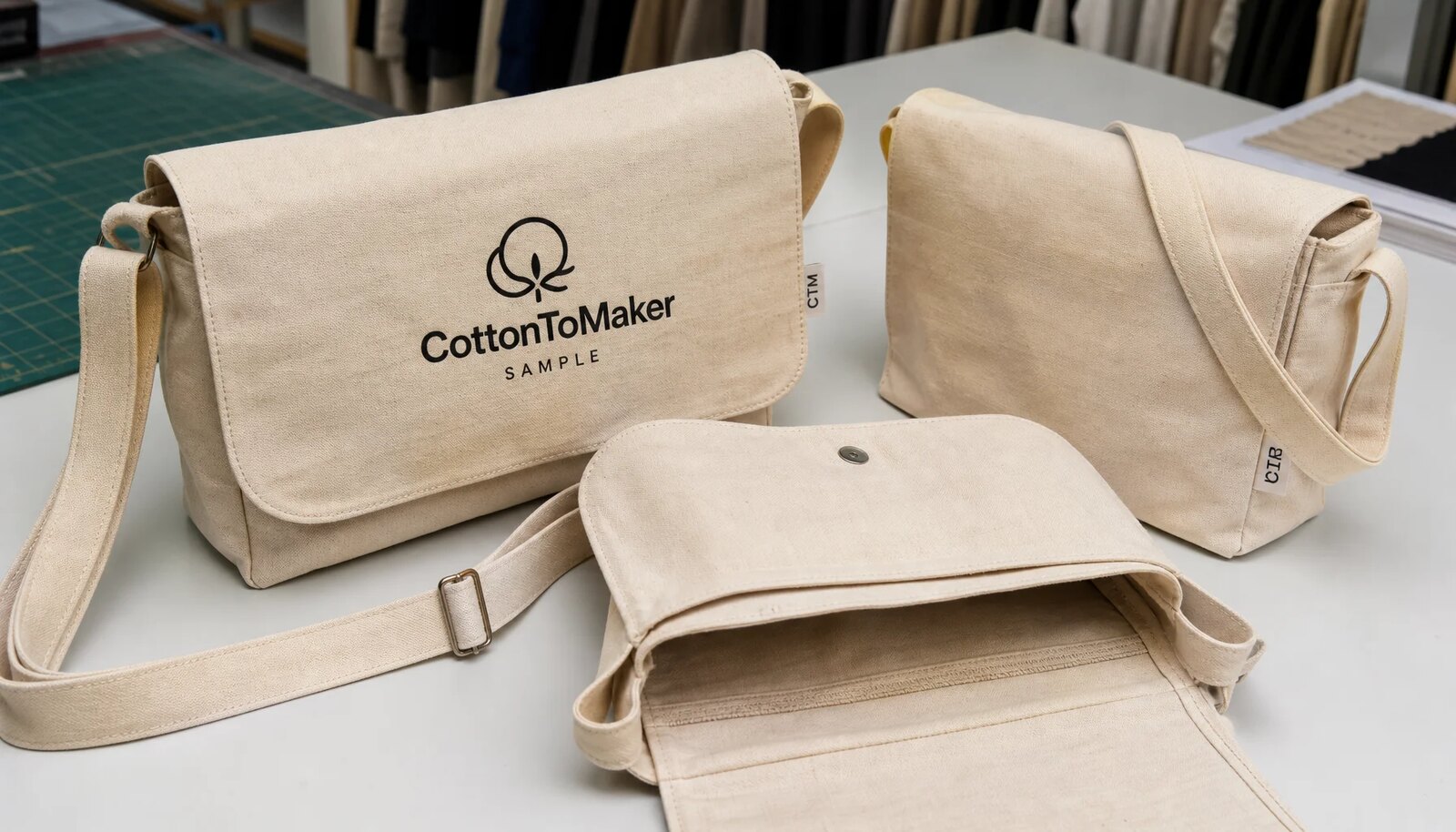
Start With the Commercial Use
The right material choice depends on how the messenger bag will be sold, displayed, and loaded. A craft fair resale bag must look credible on a booth wall, feel substantial in the shopper’s hand, and recover after being folded in a carton. A vendor staff bag needs reliable carry comfort, quick access, and reinforced pull points. A promotional version may be lighter, but it still needs enough structure to avoid looking disposable when opened.
Before requesting a price, define the expected contents. Paper goods, receipts, and a phone create a different load profile than notebooks, tools, candles, ceramics, water bottles, or boxed handmade items. Dense craft fair products can stress strap anchors and bottom corners even when the bag is not visually full. If the bag will hold a tablet, add usable pocket dimensions, lining choice, and closure security to the specification.
The RFQ should name the product, not just the style. A useful request might state: 12 oz natural cotton canvas, finished 390-420 GSM, unlined with bound seams, 38 mm adjustable cotton webbing strap, magnetic snap with backing patch, one-color screen print on flap, export carton packing, and agreed inspection tolerances. This level of detail helps factories quote comparable products instead of filling gaps with cheaper assumptions.
- For booth resale, prioritize structure, handfeel, clean sewing, print appearance, and display recovery.
- For staff use, prioritize comfort, closure reliability, pockets, stain tolerance, and reinforced stress points.
- For giveaways, control GSM, decoration coverage, carton weight, and packing cost without removing basic reinforcement.
- For distributor or retail programs, add SKU separation, barcode labels, hangtags, carton marks, and receiving requirements.
- For craft kit packaging, test the bag with the actual contents, especially rigid, pointed, fragile, or dense items.
Specify Finished Canvas Weight
Canvas weight is often where quotes become hard to compare. Some suppliers quote ounces, some quote GSM, and some refer to greige fabric before dyeing or finishing. For procurement decisions, the useful number is finished fabric weight. As a practical range, 10 oz canvas is often about 320-350 GSM, 12 oz about 390-420 GSM, 14 oz about 475-500 GSM, and 16 oz about 520-550 GSM after finishing. The approved swatch should become the physical reference because weave, yarn, moisture, dyeing, washing, coating, and calendaring can change the final handfeel.
For many craft fair messenger bag programs, 12 oz finished cotton canvas is the safest baseline. It gives the flap enough body, supports common screen printing, and keeps carton weight more manageable than heavier canvas. It can work unlined if inside seams are clean, or lined if the target retail price needs a more finished interior.
A 10 oz fabric can work for small bags, entry price points, and lighter promotional programs, but it should not be treated as a direct substitute for 12 oz. It may need stronger anchors, careful folding, and tighter review of flap collapse. A 14-16 oz fabric creates a more rugged hand, but it may increase sewing difficulty, reject risk at bulky corners, carton gross weight, and visible fold marks. Heavier fabric does not replace reinforcement; strap anchors and closures still need engineering.
- Quote both oz and GSM, and state that the value must be finished weight after processing.
- Use 10 oz when contents are light and price or freight weight is the main constraint.
- Use 12 oz for balanced structure, printability, resale feel, and practical sewing efficiency.
- Use 14-16 oz when load, brand position, and retail price justify higher material and freight cost.
- Set a GSM tolerance, commonly +/-5%, and keep a dated approved swatch for inspection.
- Match thread, needle size, stitch density, seam allowance, and fold construction to the fabric weight.
Control Finish and Shade
Natural, dyed, washed, pigment-dyed, and coated canvas behave differently even when the nominal weight is the same. Natural canvas suits craft market styling and often allows simpler sourcing, but it still needs limits. Define acceptable slubs, seed specks, yarn irregularities, stains, shade variation, and surface cleanliness. Without a standard, one lot may look artisanal while another looks dirty or inconsistent.
Dyed canvas adds color control and approval steps. Lab dips, shade tolerance, dye-lot MOQ, and colorfastness checks should appear in the timeline. Dark dyed canvas can transfer to light apparel where the bag rubs against the hip or shoulder, so dry rub and light wet rub checks matter. Washed canvas creates a softer hand and casual appearance, but it can change shrinkage and dimensions. Approve measurements after the full wash process, not from an unfinished shape sample.
Coated, wax-look, or water-resistant canvas needs extra caution. Coating can affect odor, stiffness, needle marks, print adhesion, crease recovery, and packing pressure marks. A packed sample should be opened after compression so the buyer can see whether snaps, buckles, sliders, or folded panels leave visible marks.
- Natural canvas needs approved limits for slubs, seed specks, stains, shade variation, and cleanliness.
- Dyed canvas needs lab dips, dye-lot MOQ, shade tolerance, and crocking checks for dark colors.
- Washed canvas needs shrinkage data, post-wash measurements, seam-twist review, and print testing after washing.
- Coated canvas needs odor, crease, abrasion, needle-mark, hardware-pressure, and print-adhesion checks.
- For repeat orders, keep dated swatches from approved lots and record the fabric source and finishing route.
Choose Composition and Handfeel
Many RFQs say cotton canvas when the buyer actually needs a specific composition, texture, and claim. 100% cotton gives the natural handfeel many craft fair shoppers expect. It usually prints well and softens with use, but it can shrink, absorb moisture, and show surface variation. These traits are manageable when the buyer approves physical swatches and sets reasonable tolerances.
Cotton-poly canvas may improve dimensional stability, lower cost, or provide a smoother surface depending on the fabric. It can fit promotional programs or repeat SKUs that need a more uniform appearance. The tradeoff is that it may not support the same natural-material story. Recycled cotton blends can suit rustic craft-oriented products, but the blend should be judged by strength, shade consistency, and surface quality rather than by the label alone. Any recycled, organic, or sustainability claim should be supported by documentation before the purchase order is released.
Yarn and weave affect value as much as GSM. Open-end yarn is often more economical and may feel rougher. Ring-spun yarn can feel smoother, though cost and availability vary. Two 12 oz fabrics can fold, print, and age differently. Procurement teams should bend the flap, rub the surface, inspect opacity, and test a sewn sample with realistic weight before approving bulk.
- Request actual composition instead of assuming all canvas is 100% cotton.
- Ask whether the fabric is stock, custom woven, dyed, washed, coated, blended, recycled, or supplier standard.
- Compare swatches for stiffness, softness, texture, opacity, slub level, and recovery after folding.
- Require documentation before using recycled, organic, or other material claims in sales copy or hangtags.
- Test shrinkage, colorfastness, abrasion, and decoration on the exact composition selected for production.
Decide Lining and Pockets
Interior construction changes cost, inspection time, and perceived value. An unlined messenger bag can be a strong craft fair product if the inside looks intentional. Overlocked seams are economical. Bound seams look cleaner and reduce exposed raw edges. French seams can work on lighter constructions, but heavy canvas may become bulky at corners. Since shoppers often open bags before buying, the inside should not look unfinished by accident.
A lined bag fits a higher-value product or a bag expected to carry notebooks, tablets, stationery, or delicate purchases. A 6 oz cotton lining is a common natural-feeling option because it improves presentation without excessive bulk. Polyester lining can reduce cost, improve color consistency, or add wipe-clean function, but it changes the material story. Specify lining fabric, weight, color, attachment method, and whether the lining is secured at bottom or side seams.
Pockets should match the use case. One internal slip pocket and one front pocket under the flap may be enough for many craft fair bags. Zipper pockets require zipper tape color, opening length, slider smoothness, puller strength, and checks for trapped lining. Tablet pockets need usable dimensions, padding thickness, and a retention method. Extra organizer pockets add sewing cost and can distort the outer panel if placed badly.
- Define seams as overlocked, bound, French-seamed, fully lined, or another agreed construction.
- Use unlined construction for natural styling, lower weight, simpler inspection, and cost control.
- Use 6 oz cotton lining when the product needs a cleaner retail interior with a natural handfeel.
- Use polyester lining when wipe-clean function, price, or color consistency is more important than cotton texture.
- Specify pocket usable opening, depth, placement, closure, and reinforcement at corners or zipper ends.
- Inspect lined samples for trapped threads, loose lining, pocket skew, bulky corners, and exterior distortion.
Engineer Straps and Hardware
Messenger bags usually fail where users pull: strap anchors, flap closures, rivets, pocket corners, zipper ends, gusset seams, and bottom corners. Craft fair customers may carry small but dense items, so a moderate-looking load can still tear weak anchors. Reinforcement should be part of the BOM, not an optional improvement after failures appear.
A 38 mm cotton webbing strap is a practical adult standard because it spreads weight better than narrow webbing and still fits common sliders. A 25 mm strap can work on small promotional bags, but it may feel uncomfortable or low-value on a full-size messenger. State the minimum and maximum usable strap length after sewing through sliders and anchors. Raw webbing length is not enough because folds and hardware reduce the finished range.
Anchor construction must be measurable. Box-x stitching is easy to inspect. Bartacks work well when accurately placed. Side-seam insertion can be strong if seam allowance, stitch density, and fabric layers are adequate. Rivets can add a rugged look, but they need backing and smooth edges. Snaps, magnets, buckles, and rivets should not be installed through a single canvas layer on a bag opened repeatedly.
- Use 38 mm webbing for most adult messenger bags; consider wider straps or pads for heavier premium styles.
- Specify usable strap adjustment range on the finished bag, not only total webbing length.
- Require box-x stitching, bartacks, seam insertion, reinforcement patches, rivets, or a defined combination at anchors.
- Add backing patches behind magnetic snaps, metal snaps, rivets, buckles, and repeated-pull points.
- Approve hardware finish, plating color, magnet strength, slider material, buckle function, and sharp-edge standard.
- Load-test samples with realistic contents, then inspect anchors, seams, and fabric distortion after hanging.
Match Decoration to Fabric
Screen printing is often the lowest-risk decoration method for simple craft fair artwork, especially one to three spot colors on natural cotton canvas. It works well for bold logos, event marks, and artist graphics. Coverage still matters. Large solid ink areas can stiffen the flap, highlight slubs, crack at fold lines, or transfer under carton pressure. A production-fabric strike-off is more useful than a digital proof.
Transfer print, digital print, embroidery, woven labels, and patches can all work when matched to the fabric and price point. Transfers can support gradients or smaller runs, but film edges and heat marks may show on textured or coated canvas. Digital printing can handle complex color, but rub resistance and opacity need approval. Embroidery can look premium, yet it may pucker lighter canvas or distort small text. Woven labels and fabric patches reduce the risk of a large printed panel while adding a branded finish.
Print placement should be measured from stable sewn points: flap edge, side seam, pocket edge, closure center, or centerline. A logo centered on the flat pattern may appear off once the flap curves over the filled bag. A placement tolerance such as +/-5 mm may be realistic for many flap prints; perfect placement is not realistic for sewn cotton goods.
- Use screen print for bold logos, event graphics, and limited-color artwork.
- Use transfer or digital print only after checking handfeel, edge durability, heat marks, color accuracy, and adhesion.
- Use embroidery when the canvas and backing can support stitching without puckering or distorted text.
- Use woven labels or patches when premium branding is needed with less large-panel print risk.
- Avoid small text across seams, flap curves, pocket edges, snap zones, or heavily textured canvas.
- Fold and pack printed samples to check cracking, blocking, rub transfer, and pressure marks.
Compare Quotes by BOM
MOQ is usually a set of minimums, not one number. A factory may have separate requirements for sewing, stock fabric, custom dyeing, webbing color, lining color, hardware finish, woven labels, hangtags, screen print setup, and individual packing. A stock natural canvas bag with black webbing and one-color print is usually easier to quote than a custom dyed bag with matched strap, custom lining, antique hardware, and multiple labels.
Unit price comparisons are unreliable when the BOM is hidden. One quote may assume 10 oz canvas, no lining, narrow webbing, basic overlock, no backing patches, and bulk packing. Another may include 12 oz finished canvas, bound seams, reinforced anchors, 38 mm strap, barcode labels, and a print strike-off. Those are different products. Ask every supplier to confirm body fabric, lining, seam finish, strap, hardware, decoration, reinforcement, packing, sample stages, lead time, and inspection support.
When the material level is undecided, request a quote matrix. Compare 10 oz unlined, 12 oz unlined with bound seams, 12 oz lined, and 14 oz reinforced under the same size and artwork. The matrix shows which upgrades drive cost and which deliver visible value. Also compare delivered risk, not only FOB or ex-works price. Heavier canvas increases gross weight. Individual packing adds cost but may protect presentation. Custom dyeing can add MOQ and schedule risk.
- Ask for separate MOQs for fabric, dyeing, webbing, lining, labels, hardware, printing, hangtags, and packing.
- Require each quote to state finished weight, composition, finish, lining, strap width, closure, reinforcement, decoration, and packing.
- Request a quote matrix instead of unrelated quotes when comparing material levels.
- Confirm whether pricing includes sample development, print setup, strike-off, PP sample, barcodes, carton marks, and inspection support.
- Compare unit price with carton weight, defect risk, receiving presentation, and total delivered cost.
- Use stock materials where possible, then protect value through reinforcement, clean seams, and final-fabric print approval.
Approve Samples With Tolerances
A sample should remove production ambiguity. The approved version should confirm fabric weight, finish, shade, body dimensions, flap depth, gusset, strap width, usable strap range, pocket layout, closure placement, reinforcement, seam finish, print size, print color, label placement, and packing fold. If these points remain open, the product is not ready for bulk approval.
Staged approvals are useful when order size, schedule, or customization level justifies them. A fabric swatch confirms handfeel, weight, shade, and surface texture. A shape sample confirms proportion, pocket function, and strap comfort. A strike-off confirms ink color, opacity, registration, adhesion, and handfeel on final canvas. A pre-production sample brings fabric, trims, construction, labels, decoration, and packing together. Smaller orders may combine stages, but the approval record should state exactly what is approved.
Canvas needs physical review. Photos hide stiffness, odor, slub level, lining bulk, strap comfort, and closure stress. Keep one approved reference sample with the buyer and one sealed reference sample with the factory. Label both with date, version, fabric weight, finish, artwork version, trim details, and approved tolerances.
- Approve swatch, shape sample, print strike-off, PP sample, and packed sample when order risk justifies the steps.
- Record tolerances before bulk production, such as +/-10 mm for main body dimensions and +/-5 mm for print or pocket placement where feasible.
- Measure top width, bottom width, height, gusset, flap depth, pocket opening, strap anchor spacing, and usable strap range.
- Test strap comfort and anchor strength with realistic contents instead of relying on appearance.
- Cycle snaps, magnets, buckles, and zippers to identify stress rings, weak magnets, loose hardware, or poor alignment.
- Keep sealed buyer and factory reference samples marked with version, approval date, materials, artwork, and packing method.
Build Measurable QC Standards
Quality control is stronger when defects are defined before production. Critical defects include safety or unusable issues such as sharp hardware, broken strap anchors, severe mold or odor, wrong material, wrong artwork, or nonfunctioning closures. Major defects include problems likely to cause rejection or return, such as missing reinforcement, wrong dimensions outside tolerance, crooked print, severe stain, loose snap, weak seam, wrong label, or carton count error. Minor defects may include a small loose thread, slight stitch variation, or an approved natural slub.
Sampling should be agreed in the PO or inspection manual. Many procurement teams reference ANSI/ASQ Z1.4 or ISO 2859-1 sampling with AQL limits by defect class. The exact AQL depends on buyer policy and order risk, but the important point is to set the standard before production. For craft fair bags, inspection should focus heavily on load-bearing areas: strap anchors, flap closures, pocket corners, zipper ends, gusset seams, and bottom corners.
Functional tests should have pass/fail language. For a load test, hang the finished bag with the approved maximum carrying weight plus a safety margin for a defined time, then inspect stitching, fabric, hardware, and permanent distortion. For rub testing, dry rub and light wet rub should not create unacceptable transfer from dyed fabric or printed panels. For hardware cycling, snaps, magnets, buckles, zippers, sliders, and rivets should open, close, and adjust repeatedly without loosening, tearing fabric, or exposing sharp edges. Packing QC should verify carton count, SKU mix, barcode readability, carton marks, gross weight, moisture protection, and deformation from over-compression.
- Write critical, major, and minor defect definitions before production starts.
- Check finished GSM against the approved swatch, commonly within +/-5% unless another tolerance is agreed.
- Measure every inspected bag at the same defined points and record results against tolerance.
- Inspect strap anchors, closures, pocket corners, zipper ends, gusset seams, and bottom corners as separate checkpoints.
- Reject sharp hardware, loose rivets, weak magnets, misaligned snaps, plating defects, and rough slider edges.
- Check packed cartons for quantity, SKU accuracy, carton marks, barcode readability, gross weight, moisture, odor, and compression damage.
Specification comparison for buyers
| Material option | Typical finished weight | Cost impact | Durability and structure | Printability |
|---|---|---|---|---|
| 10 oz cotton canvas | Approx. 320-350 GSM after finishing | Lower fabric and freight cost; may need added reinforcement to avoid a cheap feel | Light to medium structure; flap and gusset can collapse on larger bags | Good for small spot prints, but show-through and puckering are more likely |
| 12 oz cotton canvas | Approx. 390-420 GSM after finishing | Mid-range cost; usually a strong commercial baseline for wholesale programs | Good balance of body, sewing efficiency, and carton weight | Reliable for one to three color screen print; suitable for labels and patches |
| 14 oz cotton canvas | Approx. 475-500 GSM after finishing | Higher fabric, sewing, and freight cost; may increase needle and labor requirements | More structure and rugged handfeel; bulk increases at seams and folded flap edges | Good for bold print, labels, and patches; embroidery needs puckering review |
| 16 oz cotton canvas | Approx. 520-550 GSM after finishing | Highest common canvas cost; slower sewing and heavier cartons | Very sturdy handfeel; can become stiff or bulky on small bags | Print can look strong but large ink areas may crack at folds or feel rigid |
| Cotton-poly canvas | Varies by blend and weave; confirm finished GSM | Can reduce cost or improve dimensional stability depending on fabric source | Often smoother and more uniform; less natural craft-market texture | Usually printable, but ink adhesion and heat-transfer behavior must be tested |
| Washed or pigment-dyed canvas | Often changes after wash; approve post-process GSM | Adds processing cost, shade variation risk, and possible shrinkage adjustment | Softer, casual handfeel; dimensions can vary more than stock natural canvas | Print must be tested after the final wash or pigment process |
| Coated or wax-look canvas | Base fabric plus coating; finished GSM alone is not enough | Higher material cost and more QC risk; may need special packing | More structured and water-resistant looking; can crease or mark under pressure | Print adhesion varies; heat and rub testing are essential |
Buyer checklist before sampling
- Define the commercial use: craft fair resale, artist merchandise, vendor staff bag, promotional giveaway, retail pop-up SKU, distributor program, or craft kit packaging.
- State target contents and load: postcards, notebooks, tablet, water bottle, candles, tools, boxed handmade goods, or fragile merchandise.
- Specify finished dimensions with measurement points: top width, bottom width, height, gusset, flap depth, pocket opening, strap anchor spacing, and usable strap range.
- Require finished fabric weight in both oz and GSM after dyeing, washing, coating, calendaring, or other finishing.
- Choose natural, dyed, washed, pigment-dyed, coated, cotton-poly, recycled, or custom fabric before final costing because MOQ, shrinkage, and print behavior change.
- Define lining and seam construction: unlined overlock, bound seams, French seams, full lining, lining fabric weight, lining color, and pocket layout.
- Specify strap width, webbing composition, minimum and maximum usable length, slider type, anchor method, stitch pattern, thread color, and reinforcement patch.
- Require reinforcement at strap anchors, closures, rivets, buckle points, pocket corners, zipper ends, bottom corners, and repeated-pull areas.
- Approve decoration on the final production fabric, not only on a white fabric swatch or digital proof.
- Set written tolerances for fabric weight, shade, dimensions, print placement, stitch density, hardware placement, strap length, labels, carton count, and packing marks.
Factory quote questions to send
- What is the finished canvas weight in oz and GSM after all finishing, and can you send a swatch from the same fabric source?
- Is the canvas 100% cotton, cotton-poly, recycled cotton blend, organic cotton, or another blend, and what documentation is available for any claim?
- Is the fabric stock, custom dyed, washed, pigment dyed, coated, custom woven, or supplier standard, and what MOQ applies to each option?
- What are the separate MOQs for fabric, webbing color, lining color, hardware finish, woven label, print setup, hangtag, and individual packing?
- What shrinkage is expected after dyeing or washing, and will the pattern be adjusted so the finished bag meets approved measurements?
- Which decoration method do you recommend for our artwork size, ink coverage, fabric color, finish, and target handfeel?
- Can you provide a strike-off on the exact production fabric and confirm print position tolerance from fixed seams, flap edge, pocket edge, or closure center?
- How are strap anchors reinforced, and are box-x stitching, bartacks, backing patches, rivets, or extra seam allowance included in the quoted unit price?
- What thread type, stitch density, needle size, seam allowance, and edge finish are included for the selected canvas weight?
- What sample stages, sample charges, print setup fees, lead times, carton data, barcode labeling, and inspection support are included or excluded?
Quality-control points to confirm
- Use a written inspection plan, commonly ANSI/ASQ Z1.4 or ISO 2859-1 sampling, with AQL levels agreed before production; many buyers use tighter limits for critical defects and practical limits for major and minor defects.
- Classify critical defects as safety or unusable issues such as sharp hardware, broken strap anchor, nonfunctioning closure, severe mold or odor, wrong material, or wrong artwork.
- Classify major defects as issues likely to cause rejection or return: wrong dimensions outside tolerance, missing reinforcement, loose snap, crooked print, severe stain, weak seam, wrong label, or incorrect carton count.
- Classify minor defects as small workmanship issues within agreed limits, such as a short loose thread, slight stitch variation, or natural slub that matches the approved swatch standard.
- Check finished GSM against the approved swatch with a written tolerance, commonly +/-5% unless the PO states a tighter range.
- Measure bags flat at defined points: top width, bottom width, height, gusset, flap depth, pocket opening, print position, strap anchor spacing, and usable strap length.
- Use a static load test on finished samples: hang the bag with the approved maximum carrying weight plus a safety margin for a defined time, then inspect strap anchors, seams, closures, and distortion.
- Run strap pull checks at both anchors; pass only if stitching, fabric, rivets, and backing patches show no tearing, seam opening, or permanent distortion beyond the agreed standard.
- Check dry rub and light wet rub on dyed fabric and printed panels; reject visible transfer, ink lifting, smearing, or unacceptable color staining based on the approved standard.
- Cycle closures and hardware repeatedly during inspection; snaps, magnets, buckles, zippers, sliders, and rivets should not loosen, tear fabric, expose sharp edges, or shift out of alignment.