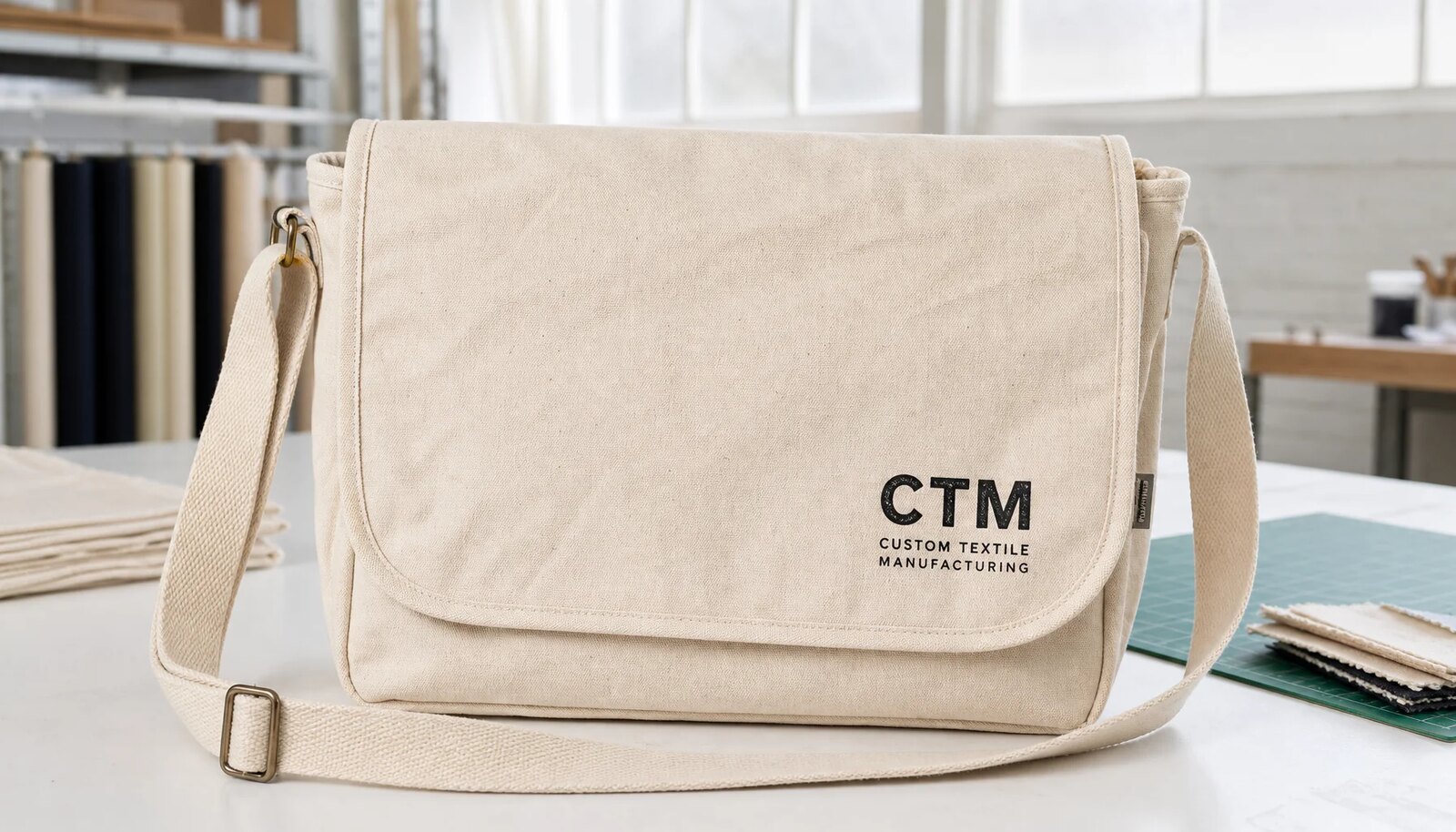
Start With the Display Problem, Not the Mockup
Wholesale canvas messenger bags for craft fairs are judged in motion and in crowded spaces. They hang from pegboards, sit in shallow stacks, swing from a shoulder, or get pulled from a carton during booth setup. That is why logo placement cannot be treated like a flat tote bag layout. A messenger bag has a flap, a gusset, a strap, closure hardware, and often a pocket under or behind the flap. Each part can change what the customer sees.
A logo that looks centered on a digital front view may sit too low once the flap curves over the bag body. It may look crooked when the bag hangs from one strap. It may be partly hidden by cotton webbing or interrupted by a magnetic snap. These are not rare defects; they are predictable construction effects. Procurement teams reduce them by specifying the bag first, then placing the logo around real pattern lines and hardware.
The commercial issue is bigger than appearance. Logo placement affects print setup, sewing sequence, sample timing, inspection tolerance, packing, and quote comparison. If one supplier assumes panel printing before sewing and another assumes finished-bag printing, their costs and risks are different. If one factory places the logo above a snap and another places it below the snap, the quotes are not describing the same product. A clean RFQ removes those assumptions before sampling starts.
- Use front flap placement when booth visibility is the priority and the flap is not crowded with hardware.
- Move the logo to a lower corner when a strap or centered closure would cover the middle of the flap.
- Use under-flap, pocket, side label, or inner pocket branding when the outside should stay cleaner.
- Avoid logo edges that touch fold lines, buckle straps, snap reinforcements, bartacks, or edge binding.
- Ask for a measured placement drawing or marked physical sample photo before approving artwork.
Lock the Bag Construction Before Logo Placement
Logo placement should come after the construction spec is clear. A simple rectangular flap creates a larger and more forgiving print zone. A rounded flap needs more judgment because visual centering shifts along the curve. A buckle flap may split the available space into smaller zones. A magnetic snap can create a hidden pressure point under the fabric. A Velcro patch can rub directly against ink or transfer film each time the bag opens.
Finished size also changes placement. A common craft fair messenger bag may be around 34 x 28 x 8-10 cm, but that size is not a universal pattern. A deeper gusset pulls the flap differently when the bag is loaded. A shorter flap may crowd the logo near the lower edge. A taller outer pocket can push the visible branding area upward. If the bag will carry prints, journals, catalogs, craft kits, or sample packs, review the sample with those contents inside, not only empty on a table.
Strap behavior deserves special attention. A wide cotton webbing strap may cross the front flap when the bag hangs vertically. Sliders and adjusters can press into the decorated panel during packing. Strap attachment points can pull the flap slightly to one side. The RFQ should state strap material, width, attachment position, and length range so the supplier can predict whether the strap will compete with the logo.
- Flat flap: easiest for screen print registration, embroidery alignment, and placement measurement.
- Rounded flap: needs wider safe margins because curved binding makes visual centering less forgiving.
- Buckle flap: place the logo between, above, below, or beside straps with space for movement.
- Velcro flap: keep ink and transfer film away from repeated hook-and-loop rubbing zones.
- Magnetic snap flap: confirm reinforcement patch size and position before locking artwork.
- Outer pocket construction: check whether pocket seams or pocket contents change the visible logo area.
Choose Canvas Weight and Finish With Printing in Mind
For craft fair retail programs, 10 oz to 12 oz cotton canvas is often the most practical range. In metric terms, that is roughly 340-407 GSM, although the exact conversion can vary by yarn count, weave density, and finishing. This range usually gives enough body for display while staying sewable and packable. An 8 oz canvas can lower cost and carton weight, but it may collapse on a table or feel light beside handmade products. A 14 oz canvas can look more substantial, yet it may stiffen the flap, increase freight cost, and require stronger needles.
Buyers should always ask when the weight is measured. Greige canvas, bleached canvas, dyed canvas, enzyme-washed canvas, and coated canvas do not behave the same way. Washing can shrink the fabric and move the final dimensions. Coating can affect ink adhesion. Dark dyed canvas often needs a white underbase for bright logos, which adds cost and changes the print hand. Natural canvas may show cotton flecks, which can suit a craft fair look but may break up fine lines or small lettering.
Texture matters as much as weight. Coarse canvas can make thin strokes, tiny text, halftones, and detailed icons look rough. A logo that is sharp on paper may lose detail on 12 oz cotton canvas. When artwork has small letters or a strict brand color, request a strike-off on the actual bulk canvas. For repeat orders, ask whether the supplier can hold the same canvas construction and finish, because even small fabric changes can make the same logo look different.
- 8 oz canvas: lighter and cheaper, but weaker for display structure and heavier contents.
- 10 oz canvas: balanced for craft fair resale, promotional programs, and moderate daily use.
- 12 oz canvas: stronger hand feel and shelf presence, with higher sewing and freight considerations.
- 14 oz canvas: premium look, but test flap fold, needle performance, and carton compression.
- Dyed canvas: confirm colorfastness, crocking, underbase needs, and ink compatibility.
- Washed canvas: confirm shrinkage and final dimensions before approving logo placement.
Match Decoration Method to Artwork and Position
Screen printing is usually the strongest cost-control option for wholesale canvas messenger bags with one to three solid logo colors. It works best on a flat flap or cut panel where the screen sits evenly. Buyers should specify artwork size, color count, Pantone targets when relevant, ink type, and printing stage. On rough cotton canvas, avoid tiny type, thin outlines, and delicate negative spaces unless the supplier has proven the result with a strike-off.
Embroidery gives a more tactile, premium look, but it has limits. Dense embroidery can pull the canvas, pucker the flap, create stiffness, and leave backing on the inside. It is better for small marks, badges, monograms, or patch-style branding than for large filled graphics. If embroidery is used on the flap, check whether the extra thickness affects closure and whether the thread backside rubs against contents.
Transfers can solve artwork problems that screen print cannot, especially gradients or complex multi-color designs. They still need validation on coarse canvas. Test edge lifting, cracking, hand feel, fold resistance, and adhesion after cooling. Woven labels are reliable for secondary branding because they repeat cleanly across orders and avoid large surface print defects. Patches can raise perceived value, but they add tooling, sewing, edge-lift, and minimum-order questions.
- Screen print: best for solid logos, repeat orders, clear flap branding, and controlled wholesale cost.
- Embroidery: best for smaller premium marks, initials, badges, or tonal branding.
- Woven label: best for side seams, straps, inner pockets, and subtle retail identity.
- Heat transfer: best for gradients or many colors, but requires adhesion, fold, rub, and cooling tests.
- Patch application: best for elevated retail feel, with added checks for thickness and edge lift.
- Mixed branding: use a main flap print plus a label only when both positions are on the dieline.
Set Logo Placement Rules Buyers Can Inspect
A useful logo placement guide gives measurable references. Do not approve only “logo on front.” State logo width, logo height, distance from the lower flap edge, distance from left and right side seams, relationship to the centerline, and clearance from closures or binding. When the bag size allows, keep the main logo at least 20-30 mm away from flap edge binding, closure hardware, thick seams, buckle straps, and reinforcement patches. Smaller bags may need tighter margins, but that should be a conscious compromise.
Tolerance also needs to be written. Many canvas factories can control flap print placement around plus or minus 5 mm when the printing jig and sewing pattern are stable. Woven labels sewn into stable seams may be controlled closer, often around plus or minus 3 mm, if the seam guide and label folding are consistent. Embroidery and patches need their own tolerance because fabric can move during hooping or sewing. If the buyer requires tighter control, expect extra jigs, slower handling, and more inspection time.
Alignment should be judged on the finished bag, not only on the fabric grain. Canvas can skew during cutting, washing, printing, or sewing. A logo may be straight to the weave but look crooked against the flap edge. The approved sample should define the visual reference: centered between side seams, parallel to the lower flap edge, aligned to a pocket seam, or offset to avoid a strap path. For craft fairs, also inspect the bag while hanging, because gravity changes how the flap sits.
- Do not cross a flap fold line unless the artwork is designed to tolerate bending.
- Keep logo edges clear of bartacks, rivets, magnetic snaps, Velcro patches, buckle holes, and strap stitching.
- Measure logo placement on finished bags, because sewing can shift the final visual position.
- Reject obvious skew when the logo visually leans against the lower flap edge or centerline.
- Approve one golden sample for each logo size, colorway, placement, and decoration method.
- Add safe-margin notes to the artwork sheet so reorders do not drift toward hardware or seams.
Compare MOQs by Component, Not by Catalog Line
A low MOQ can be helpful, but it does not automatically mean a better sourcing decision. Canvas messenger bag MOQ may come from fabric roll quantity, dye lot minimum, washing batch, cutting efficiency, screen setup, embroidery setup, transfer film, woven label production, patch tooling, hardware sourcing, hangtag printing, barcode labeling, or carton packing. Natural canvas often gives more flexibility than custom dyed canvas. A one-color flap print is simpler than a package with multiple logo positions, labels, retail tags, and custom cartons.
Procurement buyers should ask suppliers to separate quote lines. A useful quotation shows the bag body cost, fabric upgrade, decoration cost, label or patch cost, screen or plate charge, sample fee, packing cost, carton data, lead time, and incoterm. This prevents false comparisons. One supplier may look cheaper because it excludes individual packing, barcode labels, stronger cartons, or final inspection time. Another may look higher but include details that reduce repacking and event preparation work.
Quantity tiers help when the program may grow. Ask for 300, 500, 1000, and 3000 pieces if those levels are realistic. The supplier can show where setup charges dilute and where fabric or cutting efficiency improves. Avoid pushing for an artificially low MOQ if the result is substitute canvas, mixed hardware, non-final labels, rushed sampling, or weak QC. The better question is which component is driving the minimum and whether a reasonable spec change can remove that constraint.
- Fabric MOQ: affected by natural, bleached, dyed, washed, coated, or water-repellent canvas.
- Decoration MOQ: affected by color count, position count, screen setup, embroidery setup, and transfer type.
- Label MOQ: woven labels, patches, and custom hangtags often have separate minimums and lead times.
- Cutting efficiency: curved flaps, boxed gussets, and multiple pockets can increase waste and labor.
- Packing MOQ: custom cartons, barcodes, belly bands, and retail polybags can change cost and schedule.
- Inspection cost: tighter placement tolerance or retail-ready packing may require more checking time.
Approve Samples That Mirror Bulk Production
A development sample can confirm size and styling, but it should not be treated as final logo approval if it uses substitute fabric or placeholder hardware. The pre-production sample should use bulk canvas, final strap webbing, actual closure hardware, actual ink or embroidery thread, actual label, final logo size, and intended packing. If the order uses dyed canvas, approve the same dyed material or connect the sample to an approved lab dip and print strike-off.
Sample review should feel practical, not ceremonial. Load the bag with notebooks, catalogs, patterns, prints, or light merchandise to see how the flap falls. Hang it by the shoulder strap and check whether the strap crosses the logo. Open and close the flap repeatedly to see whether the logo rubs against Velcro, snaps, buckles, or reinforcement layers. If the logo is embroidered or patched, check whether added thickness changes the flap shape. If it is printed, inspect ink coverage across the canvas texture after curing.
The approval record must be specific. Take measured photos showing logo position from the lower flap edge, side seams, closure center, and nearby hardware. Record artwork version, logo size, canvas color, print method, color reference, and tolerance. Keep one signed golden sample with the factory and one with the buyer or inspection company. If changes are approved after the sample, write them in millimeters. “Move logo slightly higher” is not enough for production control.
- Approve artwork scale and placement on a physical sample and a measured specification sheet.
- Check print color under normal indoor light and booth-like lighting, not only studio lighting.
- Test logo adhesion after curing with light scratch, tape pull, dry rub, and repeated flap movement.
- Confirm the flap closes cleanly after printing, embroidery, label sewing, or patch attachment.
- Review the sample after packing pressure for ink transfer, flap creases, and strap indentation.
- Tie approval records to artwork version numbers so reorders use the same placement standard.
Protect the Decorated Flap During Packing
Messenger bags can pass sewing inspection and still arrive with damaged logos. The front flap is exposed to straps, hardware, neighboring bags, and carton compression. Fresh screen print needs full curing before stacking. Heat transfers need cooling time before pressure. Embroidery and patches can leave impressions on the opposite panel if the bags are compressed too tightly. For decorated flaps, flat packing with tissue or clean release paper is usually safer than tight rolling.
Packing should match the craft fair distribution plan. If booth teams need to unpack quickly, individual polybags, hangtags, barcode stickers, or belly bands may save labor. If the buyer wants less plastic, master-carton packing with tissue interleaving may work, but the bags still need to arrive clean and ready for display. State whether bags are packed flat, folded once, nested, individually bagged, or bulk packed.
Carton data should be confirmed before purchase order approval. Pieces per carton, carton size, gross weight, net weight, and packing layout affect freight estimates and handling. Over-compressed cartons can create permanent flap creases or logo marks. Underfilled cartons let bags shift and abrade. For craft fair programs, cartons should be strong enough for stacking and light enough for manual handling at storage rooms, booths, and small distribution points.
- Use tissue or release paper between printed flaps when ink, transfer film, or patch surfaces may mark adjacent bags.
- Avoid folding directly across the main logo unless that fold line is approved on the pre-production sample.
- Specify individual polybag, recycled polybag, paper belly band, hangtag, barcode, or master-carton-only packing.
- Control carton gross weight so event staff can move boxes without crushing or dropping them.
- Inspect first packed cartons for ink transfer, flap creasing, strap indentation, odor, moisture, and carton strength.
- Require carton dimensions and gross weight in the quote so freight estimates use real packing assumptions.
Build a Lead-Time Plan Around Fixed Event Dates
Craft fair calendars are unforgiving. If the goods miss the event window, the buyer may face lost sales, rushed local decoration, or expensive emergency shipping. A realistic schedule includes artwork proofing, material booking, sample making, sample review, possible revision, bulk fabric confirmation, cutting, decoration, sewing, trimming, inline inspection, final inspection, packing, export documentation, and transport. A natural canvas bag with one-color screen print is faster than dyed canvas with embroidery, woven labels, custom lining, hangtags, and barcode packing.
Many delays happen before the factory starts bulk sewing. Artwork may arrive as a low-resolution file instead of vector artwork. The logo may need revision after the strap covers the flap. Dyed canvas may require lab dip approval. A woven label or patch may have its own lead time. If the first sample shows the logo too close to a magnetic snap, the factory may need to remake a screen, adjust a pattern, or change the print sequence.
Before bulk cutting begins, lock the items that affect production risk: finished size, canvas weight, color, finish, logo method, logo placement, closure hardware, labels, packing, and inspection standard. If the brand is still choosing between logo sizes, order development samples early. If the delivery date cannot move, discuss partial shipment, air shipment for an opening quantity, or simplified decoration only after reviewing the cost and QC impact.
- Artwork proof: fastest when vector files, color references, and placement dimensions are complete.
- Material booking: longer for dyed canvas, washed finishes, custom straps, special hardware, or labels.
- Sample revision: common when logos conflict with flap curves, closures, straps, pockets, or binding.
- Decoration stage: affected by multi-color registration, curing capacity, embroidery queue, or transfer testing.
- Final inspection: schedule before shipment booking and before all cartons are sealed.
- Event deadline: share it with the supplier so production and shipping buffers are planned honestly.
Send an RFQ That Suppliers Can Quote Fairly
The best supplier comparison starts with a complete RFQ. Include finished dimensions, tolerance, canvas weight, fabric color, finish, lining if any, strap material, strap width, strap length range, flap type, pocket layout, closure type, decoration method, logo size, logo placement, label details, packing method, target quantity, inspection level, shipment term, and delivery deadline. If an item is open for recommendation, write “supplier to suggest” instead of leaving it blank.
Artwork files should include vector artwork, color references, and a measured placement sheet. The sheet should show the front view, flap edge, side seams, centerline, closure hardware, binding, strap path if relevant, and logo safe margins. If the supplier is asked to recommend placement, request a marked proposal with millimeter measurements, not only a visual mockup. Send the same file package to each supplier and ask them to list assumptions before pricing.
Commercial details should be just as clear as product details. Ask for setup charges, sample cost, sample time, production lead time after approval, MOQ by component, carton data, payment terms, incoterm, excluded costs, and quote validity. Also ask whether third-party inspection is supported and what inspection standard the supplier expects. A quote with better fabric, clearer packing, and realistic QC may not be the lowest unit price, but it can reduce rework, repacking, and shipment surprises.
- Send logo artwork as vector files plus a placement drawing with millimeter measurements and safe-margin notes.
- State quantity tiers such as 300, 500, 1000, and 3000 pieces if the craft fair program may scale.
- Request natural canvas, dyed canvas, or washed canvas options only when those alternatives are truly under review.
- Ask whether decoration is done before sewing, after sewing, or through label or patch application.
- Require carton dimensions, gross weight, and packing layout before purchase order approval.
- Ask suppliers to confirm every RFQ deviation in writing so quote comparisons stay transparent.
Specification comparison for buyers
| Spec decision | Recommended option | When it fits | Buyer risk to check |
|---|---|---|---|
| Main logo position | Front flap center, lower right flap, or lower left flap with 20-30 mm safe margin from binding, seams, fold lines, straps, and hardware | Best when craft fair bags hang from booth hooks, pegboards, chair backs, grid walls, or customer shoulders and the brand mark must stay visible | A flat digital mockup may ignore flap curve, snap pressure, Velcro patches, buckle straps, and sewing distortion |
| Secondary brand mark | Small woven side label, inner pocket print, strap label, under-flap mark, or low-profile patch | Useful when the brand wants a cleaner exterior or a more retail-style identity after purchase | Labels and patches change sewing sequence, seam allowance, and sample timing if added after the first quote |
| Canvas weight | 10 oz to 12 oz cotton canvas, roughly 340-407 GSM before heavy washing or specialty finishing | Balanced for craft fair merchandise, notebooks, catalogs, kits, samples, and lightweight daily carry | Lighter canvas may collapse on display; heavier canvas can raise freight cost, stiffen the flap, and increase needle or sewing-machine demands |
| Decoration method | Screen print for solid artwork; embroidery or woven label for smaller premium marks; transfer only for gradients or complex color artwork | Screen printing gives strong cost control at wholesale quantities when the factory uses stable jigs and cured ink | Transfers may crack, lift, or feel plasticky on coarse canvas unless temperature, pressure, film, cooling, and fold testing are validated |
| Artwork scale | Logo width 120-180 mm on a common front flap; 80-120 mm for pocket, side, strap, or inner branding | Keeps the mark visible on messenger bags around 34 x 28 x 8-10 cm without crowding the panel | Oversized logos can cross fold lines, edge binding, closure reinforcement, or packed crease areas |
| MOQ logic | Ask MOQ by fabric, dye lot, cutting batch, print setup, label production, hardware, packing, and carton requirement | Helps procurement teams compare suppliers on the same assumptions instead of one vague catalog MOQ | A low MOQ may hide setup charges, substitute fabric, simplified packing, limited inspection time, or non-final components |
| Closure area | Keep the main logo away from magnetic snaps, Velcro, buckles, buttons, rivets, bartacks, and reinforcement patches | Reduces rubbing, pressure marks, ink cracking, surface abrasion, and visual distortion during repeated opening | Artwork approved on a smooth dieline can fail after hardware and reinforcement layers are sewn into the flap |
| Production printing stage | Panel printing before sewing for a flatter surface; finished-bag printing only when the factory has suitable jigs and clearance | Panel printing suits repeat programs with stable patterns; finished-bag printing helps when alignment to the finished flap edge is critical | Panel printing can shift after sewing, while finished-bag printing is restricted by seams, gussets, binding, straps, and hardware |
| Packing format | Flat pack with tissue or clean release paper between decorated flaps; avoid tight rolling for printed or transferred panels | Protects logo surfaces and keeps bags ready for craft fair booth setup or retail cartons | Fresh ink, transfer film, embroidery, patches, or strap hardware can leave marks, dents, or creases if packed too soon or too tightly |
Buyer checklist before sampling
- Define finished bag size, flap shape, gusset depth, pocket layout, lining if any, strap width, strap length range, attachment points, closure type, and whether the bag must stand, hang, or fold flat for craft fair display.
- Specify canvas weight in both oz and GSM, and state whether the quoted weight is greige, finished, dyed, washed, enzyme washed, coated, or water-repellent treated.
- Provide a measured logo placement dieline showing logo width, logo height, distance from flap edge, side seams, centerline, fold line, closure hardware, buckle straps, pocket seams, binding, and strap path.
- Choose decoration by artwork and use case: screen print for solid colors, embroidery for small premium marks, woven label for subtle branding, patch for higher perceived value, and transfer only for gradients or complex multi-color artwork.
- Ask the supplier to confirm whether decoration is applied before sewing, after sewing, or on a separate patch or label, because that choice affects placement tolerance, inspection method, and lead time.
- Require a physical pre-production sample made with bulk canvas, final strap webbing, actual hardware, actual ink or thread, actual label, final logo size, and intended packing method.
- Set written acceptance tolerances for logo position, logo skew, print color, ink coverage, adhesion, seam alignment, flap symmetry, strap strength, closure alignment, trimming, odor, and carton packing.
- Request separated quote lines for bag sewing, fabric upgrade, printing, embroidery or labels, screen or plate charges, sample fees, custom packing, carton data, inland freight, export handling, and production lead time.
- Confirm whether MOQ is driven by fabric purchasing, dye lot, washing batch, cutting efficiency, print setup, label production, hardware sourcing, custom carton, barcode sticker, or retail packing.
- Check carton quantity, carton size, gross weight, net weight, stacking direction, and protective interleaving so decorated flaps are not crushed, creased, or marked before craft fair distribution.
Factory quote questions to send
- What canvas weight in oz and GSM are you quoting, and is the weight measured before finishing, after dyeing, after washing, or after coating?
- What finished bag dimensions, flap dimensions, gusset depth, strap width, strap adjustment range, pocket layout, lining, and closure hardware are included in the quote?
- What logo placement do you recommend for this flap pattern, and how many millimeters of safe margin do you require from seams, binding, fold lines, Velcro, snaps, buckles, strap paths, and reinforcement patches?
- Which decoration method are you pricing for the main logo, how many colors are included, what ink, thread, transfer, or label type will be used, and what setup charge applies per color or position?
- Will the logo be printed before sewing, printed after sewing, embroidered after cutting, or applied as a label or patch, and how does that choice affect placement tolerance and lead time?
- Can the pre-production sample be made with bulk fabric, final strap webbing, final closure hardware, final label, actual logo process, and final packing method?
- What is the MOQ for natural canvas, dyed canvas, washed canvas, printed logo, embroidery, woven side label, patch, custom hangtag, barcode sticker, and retail packing if these MOQs are different?
- What placement tolerance do you normally control for flap printing, side labels, embroidery, and patches, and how do your inline inspectors measure it during production?
- How many days are required for artwork proofing, material sourcing, sample making, sample revision, bulk cutting, decoration, sewing, trimming, inspection, packing, and export documentation?
- What are the estimated pieces per carton, carton size, gross weight, net weight, packing layout, and whether bags are packed flat, folded, nested, individually polybagged, or bulk packed?
Quality-control points to confirm
- Logo placement tolerance should be agreed in writing; plus or minus 5 mm is commonly practical for flap printing when the pattern and jig allow it, while woven labels may be held closer, often around plus or minus 3 mm on stable seams.
- Print skew should be checked against the visible flap edge and flap centerline, not only against fabric grain, because the shopper judges the finished bag, not the cut panel.
- Ink adhesion should be tested only after full curing by light scratch, tape pull, dry rub, and repeated flap-fold rubbing on the same bulk canvas used for production.
- Color approval should use the agreed Pantone or physical color reference while recognizing that natural canvas texture, dyed fabric, and white underbase choices can shift perceived color.
- Canvas weight should be verified from bulk fabric cuttings because supplier catalog descriptions may mix greige weight, finished weight, oz, GSM, and washed fabric measurements.
- Strap attachment should be inspected for reinforced box stitches or bartacks, correct stitch density, skipped stitches, broken threads, loose ends, and adequate reinforcement at stress points.
- Closure hardware should align with the reinforcement patch and should not press directly into the printed logo during opening, closing, stacking, or carton packing.
- Finished bags should be checked for flap symmetry, edge binding tension, gusset depth, pocket opening, strap adjuster function, odor, loose threads, and whether the bag hangs cleanly for booth display.
- Embroidery and patch applications should be checked for puckering, backing irritation, loose thread ends, patch edge lift, needle damage, and whether the added thickness affects flap closure.
- Cartons should be inspected for ink transfer, compression marks, fold creases, strap indentation, barcode accuracy if used, carton strength, and actual carton dimensions against the quoted data.