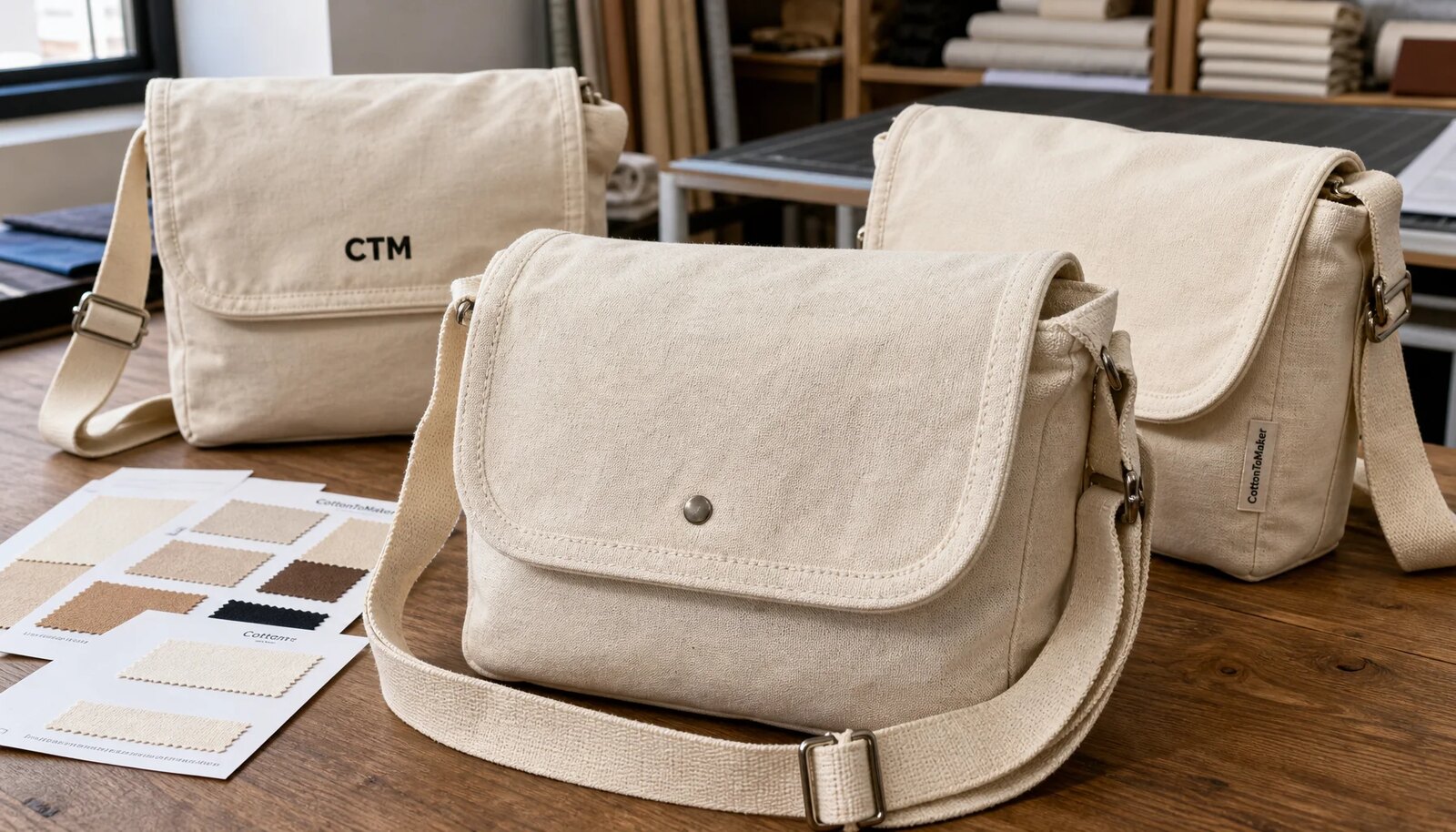
Start with the selling use, not the fabric number
For wholesale canvas messenger bags sold through craft fairs, fabric weight is not a decoration detail. It controls how the bag hangs on a booth hook, how it feels when a customer opens the flap, how well it carries sketchbooks or market purchases, and how much the shipment costs per carton. A procurement team that only writes “heavy canvas messenger bag” in an RFQ will receive quotes that look comparable but are built on different fabrics, reinforcement methods, and packing assumptions.
The practical starting point is the retail use case. A small craft fair brand selling printed bags at a lower price point may accept 10 oz canvas if the strap joins and flap are reinforced. A maker-focused retailer that wants a durable everyday shoulder bag usually needs 12 oz canvas as the working middle ground. A boutique distributor selling premium artist merchandise may prefer 14 oz or heavier canvas, but that choice affects sewing speed, carton volume, and the risk of hard creasing during shipping.
- Use 10 oz canvas when the bag is mostly promotional, lightweight, or folded for compact shipment.
- Use 12 oz canvas when the bag must look retail-ready, hold shape, and still control cost.
- Use 14-16 oz canvas when the selling point is premium handfeel and rugged appearance.
- Do not compare quotes unless the fabric weight, lining, hardware, and reinforcement details are written into the same RFQ.
Understand oz and GSM before comparing supplier quotes
Canvas messenger bag factories may quote fabric weight in ounces, grams per square meter, or both. In general, 10 oz canvas is around 340 GSM, 12 oz is around 400 GSM, 14 oz is around 470 GSM, and 16 oz is around 540 GSM. These are useful references, not exact universal values, because fabric construction, finishing, dyeing, and washing can change the measured weight. A tight weave 12 oz canvas may feel firmer than a looser 14 oz fabric.
The quote should say whether the weight is greige fabric weight, finished fabric weight, or washed fabric weight. This matters for craft fair bags because many buyers like natural, washed, or slightly softened canvas. Washing improves handfeel but may reduce size and change shade. If the factory cuts panels before fabric shrinkage is stabilized, the finished bag can be smaller than the approved sample or the flap can misalign with the snap.
- Request weight in both oz and GSM so overseas suppliers and internal teams use the same reference.
- Clarify whether canvas is raw, dyed, washed, enzyme washed, or pre-shrunk.
- Approve finished dimensions after any washing process, not only the paper pattern.
- Treat fabric stiffness, weave density, and shrinkage as part of the fabric specification, not separate issues.
The best middle specification for craft fair resale
For most wholesale craft fair programs, 12 oz cotton canvas is the safest first specification. It has enough body for a messenger bag flap, gives a stronger handfeel than a tote-bag promotional fabric, and still runs efficiently on standard industrial sewing machines. It also accepts screen printing well if the artwork is not too fine. When combined with a 38 mm cotton or polyester webbing strap and reinforced strap anchors, it can cover a wide range of retail uses without turning the shipment into an expensive heavyweight product.
A good 12 oz messenger bag RFQ should not stop at fabric weight. The body construction, flap closure, thread, and strap reinforcement decide whether the product performs like a real bag or a flat promotional sleeve. For craft fairs, customers often open the flap repeatedly at a booth, compare handfeel, and judge whether the bag feels worth the retail price. A slightly higher fabric weight will not save the product if the strap join is weak or the flap has no structure.
- Suggested base spec: 12 oz cotton canvas, unlined or with simple polyester lining, 38 mm adjustable strap, reinforced flap closure.
- Use bar tack, box stitch, or crossed reinforcement at strap anchor points depending on the design.
- Keep the flap wide enough to cover the opening after the bag is loaded, not only when it is flat.
- If the bag has a front print, avoid placing detailed artwork directly over thick seam steps.
When lighter 10 oz canvas is commercially reasonable
A 10 oz canvas messenger bag can be a sensible option when the order is price-sensitive, used for event merchandise, or sold as part of a craft fair vendor kit. It reduces fabric consumption cost, carton weight, and sometimes sewing difficulty. For importers running multiple designs or seasonal prints, the lower material cost can help maintain margin when artwork variety is more important than premium handfeel.
The risk is that a messenger bag has more structure demands than a flat tote. A long flap in 10 oz canvas may curl, the front panel may collapse, and the strap area may wrinkle under load. These issues are not always visible in a flat sample photo. The buyer should test the sample with real contents: notebook, phone, small water bottle, craft tools, or packaged goods. If the silhouette fails when loaded with 2-3 kg, the lower fabric cost may create returns or weak retail sell-through.
- Use reinforcement patches behind magnetic snaps or metal snaps.
- Shorten overly long flaps or add lining/interlining if the flap needs more body.
- Specify stronger stitching at strap joins instead of relying on fabric weight alone.
- Keep artwork bold; fine print loses clarity faster on softer, lighter canvas.
When premium 14-16 oz canvas is worth the extra cost
Heavier canvas is attractive for craft fair buyers because it feels closer to handmade or workshop-grade product. A 14 oz or 16 oz messenger bag can hold a sharper silhouette, support a larger flap, and give better perceived value on a retail table. It is suitable for artist merchandise, museum shop-style assortments, outdoor craft events, and small-batch brand programs where the buyer wants a product that does not feel like a giveaway.
The tradeoff is not only fabric price. Heavy canvas slows cutting and sewing, requires correct needle and thread selection, and creates thick seam intersections at the flap, side gusset, and strap anchor. If the factory uses the same machine settings as a lighter bag, skipped stitches, visible needle holes, or uneven topstitching can appear. Heavy canvas also makes cartons bulkier, so landed cost can rise even when the unit FOB increase looks acceptable.
- Confirm the factory has produced messenger bags in the same weight, not only tote bags.
- Review seam thickness at gusset corners and flap edge binding before approving bulk.
- Use larger needles and suitable thread to avoid weak or irregular stitches.
- Avoid over-compressing cartons, because heavy canvas flap creases can be hard to remove.
Print method decisions on textured canvas
Craft fair messenger bags are often bought because the artwork matters. The fabric weight affects print quality because heavier canvas usually has a stronger texture and may show more broken ink coverage on fine lines. Screen printing is still the most cost-effective method for wholesale quantities with one to three spot colors. It gives good durability, but the artwork should be adjusted for canvas texture by avoiding very small text, thin outlines, and large solid ink areas that crack when the flap bends.
Heat transfer can be useful for small MOQs, many designs, or detailed artwork, but it must be tested for adhesion on the selected canvas finish. Embroidery can work on heavier canvas, especially for a small logo or woven-style brand mark, but it should not be placed across thick folded seams or unsupported flap sections. For a clean craft fair retail look, print position should be specified by measurement from the flap edge or body centerline, not described only as “center front.”
- Screen print: best for stable wholesale repeat orders and simple brand graphics.
- Heat transfer: useful for mixed designs, lower MOQ, or detailed color artwork.
- Embroidery: premium look, but needs backing and should avoid high-stress fold zones.
- Woven or sewn label: good for small brand identity without risking large print defects.
MOQ logic: why fabric color and construction change the minimum
MOQ is not a random number. For canvas messenger bags, the minimum depends on fabric procurement, dyeing, printing setup, cutting efficiency, hardware purchasing, and sewing line arrangement. Natural canvas usually allows a lower MOQ because the fabric is commonly available. Dyed canvas, custom Pantone shades, yarn-dyed stripes, custom lining, or special metal hardware can raise the minimum because the supplier must meet mill or hardware vendor requirements.
Construction also changes MOQ. A simple unlined 12 oz canvas messenger bag with one-color print may be practical at a lower quantity than a lined bag with inner zipper pocket, adjustable metal slider, woven label, hangtag, and custom carton marks. Buyers comparing quotes should separate the factory’s bag MOQ from the material MOQ. Sometimes the factory can produce a smaller bag quantity, but the buyer must pay for leftover dyed fabric or accept a surcharge.
- Natural canvas with standard black print normally has the most flexible MOQ.
- Custom dyed canvas should include lab dip approval and possible fabric minimums.
- Multiple artwork designs may share one bag body MOQ if print setup is managed efficiently.
- Hardware in antique brass, matte black, or custom finish may have a separate minimum.
Sample approval should simulate real craft fair handling
A messenger bag sample can look acceptable when empty and flat but fail when used. For craft fair resale, approval should include practical handling: hanging on a rack, opening and closing the flap, adjusting the strap, loading the bag, and viewing the front print under normal booth lighting. The sample should be made from the same fabric weight, same print method, same strap material, and same closure type expected for bulk production. Substitute fabric is acceptable only for early shape review, not for final approval.
The pre-production sample should become the reference for bulk inspection. It should show final logo placement, side label position, seam allowance, stitch density, hardware finish, and packing fold method. If the buyer approves only photos, color and texture risks remain. If physical approval is impossible due to schedule, the quote and purchase order should still list measurable criteria, because “same as photo” is weak protection when fabric weight, flap shape, and print coverage are involved.
- Load the sample with 2 kg, 3 kg, and 5 kg depending on the claimed use.
- Measure strap adjustment range and comfort on shoulder height, not only strap length flat.
- Open and close snap or magnetic closure at least 30 times during approval.
- Photograph the approved packing fold so the bulk cartons follow the same method.
- Keep one approved sample at the factory and one with the buyer or inspection team.
Packing and freight effects of fabric weight
Fabric weight changes carton planning. A 10 oz unlined bag can usually be packed flatter and tighter than a 14 oz lined bag with hardware. Heavy canvas increases gross weight, but volume can be the bigger issue because flaps, gussets, and straps create air space. For importers and distributors, carton dimensions should be requested at quote stage so the landed-cost team can estimate freight before the purchase order is issued.
Craft fair retail inventory also needs packing that protects presentation. Over-compressed cartons can leave deep flap creases. Natural canvas can pick up dust, moisture marks, or carton odor if packed poorly. Individual polybags protect the product but may conflict with some retail sustainability preferences. A kraft paper band or recycled polybag may be acceptable if the buyer controls moisture risk and carton cleanliness.
- Request estimated pieces per carton, carton size, net weight, and gross weight for each fabric weight option.
- Use flat packing with controlled fold lines for flap and strap, rather than random compression.
- Consider a carton liner for natural or light-colored canvas shipments.
- Specify hangtag, barcode sticker, inner bag, and master carton marks before production packing begins.
- For retail-ready resale, inspect crease severity before authorizing full shipment.
Lead time risks that affect fabric-weight decisions
Lead time for canvas messenger bags depends on more than sewing capacity. Fabric availability is the main variable. Natural canvas in standard weights may be in stock or quickly available. Custom dyed 12 oz or 14 oz canvas needs lab dips, buyer approval, bulk dyeing, drying, finishing, and shrinkage control. If the buyer changes the fabric weight after sample approval, the pattern, sewing method, and carton plan may also need adjustment.
For craft fair programs tied to seasonal events, schedule risk should be managed before the order is confirmed. Artwork approval, print strike-off, fabric shade approval, hardware selection, and packing artwork should move in parallel where possible. A factory can often cut and sew quickly once materials are ready, but it cannot recover time lost through late logo files, unclear Pantone references, or unapproved strap hardware.
- Typical schedule items to track: fabric sourcing, lab dip, sample making, print test, pre-production sample, bulk cutting, sewing, inspection, packing, and export booking.
- Natural canvas can shorten the approval path because color matching is simpler.
- Custom dyed heavy canvas has higher delay risk due to shade matching and shrinkage variation.
- Late artwork changes affect screen making, print position, and sometimes flap pattern approval.
- Book inspection time before the event deadline, not after cartons are already sealed for export.
Specification comparison for buyers
| Spec decision | Recommended option | When it fits | Buyer risk to check |
|---|---|---|---|
| Main body fabric weight | 12 oz canvas, about 400 GSM, pre-shrunk or enzyme washed if the color allows | Most craft fair retail programs where the bag must feel substantial but still fold and ship efficiently | Unwashed canvas may shrink after consumer washing; confirm finished dimensions after washing, not only greige fabric weight |
| Lightweight economy option | 10 oz canvas, about 340 GSM, with reinforcement at flap corners and strap joins | Lower retail price points, event merchandise, bundled vendor kits, or seasonal programs with tight freight limits | Can look soft on a wide messenger silhouette; sample must be loaded with 2-3 kg to judge sagging |
| Premium handmade-market option | 14-16 oz canvas, about 470-540 GSM, with heavier thread and stronger needle setup | Boutique craft fair booths, artist merchandise, small-batch brand drops, or higher perceived value packaging | Higher fabric cost, slower sewing speed, bulkier cartons, and possible needle holes around dense seams |
| Lining decision | Unlined for price-sensitive orders; 150-210D polyester lining for cleaner interior and zipper pocket options | Unlined suits rustic cotton look; lined suits retail buyers who want a finished interior | Lining adds labor and QC complexity; loose lining can twist unless anchored at bottom and side seams |
| Strap material | 38 mm cotton webbing for natural look; polyester webbing for colorfastness and strength consistency | Cotton webbing matches eco-style craft products; polyester works for darker colors or heavier load claims | Cotton webbing can shrink or twist; specify webbing GSM, width tolerance, and adjuster hardware finish |
| Print method | Screen print for 1-3 spot colors; heat transfer for small runs or detailed artwork; embroidery only on reinforced panels | Screen print gives best unit cost at wholesale quantities; transfer helps mixed SKUs or detailed logos | Heavy canvas texture breaks fine lines; require print test on actual production fabric, not smooth cotton swatch |
| Flap closure | Magnetic snap or metal snap with reinforcement patch; Velcro only when noise and lint are acceptable | Snap closures suit retail display and perceived quality; Velcro fits utility-style vendor bags | Closure position shifts if fabric shrinks or flap pattern is not graded correctly; approve closure alignment on loaded sample |
| Packing format | Flat packed in individual polybag or kraft band, 20-40 pcs per export carton depending on fabric weight | Flat packing protects shape and reduces wrinkles for craft fair resale inventory | Over-compressed cartons crease heavy canvas; carton drop test and moisture control matter for natural cotton |
Buyer checklist before sampling
- Define finished bag size, not only panel size; include flap length, gusset width, and usable interior opening.
- State the target fabric weight in oz and GSM, plus whether the value is before or after washing.
- Request actual fabric swatches for 10 oz, 12 oz, and 14 oz canvas before approving the selling sample.
- Load-test the sample with the expected consumer use weight, normally 2-5 kg for craft fair messenger bags.
- Approve strap width, strap length range, adjuster hardware, and reinforcement stitch pattern together.
- Choose the print method based on artwork, quantity, and canvas texture; require print on actual fabric.
- Specify whether the bag is unlined, lined, or has an internal pocket, because this changes labor and MOQ.
- Set carton packing rules that avoid deep creases on flap and bottom panels.
- Collect quote data by SKU: fabric GSM, color, print colors, hardware, packing, MOQ, sample cost, lead time, and carton dimensions.
- Use a signed pre-production sample as the production reference, including label position, seam tolerance, and closure alignment.
Factory quote questions to send
- What canvas weight do you propose in both oz and GSM, and is that weight measured before or after dyeing, washing, or finishing?
- Can you provide swatches or previous sample photos for 10 oz, 12 oz, and 14 oz messenger bag canvas using similar construction?
- What is the MOQ difference between natural canvas, dyed canvas, yarn-dyed stripe, and custom Pantone dyed fabric?
- Which print method do you recommend for our artwork on textured canvas, and what is the maximum printable area on the flap?
- What reinforcement will be used at the strap anchor, flap corner, snap position, and bottom side seam?
- What thread size, stitch density, and needle setup will be used for 12 oz or heavier canvas?
- What are the sample lead time, bulk lead time, and cut-off date for artwork and fabric color approval?
- How many pieces fit into one export carton for each fabric weight, and what are the estimated carton dimensions and gross weight?
- Will the production sample be made from bulk fabric and final hardware, or only available substitute materials?
- What inspection standard do you use for fabric stains, print defects, seam slippage, loose threads, and closure alignment?
Quality-control points to confirm
- Finished size tolerance should normally stay within ±1 cm for body width and height, and ±0.5 cm for flap symmetry on standard messenger bags.
- Fabric weight should be verified by cutting and weighing a measured swatch, not accepted only from a mill label.
- Strap anchor seams should show no skipped stitches, broken thread, or seam opening after a practical load test.
- Print registration and ink coverage should be checked on the textured canvas surface under normal retail lighting.
- Closure alignment should be checked with the bag empty and loaded, because the flap position changes under weight.
- Metal hardware should be free from sharp edges, rust marks, plating bubbles, and weak spring action.
- Natural canvas should be inspected for oil spots, weaving slubs beyond the approved standard, and inconsistent bleaching.
- Cartons should protect against moisture with clean inner bags or liners when shipping natural cotton canvas.