Start With the Craft Fair In-Hand Date
Craft fair bags are bought against dates that rarely move. The opening day, booth kit deadline, sponsor handout window, warehouse appointment, or pop-up launch does not pause because fabric arrived late or carton labels need rework. Start with the required in-hand date: the day the bags must be received, counted, sorted, labeled, and ready to sell or distribute. That date is not the factory finish date. It is not the export handoff date. It is not even the estimated delivery date if the goods still need receiving work after arrival.
Build the calendar backward and make each stage owner visible. Design owns final artwork. Merchandising or product development owns sample approval. The factory owns material preparation, cutting, sewing, printing, packing, and correction before shipment. The inspection party owns the QC report. The forwarder owns booking and transit milestones. The importer, distributor, warehouse, or event operations team owns customs clearance, receiving, allocation, and final delivery to the fair site. Without this split, an order can look on time in a factory update and still miss the event team’s usable deadline.
For a standard natural canvas messenger bag with stock trim and one-color screen print, many buyers plan around 7-14 calendar days for swatch and strike-off, 25-45 days for bulk production after written approval, and separate time for inspection, rework, booking, transit, customs, domestic delivery, and warehouse handling. Treat these as planning ranges, not promises. Custom dyeing, washed canvas, several artwork versions, nonstandard hardware, lining changes, retail packaging, or a failed inspection can add 5-15+ days. Ask the supplier for the last safe approval date that still protects your in-hand date, then add your own buffer if the fair date is fixed.
- Anchor the schedule on the in-hand date, not the supplier ship date.
- Freeze artwork before sampling so late sponsor logos do not reset the production clock.
- Reserve a 3-7 day inspection and rework buffer before export whenever the fair date is fixed.
- Separate production lead time from transit, customs clearance, domestic delivery, and warehouse allocation.
- If the date is already tight, simplify to stock canvas, one artwork, standard trim, and one packing method.
Turn the Bag Concept Into a Measurable Spec
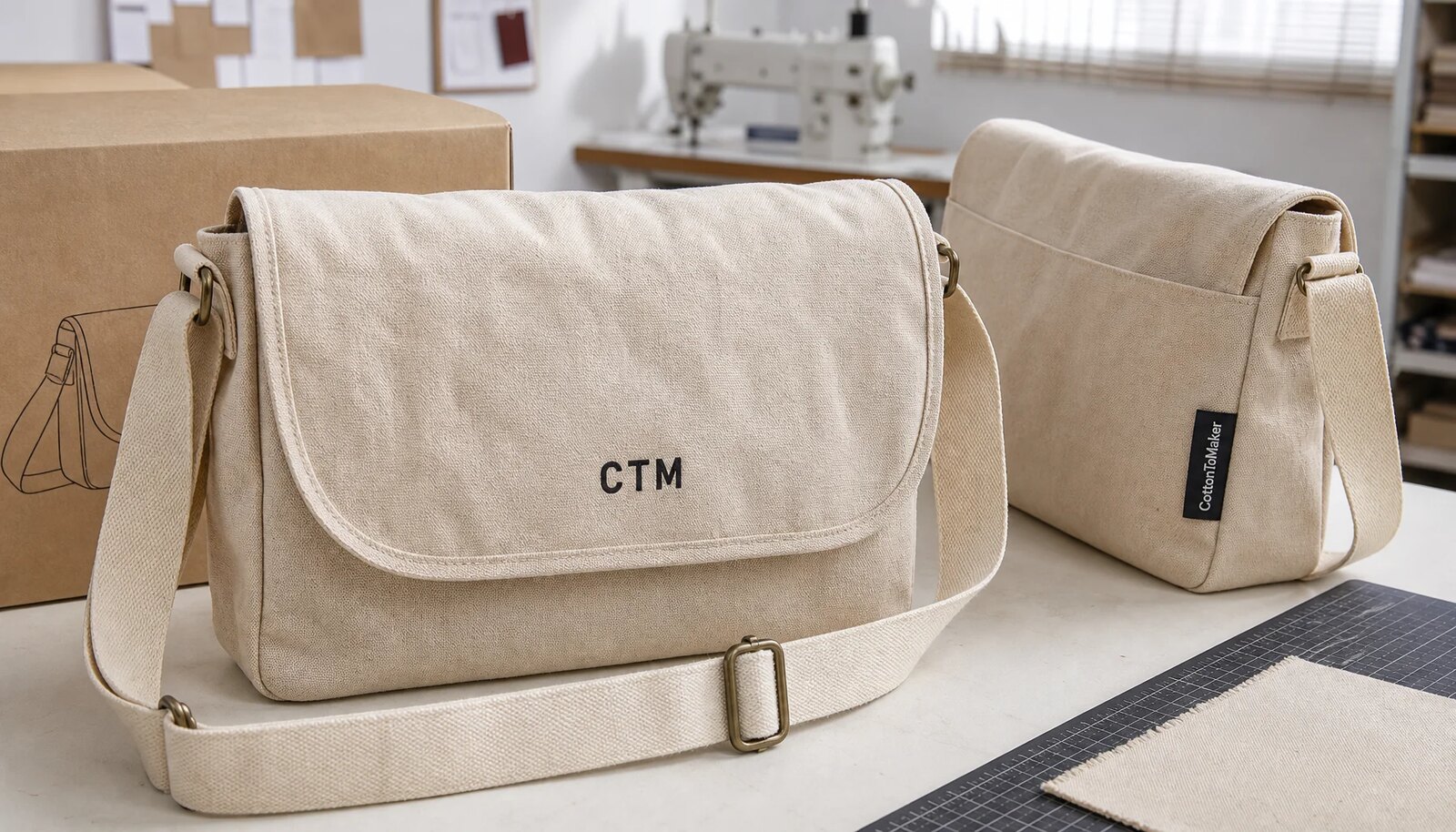
A canvas messenger bag has more cost variables than a flat tote. The flap, gusset, strap, adjuster, closure, pocket, lining, binding, reinforcement, and fold method all affect fabric use, sewing time, carton volume, and perceived value. If the RFQ only says “canvas messenger bag with logo,” suppliers will fill in the blanks in different ways. One quote may include a 4 cm cotton webbing strap, bartacked stress points, magnetic snap closure, and bound seams. Another may remove the closure, narrow the strap, skip the pocket, use lighter canvas, and finish seams with a basic overlock.
Write the specification in finished dimensions, not just a reference photo. A practical craft fair messenger bag spec states width x height x gusset, flap depth, measurement method, strap width, adjustable strap length range, closure type, pocket layout, lining requirement, seam finish, and reinforcement. A common event range is about 30-38 cm wide, 24-30 cm high, and 7-10 cm deep, but the right size depends on use. Artist kits may need notebooks, catalogs, small wrapped purchases, or lightweight tools. Sponsor gifts may need a clean flap, symmetrical shape, and a logo panel that photographs well.
Photos and samples are useful, but they cannot carry the entire purchase order. A photo may not show whether the strap is cotton or polyester, whether the pocket is lined, whether the canvas is 10 oz or 12 oz, or whether the closure is functional. Ask the supplier to confirm each line item in writing and send annotated sample photos where possible. That extra step keeps quote comparison fair and gives the inspector a standard to check against later.
- State body size, gusset depth, flap depth, and measurement points in the RFQ.
- Specify strap material, strap width, adjuster material, and adjustable length range.
- Define closure type: none, magnetic snap, metal snap, hook-and-loop, button, buckle-style trim, zipper, or zipper under flap.
- List internal details such as slip pocket, divider, pen slot, lining, seam binding, or overlock finish.
- Require reinforcement at strap joins, flap corners, pocket openings, and gusset stress points.
Choose Canvas Weight, Finish, and Shade Control
Canvas weight drives cost, handfeel, durability, sewing difficulty, and freight weight. A 10 oz canvas, often around 320-360 GSM depending on construction, can work for light promotional messenger bags used for brochures, registration materials, or small purchases. A 12 oz canvas, often around 380-420 GSM, is a balanced choice for many craft fair messenger bags because the body and flap hold shape without becoming too bulky. A 14-16 oz canvas, often around 475-540 GSM, can feel more premium, but it raises fabric cost, folded thickness, needle load, carton weight, and seam bulk.
Do not compare quotes by ounce wording alone. Canvas weight terminology varies by market, supplier, finishing process, and whether the fabric is measured before or after washing. Two fabrics both described as 12 oz can differ in yarn size, weave density, stiffness, shrinkage, and print surface. A dense canvas may print more cleanly than a loose weave. Washed canvas may feel softer but show wider shade variation. Bleached or dyed canvas may look cleaner than natural cotton, yet it usually needs tighter shade control and may carry a higher MOQ.
Decide the intended look early. Natural cotton canvas often has seed flecks, small slubs, and slight color variation. That can suit a maker-market feel, but it may disappoint a sponsor or retail buyer expecting a cleaner surface. Approve a fabric swatch and record the standard: GSM, shade, handfeel, fleck level, finish, and shrinkage expectation. If the bag will be printed, approve the print on the same fabric whenever possible, not on a smoother substitute that will not be used in bulk.
- Use 10 oz canvas for budget promotional programs and lighter short-term carrying needs.
- Use 12 oz canvas for a balanced craft fair messenger bag with better flap structure.
- Use 14-16 oz canvas for premium retail or heavier use when freight and sewing cost are acceptable.
- Specify natural, bleached, dyed, washed, or laminated finish; each changes MOQ and quality checks.
- Agree whether cotton flecks, slubs, and shade variation are acceptable before sample approval.
Match Branding Method to Artwork and Deadline
Branding choice affects unit price, setup charges, sample timing, inspection, and the way the finished bag feels in the customer’s hand. Screen printing is usually the practical route for wholesale canvas messenger bags for craft fairs when the artwork is bold, flat, and limited to one or two colors. It works especially well on the front flap when the print area is smooth and away from seams, snaps, and thick folds. It is also easy to inspect because size, color, placement, edge sharpness, and rub resistance can be checked with simple tools.
Heat transfer can handle more colors, gradients, or artwork that changes by location, but it creates a different surface feel and may not match a natural canvas aesthetic. Embroidery can look premium for a small logo or initials, yet large embroidery on a flap can pucker fabric, add weight, raise cost, and slow production. Woven labels and sewn patches are useful when the same bag body will run across several seasons or when the buyer wants a repeatable brand detail that does not depend on print screens each time.
Artwork should arrive as production-ready files, not only as a mockup. Provide vector artwork, color references, maximum print size, and a placement diagram. Also state whether the logo should be visually centered when the flap is closed or technically centered on the flat panel before folding. Thin lines, small type, distressed textures, gradients, and tight sponsor lockups need factory feedback before screens are made. A strike-off on approved canvas is the checkpoint that catches poor coverage, weak curing, soft edges, and color mismatch before bulk printing starts.
- Use screen print for simple solid logos, event names, sponsor marks, and bold graphics.
- Use heat transfer for short-run full-color artwork when a transfer handfeel is acceptable.
- Use embroidery for small premium branding, not dense artwork across the full flap.
- Use woven labels or patches when repeat orders and consistent brand placement matter.
- Avoid printing over seams, snaps, folds, or rough stitch areas unless a physical strike-off proves quality.
Read MOQ and Price Breaks Carefully
MOQ comes from production economics, not just supplier preference. Fabric buying, dye lot minimums, cutting efficiency, trim sourcing, sewing line setup, screen preparation, packing labor, barcode application, and carton sorting can all create separate minimums. A supplier may accept a lower MOQ when the order uses stock natural canvas, standard cotton webbing, one artwork, one print color, and bulk packing. The same total quantity becomes harder when it is split into several fabric colors, sponsor logos, hardware finishes, barcode versions, or destination assortments.
Instead of asking only for a lower MOQ, ask what creates it. If custom dyeing is the driver, stock natural, black, or navy canvas may protect both MOQ and timing. If screens drive cost, fewer artwork versions may help. If packing labor is the problem, standardized carton labels and no mixed cartons may keep the unit price stable. If hardware sourcing is slow, a standard slider or adjuster may be safer than a custom finish. Once the MOQ driver is clear, procurement can trade features without guessing.
Use identical specifications when comparing price breaks. A 500-piece quote for an unlined, no-closure, bulk-packed bag is not comparable to a 1,000-piece quote for a lined bag with magnetic snaps, individual polybags, hangtags, and carton allocation by fair location. Ask for realistic tiers such as 300, 500, 1,000, 3,000, and 5,000 pieces. Separate one-time sample, screen, and setup costs from repeat-order pricing so reorders are not budgeted against an inflated first-order total.
- Ask MOQ per fabric color, artwork version, print color count, hardware finish, packing format, and barcode version.
- Ask whether stock canvas reduces MOQ compared with custom dyed or washed fabric.
- Ask whether each logo needs separate screens, strike-offs, setup time, and carton segregation.
- Ask whether mixed cartons, inner bundles, hangtags, or labels add labor cost.
- Ask what changes on repeat orders when fabric, artwork, screens, and carton marks remain unchanged.
Use Sampling to Prevent Expensive Corrections
The fastest sourcing route is not always the one with the fewest samples. It is the route that catches the right problems before bulk cutting and printing. Canvas messenger bags should normally move through fabric swatch approval, logo strike-off, pre-production sample, and packed carton or packed sample review. Each checkpoint answers a different question. The swatch confirms fabric weight, shade, handfeel, surface, and finish. The strike-off confirms print color, curing, coverage, and placement. The pre-production sample confirms construction, dimensions, strap function, pocket layout, closure, and flap alignment. The packed sample confirms fold method, wrinkle risk, label position, carton fit, and count assumptions.
Make approval records measurable. A simple “approved” is too vague for a B2B craft fair order with a fixed in-hand date. The approval note should record body measurements, tolerance, flap depth, gusset depth, strap length range, logo size, logo placement reference, print color, hardware finish, pocket layout, fabric GSM, closure function, and packing method. Photos with rulers are worth the small effort, especially for flap alignment and logo placement. If approval includes comments, separate mandatory corrections before bulk from small notes that can wait for a future reorder.
Keep changes under control after approval. A late request to change strap color, add a sponsor logo, move a barcode, switch to polybags, or add a closure can affect material purchasing, screens, cutting, sewing, packing, carton labels, and schedule. The supplier should confirm timing impact before acting on any revision. If the craft fair date is locked, procurement may need to postpone noncritical changes rather than endanger the entire shipment.
- Approve fabric swatch for GSM, shade, handfeel, finish, shrinkage expectation, and fleck level.
- Approve strike-off for ink color, logo size, curing, coverage, edge sharpness, and placement.
- Approve pre-production sample for sewing, flap alignment, closure, strap adjustment, pocket layout, and measurements.
- Approve packed photos for fold method, polybag fit, barcode position, carton quantity, and wrinkle risk.
- Freeze the specification in writing before bulk cutting and treat later revisions as schedule-impacting changes.
Set Inspection Standards Before Cutting Starts
Canvas messenger bags can look fine in supplier photos and still fail at receiving or during use. Typical defects include weak strap joins, crooked flaps, uneven gussets, open seams, skipped stitches, loose threads, stains, musty odor, rusted hardware, wrong logo placement, print rub-off, mixed artwork versions, and incorrect carton quantities. Since craft fair orders often arrive close to event dates, inspection rules should be agreed before production starts. Waiting until cartons are packed to debate defect definitions creates pressure to ship goods that may need sorting after arrival.
Use tolerances an inspector can measure. A common body dimension tolerance for sewn canvas bags is ±1 cm, although retail packaging or display fixtures may require tighter control. Print placement is often set around ±0.5 cm to ±1 cm depending on artwork size and panel shape. Fabric shade should be checked against the approved swatch under consistent light, with realistic allowance for natural cotton. Strap length, flap alignment, closure placement, and pocket dimensions should also have fixed measurement points. Visual judgment alone is not enough when the logo sits on a folding flap.
If using AQL inspection, agree the level and defect definitions before the PO is placed. Critical defects may include mold, strong odor, unsafe sharp hardware, broken strap attachment, wrong artwork, or missing main components. Major defects may include severe stains, wrong size beyond tolerance, weak seams, missing closures, heavy print cracking, or visibly crooked flaps. Minor defects may include small loose threads or slight natural fleck variation within the approved standard. The point is not to overcomplicate inspection. The point is to remove ambiguity when the shipment clock is running.
- Define critical defects that require rejection or full sorting, such as mold, unsafe hardware, wrong artwork, or broken straps.
- Define major defects that affect saleability or function, such as open seams, severe stains, poor print curing, or missing closures.
- Define minor defects that may pass within limits, such as small loose threads or slight approved natural-canvas variation.
- Measure dimensions, logo placement, strap length, flap alignment, and closure position using fixed reference points.
- Inspect sealed cartons as well as loose product to catch quantity, label, assortment, and carton mark errors.
Plan Packing for Freight and Fair-Site Handling
Packing is a cost, logistics, and presentation decision at the same time. Individual polybags protect against dust and help with resale, e-commerce, barcode handling, and long-term storage. They also add material cost, packing time, plastic use, and sometimes carton volume. Bulk packing with paper interleaving can reduce cost and plastic, but it may push more sorting work onto the distributor warehouse or craft fair site. Neither method is automatically best; the right choice depends on how the bags will move after production.
Map the downstream path before approving packing. Bags sold at a booth may need hangtags, barcode labels, size or color stickers, and a retail-ready fold. Exhibitor kits may need inner bundles by booth, sponsor, or fair location to reduce sorting errors. Central warehouse shipments may care most about consistent carton quantity and clear carton marks. Direct-to-location shipments need destination labels, carton numbering, and version identification that can be checked quickly by event staff.
Request carton data during the RFQ, not after production. Messenger bags with straps, flaps, snaps, and gussets take more space than flat totes. A carton packed too tightly can crush flaps and set hard creases. A carton packed too loosely can collapse in transit. Ask for estimated units per carton, carton dimensions, net weight, gross weight, carton material, fold method, carton marks, and palletization assumptions. If your warehouse has a maximum gross weight per carton, state it before the factory calculates packing.
- Use bulk pack with paper interleaving for cost-sensitive event distribution and lower plastic use.
- Use individual polybags for resale, barcode scanning, store delivery, e-commerce, or longer storage.
- Use inner bundles or inner cartons when one master carton will be split across booths, sponsors, or fair locations.
- Specify barcode labels, hangtags, suffocation warnings, destination labels, carton marks, and carton numbering before packing starts.
- Confirm units per carton, carton size, net weight, gross weight, fold method, and palletization assumptions in the quote.
Compare Quotes by Landed Cost
A low unit price is only useful if it covers the work needed to make the order usable. Landed cost includes product price, sample charges, screen or setup fees, packing upgrades, hangtags, barcode labels, inland transport, export fees, international freight, customs duties, taxes, inspection, re-inspection, domestic delivery, and possible sorting or defect allowance. For craft fair programs, schedule risk also has a real cost. Late goods may require upgraded freight, local replacement purchases, overtime receiving labor, or reduced selling time.
Factory-direct suppliers, trading companies, and domestic distributors often quote different scopes. A factory-direct quote may reduce unit cost, but the buyer may need to manage technical specs, artwork approvals, inspection, forwarder coordination, import clearance, and rework decisions. A trading company may add communication and coordination support while still relying on the factory’s production calendar. A domestic distributor may cost more per unit but can offer shorter delivery windows, local inventory, simpler replacement handling, or less import-management burden. The best choice depends on quantity, customization, internal sourcing capacity, and deadline risk.
Compare quotes under the same Incoterm and carton assumptions. EXW may exclude inland transport, export clearance, and port charges. FOB generally includes delivery to the named export port or point but excludes international freight and import costs. CIF includes freight to the destination port but does not necessarily include clearance, duty, tax, or final delivery. DDP can simplify delivery, but confirm whether duty, tax, address limits, remote-area charges, and customs-documentation issues are covered. If the Incoterm differs, the unit price comparison is incomplete.
- Compare EXW, FOB, CIF, DDP, and domestic delivered only after confirming included and excluded charges.
- Separate one-time artwork, screen, sample, and setup fees from repeat-order unit cost.
- Use the same carton dimensions and gross weight estimates when comparing freight.
- Include inspection, sorting, rework, and re-inspection time in both budget and schedule.
- Calculate cost per approved sellable unit if defect replacement or shortage terms are weak.
Lock the Timeline With a Purchase Confirmation Sheet
A useful quote for wholesale canvas messenger bags for craft fairs should read like a production plan. It should include the product specification, fabric basis, artwork method, MOQ structure, price breaks, sample timing, bulk lead time, packing plan, carton data, Incoterm, payment terms, quote validity, excluded charges, inspection standard, and defect handling. If these details are missing, procurement cannot fairly compare suppliers or explain risk to finance, marketing, sales, event operations, or warehouse teams.
Before issuing the PO, turn the accepted quote into a purchase confirmation sheet. Include annotated product photos or drawings, approved fabric reference, approved artwork file names, logo placement, sample approval notes, dimensions and tolerances, trim details, packing instructions, carton marks, inspection standard, production calendar, shipment window, and escalation contacts. Share the same version with the supplier, buyer, merchandiser, inspector, forwarder, warehouse, and event team. Version control matters because one outdated artwork file or carton label can create days of avoidable rework.
Decision authority should be clear as well. State who can approve artwork, who can approve samples, who receives inspection reports, and who can authorize shipment if defects are found. Fast sourcing fails when every decision waits several days for internal discussion. For craft fair orders, a clear RFQ, written approval path, and milestone calendar let the supplier move quickly without guessing. They also give the buyer a factual basis for escalation if the schedule starts to slip.
- Quote data should include quantity breaks, unit price, setup fees, sample cost, repeat-order assumptions, and validity date.
- Technical data should include GSM, fabric finish, dimensions, strap, hardware, pocket, lining, closure, reinforcement, and tolerances.
- Schedule data should include swatch date, strike-off date, sample approval deadline, bulk start, inspection date, and shipment handoff.
- Logistics data should include carton quantity, carton size, units per carton, net weight, gross weight, Incoterm, and delivery assumptions.
- Commercial data should include payment terms, excluded charges, defect handling, inspection responsibility, and artwork error responsibility.
Specification comparison for buyers
| Procurement decision | Typical B2B specification | Best-fit scenario | Quote or QC risk to control |
|---|---|---|---|
| Canvas weight and fabric basis | 10 oz / about 340 GSM for light promo; 12 oz / about 380-420 GSM for most craft fair messenger bags; 14-16 oz / about 475-540 GSM for premium retail, depending on weave and finish | 12 oz cotton canvas is often the safest middle ground for resale booths, exhibitor kits, artist supplies, sponsor merchandise, and event staff use | Ounce ratings are not always measured the same way. Request finished GSM, weave construction, shrinkage target, fabric finish, shade range, and whether the weight is before or after washing |
| Finished bag size | Common craft fair range: 30-38 cm W x 24-30 cm H x 7-10 cm gusset, flap depth 16-22 cm, strap width 3.2-4.0 cm, adjustable strap about 70-130 cm | Works for notebooks, small catalogs, maker tools, light purchases, registration packs, and booth staff essentials | Suppliers may measure from different points. State whether dimensions are measured flat, filled, or seam-to-seam, and agree a practical tolerance such as ±1 cm for body dimensions |
| Construction package | Front flap, adjustable shoulder strap, internal slip pocket, reinforced strap joins, bartacks at stress points, bound or overlocked seams, and defined closure | Useful when the bag must feel more valuable than a flat tote and hold up through repeated event handling | Low quotes may remove lining, closure, pocket, reinforcement, edge binding, adjuster hardware, or strap width. Ask for annotated sample photos and a bill of materials |
| Branding method | Screen print for 1-2 color solid artwork; heat transfer for short-run full-color designs; embroidery or woven label for small premium branding | Screen print is predictable for simple craft fair logos, sponsor names, and event graphics on a flat flap panel | Control ink curing, rub resistance, edge sharpness, print placement tolerance, and whether printing crosses seams, snaps, folds, or uneven canvas texture |
| MOQ structure | Quote MOQ separately by fabric color, artwork version, print method, trim color, hardware finish, and packing format | Best for buyers splitting one bag program across fair locations, sponsors, seasonal editions, or retail channels | A low total MOQ can hide separate screen fees, dye lot minimums, cutting surcharges, sorting labor, barcode fees, or mixed-carton packing charges |
| Sampling route | Fabric swatch, logo strike-off, pre-production sample, size-set or production reference sample when needed, and packed carton photo before release | Important for orders tied to immovable fair dates, distributor receiving appointments, or kit assembly windows | Skipping strike-off or packed-sample review can save days but raises risk on logo color, flap alignment, fold method, carton count, and barcode placement |
| Lead time assumptions | 7-14 calendar days for swatch and strike-off; 10-20 days for sample iteration if construction changes; 25-45 days bulk after written approval for standard specs; transit separate | Realistic for stock canvas, standard trim, simple sewing, and one-color print at moderate wholesale quantities | Custom dyeing, washed finishes, nonstandard hardware, late artwork, multi-location packing, inspection failure, or carton mark changes can add 5-15+ days |
| Packing plan | Bulk pack 25-50 pcs/carton for lower cost; individual polybag for retail, dust protection, barcode handling, or multi-site distribution; inner bundles when allocation matters | Bulk packing suits central warehouse distribution; individual packaging suits retail shelves, e-commerce, booth-ready merchandise, and longer storage | Carton dimensions, units per carton, fold method, gross weight, and label rules affect freight cost, warehouse receiving, carton crushing, and event sorting labor |
| Quote comparison | Compare EXW, FOB, CIF, DDP, and domestic delivered using the same spec sheet, carton plan, inspection level, and payment terms | Needed when comparing factory-direct, trading company, and domestic distributor offers | Low unit price can exclude inland freight, export fees, inspection, setup charges, duty/tax, replacement terms, or required packing materials |
Buyer checklist before sampling
- Set the required in-hand date, not only the ship date, and include receiving, counting, sorting, labeling, and delivery to the craft fair site.
- Define the program type: resale merchandise, exhibitor giveaway, artist kit, registration pack, sponsor gift, staff bag, retail pop-up inventory, or multi-location distribution.
- Specify finished dimensions in width x height x gusset, flap depth, strap width, adjustable strap length range, pocket layout, closure type, lining requirement, seam finish, and reinforcement method.
- State canvas weight in both oz and GSM, fabric color reference, finish such as natural, dyed, bleached, washed, or laminated, acceptable cotton flecks, shade tolerance, and shrinkage expectation.
- Provide vector artwork with Pantone or other color references, print size, placement diagram, print method preference, maximum colors, and a named approver for artwork revisions.
- Separate quantities by fabric color, logo version, print color count, hardware finish, packing format, barcode or hangtag version, and destination so each supplier quotes the same order structure.
- Request fabric swatch, print strike-off on approved fabric, pre-production sample, production reference photo, and packed carton photo before mass production or shipment release.
- Set measurable QC tolerances: body size commonly ±1 cm, print placement commonly ±0.5 cm to ±1 cm depending on design, shade judged against approved swatch, and no major odor, mildew, oil stains, or broken hardware.
- Confirm carton plan including units per carton, carton dimensions, net weight, gross weight, bundle count, polybag thickness if used, barcode location, carton marks, palletization, and destination labels.
- Build a backward calendar covering RFQ deadline, artwork freeze, sample review, deposit date, bulk cutting, inline check, final inspection, rework buffer, export booking, transit, customs clearance, warehouse receiving, and event allocation.
Factory quote questions to send
- What canvas weight are you quoting in both oz and finished GSM, and can you state the weave construction, yarn count if available, finish, expected shrinkage, and whether weight is measured before or after washing?
- Is the fabric stock natural canvas, stock dyed canvas, custom dyed canvas, bleached canvas, washed canvas, recycled cotton blend, organic cotton, or greige fabric finished after order confirmation?
- What body dimensions, gusset depth, flap depth, strap width, adjustable strap length range, pocket layout, closure, seam finish, lining, and reinforcement method are included in the price?
- What MOQ applies per fabric color, printed artwork version, print color count, hardware finish, trim color, barcode version, packing format, and delivery destination?
- Please quote the same specification at 300, 500, 1,000, 3,000, and 5,000 pieces, and separate unit price, sample fees, screen or setup charges, packing charges, and repeat-order assumptions.
- Which branding method are you quoting, how many colors are included, what artwork file format is required, what is the minimum line thickness or text size you recommend, and what limitations apply on textured canvas?
- Can you provide a print strike-off on the approved canvas, and what dry rub, light scratch, curing, wash, or adhesion checks do you perform before mass printing?
- How many calendar days are required for swatch, strike-off, pre-production sample, buyer approval review, bulk material preparation, cutting, sewing, printing, packing, final inspection, rework if needed, and export handoff?
- What tolerances will you accept for finished dimensions, strap length, flap alignment, print placement, print color, fabric shade, carton quantity, and carton dimensions?
- What AQL level or inspection plan do you normally support for fabric bags, and how do you classify critical, major, and minor defects for sewing, print, hardware, odor, stains, and packing?
Quality-control points to confirm
- Fabric weight should match the approved standard within the agreed GSM tolerance, commonly ±5% unless a tighter tolerance is written into the PO.
- Fabric appearance should be checked against the approved swatch for shade, handfeel, cotton flecks, slubs, stains, mildew, water marks, oil marks, weaving holes, and strong chemical or musty odor.
- Finished body dimensions should be measured at defined points, with a practical tolerance such as ±1 cm for width, height, and gusset unless retail packaging requires tighter control.
- Flap depth, flap angle, and closure alignment should allow the bag to close naturally without twisting, pulling the logo off-center, or exposing uneven side edges.
- Strap width, strap length range, adjuster function, and strap attachment should match the approved sample; strap joins should have reinforcement stitching or bartacks at load points.
- Seams should be secure with consistent stitch density, trimmed threads, no skipped stitches, no open seams, no seam slippage, and no raw edges unless intentionally specified.
- Screen print should be checked for correct artwork, size, position, color, coverage, edge sharpness, pinholes, under-cured tackiness, cracking, flaking, and obvious registration error.
- Logo placement should be measured from fixed edges, seam lines, or flap references using a ruler; do not rely only on visual centering after the flap is folded.
- Hardware should be tested for smooth adjustment and closure, with no rust, sharp edges, loose sliders, missing snaps, plating chips, color mismatch, or weak magnetic pull if magnets are used.
- Closures should align with the body and flap, and repeated open-close checks should not loosen snaps, distort the flap, or stress the printed area.