1. The quote problem: same messenger bag name, different product cost
A wholesale canvas messenger bag quote becomes unreliable when the RFQ only says “canvas shoulder bag with flap and logo.” One supplier may quote 10 oz unlined canvas with a narrow webbing strap. Another may quote 16 oz canvas, cotton lining, metal slider, inner zipper pocket, reinforced bottom, and individual polybag. Both can honestly call the item a canvas messenger bag, but the cost structure is not comparable.
The buying problem is not only finding the lowest price. The real problem is quote variance caused by missing specification data. If procurement compares unit prices before locking fabric weight, lining, strap, hardware, print, packing, and sample standard, the selected supplier may later increase price, simplify construction, or fail inspection because the buyer and factory were not quoting the same bag.
- Use a cost-controlled RFQ when at least three suppliers are being compared.
- Ask each supplier to confirm what is included and excluded, line by line.
- Do not accept “same as photo” as a specification; photos do not define GSM, seam allowance, or reinforcement.
- Treat a very low quote as incomplete until the supplier confirms material, hardware, print, and packing details.
2. Fabric GSM is the first cost lever to lock
Canvas messenger bags are often quoted by ounce weight, but importers should also request GSM because different markets and mills describe fabric differently. A practical retail messenger bag often uses 12 oz canvas, roughly 407 GSM. A lighter promotional version may use 10 oz, around 339 GSM. A stronger premium version may use 16 oz, around 542 GSM. The difference is visible in hand feel, folding behavior, seam thickness, and carton weight.
Fabric cost affects more than material price. Heavy canvas slows sewing, requires stronger needles, increases thread tension issues, and can make multi-layer areas bulky near strap anchors and flap corners. Lighter canvas may save cost but can look weak when loaded or when used with large flap prints. Procurement should not request the heaviest fabric automatically; it should match the expected load, brand position, and retail price point.
- For lightweight giveaways: 8-10 oz canvas may be acceptable if the bag carries documents or light items only.
- For standard brand merchandise: 12 oz canvas is a common balance of cost, strength, and appearance.
- For premium or heavy-duty use: 14-16 oz canvas may fit, but ask for seam and carton weight review.
- For colored canvas: confirm whether color is in-stock dyed fabric or custom dyed fabric with separate MOQ.
- For natural canvas: ask whether the supplier is quoting bleached, unbleached, or enzyme-washed appearance.
3. Construction details decide whether two prices are truly comparable
Messenger bags have more hidden labor than simple tote bags. The flap, gusset, shoulder strap, adjustable slider, pocket layout, lining, and closure alignment all add sewing operations. A small difference such as one inner zipper pocket versus one open slip pocket can change both material and labor. A quote without a construction diagram or clear photo annotations leaves too much room for interpretation.
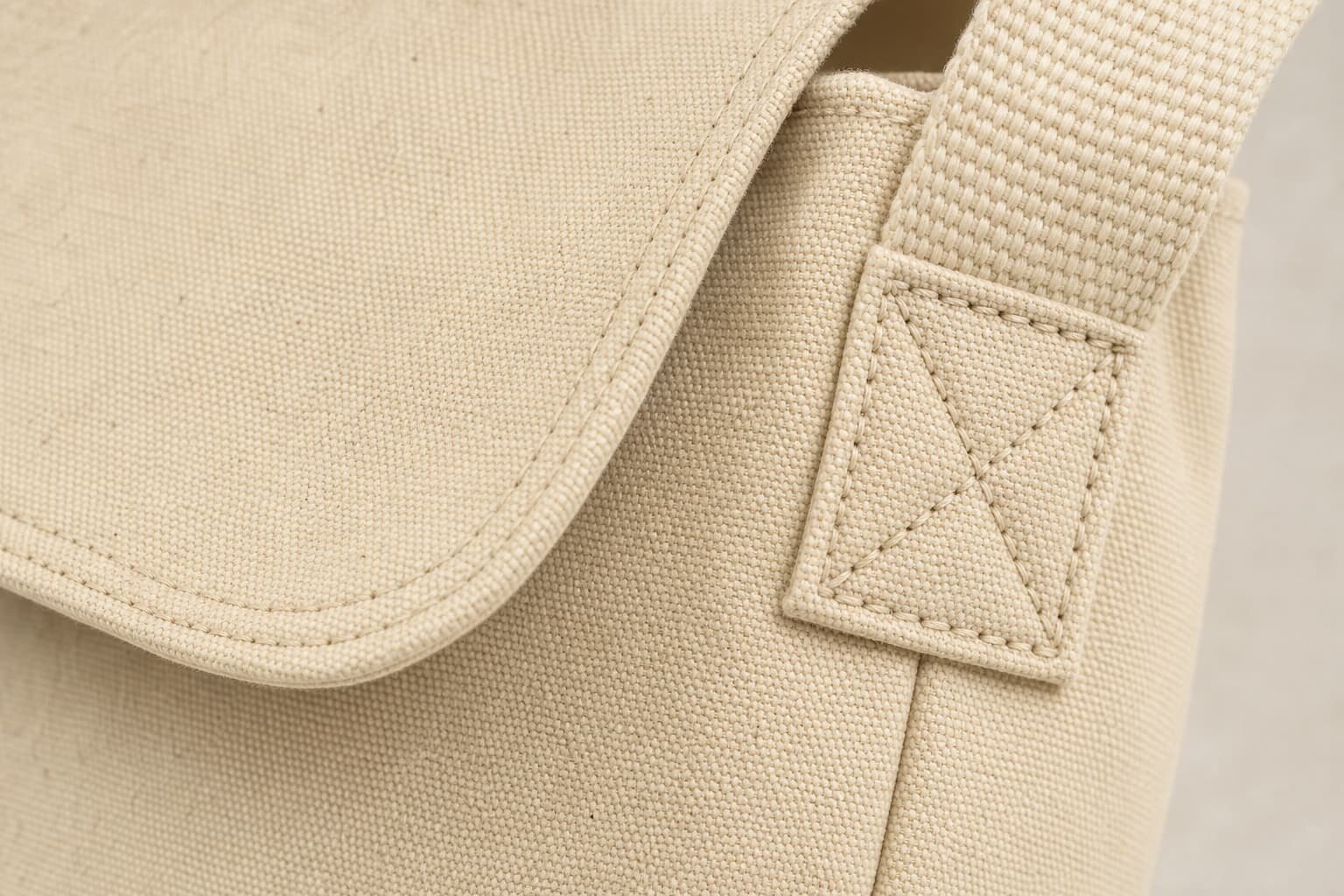
The most common cost misunderstanding is reinforcement. Buyers may assume stress points are bar-tacked and strap anchors are backed with extra canvas. The factory may only quote straight stitching unless reinforcement is specified. This matters because messenger bags are carried across the body and experience twisting force at the strap ends, not only vertical load like a tote handle.
- Define flap style: straight flap, rounded flap, buckle flap, or magnetic snap flap.
- Define gusset: flat document style, boxed bottom, or side gusset with depth.
- Define pocket layout: front pocket under flap, back pocket, inner slip pocket, inner zipper pocket, laptop sleeve.
- Define strap anchor: sewn into side seam, patched onto body, D-ring connection, or metal swivel hook.
- Define reinforcement: bar tack, box stitch, cross stitch, or extra fabric patch at load points.
4. Print method changes price, risk, and sample approval time
For most canvas messenger bags, screen printing is the best cost method for solid logos in one to three colors. It gives a clean result on natural canvas and is efficient for volume production. However, dark canvas often needs a white underbase for color accuracy, and that adds setup, ink, and printing steps. If the quote does not mention underbase, the buyer may receive a dull logo or a later price revision.
Heat transfer, digital print, embroidery, woven labels, and leather or PU patches each serve different buying goals. Embroidery looks durable but may distort thin fabric or pucker around detailed artwork. A woven label is stable for small brand marks and avoids large print curing risk. A patch can support a premium look, but it adds material, cutting, stitching, and sometimes MOQ. Artwork decisions should be made before final price comparison, not after supplier selection.
- Screen print: best for simple logos, flat colors, and large runs.
- Heat transfer: useful for gradients or photographic artwork, but check adhesion and hand feel.
- Embroidery: good for small marks, not ideal for very detailed large flap graphics.
- Woven label: consistent for brand identification with low visual risk.
- Patch label: premium appearance but adds sewing labor and material MOQ.
- Always confirm print size, location reference points, Pantone colors, and tolerance before sampling.
5. MOQ logic: bag MOQ is not the only MOQ
A supplier may advertise a low MOQ for canvas messenger bags because the sewing line can produce small batches. That does not mean every material and trim can be customized at the same quantity. Fabric dyeing, custom webbing, custom metal hardware, woven labels, zipper pulls, and printed packaging each may carry separate MOQs. This is where many cost reports fail: the buyer compares bag MOQ but misses the trim MOQ.
For a practical sourcing plan, ask for separate MOQ by fabric color, print design, label, hardware color, and packing format. If the launch order is 500 pieces split across five colors, the factory may need to use in-stock canvas colors or charge a dye surcharge. If the buyer wants a custom strap color, the strap mill may require more meters than one small bag order consumes.
- Ask MOQ per finished bag color, not only total order quantity.
- Ask whether natural, black, navy, and olive canvas are stock colors.
- Confirm MOQ for custom dyed canvas before approving seasonal colors.
- Check MOQ for custom woven labels, hangtags, barcode stickers, and retail sleeves.
- Request price breaks at realistic order levels such as 300, 500, 1000, 3000, and 5000 pieces.
- If testing a market, simplify color and trim customization to avoid paying small-batch surcharges.
6. Sampling should verify cost assumptions, not just appearance
A nice-looking sample does not prove the bulk quote is safe. The buyer should use sampling to confirm the exact material, construction, print, and packing assumptions behind the quote. A showroom sample may use available fabric and approximate hardware, while the bulk order may use different materials. This is acceptable only if the difference is documented and the pre-production sample is made from confirmed bulk inputs.
For canvas messenger bags, sample checks should include GSM, color, shrinkage risk, strap comfort, hardware function, print curing, and alignment. If the bag has a laptop sleeve or inner pocket, measure real usable space, not only outer bag size. A 15-inch laptop claim can fail if the opening, flap, or zipper position reduces access.
- Request fabric swatch approval before full sample if color or GSM is critical.
- Ask for a plain construction sample when budget is tight, then printed pre-production sample before bulk.
- Measure the bag loaded and unloaded; canvas can collapse differently depending on fabric weight.
- Check whether flap fully covers the front pocket after the bag is loaded.
- Review strap length on different body sizes if the bag is crossbody.
- Seal one approved pre-production sample with date, supplier name, material reference, and buyer signature or written approval.
7. Packing affects landed cost and defect claims
Packing is often treated as a small detail, but it affects carton volume, labor, presentation, moisture risk, and claims. A messenger bag with a flap and strap can wrinkle if folded aggressively. Metal buckles can mark the canvas or scratch printed areas if not protected. Natural canvas can absorb odor or dust during storage and transport. A quote without packing details is not a complete cost quote.
Procurement should choose packing based on channel. Ecommerce and retail distribution often need individual polybags, barcode stickers, and clean folding. Corporate gift programs may accept bulk packing with tissue protection if the bag is distributed quickly. Plastic-reduction programs may use paper belly bands or recycled polybags, but the factory must still prevent rubbing and moisture damage inside export cartons.
- Define whether each bag is flat packed, folded, or shaped with light stuffing.
- Confirm individual polybag, recycled polybag, glassine bag, paper band, or bulk pack.
- Protect metal buckles, sliders, and magnetic snaps from rubbing the print.
- Set maximum carton gross weight, especially for heavy 16 oz canvas programs.
- Ask for estimated carton dimensions during quote stage for freight planning.
- Require desiccant or moisture control when shipping in humid season or long sea transit.
8. Lead time should be quoted by process stage
A simple lead time statement such as “30 days production” is not enough for a messenger bag program. The real schedule includes artwork confirmation, material sourcing, sample making, sample review, fabric cutting, printing, sewing, finishing, inspection, packing, and export handover. If custom dyed fabric or custom hardware is involved, the calendar can change significantly before sewing even starts.
Buyers should ask suppliers to break down timing after deposit and after sample approval. This prevents conflict when sample revisions take longer than planned. It also allows procurement to decide whether to use stock fabric for a launch order, then move to custom color for repeat production. Lead time control is part of cost control because rushed production can increase defect risk and air freight pressure.
- Plain development sample: ask for estimated days after tech pack and artwork confirmation.
- Printed sample: include time for screen setup or transfer preparation.
- Bulk material preparation: separate stock fabric from custom dyed fabric timing.
- Bulk production: confirm cutting, printing, sewing, finishing, and packing duration.
- Inspection window: reserve time before shipment, not after goods are already packed for container loading.
- Shipping handover: confirm whether lead time ends at factory, forwarder warehouse, port, or buyer warehouse.
9. Quote data that procurement should request before comparison
The best way to compare canvas messenger bag suppliers is to force all quotes into the same cost map. The map does not need to reveal the factory’s internal margin, but it should separate the major buyer-controlled decisions: fabric, lining, hardware, printing, labels, packing, sample, and freight basis. Without this structure, a cheaper quote may simply exclude items that another supplier included.
A clean quote should also state validity period, currency, Incoterm, payment terms, production lead time, MOQ, sample cost, and assumptions. Cotton fabric and metal hardware costs can move, so procurement should avoid keeping old quotes open without checking validity. If a supplier refuses to specify what is included, the buyer should treat the quote as high risk even if the unit price looks attractive.
- Request itemized cost adders where possible: logo print, label, hangtag, special packing, and sample.
- Ask for Incoterm clearly: EXW, FOB, CIF, DDP, or another agreed term.
- Confirm whether export carton, inner bag, barcode sticker, and carton mark are included.
- Ask for estimated net weight and gross weight per piece and per carton.
- Request clear quote validity, especially for cotton canvas and dyed fabric.
- Keep supplier answers in one comparison sheet so commercial and technical teams review the same assumptions.
10. Acceptance criteria reduce disputes after production
Canvas messenger bags have natural fabric variation, but that does not mean every variation is acceptable. Buyers should define acceptance criteria before production. This includes size tolerance, fabric shade tolerance, print placement tolerance, loose thread standard, stitch density, hardware finish, and packing method. If criteria are not written, inspection becomes subjective and dispute resolution becomes slower.
A practical acceptance standard does not need to be complicated. It should focus on defects that affect function, saleability, or brand presentation. For example, a small natural slub in canvas may be acceptable, but a dirty mark on the front flap or a crooked logo may not be. A slightly uneven internal seam may pass, but a weak strap anchor should fail. The sealed pre-production sample should be the reference, but written tolerances make the sample easier to enforce.
- Finished size tolerance: commonly define an allowed range such as plus or minus 1 cm, adjusted to design complexity.
- Print placement tolerance: define distance from flap edge, side seam, or center line.
- Stitching: define no broken stitches, no skipped stitches on visible seams, and secure backstitching.
- Hardware: no rust, sharp edges, loose rivets, weak magnets, or plating scratches on visible parts.
- Cleanliness: no oil stains, dust marks, mildew odor, or heavy creasing on the front panel.
- Function: strap adjusts smoothly, flap closes correctly, pocket openings are usable, and zipper runs without catching.
Specification comparison for buyers
| Spec decision | Recommended option | When it fits | Buyer risk to check |
|---|---|---|---|
| Main canvas fabric | 12 oz / about 407 GSM cotton canvas for standard retail messenger bags | Good balance for brand programs, campus bags, and light work bags without becoming too stiff | Confirm actual GSM after washing or finishing; some quotes use lighter 10 oz fabric while naming it canvas |
| Heavy-duty version | 16 oz / about 542 GSM canvas with reinforced stress points | Higher perceived value, tool kits, corporate gifts with heavier contents, premium retail lines | Higher material cost, slower sewing speed, thicker seams, larger carton weight, and possible needle marks |
| Lining | Unlined or 150D polyester lining depending on price position | Unlined works for simple eco programs; lining fits retail bags needing inner pockets and cleaner finishing | A lined bag may hide weak seam allowance; require internal photos and sample teardown checks |
| Closure | Flap with magnetic snap or metal buckle depending on brand style | Magnetic snap is faster and cheaper for daily use; buckle gives a heritage look | Buckles add labor and may scratch during bulk packing; magnets need pull-force consistency |
| Shoulder strap | 4 cm cotton webbing with adjustable metal slider | Most adult messenger bag programs needing comfort and size flexibility | Narrow straps reduce cost but feel cheap under load; check slider thickness and anti-slip function |
| Print method | Screen print for 1-3 solid colors; heat transfer or digital print for gradients | Screen print is stable for volume logos and simple artwork | Dark canvas may need underbase; ask whether quoted price includes print setup, color matching, and curing |
| MOQ structure | 300-500 pcs per color for basic canvas and standard trims | Practical for repeat brand programs with controlled colorways | Custom dyed canvas, custom woven straps, and metal logo hardware can push MOQ higher than bag MOQ |
| Packing | Individual polybag or paper belly band plus export carton with moisture protection | Polybag suits ecommerce and retail distribution; belly band supports plastic-reduction goals | Unprotected canvas can pick up dust, odor, or carton rubbing; packing method changes labor and unit cost |
Buyer checklist before sampling
- Define finished bag size, not only approximate laptop size; include tolerance for length, height, gusset, and flap drop.
- State main fabric weight in oz and GSM, fabric composition, color, finishing, and whether shrinkage after washing is acceptable.
- Specify whether the bag is unlined, cotton lined, or polyester lined, and list all internal pocket dimensions.
- Lock strap width, strap material, adjustable range, hardware material, and color finish.
- Confirm reinforcement method at strap anchors, flap corners, bottom corners, and pocket openings.
- Provide artwork files with Pantone references, print size, print location, number of colors, and required wash or rub resistance.
- Request one quote for base bag cost and separate lines for print, custom label, packing, sample, mold, and shipping if applicable.
- Ask suppliers to quote MOQ by bag color, print design, fabric dye lot, and custom trim item, not only total order MOQ.
- Define sample approval stages: material swatch, pre-production sample, and sealed production sample.
- Set carton packing requirements including units per carton, carton dimensions, gross weight limit, inner protection, and barcode or carton mark rules.
Factory quote questions to send
- What exact fabric weight are you quoting in oz and GSM, and is it measured before or after any washing, coating, or finishing?
- Is the quoted canvas in-stock greige, in-stock dyed color, or custom dyed to Pantone? What is the MOQ for each option?
- Does the unit price include lining, inner pockets, zipper pocket, pen slots, key hook, or only the outer shell?
- What strap width, strap thickness, slider material, and hardware finish are included in your quote?
- Which stress points will be reinforced with bar tacks, cross stitching, or additional canvas patches?
- Which print method are you quoting, and does the price include screen setup, underbase for dark fabric, curing, and artwork positioning sample?
- What is the MOQ per color and per design, and what price break applies at 500, 1000, 3000, and 5000 pieces?
- What sample fee and sample lead time apply for a plain sample, printed sample, and pre-production sample using bulk materials?
- How will each bag be packed, how many pieces per export carton, and what is the estimated carton size and gross weight?
- What is excluded from the quote: labels, hangtags, barcode stickers, carton marks, inspection, local charges, or freight?
Quality-control points to confirm
- Check fabric GSM using a cut sample from production material, not only supplier declaration.
- Measure finished bag dimensions at top, bottom, gusset, flap, strap length, and pocket openings against approved tolerance.
- Load test strap anchors and handle points using the agreed working load, with attention to seam tearing and hardware deformation.
- Inspect print color, print size, registration, edge sharpness, curing, rub resistance, and placement from flap edge or seam reference points.
- Review lining attachment, inner pocket stitch security, zipper movement, magnet position, buckle alignment, and loose thread control.
- Check metal hardware for rust, sharp edges, plating scratches, color consistency, and secure installation.
- Confirm carton packing count, bag folding method, moisture protection, barcode placement, carton marks, and gross weight.
- Compare bulk production against the sealed pre-production sample before final packing, not only against the original artwork.